Analyzing Sentiment Word Relations with Affect, Judgment,
and Appreciation
Alena NEVIAROUSKAYA Masaki AONO
TOYOHASHI UNIVERSITY OF TECHNOLOGY, 1-1 Hibarigaoka, Tempaku-cho, Toyohashi, Japan
[email protected], [email protected]
ABSTRACT
In this work, we propose a method for automatic analysis of attitude (affect, judgment, and appreciation) in sentiment words. The first stage of the proposed method is an automatic separation of unambiguous affective and judgmental adjectives from miscellaneous that express appreciation or different attitudes depending on context. In our experiments with machine learning algorithms we employed three feature sets based on Pointwise Mutual Information, word-pattern co-occurrence, and minimal path length. The next stage of the proposed method is to estimate the potentials of miscellaneous adjectives to convey affect, judgment, and appreciation. Based on the sentences automatically collected for each adjective, the algorithm analyses the context of phrases that contain sentiment word by considering morphological tags, high-level concepts, and named entities, and then makes decision about contextual attitude labels. Finally, the appraisal potentials of a word are calculated based on the number of sentences related to each type of attitude.
1
Introduction and related work
‘Attitudinal meanings tend to spread out and colour a phase of discourse as speakers and writers take up a stance oriented to affect, judgment or appreciation.’ Martin and White (2005: 43)
Rapid growth of online media and sources of different genres (blogs, product or service reviews, social networks etc.) has prompted the emergence and development of a sentiment analysis field aimed at automatic analysis of people’s preferences, emotions, and attitudes communicated through written language. A variety of lexical resources has been created to support recognition and interpretation of different kinds of subjective phenomena: subjective (Wilson, Wiebe, & Hoffmann, 2005), polarity (Esuli & Sebastiani, 2006; Hatzivassiloglou & McKeown, 1997; Neviarouskaya, Prendinger, & Ishizuka, 2011), affective (De Albornoz, Plaza, & Gervás, 2012; Strapparava & Valitutti, 2004), and appraisal (Argamon, Bloom, Esuli, & Sebastiani, 2007) lexicons.
The subjectivity lexicon developed by Wilson et al. (2005) is comprised by over 8000 subjectivity clues annotated by type (strongly subjective / weakly subjective) and prior polarity (positive/negative/both/neutral). Hatzivassiloglou and McKeown (1997) created a list of 1336 adjectives manually labeled as either positive or negative. Esuli and Sebastiani (2006) developed a SentiWordNet lexicon based on WordNet (Miller, 1990) synsets comprised from synonymous terms. Three numerical scores characterizing to what degree the terms included in a synset are objective, positive, and negative, were automatically determined based on the proportion of eight ternary classifiers that assigned the corresponding label to the synsets of adjectives, adverbs, nouns, and verbs by quantitatively analysing the glosses associated with them. Neviarouskaya et al. (2011) developed a SentiFul lexicon using the core of sentiment lexicon and automatically expanding it through direct synonymy and antonymy relations, hyponymy relations, and manipulations with morphological structure of words (derivation and compounding). Aimed at introducing the hierarchy of affective domain labels, Strapparava and Valitutti (2004) manually created WordNet-Affect, a lexicon of affective concepts. An affective lexicon SentiSense (De Albornoz et al., 2012) that contains concept-level emotional annotations has been developed semi-automatically by considering semantic relations between synsets in WordNet. The appraisal lexicon (Argamon et al., 2007) developed by applying supervised learning to WordNet glosses contains adjectives and adverbs annotated by attitude type and force.
The goal of our research is to develop a method for automatic analysis of attitude expressed by sentiment words. Such method will support analytical applications relying on recognition of fine-grained context-dependent attitudes conveyed in text. According to the Appraisal Theory (Martin & White, 2005), there are three high-level attitude types: affect (a personal emotional state, feeling, or reaction), judgment (an ethical appraisal of person’s character, behaviour, skills etc.), and appreciation (an aesthetic evaluation of semiotic and natural phenomena, events, objects etc.).
We distinguish sentiment-related adjectives expressing unambiguous attitude type (e.g., happy
conveys affect, fainthearted – judgment, and tasty – appreciation) and ambiguous attitude type that depends on context (e.g., useless expresses affect in the context of my useless attempts, judgment in case of his useless skills, and appreciation in the phrase useless information).
In the first stage of the proposed method, unambiguous affective and judgmental adjectives are automatically separated from miscellaneous adjectives expressing unambiguous appreciation or different attitudes depending on context. The classification is based on a machine learning algorithm employing three feature sets based on Pointwise Mutual Information (PMI), word-pattern co-occurrence, and minimal path length. An early attempt to determine the potentials of an adjective to express affect, judgment or appreciation in evaluative discourse was made by
Taboada and Grieve (2004), who calculated the PMI with the pronoun-copular pairs ‘I was
(affect)’, ‘He was (judgement)’, and ‘It was (appreciation)’. However, affect-conveying adjectives (e.g., ‘depressed’) may equally well occur not only with first person pronouns, but also with third person pronouns, thus describing emotional states experienced by oneself or by other person. Our PMI features are inspired by the approach from (Taboada & Grieve, 2004). However, as distinct from their method, we calculate the strength of the association between attitude-conveying adjectives and patterns, in which they most probably occur (the example patterns for affect and judgment are ‘feel XX’ and ‘XX personality’, respectively). The next stage of the proposed method is to estimate the potentials of miscellaneous adjectives to convey affect, judgment, and appreciation. Based on the sentences automatically collected for each adjective, the algorithm analyses the context of phrases that contain sentiment word and makes decision about contextual attitude labels. Finally, the appraisal potentials of a word are calculated based on the number of sentences related to each type of attitude.
The remainder of the paper is structured as follows: In Section 2, we describe the method for separation of unambiguous affective and judgmental adjectives from miscellaneous. The algorithm for estimation of the potentials of miscellaneous adjectives to express affect, judgment, and appreciation is detailed in Section 3. In next section, we conclude the paper.
2
Method for separation of unambiguous affective and judgmental adjectives
from miscellaneous
2.1
Data set
For the evaluation of the proposed methodology, we have extracted 1500 attitude-annotated adjectives from the AttitudeFul database (Neviarouskaya, 2011). These adjectives are annotated by at least one of 13 labels: nine for affect (AFF), two for positive and negative judgment (JUD), and two for positive and negative appreciation (APP). As we are interested in separating unambiguous affective (e.g., joyful) and judgmental (e.g., egoistic) adjectives from miscellaneous
(MISC, e.g., good) that express appreciation or different attitudes depending on context (for
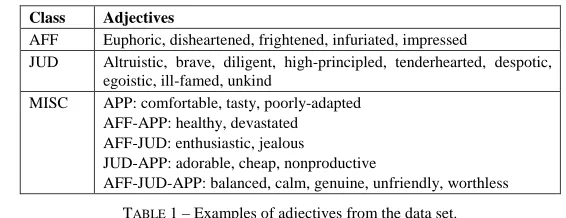
The distribution of classes is as follows: AFF – 510 (34.0%), JUD – 414 (27.6%), and MISC – 576 (38.4%) adjectives. The examples are listed in Table 1.
Class Adjectives
AFF Euphoric, disheartened, frightened, infuriated, impressed
JUD Altruistic, brave, diligent, high-principled, tenderhearted, despotic,
egoistic, ill-famed, unkind
MISC APP: comfortable, tasty, poorly-adapted
AFF-APP: healthy, devastated AFF-JUD: enthusiastic, jealous
JUD-APP: adorable, cheap, nonproductive
AFF-JUD-APP: balanced, calm, genuine, unfriendly, worthless
TABLE 1 – Examples of adjectives from the data set.
2.2
Feature sets
In our experiments we employed the following feature sets that are further described in details:
1. Pointwise Mutual Information (PMI) based.
2. Word-pattern co-occurrence (WPC) based.
3. Minimal path length (MPL), or proximity, based.
The complete feature set is comprised of 88 features. These features were automatically defined for each adjective from the attitude-annotated data set in order to conduct experiments with cross-validation process.
2.2.1 Pointwise Mutual Information (PMI) based feature set
The Pointwise Mutual Information had been used by researchers to calculate the strength of the semantic association between words (Church & Hanks, 1989), to determine the semantic orientation (positive or negative) of words (Turney & Littman, 2002), and to measure the strength
of the association between attitude-conveying adjectives and pronoun-copular pairs, such as ‘I
was’, ‘he was’, and ‘it was’ (Taboada & Grieve, 2004). In defining PMI features we partially follow the approach from (Taboada & Grieve, 2004). However, as distinct from their method, we calculate the strength of the association between attitude-conveying adjectives and patterns, in which they most probably occur.
The Pointwise Mutual Information is calculated based on the following equation:
𝑃𝑃𝑃𝑃𝑃𝑃(𝑤𝑤𝑤𝑤𝑤𝑤𝑤𝑤,𝑝𝑝𝑝𝑝𝑝𝑝𝑝𝑝𝑝𝑝𝑤𝑤𝑝𝑝) = log2ℎ𝑖𝑖𝑝𝑝𝑖𝑖ℎ𝑖𝑖𝑝𝑝𝑖𝑖(𝑤𝑤𝑤𝑤𝑤𝑤𝑤𝑤(𝑤𝑤𝑤𝑤𝑤𝑤𝑤𝑤)×𝑖𝑖𝑝𝑝ℎ𝑖𝑖𝑝𝑝𝑖𝑖𝑝𝑝𝑝𝑝𝑝𝑝𝑝𝑝𝑝𝑝𝑝𝑝𝑤𝑤𝑝𝑝(𝑝𝑝𝑝𝑝𝑝𝑝𝑝𝑝𝑝𝑝𝑤𝑤𝑝𝑝)) , (1)
where word stands for one of the adjectives; pattern – one of the patterns for affect or judgment; and hits – number of hits in the search engine.
[image:4.420.58.341.92.201.2]Affect patterns Judgment patterns
feel XX (e.g., feel happy) XX character XX is a character
XX emotion XX personality XX is a personality
XX is an emotion (e.g., [being] happy is an emotion)
XX trait XX is a trait
XX as an emotion XX behavior XX is a behavior
XX feeling XX behaviour XX is a behaviour
XX is a feeling XX skill XX is a skill
XX as a feeling XX skills admire XX
XX mood criticise XX criticize XX
XX is a mood praise XX condemn XX
XX as a mood to sanction XX to esteem XX
TABLE 2 – Patterns for affect and judgment adjectives.
The schematic representation of the algorithm for PMI calculation is shown in Fig. 1. As a search
engine, we selected BING (http://www.bing.com/). In our work, each BING query is submitted
through BING search API (http://www.bing.com/toolbox/bingdeveloper/) using the following
structure ensuring retrieval of exact phrases in web documents written in English:
http://api.search.live.net/xml.aspx?Appid=[application_id]&sources=web&query=inbody:[“wor d_or_phrase”]language:en.
The total number of the returned query results (that is the number of hits) is then retrieved from the downloaded XML file.
FIGURE 1 – Working flow of the PMI calculation algorithm. word
word in a pattern
pattern list of patterns
Retrieve results (occurrence frequency)
Search engine query XML hits(word)
hits(pattern)
hits(word in a pattern)
There are four groups of PMI based features employed in our experiments:
1. PMI: PMI of an adjective with each affect pattern and each judgment pattern (in total, 30 features).
2. maxPMI: maximum PMI with affect patterns and maximum PMI with judgment patterns (2 features).
3. avgPMI: average PMI with affect patterns and average PMI with judgment patterns (2 features).
4. %undefPMI: percent of "undefined" PMI with affect patterns and percent of "undefined" PMI with judgment patterns (2 features). PMI with a particular pattern is "undefined" in case the search engine returns 0 for number of hits of a word in this pattern (i.e., PMI equals negative infinity).
2.2.2 Word-pattern co-occurrence (WPC) based feature set
In addition to PMI based features, we considered the following four co-occurrence based features (max%rate):
1. maximum percent rate of hits(word in a pattern) to hits(pattern) among affect patterns. 2. maximum percent rate of hits(word in a pattern) to hits(pattern) among judgment patterns. 3. maximum percent rate of hits(word in a pattern) to hits(word) among affect patterns. 4. maximum percent rate of hits(word in a pattern) to hits(word) among judgment patterns.
2.2.3 Minimal path length (MPL) based feature set
To establish the relatedness of a given adjective with affect or judgment, we decided to employ features based on estimation of proximity between two adjectives through synonymy relation in WordNet (Miller, 1990).
We adopted the following definitions of MPL from (Kamps & Marx, 2002):
Two words w0 and wn are n-related if there exists an (n+1)-long sequence of words
<w0,w1,...,wn> such that for each i from 0 to n-1 the two words wi and wi+1 are in the same
SYNSET.
Let MPL be a partial function such that MPL(wi,wj) = n if n is the smallest number such that wi
and wj are n-related.
For the exploration of WordNet relations, we employed Java API for WordNet Searching (JAWS) publicly available at http://lyle.smu.edu/~tspell/jaws. Automatically analysing synonymy relations in WordNet, we estimate the shortest synonymy paths from a given adjective to each word from the representative lists of affect and judgment adjectives using Equation (2). These representative lists were created manually and include 25 affect adjectives (e.g., angry, afraid, happy, downhearted, surprised, and others) and 20 judgment adjectives (e.g., clever, well-mannered, cynical, dishonorable, etc.).
To make the task of analysing large synonymous network in WordNet feasible, we established the maximum limit for MPL, as the relatedness between non-direct synonyms disappears quickly when the number of synonymy links grows. Therefore, if MPL(wi,wj) is outside the range from 0 to 4, it is considered to be >4 or undefined (no synonymy path between two words).
The feature set based on MPL contains two groups of features:
1. MPL: MPL between an adjective and each representative affect or judgment adjective (in
total, 45 features).
2. minMPL: minimal MPL among MPLs between an adjective and affect adjectives and minimal MPL among MPLs between an adjective and judgment adjectives (in total, 2 features).
2.3
Classification algorithmsWith the aim to find the best performing machine learning algorithm classifying attitude adjectives into AFF, JUD, and MISC classes, we conducted a series of experiments with the following algorithms from WEKA software (Hall, Frank, Holmes, Pfahringer, Reutemann, & Witten, 2009):
1. J48 (Decision Trees).
2. Naive Bayes (Bayesian classifier).
3. SMO (Sequential Minimal Optimization algorithm for training a support vector classifier).
As a baseline, we considered rule-based classifier ZeroR that classifies data using the most frequent label.
2.4
Evaluation resultsWe performed 10-fold cross-validations on our data set in order to get reasonable estimate of the expected accuracy on unseen adjectives.
First, we evaluated the effectiveness of distinct groups of features. The results (percents of correctly classified instances) are given in Table 3.
Groups of features
Accuracy rate (%)
ZeroR J48 Naive
Bayes SMO
%undefPMI
38.40
46.56* 44.22* 45.14*
maxPMI 49.91* 47.99* 48.42*
max%rate 52.30*** 36.01 38.80
avgPMI 51.67* 52.39* 53.55*
minMPL 54.40* 54.25* 54.25*
MPL 55.06** 44.13* 53.51**
PMI 47.68* 54.17** 55.08**
Best results are given in bold. * Significantly higher than the baseline.
** Significantly higher than the baseline and one of the other methods. *** Significantly higher than the baseline and two other methods.
Paired t-tests with significance level of 0.05 showed that all ML algorithms (J48, Naive Bayes, and SMO) employing distinct groups of features outperformed the baseline method with statistically significant difference in accuracy rate, with the exceptional cases of Naive Bayes and
SMO using max%rate features. As seen from the obtained results, algorithms based on the
decision trees (J48) and support vectors (SMO) overall resulted in higher accuracy than Naive Bayes classifier. PMI and MPL features proved to be more effective than other features, when employed independently in SMO and J48 algorithms, respectively.
In our next experiment, to analyse the importance of different groups of features, first we
evaluated the performance of the classification algorithms with PMI features only, then we
cumulatively added other features to the algorithms. The results in terms of accuracy rate at each step of this experiment are given in Table 4 for each classification algorithm.
Features
Accuracy rate (%)
ZeroR J48 Naive
Bayes SMO
PMI
38.40
47.68* 54.17** 55.08**
PMI + maxPMI 50.54* 54.29** 55.40**
PMI + maxPMI + avgPMI 51.17* 55.16** 56.85** PMI + maxPMI + avgPMI + %undefPMI 50.50* 54.37** 57.61*** PMI + maxPMI + avgPMI + %undefPMI +
max%rate 52.74* 50.79* 57.77***
PMI + maxPMI + avgPMI + %undefPMI +
max%rate + MPL 57.64* 54.78* 61.88***
PMI + maxPMI + avgPMI + %undefPMI +
max%rate + MPL + minMPL 58.47* 57.15* 61.81***
Best results are given in bold. * Significantly higher than the baseline.
** Significantly higher than the baseline and one of the other methods. *** Significantly higher than the baseline and two other methods.
TABLE 4 – Classification results based on features cumulatively added to the algorithms. The evaluation revealed that the support vector classifier SMO significantly outperformed other methods at each step of the experiment, with only statistically insignificant difference in case of comparison to Naive Bayes at first three steps. As was expected, the obtained results indicate that the classification algorithm benefits from consideration of all groups of features. The analysis of results from the best-performing algorithm (SMO) shows that adding PMI based features, such as maxPMI, avgPMI, and %undefPMI, to PMI features allows obtaining 2.53% gain in accuracy. Insignificant improvement is observed after inclusion of WPC based features (namely, max%rate), and this is not surprising, as these features proved to be ineffective when independently employed in SMO (i.e., there is almost no improvement over the baseline, as seen in Table 3). Statistically significant gain in accuracy is obtained after inclusion of MPL based features (namely, MPL and minMPL). It is important to note, however, that the performance of
SMO classifier does not benefit from minMPL features, in contrast to J48 and Naive Bayes
classifiers.
Class Detailed accuracy of SMO
Precision Recall F-measure
AFF 0.748 0.594 0.662
JUD 0.594 0.551 0.571
MISC 0.558 0.689 0.617
TABLE 5 – Detailed accuracy of SMO with full set of features.
The classifier achieved the highest level of precision in classifying adjectives related to AFF (0.748), while it was least precise in case of MISC (0.558) adjectives. F-measures indicate that it is easier for SMO algorithm to classify AFF adjectives than MISC and JUD adjectives.
The confusion matrix (Table 6) shows that AFF and JUD adjectives were predominantly incorrectly predicted as MISC adjectives, while MISC adjectives were mostly confused with JUD ones. This is due to the fact that the MISC class in the data set includes adjectives that are annotated by multiple labels (AFF-APP, AFF-JUD, JUD-APP, AFF-JUD-APP) and may express affect or judgment depending on the context. Interesting observation is that AFF and JUD adjectives were rarely confused: only 10% of AFF adjectives were incorrectly labeled as JUD, while about 6.8% of JUD adjectives were confused with AFF ones), thus demonstrating that PMI and MPL based features proposed in our work are good enough in characterizing these categories of adjectives.
Class AFF JUD MISC
AFF 303 51 156
JUD 28 228 158
MISC 74 105 397
TABLE 6 – Confusion matrix.
3
Estimation of appraisal potential
The next stage of the proposed method is to estimate the potentials of MISC adjectives to express affect, judgment, and appreciation. The schematic representation of the algorithm for appraisal potential estimation is shown in Fig. 2.
FIGURE 2 – Working flow of the algorithm for appraisal potential estimation. Collect sentences for
each word
Morphological tags
Analyse phrases MISC
words
Apply syntactic and dependency parsing
Extract phrases
High-level concepts Named entities
Determine attitude labels
The algorithm starts with the collection of sentences for each MISC word from online ABBYY
Lingvo.Pro dictionary (http://lingvopro.abbyyonline.com/en). This dictionary allows access to
unique online storage of sentences taken from real texts of different genres and language styles (classic and modern literature, web sites, technical publications, and legal documents) with the purpose to demonstrate typical use of a word. To restrict the number of example sentences extracted for each MISC adjective, the upper limit was set to 75 sentences.
Given 576 MISC adjectives, the algorithm collected 16217 sentences. About 78% of all MISC adjectives were productive, resulting in at least one example sentence. The average number of sentences per productive word is about 36. The percent distribution of productive words is as
follows: low-productive adjectives (from 1 to 25 sentences) – 51.1%, including truthful,
inhumane; medium-productive adjectives (from 26 to 50 sentences) – 11.3%, including gorgeous, irrational; and highly productive adjectives (from 51 to 75 sentences) – 37.6%, including successful, difficult etc. The analysis of non-productive adjectives (for example, glamourous, ill-proportioned, uninspiring) that did not yield any example sentence revealed that about 57% of them are hyphenated compound adjectives (for comparison, such adjectives occur only in 13% of productive ones). To collect example sentences for MISC adjectives that turned out non-productive in online ABBYY Lingvo.Pro dictionary, the algorithm may employ other online sources (for example, news, forums, blogs etc.); however, this is out of scope of this work.
Then, Connexor Machinese Syntax parser (Connexor Oy. http://www.connexor.eu/technology/machinese/machinesesyntax/) is applied to each sentence in order to get lemmas, syntactic relations, dependencies, syntactic and morphological information.
Using the parser output, the method then extracts phrases that include the corresponding adjective. Some examples of sentences that contain MISC adjective beautiful are demonstrated in Table 7.
Sentence Phrase Annotations Attitude
label
Thus all my beautiful
feelings ended in smoke.*
my beautiful feelings
my [PRON PERS GEN SG1] beautiful feelings [N NOM PL] [FEELING]
AFF
She helped him to get well, and he fell madly in love with the beautiful young Indian and married her. **
beautiful young Indian
beautiful young Indian [N NOM SG] [PERSON]
JUD
‘He apologizes for any inconvenience and hopes you will enjoy your stay in his beautiful city,’ said Inigo. ***
his beautiful city
his [PRON PERS GEN SG3] beautiful city [N NOM SG] [LOCATION]
APP
* Youth. Tolstoy, Leo.
** The Fire From Within. Castaneda, Carlos. *** Fifth Elephant. Pratchett, Terry.
Three types of annotations are considered in the stage of phrase analysis (example annotations are given in Table 7):
1. morphological tags. 2. high-level concepts. 3. named entities.
Morphological tags of our particular interest that are taken from the output of Connexor Machinese Syntax parser are related to pronouns and nouns. They include N (noun), PRON (pronoun), PERS (personal), NOM (nominative), GEN (genitive), ACC (accusative), SG1/PL1 (singular/plural, first person), SG3/PL3 (singular/plural, third person), <Refl> (reflexive), <Rel> (relative), <Interr> (interrogative), and WH (wh-pronoun).
In addition to morphological tags, high-level concepts of nouns are automatically extracted from WordNet based on the analysis of bottom-up sequence of hypernymic semantic relations. The hierarchy of high-level concepts used in our approach is given in Table 8. For example, musician is related to high-level concept PERSON, virtuosity – to SKILL, and contest – to EVENT.
ENTITY
1. ABSTRACTION ATTRIBUTE PERSONALITY SHAPE SKILLFULNESS TRAIT
SELF-POSSESSION COMMUNICATION FEELING
GROUP
ETHNIC GROUP PEOPLE SOCIAL GROUP
PSYCHOLOGICAL FEATURE COGNITION
ATTITUDE
BELIEF, incl. OPINION, JUDGMENT MIND
SKILL
MOTIVATION, incl. ETHICAL MOTIVE QUANTITY
RELATION TIME
2. ACTIVITY 3. BODY 4. EVENT 5. FOOD 6. LOCATION 7. OBJECT ARTIFACT NATURAL OBJECT 8. ORGANISM ANIMAL HUMAN PERSON MAN RELATIVE 9. PLANT 10. POSSESSION 11. PROCESS
NATURAL PHENOMENON 12. STATE
13. SUBSTANCE
TABLE 8 – The hierarchy of high-level concepts.
Next stage is to determine attitude label for the MISC adjective depending on phrase context. The algorithm (1) analyses the morphological tags, high-level concepts, and named entities in the phrase, (2) applies rules depending on these features, and (3) makes decision about attitude label. For example, beautiful expresses affect in the context of my beautiful feelings, judgment in case of beautiful young Indian, and appreciation in the phrase his beautiful city.
The attitude label rules were developed in accordance with the definitions of affect, judgment, and appreciation given in the Appraisal Theory by (Martin & White, 2005).
• Affect is a personal emotional state, feeling, or reaction to behaviour, process, or
phenomena.
• Judgment is an ethical appraisal of person’s character, behaviour, skills etc. according to various normative principles.
• Appreciation is an aesthetic evaluation of semiotic and natural phenomena, events, objects
etc.
The features related to AFF, JUD and APP are listed below (note that some features are common for both AFF and JUD).
• AFF: nominal head of a phrase, or subject (where adjective functions as a subject
complement), or object (where adjective functions as an object complement) is
- nominative first person pronoun (I, we), second person pronoun (you), or third person pronoun (he, she);
- accusative first person pronoun (me, us), second person pronoun (you), or third person pronoun (him, them);
- reflexive first person pronoun (myself, ourselves), second person pronoun (yourself), or third person pronoun (herself, himself);
- relative wh-pronoun (who, whoever; whom, whomever);
- named entity (nominative) labelled as PERSON;
- one of high-level concepts: FEELING, PERSON, MAN, HUMAN, RELATIVE, PEOPLE,
ETHNIC GROUP, or SOCIAL GROUP;
- high-level concept ACTIVITY pre-modified by genitive first person pronoun (for
example, my useless attempts).
Examples of sentences, where MISC adjectives (underlined) are related to affect, include:
It was a beneficent pause, relaxed, and filled with {peaceful satisfaction [N NOM SG] [FEELING]} in respect of work already accomplished. (The Magic Mountain. Mann, Thomas).
Again was all {my [PRON PERS GEN SG1] arduous labor [N NOM SG] [ACTIVITY]} gone for naught. (The Warlord of Mars.Burroughs, Edgar Rice).
• JUD: head of a phrase, or subject (where adjective functions as a subject complement), or
object (where adjective functions as an object complement) is
- nominative first person pronoun, second person pronoun, or third person pronoun;
- accusative first person pronoun, second person pronoun, or third person pronoun; - reflexive first person pronoun, second person pronoun, or third person pronoun;
- relative wh-pronoun;
- named entity (nominative) labelled as PERSON or ORGANIZATION;
PERSONALITY, SELF-POSSESSION, SKILL, SKILLFULNESS, TRAIT, PERSON, MAN, HUMAN, RELATIVE, PEOPLE, ETHNIC GROUP, SOCIAL GROUP;
- high-level concept ACTIVITY
(1) pre-modified by genitive second person pronoun (your), genitive third person
pronoun (his), genitive wh-pronoun (whose), genitive named entity labelled as
PERSON (for example, John’s) or ORGANIZATION, or genitive noun related to
one of high-level concepts: PERSON (for example, doctor’s), MAN, HUMAN,
RELATIVE, PEOPLE, ETHNIC GROUP, SOCIAL GROUP, or
(2) post-modified by phrase beginning with of, where prepositional complement is
represented by one of named entities or high-level concepts mentioned above.
For instance, His acting was perfect and Doctor’s assistance was productive convey inscribed JUD and invoked APP, as a person is explicitly mentioned in both sentences.
Examples of sentences, where MISC adjectives (underlined) are related to judgment, include:
She has {fantastic organizational skills [N NOM PL] [SKILL]} that have been a tremendous help in managing all the information that comes into and goes out of this office.
(Upgrading and Repairing Laptops.Mueller, Scott).
{Russia’s [N GEN SG] [LOCATION] exalted view [N NOM SG] [ATTITUDE] of itself} was rarely shared by the outside world. (Diplomacy.Kissinger, Henry).
• APP: head of a phrase, or subject (where adjective functions as a subject complement), or
object (where adjective functions as an object complement) is
- named entity labelled as LOCATION;
- one of high-level concepts: ABSTRACTION, ANIMAL, ARTIFACT, ATTRIBUTE, BODY,
COGNITION, COMMUNICATION, ENTITY, EVENT, FOOD, GROUP, LOCATION, NATURAL OBJECT, NATURAL PHENOMENON, OBJECT, ORGANISM, PLANT, POSSESSION, PROCESS, PSYCHOLOGICAL FEATURE, QUANTITY, RELATION, SHAPE, STATE, SUBSTANCE, TIME;
- high-level concept ACTIVITY used without explicit mention of a person (for example,
successful filtration is a natural process (APP); the sentence It was responsible innings conveys inscribed APP and invoked JUD, as the person is not mentioned explicitly).
Examples of sentences, where MISC adjectives (underlined) are related to appreciation, include:
The Advisory Committee found {the presentation [N NOM SG] [ACTIVITY] lengthy and cumbersome}, particularly in the addendum to the report. (United Nations 2010).
He seemed to be sitting in {a very uncomfortable pram [N NOM SG] [ARTIFACT]}, with some strange insects buzzing around him. (Reaper Man.Pratchett, Terry).
After all collected sentences were labeled by attitude types, the appraisal potentials of productive MISC adjectives were estimated. The potentials of a word to express affect, judgment, and appreciation were calculated based on the number of sentences related to each type of attitude using Equations (3)-(5).
𝐴𝐴𝐴𝐴𝐴𝐴𝑝𝑝𝐴𝐴𝑝𝑝𝑃𝑃𝑤𝑤𝑝𝑝𝑝𝑝𝑝𝑝𝑝𝑝𝑖𝑖𝑝𝑝𝑃𝑃 (𝑤𝑤𝑤𝑤𝑤𝑤𝑤𝑤) = 𝑁𝑁𝑝𝑝𝐴𝐴𝐴𝐴(𝑤𝑤𝑤𝑤𝑤𝑤𝑤𝑤)
𝐽𝐽𝑗𝑗𝑤𝑤𝐽𝐽𝐽𝐽𝑝𝑝𝑝𝑝𝑝𝑝𝑃𝑃𝑤𝑤𝑝𝑝𝑝𝑝𝑝𝑝𝑝𝑝𝑖𝑖𝑝𝑝𝑃𝑃 (𝑤𝑤𝑤𝑤𝑤𝑤𝑤𝑤) = 𝑁𝑁𝑗𝑗𝑗𝑗𝑤𝑤(𝑤𝑤𝑤𝑤𝑤𝑤𝑤𝑤)
𝑁𝑁𝑝𝑝𝐴𝐴𝐴𝐴(𝑤𝑤𝑤𝑤𝑤𝑤𝑤𝑤)+𝑁𝑁𝑗𝑗𝑗𝑗𝑤𝑤(𝑤𝑤𝑤𝑤𝑤𝑤𝑤𝑤)+𝑁𝑁𝑝𝑝𝑝𝑝𝑝𝑝(𝑤𝑤𝑤𝑤𝑤𝑤𝑤𝑤) (4)
𝐴𝐴𝑝𝑝𝑝𝑝𝑤𝑤𝑝𝑝𝐴𝐴𝑖𝑖𝑝𝑝𝑝𝑝𝑖𝑖𝑤𝑤𝑝𝑝𝑃𝑃𝑤𝑤𝑝𝑝𝑝𝑝𝑝𝑝𝑝𝑝𝑖𝑖𝑝𝑝𝑃𝑃 (𝑤𝑤𝑤𝑤𝑤𝑤𝑤𝑤) = 𝑁𝑁𝑝𝑝𝑝𝑝𝑝𝑝(𝑤𝑤𝑤𝑤𝑤𝑤𝑤𝑤)
𝑁𝑁𝑝𝑝𝐴𝐴𝐴𝐴(𝑤𝑤𝑤𝑤𝑤𝑤𝑤𝑤)+𝑁𝑁𝑗𝑗𝑗𝑗𝑤𝑤(𝑤𝑤𝑤𝑤𝑤𝑤𝑤𝑤)+𝑁𝑁𝑝𝑝𝑝𝑝𝑝𝑝(𝑤𝑤𝑤𝑤𝑤𝑤𝑤𝑤) , (5)
where word stands for an adjective; Naff, Njud,and Napp– number of sentences, where word conveys affect, judgment, and appreciation, correspondingly.
The examples of appraisal potentials calculated for adjectives are given in Table 9.
Adjective Affect Potential
Judgment Potential
Appreciation Potential
appealing 0.15 0.22 0.63
awkward 0.29 0.31 0.40
bashful 0.38 0.44 0.18
consummate 0.25 0.58 0.17
excellent 0.19 0.22 0.59
genuine 0.32 0.16 0.52
jealous 0.46 0.44 0.10
loving 0.41 0.31 0.28
tasty 0.0 0.0 1.0
unsuitable 0.0 0.05 0.95
upbeat 0.5 0.33 0.17
TABLE 9 – Appraisal potentials.
Conclusions
In this paper, we proposed a novel method for analysing sentiment word relations with three attitude types, namely affect, judgment, and appreciation. We emphasized the importance of recognition of context-dependent attitudes conveyed by adjectives of ambiguous attitude type. With the aim to find the best performing machine learning algorithm classifying attitude adjectives into affect, judgment, and miscellaneous classes, we created a dataset (1500 attitude-annotated adjectives) and conducted a series of experiments with the following algorithms: Decision Trees, Naive Bayes, and Support Vector classifier. In our experiments we employed three feature sets comprising of 88 features. The evaluation revealed that the classification algorithms benefited from consideration of all groups of features, and the Support Vector classifier significantly outperformed other algorithms (with about 62% accuracy). The classifier achieved the highest level of precision in classifying adjectives related to affect (0.748), while it was least precise in case of miscellaneous (0.558) adjectives. The appraisal potentials of miscellaneous adjectives to convey affect, judgment, and appreciation were estimated based on a novel algorithm analysing contextual attitudes expressed by each word in a set of sentences.
Acknowledgments
References
Andreevskaia, A. and Bergler, S. (2006). Mining WordNet for fuzzy sentiment: sentiment tag
extraction from WordNet glosses. In Eleventh Conference of the European Chapter of the
Association for Computational Linguistics, pages 209–216.
Argamon, S., Bloom, K., Esuli, A., and Sebastiani, F. (2007). Automatically determining attitude type and force for sentiment analysis. In Third Language and Technology Conference.
Banea, C., Mihalcea, R., and Wiebe, J. (2008). A bootstrapping method for building subjectivity
lexicons for languages with scarce resources. In International Conference on Language
Resources and Evaluations (LREC 2008).
Baroni, M. and Vegnaduzzo, S. (2004). Identifying subjective adjectives through web-based
mutual information. In Seventh German Conference on Natural Language Processing.
Church, K. W. and Hanks, P. (1989). Word association norms, mutual information and
lexicography. In 27th Annual Conference of the Association of Computational Linguistics,
pages 76–83, New Brunswick, NJ: Association for Computational Linguistics.
De Albornoz, J. C., Plaza, L., and Gervás, P. (2012). SentiSense: An easily scalable concept-based affective lexicon for sentiment analysis. In Eighth International Conference on Language Resources and Evaluation (LREC 2012).
Esuli, A. and Sebastiani, F. (2006). SentiWordNet: a publicly available lexical resource for
opinion mining. In Fifth International Conference on Language Resources and Evaluation
(LREC 2006), pages 417–422, Genoa, Italy.
Finkel, J. R., Grenager, T., and Manning, C. (2005). Incorporating non-local information into
information extraction systems by Gibbs sampling. In 43rd Annual Meeting of theAssociation
of Computational Linguistics, pages 363–370.
Hall, M., Frank, E., Holmes, G., Pfahringer, B., Reutemann, P., and Witten, I. H. (2009). The
WEKA data mining software: An update. SIGKDD Explorations, 11(1).
Hatzivassiloglou, V. and McKeown, K. R. (1997). Predicting the semantic orientation of adjectives. In 35th Annual Meeting of the Association for Computational Linguistics and the 8th Conference of the European Chapter of the ACL, pages 174–181.
Kamps, J. and Marx, M. (2002). Words with attitude. In Belgian-Dutch Conference on Artificial
Intelligence, pages 449–450.
Kim, S.-M. and Hovy, E. (2004). Determining the sentiment of opinions. In International
Conference on Computational Linguistics (COLING 2004), pages 1367–1373.
Ku, L.-W., Huang, T.-H., and Chen, H.-H. (2009). Using morphological and syntactic structures
for Chinese opinion analysis. In International Conference on Empirical Methods in Natural
Language Processing, pages 1260–1269.
Martin, J. R. and White, P. R. R. (2005). The Language of Evaluation: Appraisal in English.
Palgrave, London, UK.
Miller, G. A. (1990). WordNet: An on-line lexical database. International Journal of
Lexicography, Special Issue, 3(4):235–312.
sentiment tagging of unseen words. In Proceedings of the ACL-08: HLT, pages 109–112.
Neviarouskaya, A. (2011). Compositional Approach for Automatic Recognition of Fine-Grained
Affect, Judgment, and Appreciation in Text. PhD Dissertation, Graduate School of Information Science and Technology, University of Tokyo.
Neviarouskaya, A., Prendinger, H., and Ishizuka, M. (2011). SentiFul: A lexicon for sentiment analysis. IEEE Transactions on Affective Computing, 2(1):22–36.
Riloff, E., Wiebe, J., and Wilson, T. (2003). Learning subjective nouns using extraction pattern
bootstrapping. In Conference on Natural Language Learning, pages 25–32.
Strapparava, C. and Valitutti, A. (2004). WordNet-Affect: an affective extension of WordNet. In International Conference on Language Resources and Evaluation, pages 1083–1086.
Su, F. and Markert, K. (2009). Subjectivity recognition on word senses via semi-supervised
mincuts. In North American Association of Computational Linguistics (NAACL 2009).
Taboada, M. and Grieve, J. (2004). Analyzing appraisal automatically. In AAAI Spring
Symposium on Exploring Attitude and Affect in Text, pages 158–161.
Takamura, H., Inui, T., and Okumura, M. (2005). Extracting semantic orientation of words
using spin model. In 43rd Annual Meeting of the Association of Computational Linguistics,
pages 133–140.
Turney, P. and Littman, M. (2002). Unsupervised learning of semantic orientation from a
hundred-billion-word corpus. Technical Report ERC-1094 (NRC 44929), National Research
Council of Canada.
Wiebe, J. (2000). Learning subjective adjectives from corpora. In 17th Conference of the AAAI.
Wiebe, J. and Mihalcea, R. (2006). Word sense and subjectivity. In Joint Conference of the
International Committee on Computational Linguistics and the Association for Computational Linguistics (COLING-ACL 2006).
Wilson, T., Wiebe, J., and Hoffmann, P. (2005). Recognizing contextual polarity in phrase-level
sentiment analysis. In Human Language Technology Conference and Conference on Empirical