Dive deeper: Deep Semantics for Sentiment Analysis
Nikhikumar Jadhav Masters Student
Computer Science & Engineering Dept. IIT Bombay
Pushpak Bhattacharyya Professor
Computer Science & Engineering Dept. IIT Bombay
Abstract
This paper illustrates the use of deep se-mantic processing for sentiment analysis. Existing methods for sentiment analysis use supervised approaches which take into account all the subjective words and or phrases. Due to this, the fact that not all of these words and phrases actually con-tribute to the overall sentiment of thetext
is ignored. We propose an unsupervised rule-based approach using deep semantic processing to identify only relevant sub-jective terms. We generate a UNL (Uni-versal Networking Language) graph for the input text. Rules are applied on the graph to extract relevant terms. The sen-timent expressed in these terms is used to figure out the overall sentiment of thetext. Results on binary sentiment classification have shown promising results.
1 Introduction
Many works in sentiment analysis try to make use of shallow processing techniques. The common thing in all these works is that they merely try to identify sentiment-bearing expressions as shown by Ruppenhofer and Rehbein (2012). No effort has been made to identify which expression actu-ally contributes to the overall sentiment of the text. In Mukherjee and Bhattacharyya (2012) these ex-pressions are given weight-age according to their position w.r.t. the discourse elements in the text. But it still takes into account each expression.
Semantic analysis is essential to understand the exact meaning conveyed in thetext. Some words tend to mislead the meaning of a given piece oftext
as shown in the previous example. WSD (Word Sense Disambiguation) is a technique which can been used to get the right sense of the word. Bal-amurali et al., (2012) have made use of
Word-Net synsets for a supervised sentiment classifica-tion task. Tamare (2010) and Rentoumi (2009) have also shown a performance improvement by using WSD as compared to word-based features for a supervised sentiment classification task. In Hasan et al., (2012), semantic concepts have been used as additional features in addition to word-based features to show a performance improve-ment. Syntagmatic or structural properties of text are used in many NLP applications like ma-chine translation, speech recognition, named en-tity recognition, etc. A clustering based approach which makes use of syntactic features of text has been shown to improve performance in Kashyap et al., (2013). Another approach can be found in Mukherjee and Bhattacharyya (2012) which makes use of lightweight discourse for sentiment analysis. In general, approaches using seman-tic analysis are expensive than syntax-based ap-proaches due to the shallow processing involved in the latter. As pointed out earlier, all these works incorporate all the sentiment-bearing expressions to evaluate the overall sentiment of thetext. The fact that not all expressions contribute to the over-all sentiment is completely ignored due to this. Our approach tries to resolve this issue. To do this, we create a UNL graph for each piece oftext and include only the relevant expressions to predict the sentiment. Relevant expressions are those which satisfy the rules/conditions. After getting these ex-pressions, we use a simple dictionary lookup along with attributes of words in a UNL graph to calcu-late the sentiment.
The rest of the paper is organized as follows. Section 2 discusses related work. Section 3 ex-plains our approach in detail. The experimental setup is explained in Section 4. Results of the ex-periments are presented in Section 5. Section 6 discusses these results followed by conclusion in Section 7. Section 8 hints at some future work.
2 Related Work
There has been a lot of work on using semantics in sentiment analysis. Hasan et al., (2012) have made use of semantic concepts as additional fea-tures in a word-based supervised sentiment classi-fier. Each entity is treated as a semantic concept e.g. iPhone, Apple, Microsoft, MacBook, iPad, etc.. Using these concepts as features, they try to measure their correlation with positive and nega-tive sentiments. In Verma et al., (2009), effort has been made to construct document feature vectors that are sentiment-sensitive and use world knowl-edge. This has been achieved by incorporating sentiment-bearing words as features in document vectors. The use of WordNet synsets is found in Balamurali et al., (2012), Rentoumi (2009) and Tamara (2010). The one thing common with these approaches is that they make use of shallow se-mantics.An argument has been made in Choi and Carde (2008) for determining the polarity of a sentiment-bearing expression that words or con-stituents within the expression can interact with each other to yield a particular overall polarity. Structural inference motivated by compositional semantics has been used in this work. This work shows use of deep semantic information for the task of sentiment classification. A novel use of semantic frames is found in Ruppenhofer and Re-hbein (2012). As a step towards making use of deep semantics, they propose SentiFrameNet which is an extension to FrameNet. A semantic frame can be thought of as a conceptual struc-ture describing an event, relation, or object and the participants in it. It has been shown that po-tential and relevant sentiment bearing expressions can be easily pulled out from the sentence using the SentiFrameNet. All these works try to bridge the gap between rule-based and machine-learning based approaches but except the work in Ruppen-hofer and Rehbein (2012), all the other approaches consider all the sentiment-bearing expressions in the text.
3 Use of Deep Semantics
Before devising any solution to a problem, it is ad-visable to have a concise definition of the prob-lem. Let us look at the formal definition of the sentiment analysis problem as given in Liu (2010). Before we do that, let us consider the following review for a movie, ”1) I went to watch the new James Bond flick, Skyfall at IMAX which is the
best theater in Mumbai with my brother a month ago. 2) I really liked the seating arrangement over there. 3) The screenplay was superb and kept me guessing till the end. 4) My brother doesnt like the hospitality in the theater even now. 5) The movie is really good and the best bond flick ever.”This is a snippet of the review for a movie named Skyfall . There are many entities and opinions expressed in it. 1) is an objective statement. 2) is subjective but is intended for the theater and not the movie. 3) is a positive statement about the screenplay which is an important aspect of the movie. 4) is a subjective statement but is made by the authors brother and also it is about the hospitality in the theater and not the movie or any of its aspects. 5) reflects a positive view of the movie for the author. We can see from this example that not only the opinion but the opinion holder and the entity about which the opinion has been expressed are also very impor-tant for sentiment analysis. Also, as can be seen from 1),4) and 5) there is also a notion of time as-sociated with every sentiment expressed. Now, let us define the sentiment analysis problem formally as given in Liu (2010).
A direct opinion about the object is a quintuple < oj, fjk, ooijkl, hi, tl >, whereoj is the the
ob-ject,fjk is the feature of the objectoj,ooijklis the
orientation or polarity of the opinion on feature fjk of objectoj,hi is the opinion holder andtiis
the time when the opinion is expressed byhi.
As can be seen from the formal definition of sentiment analysis and the motivating example, not all sentiment-bearing expressions contribute to the overall sentiment of the text. To solve this problem, we can make use of semantic roles in the
text. Semantic role is the underlying relationship that the underlying participant has with the main verb. To identify the semantic roles, we make use of UNL in our approach.
UNL (Universal Networking Language)
UNL better, let us consider an example. UNL graph for”I like that bad boy”is as shown in Fig-ure 1
Figure 1: UNL graph for”I like that bad boy”
Here, ”I”, ”like”, ”bad”, and ”boy” are the UWs. ”agt”(agent),”obj”(patient), and”mod”
(modifier) are the Universal Relations. Universal attributes are the properties associated with UWs which will be explained as and when necessary with the rules of our algorithm.
UNL relations
Syntax of a UNL relation is as shown below,
< rel >:< scope >< source >;< target >
Where, < rel > is the name of the rela-tion, < scope > is the scope of the relation,
< source > is the UW that assigns the relation, and < target > is the UW that receives the relation
We have considered the following Universal re-lations in our approach,
1)agtrelation:agtstands for agent. An agent is a participant in action that provokes a change of state or location. Theagtrelation for the sentence
”John killed Mary” is agt( killed , John ). This means that the action ofkillingwas performed by
John.
2)objrelation:objstands for patient. A patient is a participant in action that undergoes a change of state or location. Theobjrelation for the sentence
”John killed Mary” is obj( killed , Mary ). This means that the patient/object ofkillingisMary. 3) aojrelation : aoj stands for object of an at-tribute. In the sentence ”John is happy”, theaoj
relation isaoj( happy , John ).
4)modrelation:modstands for modifier of an ob-ject. In the sentence”a beautiful book”, themod
relation ismod( book , beautiful ).
5)manrelation:manrelation stands for manner.
It is used to indicate how the action, experience or process of an event is carried out. In the sentence
”The scenery is beautifully shot”, themanrelation isman( beautifully , shot ).
6) andrelation : and relation is used to state a conjunction between two entities. In the sen-tence ”Happy and cheerful”, the and relation is
and(Happy,cheerful).
Architecture
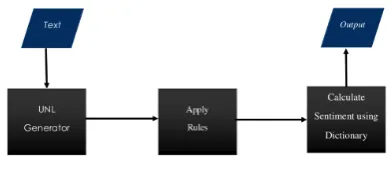
As show in Figure 1, the modifier”bad”is associ-ated with the object of the main verb. It shouldn’t affect the sentiment of the main agent. Therefore, we can ignore the modifier relation of the main ob-ject in such cases. After doing that, the sentiment of this sentence can be inferred to be positive. The approach followed in the project is to first generate a UNL graph for the given input sentence. Then a set of rules is applied and used to infer the sen-timent of the sentence. The process is shown in Figure 2. The UNL generator shown in the Figure 2 has been developed at CFILT.1Before, the given
[image:3.595.317.513.511.596.2]piece of text is passed on to the UNL generator, it goes through a number of pre-processing stages. Removal of redundant punctuations, special char-acters, emoticons, etc. are part of this process. This is extremely important because the UNL gen-erator is not able to handle special characters at the moment. We can see that, the performance of the overall system is limited by this. A more robust version of the UNL generator will certainly allow the system to infer the sentiment more accurately.
Figure 2: System Architecture
Rules
There is a separate rule for each relation. For each UW (Universal word) considered, if it has a@not
attribute then its polarity is reversed. Rules used by the system are as follows,
1) If a given UW is source of theagtrelation, then its polarity is added to the overall polarity of the
text. e.g.,”I like her”. Here, the agt relation will beagt ( like , I ). The polarity of like being posi-tive, the overall polarity of the text is positive. e.g,
”I don’t like her”. Here the agt relation will beagt ( like@not , I ). The polarity of like is positive but it has an attribute@notso its polarity is negative. The overall polarity of the text is negative in this case.
2) If a given UW is source or target of theobj rela-tion and has the attribute@entrythen its polarity is added to the overall polarity of the text. This rule merely takes into account the main verb of the sentence into account, and the it’s is polarity considered. e.g.,”I like her”, here the obj relation will beobj ( like@entry , her ). The polarity of like being positive, the overall polarity of the text is positive
3) If a given UW is the source of the aoj rela-tion and has the attribute@entrythen its polarity is added to the overall polarity of the text. e.g.,
”Going downtown tonight it will be amazing on the waterfront with the snow”. Here, theaoj re-lation isaoj ( amazing@entry , it ). amazing has a positive polarity and therefore overall polarity is positive in this case.
4) If a given UW is the target of themodrelation and the source UW has the attribute@entryor has the attribute@indefthen polarity of the target UW is added to the overall polarity of the text. e.g.,”I like that bad boy”. Here, the aoj relation ismod ( boy , bad ). bad has a negative polarity but the source UW, boy does not have an@entryattribute. So, in this case negative polarity of bad is not con-sidered as should be the case. e.g., ”She has a gorgeous face”. Here, the mod relation ismod ( face@indef , gorgeous ). gorgeoushas a positive polarity and face has an attribute@indef. So, po-larity of gorgeous should be considered.
5) If a given UW is the target of themanrelation and the source UW has the attribute@entrythen polarity of the target UW is added to the overall polarity of the text. Or if the target UW has the attribute@entrythen also we can consider polar-ity of the target UW. e.g.,”He always runs fast”. Here, theaojrelation ismod ( run@entry , fast ).
fasthas a positive polarity and the source UW, run has the@entryattribute. So, in this case positive polarity of fast is added to the overall polarity of the sentence. Polarities of both the source and tar-get UW of theandrelation are considered. 6) In ”Happy and Cheerful”, the and relation is
and(Happy, Cheerful). HappyandCheerful, both have a positive polarity, which gives this sentence an overall positive polarity.
The polarity value of each individual word is looked up in a dictionary of positive of negative words used is Liu (2010) After all the rules are applied, summation of all the calculated polarity values is done. If this sum is greater than 0 then it is considered as positive, and negative otherwise. This system is negative biased due to the fact that people often tend to express negative sentiment in-directly or by comparison with something good. A more detailed discussion on negative texts is pro-vided in section 6.
4 Experimental Setup
Analysis was performed for monolingual binary sentiment classification task. The language used in this case was English. The comparison was done between 5 systems viz. System using words as features, WordNet sense based system as given in Balamurali et al., (2012), Clusters based sys-tem as described in Kashyap et al., (2013), Dis-course rules based system as given in Mukherjee and Bhattacharyya (2012), UNL rule based sys-tem. Two polarity datasets were used to perform the experiments.
1. EN-TD: English Tourism corpus as used in Ye et al., (2009). It consists of 594 positive and 593 negative reviews.
2. EN-PD: English Product (music albums) re-view corpus Blitzer et al., (2007). It consists of 702 positive and 702 negative reviews. For the WordNet sense, and Clusters based sys-tems, a manually sense tagged version of the (EN-PD) has been used. Also, a automatically sense tagged version of (EN-TD) was used on these sys-tems. The tagging in the later case was using an automated WSD engine, trained on a tourism do-main Khapra et al., (2013). The results reported for supervised systems are based on 10-fold cross validation.
5 Results
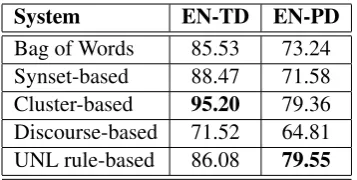
System EN-TD EN-PD Bag of Words 85.53 73.24 Synset-based 88.47 71.58 Cluster-based 95.20 79.36 Discourse-based 71.52 64.81 UNL rule-based 86.08 79.55
Table 1: Classification accuracy (in %) for mono-lingual sentiment analysis
[image:5.595.71.250.61.151.2]EN-TD EN-PD System Pos Neg Pos Neg Discourse rules 94.94 48.06 92.73 36.89 UNL rules 95.72 76.44 90.75 68.35
Table 2: Classification accuracy (in %) for positive and negative reviews
performs the best in both cases. The UNL rule-based system performs better only than the bag of words and discourse rule based system. For EN-PD ( music album reviews ) dataset, the UNL based system outperforms every other system . These results are very promising for a rule-based system. The difference between accuracy for pos-itive and negative reviews for the rule-based sys-tems viz. Discourse rules based and UNL rules based is shown in Table 2. It can be seen that the Discourse rules based system performs slightly better than the UNL based system for positive re-views. On the other hand, the UNL rules based system outperforms it in case of negative reviews by a huge margin.
6 Discussion
The UNL generator used in this case is the bottle-neck in terms of performance due to it’s speed. It can take a long time to generate UNL graphs for large sentences. Also, it makes use of the stan-dard NLP tools viz. parsing, co-reference resolu-tion, etc. to assign the proper semantic roles in the giventext. It is well known fact that these tech-niques work properly only on structured data. The language used in the reviews present in both the datasets is unstructured in considerable number of cases. The UNL generator is still in its infancy and cannot handle text involving special charac-ters. Due to these reasons, a proper UNL graph is not generated in some cases. Also, it is not able to generator proper UNL graphs for even well
struc-tured sentences. As a result of these things, the classification accuracy is low. Negative reviews are difficult to classify due to comparitive state-ments and presence of positive words. Also there are some sarcastic sentences which are difficult to classify. Sarcasm is a very difficult problem to tackle. Some related works can be found in Car-valho et al., (2009) and Muresan et al., (2011). In some cases, the reviewers make use of their native language and expressions. This is a big problem for the task of monolingual sentiment classifica-tion.
7 Conclusion
This paper made use of deep semantics to tackle the the problem of sentiment analysis. A seman-tic role labeling method through generation of a UNL graph was used to do this. The main mo-tivation behind this research was the fact that not all sentiment bearing expressions contribute to the overall sentiment of the text. The approach was evaluated on two datasets and compared with suc-cessful previous approaches which don’t make use of deep semantics. The system underperformed all the supervised systems but showed promise by yielding better results than the other rule-based ap-proach. Also, in some cases the performance was very close to the other supervised systems. The system works well on sentences where are inher-ently complex and difficult for sentiment analysis as it makes use of semantic role labeling. Any rule based system can never be exhaustive in terms of rules. We always need to add new rules to improve on it. In some case, adding new rules might cause side-effects. In this case, as the rules are intuitive, adding of new rules will be easy. Also, analysis of the results hints at some ways to tackle specific problems effectively.
8 Future Work
References
Ruppenhofer, Josef and Rehbein, Ines. 2012.
Seman-tic frames as an anchor representation for sentiment analysis. Proceedings of the 3rd Workshop in Com-putational Approaches to Subjectivity and Sentiment Analysis
Mukherjee, Subhabrata and Bhattacharyya,
Push-pak. 2012. Sentiment Analysis in Twitter with
Lightweight Discourse Analysis. COLING
Balamurali, AR and Joshi, Aditya and Bhattacharyya,
Pushpak 2011. Harnessing wordnet senses for
su-pervised sentiment classification. Proceedings of the Conference on Empirical Methods in Natural Language Processing
Rentoumi, Vassiliki and Giannakopoulos, George and Karkaletsis, Vangelis and Vouros, George A 2009.
Sentiment analysis of figurative language using a word sense disambiguation approach. Proceedings of the International Conference RANLP
Martın-Wanton, Tamara and Balahur-Dobrescu,
Alexandra and Montoyo-Guijarro, Andres and
Pons-Porrata, Aurora 2010. Word sense
dis-ambiguation in opinion mining: Pros and cons. Special issue: Natural Language Processing and its Applications
Kashyap Popat, Balamurali A.R, Pushpak
Bhat-tacharyya and Gholamreza Haffari 2013. The
Haves and the Have-Nots: Leveraging Unlabelled Corpora for Sentiment Analysis. The Association for Computational Linguistics
Saif, Hassan and He, Yulan and Alani, Harith 2012.
Semantic sentiment analysis of twitter. The Seman-tic Web–ISWC 2012
Verma, Shitanshu and Bhattacharyya, Pushpak 2009.
Incorporating semantic knowledge for sentiment analysis. Proceedings of ICON
Choi, Yejin and Cardie, Claire 2008. Learning with
compositional semantics as structural inference for subsentential sentiment analysis. Proceedings of the Conference on Empirical Methods in Natural Lan-guage Processing
Liu, Bing 2010. Sentiment analysis and subjectivity.
Handbook of natural language processing
Ye, Qiang and Zhang, Ziqiong and Law, Rob 2009.
Sentiment classification of online reviews to travel destinations by supervised machine learning ap-proaches. Expert Systems with Applications
Balamurali, AR and Khapra, Mitesh M and
Bhat-tacharyya, Pushpak 2013. Lost in translation:
via-bility of machine translation for cross language sen-timent analysis. Computational Linguistics and In-telligent Text Processing
Blitzer, John and Dredze, Mark and Pereira, Fernando
2007. Biographies, bollywood, boom-boxes and
blenders: Domain adaptation for sentiment classi-fication. ACL
Gonz´alez-Ib´a˜nez, Roberto and Muresan, Smaranda and
Wacholder, Nina 2011. Identifying Sarcasm in
Twit-ter: A Closer Look. ACL