Experiments in Medical Translation Shared Task at WMT 2014
Jian Zhang, Xiaofeng Wu,
Iacer Calixto, Ali Hosseinzadeh Vahid, Xiaojun Zhang, Andy Way, Qun Liu
The CNGL Centre for Global Intelligent Content School of Computing
Dublin City University, Ireland
{zhangj,xiaofengwu, icalixto,avahid,xzhang, away,qliu}@computing.dcu.ie
Abstract
This paper describes Dublin City Uni-versity’s (DCU) submission to the WMT 2014 Medical Summary task. We re-port our results on the test data set in the French to English translation direction. We also report statistics collected from the corpora used to train our translation sys-tem. We conducted our experiment on the Moses 1.0 phrase-based translation system framework. We performed a variety of ex-periments on translation models, reorder-ing models, operation sequence model and language model. We also experimented with data selection and removal the length constraint for phrase-pair extraction.
1 System Description
1.1 Training Data Statistics and Preparation
The training corpora provided to the medical translation shared task can be divided into 3 cat-egories:
Medical in-domain corpora: these corpora
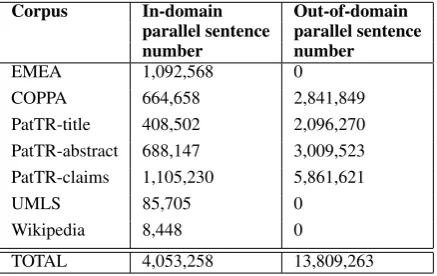
contain documents, patents, articles, terminology lists, and titles that are representative of the same medical domain as the development and test data sets (Table 1, second column).
Medical out-of-domain corpora: these
cor-pora also contain medical documents, patents, ar-ticles, terminologies lists and titles, but describe a different domain from the development and test data sets (Table 1, third column).
General domain corpora: these corpora
con-sist of general-domain text (WMT 2014 general
translation subtask corpora), and encompass vari-ous domains. (We did not use these corpora in our system).
Corpus In-domain Out-of-domain
parallel sentence parallel sentence
number number
EMEA 1,092,568 0
COPPA 664,658 2,841,849
PatTR-title 408,502 2,096,270 PatTR-abstract 688,147 3,009,523 PatTR-claims 1,105,230 5,861,621
UMLS 85,705 0
Wikipedia 8,448 0
[image:1.595.308.527.344.482.2]TOTAL 4,053,258 13,809,263
Table 1: WMT 2014 Medical Translation shared task parallel training data before preprocessing.
Within all the provided training corpora from WMT 2014, 70.72% of the medical in domain bilingual sentences, and 100% of the medical out-of-domain bilingual sentences were obtained from patent document collections. Motivated by these percentages, we view the WMT 2014 med-ical translation shared task as similar to training a patent-specific translation system. The mono-lingual corpora are taken from 9 different cor-pora collections, and there is no clear demarca-tion of the in/out-of-domain boundaries (except the PatTR collection). Our method of differenti-ating between the in/out-of-domain monolingual corpora is that only English sentences from the third column of Table 1, and the patent descrip-tion documents from PatTR collecdescrip-tion, are out-of-domain monolingual corpora. All other English
sentences are treated as an in-domain monolingual resource.
A patent document usually comprises title, ab-stract, claims and description fields. The docu-ments often use its unique formatting and con-tain linguistic idiosyncrasies, which distinguish patent-specific translation systems from general translation systems, in both training and transla-tion phases (Ceaus¸u et al., 2011). We have also found that some common writing styles are con-stantly used, especially for long sentences. For example, a typical patent claim begins with
Method of [X], which comprising:
followed by a numbered list. The abstract field normally contains one paragraph only, but with multiple sentences. Those long sentences are necessarily filtered out to facilitate efficient word alignment, using a tool such as GIZA++ (Och, 2003) word aligner with the default param-eter settings. However, because statistical ma-chine translation depends on the training data to estimate translation probability, more high qual-ity training data often leads a better translation re-sult. One possible method of including long sen-tences into the training cycle is to change the word aligner’s parameter settings to handle longer sen-tences; however, aligning long sentences is time consuming. Our solution is to capture the styled long sentences and attempt to split them on both source and target side simultaneously according to the numbered list or sentence boundary indica-tions. If the sentence number after splitting are matching in both source and target sides, and each sentence pair is within the token length ratio of 3, we assume the split attempt is successful, oth-erwise the sentences are kept unchanged and will be filtered out eventually. We applied our splitting attempt approach on the patent documents at the data preparation step which consequently results in 19.35% and 7.1% increase in the number of sentence pairs compared with the original medical in-domain (from 4053258 to 4837382) and over-all medical (from 17862521 to 19124142) datasets respectively.
Another finding from the training corpora is that the titles of the patent documents are often capital-ized in the training corpora. Since we are training a true-cased translation system, and the transla-tion inputs contain non-title sentences, capitalized training sentences will contribute biased weights to our true-case model. We addressed this issue by
creating a lowercase version of the title corpora, then we trained our true-case model with the low-ercased titles corpora and other non-title corpora. We also included the lowercased title corpora in the translation system training.
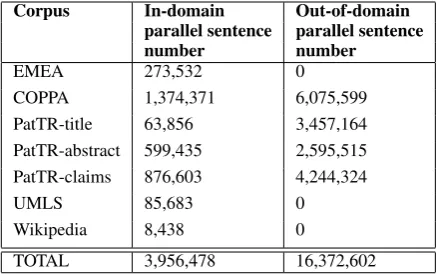
We tokenized the training corpora using the tokenizer script distributed in the Moses 1.0 framework with additional patent document non-breaking preferences observed during data prepa-ration, such as Figs and FIGS etc., and a modified aggressive setting (split hyphen character in all cases). Other data preparation steps included char-acter normalization, charchar-acter/token based foreign language detection, HTML/XML tag removal, case insensitive duplication removal, longer sen-tence removal (2-80, length ratio 9), resulting in the preprocessed data shown in Table 2.
Corpus In-domain Out-of-domain
parallel sentence parallel sentence
number number
EMEA 273,532 0
COPPA 1,374,371 6,075,599
PatTR-title 63,856 3,457,164 PatTR-abstract 599,435 2,595,515 PatTR-claims 876,603 4,244,324
UMLS 85,683 0
Wikipedia 8,438 0
[image:2.595.307.526.305.442.2]TOTAL 3,956,478 16,372,602
Table 2: WMT 2014 Medical Translation shared task parallel training data after preprocessing steps.
1.2 Training Data Selection
It is an open secret that high quality and large quantity of the parallel corpus are the two most important factors for a high-quality SMT system. These factors assist the word aligner in producing a precise alignment model, which in turn brings benefits to the other SMT training steps.
system using the test data set as our baseline (Ta-ble 3). For the purpose of making the potential baseline systems comparable, instance selection was employed after word alignment using word aligner MGIZA++ (Gao and Vogel, 2008) on all the available data. The transductive learning uses features extracted from the source data of the de-velopment set with the default feature decay algo-rithm weight settings. All of systems were trained using the default phrase-based training parameter settings of Moses 1.0 framework, with additional msd-bidirectional-fe reordering model (Koehn et al., 2005). We extract phrase pairs based on grow-diag-final-and (Koehn et al., 2003) heuristics. The language model was created with open source IRSTLM toolkit (Federico et al., 2008) using all the English in-domain data (monolingual and par-allel). We used 5-gram with modied Kneser-Ney smoothing (Kneser and Ney, 1995). The tuning step used minimum error rate training (MERT) (Och, 2003). The performance was measured by the test data set in case insensitive BLEU score.
Proportions Test set
case insensitive BLEU
1/64 0.4374
1/32 0.4409
1/16 0.4370
1/8 0.4419
1/4 0.4390
1/2 0.4399
3/4 0.4397
1 0.4260
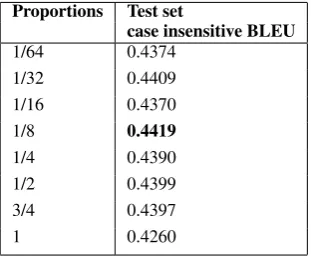
Table 3: Feature decay algorithm transductive learning selection on all in-domain data using ex-tracted features from the source side of the test data set. We choose system uses 1/8 proportions of the in-domain data as our baseline system.
Our results show that the system trained with 1/8 proportion of the in-domain medical training data (398,098 sentence pairs) selected by FDA outperformed the others. We chose this system as our baseline system.
2 Experiments
2.1 Maximum Phrase Length
While extracting phrase pairs, collecting longer phrases is not guaranteed to produce a better qual-ity phrase table than the shorter settings, even setting the maximum phrase length to three can
achieve top performance (Koehn et al., 2003). We take this WMT 2014 opportunity to study the capability of long phrase lengths ( >=10 ). We trained translation models with phrase length set-ting from 10 to 15, employed them to our base-line system and compared the performance with the default setting (length = 7).
Phrase Length Phrase Table Test set Entries case insensitive
BLEU 7 (Baseline) 19.31 0.4419
10 29.67 0.4400
11 32.87 0.4416
12 35.95 0.4444*
13 38.91 0.4448*
14 41.75 0.4444*
[image:3.595.314.518.168.295.2]15 44.47 0.4362
Table 4: -max-phrase-length setting experiment, where phrase table entries is in millions. * indi-actes statistically significant improvement at thep
= 0.05 level.1
As stated in (Koehn et al., 2003) and expected, the size of the phrase table is linear with respect to the maximum phrase length restriction. Surpris-ingly, we also found the performance can still im-prove after the default length setting, until a peak point (Table 4).
It is also interesting to see the effect for each sentence in the test set when the default phrase length setting in Moses framework is changed. We first evaluated the sentence level BLEU scores for the systems listed in Table 4, then compared them with our baseline system sentence level BLEU scores and categorised the compared results into increased, decreased or unaffected groups (Fig-ure 1). We found that system with -max-phrase-length set to 12 is influenced the least (158, 118 and 724 sentences have BLEU score increased, decreased and unaffected respectively) and with -max-phrase-length sets to 10 is influenced the most (261, 257 and 482 sentences have BLEU score increased, decreased and unaffected respec-tively).
We then looked into the decoding phase and tried to discover the actual phrase length that was used to generate the translation outputs. We ex-posed the translation segmentations by trigger-ing the -report-segmentation decodtrigger-ing parameter
[image:3.595.104.260.370.498.2]10 11 12 13 14 15 200
250 300 350 400 450 500 550 600 650 700 750
261 208
158 258
217 218
257
180
118 213
163 227
482 612
724
529 620
555
-max-phrase-length from 10 to 15
test
set
(1000
sentences)
[image:4.595.78.258.62.230.2]increased decreased unaffected
Figure 1: Sentence level BLEU score affects when enlarge -max-phrase-length
7 10 11 12 13 14 15
5·10−4
5·10−2
0.1 0.15 0.2 0.25 0.3 0.35 0.4 0.45 0.5 0.55 0.6
baseline and -max-phrase-length from 10 to 15
Source
phrase
used
in
decoding
(%)
[image:4.595.85.281.303.472.2]pl=1 pl=2 pl=3 pl=4 pl=5 pl=6 pl=7 pl=8
Figure 2: Phrase length (pl) distribution used in decoding
in the Moses framework and computed the per-centage of different phrases used according to the phrase token number (Figure 2). The transla-tion is mostly generated from short source phrases (length<4) in all the systems during decoding, which we think is the reason that setting phrase ex-traction to length 3 can achieve top performance.
We did not carry out more experiments in this case, as we think there is no absolute maximum phrase length setting which can fit into all experi-ments and such experiexperi-ments depend on many fac-tors, such as the similarity between the training corpus and then testing data. The choice to set -max-phrase-length to 13 is purely directed by the BLEU score shown in Table 4.
2.2 Reordering Models
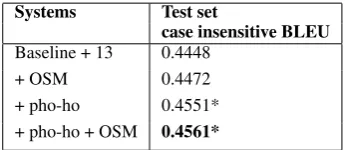
Ceaus¸u et al. (2011) also found that long-range re-ordering is one of the characteristics of patent doc-uments; however, long-range reordering increases the difficulty of SMT training and decoding. We experimented two approaches to address this chal-lenge. Apart from the msd-bidirectional-fe lexi-cal reordering model (Koehn et al., 2005) in our baseline system, the phrase-based orientation and hierarchical orientation reordering models (Gal-ley and Manning, 2008) can capture long distance dependencies. The phrase-based orientation re-ordering model is similar to the lexical rere-ordering approach, the only difference between these two models is the phrase-based reordering model per-forms reordering only on the phrase level, but the hierarchical reordering model does not have such constraint - it does not require phrases to be ad-jacent. OSM (Durrani, 2011) (Durrani, 2013b) is a sequence model integrating the N-gram-based translation model and reordering model. It de-fines three operations for reordering and consid-ers all reordering possibilities within a fixed win-dow while searching. We experimented with both reordering models, and found that the system de-fined with three reordering models performs bet-ter (Table 5) than OSM. We then tried to use both OSM and the reordering models together, which produced the best system at this point.
Systems Test set
case insensitive BLEU Baseline + 13 0.4448
+ OSM 0.4472
+ pho-ho 0.4551* + pho-ho + OSM 0.4561*
Table 5: Reordering Model or/and OSM results
2.3 Two Translation Models
The back-off model aims to produce translations for the unknown words or unknown phrases in the primary translation table by yielding the phrase ta-ble translation probability from primary transla-tion table to the back-off table, as in (Koehn et al., 2012a)
pBO(e|f) =
(
p1(e|f) if count1(f)>0
p2(e|f) otherwise
[image:4.595.330.503.470.545.2]as a domain adaptation approach, which is to con-strain the translation options within the target do-main unless no options can be found, in which case the translation will be selected from the back-off model.
Phrase table fill-up (Bisazza et al., 2011) is a very similar approach with back-off models, it col-lects and uses the phrase pairs from the out-of-domain phrase table only when the input is un-available at the in-domain phrase table. It merges the in-domain and out-of-domain translation mod-els into one, where the scores are taken from more reliable source. To distinguish the source of a phrase pair entry, fill-up assigns a binary value as an additional feature at the merged phrase table.
We trained our out-of-domain translation model separately using all of the out-of-domain medi-cal data listed at Table 2 with the same parame-ter settings as our baseline system, then employed Moses’s back-off model feature to pass the pri-mary and back-off translation models to the de-coder at tuning and translation time. The fill-up tool was sourced from (Bisazza et al., 2011) at Moses’s distribution. Our experiment results (Ta-ble 6) show that the fill-up approach performed better than the back-off model approach.
Systems Test set
case insensitive BLEU Baseline + 13 + pho-ho + OSM 0.4561
Back-off 0.4573
[image:5.595.320.513.61.135.2]Fill-up 0.4599*
Table 6: Back-off and fill-up experiment results
2.4 Language Model
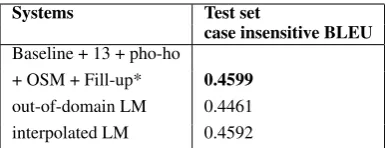
Until now, we have reported our results using a language model trained with all in-domain medi-cal data only. We also took the similar approach to (Koehn et al., 2007) and carried out language model experiments. We trained our out-of-domain language model with all the out-of-domain En-glish sentences mentioned in section 1.1, then in-terpolated the in-domain and out-of-domain lan-guage model by optimizing the perplexity to the development data set. We received a similar pic-ture to (Koehn et al., 2007), where the language model trained with only in-domain data performed the best (Table 7).
Our final submission for WMT 2014 Medical Translation shared task is the * system at Table 7.
Systems Test set
case insensitive BLEU Baseline + 13 + pho-ho
+ OSM + Fill-up* 0.4599 out-of-domain LM 0.4461 interpolated LM 0.4592
Table 7: Language model experiment results
3 Conclusion
In this paper, we report our results on the WMT 2014 in the French to English translation direc-tion. We shared our statistics for the bilingual corpora used to train our translation system. All systems were trained using the open source Moses 1.0 translation framework. Based on the feature set of Moses phrased-based translation system, we carried out our experiments on translation models, reordering models, operation sequence model and language model. We also experimented on data selection and releasing the length restriction while extracting phrase pairs.
4 Acknowledgements
This research is supported by the Science Foun-dation Ireland (Grant 12/CE/I2267) as part of the Centre for Next Generation Localisation (www.cngl.ie) at Dublin City University. We would also like to acknowledge Ergun Bicici who gives suggestions at the data selection approach.
References
Alexandru Ceaus¸u, John Tinsley, Jian Zhang and Andy Way. 2011. Experiments on domain adaptation for patent machine translation in the PLuTO project, The 15th conference of the European Association for Machine Translation, Leuven, Belgium.
Arianna Bisazza, Nick Ruiz, and Marcello Fed-erico. 2011. Fill-up versus Interpolation Meth-ods for Phrase-based SMT Adaptation., In Interna-tional Workshop on Spoken Language Translation (IWSLT), San Francisco, CA.
Durrani, N., Schmid, H., and Fraser, A. 2011. A Joint Sequence Translation Model with Integrated Reordering., The 49th Annual Meeting of the As-sociation for Computational Linguistics, Portland, Oregon, USA.
Ergun Bicici and Deniz Yuret. 2014. Optimizing In-stance Selection for Statistical Machine Translation with Feature Decay Algorithms, IEEE/ACM Trans-actions On Audio, Speech, and Language Process-ing (TASLP).
Franz J. Och and Hermann Ney. 2003. A systematic comparison of various statistical alignment models, Computational Linguistics, 29(1):1951.
Franz Josef Och. 2003. Minimum error rate training in statistical machine translation, The 41th Annual Meeting of the Association for Computational Lin-guistics, Sapporo, Japan.
Marcello Federico, Nicola Bertoldi, and Mauro Cet-tolo. 2008. IRSTLM: an open source toolkit for handling large scale language models, Interspeech, Brisbane, Australia.
Michel Galley and Christopher D. Manning. 2008. A simple and effective hierarchical phrase reordering model., The 2008 Conference on Empirical Meth-ods in Natural Language Processing,pages 848856, Honolulu, Hawaii, October. Association for Compu-tational Linguistics.
Qin Gao and Stephan Vogel. 2008.Parallel implemen-tations of word alignment tool, In Software Engi-neering, Testing, and Quality Assurance for Natu-ral Language Processing, SETQA-NLP 2008, pages 49-57, Stroudsburg, PA, USA. Association for Com-putational Linguistics.
Philipp Koehn, Amittai Axelrod, Alexandra Birch Mayne, Chris Callison-Burch, Miles Osborne and David Talbot. 2005. Edinburgh System Description for the 2005 IWSLT Speech Translation Evaluation, International Workshop on Spoken Language Trans-lation.
Philipp Koehn and Josh Schroeder. 2007. Experi-ments in Domain Adaptation for Statistical Machine Translation, The Second Workshop on Statistical Machine Translation, pages 224227, Prague. Philipp Koehn, Amittai Axelrod, Alexandra Birch
Mayne, Chris Callison-Burch, Miles Osborne and David Talbot. 2003. Statistical phrase-based trans-lation, 2003 Conference of the North American Chapter of the Association for Computational Lin-guistics on Human Language Technology, pages 4854, Edmonton, Canada.
Philipp Koehn, and Barry Haddow. 2012. Interpolated backoff for factored translation models., The 10th Conference of the Association for Machine Transla-tion in the Americas (AMTA).