Proceedings of the 2012 Workshop on Biomedical Natural Language Processing (BioNLP 2012), pages 231–239,
Scaling up WSD with Automatically Generated Examples
Weiwei Cheng, Judita Preiss and Mark Stevenson
Department of Computer Science, Sheffield University, Regent Court, 211 Portobello,
Sheffield, S1 4DP United Kingdom
{W.Cheng, J.Preiss, M.Stevenson}@dcs.shef.ac.uk
Abstract
The most accurate approaches to Word Sense Disambiguation (WSD) for biomedical docu-ments are based on supervised learning. How-ever, these require manually labeled training examples which are expensive to create and consequently supervised WSD systems are normally limited to disambiguating a small set of ambiguous terms. An alternative approach is to create labeled training examples automat-ically and use them as a substitute for manu-ally labeled ones. This paper describes a large scale WSD system based on automatically la-beled examples generated using information from the UMLS Metathesaurus. The labeled examples are generated without any use of la-beled training data whatsoever and is therefore completely unsupervised (unlike some previ-ous approaches). The system is evaluated on two widely used data sets and found to outper-form a state-of-the-art unsupervised approach which also uses information from the UMLS Metathesaurus.
1 Introduction
The information contained in the biomedical liter-ature that is available in electronic formats is use-ful for health professionals and researchers (West-brook et al., 2005). The amount is so vast that it is difficult for researchers to identify informa-tion of interest without the assistance of automated tools (Krallinger and Valencia, 2005). However, processing these documents automatically is made difficult by the fact that they contain terms that are ambiguous. For example, “culture” can mean
“laboratory procedure” (e.g. “In peripheral blood mononuclear cellculture”) or “anthropological cul-ture” (e.g. “main accomplishments of introducing a quality managementculture”). These lexical ambi-guities are problematic for language understanding systems.
Word sense disambiguation (WSD) is the process of automatically identifying the meanings of am-biguous terms. Some WSD systems for the biomed-ical domain are only able to disambiguate a small number of ambiguous terms (see Section 2). How-ever, for WSD systems to be useful in applications they should be able to disambiguate all ambiguous terms. One way to create such a WSD system is to automatically create the labeled data that is used to train supervised WSD systems. Several approaches (Liu et al., 2002; Stevenson and Guo, 2010; Jimeno-Yepes and Aronson, 2010) have used information from the UMLS Metathesaurus1 to create labeled training data that have successfully been used to cre-ate WSD systems.
A key decision for any system that automatically generates labeled examples is the number of exam-ples of each sense to create, known as thebiasof the data set. It has been shown that the bias of a set of la-beled examples affects the performance of the WSD system it is used to train (Mooney, 1996; Agirre and Mart´ınez, 2004b). Some of the previous approaches to generating labeled data relied on manually anno-tated examples to determine the bias of the data sets and were therefore not completely unsupervised.
This paper describes the development of a large scale WSD system that is able to disambiguate all
1http://www.nlm.nih.gov/research/umls/
terms that are ambiguous in the UMLS Metathe-saurus. The system relies on labeled examples that are created using information from UMLS. Various bias options are explored, including ones that do not make use of information from manually labeled ex-amples, and thus we can create a completely unsu-pervised system. Evaluation is carried out on two standard datasets (the NLM-WSD and MSH-WSD corpora). We find that WSD systems can be cre-ated without using any information from manually labeled examples and that their performance is bet-ter than a state-of-the-art unsupervised approach.
The remainder of this paper is organized as fol-lows. Previous approaches to WSD in biomedical documents are described in the next Section. Section 3 presents the methods used to identify bias in the labeled examples and WSD system. Experiments in which these approaches are compared are described in Section 4 and their results in Section 5.
2 Background
Many WSD systems for the biomedical domain are based on supervised learning (McInnes et al., 2007; Xu et al., 2007; Stevenson et al., 2008; Yepes and Aronson, 2011). These systems require labeled training data, examples of an ambiguous term la-beled with the correct meaning. Some sets of lala-beled data have been developed for the biomedical domain (Weeber et al., 2001; Savova et al., 2008; Jimeno-Yepes et al., 2011). However, these data sets only contain examples for a few hundred terms and can only be used to develop WSD systems to identify the meanings of those terms. The process of creat-ing labeled examples is extremely time-consumcreat-ing and difficult (Artstein and Poesio, 2008), making it impractical to create labeled examples of all possible ambiguous terms found in biomedical documents.
Two alternative approaches have been explored to develop systems which are able to disambiguate all ambiguous terms in biomedical documents. The first makes use of unsupervised WSD algorithms (see Section 2.1) and the second creates labeled data au-tomatically and uses it to train a supervised WSD system (see Section 2.2).
2.1 Unsupervised WSD
Unsupervised WSD algorithms make use of infor-mation from some knowledge source, rather than re-lying on training data.
Humphrey et al. (2006) describe an unsupervised system which uses semantic types in UMLS to dis-tinguish between the possible meanings of ambigu-ous words. However, it cannot disambiguate be-tween senses with the same semantic type, i.e., it is not possible for the system to recognise all sense distinctions.
The Personalised Page Rank (PPR) system (Agirre et al., 2010; Jimeno-Yepes and Aronson, 2010) relies on a a graph-based algorithm similar to the Page Rank algorithm originally developed for use in search engines (Brin, 1998). It performs WSD by converting the UMLS Metathesaurus into a graph in which the possible meanings of ambigu-ous words are nodes and relations between them are edges. Disambiguation is carried out by providing the algorithm with a list of senses that appear in the text that is being disambiguated. This information is then combined with the graph and a ranked list of the possible senses for each ambiguous word generated. Unsupervised systems have the advantage of be-ing able to disambiguate all ambiguous terms. How-ever, the performance of unsupervised systems that have been developed for biomedical documents is lower than that of supervised ones.
2.2 Automatic Generation of Labeled Data
Automatic generation of labeled data for WSD com-bines the accuracy of supervised approaches with the ability of unsupervised approaches to disam-biguate all ambiguous terms. It was first suggested by Leacock et al. (1998). Their approach is based on the observation that some terms in a lexicon oc-cur only once and, consequently, there is no doubt about their meaning. These are referred to as being
Liu et al. (2002) were the first to apply the monosemous relatives approach to biomedical WSD and use it to disambiguate a set of 35 abbreviations. They reported high precision but low recall, indicat-ing that labeled examples could not be created for many of the abbreviations. Jimeno-Yepes and Aron-son (2010) applied a similar approach and found that it performed better than a number of alternative approaches on a standard evaluation resource (the NLM-WSD corpus) but did not perform as well as supervised WSD. Stevenson and Guo (2010) com-pared two techniques for automatically creating la-beled data, including the monosemous relatives ap-proach. They found that the examples which were generated were as good as manually labeled exam-ples when used to train a supervised WSD system. However, Stevenson and Guo (2010) relied on la-beled data to determine the number of examples of each sense to create, and therefore the bias of the data set. Consequently their approach is not com-pletely unsupervised since it could not be applied to ambiguous terms that do not have labeled training data available.
3 Approach
3.1 WSD System
The WSD system is based on a supervised approach that has been adapted for the biomedical domain (Stevenson et al., 2008). The system was tested on the NLM-WSD corpus (see Section 4.1) and found to outperform alternative approaches.
The system can exploit a wide range of fea-tures, including several types of linguistic informa-tion from the context of an ambiguous term, MeSH codes and Concept Unique Identifiers (CUIs) from the UMLS Metathesaurus. However, computing these features for every example is a time consum-ing process and to make the system suitable for large scale WSD it was restricted to using a smaller set of features. Previous experiments (Stevenson et al., 2008) showed that this only leads to a small drop in disambiguation accuracy while significantly reduc-ing the computational cost of generatreduc-ing features.
3.1.1 Features
Two types of context words are used as features: the lemmas of all content words in the same
sen-tence as the ambiguous word and the lemmas of all content words in a±4-word window around the am-biguous term. A list of corpus-specific stopwords was created containing terms that appear frequently in Medline abstracts but which are not useful for dis-ambiguation (e.g. “abstract”, “conclusion”). Any lemmas found in this list were not used as features.
3.1.2 Learning algorithm
Disambiguation is carried out using the Vector Space Model, a memory-based learning algorithm in which each occurrence of an ambiguous word is represented as a vector created using the features ex-tracted to represent it (Agirre and Mart´ınez, 2004a). The Vector Space Model was found to outperform other learning algorithms when evaluated using the NLM-WSD corpus (Stevenson et al., 2008).
During the algorithm’s training phase a single centroid vector, C~sj, is generated for each possible
sense, sj. This is shown in equation 1 whereT is
the set of training examples for a particular term and sense(~t)is the sense associated with the vector~t.
~ Csj =
P
~
ti T:sense(t~i)=sjt~i
|~ti T :sense(~ti) =sj| (1)
Disambiguation is carried out by comparing the vector representing the ambiguous word,~a, against the centroid of each sense using the cosine metric, shown in equation 2, and choosing the one with the highest score.
score(sj, ~a) =cos(C~sj, ~a) =
~ Csj.~a
|C~sj||~a|
(2)
Note that the learning algorithm does not ex-plicitly model the prior probability of each possi-ble sense, unlike alternative approaches (e.g. Naive Bayes), since it was found that including this infor-mation did not improve performance.
3.2 Automatically generating training examples
The approaches used for generating training exam-ples used here are based on the work of Stevenson and Guo (2010), who describe two approaches:
1. Monosemous relatives
Both approaches are provided with a set of ambigu-ous CUIs from the UMLS Metathesaurus, which represent the possible meanings of an ambiguous term, and a target number of training examples to be generated for each CUI. Each CUI is associated with at least one term and each term is labeled with a lex-ical unique identifier (LUI) which represents a range of lexical variants for a particular term. The UMLS Metathesaurus contains a number of data files which are exploited within these techniques, including:
AMBIGLUI: a list of cases where a LUI is linked
to multiple CUIs.
MRCON: every string or concept name in the
Metathesaurus appears in this file.
MRCOC: co-occuring concepts.
For the monosemous relatives approach, the strings of monosemous LUIs of the target CUI and its relatives are used to search Medline to trieve training examples. The monosemous LUIs re-lated to a CUI are defined as any LUIs associated with the CUI in theMRCON table and not listed in
AMBIGLUItable.
The co-occurring concept approach works differ-ently. Instead of using strings of monosemous LUIs of the target CUI and its relatives, the strings associ-ated with LUIs of a number of co-occurring CUIs of the target CUI and its relatives found in MRCOC ta-ble are used. The process starts by finding the LUIs of the topn co-occurring CUIs of the target CUI. These LUIs are then used to form search queries. The query is quite restrictive in the beginning and re-quires all terms appear in the Medline citations files. Subsequently queries are made less restrictive by re-ducing the number of required terms in the query.
These techniques were used to generate labeled examples for all terms that are ambiguous in the 2010 AB version of the UMLS Metathesaurus.2The set of all ambiguous terms was created by analysing
theAMBIGLUItable, to identify CUIs that are
asso-ciated with multiple LUIs. The Medline Baseline Repository (MBR)3 was also analysed and it was found that some terms were ambiguous in this re-source, in the sense that more than one CUI had been
2
Stevenson and Guo (2010) applied them to a small set of examples from the NLM-WSD data set (see Section 4.1).
3http://mbr.nlm.nih.gov
assigned to an instance of a term, but could not be identified from theAMBIGLUItable. The final list of ambiguous CUIs was created by combining those identified from theAMBIGLUItable and those find in the MBR. This list contained a total of 103,929 CUIs.
Both techniques require large number of searches over the Medline database and to carry this out ef-ficiently the MBR was indexed using the Lucene Information Retrieval system4 and all searches ex-ecuted locally.
Examples were generated using both approaches. The monosemous relatives approach generated ex-amples for 98,462 CUIs and the co-occurring con-cepts for 98,540. (Examples generated using the monosemous relatives approach were preferred for the experiments reported later.) However, neither technique was able to generate examples for 5,497 CUIs, around 5% of the total. This happened when none of the terms associated with a CUI returned any documents when queried against the MBR and that CUI does not have any monosemous relatives. An example is C1281723 “Entire nucleus pulpo-sus of intervertebral disc of third lumbar vertebra”. The lengthy terms associated with this CUI do not return any documents when used as search terms and, in addition, it is only related to one other CUI (C0223534 “Structure of nucleus pulposus of inter-vertebral disc of third lumbar vertebra”) which is it-self only connected to C1281723. Fortunately there are relatively few CUIs for which no examples could be generated and none of them appear in the MBR, suggesting they refer to UMLS concepts that do not tend to be mentioned in documents.
3.3 Generating Bias
Three different techniques for deciding the number of training examples to be generated for each CUI (i.e. the bias) were explored.
Uniform Bias (UB) uses an equal number of training examples to generate centroid vectors for each of the possible senses of the ambiguous term.
Gold standard bias (GSB)is similar to the uni-form bias but instead of being the same for all pos-sible CUIs the number of training examples for each CUI is determined by the number of times it appears
in a manually labeled gold standard corpus. Assume tis an ambiguous term andCtis the set of possible
meanings (CUIs). The number of training examples used to generate the centroid for that CUI, Ec, is
computed according to equation 3 whereGcis the
number of instances in the gold standard corpus an-notated with CUIcandnis a constant which is set to 100 for these experiments.5
Ec=
Gc
P
ci CtGci,t
.n (3)
The final technique, Metamap Baseline Repos-itory Bias (MBB), is based on the distribution of CUIs in the MBR. The number of training examples are generated in a similar way to the gold standard bias with MBR being used instead of a manually la-beled corpus and is shown in equation 4 whereMcis
the number of times the CUIcappears in the MBR.
Ec=
Mc
P
ci CtMci
.n (4)
For example, consider the three possible CUIs as-sociated with term “adjustment” in the NLM-WSD corpus: C0376209, C0456081 and C06832696. The corpus contains 18 examples of C0376209, 62 examples of C0456081 and 13 of C0683269. Using equation 3, the number of training exam-ples when GSB is applied for C0376209 is 20, 67 for C0456081 and 14 for C0683269. In the Metamap Baseline Repository files, C0376209 has a frequency count of 98046, C0456081 a count of 292809 and C0683269 a count of 83530. Therefore the number of training examples used for the three senses when applying MBB is: 21 for C0376209, 62 for C0456081 and 18 for C0683269.
4 Evaluation
4.1 Data sets
We evaluate our system on two datasets: the NLM-WSD and MSH-NLM-WSD corpora.
5
Small values forEcare rounded up to ensure that any rare
CUIs have at least one training example.
6These CUIs are obtained using the mappings from
NLM-WSD senses to CUIs available on the NLM website: http: //wsd.nlm.nih.gov/collaboration.shtml
The NLM-WSD corpus7(Weeber et al., 2001) has been widely used for experiments on WSD in the biomedical domain, for example (Joshi et al., 2005; Leroy and Rindflesch, 2005; McInnes et al., 2007; Savova et al., 2008). It contains 50 ambiguous terms found in Medline with 100 examples of each. These examples were manually disambiguated by 11 an-notators. The guidelines provided to the annotators allowed them to label a senses as “None” if none of the concepts in the UMLS Metathesaurus seemed appropriate. These instances could not be mapped onto UMLS Metathesaurus and were ignored for our experiments.
The larger MSH-WSD corpus (Jimeno-Yepes et al., 2011) contains 203 strings that are associated with more than one possible MeSH code in the UMLS Metathesaurus. 106 of these are ambiguous abbreviations, 88 ambiguous terms and 9 a combi-nation of both. The corpus contains up to 100 ex-amples for each possible sense and a total of 37,888 examples of ambiguous strings taken from Medline. Unlike the NLM-WSD corpus, all of the instances can be mapped to the UMLS Metathesaurus and none was removed from the dataset for our exper-iments.
The two data sets differ in the way the number of instances of each sense was determined. For the NLM-WSD corpus manual annotation is used to decide the number of instances that are annotated with each sense of an ambiguous term. However, the NLM-MSH corpus was constructed automati-cally and each ambiguous term has roughly the same number of examples of each possible sense.
4.2 Experiments
The WSD system described in Section 3 was tested using each of the three techniques for determining the bias, i.e. number of examples generated for each CUI. Performance is compared against various alter-native approaches.
Two supervised approaches are included. The first, most frequent sense (MFS) (McCarthy et al., 2004), is widely used baseline for supervised WSD systems. It consists of assigning each ambiguous term the meaning that is more frequently observed in the training data. The second supervised approach
is to train the WSD system using manually labeled examples from the NLM-WSD and MSH-WSD cor-pora. 10-fold cross validation is applied to evaluate this approach.
Performance of the Personalised Page Rank ap-proach described in Section 2.1 is also provided to allow comparison with an unsupervised algorithm. Both Personalised Page Rank and the techniques we employ to generate labeled data, base disam-biguation decisions on information from the UMLS Metathesaurus.
The performance of all approaches is measured in terms of the percentage of instances which are correctly disambiguated for each term with the av-erage across all terms reported. Confidence inter-vals (95%) computed using bootstrap resampling (Noreen, 1989) are also shown.
5 Results
Results of the experiments are shown in Table 1 where the first three rows show performance of the approach described in Section 3 using the three methods for computing the bias (UB, MMB and GSB). MFS and Sup refer to the Most Frequent Sense supervised baseline and using manually la-beled examples, respectively, and PPR to the Per-sonalised PageRank approach.
When the performance of the approaches us-ing automatically labeled examples (UB, MMB and GSB) is compared it is not surprising that the best re-sults are obtained using the gold standard bias since this is obtained from manually labeled data. Results using this technique for computing bias always out-perform the other two, which are completely unsu-pervised and do not make use of any information from manually labeled data. However, the improve-ment in performance varies according to the corpus, for the NLM-WSD corpus there is an improvement of over 10% in comparison to UB while the corre-sponding improvement for the MSH-WSD corpus is less than 0.5%.
A surprising result is that performance obtained using the uniform bias (UB) is consistently better than using the bias obtained by analysis of the MBR (MMB). It would be reasonable to expect that in-formation about the distribution of CUIs in this cor-pus would be helpful for WSD but it turns out that
making no assumptions whatsoever about their rel-ative frequency, i.e., assigning a uniform baseline, produces better results.
The relative performance of the supervised (MFS, Sup and GSB) and unsupervised approaches (UB, MMB and PPR) varies according to the corpus. Un-surprisingly using manually labeled data (Sup) out-performs all other approaches on both corpora. The supervised approaches also outperform the unsuper-vised ones on the NLM-WSD corpus. However, for the MSH-WSD corpus all of the unsupervised ap-proaches outperform the MFS baseline.
A key reason for the differences in these results is the different distributions of senses in the two cor-pora, as shown by the very different performance of the MFS approach on the two corpora. This is dis-cussed in more detail later (Section 5.2).
Comparison of the relative performance of the un-supervised approaches (UB, MMB and PPR) shows that training a supervised system with the automat-ically labeled examples using a uniform bias (UB) always outperforms PPR. This demonstrates that this approach outperforms a state-of-the-art unsu-pervised algorithm that relies on the same infor-mation used to generate the examples (the UMLS Metathesaurus).
5.1 Performance by Ambiguity Type
The MSH-WSD corpus contains both ambiguous terms and abbreviations (see Section 4.1). Perfor-mance of the approaches on both types of ambiguity are shown in Table 2.
MSH-WSD Ambiguity Type Approach Abbreviation Term
UB 91.40[91.00, 91.75] 72.68[72.06, 73.32] MMB 84.43[83.97, 84.89] 69.45[68.86, 70.10] GSB 90.82[90.45, 91.22] 73.96[73.40, 74.62] MFS 52.43[51.73, 53.05] 51.76[51.11, 52.36] Sup. 97.41[97.19, 97.62] 91.54[91.18, 91.94] PPR 86.40[86.00, 86.85] 68.40[67.80, 69.14]
Table 2: WSD evaluation results for abbreviations and terms in the MSH-WSD data set.
par-Corpus
Approach Type NLM-WSD MSH-WSD
[image:7.612.184.467.64.180.2]UB Unsup. 74.00[72.80, 75.29] 83.19[82.87, 83.54] MMB Unsup. 71.18[69.94, 72.38] 78.09[77.70, 78.46] GSB Sup. 84.28[83.12, 85.36] 83.39[83.08, 83.67] MFS Sup. 84.70[83.67, 85.81] 52.01[51.50, 52.45] Sup Sup. 90.69[89.87, 91.52] 94.83[94.63, 95.02] PPR Unsup. 68.10[66.80, 69.23] 78.60[78.23, 78.90]
Table 1: WSD evaluation results on NLM-WSD and MSH-WSD data sets.
ticular using automatically generated examples with a uniform bias (UB) outperforms using the bias de-rived from the Medline Baseline Repository (MBR) while using the gold standard baseline (GSB) im-proves results slightly for terms and actually reduces them for abbreviations.
Results for all approaches are higher when disam-biguating abbreviations than terms which is consis-tent with previous studies that have suggested that in biomedical text abbreviations are easier to disam-biguate than terms.
5.2 Analysis
An explanation of the reason for some of the re-sults can be gained by looking at the distributions of senses in the various data sets used for the ex-periments. Kullback-Leibler divergence (or KL di-vergence) (Kullback and Leibler, 1951) is a com-monly used measure for determining the difference between two probability distributions. For each term t, we define S as the set of possible senses of t, the sense probability distributions oftasDandD0. Then the KL divergence between the sense probabil-ity distributionsDandD0can be calculated accord-ing to equation 5.
KL(D||D0) = X s S
D(s).log D(s)
D0(s) (5)
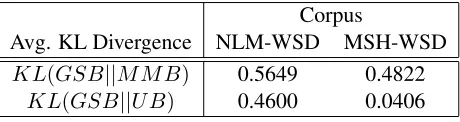
The three techniques for determining the bias de-scribed in Section 3.3 each generate a probability distribution over senses. Table 2 shows the average KL divergence when the gold standard distribution obtained from the manually labeled data (GSB) is compared with the uniform bias (UB) and bias ob-tained by analysing the Medline Baseline Reposi-tory (MMB).
Corpus
Avg. KL Divergence NLM-WSD MSH-WSD
KL(GSB||M M B) 0.5649 0.4822
KL(GSB||U B) 0.4600 0.0406
Table 3: Average KL divergence of sense probability dis-tributions in the NLM-WSD and MSH-WSD data sets.
The average KL divergence scores in the table are roughly similar with the exception of the much lower score obtained for the gold-standard and uni-form bias for the MSH-WSD corpus (0.0406). This is due to the fact that the MSH-WSD corpus was designed to have roughly the same number of ex-amples for each sense, making the sense distribu-tion close to uniform (Jimeno-Yepes et al., 2011). This is evident from the MFS scores for the MSH-WSD corpus which are always close to 50%. This also provides as explanation of why performance us-ing automatically generated examples on the MSH-WSD corpus only improves by a small amount when the gold standard bias is used (see Table 1). The gold standard bias simply does not provide much addi-tional information to the WSD system. The situa-tion is different in the NLM-WSD corpus, where the MFS score is much higher. In this case the additional information available in the gold standard sense dis-tribution is useful for the WSD system and leads to a large improvement in performance.
[image:7.612.334.564.222.283.2]the MSH-WSD corpus, since it contains roughly the same number of examples for each possible sense and does not attempt to represent the relative fre-quency of the different senses. However, it is sur-prising to observe a similar difference for the NLM-WSD corpus, which does not have this constraint. The difference suggests the information about CUIs in the MBR, which is generated automatically, has some limitations.
Table 4 shows a similar analysis for the MSH-WSD corpus when abbreviations and terms are con-sidered separately and supports this analysis. The figures in this table show that the gold standard and uniform distributions are very similar for both ab-breviations and terms, which explains the similar re-sults for UB and GSB in Table 2. However, the gold standard distribution is different from the one ob-tained from the MBR. The drop in performance of MMB compared with GBS in Table 2 is a conse-quence of this.
Ambiguity Type Avg. KL Divergence Abbreviation Term
KL(GSB||M M B) 0.4554 0.4603
KL(GSB||U B) 0.0544 0.0241
Table 4: Average KL divergence for abbreviations and terms in the MSH-WSD data set.
6 Conclusion
This paper describes the development of a large scale WSD system based on automatically labeled examples. We find that these examples can be gener-ated for the majority of CUIs in the UMLS Metathe-saurus. Evaluation on the NLM-WSD and MSH-WSD data sets demonstrates that the MSH-WSD system outperforms the PPR approach without making any use of labeled data.
Three techniques for determining the number of examples to use for training are explored. It is found that a supervised approach (which makes use of manually labeled data) provides the best results. Surprisingly it was also found that using information from the MBR did not improve performance. Anal-ysis showed that the sense distributions extracted from the MBR were different from those observed in the evaluation data, providing an explanation for
this result.
Evaluation showed that accurate information about the bias of training examples is useful for WSD systems and future work will explore other un-supervised ways of obtaining this information. Al-ternative techniques for generating labeled examples will also be explored. In addition, further evaluation of the WSD system will be carried out, such as ap-plying it to an all words task and within applications.
Acknowledgements
This research has been supported by the Engineer-ing and Physical Sciences Research Council and a Google Research Award.
References
E. Agirre and D. Mart´ınez. 2004a. The Basque Country University system: English and Basque tasks. In Rada Mihalcea and Phil Edmonds, editors, Proceedings of Senseval-3, pages 44–48, Barcelona, Spain.
E. Agirre and D. Mart´ınez. 2004b. Unsupervised WSD Based on Automatically Retrieved Examples: The Importance of Bias. InProceedings of EMNLP-04, Barcelona, Spain.
E. Agirre, A. Sora, and M. Stevenson. 2010. Graph-based word sense disambiguation of biomedical docu-ments. Bioinformatics, 26(22):2889–2896.
R. Artstein and M. Poesio. 2008. Inter-Coder Agree-ment for Computational Linguistics. Computational Linguistics, 34(4):555–596.
S. Brin. 1998. Extracting Patterns and relations from the Word-Wide Web. InProceedings of WebDB’98. S. Humphrey, W. Rogers, H. Kilicoglu, D.
Demner-Fushman, and T. Rindflesch. 2006. Word Sense Disambiguation by Selecting the Best Semantic Type Based on Journal Descriptor Indexing: Preliminary ex-periment. Journal of the American Society for Infor-mation Science and Technology, 57(5):96–113. A. Jimeno-Yepes and A. Aronson. 2010.
Knowledge-based biomedical word sense disambiguation: com-parison of approaches. BMC Bioinformatics, 11(1):569.
A. Jimeno-Yepes, B. McInnes, and A. Aronson. 2011. Exploiting MeSH indexing in MEDLINE to generate a data set for word sense disambiguation.BMC Bioin-formatics, 12(1):223.
M. Krallinger and A. Valencia. 2005. Text mining and information retrieval services for molecular biology.
Genome Biology, 6(7):224.
S. Kullback and R. A. Leibler. 1951. On Information and Sufficiency. The Annals of Mathematical Statistics, 22(1):79–86.
C. Leacock, M. Chodorow, and G. Miller. 1998. Us-ing Corpus Statistics and WordNet Relations for Sense Identification. Computational Linguistics, 24(1):147– 165.
G. Leroy and T. Rindflesch. 2005. Effects of Information and Machine Learning algorithms on Word Sense Dis-ambiguation with Small Datasets. International Jour-nal of Medical Informatics, 74(7-8):573–585.
H. Liu, S. Johnson, and C. Friedman. 2002. Au-tomatic Resolution of Ambiguous Terms Based on Machine Learning and Conceptual Relations in the UMLS. Journal of the American Medical Informatics Association, 9(6):621–636.
D. McCarthy, R. Koeling, J. Weeds, and J. Carroll. 2004. Finding Predominant Word Senses in Untagged Text. InProceedings of ACL-2004, pages 280–287, Barcelona, Spain.
B. McInnes, T. Pedersen, and J. Carlis. 2007. Using UMLS Concept Unique Identifiers (CUIs) for Word Sense Disambiguation in the Biomedical Domain. In
Proceedings of the AMIA Symposium, pages 533–537, Chicago, IL.
R. Mooney. 1996. Comparative Experiments on Disam-biguating Word Senses: An Illustration of the Role of Bias in Machine Learning. InProceedings of EMNLP-96, pages 82–91, Philadelphia, PA.
E. W. Noreen. 1989. Computer-Intensive Methods for Testing Hypotheses. John Wiley & Sons.
G. Savova, A. Coden, I. Sominsky, R. Johnson, P. Ogren, C. de Groen, and C. Chute. 2008. Word Sense Disam-biguation across Two Domains: Biomedical Literature and Clinical Notes. Journal of Biomedical Informat-ics, 41(6):1088–1100.
M. Stevenson and Y. Guo. 2010. Disambiguation of Am-biguous Biomedical Terms using Examples Generated from the UMLS Metathesaurus. Journal of Biomedi-cal Informatics, 43(5):762–773.
M. Stevenson, Y. Guo, R. Gaizauskas, and D. Martinez. 2008. Disambiguation of biomedical text using di-verse sources of information. BMC Bioinformatics, 9(Suppl 11):S7.
M. Weeber, J. Mork, and A. Aronson. 2001. Developing a Test Collection for Biomedical Word Sense Disam-biguation. InProceedings of AMIA Symposium, pages 746–50, Washington, DC.
J. Westbrook, E. Coiera, and A. Gosling. 2005. Do On-line Information Retrieval Systems Help Experienced
Clinicians Answer Clinical Questions? Journal of the American Medical Informatics Association, 12:315– 321.
H. Xu, J. Fan, G. Hripcsak, E. Mendonc¸a, Markatou M., and Friedman C. 2007. Gene symbol disambigua-tion using knowledge-based profiles. Bioinformatics, 23(8):1015–22.