
D S Sharma, R Sangal and A K Singh. Proc. of the 13th Intl. Conference on Natural Language Processing, pages 55–64, Varanasi, India. December 2016. c2016 NLP Association of India (NLPAI)
Biomolecular Event Extraction using a Stacked Generalization based
Classifier
Amit Majumder Dept. of MCA Academy Of Technology
West Bengal, India
Asif Ekbal Dept. of CSE IIT Patna, Patna
India
Sudip Kumar Naskar Dept. of CSE Jadavpur University
West Bengal, India
Abstract
In this paper we propose a stacked gener-alization (or stacking) model for event ex-traction in bio-medical text. Event extrac-tion deals with the process of extracting detailed biological phenomenon, which is more challenging compared to the tradi-tional binary relation extraction such as protein-protein interaction. The overall process consists of mainly three steps: event trigger detection, argument extrac-tion by edge detecextrac-tion and finding cor-rect combination of arguments. In stack-ing, we use Linear Support Vector Clas-sification (Linear SVC), Logistic Regres-sion (LR) and Stochastic Gradient Descent (SGD) as base-level learning algorithms. As meta-level learner we use Linear SVC. In edge detection step, we find out the ar-guments of triggers detected in trigger de-tection step using a SVM classifier. To find correct combination of arguments, we use rules generated by studying the prop-erties of bio-molecular event expressions, and form an event expression consisting of event trigger, its class and arguments. The output of trigger detection is fed to edge detection for argument extraction. Experi-ments on benchmark datasets of BioNLP-2011 show the recall, precision and F-score of 48.96%, 66.46% and 56.38%, re-spectively. Comparisons with the existing systems show that our proposed model at-tains state-of-the-art performance.
1 Introduction
Huge amount of electronic bio-medical docu-ments, such as molecular biology reports, ge-nomic papers or patient records are generated
daily. These contents need to be organized in a more principled way so as to enable advanced search and efficient information retrieval and in-formation extraction methods. This can be ben-eficial to the practitioners and researchers in bi-ology, medicine and the other allied disciplines. Success of text mining (TM) is evident from the organization of different shared-task evalu-ation campaigns. The bulk of research in the field of biomedical natural language processing (BioNLP) have mainly focused on the extraction of simple binary relations. Some of the very popular bio-text mining evaluation challenges in-clude TREC Genomics track (Voorhees, 2007), JNLPBA1, LLL (Nedellec, 2005) and BioCreative
(Lynette Hirschman, 2007). While the first two evaluation challenges were concerned with the issues of information retrieval and named-entity recognition (NER), the last two addressed the is-sues of information extraction and seeking rela-tions between bio-molecules. Relarela-tions among biomedical entities (i.e. proteins and genes) must be extracted automatically from a large collec-tion of biomedical datasets since they are very im-portant in understanding biomedical phenomena. Simple binary relations are not itself sufficient for capturing the detailed phenomenon, and there is a growing demand for capturing more detailed and complex relations. Two large corpora, BioInfer (Pyysalo S, 2007) and GENIA (Tomoko Ohta and Tsujii, 2009), have been proposed for this purpose. In recent times there has been a trend for fine-grained information extraction from text (Kim J-D, 2009). This was addressed in three consecutive text mining challenges, BioNLP-2009 (Hyoung-Gyu Lee, 2009), BioNLP-2011 (Jin-Dong Kim, 2011) and BioNLP-2013 (Lishuang Li, 2013). In this paper we propose an effective technique for
1http://www.geniaproject.org/
information extraction (more specifically, event extraction) at more finer level. This is known as event extraction where the focus is to extract events and their different properties that denote detailed biological phenomenon. This can be thought of as a three-steps process,viz.event trig-ger detection, classification of trigtrig-gers into pre-defined categories and argument extraction. The events are classified into 9 potential events, out of which 5 are simple which corresponds togene ex-pression, transcription,protein catabolism, phos-phorylationandlocalization. Among the rest four events, onebindingevent and three regulatory or complex events namelyregulation, positive regu-lationandnegative regulation. For simple events we have a single primary theme, which is usually a protein. But a complex event can include a theme as well as a cause argument. These themes and causes can be either proteins or events. Moreover, number of themes could also vary. In order to ex-plain this, we consider the following sentence as an example, where TRAF2 and CD40 denote pro-teins.
Sentence: In this study we hypothesized that the phosphorylation of TRAF2 inhibits binding to the CD40 cytoplasmic domain.
This sentence contains simple, binding and complex events. Each bio-molecular event expres-sion contains a trigger word and one or more ar-guments. The identified events from the sentence are:
Simple event: The wordphosphorylation is a trigger of typePhosphorylation. Argument of this trigger isTRAF2as theme.
Binding event: The wordbinding is a trigger word ofBindingtype. Arguments of this trigger areTRAF2andCD40.
Complex event: The wordinhibitsis a trigger word ofNegative regulation type. The previously mentioned two events(i.e. Phosphorylation and Binding) arethemetype arguments of this trigger word.
Here, we propose a stack model for event extraction. In stacking, Linear Support Vector Classification (Linear SVC)2, Logistic Regression
(LR)3 and Stochastic Gradient Descent (SGD)4
2http://scikit-learn.org/stable/
modules/generated/sklearn.svm.LinearSVC. html
3http://scikit-learn.org/stable/
modules/generated/sklearn.linear_model. LogisticRegression.html
4http://scikit-learn.org/stable/
from Scikit-learn (sklearn)5 have been used as
base-level learning algorithms. Linear SVC is an implementation of Support Vector Machine using liblinear library6. For meta learning we use Linear
Support Vector Classification. The system is eval-uated based on the framework of BioNLP 2011 shared task7.
Event extraction systems find both triggers and their associated arguments. These could pose a number of challenges. Exact interpretation of trig-gers depend upon the context, e.g. expression of [gene] is an event of type Gene Expression, but ex-pression of [mRNA] is of type Transcription. So there is ambiguity in sense of trigger words. It is a challenge to fix these ambiguities. Event argu-ments can be difficult to detect in case of binding and regulatory type of arguments, because in these cases, number of arguments is not fixed. Number of arguments in binding events can be one or more. Finding correct combination of arguments is very challenging. More precisely, we use the annotated data collected for these tasks and report the results returned by the evaluation servers on the test sets of the 2011 GE task. From the experiment it has been seen that evaluation on test data shows 2-3% less in performance than the performance on de-velopment data. So it is challenge to increase the performance on test data. Coreference resolution is required for the correct interpretation of certain event arguments. For example, in the sentence M-CSF treatment was also associated with a rapid induction of the jun-B gene, although expression of this gene was prolonged compared to that of c-jun. In this example, the word this gene refers jun-B and the word that refers expression. There are two gene expression events in the sentence. Ar-guments of these events can be identified correctly if coreference resolution method is applied on the dataset and it is a challenging issue.
2 Few Existing Methods for Combining Classifiers
In our day to day life, when crucial decisions are made in a meeting, a voting among the mem-bers present in the meeting is conducted when the opinions of the members conflict with each other.
modules/generated/sklearn.linear_model. SGDClassifier.html
5http://scikit-learn.org/stable/
6https://www.csie.ntu.edu.tw/˜cjlin/
liblinear/
7http://2011.bionlp-st.org/
This principle of ”voting is very popular in data mining and machine learning. In voting, when classifiers are combined, the class assigned to a test instance will be the one suggested by most of the base level classifiers involved in the en-semble process. Bagging (Breiman, 1996) and boosting (SCHAPIRE, 1990) are the widely used variants of voting schemes. Bagging is a voting scheme in which n models, usually of same type, are constructed. For an unknown instance, each models predictions are recorded. Finally, that par-ticular class is assigned which has the maximum votes among the predictions from models. Boost-ing is very similar to baggBoost-ing in which only the model construction phase differs. Here the in-stances which are often misclassified are allowed to participate in training more number of times. There will be n classifiers which themselves will have individual weights for their accuracies. Fi-nally, the class is assigned which is having the maximum weight.
The classifiers can be combined using two popular approaches, viz. majority voting and weighted voting. In majority voting, we se-lect the class that receives maximum votes. In weighted voting, classifiers are combined based on the strengths and weaknesses of classifiers.
Stacked generalization or stacking is a method for combining multiple classifiers. The idea of stacked generalization (Wolpert, 1992; Geor-gios Sigletos, 2005) is to learn a meta-level (or level-1) classifier based on the output of base-level (or level-0) classifiers, estimated as follows: Define D as a training data set consisting of fea-ture vectors, also referred to as level-0 data, and L1...LNas a set of N different learning algorithms.
During the K-fold cross-validation process, D is randomly split into K disjoint parts D1...DK of almost equal sizes. At each j-th fold, j =1..K , theL1...LN learning algorithms are applied to the training part D-Dj (i.e. part of training data ex-cludingDj, where D is the whole training data and
Djis the current test part for cross-validation) and the induced classifiersC1(j)...CN(j) are applied to the test partDj. The concatenated predictions of
the induced classifiers on each feature vectorxiin
Dj, together with the original class valueyi(xi),
form a new setM Djof meta-level vectors.
At the end of the entire cross-validation process, MD=KS
j=1
M Djconstitutes the full meta-level data
set, also referred to as level-1 data, which is used for applying a learning algorithm LM and
induc-ing the meta-level classifierCM . The learning al-gorithmLM that is employed at meta-level could be one of theL1 ...LN or a different one. Finally,
theL1...LN learning algorithms are applied to the entire data set D inducing the final base-level clas-sifiersC1...CN to be used at runtime. In order to
classify a new instance, the concatenated predic-tions of all base-level classifiers C1...CN form a meta-level vector that is assigned a class value by the meta-level classifierCM.
3 Proposed Approach
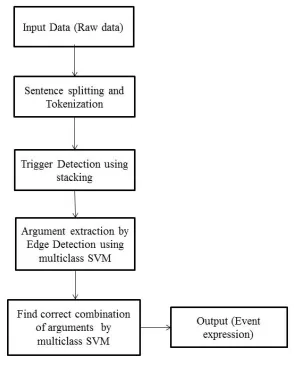
In this section we describe our proposed approach for event extraction. The steps to extract event ex-pression are sentence splitting, tokenization, trig-ger detection, argument extraction by edge detec-tion and finding correct combinadetec-tion of arguments as shown in figure 1. In sentence splitting and tok-enization steps we use sentence split and tokenised data which was made available as the supportive resources in BioNLP-2011 shared task8. We use
[image:3.612.363.510.406.590.2]SVM to extract arguments and its correct combi-nations.
Figure 1: Steps to extract event expression
Our method is based on the principle of stack-ing. We generate 10 classifiers for each of the al-gorithms (i.e. Linear SVC, SGD and LR) men-tioned above. We describe the algorithms in the subsequent sections.
8http://weaver.nlplab.org/˜bionlp-st/
BioNLP-ST/downloads/support-downloads. html#parse-formats
3.1 Linear Support Vector Classification (Linear SVC)
Linear SVC is learning algorithm for classifica-tion. Using Linear SVC algorithm, we generate 10 classifiers by varying C parameter of the algo-rithm. The C parameter is a parameter for opti-mization that specifies the learning algorithm how much it wantS to avoid misclassifying each train-ing example. Starttrain-ing C value (here, 0.001) is cho-sen by running the algorithm using C values as 1000, 100, 1, 0.1, 0.001, 0.00001, and choose final value based on the highest accuracy obtained.
CiSV C = 0.001 +i×0.05 (1)
where CiSV C represents C parameter for SV Ci
classifier.
3.2 Stochastic Gradient Descent (SGD) We generate 10 classifiers by varying the alpha parameters of SGD algorithm. The parameter al-phais Constant that multiplies the regularization term used in the implementation of the algorithm. These 10 classifiers areSGDi, for i=0 to 9. The
value ofalphais set to 0.000029 based on the dif-ferent experiments executed.
alphaSGDi = 0.000029 +i×0.000015 (2)
wherealphaSGDi represents alpha parameter for SGDiclassifier.
3.3 Logistic Regression (LR)
We generate 10 classifiers by varying the C param-eter of LR algorithm. These classifiers areLRi,
for i=0 to 9. The value of C is set to 7.2101 which is chosen by running the algorithm with different C values.
CiLR = 7.2101 +i×0.05 (3)
whereCLR
i represents C parameter for LRi
clas-sifier.
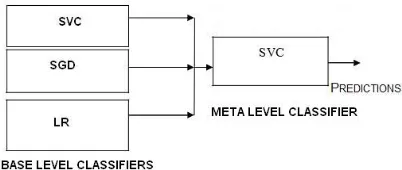
[image:4.612.327.528.41.126.2]The architecture of our proposed stacked method is shown in Fig 2 where SVC, SGD and LR have been used as base level classifiers. Here, SVC is used as meta-level classifier.
Figure 2: Model ensemble using stacking
4 Features
In this section we describe the features that we use for developing the models. To explain the fea-tures, let us consider the following example sen-tence: “BMP-6 inhibits growth of mature human B cells; induction of Smad phosphorylation and upregulation of Id1”. The sentence is tokenised and features are extracted for every token. We use token“upregulation”in the above example to ex-plain the features.
4.1 Features for trigger detection and classification
Here, we describe the set of features that we use for event trigger detection and classification.
1. Surface Word, Stem, PoS, Chunk and Named Entity: We use surface forms, lemma, Part-of-Speech (PoS), chunk and named entity (NE) as features for trigger de-tection and classification. These information were extracted from the GENIA tagger9. For
the token “upregulation”, the feature values extracted areupregulation, upregulate, NN, I-NP and Ofor the surface form, lemma, PoS, Chunk and NE features, respectively. All these information are very critical to identify the trigger and its class.
2. Bag-of-Words: The bag-of-word (BoW) feature plays a crucial role in many text min-ing tasks. This particular feature is defined in different ways. At first we extract BoWs within the context of sizes 3 and 5 (i.e., ±1 and±2). We also extract NEs from this con-text, and use their counts as features. Entire sentence is then considered as a context and BoWs and NE features are extracted. For
9http://www.nactem.ac.uk/GENIA/tagger/
example, BoW feature for the token “up-regulation” are “and upregulation of” and “phosphorylation and upregulation of Id1” for window sizes 3 and 5, respectively.
3. Linear Features: Linear features are gen-erated by marking token with a tag that de-notes their relative positions in the linear or-der. This feature is defined with respect to a context window. Ifiis a position (i.e. index) of the token under consideration, then the lin-ear features are calculated from the words with indicesi-3toi+3. In our experiment we use the word along with its PoS tag to gener-ate linear features.
4. upper case start, upper case middle, has digits, has hyphen: These features are defined based on the orthographic con-structions: whether the token starts with an uppercase character, or it has any uppercase character in the middle, or has any digit(s) or hyphen inside it.. These features are important from the observations that there are some trigger words in the dataset which start with uppercase character or hyphen inside it. For example, in the sentence TGF-beta mediates RUNX induction and FOXP3 is efficiently up-regulated by RUNX1 and RUNX3 in human CD4+ T cells., the word up-regulated is Positive regulation type rvent trigger which has hyphen inside it.
5. Bi-gram and Tri-gram Features: We use the character bi-gram and tri-gram sequences extracted from a token as features. For ex-ample, for the token “upregulation”, the bi-gram features will be up pr re eg gu ul la at ti io onand tri-gram features will beupr pre reg egu gul ula lat ati tio ion.
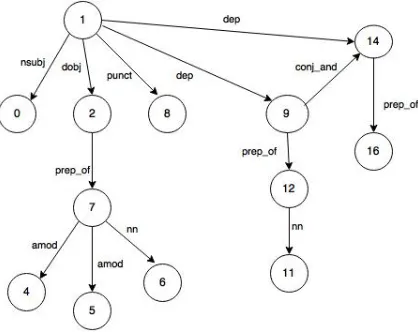
6. Dependency Path Features: There are are some trigger words which ca not be detected using context features or b-gram or tri-gram features. So we depend on dependency rela-tions inside sentence. Dependency features are extracted from dependency graph gener-ated by dependency parser(David McClosky and Manning, 2011; David McClosky and Johnson, 2006) . Figure 3 shows the de-pendency graph for the sentence“BMP-6 hibits growth of mature human B cells; in-duction of Smad phosphorylation and
[image:5.612.320.529.198.364.2]upreg-ulation of Id1”, generated by the Charniak-McCloskey parser (David McClosky and Johnson, 2006). In the graph, an edge label represents the dependency relation between two nodes. Each node in the graph is labelled by a number which represents a word appear-ing in that position (0-based index) of the sen-tence. For example, node labelled with num-ber 0 indicates the wordBMP-6and node la-belled with number 1 indicates the word in-hibits.
Figure 3: Dependency graph for the example sen-tence“BMP-6 inhibits growth of mature human B cells; induction of Smad phosphorylation and up-regulation of Id1”
.
In the graph, node 0 and 16 represent pro-teins (i.e. NE) as specified in the training dataset. In the feature value NE is denoted by NAMED ENT.
Edges in a dependency graph are directed arcs. Each edge connects two nodes. Nodes represent words along with other information like PoS tags of the words. A node can be connected to two types of edges: one is in-type (or incoming) edges which are incident on the node and the other type is out-type (or outgoing) edges which emanate from the node.
Features for in-type edges:
node numbered 14.
(a) Edge type (i.e. dependency relation) – dep
(b) PoS of source node –VBZ
(c) Edge type combined with PoS – dep VBZ
(d) Text of the source node –inhibits (e) Edge type merged with PoS and token
of source node –dep VBZ inhibits (f) Stem of the source node –inhibit (g) Edge type combined with stem of the
source node –dep inhibit
(h) Stem of the current word combined with edge-type and stem of the source node – upregul dep inhibit
Features for out-type edges:
For out-type edges emanating from the target word, in addition to the target word feature we also take into consideration the features belonging to the edge (i.e. the dependency relation) and the destination node on which the edge is incident.
The list of features considered for out-type edges are listed below. For illustration, we consider node 14 (upregulation) as the target node and the corresponding feature values are shown next to the out-type edge features for the out-type edge emanating from node 14 (upregulation) and incident on node 16 (Id1).
(a) Edge type – prep of
(b) PoS of destination node – NN
(c) Edge-type combined with PoS of desti-nation node – prep of NN
(d) Text of the destination node – NAMED ENT
(e) Edge-type combined with the to-ken text of the destination node – prep of NAMED ENT
(f) Stem of the current word
com-bined with the edge-type and
stem of the destination node – up-regul prep of NAMED ENT
7. Dependency chain: These features are syn-tactic dependencies up to a certain depth limit, starting from a token of interest. In our case we consider the depth of limit three. They are used to define the immediate con-text of these words.
4.2 Features for argument extraction by edge detection
To find out features for argument extraction, for every sentence, we form a dependency graph con-sisting of the triggers detected in trigger detection step and proteins mentioned in the data set for that sentence. Following features are extracted for ar-gument extraction.
1. Token features: These are features of two tokens connected by an edge. A token can potentially be a protein (i.e NE) or a trig-ger word detected during the trigtrig-ger detection phase. The token features are surface word, stem, PoS, chunk and NE, BoW, prefix and suffix, linear features, bi-gram and tri-gram features. These have been discussed in de-tails in Section 4.1.
2. Dependency Features: Dependency fea-tures play important role to extract arguments of triggers. The following dependency fea-tures are extracted from dependency graph.
Single element feature: A path in depen-dency graph has a starting token, ending to-ken and some intermediate toto-kens. Toto-ken can be considered as a node in the graph. A path consists of a sequence of edges starting from the initial node, followed by a set of interme-diate nodes, and ending in a terminal node.
(a) For each pair of adjacent tokens, all the dependency relations are considered. (b) Lexical features of all the internal tokens
in the path are also considered. These are surface word, stems, PoS, chunk, NE, BoW, prefix, suffix, linear features, bi-gram and tri-gram features.
(c) Dependency features that we use are mentioned in Section 4.1.
N-gram feature: We compute the shortest path from starting to the end token in the de-pendency graph in figure-3. From this walk we compute bi-grams from all the combina-tions of two consecutive edges. In the same way, we compute n-grams (n=3,4) by con-sidering three and four consecutive edges, re-spectively.
5 Experimental Results and Analysis
We perform experiments on BioNLP-11 Genia event dataset10. Statistics of BioNLP-11 dataset
for genia event extraction has been mentioned in table 1.
Attributes Training Development Test
Abstracts+Full articles 908 (5) 259 (5) 347 (5)
Sentences 8,759 2,954 3,437
Proteins 11,625 4,690 5,301
Total events 10,287 3,243 4,457
Table 1: Statistics of BioNLP-ST 2011 Genia Event dataset (training, development and test). Value inside parentheses indicates the number of full articles
The overall algorithm comprises of three basic steps: trigger detection, edge detection and argu-ment extraction. Trigger detection is performed using the stacked generalization method. Experi-mental results are shown in Table 2. From the
ex-Base/Meta classifier Classifiers Recall Precision F-score
Base level classifiers
[image:7.612.80.300.328.650.2]SVC0 48.22 84.81 61.48 SVC1 74.42 67.58 70.84 SVC2 65.82 76.61 70.81 SVC3 71.46 70.42 70.94 SVC4 66.07 75.49 70.46 SVC5 70.25 71.20 70.72 SVC6 66.13 74.92 70.25 SVC7 69.57 71.81 70.67 SVC8 66.04 74.54 70.03 SVC9 68.89 72.08 70.45 LR0 64.69 76.08 69.92 LR1 64.95 76.28 70.16 LR2 65.22 76.37 70.36 LR3 65.91 76.46 70.80 LR4 65.72 77.33 71.05 LR5 65.91 77.43 71.21 LR6 65.16 78.67 71.28 LR7 66.13 78.10 71.62 LR8 65.47 78.57 71.43 LR9 64.97 79.66 71.57 SGD0 71.43 71.35 71.39 SGD1 71.38 71.34 71.36 SGD2 71.43 71.33 71.38 SGD3 71.34 71.36 71.35 SGD4 71.39 71.38 71.38 SGD5 71.42 71.39 71.41 SGD6 71.38 71.38 71.38 SGD7 71.41 71.36 71.38 SGD8 71.38 71.42 71.40 SGD9 71.38 71.37 71.37 Meta level classifier SVC 69.13 74.96 71.93
Table 2: Stacked generalization result in trigger detection
perimental results of stacking mentioned in table 2, it is evident that performances of LR and SGD
10http://2011.bionlp-st.org/
algorithms are better than Linear SVC. SGD clas-sifier is an implementation of SVM with stochastic gradient descent (SGD) learning, whereas Linear SVC is an implementation of SVM using liblinear library. Linear SVC shows low performance, but it is very fast. We recorded the results for each class label (though, not shown in table) and we see that linear SVC generates best result for Tran-scriptionandRegulationtype triggers. LR classi-fier shows best result, but it takes more time than the other two algorithms. This happens due to the fact that each of these classifiers have their own default parameter settings in sklearn tool. We have tuned C parameter in SGD and Linear SVC. In SGD classifier, we tunealphaparameter. Among all the base-level classifiers, classifier LR7 using Logistic Regression algorithm provides best re-sult (F-score=71.62). Rere-sults show that stacked model achieves better performance compared to the best base-level classifier. Output of trigger de-tection is fed to the input of edge dede-tection step. In this step we use multi-class SVM11as a
classi-fication algorithm to find out themeand/or cause relationships between triggers and proteins. Af-ter finding the relationships we generate the event expression. In Table 3 and Table 4, we show the results of experiments on BioNLP-11 shared task dataset on development and test set, respec-tively. We achieve satisfactory F-score of 80.04% on development dataset and 78.15% on test dataset forGene expression type event. System also per-forms well forprotein catebolismevent with an F-score of 91.30% on the development set. Results of phosphorylation event is also satisfactory for the test and development datasets (around 84% F-score). The system suffers most for the relatively complex regulatory events where it shows around 42% to 51% F-score.
Event Class gold (match) answer (match) recall precision fscore
[image:7.612.82.298.329.644.2]Gene expression 749 ( 582 ) 704 ( 581 ) 77.70 82.53 80.04 Transcription 158 ( 79 ) 93 ( 79 ) 50.00 84.95 62.95 Protein catabolism 23 ( 21 ) 23 ( 21 ) 91.30 91.30 91.30 Phosphorylation 111 ( 94 ) 111 ( 94 ) 84.68 84.68 84.68 Localization 67 ( 49 ) 58 ( 49 ) 73.13 84.48 78.40 =[SVT-TOTAL]= 1108 ( 825 ) 989 ( 824 ) 74.46 83.32 78.64 Binding 373 ( 171 ) 311 ( 171 ) 45.84 54.98 50.00 ==[EVT-TOTAL]== 1481 ( 996 ) 1300 ( 995 ) 67.25 76.54 71.60 Regulation 292 ( 104 ) 182 ( 104 ) 35.62 57.14 43.88 Positive regulation 999 ( 376 ) 667 ( 376 ) 37.64 56.37 45.14 Negative regulation 471 ( 168 ) 264 ( 168 ) 35.67 63.64 45.71 ==[REG-TOTAL]== 1762 ( 648 ) 1113 ( 648 ) 36.78 58.22 45.08 ==[ALL-TOTAL]== 3243 ( 1644 ) 2413 ( 1643 ) 50.69 68.09 58.12
Table 3: Result on development data [Approxi-mate Span/Approxi[Approxi-mate Recursive]
11https://www.cs.cornell.edu/people/tj/
[image:7.612.318.535.563.673.2]Event Class gold (match) answer (match) recall precision fscore
Gene expression 1002 ( 728 ) 861 ( 728 ) 72.65 84.55 78.15 Transcription 174 ( 87 ) 123 ( 87 ) 50.00 70.73 58.59 Protein catabolism 15 ( 7 ) 9 ( 7 ) 46.67 77.78 58.33 Phosphorylation 185 ( 154 ) 184 ( 154 ) 83.24 83.70 83.47 Localization 191 ( 99 ) 116 ( 99 ) 51.83 85.34 64.50 =[SVT-TOTAL]= 1567 ( 1075 ) 1293 ( 1075 ) 68.60 83.14 75.17 Binding 491 ( 234 ) 408 ( 234 ) 47.66 57.35 52.06 ==[EVT-TOTAL]== 2058 ( 1309 ) 1701 ( 1309 ) 63.61 76.95 69.65 Regulation 385 ( 120 ) 221 ( 120 ) 31.17 54.30 39.60 Positive regulation 1443 ( 549 ) 980 ( 549 ) 38.05 56.02 45.32 Negative regulation 571 ( 204 ) 381 ( 204 ) 35.73 53.54 42.86 ==[REG-TOTAL]== 2399 ( 873 ) 1582 ( 873 ) 36.39 55.18 43.86 ==[ALL-TOTAL]== 4457 ( 2182 ) 3283 ( 2182 ) 48.96 66.46 56.38
Table 4: Results on test data [Approximate Span/Approximate Recursive]
5.1 Effectiveness of features
Finding importance of individual feature (e.g. root words, n-gram features, linear features etc.) used in our experiment is not an easy task. Transfor-mation of textual features into numeric features generates a lot of features. For example, in trig-ger detection step we use 38 features, but when these are converted to numerical data for machine learning purpose, number of features increases to 5 lakhs. Finding the most relevant set of features from this collection is a complex problem. We keep a record of how the original 38 features (rep-resented in text format) are mapped in higher di-mensional space containing more than 5 lakh of features. For example, if we use 0-based index for feature, then in trigger detection 0-th feature (from the 38 original features) is mapped to fea-ture indices in the range of 0 to 11,036 and 1-st feature (from 38 original features) is mapped to feature indices in the range of 11,037 to 20,080 in higher dimensional space and so on. Using Linear SVC classifier we select some of the top features which are mapped to the original fea-tures. We observe that the features for outgoing edges from the dependency graph are most impor-tant forGene expression, Transcription, Localiza-tion, Phosphorylation and Bindingtype event trig-gers. ForPositive regulation,Negative regulation and Regulation type event triggers, the most im-portant feature is the dependency chain features.
5.2 Comparison with existing systems
For bio-molecular event extraction, the state-of-the-art system is TEES (Bj¨orne, 2014), which ranked first place in BioNLP-ST-200912. Along
with this we also compare our proposed system with the other existing systems, which participated
12http://www.nactem.ac.uk/tsujii/GENIA/
SharedTask/
in BioNLP-2011 shared task (Jin-Dong Kim, 2011) . Our experimental results show recall, precision and F-score values of 50.69%, 68.09% and 58.12%, respectively on development dataset, whereas official result attained by TEES (Bj¨orne, 2014) is 52.45%, 60.05% and 55.99% respec-tively. As compared to the official scores of TEES on the test set (recall: 49.56%, precision: 57.65% and F-score: 53.30%), our system achieves recall, precision and F-score values of 48.96%, 66.46% and 56.38%, respectively. Hence, our system per-forms better with more than 3 points. While we compare our proposed model with the systems presented in BioNLP-2011 (Jin-Dong Kim, 2011), it shows that we achieve performance very close to the best performing system, FAUST (Sebas-tian Riedela and Manning, 2011)(recall:49.41%, precision: 64.75% and F-score:56.04%) and better than the second ranked system, UMass, (McCal-lum, 2011) (recall:48.49%, precision:64.08% and F-score:55.20% ). A recently developed system named as EventMine (Makoto Miwa and Anani-adou, 2013), which made use of coreference res-olution obtains significant improvement with re-call, precision and F-score of 51.25%, 64.92% and 57.28%, respectively. The performance in our model is very close to system, EventMine (Makoto Miwa and Ananiadou, 2013).
5.3 Error Analysis
[image:8.612.82.298.38.145.2]trigger word of types Gene expression and Posi-tive regulation both.
In argument extraction step, arguments of the triggers detected in trigger detection and classifi-cation step are identified. Relation between a trig-ger word and its argument is also found out in this step. Possible arguments are proteins and/or event trigger words. Possible relations aretheme andcause. From a closer analysis we see that our system performs satisfactorily in detectingtheme argument, but for detectingcauseargument clas-sifier is not very robust. This may be due to the fact that a cause expression could be both a pro-tein (or, NE) or an event trigger expression. The system suffers most for the regulatory events as the errors might have propagated from the earlier step, i.e. trigger detection and classification step. For example trigger wordphosphorylationin one example sentence is originally athemeargument of a regulatory event, but our system is unable to detect the trigger wordphosphorylationas an ar-gument of that regulatory event.
6 Conclusion and Future Works
In this paper we propose a stacking approach for event extraction. The idea of stacking is to per-form cross-validation on the training data set using some learning algorithms in order to create a meta-level data set. Meta-meta-level dataset is formed using predictions generated by the learning algorithms along with the actual output class. In edge detec-tion step, we find out arguments of the triggers de-tected in trigger detection step using SVM algo-rithm. To find correct combination of arguments we use rules of bio-molecular events and form an event expression consisting of event trigger, its class and arguments. Experiments on BioNLP-2011 datasets show the efficacy of our proposed model with significant performance improvement over the state-of-the-art systems. This improve-ment is due to application of stacking aproach along with efficient features. In future we would like to study whether coreference resolution could improve the performance of the system.
References
Jari Bj¨orne. 2014. Biomedical Event Extraction with Machine Learning. Ph.D. thesis, University of Turku.
L Breiman. 1996. Bagging predictors. InMachine Learning, pages 123–140.
Eugene Charniak David McClosky and Mark Johnson. 2006. Effective self-training for parsing. In Pro-ceedings of the Human Language Technology Con-ference of the North American Chapter of the ACL, pages 152–159. New York.
Mihai Surdeanu David McClosky and Christopher D. Manning. 2011. Event extraction as dependency parsing for bionlp 2011. InProceedings of BioNLP Shared Task 2011 Workshop, pages 41–45. June.
Constantine D. Spyropoulos Georgios Sigletos. 2005. Combining information extraction systems using voting and stacked generalization. InJournal of Ma-chine Learning Research, volume 6, pages 1751– 1782.
Min-Jeong Kim Joo-Young Lee Gumwon Hong Hae-Chang Rim Hyoung-Gyu Lee, Han-Cheol Cho. 2009. A multi-phase approach to biomedical event extraction. in bionlp 09. InProceedings of the Work-shop on BioNLP, pages 107–110.
Tomoko Ohta-Robert Bossy Ngan Nguyen Ju-nichi Tsujii Jin-Dong Kim, Sampo Pyysalo. 2011. Overview of bionlp shared task 2011. In Proceed-ings of BioNLP Shared Task 2011 Workshop, pages 1–6. June.
Pyysalo S-Kano Y Tsujii J Kim J-D, Ohta T. 2009. Overview of bionlp09 shared task on event extrac-tion. InBioNLP 09: Proceedings of the Workshop on BioNLP, pages 1–9.
Degen Huang Lishuang Li, Yiwen Wang. 2013. Im-proving feature-based biomedical event extraction system by integrating argument information. In Pro-ceedings of the BioNLP Shared Task 2013 Work-shop, pages 109–115. August.
Alfonso Valencia Lynette Hirschman, Mar-tin Krallinger. 2007. Proceedings of the sec-ond biocreative challenge evaluation workshop. In CNIO Centro Nacional de Investigaciones Oncologicas.
Tomoko Ohta Makoto Miwa, Sampo Pyysalo and Sophia Ananiadou. 2013. Wide coverage biomedi-cal event extraction using multiple partially overlap-ping corpora. InBMC Bioinformatics.
Sebastian Riedel Andrew McCallum. 2011. Robust biomedical event extraction with dual decomposi-tion and minimal domain adaptadecomposi-tion. In Proceed-ings of BioNLP Shared Task 2011 Workshop, pages 46–50.
Claire Nedellec. 2005. Learning language in logic -genic interaction extraction challenge. In Proceed-ings of the 4th Learning Language in Logic Work-shop (LLL05), pages 31–37.
Heimonen J Bjorne J Boberg J Jarvinen J Salakoski T Pyysalo S, Ginter F. 2007. A corpus for informa-tion extracinforma-tion in the biomedical domain. InBMC Bioinformatics, pages 8–50.
ROBERT E. SCHAPIRE. 1990. The strength of weak learnability. InMachine Learning, pages 197–227.
Mihai Surdeanub Andrew McCalluma Sebas-tian Riedela, David McCloskyb and Christopher D. Manning. 2011. Model combination for event ex-traction in bionlp 2011. InProceedings of BioNLP Shared Task 2011 Workshop, pages 51–55.
Sampo Pyysalo Tomoko Ohta, Jin-Dong Kim and Ju-nichi Tsujii. 2009. Incorporating genetag-style an-notation to genia corpus. In Proceedings of Natu-ral Language Processing in Biomedicine (BioNLP), pages 1–9.
Ellen Voorhees. 2007. Overview of trec 2007. In Six-teenth Text REtrieval Conference (TREC 2007) Pro-ceedings, pages 1–16. Gaithersburg,Maryland,USA.
D. Wolpert. 1992. Stacked generalization. InNeural Networks, pages 241–260.
![Table 3: Result on development data [Approxi-mate Span/Approximate Recursive]](https://thumb-us.123doks.com/thumbv2/123dok_us/1489650.689109/7.612.82.298.329.644/table-result-development-data-approxi-span-approximate-recursive.webp)
![Table 4:Results on test data [ApproximateSpan/Approximate Recursive]](https://thumb-us.123doks.com/thumbv2/123dok_us/1489650.689109/8.612.82.298.38.145/table-results-on-test-data-approximatespan-approximate-recursive.webp)
