A Word-Embedding-based Sense Index for Regular Polysemy
Representation
Marco Del Tredici
Universitat Pompeu Fabra Roc Boronat, 138
Barcelona, Spain
N´uria Bel
Universitat Pompeu Fabra Roc Boronat, 138
Barcelona, Spain [email protected]
Abstract
We present a method for the detection and representation of polysemous nouns, a phe-nomenon that has received little attention in NLP. The method is based on the exploita-tion of the semantic informaexploita-tion preserved in Word Embeddings. We first prove that poly-semous nouns instantiating a particular sense alternation form a separate class when cluster-ing nouns in a lexicon. Such a class, however, does not include those polysemes in which a sense is strongly predominant. We address this problem and present a sense index that, for a given pair of lexical classes, defines the degree of membership of a noun to each class: polysemy is hence implicitly represented as an intermediate value on the continuum between two classes. We finally show that by exploit-ing the information provided by the sense in-dex it is possible to accurately detect polyse-mous nouns in the dataset.
1 Introduction
A major issue in lexical semantics is regular polysemy (also known as systematic or logical
polysemy), the phenomenon whereby words be-longing to a semantic class can predictably act as members of another class (Pustejovsky, 1991; Mart´ınez Alonso et al., 2013). For example, the word chicken can be considered a member of the class ANIMAL but also of FOOD, thus defining its senses in terms of lexical semantic classes. For some polysemous nouns one sense can be much more fre-quent than the other, thus causing asymmetry in sense predominance; this is the case of turkey, in
which the food sense is clearly more frequent than the animal one (Copestake and Briscoe, 1995).
Given its pervasiveness in natural language, reg-ular polysemy has been extensively investigated in lexical semantics (Apresjan, 1974; Nunberg, 1992). However, only few works attempted to computa-tionally model this phenomenon (Copestake, 2013; Boleda et al., 2012b). The vast majority of applica-tions treat regular polysemy like other phenomena of lexical ambiguity, such as homography, not con-sidering the relevant theoretical differences between those phenomena, for example that regular poly-semy is predictable, while homography is not (Utt and Pad´o, 2011). Information on regular polysemy would be valuable for a task like Word Sense Dis-ambiguation, since it would reduce the number of possible options when choosing the right sense of a word. More generally, every lexical resource would benefit from the capability to cope with the shifts of meaning produced by regular polysemy, and this, in turn, would lead to improvements in several NLP applications as such machine translation, textual en-tailment or text analytics.
In this paper we present a method for polysemy detection and representation based on Word Embed-dings (WE) (Mikolov et al., 2013a). WE are low dimensional, dense and real-valued vectors which preserve word syntactic and semantic information in a Vector Space Model (VSM). WE have recently been proved to be efficient in several NLP tasks, such as detection of relational similarity (Mikolov et al., 2013d), word similarity tasks (Mikolov et al., 2013a) and automatic building of bilingual lex-ica (Mikolov et al., 2013b), in which this word
sentations outperformed others with state-of-the-art methods (Baroni et al., 2014).
However, at the best of our knowledge, this is the first work in which WE are used to represent and ac-count for regular polysemy. Our work departs from the assumption that lexical classes related by regu-lar polysemy are limited and known and that since the class-related senses of a polysemous nouns can be considered as modulations of meaning of a sin-gle lemma (Copestake and Briscoe, 1995), they are to be represented by a single vector. As a first step, we will prove through a clustering task that nouns instantiating a particular sense alternation (e.g. an-imal/food) group together and separately from non-polysemous nouns, forming a distinct cluster. Such a cluster, however, does not include polysemous nouns with a strong sense asymmetry. Therefore, obtained clustering information is exploited in or-der to assign each noun asense index, which can be thought as the value associated to a noun on a contin-uum, whose ends are lexical classes, and where pol-ysemy is implicitly represented as an intermediate value between two classes. Such an index allows to represent sense modulation of disemous nouns (i.e. polysemes with two senses) and to account for the predominance of one the senses, if any, and there-fore to accurately detect polysemes.
The main contribution of the work is a novel method for the identification and representation of polysemous nouns, which accounts for the semantic of such nouns and explicitly represents it.
2 Motivation and Related Works
In the field of NLP the information regarding lexical semantic classes has been proved to be crucial for several applications, such as information extraction, machine translation and question answering, and an increasing amount of research has been carried out in order to create models for the automatic classi-fication of nouns (Romeo et al., 2014a; Bel et al., 2013; Schwartz et al., 2014).
Despite the effects of regular polysemy on lexi-cal classification, few work attempted to computa-tionally model the phenomenon. The approaches in the literature for the representation of polyse-mous words are basically three. Polysemes can be simultaneously represented as members of several
classes (e.g. the polysemous word xy belongs to both the classesX andY); as members of new, in-dependent class which includes only words with the same hybrid distributional behaviour (xybelongs to the new class XY); on a continuum, thus assign-ing each word a polysemy index between 0 and 1. Boleda et al. (2012a) present an in-depth study on adjective categorization with a special focus on pol-ysemy, in which they conclude that multiple attribu-tion is the best way to model polysemy. Boleda et al. (2012b) present a model to determine whether a noun matches a given sense alternation, while Romeo et al. (2013) introduce a supervised model for polysemy detection and conclude that since pol-ysemes demonstrate lexico-syntactic traits of multi-ple classes, they can be considered as members of such classes. Romeo et al. (2014b) improve the pre-vious approach reaching an accuracy of 60.71% in a polysemous noun classification task.
As pointed out by Boleda et al. (2012a) both the first two approaches are not completely satisfac-tory: the multi-labelling approach fails to represent the differences between polysemous and monose-mous nouns in a class, while the second one does not account for the significant similarities between a polyseme and monosemous nouns belonging to the same classes of its senses. Furthermore, none of the two approaches can provide an adequate represen-tation of the asymmetry of senses in a polysemous word.
The third approach has been explored by Utt and Pad´o (2011): they introduce apolysemy indexbased on the systematicity of sense variation of polyse-mous nouns to distinguish between polysemy and homonymy. Building on the same methodology, Frontini et al. (2014) define a threshold based on known basic type alternations, and use such a thresh-old to calculate the polysemy of new words. Finally, Mart´ınez (2013) proposes an index that ranges from literal to metonymic, and that is used to account for the underspecified sense of polysemes.
fi-nally, Frontini et al. (2014) investigate the system-atic aspect of the phenomenon, focusing on the de-tection of new basic sense alternations not consid-ered in literature. Differently, in our work we aim to provide a single representation for each polysemous noun that explicitly accounts for its degree of mem-bership to the basic lexical classes its senses belong to, thus highlighting the differences in distributional behaviour of different polysemes and addressing the problem of sense asymmetry.
3 Polysemy Detection
We present in this section a method for the iden-tification of polysemous nouns. Firstly, a clus-tering algorithm was employed in order to verify that the semantic information preserved in WE was enough to separate nouns belonging to different lex-ical classes. Given a gold standard composed ofL
lexical classes and a set of nouns N={n1,n2,...ni}
distributed across these classes, WE representing the nouns in N were clustered in a number L of clus-ters. As a result of this first task, the clusters were expected to largely correspond to the classes in the gold standard.
Once the reliability of the semantic information in WE was proved, a second clustering task was performed to assess the following hypothesis: since polysemous nouns show distributional patterns that are different from non-polysemous nouns, WE rep-resenting polysemes are different from the others, and this difference can be captured by means of a clustering algorithm. This hypothesis was verified by clustering the WE of nouns in N in L+1 clus-ters: as a result, L clusters of monosemous nouns and one cluster composed of polysemes instantiat-ing a specific alternation were expected. Note that the fact that just one class of polysemous nouns was expected only depended on the fact that all the cases of polysemy in the dataset instantiated a single sense alternation (animal/food).
3.1 Word Embeddings
WE of size 200 were trained using the word2vec toolkit1 with the CBOW architecture, which has
been proved computationally efficient for large datasets (Mikolov et al., 2013b; Baroni et al., 2014).
1https://code.google.com/p/word2vec/
Given the results of some preliminary studies, three relevant choices were made in the training phase. Firstly, WE were trained on a parsed version of the British National Corpus (BNC). The choice is in line with previous research (Levy and Goldberg, 2014) that proved how the embeddings created on input annotated with dependency relations better represent similarity (i.e. the paradigmatic relation existing be-tween words, e.g. coffee and tea) compared with embedding created on linear contexts, which tend to encode more contextual information, or relatedness (e.g.coffeeandcup).
Second, the size of the window was 1 word ei-ther side of the target word: once again, the reason is that smaller context windows have been proved to improve the ability of the model to represent simi-larity (Kiela and Clark, 2014).
Finally, consistently with the theoretic approach adopted, a single WE was created for each noun; thus, only one vector representation was available for the two senses of a disemous noun.
3.2 Clustering
WE have proved to be a representation that preserves semantic information in a vectorial space. There-fore, since nouns belonging to the same lexical class are close in the semantic space, a clustering algo-rithm should be capable of discovering the portion of the space where all the members of a class are located and include them in a cluster, thus separat-ing them from nouns of other classes. We used the
k-means algorithm, a flat, partitional algorithm that minimizes the distance from objects and their cen-troid and performs hard clustering.
3.3 Evaluation
For evaluation, we used the dataset proposed by Schwartz et al. (2014), which was built on the CSLB norms dataset created by Devereux et al. (2014), a very rich dataset made up of 638 concepts manu-ally labelled by thirty annotators. Schwarz et al. (2014) applied a filtering mechanism to the original CSLB and obtained a final dataset made up of 346 nouns belonging to four semantic categories: ani-macy (ANI, 146 nouns), edibility (i.e. food items,
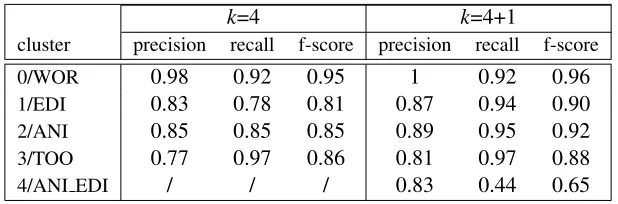
k=4 k=4+1
cluster precision recall f-score precision recall f-score
0/WOR 0.98 0.92 0.95 1 0.92 0.96
1/EDI 0.83 0.78 0.81 0.87 0.94 0.90
2/ANI 0.85 0.85 0.85 0.89 0.95 0.92
3/TOO 0.77 0.97 0.86 0.81 0.97 0.88
[image:4.612.152.461.53.155.2]4/ANI EDI / / / 0.83 0.44 0.65
Table 1: Results of the clustering tasks withk=4 andk=4+1.
as two lexical items (e.g. for the noun chicken,
chicken ANI andchicken EDI 2). The results of the
first clustering task (k=4) were evaluated against this dataset.
For the second clustering (k=4+1), the dataset was slightly modified, and disemous nouns were repre-sented with a new label indicating their polysemy (chicken ANI EDI).
In table 1 the results of the two clustering tasks are shown. For each cluster and its corresponding class in the dataset (first column) precision, recall
andf-score fork=4 andk=4+1 were computed. The results confirmed that (i) the semantic information kept in WE was enough to include nouns of the same lexical class in the same cluster: this is proved by the high f-scores fork=4; (ii) WE preserved enough in-formation to distinguish polysemous nouns instan-tiating a specific sense alternation from the other nouns in the dataset. As expected, when clustering with k=4+1, four out of five clusters were mainly composed of monosemous nouns, thus correspond-ing to the four classes ANI, EDI, WOR and TOO
of the dataset, whereas the fifth included polysemes labelled as ANI EDI. The f-score for this cluster was significantly lower than the others, but note that Mart´ınez et al. (2013) report about the difficulties of the task also for human annotators.
The most relevant data are the precision and re-call of the cluster4/ANI EDI. We will discuss about the recall in the following section. The high result in precision confirmed that the great majority of the nouns in the cluster were polysemous, and hence that it was possible to find a portion of the
seman-2The notation ’CAT’ is used to identify the class in the dataset which a lexical item belongs to, while ’n/CAT’ iden-tifies the cluster - and the corresponding class - to which a noun is assigned by our method.
tic space populated only by polysemes.
Finally, the data regarding the f-scores with
k=4+1 show that considering polysemous nouns as members of a new class led to an improvement of the results for all the other clusters. This confirms that by accounting for regular polysemy it is possi-ble to improve the performance of a system in a task of lexical classification.
3.4 Discussion
From the error analysis, two general errors causes and a specific one for k=4 and k=4+1 were identi-fied. Firstly, theassociation effect: even if the set-ting chosen for the creation of the WE was intended to maximize similarity and to minimize relatedness, a noun likepeeler TOO, which co-occurs almost ex-clusively with nouns referring to fruits and vegeta-bles (akin nouns belonging toEDI), was included in
1/EDI instead of 3/TOO. The same effect has also been found in other works (Hill et al., 2014).
Secondly, the low frequency effect: the major-ity of the misclassified monosemous nouns had less than 50 occurrences in the BNC corpus (e.g. chip-munk ANI, 20 occurrences). Few occurrences of a word seemed to produce less informative WE and this, in turn, less accurate cluster assignment. Note that WE for low frequency words are usually dis-carded (Mikolov et al., 2013c).
For the first task (k=4) the polysemy effect: 36 out of 51 errors were due to regular polysemy, an expected result, given that only one embedding for each noun had been used. Thus, for example, since
chicken ANI andchicken EDI were represented by the same vector, they were both assigned to1/EDI.
taxonomic production taxonomic production labelling frequency labelling frequency crustacean 6 edible eaten 20
shellfish 7 seafood 6
tot animal 13 tot food 26
[image:5.612.73.300.54.140.2]% ANI 33 % EDI 67
Table 2: Taxonomic labelling and production frequency for the nounprawn
frequent or predominant that the other, the WE is expected to be more similar to those of non ambigu-ous nouns in a basic class, as it mostly behaves, in distributional terms, like them.
Sense predominance was also observed in the hu-man annotated CSLB dataset. For every concept in the CSLB, information about the taxonomic group the concept belongs to is also provided as well as the relative production frequency, i.e. the number of times the taxonomic group has been associated to the target concept. As an example, for the noun
prawn the information reported in table 2 is pro-vided. Our assumption was that the difference in taxonomic labelling adequately reflects the differ-ence in sense predominance: hdiffer-enceprawn, on aver-age, is associated to the classEDI on 67% of times, and toANIin the remaining 33%.
In table 3, we averaged relevant values of produc-tion frequency for polysemous nouns in4/ANI EDI,
2/ANI and 1/EDI. On average, polysemous nouns that in task k=4+1 were included in cluster 1/EDI
were judged to belong to the taxonomic category of food in 64% of cases, and only 36% to the class of animals; polysemous nouns assigned to cluster
2/ANI, were labelled by humans as animals in 67% of cases (33% food). Finally, polysemous nouns clustered in4/ANI EDIhad almost equal average of human labelling for the two senses: 48% food, 52% animal.
Human judgements support our explanation of the low recall of cluster 4/ANI EDI: on average, the same polysemous nouns that were incorrectly in-cluded in1/EDI and2/ANI because of their strong sense asymmetry, are mostly considered as food or animal respectively by humans.
On the basis of these data, it is possible to con-clude that, as expected, cluster4/ANI EDI included
cluster % EDI-related % ANI-related human judgements human judgements
1/EDI 64 36
2/ANI 33 67
4/ANI EDI 48 52
Table 3: Averaged taxonomic labelling for nouns in 1/EDI,2/ANIand4/ANI EDI
only polysemous nouns, but only those whose senses are balanced, i.e. not strongly asymmet-ric. On the contrary,unbalancedpolysemous nouns tended to be included in the classes the predominant sense belongs to.
4 Modeling Sense Asymmetry
The clustering introduced above allowed to identify most polysemous nouns for a specific class alterna-tion but failed to handle polysemes with a strong sense asymmetry. In order to overcome this prob-lem, in this section we propose asense indexwhich, given a specific class alternation, makes it possible to identify and represent disemous nouns and their particular sense asymmetries. Such an index allows to detect and accurately represent polysemes, since it locates nouns on a continuum whose ends are the two involved lexical classes: monosemous nouns lay close to one of the ends, while polysemous nouns lay in the middle of the continuum, in a different posi-tion depending on the degree of asymmetry of their senses.
The sense index was calculated considering the
k=4 scenario, that is without taking into account the polysemous classANI EDI. For each cluster, the centroidsCwere computed. A centroid is an aver-age vector and hence, in our method, it represents the centre of a class; therefore, the closer a noun is to the centroid of a class, higher its degree of mem-bership to such a class is.
Our goal was to identify which nouns were poly-semous for a specific class alternation; for this rea-son the method considered one pair of clusters X,
Y at a time. Given X={x1, x2,...xn} and Y={y1,
y2,...yn}, and the centroids of the two addressed
clusters Cx and Cy, the cosine similarity between
[image:5.612.311.548.55.125.2]fol-lows, we will refer to this initial value as absolute cosine class membership(θAbs).
The highest (θMaxAbs) and the lowest (θMinAbs) values ofθAbswere then used in order to define a
relative cosine class membership(θRel). The reason for switching from absolute to relative class mem-bership is the following. WE represent the whole vocabulary of the corpus in a single vector seman-tic space: since θAbsis computed in this space, it accounts for the distance between the nouns of the dataset and all the other words of the vocabulary. This fact had a major drawback: while accounting for the cosine distance with very distant words in the semantic space, it minimized the distances between class-related nouns. By adoptingθRelwe overcame this problem, since this measure is aimed to only ac-count for the semantic space in which nouns of two classes and their centroids are included, thus making evident the differences of targeted nouns.
Relative cosine class membership between a cen-troid and a nounnin the dataset can be computed as in (1):
θRel= θAbsRanMaxMin−θMinAbs (1)
where θAbs is the absolute cosine similarity be-tween the target name and the centroid, θMinAbs
andθMaxAbsare the values of cosine similarity be-tween the centroid and the farthest and closest point respectively, andRanMaxMinis the range between these two values.
Let’s consider the nounfoxand the centroidsCani
and Cedi. The θAbs between fox and Cani was
0.73, between fox and Cedi 0.48, while the values
of θRel were 0.80 with Cani and 0.30 with Cedi.
Clearly, relative cosine similarity made more evident the proximity in the semantic space offoxtoCani,
and stressed the distance betweenfoxandCedi.
Finally, the values of θRel between a noun and the two centroids were used to obtain the sense in-dex, whereby the degree of membership of a noun to two classes is defined. Given the two values of rel-ative cosine class membership between a noun and the two centroids θRel1 and θRel2 sense index for
the first sense was computed as in (2):
SenseIndex1= θRelθRel12
12 +θRel22 (2)
Since the indexes for the first and the second sense are complementary, the second index was obtained by computing 1-SenseIndex1. Forfoxthe final sense index was 0.88 for ANI and a corresponding 0.12
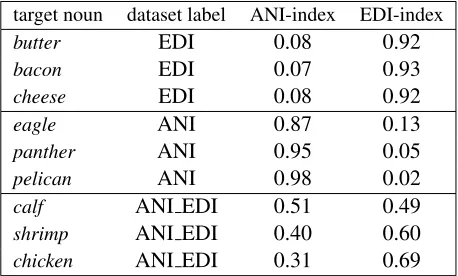
EDI, a result that indicates a clear membership of the target noun to lexical class of the animals, and there-fore thatfoxcan be considered a monosemous noun. The differences between monosemous and polyse-mous are evident for nouns in table 4.
target noun dataset label ANI-index EDI-index
butter EDI 0.08 0.92
bacon EDI 0.07 0.93
cheese EDI 0.08 0.92
eagle ANI 0.87 0.13
panther ANI 0.95 0.05
pelican ANI 0.98 0.02
calf ANI EDI 0.51 0.49
shrimp ANI EDI 0.40 0.60
[image:6.612.313.542.244.382.2]chicken ANI EDI 0.31 0.69
Table 4: Examples of sense indexes
balanced (0.51ANI/0.49EDI),shrimpis more sim-ilar to the monosemous nouns in EDI (0.60) than to those inANI (0.40). Finally, the present method overcame the limitation of the previous one related to sense asymmetry. For example, chicken was in the cluster 1/EDI in k=4+1 given its strongly pre-dominant food sense, while its sense index is 0.69
EDI/0.31ANI: by comparing this index with that of the monosemous nouns of the first part of the table 4, it becomes clear thatchickenis not so strictly tied to the food sense, i.e. it is not a monosemous noun, but also that, differently from other polysemous nouns in the third part of the table, itsEDI-related sense is strongly predominant.
4.1 Evaluation
In order to asses the quality with which our method distinguished between polysemous and monose-mous nouns we turned the evaluation of the sense index in a classification task. For this purpose, given a pair of lexical classes, we identified two thresh-olds ’α’ and ’γ’ on the continuum between such classes, thus obtaining three separate ranges. For such ranges, we expected the following distribution: monosemous nouns labelled as the first sense in the range [0-α], nouns labelled as the second sense in the range [γ-1] and polysemous nouns instantiat-ing the alternation of the two senses in [α-γ]. The populations of the three ranges were than evaluated against the classes of the dataset annotated with pol-ysemous nouns, from which we removed WE that proved to preserve insufficient information due to low frequency of the noun in the corpus (see 3.4.). We selected two pairs of lexical classes for the eval-uation, namelyANI-EDI, a typical regular polysemy alternation, and WOR-EDI, an impossible alterna-tion according to the literature. While for the former a certain number of polysemes in the middle of the continuum was expected, for the latter the expecta-tion was to find two groups of nouns laying at the ends of the continuum, and nothing in the middle.
Along with Utt and Pad´o (2011), in order to chose the best threshold for the two pairs of classes we ex-perimented with different values for α and γ and evaluated the resulting populations of the ranges with the Mann-Whitney U-Test, a non parametric test that is used to test whether two populations are significantly different or not. The output of the test
is theU-value, which can range from 0 to a number computed considering the values of the two popu-lations in exam. In our case, values of U close to 0 would mean that monosemous and polysemous nouns lay in different ranges, while high values of
U indicate that they are approximately evenly dis-tributed on the continuum.
ForANI-EDI we identified the best threshold for
α=0.23 (U=46 on a maximum value of 5671) and
γ=0.59 (U=227, max value 9730), with p≤0.05 for both the results. As expected, EDI-nouns were in the range [0-α], ANI-nouns in the range [γ-1] and polysemes in [α-γ]. The low values ofU indicate that, even if there was a partial overlapping of the three populations on the continuum, there were sig-nificant differences among them.
ForWOR-EDIthe identification of best values for
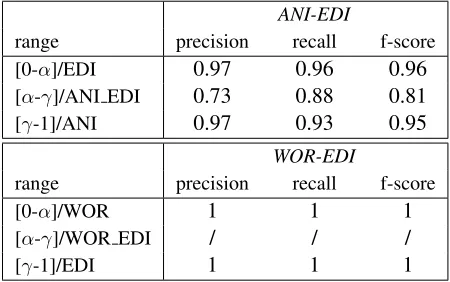
α and γ was fairly straightforward. Since all the nouns labelled as WOR were in the range [0-0.26] and the nouns labelled as EDI in the range [0.63-1], the values of the two thresholds were atα=0.26 (U=0, p≤0.05) andγ=0.63 (U=0, p≤0.05). In table 5 are shown the results obtained using the polysemy index for the classification of polysemous nouns for the two class pairsANI-EDIandWOR-EDI.
ANI-EDI
range precision recall f-score [0-α]/EDI 0.97 0.96 0.96
[α-γ]/ANI EDI 0.73 0.88 0.81
[γ-1]/ANI 0.97 0.93 0.95
WOR-EDI
range precision recall f-score
[0-α]/WOR 1 1 1
[α-γ]/WOR EDI / / /
[image:7.612.314.539.406.547.2][γ-1]/EDI 1 1 1
Table 5: Results of the evaluation of the Sense Index.
4.2 Discussion
alterna-tion were found among them.
Following the comparison of the sense index re-sults for ANI-EDI with those of the k=4+1 cluster-ing, some conclusions can be drawn. Firstly, the general improvement in the f-score ofANI,EDIand
ANI EDI proved that the method presented in this section outperformed the clustering algorithm in the task of polysemy detection.
Secondly, the significant improvement in recall forANI EDIshowed that by exploiting the informa-tion provided by the sense index it was possible to detect those polysemous nouns with a strongly dominant sense that were misclassified with the pre-vious method, even if there were few exceptions.
Tuna was found among nouns laying in the EDI
range, but close to the thresholdα (tuna’s index is 19,α=23). As for polysemes found in theANIrange some explanations can be advanced:sheepandcow
are not usually employed to denote meat as they have a corresponding term specific for this use;snail
is very seldom meant as food; forrabbitwe conjec-ture that there are a number of figurative uses that made it more distant for the group of edible things.
The results show that the sense index has consid-erably increased ANI EDI recall but, to some ex-tent, at the expenses of the precision, what was al-ready expected after the U-test which showed the existence of some overlap between ranges. Never-theless, the general increase in f-score terms for the three involved classes shows the benefits of the in-dex approach.
The correspondence of the values of the thresh-olds α and γ placed on the two continua was al-most perfect: 0.23 and 0.59 onANI-EDI, 0.26 and 0.63 on WOR-EDI. This means that the separation of the ranges on the continuum was consistent be-tween different senses alternations, thus proving the robustness of the method.
Finally, the considerable distance between the first polysemous noun (tuna), laying at point 0.19, and the last one (octopus) at point 0.70 on theANI
-EDI continuum, reflects the fact that the distribu-tional characteristics of polysemes are more disperse than those of monosemous nouns.
5 Conclusions
We have presented an ongoing work that proposes a method for the detection and representation of pol-ysemous nouns based on the semantic information preserved in WE. We initially showed that polyse-mous nouns instantiating a particular sense alterna-tion group together in a specific area of the vector se-mantic space. Subsequently, we proposed a method by which, given a pair of lexical classes, a sense index defining the degree of membership to such classes is assigned to each noun. In this method, pol-ysemy is implicitly represented as a balanced value of the degree of membership. We finally showed that it is possible to identify two thresholdsαandγsuch that nouns having sense index included in the ranges [0-α] and [γ-1] are monosemous nouns belonging to the first and the second class of the pair respectively, while polysemes are included in the range between
αandγ.
Results, although limited in scale, show that the method allows a clear separation between monose-mous belonging to a lexical class and polysemonose-mous nouns instantiating specific sense alternation, also accounting for those polysemes with a strong asym-metry in sense predominace.
In future work, we plan to double check that the results are independent of the datasets, provided enough data is considered. Furthermore, more ex-periments with other class alternations are planned as well as particular application of our sense index in actual WSD applications.
6 Acknowledgements
This work was funded with the support of the IULA-UPF PhD fellowship program.
References
Ju D Apresjan. 1974. Regular polysemy. Linguistics, 12(142):5–32.
Marco Baroni, Georgiana Dinu, and Germ´an Kruszewski. 2014. Dont count, predict! a systematic comparison of context-counting vs. context-predicting semantic vec-tors. InProceedings of the 52nd Annual Meeting of the Association for Computational Linguistics, volume 1, pages 238–247.
Au-tomatic lexical semantic classification of nouns. arXiv preprint arXiv:1303.1930.
Gemma Boleda, Sabine Schulte im Walde, and Toni Ba-dia. 2012a. Modeling regular polysemy: A study on the semantic classification of catalan adjectives. Com-putational Linguistics, 38(3):575–616.
Gemma Boleda, Sebastian Pad´o, and Jason Utt. 2012b. Regular polysemy: A distributional model. In Pro-ceedings of the First Joint Conference on Lexical and Computational Semantics-Volume 1: Proceedings of the main conference and the shared task, and Volume 2: Proceedings of the Sixth International Workshop on Semantic Evaluation, pages 151–160. Association for Computational Linguistics.
Ann Copestake and Ted Briscoe. 1995. Semi-productive polysemy and sense extension. Journal of semantics, 12(1):15–67.
Ann Copestake. 2013. Can distributional approached improve on goold old-fashioned lexical semantics. In IWCS Workshop Towards a Formal Distributional Se-mantics.
Barry J Devereux, Lorraine K Tyler, Jeroen Geertzen, and Billi Randall. 2014. The centre for speech, language and the brain (cslb) concept property norms.Behavior research methods, 46(4):1119–1127.
Francesca Frontini, Valeria Quochi, Sebastian Pad´o, Ja-son Utt, and Monica Monachini. 2014. Polysemy index for nouns: an experiment on italian using the parole simple clips lexical database.
Felix Hill, KyungHyun Cho, Sebastien Jean, Coline Devin, and Yoshua Bengio. 2014. Not all neu-ral embeddings are born equal. arXiv preprint arXiv:1410.0718.
Douwe Kiela and Stephen Clark. 2014. A systematic study of semantic vector space model parameters. In Proceedings of the 2nd Workshop on Continuous Vec-tor Space Models and their Compositionality (CVSC) at EACL, pages 21–30.
Omer Levy and Yoav Goldberg. 2014. Dependency-based word embeddings. InProceedings of the 52nd Annual Meeting of the Association for Computational Linguistics, volume 2, pages 302–308.
H´ector Mart´ınez Alonso, Bolette Sandford Pedersen, and N´uria Bel. 2013. Annotation of regular polysemy and underspecification. InACL (2), pages 725–730. H´ector Mart´ınez Alonso. 2013. Annotation of regular
polysemy: an empirical assessment of the underspeci-fied sense.
Tomas Mikolov, Kai Chen, Greg Corrado, and Jeffrey Dean. 2013a. Efficient estimation of word representa-tions in vector space. arXiv preprint arXiv:1301.3781. Tomas Mikolov, Quoc V Le, and Ilya Sutskever. 2013b. Exploiting similarities among languages for machine translation. arXiv preprint arXiv:1309.4168.
Tomas Mikolov, Ilya Sutskever, Kai Chen, Greg S Cor-rado, and Jeff Dean. 2013c. Distributed represen-tations of words and phrases and their composition-ality. In Advances in Neural Information Processing Systems, pages 3111–3119.
Tomas Mikolov, Wen-tau Yih, and Geoffrey Zweig. 2013d. Linguistic regularities in continuous space word representations. In HLT-NAACL, pages 746– 751.
Geoff Nunberg. 1992. Systematic polysemy in lexicol-ogy and lexicography.
James Pustejovsky. 1991. The generative lexicon. Com-putational linguistics, 17(4):409–441.
J Pustejovsky. 1995. Tile generative lexicon. ms. Bran-deis University.
Lauren Romeo, Sara Mendes, and N´uria Bel. 2013. Towards the automatic classification of complex-type nominals. In6th International Conference on Gener-ative Approaches to the Lexicon, page 21. Citeseer. Lauren Romeo, Gianluca E Lebani, N´uria Bel, and
Alessandro Lenci. 2014a. Choosing which to use? a study of distributional models for nominal lexical semantic classification. In Proceedings of the Ninth International Conference on Language Resources and Evaluation (LREC 2014), pages 4366–4373.
Lauren Romeo, Sara Mendes, and N´uria Bel. 2014b. A cascade approach for complex-type classification. InProceedings of the Ninth International Conference on Language Resources and Evaluation (LREC 2014), pages 4451–4458.
Roy Schwartz, Roi Reichart, and Ari Rappoport. 2014. Minimally supervised classification to semantic cat-egories using automatically acquired symmetric pat-terns. InProceedings of COLING 2014 the 25th In-ternational Conference on Computational Linguistics, pages 1612–1623.