Statistical Natural Language Generation from Tabular Non-textual Data
Joy Mahapatra
and
Sudip Kumar Naskar
and
Sivaji Bandyopadhyay
Jadavpur University, India
[email protected], [email protected],
[email protected]
Abstract
Most of the existing natural language gener-ation (NLG) techniques employing statistical methods are typically resource and time in-tensive. On the other hand, handcrafted rule-based and template-rule-based NLG systems typ-ically require significant human/designer ef-forts. In this paper, we proposed a statistical NLG technique which does not require any se-mantic relational knowledge and takes much less time to generate output text. The sys-tem can be used in those cases where source non-textual data are in the form of tuple in some tabular dataset. We carried out our ex-periments on the Prodigy-METEO wind fore-casting dataset. For the evaluation purpose, we used both human evaluation and automatic evaluation. From the evaluation results we found that the linguistic quality and correct-ness of the texts generated by the system are better than many existing NLG systems.
1 Introduction
The aim of a natural language generation (NLG) system is to produce apprehensible natural language text from non-textual data source which could be a table, an image, numerical data or graphical data (Reiter and Dale, 1997). NLG is just the reverse pro-cess of the natural language understanding task.
Although many NLG systems have been pro-posed so far, there are mainly two types of lan-guage generation systems: knowledge-intensive systems and knowledge-light systems (Adeyanju, 2012). Knowledge-intensive NLG systems can be categorized mainly into two categories: template-based systems and handcrafted rule-template-based systems.
Knowledge-intensive generation approaches take significant human effort or expert advise for build-ing an NLG system. Some examples of this type of NLG systems are SumTime system (Reiter et al., 2005), FoG system (Goldberg et al., 1994), PLANDOC system (McKeown et al., 1994), etc. On the other hand, knowledge-light NLG systems mostly use statistical methods to generate output text and take less human effort. Being automatic sys-tems, knowledge-light systems mostly employ ma-chine learning and data mining techniques. There are many types of knowledge-light systems; n-gram based NLG (Langkilde and Knight, 1998), neural network based NLG (Sutskever et al., 2011), case based NLG (Pan and Shaw, 2004), etc. However, it has been observed that knowledge-intensive sys-tems typically perform better than knowledge-light systems as per human evaluation (Adeyanju, 2012). Beside knowledge-intensive and knowledge-light NLG systems, there are also some NLG systems which can be built through semi-automatic tech-niques. Probabilistic synchronous context free grammar (PSCFG) based NLG system (Belz, 2008) falls into this category of NLG systems.
In this paper we propose a novel, knowledge-light approach based NLG system which converts a tu-ple of tabular-formed non-textual data into its cor-responding natural language text data. Unlike most of the existing NLG systems, our system does not require any human effort or domain expert help. Moreover, the system does not require much time and computer resources (i.e., hardware equipments) for training and generation purpose. Most of the neural network (especially Recurrent Neural
work) based knowledge-light NLG systems demand advanced computer resources and processing time for training. Contrastingly, without taking much hu-man effort and resources, our system is able to gen-erate intelligible and readable text output.
The remainder of the paper is organized as fol-lows. Section 2 briefly presents relevant related work. The proposed NLG system is described in Section 3. Section 4 elaborates the experimental set-tings, dataset and the corresponding results. Section 5 concludes the paper.
2 Related works
Till date, a number of knowledge-light approach based language generator systems have been pro-posed and some of them achieved quite good results in the generation task. Two such successful statis-tical NLG systems are Nitrogen (Knight and Hatzi-vassiloglou, 1995; Langkilde and Knight, 1998) and Oxygen (Habash, 2000). These two NLG systems are based on statistical sentence realizer. Similarly Halogen (Langkilde and Knight, 1998) represents another statistical language generator which is based on statistical n-gram language model. Oh and Rud-nicky (2000) also proposed an NLG system based on statistical language model.
Since its inception, statistical machine translation (Brown et al., 1993; Koehn, 2010) has gained im-mense popularity and it is the most prominent ap-proach and represents the state-of-the-art in auto-matic machine translation. The task of NLG can be thought as a machine translation task because of the similarity between their end objectives - con-verting from one language to another. Langner and Black (2009) proposed an NLG system, Mountain, which modelled the task of NLG as statistical ma-chine translation (SMT). They used the MOSES1
toolkit (Koehn et al., 2007) for this purpose. Belz and Kow (2009) proposed another SMT based NLG system which made use of the phrase-based SMT (PB-SMT) model (Koehn et al., 2003). The MOSES toolkit offers an efficient implementation of the PB-SMT model. However, the linguistic quality and readability of PB-SMT based NLG systems were not as good as compared to other statistical NLG sys-tems like Nitrogen, Oxygen, etc. (Belz and Kow,
1http://www.statmt.org/moses
2009).
Some semi-automatic NLG systems had also been proposed. The Probabilistic synchronous context-free grammar (PSCFG) generator (Belz, 2008) rep-resents this category of NLG systems which can be created mostly automatically but requires man-ual help to certain extent. In synchronous context-free grammar (SCFG) a pair of CFGs are consid-ered, where one CFG of CFG pair is responsible for the meaning representation and the other CFG of the pair is responsible for generating the natural language text output.
Another type of automatic NLG systems makes use of case-based reasoning (CBR) or instance based learning. This type of CBR based NLG systems are based on the concept that similar set of prob-lems will appear in future and the same set of so-lutions will compensate or solve those problems. SEGUE NLG system (Pan and Shaw, 2004) was partly a CBR based NLG system; SEGUE was built with a mix of CBR approach and rule based pol-icy. Adeyanju (2012) designed a CBR approach based weather forecasting text generation tool CBR-METEO. The advantage of CBR based system is that it takes very little manual help and if the given prior dataset covers almost all types of input in-stances then CBR based systems perform better.
Recently, some neural network based NLG sys-tems have been proposed. With the advent of re-current neural network (RNN) based language mod-els (RNNLM) (Mikolov et al., 2010), some RNN based NLG systems have been proposed. An idea of generating text through recurrent neural network based approach with Hessian-free optimization was proposed by (Sutskever et al., 2011). However, this method takes a long training time. An RNN based NLG technique was proposed by (Wen et al., 2015) based on a joint recurrent and convolutional neu-ral network structure. This system was able to train on dialogue act-utterance pairs without any semantic alignments or predefined grammar trees.
output text quality was found to be quite better com-pared to other automatic NLG systems. Another rule based system, probabilistic context free gram-mar based generator (Belz, 2008) is also able to generate high quality sentences which mostly corre-late well with the given corpus text. In PCFG based system, all possible generation grammars are first discovered manually and then probabilities are as-signed to those grammars automatically by observ-ing the corpus.
3 System Description
This section describes our knowledge-light, statis-tical NLG system. Like any other computer soft-ware system, the system goes through similar de-velopment stages. We describe those stages in the following subsections.
3.1 Task definition
The primary objective of the system is to generate natural language text output from tuple record of a non-textual table structure dataset. The table con-tains a set of different attributes (qualitative or quan-titative). Each row or tuple of the table represents a single unit of non-textual data which represents a vector of that particular tuple’s attribute values.
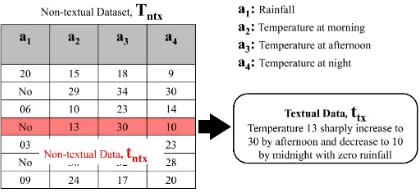
Figure 1 visualizes this task for a typical weather forecasting application. According to that figure, the task is to generate textual datattx from a
tuple-formed non-textual datatntxof theTntxdataset
(ta-ble). TheTntxdataset (table) has four attributes,ax,
[image:3.612.81.291.504.600.2]wherex= 1....4.
Figure 1:Basic input-output structure of our system
3.2 Requirement analysis
Being a supervised statistical model, the system needs a parallel corpus for training purpose which should be a collection of non-textual tuple data and
the corresponding textual data. We make an assump-tion here, that most of the attribute values present in any non-textual data will also appear in the cor-responding textual data for that non-textual data. For our experiments we used the Prodigy-METEO (Belz, 2009) parallel corpus on wind-speed forecast data.
3.3 Design and development
To generate human readable and easily understand-able textual data from non-textual data, an NLG sys-tem must ensure two criteria. Firstly, natural lan-guage text output should be related to the corre-sponding non-textual data’s topic, i.e., output text must contain appropriate information. Secondly, the output text must be fluent, i.e., the output text must ensure its linguistic quality.
In the design step, we divide our system into two modules; one module holds the responsibility of en-suring informativeness and the other module main-tains linguistic quality of the generated output text.
3.3.1 Informativeness Management Module
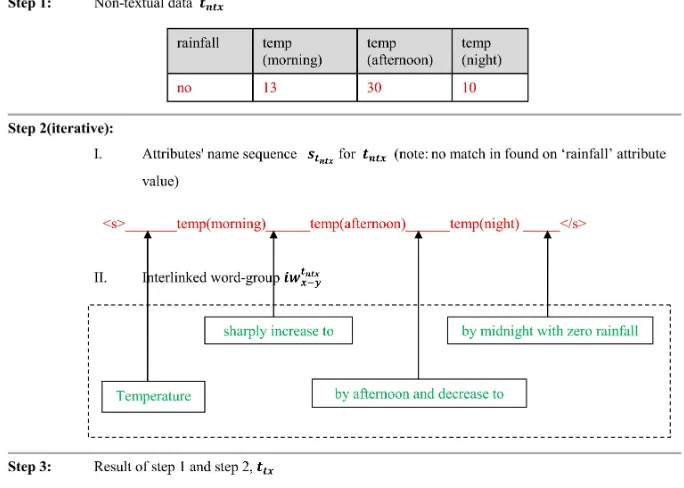
We define informative quality of a generated out-put text by considering how many attribute values of its corresponding non-textual data are present in the generated output text and in which order. It can be noted that if a given parallel corpus holds our requirement analysis criteria (cf. Section 3.2) then we can represent each textual data as a se-quence of attribute-names (which should later be replaced with attribute-values) of its corresponding non-textual data with interlinked word-groups be-tween two adjacent attribute values present in the sequence. This concept is illustrated in figure 2. Fig-ure 2 shows the steps which are necessary for main-taining informativeness of the output textual data. The example shown in Figure 2 is taken from a non-textual tuple formed data from a temperature and rainfall weather dataset which is not our actual ex-perimental dataset; it is presented only for illustra-tion purpose.
Figure 2:Steps for maintaining informativeness in the system Let us consider generating textttx from a given
non-textual data tntx. To achieve this we first
need to find out the attributes’ name sequencestntx and thereafter identify all interlinked word-groups
iwtntx
∗−∗. Mathematically we can express this as in Equation 1 sincettxis made up ofstntxandiw∗−∗tntx.
P(ttx|tntx) =P(stntx, iwt∗−∗ntx|tntx) (1)
P(ttx|tntx) =P(stntx|tntx)∗P(iw∗−∗tntx|tntx, stntx) (2) Equation 2 rewrites Equation 1 as the product of two individual models where the first model,
P(stntx|tntx), denotes prediction of attribute name sequence stntx for the non-textual data tntx, while the second model, P(iwtntx
∗−∗|tntx, stntx), denotes prediction of all the interlinked word-groupsiwtntx ∗−∗ for tntx in the attribute name sequence stntx pre-dicted by the first model.
i. Predicting Attribute Name Sequence
This model predicts the probable attribute name sequence for a given tuple-formed non-textual data. For this prediction, firstly each attribute value of a non-textual data needs to be identi-fied in the corresponding textual data. It may
so happen that some of the attribute values of the non-textual data might not be present in the corresponding textual data. However, we must add those attribute values (as features) in predicting attribute name sequence since they can play a crucial role in that prediction. After identification of all the attribute values present in each training textual data, we can train a model on this dataset which can take a new non-textual data and identify the corresponding textual data’s attribute sequence. After predict-ing the attribute name sequence for a test non-textual data, we replace the attributes’ names with their corresponding values.
Let us consider that we want to find the at-tribute name sequence stntx corresponding to some non-textual datatntx. Let the non-textual
datasetTntx(tntx ∈ Tntx) containa1, a2, ...an
attributes and the corresponding attribute val-ues in tntx are at1ntx, at2ntx, ...atnntx. Then we
can express the attribute name sequence predic-tion fortntxas given in Equation 3.
P(stntx|at1ntx, at2ntx, ..., atnntx) (3)
ii. Predicting interlinked word-groups
For a sequence containingnpossible attribute names/values corresponding to a textual data, there will be n + 1 number of interlinked word(s) (or word-groups) as we introduce two default pseudo-attributes, one at the start and the other at the end of the text.
We predict the interlinking word-group be-tween two attribute names along the attribute name sequence predicted in the earlier step for a test textual data from a context window of six attribute names around the two attribute names currently being considered. Therefore, predict-ing the interlinked word-groups for a textual data are considered to be independent of each other. We also consider the attribute names of the non-textual data which do not appear in the attribute name sequence. Let us consider that we want to predict the interlinking word-groups
iwtntx
∗−∗for an attribute name sequencestntxof a non-textual datatntx. Let thisstntxsequence be
[...al am an ao ar as at au...] and we
want to determine the intermediate word-group between ao and ar. Let us also assume that
some of the attributes’ (ae, af, ag) values of
tntx are not present in stntx, which are atentx,
atntx
f andatgntx. We model this task of
predict-ing interlinkpredict-ing word-group betweenaoandar
fortntxandstntxas in Equation 4.
P(iwtntx
o−r|tntx, stntx) =
P(iwtntx
o−r|atmntx, atnntx, atontx, atrntx, atsntx,
atntx
t , atentx, atfntx, atgntx) (4)
More precisely we can write the
P(iwtntx
∗−∗|tntx, stntx) term as the product of independent interlinking word-group pre-diction tasks as in Equation 5, where prev
(previous) and next (next) are any of two adjacent attribute names instntx.
P(iwtntx
∗−∗|tntx, stntx) =
Y
P(iwtntx
(prev)−(next)|tntx, stntx) (5)
Therefore, Equation 2 can be rewritten as in Equation 6.
P(ttx|tntx) =P(stntx, iw∗−∗tntx|tntx)
=P(stntx|tntx)∗P(iwt∗−∗ntx|tntx, stntx)
=P(stntx|tntx)∗
Y
P(iwtntx
(prev)−(next)|tntx, stntx) (6)
3.3.2 Linguistic Quality Management Module
The informativeness management module tries to answer “what will be content within the output tex-tual data ”, but it does not concern the linguistic quality of the generated text, e.g., fluency, readabil-ity, etc. In the linguistic quality management mod-ule we try to deal with the deficiency of linguistic quality in the generated textual data. Statistical lan-guage modelling is a well established technique for ensuring fluency and readability in natural language text. Therefore, as a final component, we incor-porate a language model in our system. Hence, to maintain both informativeness and linguistic quality of the generated textual data, we model the task of NLG as given in Equation 7, whereP P(x)stands for the perplexity of stringx.
P(ttx|tntx) =P(stntx|tntx)
∗YP(iwtntx
(prev)−(next)|tntx, stntx)∗P P−1(ttx) (7) For our experiments, we trained a trigram lan-guage model on the training set textual data with a minor modification by replacing the attribute values with their attribute names.
3.3.3 Decoding
reduce the size of the search space and keep the com-putation problem tractable, we implemented the task of text generation as modelled in Equation 7 using
stack decoding(Jelinek, 1969) with histogram
prun-ing which limits the number of most promosprun-ing hy-potheses to be explored by the size of the stack. In stack decoding with histogram pruning, the stack at any point of time contains onlyN (size of the stack) most promising partial hypotheses and during hy-pothesis expansion, a partial hyhy-pothesis is placed on the stack provided there is space in the stack, or, it is more promising than at least one of the par-tial hypotheses already stored in the stack. In case of stack overflow, the least promising hypothesis is discarded.
4 Experiments
This section presents the dataset used in our experi-ments and the evaluation results of our system com-pared to some other NLG systems.
4.1 Dataset
As mentioned in Section 3.2, a non-textual–textual parallel dataset is required to train our system. The parallelism should be in such a form that each non-textual data can be represented as a tuple of attribute value instances and most of those attribute values should be present in its corresponding textual data.
We used the Prodigy-METEO2 corpus (Belz,
2009), a wind forecast dataset, for our experi-ment. In the Prodigy-METEO corpus a single pair of non-textual–textual data stands for a particular day’s wind forecast report. A non-textual data in that dataset is represented by a seven-component vector, where each component expresses a partic-ular feature of wind data measurement at a mo-ment of time. The seven components belong to a vector represented by [id, direction, speed min,
speed max, gust-speed min, gust-speed max, time].
In that vector representation id stands for identifi-cation of the vector, direction mentions the wind speed direction, speed max and speed min denote the maximum and mnimum wind speed respectively,
gust max and gust minrepresent the maximum and
minimum wind gust speed respectively, and the last component timedenotes the specific time instance 2http://www.nltg.brighton.ac.uk/home/Anja.Belz/Prodigy
when rest of components’ readings were measured. For example, 1st April, 2001 wind forecast data is represented in this dataset as [[1, SW,28,32,42,-,0600],[2,-,20,25,-,-,0000]] , where ‘-’ represents a missing reading value.
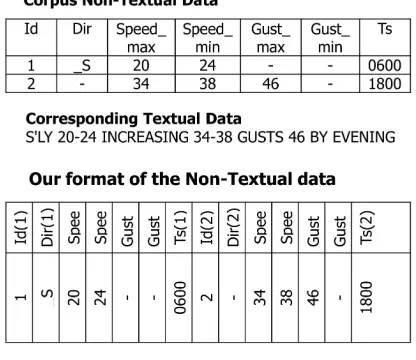
As mentioned earlier our proposed model can pro-cess only a single tuple formed non-textual data at a time. However, the Prodigy-METEO corpus repre-sents each non-textual data (wind forecast data for a particular day) by a sequence of multi-component vectors. For this reason, we merge all the vectors of a particular day’s wind forecast data into a single tu-ple formed data. The merging of a particular day’s wind forecast data vectors is illustrated in Figure 3. The Prodigy-METEO corpus comes with five
pre-Figure 3: Transformation of Prodigy-METEO corpus non-textual data representation for the system’s input
defined splits each of which has on an average 490 pairs of non-textual tuple data and the corresponding textual data.
4.2 Evaluation
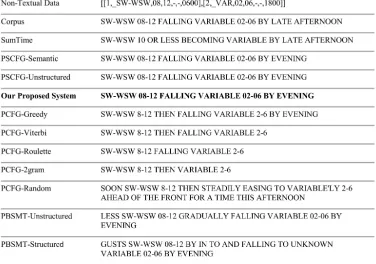
[image:6.612.311.519.295.475.2]Figure 4:An sample of input and outputs of different NLG system
SumTime-Hybrid, PBSMT-Structured and PCFG-Random (Belz and Kow, 2009). Figure 4 shows a sample input and outputs of all the above mentioned systems including our system.
4.2.1 Automatic Evaluation
For automatic evaluation, we used two automatic evaluation metrics; BLEU (Papineni et al., 2002) and METEOR (Banerjee and Lavie, 2005). Both BLEU and METEOR were originally proposed for evaluation of machine translation (MT) systems However, due to the similarity between the two tasks (i.e., MT and NLG) from the point of view of their working principles, most of the NLG systems are also evaluated using these two automatic MT evalu-ation metrics.
Because of the relatively small size of the dataset, we took a five-fold cross validation policy which was predefined in the Prodigy-METEO corpus. Ta-ble 1 presents the evaluation results obtained with BLEU and METEOR on our system along with the ten other NLG systems.
System BLEU score Meteor score
Corpus 1 1
PCFG-Greedy 0.65 0.85
PSCFG-Semantic 0.64 0.83
PSCFG-Unstructured 0.62 0.81
Proposed System 0.61 0.82
PCFG-Viterbii 0.57 0.76
PCFG-2gram 0.56 0.76
PCFG-Roulette 0.52 0.76
PBSMT-Unstructured 0.51 0.81
SumTime-Hybrid 0.46 0.67
PBSMT-Structure 0.34 0.59
PCFG-Random 0.28 0.52
Table 1:Comparison using automatic metric evaluation
4.2.2 Human-based Evaluation
[image:7.612.310.525.397.547.2]the worth of automatic evaluation metrics are typi-cally judged based on how well they correlate with human evaluation.
Figure 5:Comparison using human evaluation We also evaluated the systems using human eval-uation on a part of the test dataset. We carried out human evaluation to measure the clarity and read-ability of the texts generated by the NLG systems. Clarity measures truthfulness and correctness of a textual data whereas readability concerns fluency of the textual data. 30 instances (out of total 232) were randomly chosen from the testset for the pilot hu-man evaluation and the output from 11 different sys-tems along with the corresponding non-textual data were presented to the human evaluators. Five stu-dents from different backgrounds who acted as hu-man evaluators were asked to rate 72 outputs each in a 10 point scale. The output of human evaluation is presented in Figure 5.
4.3 Result Analysis
As per the outcomes of automatic evaluation, our system provided the third and fourth best results in METEOR and BLEU, respectively. According to METEOR, our system is only behind the PCGF-Greedy and PSCFG-Semantic systems while ac-cording to BLEU, PCFG-greedy, PSCFG-Semantic and PSCFG-Unstructured systems perform better than our proposed model. However, these systems which are ahead of our system in performance as per automatic evaluation are not fully automatic, whereas our system does not require any human effort or additional knowledge other than a non-textual–textual parallel corpus.
Human evaluation preferred rule based systems over automatic knowledge-light systems. The Sum-Time system, which is a rule based system and is
placed in the ninth position according to both BLEU and METEOR, is adjudged the best system in hu-man evaluation. Our system ranks fourth among the 11 systems according to human evaluation. The gold standard reference set was also provided to the hu-man evaluators for evaluation without their knowl-edge and, surprisingly, the reference set was ranked fourth.
We calculated Pearson correlation coefficient be-tween scores produced by automatic evaluation met-rics (BLEU and METEOR) and human evaluation. For human evaluation we considered the average of clarity and readability. The correlation coeffi-cients arer(Human, Bleu)=0.61 andr(Human, ME-TEOR)=0.57 .
5 Conclusions
The statistical NLG system presented in this paper does not require any external agents’ involvement. It is a domain independent system and can easily be shifted from one application domain to another without any change.
To avail good quality output text from the system, one must conform to the requirement specified in Section 3.2. The NLG system will perform accu-rately if all attributes present in the training tuple-formed non-textual data contain distinct values. If this criterion can be assured, then it will be trivial to match each of those attribute values present in the non-textual data to their appearance in the cor-responding textual data. However, if this constraint is not possible to be satisfied the system will still work. It is worth to be mentioned here that in cases when not a single attribute value of non-textual data can be found in the corresponding textual data, then our system will behave like an instance based NLG system.
Acknowledgments
References
Ibrahim Adeyanju. 2012. Article: Generating weather forecast texts with case based reasoning. Interna-tional Journal of Computer Applications, 45(10):35– 40, May. Full text available.
Satanjeev Banerjee and Alon Lavie. 2005. Meteor: An automatic metric for mt evaluation with improved cor-relation with human judgments. pages 65–72. Anja Belz and Eric Kow. 2009. System building cost vs.
output quality in data-to-text generation. In Proceed-ings of the 12th European Workshop on Natural Lan-guage Generation, ENLG ’09, pages 16–24, Strouds-burg, PA, USA. Association for Computational Lin-guistics.
Anja Belz. 2008. Automatic generation of weather forecast texts using comprehensive proba-bilistic generation-space models. Nat. Lang. Eng., 14(4):431–455, October.
Anja Belz. 2009. Prodigy-meteo: Pre-alpha release notes (nov 2009).
Peter F. Brown, Vincent J. Della Pietra, Stephen A. Della Pietra, and Robert L. Mercer. 1993. The mathematics of statistical machine translation: Parameter estima-tion.Comput. Linguist., 19(2):263–311, June. Eli Goldberg, Norbert Driedger, and Richard I. Kittredge.
1994. Using natural-language processing to produce weather forecasts. IEEE Expert: Intelligent Systems and Their Applications, 9(2):45–53, April.
Nizar Habash, 2000.Envisioning Machine Translation in the Information Future: 4th Conference of the Associ-ation for Machine TranslAssoci-ation in the Americas, AMTA 2000 Cuernavaca, Mexico, October 10–14, 2000 Pro-ceedings, chapter Oxygen: A Language Independent Linearization Engine, pages 68–79. Springer Berlin Heidelberg, Berlin, Heidelberg.
F. Jelinek. 1969. Fast sequential decoding algorithm us-ing a stack.IBM J. Res. Dev., 13(6):675–685, Novem-ber.
Kevin Knight and Vasileios Hatzivassiloglou. 1995. Two-level, many-paths generation. InProceedings of the 33rd Annual Meeting on Association for Computa-tional Linguistics, ACL ’95, pages 252–260, Strouds-burg, PA, USA. Association for Computational Lin-guistics.
Philipp Koehn, Franz Josef Och, and Daniel Marcu. 2003. Statistical phrase-based translation. In Pro-ceedings of the 2003 Conference of the North Ameri-can Chapter of the Association for Computational Lin-guistics on Human Language Technology - Volume 1, NAACL ’03, pages 48–54, Stroudsburg, PA, USA. As-sociation for Computational Linguistics.
Philipp Koehn, Hieu Hoang, Alexandra Birch, Chris Callison-Burch, Marcello Federico, Nicola Bertoldi,
Brooke Cowan, Wade Shen, Christine Moran, Richard Zens, Chris Dyer, Ondˇrej Bojar, Alexandra Con-stantin, and Evan Herbst. 2007. Moses: Open source toolkit for statistical machine translation. In Proceed-ings of the 45th Annual Meeting of the ACL on Inter-active Poster and Demonstration Sessions, ACL ’07, pages 177–180, Stroudsburg, PA, USA. Association for Computational Linguistics.
Philipp Koehn. 2010. Statistical Machine Translation. Cambridge University Press, New York, NY, USA, 1st edition.
Irene Langkilde and Kevin Knight. 1998. Generation that exploits corpus-based statistical knowledge. In
Proceedings of the 36th Annual Meeting of the As-sociation for Computational Linguistics and 17th In-ternational Conference on Computational Linguistics, Volume 1, pages 704–710, Montreal, Quebec, Canada, August. Association for Computational Linguistics. Brian Langner and Alan W Black. 2009. Mountain: a
translation-based approach to natural language gener-ation for dialog systems.
Kathleen McKeown, Karen Kukich, and James Shaw. 1994. Practical issues in automatic documentation generation. InProceedings of the Fourth Conference on Applied Natural Language Processing, pages 7–14, Stuttgart, Germany, October. Association for Compu-tational Linguistics.
Tomas Mikolov, Martin Karafi´at, Luk´as Burget, Jan Cernock´y, and Sanjeev Khudanpur. 2010. Re-current neural network based language model. In
INTERSPEECH 2010, 11th Annual Conference of the International Speech Communication Association, Makuhari, Chiba, Japan, September 26-30, 2010, pages 1045–1048.
Alice H. Oh and Alexander I. Rudnicky. 2000. Stochas-tic language generation for spoken dialogue sys-tems. In Proceedings of the 2000 ANLP/NAACL Workshop on Conversational Systems - Volume 3, ANLP/NAACL-ConvSyst ’00, pages 27–32, Strouds-burg, PA, USA. Association for Computational Lin-guistics.
Shimei Pan and James Shaw. 2004. Segue: A hybrid case-based surface natural language generator. InIn Proceedings of INLG 2004, pages 130–140.
Kishore Papineni, Salim Roukos, Todd Ward, and Wei-Jing Zhu. 2002. Bleu: A method for automatic evaluation of machine translation. InProceedings of the 40th Annual Meeting on Association for Computa-tional Linguistics, ACL ’02, pages 311–318, Strouds-burg, PA, USA. Association for Computational Lin-guistics.
Ehud Reiter, Somayajulu Sripada, Jim Hunter, Jin Yu, and Ian Davy. 2005. Choosing words in computer-generated weather forecasts. Artif. Intell., 167(1-2):137–169, September.
Ilya Sutskever, James Martens, and Geoffrey E. Hinton. 2011. Generating text with recurrent neural networks. In Lise Getoor and Tobias Scheffer, editors, Proceed-ings of the 28th International Conference on Machine Learning (ICML-11), pages 1017–1024, New York, NY, USA. ACM.