Proceedings of the 3rd Workshop on EVENTS at the NAACL-HLT 2015, pages 53–57,
Evaluation Algorithms for Event Nugget Detection : A Pilot Study
Zhengzhong Liu, Teruko Mitamura, Eduard Hovy Carnegie Mellon University
5000 Forbes Avenue Pittsburgh, PA 15213, USA
[email protected], [email protected], [email protected]
Abstract
Event Mention detection is the first step in tex-tual event understanding. Proper evaluation is important for modern natural language process-ing tasks. In this paper, we present our eval-uation algorithm and results during the Event Mention Evaluation pilot study. We analyze the problems of evaluating multiple event men-tion attributes and discontinuous event menmen-tion spans. In addition, we identify a few limita-tions in the evaluation algorithm used for the pilot task and propose some potential improve-ments.
1 Introduction
Textual event understanding has attracted a lot of at-tention in the community. Recent work has covered several areas about events, such as event mention detection(Li et al., 2013; Li et al., 2014) , event coref-erence (Bejan et al., 2005; Chen and Ji, 2009; Lee et al., 2012; Chen and Ng, 2013; Liu et al., 2013), and script understanding (Chambers and Jurafsky, 2008; Chambers and Jurafsky, 2009). Event Mention detection is the fundamental preprocessing step for these tasks. However, downstream event researches often make minimal effort for event mention detec-tion. For example, in event coreference work, Lee et al. (2012) do not make clear distinction between event and entity mentions. Bejan et al. (2005) and Liu et al. (2013) use oracle event mentions from human annotations. Building robust event mention detection system can help promote research in these areas and enable researchers to produce end-to-end systems. In this paper, we discuss our recent effort in providing a proper evaluation metric for event mention detection.
1.1 The Event Nugget Detection Task
As defined in Mitamura (2014), event nugget detec-tion involves identifying semantic meaningful units (mention span detection) that refer to an event1.
The task also requires a system to identify other at-tributes (attribute detection). In this pilot study, the attributes areevent typeandrealis status.
(1) President Obama willnominate[realis: Othertype: Personnel.Nominate] John Kerry for Secretary of State.
(2) Hecarried outtheassassination[realis: Actualtype: Life.Die] .
Example 1 shows one annotated event nugget
nominate, which has the realis type “other” and event type “Personnel.Nominate”. Example 2 anno-tates one event nugget with discontinuous event span
carried out assassination. The evalua-tion corpus is annotated with event nuggets that fall into 8 types of event2. Please refer to Mitamura
(2014) for detailed definitions of the attributes. 1.2 Past Evaluation Methods
The Automatic Content Extraction 2005 evaluation task involves event extraction. The Event Detection and Recognition (VDR) task in the Automatic Con-tent Extraction 2005 evaluation (NIST, 2005) eval-uate the accuracy of event arguments and multiple other event attributes. However, event mention recog-nition is not directly evaluated (§3.2).
1This is similar to Event Trigger in ACE 2005, which is
adopted in other work (Li et al., 2013; Li et al., 2014)
2These areLife, Movement, Business, Conflict, Contact,
Per-sonnel, Transaction, Justice
Li et al. (2013; 2014) evaluate event trigger de-tection using a mention-wise F-1 score. An event trigger is considered correct only when the span and event type are matched exactly. Errors from different sources are not separately presented.
In addition, most previous evaluations on event mention evaluation do not give partial credits to par-tial matches. Parpar-tial scoring is more important in the current setting because of the mention span detection task is difficult with discontinuous event nuggets.
2 The Evaluation Algorithm in Pilot Study
In this section, we describe our mention detection algorithms3. We will use the terms Event Nugget and
Event Mention interchangeably. 2.1 Prerequisites
The main prerequisite for the evaluation is tokeniza-tion. In our pilot study, we provide a standard to-kenization for all participants. System responses represent each event mention in terms of predefined token ids4. Discontinuous mentions can be easily
represented using tokens. 2.2 Partial Span Scoring
The proposed evaluation produces a span similarity score for a pair of mentions (system and gold stan-dard) between 0 and 1. Given a pair of mentions (G,
S), we represent the span of each mention by a set of token ids (TG,TS). The span similarity score is
defined as the Dice coefficient between the two sets (which is the same as the F-1 score).
Dice(TG, TS) = |T2|TGTS| G|+|TS|
= |T 2
G|/|TGTS|+|TS|/|TGTS|
=F1(TG, TS) = 1/P + 12 /R
2.3 Mention Mapping
To evaluate mention attributes, the evaluation algo-rithm needs to decide which system mention
corre-3Code base:github.com/hunterhector/EvmEval 4Some other KBP evaluations use character span evaluation,
which will favor long words than short words. We argue that the difficulties in tokenizing a long word and a short word in English should be virtually the same; hence scoring these two cases differently is not fair.
sponds to a gold standard mention. We refer to this step as mention mapping. The input of our mention-mapping algorithm is the pairwise scores between all gold standard vs. system mention pair. We use the token-based Dice score (§2.2). Algorithm 1 shows our mapping algorithm to compute the mapping in one document.
Algorithm 1Compute a mapping between system and gold standard mentions
Input: A listLof scoresDice(TG, TS)for all pair
of G, S in the document 1: M ←∅;U ←∅ 2: whileL6=∅do
3: Gm, Sn←arg max(G,S)∈LDice(TG, TS) 4: ifSn6∈U andDice(TGm, TSn)>0 then 5: MGm ←MGm∪(Sn, Dice(TGm, TSn)) 6: U ←U ∪ {Sn}
Output: The mappingM
Algorithm 1 iteratively searches for the highest Dice score in all remaining mention pairs. Line 4 en-sures that each system mention can only be mapped to one gold standard mention to avoid multiple count-ing. One gold standard mention is allowed to be mapped to multiple system mentions, which will be used in calculating attribute accuracy scores. 2.4 Overall Span Scoring
In the pilot study, we first evaluate the system’s per-formance on span detection5. We use F-1 score
(re-ferred as mention level F-1 score to distinguish with the token level F-1 score in§2.2) for this task.
The definition of True Positive (TP) and False Pos-itive (FP) for mention-level F-1 are slightly adjusted to reflect partial matching. TP values are accumu-lated according to Algorithm 2.
Precision, Recall, F-1 are calculated as followed:
P = T PT P+F P;R= T PN
G;F1 =
2P R P +R NGis the number of gold standard mentions.
In the study, we useT P +F P as the denominator for Precision. We later identify a problem of this formulat. WhenF P is 0, even if the span range is
5For simplicity, we describe our algorithm on a single
Algorithm 2Compute TP and FP
Input: The set of gold standardG; The mappingM
indexed byG; Number of system mentionsNS
1: T P ←0;F P ←0 2: for∀G∈ Gdo 3: if|MG|= 0then
4: F P ←F P + 1
5: else
6: ST ←arg maxDice(S, Dice)∈MG
7: T P ←T P +Dice(G, ST) Output: T P
not exactly correct, the system can still get perfect precision (though imperfect recall), which is counter-intuitive. If we calculate F P withNS −T P, the
precision, recall calculation will naturally resolve to:
P = T PN
S;R=
T P NG
The new formula is also aesthetically symmetric on precision and recall. We present the influence of this fix in§4.1.
2.5 Attribute Scoring
For each attribute and gold standard mention, we calculate the accuracy according to algorithm 3. This algorithm will give a system full credit even when the span matching is not perfect. In addition, when one system incorrectly splits one gold standard mention into two, we still give it credit as long as attributes are all predicted correctly.
Algorithm 3 Compute Attribute Accuracy for one Gold Standard Mention
Input: The gold standard mention G; The mapping
M indexed byG; The setAindexing target at-tributes for all mentions;
1: Accuracy←0
2: forS, Dice(TS, TG)∈MGdo 3: ifAS=AGthen
4: Accuracy←Accuracy+ 1/|MG|
Output: Accuracy
Gold Hecarried outtheassassination[type:
Life.Die] .
System 1 Hecarried[type: Life.Die] out the
assassination[type: Life.Die] .
System 2 Hecarried[type: Business.MERGE] out the
assassination[type: Life.Die].
In the above examples, there is one gold standard mention while both systems report two event men-tions, and they both omit the word “out”. According algorithm 3,System 1gets full credit whileSystem 2 gets 0.5. The algorithm is designed this way to prevent a system being penalized again for its span error. However, this make it difficult to find a natural way to combine span scores with attribute scores. 2.6 Combining multiple scores
Algorithm 2 and 3 are limited in that there is no one simple score for final system ranking. Furthermore, the span score only reflects the system’s ability to distinguish the 8 types of event mentions from every-thing else, which is not a useful metric by its own.
A naive way to combine the scores is to multiply these individual scores. However, theoretically, the errors in attribute scoring and the span scoring are not independent, thus it is inappropriate to perform a simple multiplication. We propose a natural ad-justment by directly augmenting attribute evaluation into F1 score calculation (Algorithm 4). Line 3 in the algorithm finds a system mention with the high-est mapping score that also fits all the attributes of interest as true positive. We can choose the setA
to contain the desired attributes we would like to evaluate on. In our implementation, we iterate all possible attribute combinations and produce all the scores (§4.2).
Algorithm 4Compute True Postive with Attributes Input: The set of gold standard mentionsG; The
mappingM indexed by gold standard mentions; Number of system mentionsNS; The setA
in-dexing the attributes that will be evaluated for all mentions
1: T P ←0 2: forG∈ Gdo
3: Smax ← arg maxDice(S, Dice) ∈ MG
Subject toASmax =AG
4: T P ←T P +Dice(Smax, G)
3 Comparison with Previous Methods
3.1 Comparison with MUC
The Message Understanding Conference provides a scoring algorithm for the information extraction task (Chinchor, 1992). Though there is no event mention evaluation, some algorithm design can still be compared with our methods.
The MUC scorer first calculates an alignment be-tween gold standard mention and system, and then counts the number of exact matchesCOR, the num-ber of partial matches P AR, the number of gold standard keysP OS, the number of system responses
ACT. The precision and recall are calculated as6:
P = COR+ 0.5P AR
P OS ;R=
COR+ 0.5P AR ACT
The MUC scorer then takes the highest F-Score from all possible alignments.
Our method makes several different decisions. First, we use a simple greedy method for choosing an alignment based on span matching instead of trying to find the best alignment.
Second, we give a partial score between 0 to 1 using the Dice Coefficient, while MUC uses a univer-sal partial credit of 0.5. A variable partial score can reflect more subtle differences between systems. 3.2 Comparison with ACE
The Automatic Content Extraction 2005 task in-cluded an event related evaluation (NIST, 2005). The Event Mention Detection (VMD) task described in the evaluation guideline defines the event mention as a sentence or phrase. The ACE event task evalu-ates the systems on the attributes and arguments of a whole event (which may contains multiple event mentions). Such evaluation also requires a system to resolve event coreference. Thus, there is no direct evaluation for event nuggets in ACE 2005.
4 Experiments
We conduct evaluation on the 15 pilot study submis-sions using the LDC2015E3 dataset, which contains 200 documents with 6921 annotated event mentions. The results we show in this section are all micro average across these mentions.
6We simplified the discussion by assuming there is no
op-tional gold standard key, which will be removed by the MUC scorer if exists but not aligned
4.1 Fixing the Precision Formula
The simple fix on precision calculation (§2.4) does not affect the overall trend of the evaluation. The scores of the participant systems only change by a very small value, and the span-based ordering re-mains the same. We argue that this fix is both more theoretically sound and mathematically pleasing. 4.2 Combining Multiple Scores
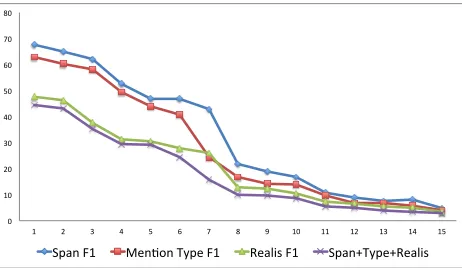
As discussed in§2.6, scoring each metric individu-ally will make it difficult to provide one unified score to rank all systems. This can be seen from Figure 1, which plot the evaluation results using the original scoring (sorted on Span F1). In addition, because at-tribute scores are only calculated on the gold standard mentions, the false alarms on the rest of the predicted mentions are not penalized.
Figure 2 shows the results using multiplicity com-bination. We observe that the resulting scores will soon become too small after multiplication, which are less interpretable.
Figure 3 presents the results after applying Algo-rithm 4. The combined score of all attributes now falls into a more reasonable range (bounded by the performance of the hardest attribute, namely realis status). We also observe that all performances de-crease monotonically.
We can also use the results from Figure 3 to un-derstand the performance bottleneck of the systems. For example, in system 7, there is a big gap between the mention type F1 score and the span F1. This indicates that the type detection accuracy is low and should be improved. In system 5, the mention span F1 and mention type F1 are very close. Therefore the bottleneck might be in event span identification. This information is not immediately clear from the other figures.
5 Conclusions
In this paper we describe our proposed evaluation metric for event nugget task and identify two prob-lems in evaluation design. We propose solutions to these problems and find out that the new methods produce more interpretable results.
Acknowledgments
0 10 20 30 40 50 60 70 80
[image:5.612.80.528.67.736.2]1 2 3 4 5 6 7 8 9 10 11 12 13 14 15 Span F1 Men3on Type Accuracy Realis Status Accuracy
Figure 1: System results sorted by Span F1 score
0 10 20 30 40 50 60 70 80
1 2 3 4 5 6 7 8 9 10 11 12 13 14 15
[image:5.612.72.305.70.224.2]Span F1 Span*Type Span*Realis Span*Type*Realis
Figure 2: Combining scores with multiplicity (sorted on combined score)
0 10 20 30 40 50 60 70 80
1 2 3 4 5 6 7 8 9 10 11 12 13 14 15 Span F1 Men3on Type F1 Realis F1 Span+Type+Realis
Figure 3: Attribute augmented scoring (sorted on com-bined score)
References
Cosmin Adrian Bejan, Matthew Titsworth, Andrew Hickl, and Sanda Harabagiu. 2005. Nonparametric Bayesian
Models for Unsupervised Event Coreference Resolu-tion. In Y Bengio, D Schuurmans, J Lafferty, C K I Williams, and A Culotta, editors,Advances in Neural Information Processing Systems 22 (NIPS), pages 1–9. Nathanael Chambers and Dan Jurafsky. 2008. Unsuper-vised Learning of Narrative Event Chains. InACL ’08 Meeting of the Association for Computational Linguis-tics, pages 789–797.
Nathanael Chambers and Dan Jurafsky. 2009. Unsuper-vised learning of narrative schemas and their partici-pants. InACL ’09 Proceedings of the Joint Conference of the 47th Annual Meeting of the ACL and the 4th International Joint Conference on Natural Language Processing of the AFNLP, pages 602–610. Association for Computational Linguistics.
Zheng Chen and H Ji. 2009. Graph-based event corefer-ence resolution.Proceedings of the 2009 Workshop on Graph-based Methods for Natural Language Process-ing, pages 54–57.
Chen Chen and Vincent Ng. 2013. Chinese Event Corefer-ence Resolution: Understanding the State of the Art. In Proceedings of the 6th International Joint Conference on Natural Language Processing, pages 822–828. Nancy Chinchor. 1992. Muc-5 evaluation metric. In
Proceedings of the 5th Conference on Message Under-standing, pages 69–78.
Heeyoung Lee, Marta Recasens, Angel Chang, Mihai Sur-deanu, and Dan Jurafsky. 2012. Joint Entity and Event Coreference Resolution across Documents. In Proceed-ings of the 2012 Conference on Empirical Methods in Natural Language Processing and Natural Language Learning.
Qi Li, Heng Ji, and Liang Huang. 2013. Joint Event Extraction via Structured Prediction with Global Fea-tures. InProceedings of the 51st Annual Meeting of the Association for Computational Linguistics (ACL2013). Qi Li, Heng Ji, Yu Hong, and Sujian Li. 2014. Construct-ing Information Networks UsConstruct-ing One SConstruct-ingle Model. In Proceedings the 2014 Conference on Empirical Meth-ods on Natural Language Processing (EMNLP2014). Zhengzhong Liu, Jun Araki, Eduard Hovy, and Teruko
Mitamura. 2013. Supervised Within-Document Event Coreference using Information Propagation. In Pro-ceedings of the Ninth International Conference on Lan-guage Resources and Evaluation (LREC’14), pages 4539–4544, Reykjavik, Iceland. European Language Resources Association (ELRA).
Teruko Mitamura. 2014. TAC KBP event detection an-notation guidelines, v1.7. Technical report, Carnegie Mellon University, September.
[image:5.612.73.304.460.594.2]