Unsupervised False Friend Disambiguation Using Contextual Word Clusters
and Parallel Word Alignments
Maryam Aminian, Mahmoud Ghoneim, Mona Diab Department of Computer Science
The George Washington University Washington, DC
{aminian,mghoneim,mtdiab}@gwu.edu
Abstract
Lexical false friends (FF) are the phenomena where words that look the same, do not have the same meaning or lexical usage. FF im-pose several challenges to statistical machine translation. We present a methodology which exploits word context modeling as well as in-formation provided by word alignments for identifying false friends and choosing the right sense for them in the context. We show that our approach enhances SMT lexical choice for false friends across language variants. We demonstrate that our approach reduces word error rate (WER) and position independent er-ror rate (PER) for Egyptian-English SMT by
0.6% and0.1% compared to the baseline.
1 Introduction
False friends (FF), aka faux amis, are words in two or more language variants that are orthographically and/or phonetically similar but do not convey the same meaning (Brown and Allan, 2010). FF sense divergence is one of the main sources of perfor-mance degradation in statistical machine translation (SMT) systems. These words are frequently ob-served when the underlying distribution of the test set is different from that of the train data. In other words, the sense of a particular word in the in-put sentence varies from all observed senses of that word in the train data. Thus, SMT may choose the target language translation which is considered in-appropriate based on the context.
Standard form of a language has different infor-mal spoken varieties which are known as dialects. For instance, standard form of Arabic has different dialects (Habash, 2010). These dialects typically
share a set of cognates that could bear the same meaning in both varieties or only be shared homo-graphs but serve as false friend. The usage of di-alects in textual social media and communication channels is rapidly increasing. On the other hand, usually there is not enough dialectal parallel data to train the translation model and build stand alone ma-chine translation systems for dialects. However, the standard official forms of language usually have a wealth of resources and tools that can be adapted to dialects of that language.
The main goal of this paper is to enhance dialectal SMT performance without any in-domain training data. We move towards this goal by performing a pre-processing phase which includes, 1) identifying false friends in the input sentence and, 2) replacing them with an appropriate equivalent from standard language which bears the same meaning. By doing this, we benefit from availability of standard parallel data to choose a more accurate target translation for the false friends.
We aim to identify false friends without any la-beled training data. We then try to choose equiva-lents from the standard language for the identified false friends. We exploit a classifier for identify-ing false friends and designidentify-ing a word sense dis-ambiguator for finding the best equivalent from the standard language. We employ unsupervised word alignment from parallel text and a taxonomy-based semantic similarity measure (Wu and Palmer, 1994) to automatically acquire training data for the FF identifier. Our word sense disambiguator benefits from unsupervised word clusters to model the con-text. We obtain word clusters from a large mono-lingual text in the standard language. Training the model only involves counting the coocurrences of
each word with word clusters for different context definitions. During decoding (disambiguation), for a word in a sentence, we estimate the likelihood for each equivalent of that word given word clusters in its surrounding context.
We evaluate our method on Egyptian (EGY) to English (EN) SMT using a translation model trained on Modern Standard Arabic (MSA). We show that our approach improves EGY-to-EN SMT lexical choice and reachs 0.6% and 0.1% reduction in word error rate (WER) and position-independent error (PER) (Tillmann et al., 1997) over the baseline re-spectively. In summary, the main contributions of this paper are: 1) designing a FF identifier with a su-pervised classifier trained on automatically acquired labeled data, 2) designing a disambiguator for re-placing FF with their equivalent standard form and 3) improving the SMT lexical choice on dialectal data without using any in-domain parallel data to train SMT model.
The remainder of this paper is organized as fol-lows: We give a literature overview in§2. We then detail our approach in§3 . We present t experiments in§4 and discuss the results in§5. We finally make conclusions in§6.
2 Related Work
There have been several studies for identifying false friends which benefit from parallel data to measure semantic similarity of words (Frunza and Inkpen, 2006; Nakov et al., 2009; Inkpen et al., 2005; Kon-drak, 2001; Mitkov et al., 2007). Some other stud-ies such as (Nakov et al., 2007; Schulz et al., 2004; Nakov et al., 2009; Mulloni et al., 2007) exploit dis-tributional semantics to identify false friends. These methods hypothesize that words occurring in similar contexts tend to be semantically similar. Methods leveraging this idea usually use vector space models to show the local context of the target word. Con-text can be modeled either with a window of a cer-tain size around the target word e.g. (Nakov et al., 2009) and (Schulz et al., 2004) or words in a par-ticular syntactic relationships with the target word e.g. (Mulloni et al., 2007).
The most comparable work to our false friend identification approach is the work done by Mitkov et al. (2007) which uses both distributional
seman-tic evidences extracted from monolingual data and bilingual hints obtained from comparable corpora. They eventually use this information as features in a false friend classifier and reach up to 20% and 37% improvement over the baseline precision and recall respectively. Our false friend identification method is different from the mentioned studies in the sense that we generate a supervised classifier from fully unsupervised labeled data. Unlike previous work that solely focus on the identification task, our model leverages both identification and disambiguation.
From the sense disambiguation perspective, there have been several attempts to integrate word sense disambiguation (WSD) systems into the SMT framework in recent years. The main goal of these studies is to improve the target translation for an am-biguous word in the source sentence. Most stud-ies in this area incorporate supervised WSD sys-tems which exploit labeled training data. As an in-stance, Carpuat and Wu (Carpuat and Wu, 2005) integrate a supervised WSD model trained on the Senseval-3 Chinese lexical sample task data into a standard Chinese-English phrase-based SMT model with two methodologies: First, at the decode time, they limit set of translation candidates for an am-biguous word to the set of translations mapped to the sense predicted by the WSD model. Second, they replace the translations chosen by SMT with the translation predicted by WSD system. Never-theless, they show none of these methods improves baseline BLEU score (Papineni et al., 2002). Vick-rey et al (2005) formulate the task of using WSD for SMT as word translation task. They use par-allel data to train their WSD model. They showed that they improve accuracy in both word translation and blank-filling tasks. However, they did not incor-porate their word translation setup in an end-to-end SMT system.
Carpuat and Wu (2007) transformed the problem into a phrase sense disambiguation task by incorpo-rating state-of-the-art WSD features for selecting a target phrase out of all aligned phrases as the possi-ble senses. Chan et al (2007) also embedded state-of-the-art WSD system into SMT by adding more features into the SMT model. They showed that they improve Baseline BLEU score using their WSD-based model.
WSD to improve SMT final performance. Similar to previous studies, they add the WSD acquired feature to the SMT model. They could improve the BLEU score by 0.3% compared to the baseline.
All the mentioned studies aim to enhance SMT by identifying the appropriate target translation for a source word in a given context. Our approach is different from previous work in two aspects: First, we try to improve SMT lexical choice by identify-ing false friends and replacidentify-ing them with the most adequate equivalent from standard language. Un-like previous work, all these steps are done on a given input sentence and we can see them as a pre-processing phase, thereby, there is no need to change the SMT model. Second, our approach does not as-sume that the in-domain parallel data is available. Hence, it is not constrained by the domain and can be extended to any other language variants.
The main difference between this approach and our previous work as described in (Aminian et al., 2014) lies in the fact that we try to improve SMT lex-ical choice by enhancing FF translation. Rather than blindly replacing all dialectal words with their stan-dard equivalent as we did in (Aminian et al., 2014), here we try to automatically identify FF as one of the important sources of translation degradation across language variants and leverage knowledge acquired from monolingual standard data to predict the best equivalent for FF based on the context.
3 Approach
We describe our model in this section. We use two modules in our model: 1) a FF identifier (henceforth PARL) and, 2) a disambiguator (henceforth WC). PARLis based on a supervised classifier. The training data forPARLis automatically obtained from parallel data. WCis based on the likelihood of each standard equivalent given the contextual information. In all of our definitions, we useDAandSTto refer to a di-alectal and standard language, respectively.
3.1 PARL Classifier
We first give some basic definitions about the setup. Parallel text D is a set of aligned sentences S =
{S1,S2, ...,SN} andS0 = {S10,S20, ...,SN0 } in the
source and target languages respectively. We assume S0to be English (EN) in our experiments.Scontains
bothSTandDAsentences. Each training instance is shown with a tuple(k, i, y)in which1 ≤ k ≤ |S|, 1 ≤ i ≤ |Sk| andy ∈ Y. Y refers to the set of
labels{FF, NFF}. We represent theith word in the kth sentence aswkiand its features asφ(k, i)∈IRd
wheredis the size of feature vector. Given the set of training tuples(k, i, y), a classification algorithm is used to train the model. We use Averaged Percep-tron (Freund and Schapire, 1999) as our classifier with the following features: word form for the cur-rent word and part of speech tag for the previous, current and next words.
Automatic Label Estimation We use a dialect identification tool to define a functionL(k, i), that identifies the dialect forwkiout of two possibilities:
DAandST. We do word alignment onDusing an un-supervised alignment algorithm. We defineAki to
be the English word aligned towki. Accordingly, we
defineEST
w as the set of all English words aligned to
the source wordwfor the cases wherewis identified asST.EST
w can be written as:
EST
w ={∀e∈EN| ∃j, h Aj,h=e, wj,h=w,
L(j, h) =ST} (1) To reduce noise in the automatically acquired word alignments, we just consider aligned word pairs with frequency more than 5. For each wki
where L(k, i) is equal to DA, we have to decide whether the word is FF or not. We define a function F(wki, Aki) that returns true if we decide to label
wkias FF and false otherwise (Eq. 2).
F(wki, Aki) =true⇔Sim(Aki, EwSTki)< δ (2) whereδis a manually defined threshold andSim is defined in Eq. 3:
Sim(e, E) = |C1
E|
X
c∈CE
P
e0∈cdist(e, e0)
|c| (3)
whereCE partitionsEinto non-overlapping
clus-ters. Each c∈ CE contains a cluster of words in
dist(e, e0) = d2(e·) +d(sde,e(e0)0) (4)
wherese,e0is a maximally specific superclass ofe
ande0in WordNet (Miller, 1995) anddis the depth
of the node in the WordNet taxonomy.
In short, Eq. 3 computes a weighted average sim-ilarity between variousSTsenses of the target word and itsDAsense in the sentencek. The intuition be-hind this setting is as follows: for a particular word that is identified as DAin a sentence, we measure similarity of its aligned English word to the set of all English words aligned to SToccurrences of the same word (EST
w ). If this similarity is less than a
threshold δ, we label that word as FF. We setδ to 0.5 in our experiments.
3.2 WC Classifier
We now describe our disambiguation model. We use a large amount of monolingual data D0 as a
set of sentences S = {S1,S2, ...,SM} in the ST
form. We perform unsupervised word clustering on D0to obtain word cluster assignments for each word.
We then use word clusters to build our disambigua-tion model. The model comprises five parameters: P−2(c|w), P−1(c|w), P+1(c|w) and P+2(c|w) for
all c ∈ {1,2, ..., K} where K refers to the num-ber of clusters, in addition to the word probabil-ity P(w). Hence, context parameters arePτ(c|w)
for τ ∈ {−2,−1,+1,+2} in which c specifies cluster of the word which is placed in the offset τ for the word w. Pτ(c|w) is estimated using
max-imum likelihood estimation with additive smooth-ing. The smoothing parameter is set to 0.1 in our experiments. To avoid sparsity, we assume that all previous contexts are the same and analogously all next contexts are also the same. In other words, we tieP−2(c|w)andP−1(c|w)into one parameter and
P2(c|w)andP1(c|w) into another distinct
parame-ter.
LetΩ(w) be the list ofSTequivalents for theDA wordw. We choose the most probable candidateω∗
using Eq. 5 by havingτ ∈ {−2,−1,1,2}.
ω∗= argmax
ω∈Ω logP(ω) +
X
τ
logPτ(cτ|ω) (5)
The intuition behind this model is as follows: if a particularDAword in a sentence is identified as FF, we want to replace it by one of itsSTequivalents. If an alternative word is more likely to appear in that context compared to other possible equivalents, we expect our model to select that as the replacement. Since we train word clusters onSTdata, the model tends to assign more weight on words that fit better toSTcontexts.
4 Experimental Setup
Data Sets To trainPARLclassifier, we use parallel dataDME which is a collection of MSA and EGY
texts created from multiple LDC catalogs.1 The
data comprises 29M MSA and 5M DA tokenized words from multiple genres including newswire, broadcast news, broadcast conversations, and we-blogs. To train the disambiguator, we use the Ara-bic Gigaword 4 (Graff and Cieri, 2003) contain-ing 848M tokenized MSA words. To train the model described in § 3.2, we exclude punctuation as well as clitics from the target word local con-text. These words usually do not provide much in-formation about the target word and will increase model sparsity. All data sets used in our experi-ments have undergone the following preprocessing steps: all Arabic data is Alef/Ya normalized and to-kenized using MADAMIRA v1. (Pasha et al., 2014) according to Arabic Treebank (ATB) tokenization scheme (Maamouri et al., 2004). We used Tree Tag-ger (Schmid, 1994) to tokenize English data.
Tools We use GIZA++ (Och and Ney, 2003) for word alignment. We obtain word clusters from word2vec (Mikolov et al., 2013) K-means word clustering tool. We use the continuous bag of word model to build word vectors of size200using a word window of size8for both left and right. The number of negative samples for logistic regression is set to 25and threshold used for sub-sampling of frequent words is set to10−5in the model with15iterations.
We also use full softmax to obtain the probability distribution.
We use AIDA (Elfardy and Diab, 2013) as the di-alect identification tool. AIDA also provides a list of MSA equivalents for identified DA words in context. 141LDC catalogs including data prepared for GALE and
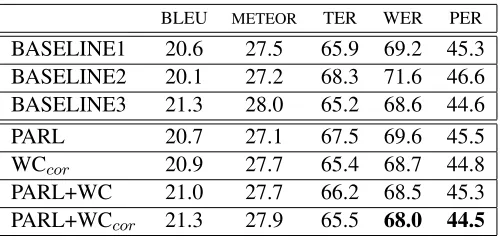
BLEU METEOR TER WER PER BASELINE1 20.6 27.5 65.9 69.2 45.3 BASELINE2 20.1 27.2 68.3 71.6 46.6 BASELINE3 21.3 28.0 65.2 68.6 44.6 PARL 20.7 27.1 67.5 69.6 45.5 WCcor 20.9 27.7 65.4 68.7 44.8
PARL+WC 21.0 27.7 66.2 68.5 45.3 PARL+WCcor 21.3 27.9 65.5 68.0 44.5
Table 1: Evaluation results (BLEU, METEOR (Banerjee and Lavie, 2005), TER (Snover et al., 2006), WER, PER) on the Bolt-arz test set compared to the baselines.
SMT System We use Moses decoder (Koehn et al., 2007) to build a standard phrase-based SMT system. Feature weights are tuned to maximize BLEU score on the tuning set using Minimum Er-ror Rate Training (MERT) (Och, 2003) algorithm. Final results are reported by averaging over three tuning sessions with random initialization. Signif-icant test is also performed to make sure that gains in the results are statistically significant. We use the implementation of Clark et al. (2011) to compute the p-value via approximate randomization algo-rithms. Since AIDA generates MSA equivalents in the lemma form, we use a factored translation model with lemma and POS factors. We use GIZA++ (Och and Ney, 2003) to word align the parallel corpus. We use SRILM (Stolcke and others, 2002) to build 5-gram language models with modified Kneser-Ney smoothing (Kneser and Ney, 1995). Our language modeling data consists of three data sets: a) The En-glish Gigaword 5 (Graff and Cieri, 2003); b) The English side of the BOLT Phase1parallel data; and, c) different LDC English corpora collected from dis-cussion forums.2.
The translation model is trained using the MSA part of DME with29M words. Therefore, any
im-provement in translating DA words on the test set is gained by our false friend identification and disam-biguation approach. Our test set comprises16K tok-enized EGY words and is acquired by selecting1065 sentences from LDC2012E30 (BOLT-arz-test). The tuning set contains 1547 sentences obtained from multiple LDC catalogs3and comprises20k tokens.
2LDC2012E04, LDC2012E16, LDC2012E21,
LDC2012E54
3LDC2012E15, LDC2012E19, LDC2012E55
5 Results and Discussion
The main goal of this work is to improve the trans-lation chosen by SMT for a false friend based on its surrounding context. The final SMT performance is affected by two factors: First, the accuracy of false friend identifier and disambiguator. Second, the quality of predefined candidates generated by AIDA (FF are then replaced by one of these can-didates chosen byWC).
In order to accurately evaluate the quality of our identification and disambiguation process, we de-sign three different baselines. As the first baseline, we randomly tag EGY words which have been ob-served as MSA in the train data as false friend. False friends then are replaced by a randomly selected sense from respective candidates list (BASELINE1). As the second baseline, we follow the setup intro-duced in (Aminian et al., 2014). In this baseline, all EGY words that meet mentioned criteria, are re-placed with one randomly selected sense from the list of candidates (BASELINE2). As the third baseline, we use the results of the raw baseline without any re-placement (BASELINE3). The first two baselines can be used to evaluate the accuracy of FF identifier and disambiguator modules. The last baseline evaluates the overall effectiveness of the approach to enhance EGY-EN SMT which depends on both factors men-tioned before.
[image:5.612.182.432.53.173.2]Ref. i will tell you a story , and you judge whose fault it is . Baseline TbAnA H+ AHky l+ HDrp +k mwqf w+ tqwly myn Ally glTAn Replacement tmAmAnA H+ AHky l+ HDrp +k mwqf w+ tqwly myn Ally glTAn Baseline Trans. ok , i am going to talk to you and say who was wrong .
[image:6.612.110.499.53.126.2]Replacement Trans. i will talk to you stand and say who was wrong .
Table 2: Example of correct FF identification and replacement with non-improving BLEU score.
list. Similarly, WCcor shows the setup whereWCis directly used to identify and replace false friends. In this setup, original EGY word is manually added to the list of MSA candidates generated by AIDA. Thus, WCmodule selects the most adequate candi-date based on the context from the list containing both MSA equivalents and original EGY word. In other words,WCsimultaneously performs FF identi-fication and sense disambiguation. PARL+WCrefers to the system that usesPARLto identify FF and then WCto disambiguate them. It is to be emphasized that in this setup, WCchooses the most appropriate MSA equivalent of each false friend only from the list of candidates generated by AIDA. We also define PARL+WCcorin whichWCcoris used as a FF identifier as well as disambiguator (similar to the second setup above). In fact, we prevent mistakes fromPARLby usingWCas an identifier as well. This setup replaces a word by its MSA equivalent only if bothPARLand WCidentify it as FF.
As shown in Table 1, all replacement experiments outperform BASELINE1 and BASELINE2 in terms of BLEU score. PARLimproves BASELINE1and BASE-LINE2 BLEU scores by 0.1% absolute (0.5% rela-tive) and 0.6% absolute (3% relative) receptively. This implies that our FF identifier achieves more ac-curate FF predictions compared to random and blind predictions.
Using WCcor for FF identification and disam-biguation shows a noticeable improvement over the case that we just usePARLfor identification (in terms of BLEU, WER and PER). This shows that contex-tual similarity plays a more important role compared to the information extracted from parallel data to train a FF identification model.PARLis also too sen-sitive to errors in the word alignment. So noise in the alignment will lead to incorrect prediction and thereby, inadequate replacement.
As expected, combining PARL and WC for FF
identification and replacement (PARL+WC) outper-forms the individual decisions made by each mod-ule solely. This setup benefits from evidences pro-vided by both modules for FF identification and sense disambiguation. Eventually, the last setup PARL+WCcor leads to 0.3% absolute (1.4% relative) BLEU improvement overPARL+WC. It also outper-forms PARL+WC in terms of other SMT evaluation metrics such as METEOR, TER, WER and PER. For example, it achieves 0.7%, 0.5% and 0.8% re-duction in TER, WER and PER respectively com-pared toPARL+WC. In the last setup, we just replace words which bothPARLandWCcommonly identify them as FF. In other words,WCrefines some of the PARLmistakes and avoids it from replacing words which are mistakenly identified as FF byPARL. It is worth noting that significant tests show that all gains in the BLEU, METEOR and TER over BASE-LINE2 andBASELINE3 are statistically significant at the 95% level.
which means ok. However, this replacement does not yield to a better translation for this word. This happens because word ‘tmAm’ has not been ob-served as an interjection in our SMT phrase table. Thus, SMT decoder is not able to find a good trans-lation for this word.
BASELINE1 BASELINE2 BASELINE3 PARL 37.7/38.5 41.5/40.3 34.7/44.2 PARL+WC 38.7/32.8 45.5/36.4 34.0/35.2 PARL+WCcor 40.5/32.2 46.4/36.3 35.7/35.1
Table 3: Percentage of BLEU-enhanced sen-tences/percentage of BLEU-degraded sentences for different replacement approaches compared to each baseline separately.
We conducted another analysis to closely assess the impact of our disambiguator module (WC) in improving target sentences BLEU score. We ran our replacement setups on the proportion of Bolt-arz sentences which contain at least one FF. FF are predicted byPARLmodule. We ended up getting a set with796sentences. Table 3 shows the percent-age of BLEU-enhanced and BLEU-degraded sen-tences in this set for each setup compared to the baselines separately. The setup which exploitsWCcor for FF identification and disambiguation is excluded from this comparison as it does not usePARLfor FF identification. As the percentages in Table 3 indi-cate,PARL+WCnoticeably increases (decreases) per-centage of BLEU-enhanced (BLEU-degraded) sen-tences compared toPARLsetup with respect to BASE-LINE1 andBASELINE2. As shown before (Table 1), the last setup PARL+WCcor did not improve BASE-LINE3 BLEU score. However, results in Table 3 show that this setup increases percentage of BLEU-enhanced sentences compared toPARL+WCandPARL with respect toBASELINE3significantly. Comparing percentages of BLEU˙degraded sentences for men-tioned setups gives the same results.
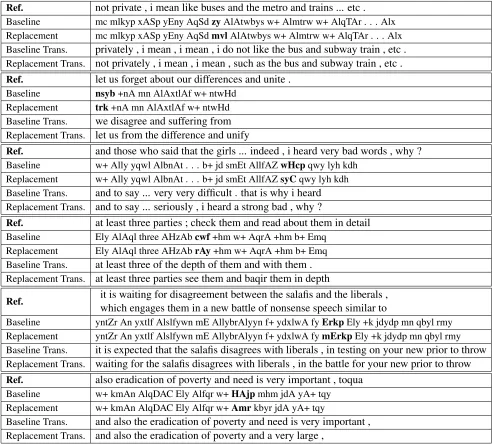
Table 4 shows some translation examples with and without any replacement. The replacement is done using our best-performing setup PARL+WCcor on Bolt-arz test set. The first four examples demon-strate cases that FF (shown in bold) are correctly identified and replaced with a proper MSA equiv-alent. For instance, the word ‘zy’ in the first
exam-ple meansuniformorclothingin MSA andsuch as
orlike in EGY. Thus, replacing the word ‘zy’ with MSA word ‘mvl’ which meanslike yields to better translation and thereby, improves BLEU score.
In the second example, word ‘nsyb’ which means
forgetin this context is replaced with MSA equiva-lent ‘trk’ that meansleaveorforget. As the result, decoder has translated phrase ‘trk +nA mn AlAxt-lAf’ into a longer phrase let us from the difference
instead of generating an incoherent translation such as baseline.
Word ‘wHcp’ in the third example is not a pure EGY word. However, it conveys a meaning different from its observed senses in the phrase table. Hence, baseline incorrectly translates this word todifficult
while the replaced setup generate the correct trans-lation bad for the replaced MSA equivalent ‘syC’. Hence, as shown, our approach has improved SMT lexical choice significantly in this example.
Word ‘cwf’ in the fourth example is also correctly identified as a FF according to context. This word is used as noun in MSA with meaningslook and ap-pearancewhile it is used as a command verb ( or-der someone to look) in EGY. As we can see, our disambiguator module has adequately replaced this word with the verb ‘rAy’ which means to look at
orto see. As the result, the decoder has translated this word into the wordseein the English sentence which leads to higher BLEU score compared to the baseline translation.
Word ‘Erkp’ in the fifth example has English equivalentbattle in EGY andtestin MSA context. Similar to the previous example, baseline selects the incorrect translationtesting. While our replace-ment setup substitues this word with MSA equiva-lent ‘mErkp’ which means battle and thereby, im-proves the translation.
Ref. not private , i mean like buses and the metro and trains ... etc . Baseline mc mlkyp xASp yEny AqSdzyAlAtwbys w+ Almtrw w+ AlqTAr . . . Alx Replacement mc mlkyp xASp yEny AqSdmvlAlAtwbys w+ Almtrw w+ AlqTAr . . . Alx Baseline Trans. privately , i mean , i mean , i do not like the bus and subway train , etc . Replacement Trans. not privately , i mean , i mean , such as the bus and subway train , etc .
Ref. let us forget about our differences and unite . Baseline nsyb+nA mn AlAxtlAf w+ ntwHd
Replacement trk+nA mn AlAxtlAf w+ ntwHd Baseline Trans. we disagree and suffering from Replacement Trans. let us from the difference and unify
Ref. and those who said that the girls ... indeed , i heard very bad words , why ? Baseline w+ Ally yqwl AlbnAt . . . b+ jd smEt AllfAZwHcpqwy lyh kdh
Replacement w+ Ally yqwl AlbnAt . . . b+ jd smEt AllfAZsyCqwy lyh kdh Baseline Trans. and to say ... very very difficult . that is why i heard Replacement Trans. and to say ... seriously , i heard a strong bad , why ?
Ref. at least three parties ; check them and read about them in detail Baseline Ely AlAql three AHzAbcwf+hm w+ AqrA +hm b+ Emq
Replacement Ely AlAql three AHzAbrAy+hm w+ AqrA +hm b+ Emq Baseline Trans. at least three of the depth of them and with them . Replacement Trans. at least three parties see them and baqir them in depth
Ref. it is waiting for disagreement between the salafis and the liberals ,which engages them in a new battle of nonsense speech similar to
Baseline yntZr An yxtlf Alslfywn mE AllybrAlyyn f+ ydxlwA fyErkpEly +k jdydp mn qbyl rmy Replacement yntZr An yxtlf Alslfywn mE AllybrAlyyn f+ ydxlwA fymErkpEly +k jdydp mn qbyl rmy Baseline Trans. it is expected that the salafis disagrees with liberals , in testing on your new prior to throw Replacement Trans. waiting for the salafis disagrees with liberals , in the battle for your new prior to throw
Ref. also eradication of poverty and need is very important , toqua Baseline w+ kmAn AlqDAC Ely Alfqr w+HAjpmhm jdA yA+ tqy Replacement w+ kmAn AlqDAC Ely Alfqr w+Amrkbyr jdA yA+ tqy
[image:8.612.71.564.54.500.2]Baseline Trans. and also the eradication of poverty and need is very important , Replacement Trans. and also the eradication of poverty and a very large ,
Table 4: Translation examples with and without replacement drawn from Bolt-arz test
6 Conclusion and Future Work
We presented a new approach for improving cross-language SMT performance without any in-domain training data by identifying false friends and replac-ing them with a semantically similar equivalent from the standard language. We show that our approach improves lexical choice in EGY-EN SMT system trained only on MSA data. We demonstrate a fully unsupervised approach for false friend identifica-tion and disambiguaidentifica-tion using evidences extracted from parallel and monolingual data. We showed
Acknowledgments
This work was supported by the Defense Advanced Research Projects Agency (DARPA) Contract No. HR0011-12-C-0014, the BOLT program with sub-contract from Raytheon BBN. We would like to acknowledge the useful comments by three anony-mous reviewers who helped in making this publica-tion more concise and better presented.
References
Maryam Aminian, Mahmoud Ghoneim, and Mona Diab. 2014. Handling oov words in dialectal arabic to english machine translation. In Proceedings of the EMNLP’2014 Workshop on Language Technology for Closely Related Languages and Language Variants, pages 99–108, Doha, Qatar, October. Association for Computational Linguistics.
Satanjeev Banerjee and Alon Lavie. 2005. METEOR: An automatic metric for MT evaluation with improved correlation with human judgments. InProceedings of the ACL Workshop on Intrinsic and Extrinsic Evalu-ation Measures for Machine TranslEvalu-ation and/or Sum-marization, pages 65–72, Ann Arbor, Michigan, June. Association for Computational Linguistics.
Keith Brown and Keith Allan. 2010. Concise encyclope-dia of semantics. Elsevier.
Marine Carpuat and Dekai Wu. 2005. Word sense disam-biguation vs. statistical machine translation. In Pro-ceedings of the 43rd Annual Meeting of the Associ-ation for ComputAssoci-ational Linguistics (ACL’05), pages 387–394, Ann Arbor, Michigan, June. Association for Computational Linguistics.
Marine Carpuat and Dekai Wu. 2007. Improving statisti-cal machine translation using word sense disambigua-tion. In Proceedings of the 2007 Joint Conference on Empirical Methods in Natural Language Process-ing and Computational Natural Language LearnProcess-ing (EMNLP-CoNLL), pages 61–72, Prague, Czech Re-public, June. Association for Computational Linguis-tics.
Yee Seng Chan, Hwee Tou Ng, and David Chiang. 2007. Word sense disambiguation improves statistical ma-chine translation. InProceedings of the 45th Annual Meeting of the Association of Computational Linguis-tics, pages 33–40, Prague, Czech Republic, June. As-sociation for Computational Linguistics.
Jonathan H. Clark, Chris Dyer, Alon Lavie, and Noah A. Smith. 2011. Better hypothesis testing for statisti-cal machine translation: Controlling for optimizer in-stability. In Proceedings of the 49th Annual Meet-ing of the Association for Computational LMeet-inguistics:
Human Language Technologies, pages 176–181, Port-land, Oregon, USA, June. Association for Computa-tional Linguistics.
Heba Elfardy and Mona Diab. 2013. Sentence level di-alect identification in arabic. In Proceedings of the 51st Annual Meeting of the Association for Compu-tational Linguistics (Volume 2: Short Papers), pages 456–461, Sofia, Bulgaria, August. Association for Computational Linguistics.
Yoav Freund and Robert E Schapire. 1999. Large margin classification using the perceptron algorithm. Machine learning, 37(3):277–296.
Oana Frunza and Diana Inkpen. 2006. Semi-supervised learning of partial cognates using bilingual bootstrap-ping. InProceedings of the 21st International Confer-ence on Computational Linguistics and 44th Annual Meeting of the Association for Computational Linguis-tics, pages 441–448, Sydney, Australia, July. Associa-tion for ComputaAssocia-tional Linguistics.
David Graff and Christopher Cieri. 2003. English gi-gaword, ldc catalog no.: Ldc2003t05. LDC2003T05. Linguistic Data Consortium, University of Pennsylva-nia.
Nizar Y Habash. 2010. Introduction to arabic natural language processing. Synthesis Lectures on Human Language Technologies, 3(1):1–187.
Diana Inkpen, Oana Frunza, and Grzegorz Kondrak. 2005. Automatic identification of cognates and false friends in french and english. InProceedings of the International Conference Recent Advances in Natural Language Processing, pages 251–257.
Reinhard Kneser and Hermann Ney. 1995. Improved backing-off for m-gram language modeling. In Acous-tics, Speech, and Signal Processing, 1995. ICASSP-95., 1995 International Conference on, volume 1, pages 181–184. IEEE.
Philipp Koehn, Hieu Hoang, Alexandra Birch, Chris Callison-Burch, Marcello Federico, Nicola Bertoldi, Brooke Cowan, Wade Shen, Christine Moran, Richard Zens, Chris Dyer, Ondrej Bojar, Alexandra Con-stantin, and Evan Herbst. 2007. Moses: Open source toolkit for statistical machine translation. In Proceed-ings of the 45th Annual Meeting of the Association for Computational Linguistics Companion Volume Pro-ceedings of the Demo and Poster Sessions, pages 177– 180, Prague, Czech Republic, June. Association for Computational Linguistics.
Mohamed Maamouri, Ann Bies, Tim Buckwalter, and Wigdan Mekki. 2004. The penn arabic treebank: Building a large-scale annotated arabic corpus. In
NEMLAR conference on Arabic language resources and tools, pages 102–109.
Tomas Mikolov, Ilya Sutskever, Kai Chen, Greg S Cor-rado, and Jeff Dean. 2013. Distributed representations of words and phrases and their compositionality. In
Advances in Neural Information Processing Systems, pages 3111–3119.
George A Miller. 1995. Wordnet: a lexical database for english. Communications of the ACM, 38(11):39–41. Ruslan Mitkov, Viktor Pekar, Dimitar Blagoev, and
An-drea Mulloni. 2007. Methods for extracting and clas-sifying pairs of cognates and false friends. Machine translation, 21(1):29–53.
Andrea Mulloni, V Pekar, R Mitkov, and D Blagoev. 2007. Semantic evidence for automatic identification of cognates. InProceedings of the RANLP2007 work-shop: Acquisition and management of multilingual lexicons, pages 49–54. Citeseer.
Svetlin Nakov, Preslav Nakov, and Elena Paskaleva. 2007. Cognate or false friend? ask the web. In Pro-ceedings of the RANLP2007 workshop: Acquisition and management of multilingual lexicons, pages 55– 62.
Svetlin Nakov, Preslav Nakov, and Elena Paskaleva. 2009. Unsupervised extraction of false friends from parallel bi-texts using the web as a corpus. In Proceed-ings of the International Conference RANLP-2009, pages 292–298, Borovets, Bulgaria, September. Asso-ciation for Computational Linguistics.
Franz Josef Och and Hermann Ney. 2003. A system-atic comparison of various statistical alignment mod-els. Computational linguistics, 29(1):19–51.
Franz Josef Och. 2003. Minimum error rate training in statistical machine translation. InProceedings of the 41st Annual Meeting of the Association for Compu-tational Linguistics, pages 160–167, Sapporo, Japan, July. Association for Computational Linguistics. Kishore Papineni, Salim Roukos, Todd Ward, and
Wei-Jing Zhu. 2002. Bleu: a method for automatic eval-uation of machine translation. InProceedings of 40th Annual Meeting of the Association for Computational Linguistics, pages 311–318, Philadelphia, Pennsylva-nia, USA, July. Association for Computational Lin-guistics.
Arfath Pasha, Mohamed Al-Badrashiny, Mona Diab, Ahmed El Kholy, Ramy Eskander, Nizar Habash, Manoj Pooleery, Owen Rambow, and Ryan Roth. 2014. Madamira: A fast, comprehensive tool for morphological analysis and disambiguation of ara-bic. In Nicoletta Calzolari, Khalid Choukri, Thierry
Declerck, Hrafn Loftsson, Bente Maegaard, Joseph Mariani, Asuncion Moreno, Jan Odijk, and Stelios Piperidis, editors, Proceedings of the Ninth Interna-tional Conference on Language Resources and Eval-uation (LREC’14), pages 1094–1101, Reykjavik, Ice-land, May. European Language Resources Association (ELRA). ACL Anthology Identifier: L14-1479. Helmut Schmid. 1994. Probabilistic part-of-speech
tag-ging using decision trees. InProceedings of the inter-national conference on new methods in language pro-cessing, volume 12, pages 44–49. Citeseer.
Stefan Schulz, Kornel Mark´o, Eduardo Sbrissia, Percy Nohama, and Udo Hahn. 2004. Cognate mapping -a heuristic str-ategy for the semi-supervised -acquisition of a spanish lexicon from a portuguese seed lexicon. In
Proceedings of Coling 2004, pages 813–819, Geneva, Switzerland, Aug 23–Aug 27. COLING.
Matthew Snover, Bonnie Dorr, Richard Schwartz, Lin-nea Micciulla, and John Makhoul. 2006. A study of translation edit rate with targeted human annotation. InProceedings of association for machine translation in the Americas, pages 223–231.
Andreas Stolcke et al. 2002. Srilm an extensible lan-guage modeling toolkit. InINTERSPEECH.
Christoph Tillmann, Stephan Vogel, Hermann Ney, Arkaitz Zubiaga, and Hassan Sawaf. 1997. Accel-erated dp based search for statistical translation. In
Proceedings of Eurospeech’97, pages 2667–2670. David Vickrey, Luke Biewald, Marc Teyssier, and
Daphne Koller. 2005. Word-sense disambiguation for machine translation. In Proceedings of Human Language Technology Conference and Conference on Empirical Methods in Natural Language Processing, pages 771–778, Vancouver, British Columbia, Canada, October. Association for Computational Linguistics. Zhibiao Wu and Martha Palmer. 1994. Verb
seman-tics and lexical selection. InProceedings of the 32nd Annual Meeting of the Association for Computational Linguistics, pages 133–138, Las Cruces, New Mex-ico, USA, June. Association for Computational Lin-guistics.