The Second QALB Shared Task on Automatic Text Correction for Arabic
Alla Rozovskaya1, Houda Bouamor2, Nizar Habash3, Wajdi Zaghouani2, Ossama Obeid2and Behrang Mohit4
1Center for Computational Learning Systems, Columbia University 2Carnegie Mellon University in Qatar
3New York University Abu Dhabi 4Ask.com
[email protected],[email protected],[email protected] [email protected],[email protected],[email protected]
Abstract
We present a summary of QALB-2015, the second shared task on automatic text correction of Arabic texts. The shared task extends QALB-2014, which focused on correcting errors in Arabic texts pro-duced by native speakers of Arabic. The competition this year, in addition to native data, includes texts produced by learners of Arabic as a foreign language. The re-port includes an overview of the QALB corpus, which is the dataset used for train-ing and evaluation, an overview of partic-ipating systems, results of the competition and an analysis of the results and systems.
1 Introduction
The task of text correction has recently been at-tracting a lot of attention in the Natural Language Processing (NLP) community, but most of the ef-fort in this area concentrated on English, espe-cially on errors made by learners of English as a Second Language. Four competitions devoted to error correction for non-native English writ-ers took place recently: HOO (Dale and Kilgar-riff, 2011; Dale et al., 2012) and CoNLL (Ng et al., 2013; Ng et al., 2014). Shared tasks of this kind are extremely important, as they bring to-gether researchers and promote the development of relevant techniques and dissemination of key re-sources, such as benchmark data sets.
In the area of Arabic text correction, there has been a significant body of work, as well (Shaalan et al., 2003; Hassan et al., 2008). However, due to the lack of a common benchmark data set, making progress on this task has been difficult. The QALB shared task on automatic text correction of Arabic,
organized within the framework of the Qatar Ara-bic Language Bank (QALB) project,1 is the first
effort aimed at constructing a benchmark data set, which will allow for development and evaluation of automatic correction systems for Arabic.
In this paper, we present a summary of the sec-ond edition of the QALB competition. The first one – QALB-2014 (Mohit et al., 2014) – took place in conjunction with the Arabic NLP work-shop at EMNLP-2014 and focused on errors found in online commentaries produced by native speak-ers of Arabic. QALB-2014 attracted a lot of at-tention and resulted in nine systems being sub-mitted with a variety of approaches that included rule-based frameworks, machine-learning classi-fiers, and statistical machine translation methods. This year’s competition extends the first edition by adding another track that focuses on errors found in essays written by learners of Arabic.
Eight teams participated in the competition this year, including several participants from last year who submitted improved systems for the native track. The non-native (L2) track also allowed the participants to determine to what extent their ap-proaches need to be modified to adapt to a new set of errors. Overall, QALB-2015 generated a di-verse set of approaches for automatic text correc-tion of Arabic.
The rest of the paper is organized as follows. In Section 2, we present the shared task framework. This is followed by an overview of the QALB cor-pus (Section 3). Section 4 describes the shared task data, and Section 5 presents the approaches adopted by the participating teams. Section 6 dis-cusses the results of the competition. Section 7 concludes the paper.
1http://nlp.qatar.cmu.edu/qalb/
2 Task Description
The 2015 shared task extends QALB-2014, the first shared task on Arabic text cor-rection that was created as a forum for competi-tion and collaboracompeti-tion on automatic error correc-tion in Modern Standard Arabic and took place in conjunction with the Arabic NLP workshop at EMNLP-2014 (Mohit et al., 2014).
QALB-2014 addressed errors in online user comments written to Aljazeera articles by native Arabic speakers. This year’s competition includes two tracks – native and non-native. In addition to the Aljazeera commentaries written by native speakers, it also includes texts produced by learn-ers of Arabic as a foreign language (L2).
Both the native and the non-native data is writ-ten in Modern Standard Arabic and is part of the QALB corpus (see Section 3), a manually-corrected collection of Arabic texts. The Aljazeera section of the corpus is presented in Zaghouani et al. (2014). The L2 data is extracted from two learner corpora of Arabic – the Arabic Learners Written Corpus (ALWC) (Farwaneh and Tamimi, 2012) and the Arabic Learner Corpus (ALC) (Al-faifi and Atwell, 2012). For details about the L2 data, we refer the reader to Zaghouani et al. (2015a).
The shared task participants were provided with training and development data to build their sys-tems, but were also free to make use of additional resources, including corpora, linguistic resources, and software, as long as these were publicly avail-able.
For evaluation, a standard framework developed for similar error correction competitions in En-glish and that we also used last year has been adopted: system outputs are compared against gold annotations using Precision, Recalland F1. Systems are ranked based on the F1 scores ob-tained on the test sets.
3 The QALB Corpus
The QALB corpus was created as part of the QALB project. One of the goals of the QALB project is to develop a large manually corrected corpus for a variety of Arabic texts, including texts produced by native and non-native writers, as well as machine translation output. Within the frame-work of this project, comprehensive annotation guidelines and a specialized web-based annotation interface have been developed (Zaghouani et al., 2014; Obeid et al., 2013; Zaghouani et al., 2015a).
The texts are manually annotated for errors by native Arabic speakers. The annotation be-gins with an initial automatic pre-processing step. Next, the files are processed with the mor-phological analysis and disambiguation system MADAMIRA (Pasha et al., 2014) that corrects a common class of spelling errors. The files are then assigned to a team of trained human anno-tators who were instructed to correct all errors in the input.
The errors include spelling, punctuation, word choice, morphology, syntax, and dialectal usage. However, it should be stressed that the error clas-sification was only used for guiding the annota-tion process; the annotators were not instructed to mark the type of error but only needed to specify an appropriate correction.
Once the annotation was complete, the correc-tions were automatically grouped into the follow-ing seven action categories based on the action
required to correct the error: {Edit, Add, Merge, Split, Delete, Move, Other}.2
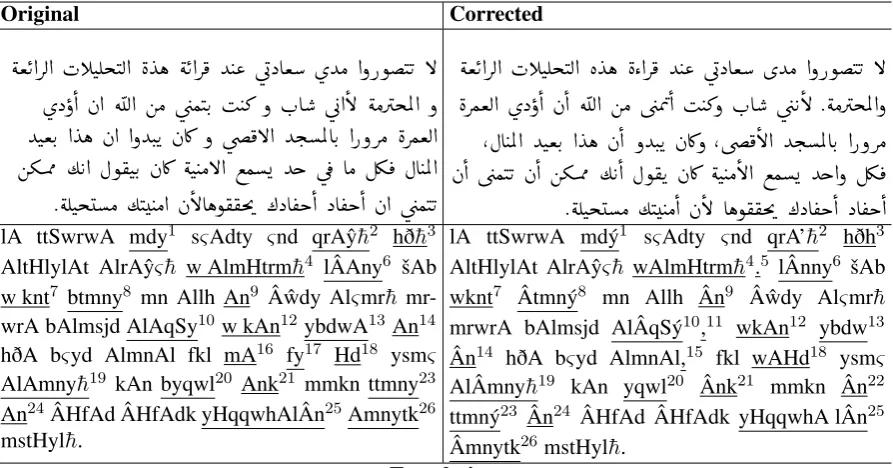
Table 1 presents a sample Arabic news com-ment along with its manually corrected form, its romanized transliteration,3 and the English
trans-lation. The errors in the original and the cor-rected forms are underlined and co-indexed. Ta-ble 2 presents a subset of the errors for the exam-ple shown in Table 1 along with the error types and annotation actions. The Appendix at the end of the paper listsallannotation actions for that example.4
Essays written by L2 speakers differ from the native texts both because of the genre and the types of mistakes. For this reason, the general QALB L1 annotation guidelines were extended by adding new rules describing the error correction proce-dure in texts produced by L2 speakers (Zaghouani et al., 2015a). Because the genres are different, the writing styles exhibit different distributions of words, phrases, and structures. Further, while na-tive texts mostly contain orthographic and punctu-ation mistakes, non-native writings also reveal lex-ical choice errors, missing and extraneous words (e.g. articles, prepositions), and mistakes in word
2In the shared task, we specified two Add categories:
add_beforeand add_after. Most of the add errors fall into the first category, and we combine these here into a single Addcategory.
3Arabic transliteration is presented in the Habash-Soudi-Buckwalter scheme (Habash et al., 2007): (in alphabetical order)AbtθjHxdðrzsšSDT ˇDςγfqklmnhwyand the additional symbols: ’
Z
, Â@
, ˇA@
, ¯A@
, ˆwð'
, ˆyZø'
,¯hè
, ýø
.Original Corrected
éªK@QË@ HCJÊjJË@ è Yë éK@Q¯ Y J« úGXAª øYÓ @ðPñJK B
øXð
@ à@ é<Ë@ áÓ ú
æÒJK. I J» ð H.A ú G@
B éÓQjÖÏ@ ð
YJªK. @ Yë à@ @ðYJ.K àA¿ ð úæ¯B@ Yj.ÖÏAK. @PðQÓ èQÒªË@
áºÜØ ½ K@ Èñ®JK. àA¿ éJ JÓB@ ©Ò Yg ú ¯ AÓ É¾ ¯ ÈA JÖÏ@
. éÊJjÓ ½J JÓ@ àBAëñ®®m' ¼XA ®k@ XA ®k@ à@ ú
æÒJK
éªK@QË@ HCJÊjJË@ è Yë èZ@Q¯ Y J« úGXAª øYÓ @ðPñJK B
èQÒªË@ øXð@ à@ é<Ë@ áÓ ú æÖß@ I J»ð H.A ú æ KB .éÓQjÖÏ@ð
,ÈA JÖÏ@ YJªK. @ Yë à@ ðYJ.K àA¿ð ,úæ¯B@ Yj.ÖÏAK. @PðQÓ
à@ ú æÒJK à@ áºÜØ ½ K@ Èñ®K àA¿ éJ JÓB@ ©Ò Yg@ð ɾ ¯
. éÊJjÓ ½J JÓ@ àB Aëñ®®m' ¼XA ®k@ XA ®k@
lA ttSwrwA mdy1 sςAdty ςnd qrAˆy¯h2 hð¯h3 AltHlylAt AlrAˆyς¯h w AlmHtrm¯h4 lÂAny6 šAb w knt7 btmny8 mn Allh An9  ˆwdy Alςmr¯h mr-wrA bAlmsjd AlAqSy10w kAn12ybdwA13An14 hðA bςyd AlmnAl fkl mA16 fy17 Hd18 ysmς AlAmny¯h19 kAn byqwl20 Ank21 mmkn ttmny23 An24ÂHfAd ÂHfAdk yHqqwhAlÂn25Amnytk26 mstHyl¯h.
lA ttSwrwA mdý1 sςAdty ςnd qrA’¯h2 hðh3 AltHlylAt AlrAˆyς¯h wAlmHtrm¯h4.5 lÂnny6 šAb wknt7 Âtmný8 mn Allh Ân9  ˆwdy Alςmr¯h mrwrA bAlmsjd AlÂqSý10,11 wkAn12 ybdw13 Ân14 hðA bςyd AlmnAl,15 fkl wAHd18 ysmς AlÂmny¯h19 kAn yqwl20 Ânk21 mmkn Ân22 ttmný23 Ân24 ÂHfAd ÂHfAdk yHqqwhA lÂn25 Âmnytk26mstHyl¯h.
Translation
[image:3.595.77.524.62.296.2]You cannot imagine the extent of my happiness when I read these wonderful and respectful analyses because I am a young man and I wish from God to perform Umrah passing through the Al-Aqsa Mosque; and it seemed that this was elusive that when anyone heard the wish, he would say that you can wish that your great grandchildren may achieve it because your wish is impossible.
Table 1: A sample of an original (erroneous) text along with its manual correction and English translation. The indices in the table are linked with those in Table 2 and the Appendix.
# Error Correction Error Type Correction Action
#1
øYÓ
mdyøYÓ
mdý Spelling Edit#6
ú G@
B
lÂAnyú æ K
B
lÂnny Spelling Edit#8
ú æÒJK.
btmnyú æÖß@
Âtmný Dialectal Edit#11 Missing Comma
,
Punctuation Add_before#12
àA¿ ð
w kAnàA¿ð
wkAn Spelling Merge #13@ðYJ.K
ybdwAðYJ.K
ybdw Morphology Edit #25àBAëñ®®m'
yHqqwhAlÂnàB Aëñ®®m'
yHqqwhA lÂn Spelling SplitTable 2: Error type and correction action for seven examples extracted from the sentence pair in Table 1. The indices are linked to those in Table 1 and the Appendix.
order, as shown in Table 3. Finally, even when a sentence written by a non-native writer does not contain obvious mistakes, it often still does not sound fluent to a native speaker.
4 Shared Task Data
To develop their systems, participants were pro-vided with training and development data three months prior to the release of the blind test sets. For the native (Aljazeera) track, the participants used the data sets from QALB-2014. We refer to these data sets asAlj-train-2014,Alj-dev-2014, andAlj-test-2014. The L2 track includes
L2-train-2015andL2-dev-2015. The systems were evalu-ated on blind test sets Alj-test-2015 and L2-test-2015.
Both for the native and L2 data, we ensured that sentences from the same comment or essay be-longed to the same set, i.e. training, development, or test. Furthermore, Aljazeera comments belong-ing to the same article were included only in one of the shared task subsets (i.e., training, develop-ment or test). The comdevelop-mentaries were also split by the annotation time.
[image:3.595.118.479.408.526.2]Error
èñk.
@Yg. ÉJÔg.
èPñ JÓ é JKYÖÏ@
é JKYÖÏ@
Almdyn¯hAlmdyn¯hmnwrhjmyl jdAjwh Edit
Aëñk.
@Yg. ÉJÔg.
èPñ JÖÏ@
é JKYÖÏ@
Almdyn¯hAlmnwr¯hjmyl jdAjwhA
[image:4.595.147.451.62.122.2]English The Madinah Munawwarah’s atmosphere is very beautiful
Table 3: Example of three errors shown in bold and described in order. The word
é JKYÖÏ@
Almdyn¯his repeated and should be removed. The wordèPñ JÓ
mnwrhis missing the definite articleÈ@
Alat the beginning of the word and the Ta-Marbutaè
¯his confused with the letter Haè
h. The correct word should beèPñ JÖÏ@
Almnwr¯h. Finally, there is a possessive pronoun agreement error in the wordèñk.
jwhand it should be spelledAëñk.
jwhAinstead.Data Edit Add Merge Split Delete Move OtherError type (%)
Alj-train-2014 55.3 32.4 5.9 3.5 2.2 0.1 0.5 Alj-dev-2014 53.5 34.2 5.0 3.7 2.0 0.1 0.5 Alj-test-2014 51.9 34.7 5.9 3.5 3.3 0.2 0.5 Alj-test-2015 51.9 34.7 5.9 3.5 3.3 0.2 0.5 L2-train-2015 60.7 27.2 5.0 1.9 4.4 <1 -L2-dev-2015 60.8 26.9 5.2 1.5 4.4 1.4 -L2-test-2015 60.3 27.5 5.2 1.5 4.6 1.1
-Table 5: Distribution of annotations by type in the shared task data. Error types denotes the action required in order to correct the error.
Data set # of words # of corrections
[image:4.595.157.444.212.338.2]Alj-train-2014 1M 306K Alj-dev-2014 54K 16K Alj-test-2014 51K 16K Alj-test-2015 49K 13K L2-train-2015 43K 13.2K L2-dev-2015 25K 7.3K L2-test-2015 23K 6.6K
Table 4: Statistics on the shared task data.
(1) plain text, one document per line; (2) text with annotations specifying errors and the corre-sponding corrections; (3) feature files specifying morphological information obtained by running MADAMIRA, a tool for morphological analysis and disambiguation of Modern Standard Arabic (Pasha et al., 2014). MADAMIRA performs mor-phological analysis and contextual disambigua-tion. Using the output of MADAMIRA, we gen-erated for each word thirty-three features. The features specify various properties: the part-of-speech (POS), lemma, aspect, person, gender, number, and so on.
Among its features, MADAMIRA generates normalization forms and as a result corrects a large subset of a special class of spelling mistakes in words containing the letters Alif and final Ya.
These letters are a source of the most common spelling types of spelling errors in Arabic and in-volveHamzated AlifsandAlif-Maqsura/Ya confu-sion (Habash, 2010; El Kholy and Habash, 2012). We refer to these errors asAlif/Yaerrors (see also Section 6). Several participants this year and in QALB-2014 (e.g. Rozovskaya et al. (2014)) used MADAMIRA predictions as part of their systems. We show the performance of the MADAMIRA baseline in Sec. 6.
[image:4.595.80.283.387.499.2]Team Name Affiliation
ARIB (AlShenaifi et al., 2015) King Saud University (Saudi Arabia) CUFE (Nawar, 2015) Cairo University (Egypt)
GWU (Attia et al., 2015) George Washington University (USA) QCMUQ (Bouamor et al., 2015) Carnegie Mellon University in Qatar (Qatar)
and Qatar Computing Research Institute (Qatar) QCRI (Mubarak et al., 2015) Qatar Computing Research Institute (Qatar) SAHSOH (Zaghouani et al., 2015b) Bouira University (Algeria)
and Carnegie Mellon University in Qatar (Qatar) TECH (Mostefa et al., 2015) Techlimed.com (France)
[image:5.595.74.527.61.225.2]UMMU (Bougares and Bouamor, 2015) Laboratoire d’Informatique de l’Université du Maine (France) and Carnegie Mellon University in Qatar (Qatar) Table 6: List of teams that participated in the shared task.
Team Approach External Resources
ARIB Corrections proposed by MADAMIRA; rules; levenshteindistance for spelling correction; Probabilistic-Based Spelling Correction; autocorrect Ghaltawi; Punctuation module
KSU corpus of classical Arabic; Open Source Arabic Corpora; Al Sulaiti Corpus; KACST Ara-bic Corpus; KHAWAS tool; autocorrect Ghaltawi CUFE Rules extracted from the Buckwalter morphological analyser;their probabilities are learned using the training data Buckwalter morphological analyzer Version 2.0(Buckwalter, 2004)
GWU A CRF model for punctuation errors; a dictionary, probabilis-tic candidate generation, and a language model for spelling and grammar errors; regular expressions and normalization rules
AraComLex Extended dictionary (Attia et al., 2012); Arabic Gigaword Fourth Edition (Parker et al., 2009)
QCMUQ Rule-based techniques; MADAMIRA corrections; SMT; lan-guage models; finite-state automata AraComLex dictionary (Attia et al., 2012);Ara-bic Gigaword Fourth Edition (Parker et al., 2009); news commentary corpus
QCRI Case-specific correction module; language model Aljazeera articles
TECH (1) Rule-based system using Hunspell (2) Hybrid system:Statistical MT with Madamira and rules Newspaper articles from Open Source ArabicCorpora; other corpora collected online; Hunspell
SAHSOH Rules, regular expressions, Ghaltawi Arabic word list; JRC-Names; Alfaifi L1 and L2corpus; Hunspell; Ayaspell dictionary; Ghalatawi; AkhtaBot script
[image:5.595.71.529.162.459.2]UMMU MADAMIRA corrections; word-level SMT and character-level SMT systems Native Arabic data
Table 7: Approaches adopted by the participating teams.
5 Participants and Approaches
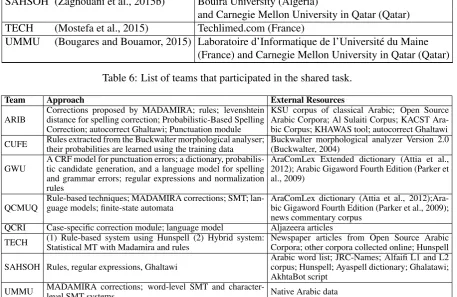
Eight teams participated in the shared task. Ta-ble 6 presents the list of participating institutions and their names in the shared task. Each team was allowed to submit up to three outputs. Overall, we received 12 outputs for the native track and 10 outputs for the non-native track (one of the teams – TECH – did not participate in the non-native track).
The submitted systems included a diverse set of approaches that incorporated rule-based frameworks, statistical machine translation and machine-learning models, as well as hybrid sys-tems. The teams that scored at the top employed hybrid methods by combining a variety of tech-niques. For example, the CUFE system extracted rules from the morphological analyzer and learned their probabilities using the training data, while the UMMU system combined statistical
machine-translation with MADAMIRA corrections. Ta-ble 7 summarizes the approaches adopted by each team.
6 Results
In this section, we present the results of the com-petition. As was done in QALB-2014, we adopted the standard Precision (P), Recall (R), andF1 met-ric. This metric was also used in recent shared tasks on grammatical error correction in English: HOO competitions (Dale and Kilgarriff, 2011; Dale et al., 2012) and CoNLL (Ng et al., 2013). The results are computed using the M2 scorer (Dahlmeier and Ng, 2012) that was also used in the CoNLL shared tasks.
Rank Team P R F1
1 CUFE 88.85 61.76 72.87
2 UMMU-1 70.28 71.93 71.10 3 GWU 74.69 67.51 70.92 4 UMMU-2 72.69 67.52 70.01 5 QCRI 84.74 58.10 68.94 6 QCMUQ 71.39 65.13 68.12 7 TECH-2 71.20 64.94 67.93 8 TECH-1 71.08 64.74 67.76 9 TECH-3 69.99 60.41 64.85 10 ARIB-1 64.50 56.50 60.23 11 ARIB-2 67.56 51.61 58.52 12 SAHSOH 81.88 40.24 53.97 MADAMIRA 80.32 39.98 53.39 Table 8: Official results on the test set (Alj-test-2015). Column 1 shows the system rank ac-cording to the F1 score. MADAMIRA refers to thebaseline of applying corrections proposed by MADAMIRA.
systems. The range of the scores is quite wide – from 53 to 72F1 on the native data and from 25 to 41 on non-native. Observe that the performance on the non-native data is substantially lower for all of the teams. This is to be expected as non-native writers exhibit a variety of errors – spelling, grammar, word choice. In contrast, the native data contains many punctuation and spelling mis-takes that can be handled by MADAMIRA and are much easier to address (see also analysis below). In fact, we used MADAMIRA as a baseline sys-tem (last row in the tables). As the results show, MADAMIRA provides quite a competitive base-line, especially on the native data. But all of the teams managed to beat this baseline, in many cases by a large margin. This suggests that even though MADAMIRA is a sophisticated system, it cannot handle all of the errors, and the participating teams developed approaches that are complementary to it.
It is interesting to compare the obtained results to those obtained on similar shared tasks on En-glish as a Second Language (ESL) writings. While the performance on native MSA data in Table 8is better than on ESL, performance on L2 writings is quite similar. For instance, the highest score in the HOO-2011 shared task (Dale and Kilgarriff, 2011) that addressed all errors was 21.1 (Rozovskaya et al., 2011); the highest performance in the CoNLL-2013 shared task that also used the same
evalua-Rank Team P R F1
1 UMMU-1 54.12 33.26 41.20
2 QCMUQ 50.37 31.68 38.90 3 UMMU-2 55.83 29.47 38.58 4 CUFE 70.92 23.85 35.69 5 GWU 55.66 23.32 32.87 6 ARIB-3 48.79 24.57 32.68 7 ARIB-2 50.08 22.30 30.86 8 QCRI-1 45.86 20.16 28.01 9 QCRI-2 54.87 17.63 26.69 10 SAHSOH 59.75 15.90 25.12 MADAMIRA 45.24 13.09 20.30 Table 9: Official results on the test set (L2-test-2015). Column 1 shows the system rank according to theF1 score. Column 1 shows the system rank according to theF1score. MADAMIRA refers to thebaselineof applying corrections proposed by MADAMIRA.
tion metric was 31.20 (Rozovskaya et al., 2013).5
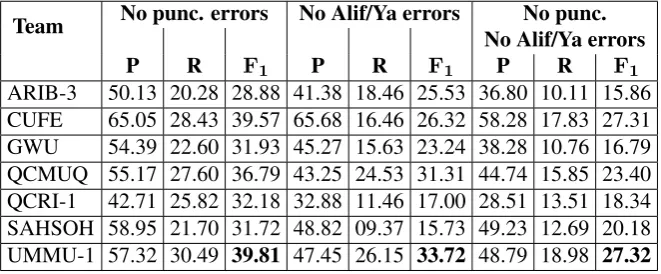
In addition to providing the official rankings, we also analyze system performance for differ-ent types of mistakes by automatically assigning errors to one of the following categories: punc-tuation errors; errors involving Alif and Ya; and all other errors. Punctuation errors account for 39% of all errors in the Aljazeera data.6 Tables 6
and 6 show the performance of the teams in three settings: with punctuation errors removed; with
Alif/Ya errors removed; and when both punctua-tion and Alif/Yaerrors are removed. In general, both for the native and the non-native data, perfor-mance drops when theAlif/Yaerrors are removed, which indicates that these errors may be easier. When the punctuation errors are removed, the per-formance on the native data improves slightly, but goes down a little on the non-native data. Overall, it can be concluded that the punctuation mistakes do not significantly affect the performance and are of the same difficulty level as the remaining of the errors.
Finally, the majority of the teams participated last year and relied on the findings from the pre-vious round. Overall, it can be said that the par-ticipants were able to make progress and to
im-5This is not a fair comparison, though, since the CoNLL-2013 shared task only evaluated on 5 types of errors and ig-nored about 50% of all mistakes in the data. In CoNLL-2014 that evaluated on all errors the top teams scored 35-37 points but the evaluation favored precision twice as much as recall.
[image:6.595.82.280.61.253.2] [image:6.595.318.515.62.230.2]Team No punc. errors No Alif/Ya errors No Alif/Ya errorsNo punc.
P R F1 P R F1 P R F1
ARIB-1 73.57 59.86 66.01 49.87 44.87 47.24 54.53 38.47 45.11 CUFE 85.80 77.98 81.70 84.25 43.29 57.19 80.12 58.24 67.45
[image:7.595.134.466.62.213.2]GWU 81.12 76.60 78.79 61.15 52.32 56.39 67.80 54.86 60.65 QCMUQ 75.89 76.29 76.09 56.45 48.73 52.31 59.05 54.77 56.83 QCRI 81.28 75.62 78.35 75.90 36.52 49.31 69.78 51.68 59.38 SAHSOH 83.85 55.65 66.90 71.44 24.78 36.79 79.86 41.45 54.57 TECH-2 81.90 70.74 75.91 54.82 46.40 50.26 65.77 39.53 49.38 UMMU-1 82.98 80.98 81.97 56.46 58.09 57.26 73.09 61.44 66.76
Table 10: Alj-test-2015: Results on the test set in different settings: with punctuation errors removed from evaluation; normalization errors removed; and when both punctuation and normalization errors are removed. Only the best output from each team is shown.
Team No punc. errors No Alif/Ya errors No Alif/Ya errorsNo punc.
P R F1 P R F1 P R F1
ARIB-3 50.13 20.28 28.88 41.38 18.46 25.53 36.80 10.11 15.86 CUFE 65.05 28.43 39.57 65.68 16.46 26.32 58.28 17.83 27.31 GWU 54.39 22.60 31.93 45.27 15.63 23.24 38.28 10.76 16.79 QCMUQ 55.17 27.60 36.79 43.25 24.53 31.31 44.74 15.85 23.40 QCRI-1 42.71 25.82 32.18 32.88 11.46 17.00 28.51 13.51 18.34 SAHSOH 58.95 21.70 31.72 48.82 09.37 15.73 49.23 12.69 20.18 UMMU-1 57.32 30.49 39.81 47.45 26.15 33.72 48.79 18.98 27.32
Table 11: L2-test-2015: Results on the test set in different settings: with punctuation errors removed from evaluation; normalization errors removed; and when both punctuation and normalization errors are removed. Only the best output from each team is shown.
prove their systems since last year. Although di-rect comparison is not possible since the test sets are not the same and the test data from last year was used for development, we observe that four teams scored more than 70F1points on the native data this year, while last year the best result that was obtained by the CLMB system (Rozovskaya et al., 2014) was 67.91 points. We refer the reader to the system description papers for more detail on how the respective systems have been improved.
7 Conclusion
This paper presented a report on QALB-2015, the second shared task on text correction of Ara-bic. QALB-2015 extended QALB-2014 that took place last year and focused on correcting texts written by native Arabic speakers. This year, we added a second track, on non-native data. We re-ceived 12 system submissions from eight teams. We are pleased with the extent of participation, the quality of results and the diversity of approaches.
Many participants continued from last year and improved and extended their systems. We feel mo-tivated to conduct new research competitions in the near future.
8 Acknowledgments
[image:7.595.134.465.274.411.2]Appendix A: Sample annotation file
The sequence of manual corrections for the example in Table 1 is shown below.
#1
øYÓ
A 2 3|||Edit|||øYÓ
|||REQUIRED|||-NONE-|||0#2
éK@Q¯
A 5 6|||Edit|||èZ@Q¯
|||REQUIRED|||-NONE-|||0#3
è Yë
A 6 7|||Edit|||è Yë
|||REQUIRED|||-NONE-|||0#4
éÓQjÖÏ@ ð
A 9 11|||Merge|||éÓQjÖÏ@ð
|||REQUIRED|||-NONE-|||0#5 A 11 11|||Add_before|||.|||REQUIRED|||-NONE-|||0
#6
ú G@
B
A 11 12|||Edit|||ú æ K
B
|||REQUIRED|||-NONE-|||0#7
I J» ð
A 13 15|||Merge|||I J»ð
|||REQUIRED|||-NONE-|||0#8
ú æÒJK.
A 15 16|||Edit|||ú æÖß@
|||REQUIRED|||-NONE-|||0#9
à@
A 18 19|||Edit|||à@
|||REQUIRED|||-NONE-|||0#10
úæ¯B@
A 23 24|||Edit|||úæ¯B@
|||REQUIRED|||-NONE-|||0#11 A 24 24|||Add_before|||
,
|||REQUIRED|||-NONE-|||0#12
àA¿ ð
A 24 26|||Merge|||àA¿ð
|||REQUIRED|||-NONE-|||0#13
@ðYJ.K
A 26 27|||Edit|||ðYJ.K
|||REQUIRED|||-NONE-|||0#14
à@
A 27 28|||Edit|||à@
|||REQUIRED|||-NONE-|||0#15 A 31 31|||Add_before|||
,
|||REQUIRED|||-NONE-|||0#16
AÓ
A 32 33|||Delete||||||REQUIRED|||-NONE-|||0#17
ú ¯
A 33 34|||Delete||||||REQUIRED|||-NONE-|||0#18
Yg
A 34 35|||Edit|||Yg@ð
|||REQUIRED|||-NONE-|||0#19
éJ JÓB@
A 36 37|||Edit|||éJ JÓB@
|||REQUIRED|||-NONE-|||0#20
閨JK.
A 38 39|||Edit|||閨K
|||REQUIRED|||-NONE-|||0#21
½ K@
A 39 40|||Edit|||½ K@
|||REQUIRED|||-NONE-|||0#22 A 41 41|||Add_before|||
à@
|||REQUIRED|||-NONE-|||0#23
ú æÒJK
A 41 42|||Edit|||ú æÒJK
|||REQUIRED|||-NONE-|||0#24
à@
A 42 43|||Edit|||à@
|||REQUIRED|||-NONE-|||0#25
àBAëñ®®m'
A 45 46|||Split|||àB Aëñ®®m'
|||REQUIRED|||-NONE-|||0References
A. Alfaifi and E. Atwell. 2012. Arabic Learner Cor-pora (ALC): A Taxonomy of Coding Errors. InThe 8th International Computing Conference in Arabic.
N. AlShenaifi, R. AlNefie, M. Yahya, and H. Al-Khalifa. 2015. ARIB@QALB-2015 Shared Task: A Hybrid Cascade Model for Arabic Spelling Error Detection and Correction . InProceedings of ACL Workshop on Arabic Natural Language Processing, Beijing, China, July.
M. Attia, P. Pecina, Y. Samih, K. Shaalan, and J. van Genabith. 2012. Improved Spelling Error Detection and Correction for Arabic. InProceedings of COL-ING.
M. Attia, M. Al-Badrashiny, and M. Diab. 2015. GWU-HASP-2015: Priming Spelling Candidates with Probability . InProceedings of ACL Workshop on Arabic Natural Language Processing, Beijing, China, July.
H. Bouamor, H. Sajjad, N. Durrani, and K. Oflazer. 2015. QCMUQ@QALB-2015 Shared Task: Com-bining Character level MT and Error-tolerant Finite-State Recognition for Arabic Spelling Correction. InProceedings of ACL Workshop on Arabic Natu-ral Language Processing, Beijing, China, July.
F. Bougares and H. Bouamor. 2015. UMMU@QALB-2015 Shared Task: Character and Word level SMT pipeline for Automatic Error Correction of Arabic Text. InProceedings of ACL Workshop on Arabic Natural Language Processing, Beijing, China, July.
T. Buckwalter. 2004. Buckwalter Arabic Morpho-logical Analyzer Version 2.0.
D. Dahlmeier and H. T. Ng. 2012. Better Evaluation for Grammatical Error Correction. InProceedings of NAACL.
R. Dale and A. Kilgarriff. 2011. Helping Our Own: The HOO 2011 Pilot Shared Task. InProceedings of the 13th European Workshop on Natural Language Generation.
R. Dale, I. Anisimoff, and G. Narroway. 2012. A Re-port on the Preposition and Determiner Error Cor-rection Shared Task. InProceedings of the NAACL Workshop on Innovative Use of NLP for Building Educational Applications.
A. El Kholy and N. Habash. 2012. Orthographic and morphological processing for English–Arabic sta-tistical machine translation. Machine Translation, 26(1-2).
S. Farwaneh and M. Tamimi. 2012. Arabic Learn-ers Written Corpus: A Resource for Research and Learning. The Center for Educational Resources in Culture, Language and Literacy.
N. Habash, A. Soudi, and T. Buckwalter. 2007. On Arabic Transliteration. In A. van den Bosch and A. Soudi, editors,Arabic Computational Mor-phology: Knowledge-based and Empirical Methods. Springer.
N. Habash. 2010. Introduction to Arabic Natural Lan-guage Processing. Morgan & Claypool Publishers. A. Hassan, S. Noeman, and H. Hassan. 2008.
Lan-guage Independent Text Correction using Finite State Automata. In Proceedings of the Third In-ternational Joint Conference on Natural Language Processing (IJCNLP 2008), pages 913–918, Hyder-abad, India.
B. Mohit, A. Rozovskaya, N. Habash, W. Zaghouani, and O. Obeid. 2014. The First QALB Shared Task on Automatic Text Correction for Arabic. In Pro-ceedings of EMNLP Workshop on Arabic Natural Language Processing, Doha, Qatar, October. D. Mostefa, J. Abualasal, O. Asbayou, M. Gzawi, and
R. Abbe`s. 2015. TECHLIMED@QALB-Shared Task 2015: a hybrid Arabic Error Correction Sys-tem. InProceedings of ACL Workshop on Arabic Natural Language Processing, Beijing, China, July. H. Mubarak, K. Darwish, and A. Abdelali. 2015. QCRI@QALB-2015 Shared Task: Correction of Arabic Text for Native and Non-Native Speakers’ Errors . InProceedings of ACL Workshop on Arabic Natural Language Processing, Beijing, China, July. M. Nawar. 2015. QALB 2015 Shared Task: CUFE Arabic Error Correction System. InProceedings of ACL Workshop on Arabic Natural Language Pro-cessing, Beijing, China, July.
H. T. Ng, S. M. Wu, Y. Wu, Ch. Hadiwinoto, and J. Tetreault. 2013. The CoNLL-2013 Shared Task on Grammatical Error Correction. InProceedings of CoNLL: Shared Task.
H. T. Ng, S. M. Wu, T. Briscoe, C. Hadiwinoto, R. H. Susanto, and C. Bryant. 2014. The CoNLL-2014 Shared Task on Grammatical Error Correction. In Proceedings of CoNLL: Shared Task.
O. Obeid, W. Zaghouani, B. Mohit, N. Habash, K. Oflazer, and N. Tomeh. 2013. A Web-based An-notation Framework For Large-Scale Text Correc-tion. InThe Companion Volume of the Proceedings of IJCNLP 2013: System Demonstrations. Asian Federation of Natural Language Processing. R. Parker, D. Graff, K. Chen, J. Kong, and K. Maeda.
2009. Arabic Gigaword Fourth Edition. LDC Cata-log No.: LDC2009T30, ISBN: 1-58563-532-4. A. Pasha, M. Al-Badrashiny, M. Diab, A. El Kholy,
A. Rozovskaya, M. Sammons, J. Gioja, and D. Roth. 2011. University of Illinois System in HOO Text Correction Shared Task. InProceedings of the Eu-ropean Workshop on Natural Language Generation (ENLG).
A. Rozovskaya, K.-W. Chang, M. Sammons, and D. Roth. 2013. The University of Illinois System in the CoNLL-2013 Shared Task. InProceedings of CoNLL Shared Task.
A. Rozovskaya, N. Habash, R. Eskander, N. Farra, and W. Salloum. 2014. The Columbia System in the QALB-2014 Shared Task on Arabic Error Correc-tion. InProceedings of EMNLP Workshop on Ara-bic Natural Language Processing: QALB Shared Task.
K. Shaalan, A. Allam, and A. Gomah. 2003. To-wards Automatic Spell Checking for Arabic. In Pro-ceedings of the 4th Conference on Language Engi-neering, Egyptian Society of Language Engineering (ELSE), Cairo, Egypt.
W. Zaghouani, B. Mohit, N. Habash, O. Obeid, N. Tomeh, A. Rozovskaya, N. Farra, S. Alkuhlani, and K. Oflazer. 2014. Large Scale Arabic Error An-notation: Guidelines and Framework. In Proceed-ings of the Ninth International Conference on Lan-guage Resources and Evaluation (LREC’14), Reyk-javik, Iceland.
W. Zaghouani, N. Habash, H. Bouamor, A. Ro-zovskaya, Behrang B. Mohit, A. Heider, and K. Oflazer. 2015a. Correction annotation for non-native arabic texts: Guidelines and corpus. In Pro-ceedings of The 9th Linguistic Annotation Work-shop, pages 129–139, Denver, Colorado, USA, June. Association for Computational Linguistics.