LIMSI @ WMT’15 : Translation Task
Benjamin Marie1,2,3, Alexandre Allauzen1,2, Franck Burlot1, Quoc-Khanh Do1,2, Julia Ive1,2,4, Elena Knyazeva1,2, Matthieu Labeau1,2, Thomas Lavergne1,2,
Kevin L¨oser1,2, Nicolas P´echeux1,2, Franc¸ois Yvon1 1LIMSI-CNRS, 91 403 Orsay, France
2Universit´e Paris-Sud, 91 403 Orsay, France 3Lingua et Machina
4Centre Cochrane franc¸ais
[email protected] Abstract
This paper describes LIMSI’s submis-sions to the shared WMT’15 translation task. We report results for French-English, Russian-English in both directions, as well as for Finnish-into-English. Our submis-sions use NCODEand MOSESalong with continuous space translation models in a post-processing step. The main novelties of this year’s participation are the follow-ing: for Russian-English, we investigate a tailored normalization of Russian to trans-late into English, and a two-step process to translate first into simplified Russian, fol-lowed by a conversion into inflected Rus-sian. For French-English, the challenge is domain adaptation, for which only mono-lingual corpora are available. Finally, for the Finnish-to-English task, we explore unsupervised morphological segmentation to reduce the sparsity of data induced by the rich morphology on the Finnish side.
1 Introduction
This paper documents LIMSI’s participation to the machine translation shared task for three language pairs: French-English and Russian-English in both directions, as well as Finnish-into-English. Each of these tasks poses its own challenges.
For French-English, the task differs slightly from previous years as it considers user-generated news discusssions. While the domain remains the same, the texts that need to be translated are of a less formal type. To cope with the style shift, new monolingual corpora have been made avail-able; they represent the only available in-domain resources to adapt statistical machine translation (SMT) systems.
For Russian-English, the main source of diffi-culty is the processing of Russian, a
morphologi-cally rich language with a much more complex in-flectional system than English. To mitigate the ef-fects of having too many Russian word forms, we explore ways to normalize Russian prior to trans-lation into English, so as to reduce the number of forms by removing some ”redundant” morpholog-ical information. When translating into Russian, we consider a two-step scenario. A conventional SMT system is first built to translate from En-glish into a simplified version of Russian; a post-processing step then restores the correct inflection wherever needed.
Finally, for Finnish-into-English, we report pre-liminary experiments that explore unsupervised morphological segmentation techniques to reduce the sparsity issue induced by the rich morphology of Finnish.
2 Systems Overview
Our experiments use NCODE1, an open source im-plementation of the n-gram approach, as well as MOSES, which implements a vanilla phrase-based approach.2 For more details about these toolkits, the reader can refer to (Koehn et al., 2007) for MOSESand to (Crego et al., 2011) for NCODE.
2.1 Tokenization and word alignments
Tokenization for French and English text relies on in-house text processing tools (D´echelotte et al., 2008). All bilingual corpora provided by the organizers were used, except for the French-English tasks where the UN corpus was not con-sidered.3 We also used a heavily filtered version of the Common Crawl corpus, where we discard all sentences pairs that do not look like proper French/English parallel sentences. For all
cor-1http://ncode.limsi.fr
2http://www.statmt.org/moses/
3In fact, when used in combination with the Giga Fr-En corpus, no improvement could be observed (Koehn and Had-dow, 2012).
pora, we finally removed all sentence pairs that did not match the default criteria of the MOSESscript
clean-corpus-n.pl or that contained more than 70 tokens.
Statistics regarding the parallel corpora used to train SMT systems are reported in Ta-ble 1 for the three language pairs under study. Word-level alignments are computed using fast align(Dyer et al., 2013) with options ”-d -o -v”.
2.2 Language Models
The English language model (LM) was trained on all the available English monolingual data, plus the English side of the bilingual data for the Fr-En, Ru-En and Fi-En language pairs. For the French language model, we also used all the provided monolingual data and the French side of the bilin-gual En-Fr data. We removed all duplicate lines4 and trained a 4-gram language model, pruning all singletons, withlmplz(Heafield et al., 2013).
2.3 SOUL
Neural networks, working on top of conventional
n-gram back-off language models, have been in-troduced in (Bengio et al., 2003; Schwenk et al., 2006) as a potential means to improve conven-tional language models. As in our previous par-ticipations (Le et al., 2012b; Allauzen et al., 2013; P´echeux et al., 2014), we take advantage of the proposal of (Le et al., 2011). Using a specific neural network architecture, theStructured OUt-put Layer (SOUL), it becomes possible to esti-maten-gram models that use large output vocab-ulary, thereby making the training of large neural network language models feasible both for target language models and translation models (Le et al., 2012a). Moreover, the peculiar parameterization of continuous models allows us to consider longer dependencies than the one used by conventional
n-gram models (e.g.n= 10instead ofn= 4).
3 Experiments for French-English
This year, the French-English translation task fo-cuses on user-generated News discusssions, a less formal type of texts than the usual News articles of the previous WMT editions. Therefore, the main
4Experiments not reported in this paper showed no changes in BLEU score between keeping or removing dupli-cate lines, but removing duplidupli-cate lines conveniently reduced the size of the models due to singleton pruning.
challenge for this task is domain adaptation, for which only monolingual data are distributed.
3.1 Development and test sets
Since this is the first time this translation task is considered, only a small development set of news-discusssions is available. In order to properly tune and test our systems, we performed a 3-fold cross-validation, splitting the 1,500 in-domain sentences in two parts. Each random split respects doc-ument boundary, and yields roughly 1,000 sen-tences for tuning and 500 sensen-tences for testing. The source of the documents, the newspapersLe Monde and The Guardian are also known. This allows us to balance the proportion of documents from each source in the development and test sets. The BLEU scores for the French-English experi-ments are computed on the concatenation of each test set decoded using weights tuned on the corre-sponding 1,000 sentence tuning set.
3.2 Domain adaptation
The vast majority of bilingual data distributed for the translation task are News articles, meaning that they correspond to a more formal register than the News discussions. The only in-domain texts pro-vided for this task are monolingual corpora. Nev-ertheless, these monolingual data have been used to adapt both the translation and language models. To adapt the bilingual data, we subsampled the concatenation of the noisy Common Crawl and Giga Fr-En corpus, which represent around 90% of all our bilingual data, using the so-called Mod-ified Moore-Lewis (Axelrod et al., 2011) filter-ing method (MML). We kept all the Europarl and News-Commentary data. MML expects 4 LMs to score sentence pairs in the corpus we wish to fil-ter: for the source and target languages, it requires a LM trained with in-domain data, along with an out-of-domain LM estimated on the data to fil-ter.5 TheMML score of a sentence pair is the sum of the source and target’s perplexity differences for both in-domain and out-of-domain LMs. Sen-tences pairs are ranked according to theMMLscore and the topN parallel sentences are used to learn the translation table used during decoding.
For LM adaptation, we used a log-linear combi-nation of our large LM with a smaller one trained only on the monolingual in-domain corpus.6
5All language models for theMML scoring are 4-grams trained withlmplz.
sen-Corpus Sentences Fr-EnTokens (Fr-En) Sentences Tokens (Ru-En) Sentences Tokens (Fi-En)Ru-En Fi→En parallel data 24.3M 712.8M-597.7M 2.3M 45.7M-47.3M 2M 37.3M-51.7M
monolingual data 2.2B-2.7B 834.7M-2.7B -2.7B
Table 1: Statistical description of the training corpora
3.3 Reranking
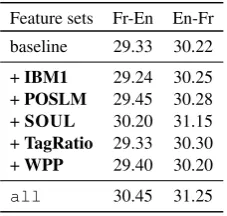
The N-best reranking steps uses the following fea-ture sets to find a better hypothesis among the 1,000-best hypotheses of the decoder:
• IBM1: IBM1 features (Hildebrand and Vo-gel, 2008);
• POSLM: 6-gram Witten-Bell smoothed POS LM trained with SRILM on all the monolin-gual news-discussions corpus;
• SOUL: Five features, one monolingual tar-get language model and 4 translation models, see section 2.3 for details;
• TagRatio: ratio of translation hypothesis by number of source tokens tagged as verb, noun or adjective;
• WPP: count-based word posterior probabil-ity (Ueffing and Ney, 2007);
POS tagging is performed using theStanford Tagger7. The reranking system is trained us-ing the kb-miraalgorithm (Cherry and Foster, 2012) implemented in MOSES.
3.4 Experimental results
For all French-English experiments, we used MOSES and NCODEwith the default options, in-cluding lexicalized reordering models. Tuning is performed using kb-mira with default options on 200-best hypotheses.
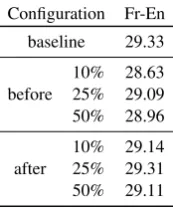
Table 2 reports experimental results for filter-ing the bilfilter-ingual data usfilter-ing MML before or after learning the word alignment step. Results for fil-tering are always lower when the word alignments are learnt only on the filtered data. The baseline system, which uses all the bilingual data, yields better performance than all our filtered systems, even though keeping only 25% of the bi-sentences, gives almost similar results. However, since there is no clear gain in filtering, we kept all the data without anyMMLfiltering for the following exper-iments. The additional LM learned only on the in-domain data gives a slight improvement, +0.18 tences for French and English.
7http://nlp.stanford.edu/software/tagger.shtml
Configuration Fr-En baseline 29.33
before 10% 28.6325% 29.09 50% 28.96
[image:3.595.373.460.165.270.2]after 10% 29.1425% 29.31 50% 29.11
Table 2: Results (BLEU) for keeping the top 10%, 25% or 50% of the bi-sentences scored withMML, before and after word alignment. The baseline sys-tem uses all the bilingual data.
[image:3.595.350.484.351.391.2]Configuration Fr-En En-Fr w/o additional LM 29.15 29.56 w/ additional LM 29.33 30.22
Table 3: Results (BLEU) with and without the ad-ditional in-domain language model.
BLEU, for Fr-En, and a larger improvement for En-Fr (+0.66 BLEU, see Table 3).
Table 4 reports the comparison between NCODE and MOSES. MOSESoutperforms NCODEon our in-house test set using the 3-fold cross-validation procedure. However, when tuning on the complete development set and testing on the official test set, we observed a different result where NCODE out-performs MOSESfor Fr-En (+0.69 BLEU), while MOSES remains the best choice for En-Fr (+0.74 BLEU). These differences between the results ob-tained with our dev/test configuration and the of-ficial ones may be due to the lack of tuning data when performing the 3-fold cross-validation, leav-ing only 1,000 sentences for tunleav-ing. Nonetheless, further investigations will be helpful to better un-derstand these discrepancies.
re-System Fr-En En-Fr Fr-En En-Frin-house test official test MOSES 29.33 30.22 32.16 35.74 NCODE 28.66 30.17 32.85 35.00
Table 4: Results (BLEU) for NCODEand MOSES on respectively the in-house and official test set.
Feature sets Fr-En En-Fr baseline 29.33 30.22 +IBM1 29.24 30.25 +POSLM 29.45 30.28 +SOUL 30.20 31.15 +TagRatio 29.33 30.30 +WPP 29.40 30.20
all 30.45 31.25
Table 5: Reranking results (BLEU) using differ-ent feature sets individually and their combination. For theall configurations these features are in-troduced during a reranking step.
sults can be further improved by adding more fea-tures during the reranking phase, with a final gain of +1.12 and +1.03 BLEU, for respectively Fr-En and En-Fr.
Our primary submissions for Fr-En and En-Fr use MOSES to generate n-best list, with phrase and reordering tables learned from all our bilin-gual data; the reranking step includes all the fea-tures presented in section 3.3.
4 Russian-English
Russian is a morphologically rich language char-acterized notably by a much more complex inflec-tion system than English. This observainflec-tion was the starting point of our work and led us to explore ways to process Russian in order to make it closer to English.
4.1 Preprocessing Russian
Inflections in Russian encode much more infor-mation than in English. For instance, while En-glish adjectives are invariable, their Russian coun-terparts surface as twelve distinct word forms, ex-pressing variations in gender (3), number (2) and case (6). Such a diversity of forms creates data sparsity issues, since many word forms are not ob-served in training corpora. When translating from Russian, the number of unknown words is accord-ingly high, making it impossible to translate many
forms, even when they exist in the training corpus with a different inflection mark. Conversely, when translating into Russian, the system may not be able to generate the correct word form in a given context. Finally note that training translation mod-els for such a language pair causes each English word to be typically paired with a lot of transla-tions of low probability, corresponding to morpho-logical variants on the Russian side.
To address this issue, we decided to normalize Russian by replacing all case marks by the cor-responding nominative inflection: this applies to nouns, adjectives and pronouns. For these word types, the case information is thus lost, but the gender and number marks are preserved.
4.2 Predicting Case Marks
When translating into Russian, the normalization scheme described above is not well suited because of its lossy reduction of Russian word forms. Its use therefore requires a post processing step which aims to recover the inflected forms from the output of the SMT system. Since normalization essen-tially removes the case information, this last step consists in predicting the right case for a given nor-malized word before generating the correctly in-flected form.
For this purpose, we designed a cascade of Con-ditional Random Fields (CRFs) models. A first model predicts POS tags, which are then used by a second model to predict the gender and number information. A last model is then used to in-fer the case from this information. POS, gender and number prediction are used to disambiguate the normalized words, which is necessary to gen-erate the correct word forms. All predictions were performed considering only the target side output, meaning that no information from the source was used. The first two models use standard features for POS tagging as described in (Lavergne et al., 2010). The last one (for case prediction) addition-ally contains features testing the presence of a verb or a preposition in the close vicinity of the word under consideration.
4.3 Experimental results
[image:4.595.125.239.169.277.2]The results reported in Table 6 show a similar trend for NCODE and MOSES in both translation directions. Note that MOSESoutperforms NCODE (+0.72 BLEU) for Ru-En task. Using normal-ized Russian as the source language allows us to achieve a slight gain of +0.4 over the baseline for both systems. Moreover, the addition of SOUL models yields a further improvement of 1.1 BLEU score (see Table 7). The English-into-normalized-Russian task has been performed for the sake of comparison, to assess the gain we could expect if we were able to always predict the right case for the normalized Russian output. The comparison of BLEU scores between translating directly into Russian and producing an intermediate normal-ized Russian shows differences of 3.15 BLEU for NCODEand 3.44 BLEU for MOSES. These scores represent an upper-bound that unfortunately we were not able to reach with our post-processing scheme.
System MOSES NCODE
Baseline 26.85 26.02 + Normalized Ru 27.27 26.44
+ SOUL 27.28
Table 6: Results (BLEU) for Russian-English with NCODEand MOSESon the official test.
System MOSES NCODE
Baseline 22.91 22.97
+ SOUL 24.08
[image:5.595.311.498.350.566.2]En-Rx 26.35 26.12 En-Rx-Ru 19.99 19.88
Table 7: Results (BLEU) for English-Russian (Rx stands for normalized Russian) with NCODE and MOSES on the official test. The score for En-Rx was obtained over the normalized test.
4.4 Error Analysis
As Russian is a morphologically rich language, which has many features not observed in the En-glish language, we conducted a simple error anal-ysis to better understand the possible morpholog-ical mistakes made by our NCODE baseline. We used METEOR to automatically align the outputs with the original references at the word level, dis-carding multiple alignment links. About 56.3%
of the words in the NCODE output have a
coun-terpart in the human references, which is consis-tent with the BLEU unigram precision (53.3%). Among those, 85.4% are identical and 9.8%are different but share a common lemma. This last sit-uation happens when our system fails to predict the correct form. The remaining 4.8% (different word forms with no common lemma), correspond either to synonyms or to METEOR alignment er-rors. Figure 1 also suggests that, within the9.8%
word form errors, most morphological errors are related to case prediction. Figure 1 displays de-tailed results split by POS. Results for MOSES or when rescoring NCODE outputs with SOUL are very similar.
case 52.5%
number
21.0% gender
14.9% tense
5.6%
voice 4.5% others
2.5%
(a) Incorrectly predicted inflections
noun 44.6%
verb
12.6% long-form adjective
35.1%
long-form participle
4.2%
others
3.5%
(b) Word form errorswrtPOS
Figure 1: Distribution of mispredictions for NCODEoutputs, according to the mispredicted in-flection (a) and their POS (b).
5 Translating Finnish into English
Configuration dev. test
Baseline 13.2 12.8
[image:6.595.111.253.64.111.2]+ large LM 16.1 15.7 + Morph. segmentation 16.2 15.9
Table 8: BLEU scores for the Finnish to English translation task, obtained with different configura-tions after a two-fold cross-validation.
lines give the BLEU scores obtained with a basic tokenization of the Finnish side. When the English LM is only estimated on the parallel data, the sys-tem achieves a BLEU score of 12.8, while using a LM estimated on all the available monolingual data yields a 1.8 BLEU point improvement.
Finnish is a synthetic language that employs ex-tensive regular agglutination. This peculiarity im-plies a large variety of word forms and, again, se-vere sparsity issues. For instance, we observed on the available parallel training data 860K different Finnish forms for 37.3M running words and only 2M sentences. Among these forms, more than half are hapax. For comparison purposes, we observed in English 208K word forms for 51.7M running words. To address this issue, we have tried to re-duce the number of forms in the Finnish part of the data. For that purpose, we useMorfessor 8 to perform an unsupervised morphological segmen-tation. The new Finnish corpus therefore con-tains 67K types for 77M running words. With this new version, we obtain only a slight improve-ment of 0.2 BLEU point. We assume that the Finnish data was over-segmented and that a bet-ter tradeoff can be found with an extensive tuning ofMorfessor.
6 Discussion and Conclusion
This paper described LIMSI’s submissions to the shared WMT’15 translation task. We reported re-sults for French-English, Russian-English in both direction, as well as for Finnish-into-English. Our submissions used NCODEand MOSES along with continuous space translation models in a post-processing step. Most of our efforts for this years participation were dedicated to domain adaptation and more importantly to explore different strate-gies when translating from and into a morpholog-ically rich language.
For French-English, we experimented
adapta-8https://github.com/aalto-speech/ morfessor
tion using only monolingual data that represents the targeted text, i.e news-discussions. Our at-tempt to filter the available parallel corpora did not bring any gain, while the use of an additional language model estimated on news-discussions yielded slight improvement.
When translating from Russian into English, small improvements were observed with a tailored normalization of Russian. This normalization was designed to reduce the number of word forms and to make it closer to English. However, experi-ments in the other direction were disappointing. While the first step that translates from English to the normalized version of Russian showed positive results, the second step designed to recover Rus-sian inflected forms failed. This failure may be related to the cascade of statistical models, work-ing solely on the target side. However, the reasons need to be better understood with a more detailed study.
To translate from Finnish into English, we explored the use of unsupervised morphological segmentation. Our attempt to reduce the num-ber of forms on the Finnish side did not sig-nificantly change the the BLEU score. This under-performance can be explained by an over-segmentation of the Finnish data, and maybe a bet-ter tradeoff can be found with a more adapted seg-mentation strategy.
We finally reiterate our past observations that continuous space translation models used in a post-processing step always yielded significant improvements across the board.
Acknowledgements
References
Alexandre Allauzen, Nicolas P´echeux, Quoc Khanh Do, Marco Dinarelli, Thomas Lavergne, Aur´elien Max, Hai-son Le, and Franc¸ois Yvon. 2013. LIMSI @ WMT13. In Proceedings of WMT, Sofia, Bul-garia.
Amittai Axelrod, Xiaodong He, and Jianfeng Gao. 2011. Domain adaptation via pseudo in-domain data selection. In Proceedings of EMNLP, Edinburgh, Scotland.
Yoshua Bengio, R´ejean Ducharme, Pascal Vincent, and Christian Jauvin. 2003. A neural probabilistic lan-guage model. Journal of Machine Learning Re-search.
Colin Cherry and George Foster. 2012. Batch tuning strategies for statistical machine translation. In Pro-ceedings of NAACL-HLT, Montr´eal, Canada. Josep M. Crego, Franc¸ois Yvon, and Jos´e B. Mari˜no.
2011. N-code: an open-source bilingual N-gram SMT toolkit. Prague Bulletin of Mathematical Lin-guistics, 96.
Daniel D´echelotte, Gilles Adda, Alexandre Allauzen, Olivier Galibert, Jean-Luc Gauvain, H´el`ene May-nard, and Franc¸ois Yvon. 2008. LIMSI’s statistical translation systems for WMT’08. InProceedings of NAACL-HTL Statistical Machine Translation Work-shop, Columbus, Ohio.
Chris Dyer, Victor Chahuneau, and Noah A. Smith. 2013. A simple, fast, and effective reparameteri-zation of ibm model 2. In Proceedings of NAACL, Atlanta, Georgia.
Kenneth Heafield, Ivan Pouzyrevsky, Jonathan H. Clark, and Philipp Koehn. 2013. Scalable modi-fied Kneser-Ney language model estimation. In Pro-ceedings of ACL, Sofia, Bulgaria.
Almut Silja Hildebrand and Stephan Vogel. 2008. Combination of machine translation systems via hy-pothesis selection from combined n-best lists. In Proceedings of AMTA, Honolulu, Hawa.
Philipp Koehn and Barry Haddow. 2012. Towards effective use of training data in statistical machine translation. In Proceedings of WMT, Montr´eal, Canada.
Philipp Koehn, Hieu Hoang, Alexandra Birch, Chris Callison-Burch, Marcello Federico, Nicola Bertoldi, Brooke Cowan, Wade Shen, Christine Moran, Richard Zens, Chris Dyer, Ondrej Bojar, Alexandra Constantin, and Evan Herbst. 2007. Moses: Open source toolkit for statistical machine translation. In Proceedings of the ACL Demo, Prague, Czech Re-public.
Thomas Lavergne, Olivier Capp´e, and Franc¸ois Yvon. 2010. Practical very large scale CRFs. In Proceed-ings of ACL, Uppsala, Sweden.
Hai-Son Le, Ilya Oparin, Alexandre Allauzen, Jean-Luc Gauvain, and Franc¸ois Yvon. 2011. Structured output layer neural network language model. In Pro-ceedings of ICASSP, Prague, Czech Republic. Hai-Son Le, Alexandre Allauzen, and Franc¸ois Yvon.
2012a. Continuous space translation models with neural networks. In Proceedings of NAACL-HLT, Montr´eal, Canada.
Hai-Son Le, Thomas Lavergne, Alexandre Al-lauzen, Marianna Apidianaki, Li Gong, Aur´elien Max, Artem Sokolov, Guillaume Wisniewski, and Franc¸ois Yvon. 2012b. LIMSI @ WMT12. In Pro-ceedings of WMT, Montr´eal, Canada.
Nicolas P´echeux, Li Gong, Quoc Khanh Do, Ben-jamin Marie, Yulia Ivanishcheva, Alexandre Al-lauzen, Thomas Lavergne, Jan Niehues, Aur´elien Max, and Franc¸ois Yvon. 2014. LIMSI @ WMT14 Medical Translation Task. InProceedings of WMT, Baltimore, Maryland.
Holger Schwenk, Daniel D´echelotte, and Jean-Luc Gauvain. 2006. Continuous space language models for statistical machine translation. InProceedings of the COLING/ACL, Morristown, US.