Do Distributed Semantic Models Dream of Electric Sheep?
Visualizing Word Representations through Image Synthesis
Angeliki Lazaridou and Dat Tien Nguyen and Marco Baroni Center for Mind/Brain Sciences
University of Trento
{angeliki.lazaridou|tiendat.nguyen|marco.baroni}@unitn.it
Abstract
We introduce the task of visualizing dis-tributed semantic representations by gen-erating images from word vectors. Given the corpus-based vector encoding the word
broccoli, we convert it to a visual repre-sentation by means of a cross-modal map-ping function, and then use the mapped representation to generate an image of broccoli as “dreamed” by the distributed model. We propose a baseline dream syn-thesis method based on averaging pictures whose visual representations are topologi-cally close to the mapped vector. Two ex-periments show that we generate dreams that generally belong to the the right se-mantic category, and are sometimes accu-rate enough for subjects to distinguish the intended concept from a related one.
1 Introduction
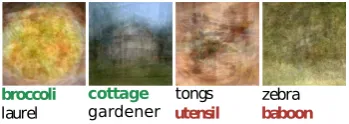
When researchers “visualize” dis-tributed/distributional semantic models, they typically present 2D scatterplots illustrating the distances between a set of word representa-tions (Van der Maaten and Hinton, 2008). We propose a much more direct approach to visual-ization. Given a vector representing a word in a corpus-derived distributed space, we generate a picture depicting how the denotatum of the word looks like, according to the model. Given, say, the word2vec vector ofbroccoli, we want to know how broccoli looks like to word2vec (see Figure 1 for the answer).
Besides the inherent coolness of the task, it has many potential applications. Current quali-tative analysis of distributed semantic models is limited to assessing the relation between words, e.g., by looking at, or plotting, nearest neighbour sets, but it lacks methods to inspect the
proper-ties of a specific word directly. Our image syn-thesis approach will allow researchers to “see”, in a very literal sense, how a model represents a sin-gle word. Moreover, in the spirit of the “A pic-ture is worth a thousand words” adage, the gener-ated images will allow researchers to quickly eye-ball the results, getting the gist of what a model is capturing much faster than from textual neigh-bour lists. For example, a more “topical” model might produce pictures depicting the wider scenes in which objects occur (a ball being dribbled by soccer players), whereas a model capturing strictly conceptual aspects might produce narrow views of the denoted objects (a close-up of the ball). Im-age synthesis could also be used to explore the ef-fect of different input corpora on representations: e.g., given a historical corpus, generate images for the car word representations induced from early 20th-century vs. 21st-century texts. As a last ex-ample, Aletras and Stevenson (2013) proposed to examine the topics of Topic Models by associating them with images retrieved from the Web. Given that topics are represented by vectors, we could di-rectlygenerateimages representing these topics.
In cognitive science, there is a lively debate on whether abstract words have embodied repre-sentations, (Barsalou and Wiemer-Hastings, 2005; Lakoff and Johnson, 1999), an issue that has re-cently attracted the attention of the distributed se-mantics community (Hill and Korhonen, 2014; Kiela et al., 2014; Lazaridou et al., 2015). An in-triguing application of image synthesis would be to produce and assess imagery for abstract con-cepts. Recent work in neuroscience attempts to generate images of “what people think”, as en-coded in vector-based representations of fMRI patterns (Naselaris et al., 2009; Nishimoto et al., 2011). With our method, we could then directly compare images produced from corpus-based rep-resentations to what humans visualize when think-ing of the same words.
In the long term, we would like to move be-yond words, towards generating images depicting the meaning of phrases (e.g., an angry cat vs. a cute cat vs. a white cat) and sentences. This would nicely complement current work on generating verbal descriptions of images (Karpathy and Fei-Fei, 2015; Kiros et al., 2014) with the inverse task of generating images from verbal descriptions.
Generating images from vectorial word rep-resentations is of course extremely challenging. However, various relevant strands of research have reached a level of maturity that makes it a realis-tic goal to pursue. First, tools such as word2vec (Mikolov et al., 2013a) and Glove (Pennington et al., 2014) produce high-quality word representa-tions, making us confident that we are not trying to generate visual signals from semantic noise. Sec-ond, there is very promising recent work on learn-ing to map between word representations and an (abstract) image space, for applications such as image retrieval and annotation (Frome et al., 2013; Karpathy and Fei-Fei, 2015; Kiros et al., 2014; Lazaridou et al., 2014; Socher et al., 2014). Fi-nally, the computer vision community is starting to explore the task of image generation (Gregor et al., 2015), typically in an attempt to understand the inner workings of visual feature extraction al-gorithms (Zeiler and Fergus, 2014).
The main aim of this paper is to present proof-of-concept evidence that the task is feasible. To this end, we rely on state-of-the-art word represen-tation and cross-modality mapping methods, but we adopt an image synthesis strategy that could be seen as an interesting baseline to compare other approaches against. Briefly, our pipeline works as follows. Our input is given by pre-computed word representations (word2vec) and a set of la-beled images together with their pre-compiled rep-resentations in a high-level visual feature space (specifically, we use activations on one of the top layers (fc7) of a convolutional neural network as high-level image representations). Given an input word vector, we use a linearcross-modal function
to map it into visual space, and we retrieve then
nearest image representations. Finally, we overlay the actual images corresponding to these nearest neighbours in order to derive a visualization of the mapped word, a method we refer to asaveraging. For example, the first image in Figure 1 below is our visualization of broccoli, obtained by project-ing thebroccoliword vector onto visual space,
re-trieving the 20 nearest images and averaging them. Importantly, we apply this synthesis method to words that are not used to train the cross-modal mapping function, and that do not match the label of any picture in the image data set. So, for ex-ample, our system had to mapbroccolionto visual space without having ever been exposed to labeled broccoli images (zero-shot setting), and it gener-ated thebroccoliimage by averaging pictures that do not depict broccoli.
2 General setup
We refer to the words we generate images for as
dreamedwords, and to the corresponding images asdreams. We refer to the set of words that are associated to real pictures asseenwords. The real picture set contains approximately 500K images extracted from ImageNet (Deng et al., 2009) rep-resenting 5.1K distinct seen words. The dreamed word set includes 510 concrete, base-level con-cepts from the semantic norms of McRae et al. (2005) (we excluded 31 McRae concepts because they were marked as ambiguous there, or for tech-nical reasons).
Linguistic and Visual Representations For all seen and dreamed concepts, we build 300-dimensional word vectors with the word2vec toolkit,1 choosing the CBOW method.2 CBOW,
which learns to predict a target word from the ones surrounding it, produces state-of-the-art re-sults in many linguistic tasks (Baroni et al., 2014). Word vectors are induced from a corpus of 2.8 billion words.3 The 500K images are
repre-sented by 4096-dimensional visual vectors, ex-tracted with the pre-trained convolutional neural network model of Krizhevsky et al. (2012) through the Caffe toolkit (Jia et al., 2014).
Cross-modal mapping We use 5.1K training pairs (wc,vc)={wc∈R300,vc∈R4096}, where wcis the word vector andvcthe visual vector for
(seen) conceptc, the latter obtained by averaging all visual representations labeled with the concept (no dreamed concept is included in the training
1https://code.google.com/p/word2vec/ 2Other hyperparameters, adopted without tuning, include
a context window size of 5 words to either side of the target, setting the sub-sampling option to 1e-05 and estimating the probability of target words by negative sampling, drawing 10 samples from the noise distribution (Mikolov et al., 2013b).
set, given the zero-shot setup). Following previ-ous work on cross-modal mapping (Frome et al., 2013; Lazaridou et al., 2014), we assume a lin-ear mapping function. To estimate its parameters
M ∈ R300×4096, given word vectors W paired
with visual vectorsV, we use L1-penalized least squares (Lasso) regression:4
ˆ
M= argmin
M∈R300×4096kWM−VkF +λkMk1 Image synthesis Suppose you have never seen cougars, but you know they are big cats. You might reasonably visualize a cougar as resembling a combination of lions, cheetahs and other fe-lines. One simple way to simulate this process is throughimage averaging. Specifically, given the word representation wc of a dreamed concept c,
we apply cross-modal mapping M to obtain an estimate of its visual vector ˆvc. Following that,
we search for the top k = 20 nearest images in 4096-dimensional visual space. Finally, the dream of concept c is obtained by averaging the colors in each pixel position (x, y) across the 20 images. These images donotcontain the dreamed concept, and they will typically depictseveraldistinct con-cepts (e.g., with a fairly accurate mappingM, we might get the dream of cougar by averaging im-ages of 5 cheetahs and 15 lions).5
3 Experiment 1: Naming the dream Task definition and data collection In this ex-periment we presented a dream, and asked sub-jects if they thought it was more likely to denote the correct dreamed word or a confounder ran-domly picked from the seen word set (we did not use the “dream” terminology to explain the task to subjects). Since the confounder is a randomly picked term, the task is relatively easy. At the same time, since the confounders are picked from a set of concrete concepts, just like the dreamed words, it sometimes happens that the two concepts are quite related, as illustrated in Figure 1. More-over, all confounders were used to train the map-ping function, and their pictures are present in the averaging pool. These factors could introduce a bias in favour of them. We tested all 510 McRae
4λis 10-fold cross-validated on the training data. 5The idea of generating a more abstract depiction of
something by averaging a number of real pictures is popular in contemporary art (Salavon, 2004) and it has recently been adopted in computer vision, as a way to visualize large sets of images of the same concept, e.g., averaging across different cat breeds (Zhu et al., 2014).
baboon zebra
broccoli
laurel
tongs utensil
cottage
[image:3.595.329.504.62.124.2]gardener
Figure 1: Experiment 1: Example dreams with correct dreamed word and confounder. Subjects showed a significant preference for the colored word (green if right, red if wrong).
words, collecting 20 ratings for each. We ran-domized word order both across and within trials. We used the CrowdFlower6platform to collect the
judgments, limiting participation to subjects from English-speaking countries who self-declared En-glish as their native language.
Results Subjects show a consistent preference for the correct (dreamed) word (median propor-tion of votes in favor of it: 90%). Prefer-ence for the correct word is significantly dif-ferent from chance in 419/510 cases (two-sided exact binomial tests, corrected for mul-tiple comparisons with the false discovery rate method, α = .05). Subjects expressed a sig-nificant preference for the confounder in only 5 cases (budgie/parakeet, cake/pie, camel/ox, shot-gun/revolver,squid/octopus).
For the first two dreams in Figure 1, subjects showed a significant preference for the dreamed word, despite the fact that the confounder is a re-lated term. Still, when the two words are closely related, it is more likely that subjects will be at random. The figure also shows two interesting ex-amples in which dreamed word and confounder are related, and subjects significantly preferred the latter. Thetongs/utensilcase is very challenging, because any tongs picture would also be an utensil picture (and the dreamed object does not look like tongs to start with). Forzebra/baboon, we conjec-ture that subjects could make up an animal in the dream, but one lacking the salient black-and-white pattern of zebras.
4 Experiment 2: Picking the right dream Task definition and data collection In this ex-periment, we matched each dreamed word with its own dream and a confounder dream gener-ated from the most similar dreamed term (see Figure 2 for examples). Word similarity was
measured in a space defined by subject-generated properties describing the concepts of interest (this method is known to produce high-quality similar-ity estimates, better than those obtained with text-based distributional models, see, e.g., Baroni et al. (2010)). Subjects were asked which of the two im-ages is more likely to contain the thing denoted by the word. This is a very challenging task, as in most cases target and confounder are closely re-lated concepts, and thus their dreams must have considerable granularity to allow subjects to make the correct choice. Again, we used CrowdFlower to collect 20 votes per item, with the same modal-ities of Experiment 1.
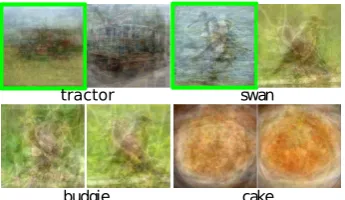
Results We expected the simple averaging method to fail completely at the level of accuracy required by this task. The results, however, sug-gest at least a trend in the right direction. This time, the median proportion of votes for the cor-rect dream is at 60%. In 165/510 cases, there is a significant preference for the correct dream (same statistical testing setup as above), and in 57 cases for the confounder. A manual annotation of higher-level categories of dreamed word and con-founder (e.g., garment, mammal, etc.) revealed that the proportion of votes for the correct dream was much higher in the 100 cases in which the two items belonged to different categories (80% vs. 55% for same-category pairs). The top row of Figure 2 illustrates cases where the pairs be-long to the same category, and yet subjects still showed a strong preference for the correct dream. In the tractor/truck case, both dreams represent vehicles, but the correct one is evoking the ru-ral environment a tractor. Forswan/dove, we can make out birds in both dreams, but theswandream is clearly of a larger, aquatic bird. Still, the more common case is the one where, if the two concepts are closely related, subjects assign random prefer-ences, as they did for the examples in the second row.
5 Discussion
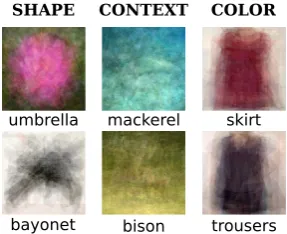
Averaging lets common visual properties in the source images emerge, as discussed in the next paragraphs in relation to the examples of Figure 3.
Shape The typical position and orientation of objects in images is an important factor deter-mining dream quality. For example, weapons of-ten appear in opposite orientations, which gives the averaged bayonet dream an improbable
X-tractor swan
[image:4.595.331.504.62.162.2]budgie cake
Figure 2: Experiment 2: Example dream pairs: the one on the left was generated from the word below the pair, the other from a confounder (clock-wise from top left: truck, dove, pie, parakeet). Subjects showed significant preference for the green-framed correct dreams, and were at chance level in the other cases.
like shape. Other concepts, like umbrella, whose dream averages circular objects, are not so strongly affected by the orientation problem.
ContextEven when bad object alignment leads to blurry dreams with unrecognizable concepts, averaging might highlight a shared context, suf-ficient to reveal the general category the dreamed concept belongs to. While both dreams in the 2nd column of Figure 3 are blurry, we can guess that the first one is related to water or to the sea, while the second is related to forest nature (dreams of a
mackerelandbison, respectively).7
Color Visual averaging can differentiate con-cepts by capturing characteristics that are not typ-ically verbalized. In black and white, theskirtand
trousers dreams look almost identical (and they wrongly depict an upper-body garment). What differentiates the two images is color, red for
skirt black for trousers. Indeed, a Google im-age search reveals that skirts tend to be color-ful and trousers dark. The McRae norms list
is colorful as a property of skirts, but not trousers. We thus conjecture that image synthe-sis could provide fine-grained perceptual informa-tion complementing linguistic properties encoded in classic nearest neighbour lists.
6 Conclusion
We presented a proof-of-concept study taking the first steps toward generation of novel images from text-based word vectors. Obviously, the next step is to use genuine image generation methods
in-7Interestingly, Torralba (2003) used same-object image
bison mackerel umbrella
bayonet
skirt
trousers SHAPE CONTEXT COLOR
Figure 3: Examples illustrating properties of dream synthesis by image averaging.
stead of averaging (Gregor et al., 2015; Mahen-dran and Vedaldi, 2015; Vondrick et al., 2014; Zeiler and Fergus, 2014).
We would also like to consider alternative eval-uation methods: for example, as suggested by a reviewer, asking subjects to label the generated dreams, and then measuring distance between the volunteered labels and the ground truth.
In a relatively short-term application perspec-tive, given the intriguing results on context and other visual properties we reported, a natural first step would be to see how such properties change when different embeddings are used as input.
References
Nikolaos Aletras and Mark Stevenson. 2013. Repre-senting topics using images. InIn Proceedings of NAACL-HLT, pages 158–167.
Marco Baroni, Eduard Barbu, Brian Murphy, and Mas-simo Poesio. 2010. Strudel: A distributional seman-tic model based on properties and types. Cognitive Science, 34(2):222–254.
Marco Baroni, Georgiana Dinu, and Germ´an Kruszewski. 2014. Don’t count, predict! a systematic comparison of context-counting vs. context-predicting semantic vectors. InProceedings of ACL.
Lawrence Barsalou and Katja Wiemer-Hastings. 2005. Situating abstract concepts. In D. Pecher and R. Zwaan, editors,Grounding Cognition: The Role of Perception and Action in Memory, Language, and Thought, pages 129–163. Cambridge University Press, Cambridge, UK.
Jia Deng, Wei Dong, Richard Socher, Lia-Ji Li, and Li Fei-Fei. 2009. Imagenet: A large-scale hierarchi-cal image database. InProceedings of CVPR, pages 248–255, Miami Beach, FL.
Andrea Frome, Greg Corrado, Jon Shlens, Samy Ben-gio, Jeff Dean, Marc’Aurelio Ranzato, and Tomas
Mikolov. 2013. DeViSE: A deep visual-semantic embedding model. In Proceedings of NIPS, pages 2121–2129, Lake Tahoe, NV.
Karol Gregor, Ivo Danihelka, Alex Graves, and Daan Wierstra. 2015. Draw: A recurrent neural network for image generation. arXiv preprint arXiv:1502.04623.
Felix Hill and Anna Korhonen. 2014. Learning ab-stract concept embeddings from multi-modal data: Since you probably can’t see what I mean. In Pro-ceedings of EMNLP, pages 255–265, Doha, Qatar. Yangqing Jia, Evan Shelhamer, Jeff Donahue, Sergey
Karayev, Jonathan Long, Ross Girshick, Sergio Guadarrama, and Trevor Darrell. 2014. Caffe: Con-volutional architecture for fast feature embedding.
arXiv preprint arXiv:1408.5093.
Andrej Karpathy and Li Fei-Fei. 2015. Deep visual-semantic alignments for generating image descrip-tions. In Proceedings of CVPR, Boston, MA. In press.
Douwe Kiela, Felix Hill, Anna Korhonen, and Stephen Clark. 2014. Improving multi-modal representa-tions using image dispersion: Why less is sometimes more. InProceedings of ACL, pages 835–841, Bal-timore, MD.
Ryan Kiros, Ruslan Salakhutdinov, and Richard Zemel. 2014. Unifying visual-semantic embeddings with multimodal neural language models. In Proceed-ings of the NIPS Deep Learning and Representation Learning Workshop.
Alex Krizhevsky, Ilya Sutskever, and Geoffrey Hinton. 2012. ImageNet classification with deep convolu-tional neural networks. In Proceedings of NIPS, pages 1097–1105, Lake Tahoe, Nevada.
George Lakoff and Mark Johnson. 1999. Philosophy in the Flesh: The Embodied Mind and Its Challenge to Western Thought. Basic Books, New York. Angeliki Lazaridou, Elia Bruni, and Marco Baroni.
2014. Is this a wampimuk? cross-modal map-ping between distributional semantics and the visual world. In Proceedings of ACL, pages 1403–1414, Baltimore, MD.
Angeliki Lazaridou, Nghia The Pham, and Marco Ba-roni. 2015. Combining language and vision with a multimodal skip-gram model. In Proceedings of NAACL, pages 153–163, Denver, CO.
Aravindh Mahendran and Andrea Vedaldi. 2015. Un-derstanding deep image representations by inverting them. InProceedings of CVPR.
Ken McRae, George Cree, Mark Seidenberg, and Chris McNorgan. 2005. Semantic feature production norms for a large set of living and nonliving things.
[image:5.595.109.253.61.178.2]Tomas Mikolov, Kai Chen, Greg Corrado, and Jeffrey Dean. 2013a. Efficient estimation of word represen-tations in vector space. http://arxiv.org/
abs/1301.3781/.
Tomas Mikolov, Wen-tau Yih, and Geoffrey Zweig. 2013b. Linguistic regularities in continuous space word representations. In Proceedings of NAACL, pages 746–751, Atlanta, Georgia.
Thomas Naselaris, Ryan J Prenger, Kendrick N Kay, Michael Oliver, and Jack L Gallant. 2009. Bayesian reconstruction of natural images from human brain activity. Neuron, 63(6):902–915.
Shinji Nishimoto, An T Vu, Thomas Naselaris, Yu-val Benjamini, Bin Yu, and Jack L Gallant. 2011. Reconstructing visual experiences from brain ac-tivity evoked by natural movies. Current Biology, 21(19):1641–1646.
Jeffrey Pennington, Richard Socher, and Christopher Manning. 2014. Glove: Global vectors for word representation. In Proceedings of EMNLP, pages 1532–1543, Doha, Qatar.
Jason Salavon. 2004. http:// cabinetmagazine.org/issues/15/ salavon.php.
Richard Socher, Quoc Le, Christopher Manning, and Andrew Ng. 2014. Grounded compositional se-mantics for finding and describing images with sen-tences. Transactions of the Association for Compu-tational Linguistics, 2:207–218.
Antonio Torralba. 2003. Contextual priming for object detection. International journal of computer vision, 53:169–191.
Laurens Van der Maaten and Geoffrey Hinton. 2008. Visualizing data using t-SNE. Journal of Machine Learning Research, 9(2579-2605).
Carl Vondrick, Hamed Pirsiavash, Aude Oliva, and Antonio Torralba. 2014. Acquiring visual clas-sifiers from human imagination. arXiv preprint arXiv:1410.4627.
Matthew Zeiler and Rob Fergus. 2014. Visualizing and understanding convolutional networks. In Pro-ceedings of ECCV (Part 1), pages 818–833, Zurich, Switzerland.