Integrated NLP Evaluation System for Pluggable Evaluation Metrics
with Extensive Interoperable Toolkit
Yoshinobu Kano1 Luke McCrohon1 Sophia Ananiadou2 Jun’ichi Tsujii1,2
1 Department of Computer Science, University of Tokyo Hongo 7-3-1, Bunkyo-ku, Tokyo 113-0033 Tokyo
2School of Computer Science, University of Manchester and National Centre for Text Mining, 131 Princess St, M1 7DN, UK
[kano,tsujii]@is.s.u-tokyo.ac.jp
Abstract
To understand the key characteristics of NLP tools, evaluation and comparison against dif-ferent tools is important. And as NLP applica-tions tend to consist of multiple semi-independent sub-components, it is not always enough to just evaluate complete systems, a fine grained evaluation of underlying compo-nents is also often worthwhile. Standardization of NLP components and resources is not only significant for reusability, but also in that it al-lows the comparison of individual components in terms of reliability and robustness in a wid-er range of target domains. But as many eval-uation metrics exist in even a single domain, any system seeking to aid inter-domain eval-uation needs not just predefined metrics, but must also support pluggable user-defined me-trics. Such a system would of course need to be based on an open standard to allow a large number of components to be compared, and would ideally include visualization of the dif-ferences between components. We have de-veloped a pluggable evaluation system based on the UIMA framework, which provides vi-sualization useful in error analysis. It is a sin-gle integrated system which includes a large ready-to-use, fully interoperable library of NLP tools.
1 Introduction
When building NLP applications, the same sub-tasks tend to appear frequently while
construct-ing different systems. Due to this, the reusability of tools designed for such subtasks is a common design consideration; fine grained interoperabili-ty between sub components, not just between complete systems.
In addition to the benefits of reusability, inte-roperability is also important in evaluation of components. Evaluations are normally done by comparing two sets of data, a gold standard data and test data showing the components perfor-mance. Naturally this comparison requires the two data sets to be in the same data format with the same semantics. Comparing of "Apples to Apples" provides another reason why standardi-zation of NLP tools is beneficial. Another advan-tage of standardization is that the number of gold standard data sets that can be compared against is also increased, allowing tools to be tested in a wider range of domains.
The ideal is that all components are standar-dized to conform to an open, widely used intero-perability framework. One possible such frame-work is UIMA; Unstructured Information Man-agement Architecture (Ferrucci et al., 2004), which is an open project of OASIS and Apache. We have been developing U-Compare (Kano et al., 2009)1, an integrated testing an evaluation platform based on this framework.
1
Features described in this paper are integrated as U-Compare system, publicly available from:
http://u-compare.org/
Although U-Compare already provided a wide range of tools and NLP resources, its inbuilt evaluation mechanisms were hard coded into the system and were not customizable by end users. Furthermore the evaluation metrics used were based only on simple strict matchings which se-verely limited its domains of application. We have extended the evaluation mechanism to al-low users to define their own metrics which can be integrated into the range of existing evalua-tion tools.
The U-Compare library of interoperable tools has also been extended; especially with regard to resources related to biomedical named entity ex-traction. U-Compare is currently providing the world largest library of type system compatible UIMA components.
In section 2 of this paper we first look at the underlying technologies, UIMA and U-Compare. Then we describe the new plugga-ble evaluation mechanism in section 3 and our interoperable toolkit with our type system in sec-tion 4 and 5.
2 Background
2.1 UIMA
UIMA is an open framework specified by OA-SIS2. Apache UIMA provides a reference im-plementation as an open source project, with both a pure java API and a C++ development kit . UIMA itself is intended to be purely a frame-work, i.e. it does not intend to provide specific tools or type system definitions. Users should develop such resources themselves. In the fol-lowing subsections, we briefly describe the basic concepts of UIMA, and define keywords used to explain our system in later sections.
2.1.1 CAS and Type System
The UIMA framework uses the “stand-off anno-tation” style (Ferrucci et al., 2006). The underl-ing raw text of a document is generally kept un-changed during analysis, and the results of processing the text are added as new stand-off annotations with references to their positions in the raw text. A Common Analysis Structure
(CAS) holds a set of such annotations. Each of which is of a given type as defined in a specified
2
http://www.oasis-open.org/committees/uima/
hierarchical type system. Annotation3 types may define features, which are themselves typed. Apache UIMA provides definitions of a range of built in primitive types, but a more complete type system should be specified by developers. The top level Apache UIMA type is referred to as TOP, other primitive types include. int, String, Annotation and FSArray (an array of any annota-tions).
2.1.2 Component and Capability
UIMA components receive and update CAS one at a time. Each UIMA component has a capabili-ty property, which describes what types of anno-tations it takes as input and what types of anno-tations it may produce as output.
UIMA components can be deployed either lo-cally, or remotely as SOAP web services. Re-motely deployed web service components and locally deployed components can be freely com-bined in UIMA workflows.
2.1.3 Aggregate Component and Flow Con-troller
UIMA components can be either primitive or
aggregate. Aggregate components include other components as subcomponents. Subcomponents may themselves be aggregate. In the case where an aggregate has multiple subcomponents these are by default processed in linear order. This or-dering can be customized by implementing a custom flow controller.
2.2 U-Compare
U-Compare is a joint project of the University of Tokyo, the Center for Computational Pharma-cology at the University of Colorado School of Medicine, and the UK National Centre for Text Mining.
U-Compare provides an integrated platform for users to construct, edit and compare workflows compatible with any UIMA compo-nent. It also provides a large, ready-to-use toolkit of interoperable NLP components for use with any UIMA based system. This toolkit is currently the world largest repository of type system com-patible components. These all implement the U-Compare type system described in section 3.
2.2.1 Related Works
There also exist several other public UIMA component repositories: CMU UIMA component repository, BioNLP UIMA repository (Baum-gartner et al., 2008), JCoRe (Hahn et al., 2008), Tsujii Lab Component Repository at the Univer-sity of Tokyo (Kano et al., 2008a), etc. Each group uses their own type system, and so com-ponents provided by each group are incompatible. Unlike U-Compare these repositories are basical-ly onbasical-ly collections of UIMA components, U-Compare goes further by providing a fully inte-grated set of UIMA tools and utilities.
2.2.2 Integrated Platform
U-Compare provides a variety of features as part of an integrated platform. The system can be launched with a single click in a web browser; all required libraries are downloaded and updated automatically in background.
The Workflow Manager GUI helps users to create workflows in an easy drag-and-drop fa-shion. Similarly, import/export of workflows, running of workflows and saving results can all be handled via a graphical interface.
U-Compare special parallel aggregate nents allow combinations of specified compo-nents to be automatically combined and com-pared based on their I/O capabilities (Kano et al., 2008b). When workflows are run, U-Compare shows statistics and visualizations of results ap-propriate to the type of workflow. For example when workflows including parallel aggregate components are run comparison statistics be-tween all possible parallel component combina-tions are given.
3 Integrated System for Pluggable Evaluation Metrics
While U-Compare already has a mechanism to automatically create possible combinations of components for comparison from a specified workflow, the comparison (evaluation) metric itself was hard coded into the system. Only com-parison based on simple strict matching was possible.
However, many different evaluation metrics exist, even for the same type of annotations. For example, named entity recognition results are often evaluated based on several different anno-tation intersection criteria: exact match, left/right only match, overlap, etc. Evaluation metrics for nested components can be even more complex (e.g. biomedical relations, deep syntactic
struc-tures). Sometimes new metrics are also required for specific tasks. Thus, a mechanism for plugg-able evaluation metrics in a standardized way is seen as desirable.
3.1 Pluggable Evaluation Component
Our design goal for the evaluation systems is to do as much of the required work as possible and to provide utilities to reduce developer’s labor. We also want our design to be generic and fix within existing UIMA standards.
The essential process of evaluation can be ge-neralized and decomposed as follows:
(a) prepare a pair of annotation sets which will be used for comparison,
(b) select annotations which should be in-cluded in the final evaluation step,
(c) compare selected annotations against each other and mark matched pairs.
For example, in the case of the Penn Treebank style syntactic bracket matching, these steps cor-respond to (a) prepare two sets of constituents and tokens, (b) select only the constituents (re-moving null elements if required), (c) compare constituents between the sets and return any matches.
In our new design, step (a) is performed by the system, (b) and (c) are performed by an evalua-tion component. The evaluaevalua-tion component is just a normal UIMA component, pluggable based on the UIMA standard. This component is run on a CAS which was constructed by the system dur-ing step (a). This CAS includes an instance of ComparisonSet type and its features GoldAnno-tationGroup and TestAnnotationGroup. Corres-ponding to step (b), based on this input the com-parison component should make a selection of annotations and store them as FSArray for both GoldAnnotations and TestAnnotations. Finally for step (c), the component should perform a matching and store the results as MatchedPair instances in the MatchedAnnotations feature of the ComparisonSet.
Precision, recall, and F1 scores are calculated by U-Compare based on the outputted Compari-sonSet. These calculation can be overridden and customized if the developer so desires.
matching, which features are matched, and which are not.
3.2 Combinatorial Evaluation and Er-ror Analysis
By default, evaluation statistics are calculated by simply counting the numbers of gold, test, matched annotations in the returned Compari-sonSet instance. Then precision, recall, and F1 scores for each CAS and for the complete set of CASes are calculated. Users can specify which evaluation metrics are used for each type of an-notations based on the input specifications they set for supplied evaluation components.
Normally, precision, recall, and F1 scores are the only evaluation statistics used in the NLP community. It is often the case in many research reports that a new tool A performs better than another tool B, increasing the F1 score by 1%. In such cases it is important to analysis what pro-portion of annotations are shared between A, B, and the gold standard. Is A a strict 1% increase over B? Or does it cover 2% of instances B doesn’t but miss a different 1%? Our system provides these statistics as well.
Further, our standardized evaluation system makes more advanced evaluation available. Since the evaluation metrics themselves are more or less arbitrary, we should carefully observe the results of evaluations. When two or more metrics are available for the same type of annotations, we can compare the results of each to analyze and validate the individual evaluations.
An immediate application of such comparison would be in a voting system, which takes the results of several tools as input and selects com-mon overlapping annotations as output.
U-Compare also provides visualizations of evaluation results allowing instance-based error analysis.
4 U-Compare Type System
U-Compare currently provides the world largest set of type system compatible UIMA compo-nents. We will describe some of these in section 5. In creating compatible components in UIMA a key task is their type system definitions.
The U-Compare type system is designed in a hierarchical fashion with distinct types to achieve a high level of interoperability. It is intended to be a shared type system capable of mapping types originally defined as part of independent type systems (Kano et al., 2008c). In this section we describe the U-Compare type system in detail.
4.1 Basic Types
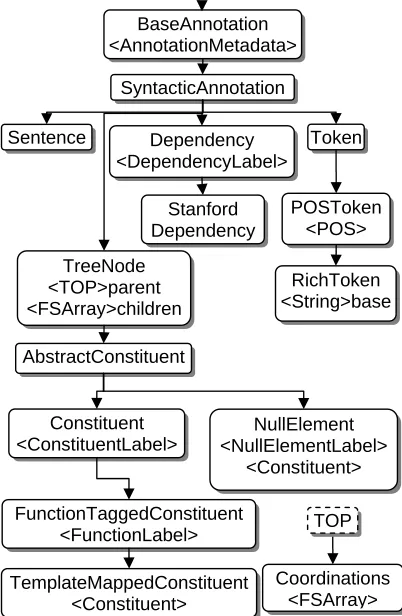
While most of the U-Compare types are inherit-ing a UIMA built-in type, Annotation (Figure 1), there are also types directly extending the TOP type; let us call these types as metadata types.
AnnotationMetadata holds a confidence value, which is common to all of the U-Compare anno-tation types as a feature of BaseAnnotation type. BaseAnnotation extends DiscontinuousAnnota-tion, in which fragmental annotations can be stored as a FSArray of Annotations, if any.
ExternalReference is another common meta-data type where namespace and ID are stored, referring to an external ontology entity outside UIMA/U-Compare. Because it is not realistic to represent everything like such a detailed ontolo-gy hierarchy in a UIMA type system, this meta-data is used to recover original information, which are not expressed as UIMA types. Refe-renceAnnotation is another base annotation type, which holds an instance of this ExternalRefe-rence.
UniqueLabel is a special top level type for ex-plicitly defined finite label sets, e.g. the Penn Treebank tagset. Each label in such a tagset is mapped to a single type where UniqueLabel as its
BaseAnnotation <AnnotationMetadata>
SyntacticAnnotation
Token
POSToken <POS>
RichToken <String>base
Sentence Dependency
<DependencyLabel>
Stanford Dependency
TreeNode <TOP>parent <FSArray>children
AbstractConstituent
NullElement <NullElementLabel>
<Constituent> Constituent
<ConstituentLabel>
FunctionTaggedConstituent <FunctionLabel>
TemplateMappedConstituent <Constituent>
TOP
[image:4.612.314.515.384.692.2]Coordinations <FSArray>
ancestor, putting middle level types if possible (e.g. Noun type for the Penn Treebank POS tag-set). These types are omitted in the figure.
4.2 Syntactic Types
SyntacticAnnotation is the base type of all syn-tactic types (Figure 2). POSToken holds a POS label, RichToken additionally holds a base form. Dependency is used by dependency parsers, while TreeNode is for syntactic tree nodes. Con-stituent, NullElement, FunctionTaggedConsti-tiuent, TemplateMappedConstituent are designed to fully represent all of the Penn Treebank style annotations. Coordination is a set of references to coordinating nodes (currently used by the Genia Treebank). We are planning on extending the set of syntactic types to cover the outputs of several deep parsers.
4.3 Semantic Types
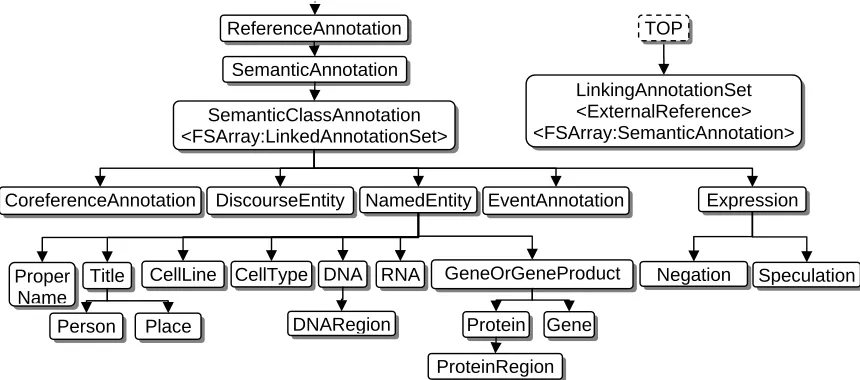
SemanticAnnotation is the base type for semantic annotations; it extends ReferenceAnnotation by holding the original reference.
SemanticClassAnnotation is a rather complex type designed to be somewhat general. In many cases, semantic annotations may reference other
semantic annotations, e.g. references between biological events. Such references are often la-beled with their roles which we express with the ExternalReference type. Such labeled references are expressed by LinkingAnnotationSet. As a role may refer to more than one annotation, Linkin-gAnnotationSet has an FSArray of SemanticAn-notation as a feature.
There are several biomedical types included in Figure 3, e.g. DNA, RNA, Protein, Gene, Cel-lLine, CellType, etc. It is however difficult to decide which ontological entities should be in-cluded in such a type system. One reason for this is that such concepts are not always distinct; dif-ferent ontologies may give overlapping defini-tions of these concepts. Further, the number of possible substance level entities is infinite; caus-ing difficult in their expression as individual types. The current set of biomedical types in the U-Compare type system includes types which are frequently used for evaluation in the BioNLP research.
4.4 Document Types
DocumentAnnotation is the base type for docu-ment related annotations (Figure 4). It extends
DocumentClassAnnotation <FSArray:DocumentAttribute> <FSArray:ReferenceAnnotation>
DocumentAttribute <ExternalReference> DocumentAnnotation
DocumentReferenceAttribute <ReferenceAnnotation>
DocumentValueAttribute <String>value
[image:5.612.97.527.66.256.2]ReferenceAnnotation TOP
Figure 4. Document types in the U-Compare type system. SemanticAnnotation
ReferenceAnnotation
SemanticClassAnnotation <FSArray:LinkedAnnotationSet>
NamedEntity EventAnnotation
CellType
CellLine DNA RNA GeneOrGeneProduct
Proper Name
Title
Place Protein Gene
Person
ProteinRegion DNARegion
LinkingAnnotationSet <ExternalReference> <FSArray:SemanticAnnotation>
CoreferenceAnnotation DiscourseEntity Expression
Negation TOP
Speculation
[image:5.612.101.512.594.685.2]ReferenceAnnotation to reference the full exter-nal type in the same way as SemanticAnnotation.
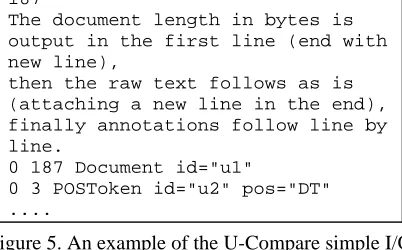
187
The document length in bytes is output in the first line (end with new line),
DocumentClassAnnotation together with Do-cumentAttribute are intended to express XML style data. XML tags may have fields storing their values, and/or idref fields refering to other tags. DocumentValueAttiributerepresents simple value field, while DocumentReferenceAttribute represents idref type fields. A DocumentClas-sAnnotation corresponds to the tag itself.
then the raw text follows as is (attaching a new line in the end), finally annotations follow line by line.
0 187 Document id="u1"
0 3 POSToken id="u2" pos="DT" ....
[image:6.612.315.516.67.192.2]Although these types can represent most doc-ument structures, we still plan to add several specific types such as Paragraph, Title, etc.
Figure 5. An example of the U-Compare simple I/O format.
5 Interoperable Components and Utili-ties
In this section, we describe our extensive toolkit of interoperable components and the set of utili-ties integrated into the U-Compare system. All of the components in our toolkit are compatible with the U-Compare type system described in the previous section.
5.1 Corpus Reader Components
In the UIMA framework, a component which generates CASes is called a Collection Reader. We have developed several collection readers which read annotated corpora and generates an-notations using the U-Compare type system.
Because our primary target domain was bio-medical field, there are corpus readers for the biomedical corpora; Aimed corpus (Bunescu et al., 2006) reader and BioNLP ’09 shared task format reader generate event annotations like protein-protein interaction annotations; Readers for BIO/IOB format, Bio1 corpus (Tateisi et al., 2000), BioCreative (Hirschman et al., 2004) task 1a format, BioIE corpus (Bies et al., 2005), NLPBA shared task dataset (Kim et al., 2004), Texas Corpus (Bunescu et al., 2005), Yapex Corpus (Kristofer Franzen et al., 2002), generate biomedical named entities, and Genia Treebank corpus (Tateisi et al., 2005) reader generates Penn Treebank (Marcus et al., 1993) style brack-eting and part-of-speech annotations. Format readers require users to prepare annotated data, while others include corpora themselves, auto-matically downloaded as an archive on users’ demand.
In addition, there is File System Collection Reader from Apache UIMA which reads files as plain text. We have developed an online interac-tive text reader, named Input Text Reader.
5.2 Analysis Engine Components
There are many tools covering from basic syn-tactic annotations to the biomedical annotations. Some of the tools are running as web services, but users can freely mix local services and web services.
For syntactic annotations: sentence detectors from GENIA, LingPipe, NaCTeM, OpenNLP and Apache UIMA; tokenizers from GENIA tag-ger (Tsuruoka et al., 2005), OpenNLP, Apache UIMA and Penn Bio Tokenizer; POS taggers from GENIA tagger, LingPipe, OpenNLP and Stepp Tagger; parsers from OpenNLP (CFG), Stanford Parser (dependency) (de Marneffe et al., 2006), Enju (HPSG) (Miyao et al., 2008).
For semantic annotations: ABNER (Settles, 2005) for NLPBA/BioCreative trained models, GENIA Tagger, NeMine, MedT-NER, LingPipe and OpenNLP NER, for named entity recogni-tions. Akane++ (Sætre et al., 2007) for protein-protein interaction detections.
5.3 Components for Developers
Although Apache UIMA provides APIs in both Java and C++ to help users develop UIMA com-ponents, a level of understanding of the UIMA framework is still required. Conversion of exist-ing tools to the UIMA framework can also be difficult, particularly when they are written in other programming languages.
We have designed a simple I/O format to make it easy for developers who just want to provide a UIMA wrapper for existing tools.
end position, type name, unique id, and feature values if any. Double newlines indicates an end of a CAS.
Output of the component is lines of annota-tions if any created by the component.
U-Compare provides a wrapper component which uses this I/O format, communicating with wrapped tools via standard I/O streams.
5.4 Type System Converters
As U-Compare is a joint project, the U-Compare toolkit includes UIMA components originally developed using several different type systems. In order to integrate these components into the U-Compare type system, we have developed type system converter components for each ex-ternal type system.
The CCP team at the University of Colorado made a converter between their CCP type system and our type system. We also developed conver-ters for OpenNLP components and Apache UI-MA components. These converters remove any original annotations not compatible with the U-Compare type system. This prevents duplicated converters from translating external annotation multiple times in the same workflow.
We are providing such non U-Compare com-ponents by aggregating with type system conver-ters, so users do not need to aware of the type system conversions.
5.5 Utility Tools
[image:7.612.95.299.59.241.2]We have developed and integrated several utility tools, especially GUI tools for usability and error analysis.
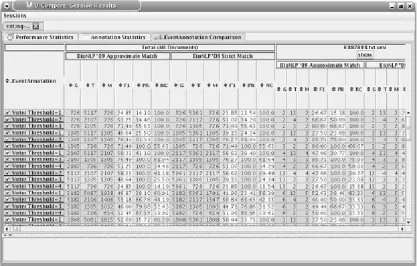
Figure 6 is showing our workflow manager GUI, which provides functions to create a user workflow by an easy drag-and-drop way. By clicking “Run Workflow” button in that manager window, statistics will be shown (Figure 8).
Figure 6. A s
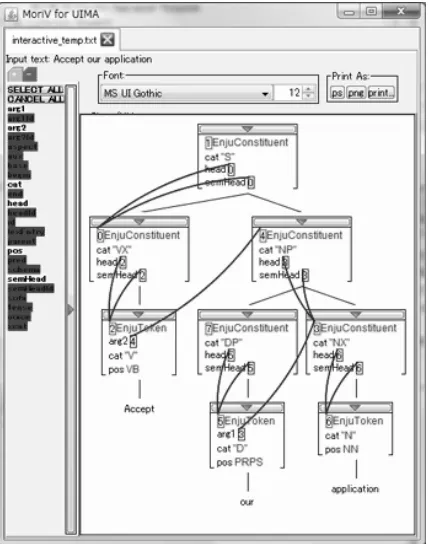
There are also a couple of annotation visuali-zation tools. Figure 7 is showing a viewer for tree structures and HPSG feature structures. Fig-ure 9 is showing a general annotation viewer, when annotations have complex inter-dependencies.
6 Summary and Future Directions
We have designed and developed a pluggable evaluation system based on the UIMA frame-work. This evaluation system is integrated with the U-Compare combinatorial comparison me-chanism which makes evaluation of many factors available automatically.
creenshot of Workflow Manager GUI and Component Library.
[image:7.612.310.524.397.669.2]Since the system behavior is dependent on the type system used, we have carefully designed the U-Compare type system to cover a broad range of concepts used in NLP applications. Based di-rectly on this type system, or using type system converters, we have developed a large toolkit of type system compatible interoperable UIMA component. All of these features are integrated into U-Compare.
In future we are planning to increase the num-ber of components available, e.g. more syntactic parsers, corpus readers, and resources for lan-guages other than English. This will also re-quired enhancements to the existing type system to support additional components. Finally we also hope to add integration with machine learn-ing tools in the near future.
Acknowledgments
[image:8.612.99.516.58.324.2]onal Centre for Text Mining is Figure 8. A screenshot of a comparison statistics showing number of instances (gold, test, and matched), F1, precision, and recall scores of two evaluation metrics on the same data.
We wish to thank Dr. Lawrence Hunter’s text mining group at Center for Computational Phar-macology, University of Colorado School of Medicine, for helping build the type system and for making their tools available for this research. This work was partially supported by Grant-in-Aid for Specially Promoted Research (MEXT, Japan). The Nati
funded by JISC.
W.
ning sys-tems. J Biomed Discov Collab, 3(1), 1.
An
ie in the Sky, ACL, Ann Arbor, Michigan, USA.
Ra
tificial Intelligence in Medi-cine, 33(2), 139-155.
References
A. Baumgartner, Jr., K. B. Cohen, and L. Hunter. 2008. An open-source framework for large-scale, flexible evaluation of biomedical text mi
n Bies, Seth Kulick, and Mark Mandel. 2005.
Pa-rallel entity and treebank annotation. In
Proceed-ings of the the Workshop on Frontiers in Corpus Annotations II: P
zvan Bunescu, Ruifang Ge, Rohit J. Kate, Edward M. Marcotte, Raymond J. Mooney, Arun Kumar Ramani, et al. 2005. Comparative experiments on learning information extractors for proteins and
[image:8.612.99.299.479.668.2]their interactions. Ar
Razvan Bunescu, and Raymond Mooney. 2006.
Sub-sequence Kernels for Relation Extraction. In Y.
Weiss, B. Scholkopf and J. Platt (Eds.), Advances
in Neural Information Processing Systems 18
(171--178). Cambridge, MA: MIT Press.
Marie-Catherine de Marneffe, Bill MacCartney, and Christopher D. Manning. 2006. Generating typed dependency parses from phrase structure parses.
In Proceedings of the the 5th International Confe-rence on Language Resources and Evaluation (LREC 2006).
David Ferrucci, and Adam Lally. 2004. Building an example application with the Unstructured
Infor-mation Management Architecture. Ibm Systems
Journal, 43(3), 455-475.
David Ferrucci, Adam Lally, Daniel Gruhl, and Ed-ward Epstein. 2006. Towards an Interoperability
Standard for Text and Multi-Modal Analytics.
U. Hahn, E. Buyko, R. Landefeld, M. Mühlhausen, M. Poprat, K. Tomanek, et al. 2008, May. An Over-view of JCoRe, the JULIE Lab UIMA Component
Repository. In Proceedings of the LREC'08
Work-shop, Towards Enhanced Interoperability for Large HLT Systems: UIMA for NLP, Marrakech, Moroc-co.
Lynette Hirschman, Alexander Yeh, Christian Blaschke, and Antonio Valencia. 2004. Overview of BioCreAtIvE: critical assessment of information
extraction for biology. BMC Bionformatics,
6(Suppl 1:S1).
Yoshinobu Kano, William A Baumgartner, Luke McCrohon, Sophia Ananiadou, Kevin B Cohen, Lawrence Hunter, et al. 2009. U-Compare: share
and compare text mining tools with UIMA.
Bioin-formatics, accepted.
Yoshinobu Kano, Ngan Nguyen, Rune Sætre, Keiichi-ro Fukamachi, KazuhiKeiichi-ro Yoshida, Yusuke Miyao, et al. 2008c, January. Sharable type system design for tool inter-operability and combinatorial
com-parison. In Proceedings of the the First
Internation-al Conference on GlobInternation-al Interoperability for Lan-guage Resources (ICGL), Hong Kong.
Yoshinobu Kano, Ngan Nguyen, Rune Sætre, Kazuhi-ro Yoshida, KeiichiKazuhi-ro Fukamachi, Yusuke Miyao, et al. 2008b, January. Towards Data And Goal Oriented Analysis: Tool Inter-Operability And
Combinatorial Comparison. In Proceedings of the
3rd International Joint Conference on Natural Lan-guage Processing (IJCNLP), Hyderabad, India.
Yoshinobu Kano, Ngan Nguyen, Rune Sætre, Kazuhi-ro Yoshida, Yusuke Miyao, Yoshimasa Tsuruoka,
et al. 2008a, January. Filling the gaps between tools and users: a tool comparator, using
protein-protein interaction as an example. In Proceedings
of the Pacific Symposium on Biocomputing (PSB), Hawaii, USA.
Jin-Dong Kim, Tomoko Ohta, Yoshimasa Tsuruoka, Yuka Tateisi, and Nigel Collier. 2004. Introduction
to the Bio-Entity Recognition Task at JNLPBA. In
Proceedings of the International Workshop on Nat-ural Language Processing in Biomedicine and its Applications (JNLPBA-04), Geneva, Switzerland.
Kristofer Franzen, Gunnar Eriksson, Fredrik Olsson, Lars Asker, Per Liden, and Joakim Coster. 2002.
Protein names and how to find them. International
Journal of Medical Informatics, 67(1-3), 49-61.
Mitchell P. Marcus, Mary Ann Marcinkiewicz, and Beatrice Santorini. 1993. Building a large
anno-tated corpus of English: the penn treebank.
Com-putational Linguistics, 19(2), 313-330.
Yusuke Miyao, and Jun'ichi Tsujii. 2008. Feature
Forest Models for Probabilistic HPSG Parsing.
Computational Linguistics, 34(1), 35-80.
Rune Sætre, Kazuhiro Yoshida, Akane Yakushiji, Yusuke Miyao, Yuichiro Matsubayashi, and To-moko Ohta. 2007, April. AKANE System: Protein-Protein Interaction Pairs in BioCreAtIvE2
Chal-lenge, PPI-IPS subtask. In Proceedings of the
Second BioCreative Challenge Evaluation Work-shop.
Burr Settles. 2005. ABNER: an open source tool for automatically tagging genes, proteins and other
entity names in text. Bioinformatics, 21(14),
3191-3192.
Yuka Tateisi, Tomoko Ohta, Nigel Collier, Chikashi Nobata, and Jun'ichi Tsujii. 2000, August. Building an Annotated Corpus from Biology Research
Pa-pers. In Proceedings of the COLING 2000
Work-shop on Semantic Annotation and Intelligent Con-tent, Luxembourg.
Yuka Tateisi, Akane Yakushiji, Tomoko Ohta, and Jun'ichi Tsujii. 2005, October. Syntax Annotation
for the GENIA Corpus. In Proceedings of the the
Second International Joint Conference on Natural Language Processing (IJCNLP '05), Companion volume, Jeju Island, Korea.
Yoshimasa Tsuruoka, Yuka Tateishi, Jin Dong Kim, Tomoko Ohta, J. McNaught, Sophia Ananiadou, et al. 2005. Developing a robust part-of-speech
tag-ger for biomedical text. In Advances in Informatics,
Proceedings (Vol. 3746, 382-392). Berlin: