D S Sharma, R Sangal and J D Pawar. Proc. of the 11th Intl. Conference on Natural Language Processing, pages 362–367, Goa, India. December 2014. c2014 NLP Association of India (NLPAI)
Named Entity Based Answer Extraction form Hindi Text Corpus Using
n-grams
Lokesh Kumar Sharma
Namita Mittal
Dept. of Computer Science and Engineering Dept. of Computer Science and Engineering Malaviya National Institute of Technology Malaviya National Institute of Technology
Jaipur, India Jaipur, India
[email protected] [email protected]
Abstract
Most existing systems, are constructed for the English language, such as state-of-art system Watson that win the Jeopardy challenge. While working with Indian languages (i.e. Hindi), a richer morphology, greater syntactic variability, and less number of standardized rules availability in the language are just some issues that complicate the construction of sys-tems. It is also considered a resource-poor language since proper gazetteer lists and tagged corpora is not available for it. In this paper, Named Entity (NE) based n-gram ap-proach is used for processing questions writ-ten in Hindi language and extract the answer from Hindi documents. Combination of clas-sical information retrieval term weighing model with a linguistic approach mainly based on syntactic analysis is used. We use a corpus of 420 questions and 300 documents contain-ing around 20,000 words as a back-end for closed-domain (World History) Question Answering. A Named Entity Recognizer is employed to identify answer candidates which are then filtered according their usage. Results obtained using this technique outperforms the previously used techniques (e.g. Semantic Based Query Logic).
1
Introduction
With the advancement in technology, Question Answering has become a major area of research. Question Answering systems enable the user to ask questions in natural language instead of a query and retrieve one or many valid and accurate an-swers in natural language. The explosion of infor-mation on Internet, Natural language QA is
recognized as a capability with great potential (Hirschman and Gaizauskas, 2001). Information retrieval systems allow us to locate full documents or best matching passages that might contain the pertinent information, but most of them leave it to the user to extract the useful information from a ranked list. Therefore, professionals from various areas are beginning to recognize the usefulness of other types of systems, such as QA systems, for quickly and effectively finding specialist informa-tion. The QA technology takes both IR and IE a step further, and provides specific and brief an-swers to the user’s questions formulated naturally. Hindi holds 5th position among top 100 spoken languages in the world, with no. of speakers being close to 200 million (Shachi et al., 2001) but com-paring Indian languages with other languages, word segmentation is a key problem in Indian question answering. As per our knowledge not much work has been done in Hindi as compared to various other languages like English (Ittycheriah et al., 2008), Chinese etc. This motivates for de-veloping a Hindi question answering system (Vi-shal and Jaspreet, 2013). Our dataset consists of 420 questions and 300 documents containing around 20,000 words chosen from a specific do-main (World History). Our model involves three general phases which are as follows. The first phase, Question Processing, involves analyzing and classifying the questions into different catego-ries. This classification later helps in Answer type Detection. Further, in this module, a query is for-mulated which is passed on to the next phase for searching the relevant documents which might contain the answer. In the second phase, Informa-tion Retrieval, we have applied an algorithm called Term Frequency-Inverse-Document-Frequency
(TF-IDF) (Ramos, 2003), which uses dot product and cosine similarity rule to find the probability of a given text in a given set of documents. This gives us the list of relevant documents. The next phase, Answer Extraction, uses bigram forming approach (Wang et al., 2005) to retrieve the answer from a given document. In this we have also used a pre-built Hindi named entity recognition model which categorizes the given text into different categories.
2
Related Work
Specific research in the area of question answer-ing has been prompted in the last few years in particular by the Question Answering track of the Text Retrieval Conference (TREC-QA) competitions (Satoshi and Ralph, 2003). Recent-ly IBM Watson defeated two human winners and win the Jeopardy game show. Watson uses very complex algorithm to read any given clue. At the first stage in question analysis Watson does pars-ing and semantic analysis uspars-ing a deep Slot Grammar parser, a named entity recognizer, a co-reference resolution component, and a rela-tion extracrela-tion component (Lilly et. al 2012). Our work uses similar approach by using named entity taggers and parsing. Research work has been done in Surprise Language Exercise (SLE) within the TIDES program where viability of a cross lingual question answering (CLQA) (Sha-chi et al., 2001) has been shown by developing a basic system. It presents a model that answers English questions by finding answers in Hindi newswire documents and further translates the answer candidates into English along with the context surrounding each answer (Satoshi and Ralph, 2003). Another approach taken by some researchers (Praveen et al., 2003) presents a Hindi QA system based on a Hindi search en-gine that works on locality-based similarity heu-ristics to retrieve relevant passages from the corpus over agriculture and science domain. Some researchers (Sahu et al., 2012) discusses an implementation of a Hindi question answer-ing system “PRASHNOTTAR”. It presents four classes of questions namely: “when”, “where”, “what time” and “how many” and their static dataset includes 15 questions of each type which gives an accuracy of 68%. In addition to the tra-ditional difficulties with syntactic analysis, there remains many other problems to be solved, e.g.,
semantic interpretation, ambiguity resolution, discourse modeling, inference, common sense etc.
3
Proposed Approach
Question Processing is the first phase of our pro-posed question answering model in which we ana-lyze the question and create a proper IR query which is further used to retrieve some relevant documents which may contain the answer of the question. Another task is question classification to classify a question by the type of answer it re-quires. The former task is called Question Classifi-cation and the latter one is known as Query Formulation. Both these aspects are equally impor-tant for Question Processing.
3.1. Question Classification
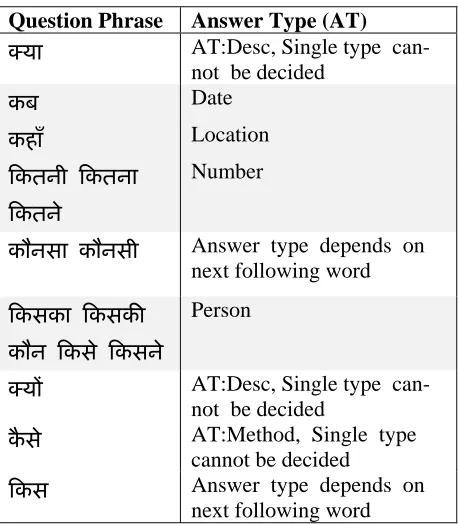
The goal of Question Classification is to accurately assign labels to questions based on expected an-swer type. Hence, we detect the category of a giv-en question.
Question Phrase Answer Type (AT)
या AT:Desc, Single type
can-not be decided
कब Date
कहाँ Location
कतनी कतना
कतने
Number
कौनसा कौनसी Answer type depends on
next following word
कसका कसक
कौन कसे कसने
Person
य AT:Desc, Single type
can-not be decided
कैसे AT:Method, Single type
cannot be decided
कस Answer type depends on
[image:2.612.313.542.373.635.2]next following word
Table 1. Possible Answer Type Based on Question Phrase
In English there are 6 main categories namely LOCATION, PERSON, NUMERIC, ENTITY, ABBREVIATION and DESCRIPTION and but for
Hindi we have taken only 4 categories for our ca-tegorization process includes PERSON, COUNT, DATE and LOCATION. We applied proposed al-gorithm over the following answer types hig-hlighted in table 1. The output file contains the previously mentioned category of question to which it belongs followed by the question itself and thus mapping from questions to answer types is done here. After categorization of the question, we store it in a file, so that it can be used later for answer extraction. Here is an example. Suppose we have the following question, लोक अदालत क
शु आत राजःथान म सबसे पहले कहां हुई ? Then
the output file will contain: LOCATION: लोक
अदालत क शु आत राजःथान म सबसे पहले कहां
हुई।
3.2. Query Formation
Query Formation is a technique to make the ques-tion format such that it can be passed on to a sys-tem which takes the input in the form of a query and searches out the relevant documents i.e. the documents which have the maximum probability of containing the answer. For this purpose, we have formulated a query by extracting the main or focus words (Haung, 2008) of the question by re-moving the stop words occurring in the question. For this, we have used a file containing a prebuilt list of stop words. Examples of some stop words are: (के, का, हुई, है, पर, इस, होता, , बनी, नह ं, तो, ह, या, एवं, दया, हो, इसका, था, ारा, हुआ, तक, साथ, करना, कुछ, सकते, कसी, हुई) After stop words removal, the text looks like this: लोक
अदालत शु आत राजःथान पहले After removal of
these less important words from the question, the resultant output can be used as a query for the in-formation retrieval system which involves the next part of the model.
3.3.
Relevant Information Extraction
The task of Information Retrieval phase is to query the IR Engine, find relevant documents and return candidate passages that are likely to contain the answer. In our model, our dataset is scattered over various documents, each containing question
re-lated text along with its answer. Then we per-formed a search within these documents in order to find out such documents which may contain the answer. And for this purpose, we have applied an algorithm called TF-IDF; it gives as output the list of various documents which may contain any of the given words from the query. The term frequen-cy (TF) for a given term ti within a particular
doc-ument dj is defined as the number of occurrences
of that term in the dj th
document, which is equal to ni,j: the number of occurrences of the termti in the
document dj.
TFi,j = ni,j
IDF(ti) = loge(Total number of documents /
Num-ber of documents with term t in it).
IDFi =
| | | |
With |D|: total number of documents in the collec-tion and |{d : ti d}|: number of documents where
the term ti appears. To avoid divide-by-zero, we
can use 1 + |{d : ti d}|. For a given corpus D,
then the TF-IDF is then defined as: (TF-IDF )i,j = TF i,j × IDFi.
The input of TF-IDF is the file which contains fo-cus words of the question i.e. the output of query processing. When TF-IDF algorithm was applied on this file, it gave as output the relevant docu-ments i.e. docudocu-ments having maximum probability of containing the answer. TF-IDF numbers imply a strong relationship with the document they appear in, suggesting that if that word were to appear in a query, the document could be of interest to the user (Ramos, 2003). For our given example, the given method extracted the following:
औधोिगक ववाद के व रत िनपटारे के कए जयपुर
ःथतराजःथानउ च- ययालयम 20 जुलाईकोमेगा
लोक अदालत का आयोजन कया जाएगा । लोक
अदालतक शु आतराजःथान मसबसेपहले कोटाम
हुई।</146.txt>
146 is the document number from which it extracts the passage. Then we take the mentioned docu-ments and retrieve all its content in a separate file which is further used to find answers in the answer extraction phase.
3.4.
Answer Extraction
The final task of a QA system is to process the relevant Passages (which we get after Information Retrieval phase) and extract a segment of word(s) that is likely to be the answer of the question. Question classification comes handy here. There are various techniques for answer extraction. We have used the following steps to extract answer.
Step 1: Take the file containing the text and
re-move all of its stop words.
Step 2: Take the file which contains the question
and form its bigrams i.e. form words taking twice a time and stored it in a file.
Step 3: Then take the output file and form the
bigram of the text it contains and match it with the file which contains the question’s bigrams.
Step 4: Save the number of bigrams matched for
each line to the question’s bigrams.
Step 5: Output the line which contains the
maxi-mum number of bigrams matched.
We have the following output after removing stop words from the passage:
औधोिगक ववाद व रत िनपटारे जयपुर ःथत
राजःथान उ च- ययालय 20 जुलाई मेगा लोक
अदालत आयोजन जाएगा लोक अदालत शु आत
राजःथानपहलेकोटा
After storing this output file as a target document. The questions are stored in a separate file of their bigrams i.e. taking two words together (Wang and McCallum, 2005). Storing the outcome in a file called QBigram-feature file. This gave us the fol-lowing output,
Q-Bi-gram(feature) = {(लोक अदालत)1, (अदालत
शु आत)2, (शु आत राजःथान)3, (राजःथान पहले)4,
(पहले हुई)5}
The given passage will have following bigrams,
P-Bi-gram(feature) = {(लोक अदालत)1, (अदालत
शु आत)2, (शु आत राजःथान)3, (राजःथान पहले)4,
(पहलेकोटा)5, (कोटाहुई)6}
Now these bigrams will be matched with the ques-tion’s bigram as per our designed algorithm. The concept in this is, the line which contains the max-imum number of two words same at a time will
have maximum probability of containing the an-swer. So when we do this we will get following line as output:
लोक अदालत क शु आत राजःथान म सबसे पहले
कोटामहुई।</146.txt>
Now we pass the question containing file to the prebuilt Hindi Named Entity Recognition (NER) System (Maksim and Andrey, 2012) which will tag the given text into the aforementioned 5 categories. The NER gives output as following:
लोक o both
अदालत o both
श आत o both
राजःथान LOCATION GAZETTEER
पहले o both
As we know the possible type of answer from the question classification method which we have ap-plied earlier, we can remove those named entities which are present in both answer and the question, as they will not be the required answer. And hence, the remaining tagged entity will be our required answer. After removing the named entities which are tagged in the question, following words are left in the text: लोक अदालत शु आत पहले कोटा Now running the NER on the output line again, getting the tagged output:
लोक o both
अदालत o both
श आत o both
पहले o both
कोटा LOCATION GAZETTEER
Through this output, we extract the entities which matches the Answer Type which we have detected earlier i.e. Answer Type Detection (Roberts and Hickl, 2008) is done on the output. For example in our case here the Answer Type is LOCATION, so we extract the entity which is tagged as location which is <कोटा>.
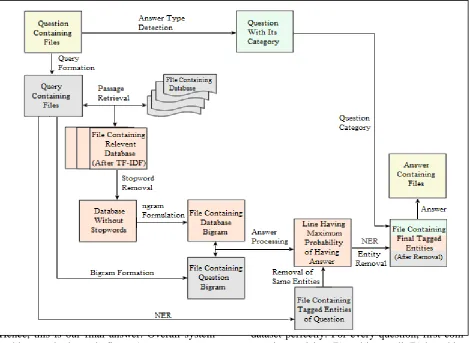
Figure 1: Proposed Named Entity Based QA System Architecture
Hence, this is our final answer. Overall system architecture is shown in figure 1.
4.
Experimental Setup and Analysis
To evaluate the effectiveness of the proposed methods for answer extraction from Hindi
cor-pus, 300 standard documents datasets is used. The accuracy for the questions of category ‘कब’, ‘कहाँ’, ‘कतनी, कतना, कतने’, and ‘कसका,
कसक’ is satisfactory in proposed approach shown in table 2. The accuracy of question type ‘ कस समय’ is not considered by the proposed approach because the answer type of this ques-tion has been not considered. The accuracy of the question type ‘कब’, ‘कहाँ’, and ‘ कसका
कसक’ is highly accurate. Some question has low syntactic information to reach the answer, and it is difficult for the system to answer. For such a questions it may have multiple documents and multiple matches in these documents, an algorithm may not extract every answer in the
dataset perfectly. For every question, first com-pute its precision (P) and its recall (R) by taking the dataset as gold standard answers as the rele-vant answer and the predicted answer at the re-trieved set. Now, taking an average of P and R over all Topics. Now, calculating macro F1 us-ing the harmonic mean of the average P and R,
Where,
and .
Accuracy (F1-measure) is calculated which out-performs existing Semantic Based Query Logic approach comparison results are highlighted in the Table 2.
Type of Question (Total 420
Question)
Accuracy (macro F1)
(Semantic Based Query
Logic)
(Proposed Approach- NE Based n-gram)
कब 66.66% 74.33%
कहाँ 53.00% 86.66%
कतना कतने कतनी
73.33% 72.50%
कसका
कसक - 82.75%
[image:6.612.72.291.71.222.2]Total 64.33% 79.06%
Table 2. Accuracy of the proposed approach The question set of 420 questions1 and supported answer documents used in this work are manual-ly collected from web. The documents have an-swer for every question still it is not easy to extract correct answers for all questions.
5.
Conclusion and Future Work
In this paper, Question answering for Hindi language has been experimented on 420 natural language questions. Results outperforms the previously used semantic based logic query approach. Using this approach, we achieved state-of-art results for most of the question types namely Person, Location, Date and Count. But as this approach is syntactic, so us-ing this approach we able to get answers for factoid questions. Text where usage of syn-onyms or hypsyn-onyms of words is seen, accurate answers could not be extracted. Such issues can be dealt by introduction of the semantic ap-proach. Results can be improved by adding fea-tures like entailment, co-reference etc in the answer extraction phase. Improving the accura-cy of Hindi NER will also help in improving the accuracy of the system. Also, as our model is domain based, one can extend its domain by using a searching algorithm over the Wikipedia or other online resources.
References
Hirschman L., Gaizauskas R., “Natural language question answering: the view from here”, Natural Language Engineering, v.7 n.4, p.275-300, De-cember, 2001.
1
https://code.google.com/p/hindiqset/
Ittycheriah et al., “IBM’s Statistical Question Answering System”, In Proceedings of the Ninth Text Retrieval Conference (TREC-9), 2000. Ro-berts, K., & Hickl, A, “Scaling Answer Type De-tection to Large Hierarchies”, In Proceedings of LREC, May 2008.
Lally A., Prager J. M., McCord M. C., Boguraev B. K., S. Patwardhan, Fan J., Fodor P., and Chu-Carroll J., “Question analysis: How Watson reads a clue”, IBM J. Res. Dev., vol. 56, no. 3/4, Paper 2, pp. 2:1–2:14, May/Jul. 2012.
Maksim Tkachenko, Andrey Simanovsky, “Named Entity Recognition: Exploring Features”. In Pro-ceedings of KONVENS 2012, Vienna, September 20, 2012.
Praveen Kumar, Shrikant Kashyap and Ankush Mit-tal, "A Query Answering System for E-Learning Hindi Documents", South Asian Lan-guage Review Vol. XIII, Nos. 1&2, January-June,2003.
Ramos J., “Using TF-IDF to determine word relev-ance in document queries”. In Proceedings of the First Instructional Conference on Machine Learn-ing, December 2003.
Roberts K. and Hickl A, “Scaling Answer Type De-tection to Large Hierarchies”, In Proceedings of LREC, May 2008.
Sahu S., Vasnik N., and Roy D., “Prashnottar: A Hindi Question Answering System”, International Journal of Computer Science and Technology, Vol 4, pp. 149-158, 2012.
Satoshi Sekine and Ralph Grishman, “Hindi-English cross-lingual question-answering system”, ACM Transactions on Asian Language Information Processing (TALIP), v.2 n.3, p.181-192, Septem-ber 2003.
Shachi Dave, Pushpak Bhattacharya & Dietrich Kla-kowya, “Knowledge Extraction from Hindi Text”, Journal of Institution of Electronic and telecom-munication engineers, 18(4), 2001.
Vishal G. and Jaspreet K., “Comparative Analysis of Question Answering System in Indian Languages”, International Journal of Advanced Research in Computer Science and Software Engineering” 3(7) pp.584-592, July 2013.
Wang X. and McCallum A., “A note on topical n-grams”, Massachusetts University Amherst Dept of Computer Science, 2005.