Discriminating between Similar Languages Using PPM
Victoria Bobicev
Technical University of Moldova
[email protected]
Abstract
The paper presents the results of participation of Bobicev team in DSL (Discriminating Simi-lar Languages) shared task 2015. It describes the use of PPM (Prediction by Partial Match-ing) for language discrimination. The accura-cy of the presented system was equal to 94.14% for the first set and 92.22% for the second set. The results were scored as the 4th for the first task and 5th for the second task, the best results being 95.54% and 94.01% re-spectively.
1
Introduction
The task of language identification is the prob-lem of detection what language a document is written in. The task seems to be relatively easy and many statistical methods achieve relatively high accuracy (more than 95%) for language de-tection. However, the good results obtained in the laboratory simplified conditions become worse in the real word circumstances. Very short documents (such as tweets), fragments of various languages in one text, documents written in simi-lar languages – here are just some difficulties encountered by the language detection systems. The present paper describes use of PPM (predic-tion by Partial Matching) statistical method for language discrimination task.
The accuracy of the presented system for the DSL 20151 (Discriminating Similar Languages) shared task (Zampieri et al., 2015) was equal to 94.14% for the first set; 92.22% for the second set respectively. The results were scored as the 4th for the first task and 5th for the second task, the best results being 95.54% and 94.01% re-spectively.
The advantage of the proposed method is its relative simplicity. The method operates with sequences of characters or even bytes, thus it
1
http://ttg.uni-saarland.de/lt4vardial2015/dsl.html
does not need to tokenize or preprocess the ana-lyzed text in any way. This also makes it rela-tively fast in training and text processing.
The paper is organized as follows: the next part gives a short overview of the related work; sec-tion 3 contains the system descripsec-tion and expla-nations how it was used for the task at hand; sec-tion 4 includes task (4.2) and data presentasec-tion (4.1), experiments and the obtained results (4.3, 4.4). Finally, a discussion concludes the paper.
2
Related work
The first DSL (Discriminating Similar Lan-guages) shared task has been organized in 2014 and the task participants presented their systems at the VarDial workshop at COLING 2014. The DSL corpus collection was created for the evaluation by merging three comparable corpora of similar languages and language varieties. Tan et al. (2014) described the process of the corpus creation and reported the performance of up to 87.4% accuracy for the baseline discrimination experiments. In the overall report for this task (Zampieri, 2014) the organizers presented the re-sults of 8 final submissions. All participants that described their systems used statistical methods such as Naïve Bayes, SVM, Max. Ent. and other. All of them used words and character n-grams as features.
The shared task organizers mentioned that the problem of similar languages discrimination was similar to the problem proposed in the Native Language Identification (NLI) shared task (Te-treault et al., 2013) where participants were pro-vided English essays written by foreign students of 11 different mother tongues and had to identi-fy the native language of the writer of each text. The differences between very similar languages can be as subtle as in case of the same language used by different people.
Ljubešić & Kranjčić (2014) presented the work on discrimination between tweets written in very similar languages, namely Bosnian, Croatian,
Montenegrin and Serbian and testing a number of statistical methods and various features such as tokens, character 3-grams and 6-grams ob-tained the best accuracy of ~97%. The authors mentioned that in some cases the text can be written in a mixture of languages either similar ones or with fragments of English or other wide-ly used languages.
Baldwin & Lui (2010) analyzed the influence of number of discriminated languages, the amount of training data and the length of documents on the accuracy of document language detection. They experimented with three relatively difficult corpora: (1) EUROGOV containing relatively longer documents, all in a single encoding, spread evenly across a relatively small number (10) of Western European languages; (2) TCL (Thai Computational Linguistics Laboratory) with a larger number of languages (60) across a wider range of language families, with shorter documents and a range of character encodings; (3) WIKIPEDIA: a slightly larger number of
lan-guages (67), a single encoding, and shorter doc-uments. Testing a number of statistical methods and using bytes, codepoints (pairs of bytes), uni-, bi-, and trigrams as features they obtained the best accuracy 0.987 for EuroGOV; 0.977 for TCL and 0.671 for Wikipedia. Experimenting with the n-grams of various length they managed to rise the accuracy to 0.729 for Wikipedia. The authors found that longer documents were easier for detection however they often contained frag-ments in other languages different than the main language of the document.
Malmasi (2015) presented the work on discri-minating two similar languages: Persian and Dari achieving the 96% accuracy using character and word n-grams on the collected corpus of 28k sen-tences (14k per-language). Out-of-domain cross-corpus evaluation, however, achieved 87% accu-racy in classifying 79k sentences from the Upp-sala Persian Corpus.
3
System description
We explored the PPM (Prediction by Partial Matching) model for automatic text language detection. Prediction by partial matching (PPM) is an adaptive finite-context method for text compression that is a back-off smoothing tech-nique for finite-order Markov models (Bratko et al., 2006). It obtains all information from the original data, without feature engineering, it is easy to implement and relatively fast. PPM pro-duces a language model and can be used in a
probabilistic text classifier. Treating a text as a string of characters, the character-based PPM avoids defining word boundaries; it deals with different types of documents in a uniform way. It can work with texts in any language and be ap-plied to diverse types of classification.
PPM is based on conditional probabilities of the upcoming symbol given several previous symbols. A blending strategy for combining text predictions is to assign a weight to each con-text model, and then calculate the weighted sum of the probabilities:
m
P(x) =
Σ
λi pi(x), (1) i=1where λiand piare weights and probabilities assigned to each order i (i=1…m).
For example, the probability of character 'm' in context of the word 'algorithm' is calculated as a sum of conditional probabilities dependent on different context lengths up to the limited maxi-mal length:
PPPM('m') = λ5⋅ P( 'm' | 'orith') + λ4⋅ P( 'm' | 'rith') +
+ λ3⋅ P( 'm' | 'ith') + λ2⋅ P( 'm' | 'th') +
+ λ1⋅ P( 'm' | 'h') + + λ0⋅ P( 'm' ) + λ-1⋅ P('esc' ), where
λi (i = 1…5) is the normalization weight;
5 is the maximal length of the context; P('esc') is so called „escape‟ probability, the probability of an unknown character.
PPM is a special case of the general blending strategy. The PPM models use an escape me-chanism to combine the predictions of all con-texts of all lengths starting with the maximal length m and ending with the context -1.
There are several versions of the PPM algorithm depending on the way the escape probability for each context is estimated. In our implementation, we used the escape method C, named PPMC; more details can be found in (Bobicev, 2007). The maximal length of a context equal to 5 in PPM model was proven to be optimal for text compression (Teahan, 1998). In all our experi-ments with character-based PPM model we used maximal length of a context equal to 5; thus our method is PPMC5.
As a compression algorithm PPM is based on the notion of entropy introduced as a measure of a message uncertainty (Shannon, 1948):
1log n
d i i
i
H p x p x
(2)where
Hd– entropy of text d;
p(xi) - probability of character xi(i = 1…n) for all
characters in the text d.
Cross-entropy is the entropy calculated for a text if the probabilities of its characters have been estimated on another text (Teahan, 1998):
1
log
n
m m m
d i i
i
H
p
x
p
x
(3)where
n is the number of symbols in a text d,
Hd m
is the entropy of the text d obtained by model m,
pm(xi) is a probability of a symbol xiin the text
d obtained by model m.
The cross-entropy between two texts is greater than the entropy of a text itself, because probabilities of characters in diverse texts are different:
Hdm Hd (4) The cross-entropy can be used as a measure for document similarity; the lower cross-entropy for two texts is, the more similar they are. Hence, if several statistical models had been created us-ing documents that belong to different classes and cross-entropies are calculated for an un-known text on the basis of each model, the low-est value of cross-entropy indicates the class of the unknown text. In this way cross-entropy is used for text classification.
In practical tasks the per-character entropy is used in order to avoid the influence of document length in the process of entropy comparison:
1
1
log
n
L i i
i
H p x p x
n
Our utility function for text classification was per-character cross-entropy of the test document
while the probabilities were estimated on the base of the known classes of documents.
On the training step, we created PPMC5 mod-els for each class of documents; on the testing step, we evaluated cross-entropy of previously unseen texts using models for each class. Thus, cross-entropy was used as similarity metrics; the lowest value of cross-entropy indicated the class of the unknown text.
There are several variations of PPM method. One possible is to use not all characters from the text but only some of them, for example, only alphanumeric characters or only letters. In our case when we have to discriminate the languages not all characters in text seem important. We probably do not need any figures or special char-acters but the punctuation may be the specific for the language.
Another variation is the word-based PPM (Bobi-cev, 2006). For some tasks words can be more indicative text features than character sequences. That‟s why we decided to try both character-based and word-character-based models for language iden-tification. In the case of word-based PPM, the context is only one word and an example for the formula (1) looks like the following:
PPPM( ' wordi ') = λ1⋅ P( ' wordi ' | ' wordi-1 ') + + λ0⋅ P( ' wordi ' ) + λ-1⋅ P( „esc‟ ),
where
wordi is the current word; wordi-1 is the previous word.
This model is coded as PPMC1 because of the same C escape method and one length con-text used for probability estimation.
4
Experiments description
The experiments were carried out during the DSL 2015 shared task event. The first set of the experiments was performed on the base of train-ing data released by the organisers in May 2015. The second set consisted of evaluation runs on test data released in June and the results for these experiments were provided by the organizers.
4.1 The Data Description
For the DSL shared task 2015 edition, the orga-nizers released two new versions of the DSL corpus collection2 (DSLCC), the version 2.0 and 2.13. The version 2.0 is the standard shared task training material whereas the version 2.1 can be
2
https://bitbucket.org/alvations/dslsharedtask2014
3
used for the unshared task track or as additional training material. The collection is described in (Tan et al., 2014).
In 2015, apart from the similar languages and varieties the training and test sets were also in-cluding texts from other languages to emulate a real-world language identification scenario. Fi-nally, the two released versions were the follow-ing:
1) DSLCC version 2.0. contained Bulga-rian, Macedonian, Serbian, Croatian, Bos-nian, Czech, Slovak, Argentinian Spanish, Peninsular Spanish, Brazilian Portuguese, European Portuguese, Malay, Indonesian and a group containing texts written in a set of other languages.
[image:4.595.70.285.316.685.2]2) DSLCC version 2.1. contained all the DSLCC version 2.0. plus Mexican Spanish and Macanese Portuguese.
Figure 1. Groups of similar languages which pre-sented difficulties in the process of language identification.
The corpus contained 20,000 instances per language (18,000 training + 2,000 development).
Each instance was an excerpt extracted from journalistic texts containing 20 to 100 tokens and tagged with the country of origin of the text. The groups of similar languages are presented in fig-ure 1.
4.2 The task description
For the testing phase two test sets (A and B) have been released. Each of them contained 1,000 unidentified instances of each language to be classified according to the country of origin. These instances contained also instances of texts from the other languages than those presented in the figure similarly to the training set DSLCC version 2.0.
Test set A contained original unmodified newspaper texts. Test set B contained modified newspapers texts processed with NER taggers to substitute named entities for place holders.
Participants had to return their results in up to 2 days after the release of the test sets. Scores were calculated according to the systems' accura-cy in identifying the country of origin of the text. Two kinds of submissions were allowed:
1) Closed submission: Using only the training corpus provided by the DSL shared task (DSLCC v.2.0).
2) Open submission: Using any corpus for training including or not the DSLCC v.2.0.
We participated only in closed submission us-ing just the corpus DSLCC v.2.0.
4.3 The first set of the experiments
In order to evaluate the PPM method for the task we used 10-fold cross-validation on the all provided training data. Initially, we excluded the instances marked as xx with the unknown lan-guages to see how the method performed on the known sets. Thus, for each step we used 1800 instances of each language for training and 200 instances of each language for test.
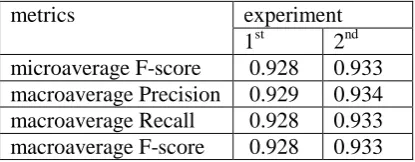
We used character-based PPM5 in the first set of the experiments. The first experiment was per-formed using only letters for training, all other characters were ignored.
metrics experiment
[image:4.595.312.520.655.736.2]1st 2nd microaverage F-score 0.928 0.933 macroaverage Precision 0.929 0.934 macroaverage Recall 0.928 0.933 macroaverage F-score 0.928 0.933
In the second experiment we used all characters from the texts; all letters were converted in lower case. The results for the first and the second ex-periments are presented in table 1.
Thus, we obtained slightly better results in case when all characters from the texts were used.
The next experiment was performed using word-based PPM1 described in the previous section. Its results were worse than for character based PPM5.
Next, we experimented with the unknown guages marked as xx. There were several lan-guages and thus, they did not present one uni-form class of texts. While the entropy for the texts written in the same language was in average 2 ± 0.5 bit/symbol, for the different languages the average entropy varied from 4 to even 12 bit/symbol.
We considered two options of the unknown languages classification:
- A threshold for these languages was used. If the smallest entropy of a test text on the base of all models is bigger than a thre-shold we considered that text as not writ-ten in any of 13 known languages and hence, as unknown one and marked as xx. In this case we created models only on 13 known classes of languages.
- All text marked with xx were treated as one more class. In this case, 14 models were created, including a model for xx class and the standard procedure was ap-plied. Each test document was attributed to the class for which it has the lowest en-tropy.
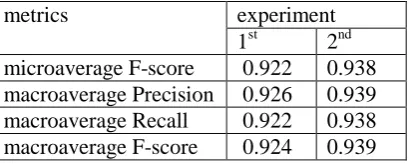
metrics experiment
[image:5.595.80.285.551.633.2]1st 2nd microaverage F-score 0.922 0.938 macroaverage Precision 0.926 0.939 macroaverage Recall 0.922 0.938 macroaverage F-score 0.924 0.939
Table 2: The results for the first and the second expe-riments with the unknown texts marked as xx
The obtained results are presented in table 2. Thus, the second option when all the documents written in the unknown languages were treated as the one class was better. More than that, this re-sult was even better than the pure classification of 13 known languages. This indicates that xx class was distinguished fairly well.
4.4 The second set of the experiments
The second set of the experiments was per-formed on the base of the test data released by the organizers of DSL shared task in June 2015.
These DSL Test Sets are part of the DSLCC v2.0, they comprise news data from various cor-pora to emulate the diverse news content across different languages and varieties.
Two types of test data were released:
•The first test set that contained 14,000 un-changed sentences for 13 anguages/varieties and others (bg, bs, cz, es-AR, es-ES, hr, id, mk, my, pt-BR, pt-PT, sk, sr, xx).
•The second test that contained 14,000 sen-tences with that had blinded Named Entities. In these texts, the Named Entities (NEs) have been replaced by placeholders; a #NE# instead of a named entity.
An example of such sentence is:
The initial sentence: La cinta, que hoy se estrena en nuestro país, competirá contra Hors la Loi, de Argelia, Dogtooth, de Grecia, Incendies, de Canadá, Life above all , de Sudáfrica, y con la ganadora del Globo de Oro, In A Better World, de Dinamarca.
The sentence with blinded NE: La cinta, que hoy se estrena en nuestro país, competirá contra #NE# la #NE# , de #NE# , #NE# , de #NE# , #NE# , de #NE# á, #NE# above all , de #NE# , y con la ganadora del #NE# de #NE# , #NE# A #NE# #NE# , de #NE# .
The participants were allowed to submit only 3 runs for closed and/or 3 runs for open task for both test sets.
We submitted only one run for each test set using PPM5 character based method using all characters from the text as this option demon-strated the best results in the first set of experi-ments. While experimenting with the second test set with blinded NE we simply removed #NE#
fragments and worked with the rest of the text.
Thus, the example of the sentence presented above would look as follows: La cinta, que hoy se estrena en nuestro país, competirá contra la , de , , de , , de á, above all , de , y con la ganadora del de , A , de .
The overall accuracies in these experiments were calculated by the organizers as such:
overall accuracy = sum(TP) / #sents
where:
TP = True Positive for all languages/varieties; #sents = total number of documents in evalua-tion dataset.
the second task, the best results being 95.54 and 94.01 respectively.
5
Discussion
The challenges are an excellent way to examine the problem at hand from the various points of view. The challenge organizer‟s work is very important in this context. The saying is that the good question contains a part of the answer. In the case of the challenge the findings depend heavily on the quality of the prepared data. It should be mentioned though that the flaws in the data preparation could lead to interesting disco-veries as well.
In this particular challenge the problem was to discriminate between similar languages. The or-ganizers indicated the groups; figure 1 presents them. The best way was to analyze the accuracy on every group apart; this information was not provided for the final test. We present and dis-cuss it on the base of the 10-fold cross-validation experiment that used the 260,000 training in-stances.
languages bg mk
bg 19996 3
[image:6.595.333.500.183.225.2]mk 1 19997
Table 3: Confusion table for Bulgarian and Macedo-nian
As it is seen from the table, Bulgarian and Macedonian can be reliably distinguished due to several specific characters in Macedonian alpha-bet which are frequent enough to appear in any sentence despite of the similarity of these two languages in both in vocabulary and syntax. A couple of misclassified sentences were written in a special manner; here is an example: “При то-зи из-раз ве-че яс-но си про-ли-ча, как да-ма-та уми-ш-ле-но вмъ-к-ва ня-ка-къв ак-цент, с дру-ги ду-ми бъл-гар-с-ки-ят й ве-че та-ка убя-г-ва, та чак го фъ-ф-ли.”
languages bs hr sr
bs 16168 2637 1195
hr 2977 16797 226
sr 2118 403 17479
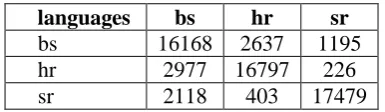
Table 4: Confusion table for Bosnian, Croatian and Serbian
The worst results were obtained for the group of Bosnian, Croatian and Serbian languages as they
overlap significantly in vocabulary, syntax and morphology. Although they claimed to be dif-ferent languages the differences were not so fre-quent and easily identified as in case of Bulga-rian and Macedonian. The most overlapping were Bosnian and Croatian; 13% of Bosnian sen-tences were classified as Croatian and 15% of Croatian sentences were classified as Bosnian.
languages es-AR es-ES
es-AR 17547 2453
[image:6.595.98.265.383.424.2]es-ES 1607 18391
Table 5: Confusion table for Argentinean Spanish and Peninsular Spanish
The two Spanish dialects discrimination results were better than for Slavic languages; 12% of Argentinean Spanish sentences were classified as Peninsular Spanish and 9% of Peninsular Span-ish sentences were classified as Argentinean Spanish. The differences here were also not so frequent and in many sentences were no any spe-cific feature to help the source detection.
languages pt-BR pt-PT
pt-BR 18440 1558
[image:6.595.332.499.383.425.2]pt-PT 1978 18021
Table 6: Confusion table for Brazilian Portuguese and European Portuguese
The situation for Brazilian Portuguese and Euro-pean Portuguese was similar; 8% of Brazilian Portuguese sentences were classified as Euro-pean Portuguese and 11% of EuroEuro-pean Portu-guese sentences were classified as Brazilian Por-tuguese.
languages id my
id 19905 93
my 177 19823
Table 7: Confusion table for Indonesian and Malay
The differences between Indonesian and Ma-lay are much more frequent and easily learned by a statistical system; less than 1% of sentences were misclassified.
[image:6.595.326.502.558.599.2] [image:6.595.84.277.634.690.2]lengua catalana "constituye una fuente de igualdad de oportunidades y de cohesión social en Balears".
The discussion raised in the corpora list dis-puted the question: has the problem of language discrimination finally been solved? The answer is no. Probably, the question should be reformu-lated as follows: is it even possible to obtain 100% correct discrimination between the lan-guages, especially similar ones? And the answer would be again no. Languages are a part of the constantly changing world, so they also tend to be highly dynamic. Some languages disappear, some appear, some split, and some merge due to linguistic researches or political changes. For example, while we were solving the discrimina-tion task between Serbian and Croatian but many linguists consider Serbian and Croatian to be di-alects of one language, not separate languages and refer to it as Serbo-Croatian. The paper by Xia et al., (2010) presented an example of the complexity of language discrimination tasks. They presented a table of language names for which they could not even find a standard lan-guage ID code. There were also “missing” and ambiguous language names; tables of 1-to-n split of languages. They pointed out that our know-ledge of languages is always changing and ex-panding, which entails the need of annual revi-sion of the language list.
A good example of all said above is Molda-vian language, which has been declared the offi-cial language with the new Moldovan Cyrillic alphabet due to political changes (appearance of Moldavian Republic as a part of Soviet Union). The differentiation of Moldavian and Romanian languages was introduced in the context of the Soviet policy that emphasized the differences between Moldova and Romania. Its existence is officially denied now because the current Mol-davian government declared Romanian language as the official one in the Republic of Moldova. As in many other cases the new language was not linguistically but purely politically moti-vated. The linguists don't even want to delve deeper into that matter because there are many conflicting interests - political, cultural and even financial.
The other, pure practical question is: do we re-ally need to obtain 100 percent accuracy in this task? The answer is also no. If the languages are really close some sentences are impossible to detect reliably; they could be written in any of related language and any language tool adapted
to one of these languages is able to analyze it satisfactory.
References
Baldwin, T., Lui, M. 2010. Language identification: The long and the short of the matter (2010) In Proc. HLT-NAACL.
Bobicev, V. 2006. Text Classification Using Word-Based PPM Models, The Computer Science Jour-nal of Moldova, vol. 14, no. 2, pp. 183–201.
Bobicev, V. 2007 Comparison of Word-based and Letter-based Text Classification. RANLP V, Bul-garia, pp. 76–80.
Bratko A., Cormack G. V., Filipic B., Lynam T. R., Zupan B. 2006. Spam filtering using statistical da-ta compression models, Journal of Machine Learn-ing Research 7:2673–2698.
Ljubešić, N., Kranjčić, D. 2014. Discriminating be-tween VERY similar languages among Twitter us-ers. 9th Language Technologies Conference In-formation Society – IS.
Malmasi, S. 2015. Discriminating Similar Languages: Persian and Dari. Volume 3 of Tiny Transactions on Computer Science.
Shannon, C. E. 1948. A Mathematical Theory of Communication. The Bell System Technical Jour-nal, vol. 27, pp. 379–423, 623–656.
Tan, L., Zampieri, M., Ljubešic, N., Tiedemann, J. 2014. Merging Comparable Data Sources for the Discrimination of Similar Languages: The DSL Corpus Collection. Proceedings of the 7th Work-shop on Building and Using Comparable Corpora (BUCC), Iceland.
Teahan, W. 1998. Modelling English text, PhD The-sis, University of Waikato, New Zealand.
Tetreault, J., Blanchard, D., Cahill, A. 2013. A report on the first native language identification shared task. In Proceedings of the Eighth Workshop on Innovative Use of NLP for Building Educational Applications, Atlanta, GA, USA. Association for Computational Linguistics.
Xia, F., Lewis, C., Lewis, W. D. 2010. The Problems of Language Identification within Hugely Multilin-gual Data Sets, Proceedings of the 7th Interna-tional Conference on Language Resources and Evaluation (LREC 2010).