Using Finite State Transducers for Helping Foreign Language Learning
Hasan Kaya
Istanbul Technical University
Department of Computer Engineering
Istanbul, 34469, Turkey
[email protected]
G¨uls¸en Eryi˘git
Istanbul Technical University
Department of Computer Engineering
Istanbul, 34469, Turkey
[email protected]
Abstract
The interest and demand to foreign language learn-ing are increased tremendously along with the glob-alization and freedom of movement in the world. To-day, the technological developments allow the cre-ation of supportive materials for foreign language learners. However, the language acquisition be-tween languages with high typological differences still poses challenges for this area and the learning task it self. This paper introduces our preliminary study for building an educational application to help foreign language learning between Turkish and En-glish. The paper presents the use of finite state tech-nology for building a Turkish word synthesis sys-tem (which allows to choose word-related features among predefined grammatical affix categories such as tense, modality and polarity etc...) and a word-level translation system between the languages in focus. The developed system is observed to out-perform the popular online translation systems for word-level translation in terms of grammatically cor-rect outputs.
1 Introduction
The influence of mother tongue on foreign language learning is discussed in many linguistic and psycholog-ical studies (Hakuta et al., 2000; Hakuta, 1999; Dur-gunoglu and Hancin-Bhatt, 1992; Ringbom, 1987; Swan, 1997; Corder, 1983) in the literature. The typological differences between the mother tongue and the second language have an important role on the duration of learn-ing process. In these studies, it is emphasized that one of the causes of frequently made mistakes in the second language is the rules learned from the first language. En-glish and Turkish being languages from totally different language families compose a very representative and in-teresting language pair for this phenomena.
Turkish is an agglutinative language with a very rich morphological structure. Most of the syntactic
informa-tion on the English side become morphological proper-ties of a word on the Turkish side. In some cases, a single Turkish word may correspond to a full English sentence. This situation results in difficulties during lan-guage learning between this lanlan-guage pair and also in sta-tistical machine translation (MT) systems. In daily life in Turkey, it is very common to come across with foreign-ers making mistakes in constructing Turkish words with invalid grammatical constructions (i.e. having difficulty to produce the correct morpheme order to form a valid Turkish word). Bisazza and Federico (2009), Yeniterzi and Oflazer (2010), El-Kahlout and Oflazer (2010) and Eyig¨oz et al. (2013) show the influence of using morpho-logical clues in increasing the MT quality.
Finite state technology is proven to increase the ef-ficiency in many rule-based NLP related tasks (Mohri, 1997; Roche and Schabes, 1997). Today, the availability of finite state transducer (FST) frameworks such as Open-FST (Allauzen et al., 2007), HOpen-FST (Lind´en et al., 2009) and XFST (Beesley and Karttunen, 2003) makes possible to create FST applications very efficiently. In this paper, we present the results of our elementary studies on us-ing finite state transducers to build supportive tools for foreign language learning; namely Turkish for English native speakers and English for Turkish native speakers. We compare our results with four popularly online trans-lation systems: 1. Google1, 2. Yandex2, 3. Bing3 and 4. Tureng4. The paper is organized as follows: Section 2 introduces the Turkish morphology, Section 3 the system architecture, Section 4 the learning use cases and Section 5 the conclusion and future work.
2 Turkish Morphology
As mentioned in the previous section, agglutinative lan-guage morphology has a high impact on the performance
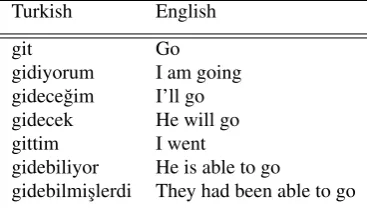
of translation process of a word. Turkish has a com-plex morphology and because of this reason, the usage of suffix concatenations at the end of a word lemma may cause the word to denote different meanings. Table 1 gives some translation examples from Turkish to English to show that the usage of dictionary/lexicon look-up sys-tems are not suitable for word translation between Turk-ish and EnglTurk-ish due to unpredictable dictionary size. For-eign language learners have even difficulty to search for the meaning of a Turkish word from a Turkish dictionary since this task requires to firstly determine the lemma of that word. To give an example for this problem, word stem for “git” (go) can be written in different conjugated word forms such as: “gidiyorum”, “gidece˘gim”, “gide-cek” etc. (up to nearly 50 variations) which refer to very different translations in the English side although the lemma of these words are the same. As a result, a Turkish word may be expressed as a single English word or a phrase or even a sentence as shown in Table 1.
Turkish English
git Go
gidiyorum I am going gidece˘gim I’ll go gidecek He will go gittim I went
gidebiliyor He is able to go
[image:2.595.314.524.169.301.2]gidebilmis¸lerdi They had been able to go
Table 1: Translation of Turkish words
3 System Architecture
Eryi˘git (2014) introduces a web service for morphologi-cal analysis and generation of Turkish. The provided ana-lyzer is an updated version of the work presented in S¸ahin et al. (2013) and uses finite state technology for the anal-ysis and generation purposes. In the provided interface the surface word form “gidiyorum” (I’m going) is ana-lyzed as the lexical form “git+Verb+Pos+Prog1+A1sg” where “git” (to go) is the lemma of the word and the following tags hold for main parts-of-speech tag and additional inflectional features: “+Pos” for the positive marker, “Prog1” for the progressive tense, “A1sg” for the 1st singular person. Similarly the same analysis given
to the morphological generator produces the same input word. Inspired from this work, we develop a new fi-nite state transducer transfer model and an English an-alyzer/generator which take the produced morphological analysis as input and produces its English counterpart. The system also works in reverse direction so that once an English input is given to the system, it transfers it to a Turkish lexical form and then uses the morpholog-ical generator to produce a valid Turkish word. Figure 1
[image:2.595.85.269.333.437.2]draws the main flow of our system which we call “ITU Morphological Transfer module for English-Turkish lan-guage pairs”; ITUMorphTrans4ET in short from now on. The figure provides the intermediate stages for two given examples: “gidiyorum” (I’m going) and “gittim” (I went).
Figure 1: ITUMorphTrans4ET System Architechture
The transfer model is very similar to an FST mor-phological analyzer but instead of producing the relevant morphological tags for a given surface form, it produces a new lexical form (the English counterpart) of the input Turkish lexical form. To this end, it contains a bilingual lexicon for word lemmas and the transfer rules. An ex-ample from the transfer model FST is given below where each morphological tag (i.e. a suffix in the word surface form) representing person agreements are coded to pro-duce two English words.
LEXICON Fin-ED-PC +A1sg:+am+I #; +A2sg:+are+you #; +A3sg:+is+he/she/it #; +A1pl:+are+we #;
+A2pl:+are+you #; +A3pl:+are+they #;
The English output of the transfer model may be ei-ther some words or some tags to be furei-ther processed by the lexical post-processor. It is not necessary that all the Turkish tags produce an output; some of them are only required for determining the possible paths on the FST. This may be observed on the lexical forms of Turkish words in Figure 1. While the “+Prog1” tag is changed to an “+ing” tag, the “+Past” tag is changed to a “+V2” tag and the “+A2sg” tag is changed to the word “+he/she/it” in the transfer model’s output, the “+Verb” or “+Noun” tags are only used for forwarding the process to possible FST paths in the coded rules.
Turkish ITUMorphTrans4ET Google Bing Tureng Yandex
gidebilirse if he can go! can go if he can go! go he could leave gidecek he will go! will go will go be destined for go gitmelilerdi they should have
gone! they should go they need to get it go they have to go gitmis¸lerse if they had gone! they have gone if they went go if they’re gone gidebilecekse if he will be able to
go! go abilecekse can go go if you can go yapmalılarsa if they should do! sign mAlIlArsA if they’re making go do they masalarımızla with our tables! our table our table table our desks
English ITUMorphTrans4ET Google Bing Yandex
if he can go gidebilirse! O gidebilirsiniz E˘ger gidebilir e˘ger gidip o he will go gidecek! O gidecek! o-ecek gitmek gidecek! they should have gone gitmelilerdi!
gitmelilermis¸! Onlar gitmis¸ olmalı Onlar gitmis¸ olmalı gitmelilerdi! if they had gone gitmis¸lerse!
gitmis¸seler! onlar gitmis¸ti e˘ger Onlar ne gitseydin e˘ger gitmis¸ olsalardı if he will be able to go gidebilecekse! O gitmek m¨umk¨un
olacak e˘ger E˘ger o-ecek var olmakg¨uc¸l¨u-e do˘gru gitmek ic¸in
e˘ger gitmek m¨umk¨un olacak
if they should do yapmalılarsa!
etmelilerse! Onlar yapmalıyım onlar yoksa e˘gere˘ger yapmalıyım
with our tables listelerimizle!
tablolarımızla! Bizim tablolarla! Bizim tablolarla! bizim tablolar ile!
Table 2: Comparison of ITUMorphTrans4ET with other popular systems
words. This doesn’t mean that the input may be any En-glish utterance but rather EnEn-glish phrases or sentences which maps to single words in the Turkish side or some compound verb forms such as “telefon etmek” (to phone). This FST also contains the list of irregular words for correct transformations: e.g. “to go” with lexical form “go+V2+I” will be converted to “went+I” as the surface form whereas a regular verb “play+V2+I” will be con-verted to “played+I”. There are some additional rules for specific cases such as “clap+ing” which be transferred to “clapping” requiring a character repetition of the letter “p”. Finally after obtaining the last surface form such as “playing+am+I”, we output this in reverse order5 by the use of a script.
Table 2 gives the comparison of our proposed sys-tem with popular online translation syssys-tems of namely
5The order of the words are rearranged so that the resulting sentence
is grammatical.
Google, Yandex, Bing and Tureng. Since the Tureng MT system is only available from Turkish to English, its re-sults are not provided in the second half of the table. The acceptable translations for each case are marked with check marks in the table. As can be noticed, the proposed system produces better results at word-level translation.
4 Learning Use Cases
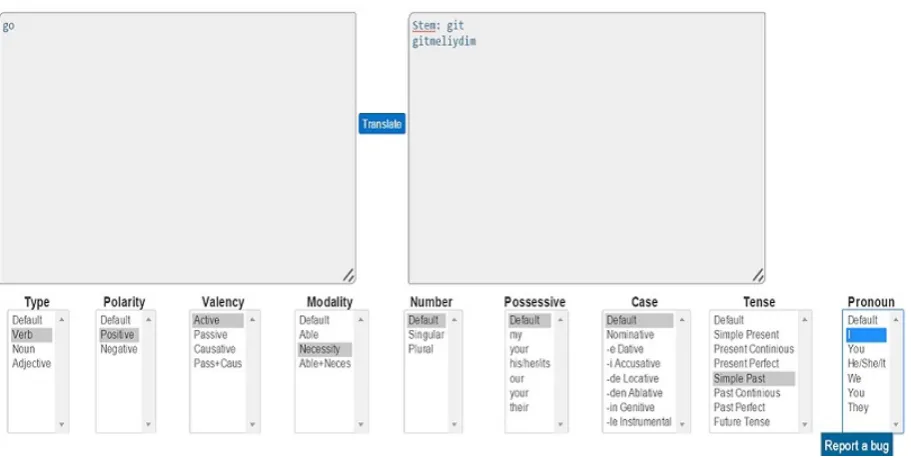
effi-Figure 2: An example output from ITUMorphTrans4ET (from English to Turkish)
ciently by providing a user friendly interface for learners.
4.1 Turkish Learning
Learning Turkish is very tough process especially for learners whose mother tongue is not agglutinative due to the fixed order of suffix concatenations to the end of the words which may become dizzy for the new language learners. To give an example for this problem, instead of saying “gitmis¸lerdi” (they had been gone) one may say “gittilermis¸” which is not a valid word in terms of suffix order. In the future, ITUMorphTrans4ET system may de-tect these mistakes (by the help of additional spelling sug-gesters) and make produce correct translations. In other term, after having a valid analysis and necessary lexical rules, our system can translate any written Turkish word to English language or vice-versa. We believe that same approach may be used for other agglutinative languages by constructing necessary transfer rules.
Figure 2 shows the preliminary interface of ITUMor-phTrans4ET where one may type an English lemma and then select morphological properties by using list boxes below. For this example, the word “go” is typed and its properties are selected as “Verb” for the word type, “Pos-itive” for the polarity and so on. Using these information, our system easily translates the word to “gitmeliydim” (I should have gone). We believe by improving our system with a more user-friendly interface, the effect of suffixes in Turkish may be efficiently realized and learned by the users.
4.2 English Learning
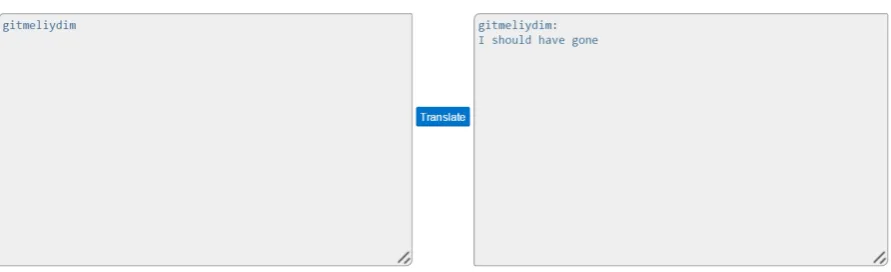
As explained in previous sections, learning English is as hard as learning Turkish for native Turkish speakers and has same challenging problems. There exists no trans-lation system that works well from Turkish to English at word level. As a consequence, these translators can not be efficient for language learning purposes. How-ever, ITUMorphTrans4ET presents a very strong transla-tion mechanism for two way Turkish-English word trans-lation. It uses morphological model of words in order to translate words. Using the advantage of the morpholog-ical structure, even very complex words can be simpli-fied into meaningful tags and then translated to English. Figure 3 gives an example screen for English learners: The word “gitmeliydim” is translated into “I should have gone”.
5 Conclusion & Future Work
[image:4.595.73.529.122.351.2]Figure 3: An example output from ITUMorphTrans4ET (from Turkish to English)
may be used in many platforms such as smart boards in classrooms, mobile applications etc. To this end, for fu-ture work we plan to focus on improving our system by 1) Developing an user-friendly interactive application for foreign Turkish learners, 2) Developing a mobile applica-tion for accessing the interface more easily, and 3) Step-ping up to sentence level instead of word level translation by using statistical machine learning approaches. The im-plementation of ITUMorphTrans4ET is available through a web service found at http://tools.nlp.itu.edu.tr/ (Eryi˘git, 2014).
Acknowledgments
The authors want to thank Dilara Toruno˘glu Selamet for her valuable contributions to this work.
References
Cyril Allauzen, Michael Riley, Johan Schalkwyk, Wojciech Skut, and Mehryar Mohri. 2007. Openfst: A general and ef-ficient weighted finite-state transducer library. In Implemen-tation and Application of Automata, pages 11–23. Springer. Kenneth R Beesley and Lauri Karttunen. 2003. Finite-state
morphology: Xerox tools and techniques.CSLI, Stanford. Arianna Bisazza and Marcello Federico. 2009.
Morphologi-cal pre-processing for Turkish to English statistiMorphologi-cal machine translation. InIWSLT, pages 129–135.
Stephen Pit Corder. 1983. A role for the mother tongue. Lan-guage transfer in lanLan-guage learning, pages 85–97.
Aydin Y. Durgunoglu and Barbara J. Hancin-Bhatt. 1992. The role of first language in the second-language reading process. Technical report, University Illinois at Urbana-Champaign. Ilknur Durgar El-Kahlout and Kemal Oflazer. 2010.
Exploit-ing morphology and local word reorderExploit-ing in English-to-Turkish phrase-based statistical machine translation. Audio, Speech, and Language Processing, IEEE Transactions on, 18(6):1313–1322.
G¨uls¸en Eryi˘git. 2014. ITU Turkish NLP web service. In Pro-ceedings of the Demonstrations at the 14th Conference of the
EACL, Gothenburg, Sweden, April. Association for Compu-tational Linguistics.
Elif Eyig¨oz, Daniel Gildea, and Kemal Oflazer. 2013. Simul-taneous word-morpheme alignment for statistical machine translation. InProceedings of NAACL-HLT, pages 32–40. Kenji Hakuta, Yuko Goto Butler, and Daria Witt. 2000. How
long does it take English learners to attain proficiency? Uni-versity of California Linguistic Minority Research Institute. Kenji Hakuta. 1999. A critical period for second language
ac-quisition? a status review. National Center for Early Devel-opment of Learning. Chapel Hill, NC: University of North Carolina.
Krister Lind´en, Miikka Silfverberg, and Tommi Pirinen. 2009. Hfst tools for morphology–an efficient open-source package for construction of morphological analyzers. InState of the Art in Computational Morphology, pages 28–47. Springer. Mehryar Mohri. 1997. Finite-state transducers in language and
speech processing. Computational linguistics, 23(2):269– 311.
H˚akan Ringbom. 1987.The role of the first language in foreign language learning, volume 34. Multilingual Matters Ltd. Emmanuel Roche and Yves Schabes. 1997. Finite-state
lan-guage processing. MIT press.
Muhammet S¸ahin, Umut Sulubacak, and G¨uls¸en Eryi˘git. 2013. Redefinition of Turkish morphology using flag diacritics. In Proceedings of The Tenth Symposium on Natural Language Processing (SNLP-2013), Phuket, Thailand, October. Michael Swan. 1997. The influence of the mother tongue on
second language vocabulary acquisition and use. Vocabu-lary: Description, acquisition and pedagogy, pages 156– 180.