VARTRA: A Comparable Corpus for Analysis of Translation Variation
Ekaterina Lapshinova-Koltunski Universit¨at des Saarlandes
A 2.2 Universit¨at Campus 66123 Saarbr¨ucken
Germany
Abstract
This paper presents a comparable lation corpus created to investigate trans-lation variation phenomena in terms of contrasts between languages, text types and translation methods (machine vs. computer-aided vs. human). These phe-nomena are reflected in linguistic fea-tures of translated texts belonging to dif-ferent registers and produced with differ-ent translation methods. For their analysis, we combine methods derived from trans-lation studies, language variation and ma-chine translation, concentrating especially on textual and lexico-grammatical varia-tion. To our knowledge, none of the ex-isting corpora can provide comparable re-sources for a comprehensive analysis of variation across text types and translation methods. Therefore, the corpus resources created, as well as our analysis results will find application in different research areas, such as translation studies, machine trans-lation, and others.
1 Introduction: Aims and Motivation
Comparable corpora serve as essential resources for numerous studies and applications in both linguistics (contrastive language, text analysis), translation studies and natural language process-ing (machine translation, computational lexicog-raphy, information extraction). Many compara-ble corpora are availacompara-ble and have been being cre-ated for different language pairs like (a) English, German and Italian (Baroni et al., 2009); (b) En-glish, Norwegian, German and French (Johans-son, 2002); (c) written or spoken English and Ger-man (Hansen et al., 2012) or (Lapshinova et al., 2012).
However, comparable corpora may be of the same language, as the feature of ’comparability’
may relate not only to corpora of different lan-guages but also to those of the same language. The main feature that makes them comparable is that they cover the same text type(s) in the same proportions, cf. for instance, (Laviosa, 1997) or (McEnery, 2003), and thus, can be used for a cer-tain comparison task.
As our research goal is the analysis of trans-lation variation, we need a corpus which allows us to compare translations, which differ in the source/target language, the type of the text lated (genre or register) and the method of
trans-lation (human with/without CAT1 tools, machine
translation). There are a number of corpus-based studies dedicated to the analysis of variation phe-nomena, cf. (Teich, 2003; Steiner, 2004;
Neu-mann, 2011) among others. However, all of
them concentrate on the analysis of human trans-lations only, comparing translated texts with non-translated ones. In some works on machine trans-lation, the focus does lie on comparing
differ-ent translation variants (human vs. machine),
e.g. (White, 1994; Papineni et al., 2002; Babych and Hartley, 2004; Popovi´c, 2011). However, they all serve the task of automatic machine transla-tion (MT) systems evaluatransla-tion and use the human-produced translations as references or training
ma-terial only. None of them provide analysis of
specifc (linguistic) features of different text types translated with different translation methods.
The same tendencies are observed in the cor-pus resources available, as they are mostly built for certain research goals. Although there exists a number of translation corpora, none of them fits our research task: most of them include one translation method only: EUROPARL (Koehn, 2005) and JRC-Acquis (Steinberger et al., 2006) – translations produced by humans, or DARPA-94 (White, 19DARPA-94) – machine-translated texts only.
1CAT = computer-aided translation
Moreover, they all contain one register only and, therefore, cannot be applied to a comprehensive analysis of variation phenomena.
Therefore, we decided to compile our own com-parable corpus which contains translations from different languages, of different text types, pro-duced with different translation methods (human vs. machine). Furthermore, both human and ma-chine translations contain further varieties: they are produced by different translators (both profes-sional and student), with or without CAT tools or by different MT systems.
This resource will be valuable not only for our research goals, or for research purposes of further translation researchers. It can also find further ap-plications, e.g. in machine translation or CAT tool development, as well as translation quality asses-ment.
The remainder of the paper is structured as fol-lows. Section 2 presents studies we adopt as the-oretical background for the selection of features and requirements for corpus resources. In section 4, we describe the compilation and design of the comparable translation corpus at hand. In section 5, we demonstrate some examples of corpus ap-plication, and in section 6, we draw some conclu-sions and provide more ideas for corpus extension and its further application.
2 Theoretical Background and Resource Requirements
To design and annotate a corpus reflecting varia-tion phenomena, we need to define (linguistic) fea-tures of translations under analysis. As sources for these features, we use studies on translation and translationese, those on language variation, as well as works on machine translation, for instance MT evaluation and MT quality assessment.
2.1 Translation analysis and translationese
As already mentioned in section 1 above, trans-lation studies either analyse differences between original texts and translations, e.g. (House, 1997; Matthiessen, 2001; Teich, 2003; Hansen, 2003; Steiner, 2004), or concentrate on the properties of translated texts only, e.g. (Baker, 1995). How-ever, it is important that most of them consider translations to have their own specific properties which distinguish them from the originals (both of the source and target language), and thus,
estab-lish specific language of translations – the
transla-tionese.
Baker (1995) excludes the influence of the source language on a translation altogether, analysing characteristic patterns of translations
in-dependent of the source language. Within this
context, she proposed translation universals – hy-potheses on the universal features of translations: explicitation (tendency to spell things out rather
than leave them implicit),simplification(tendency
to simplify the language used in translation),
nor-malisation (a tendency to exaggerate features of the target language and to conform to its
typi-cal patterns) and levelling out (individual
trans-lated texts are alike), cf. (Baker, 1996). Addition-ally, translations can also have features of “shining through” defined by Teich (2003) – in this case we observe some typical features of the source lan-guage in the translation. The author analyses this phenomena comparing different linguistic features (e.g. passive and passive-like constructions) of originals and translations in English and German.
In some recent applications of translationese
phenomena, e.g. those for cleaning parallel cor-pora obtained from the Web, or for the im-provement of translation and language models in MT (Baroni and Bernardini, 2005; Kurokawa et al., 2009; Koppel and Ordan, 2011; Lembersky et al., 2012), authors succeeded to automatically identify these features with machine learning tech-niques.
We aim at employing the knowledge (features described) from these studies, as well as tech-niques applied to explore these features in the cor-pus.
2.2 Language variation
Features of translated texts, as well as those of their sources are influenced by the text types they belong to, see (Neumann, 2011). Therefore, we also refer to studies on language variation which focus on the analysis of variation across registers and genres, e.g. (Biber, 1995; Conrad and Biber, 2001; Halliday and Hasan, 1989; Matthiessen, 2006; Neumann, 2011) among others. Register is described as functional variation, see Quirk et
al. (1985) and Biber et al. (1999). For
exam-ple, language may vary according to the activ-itiy of the involved participants, production
va-rieties (written vs. spoken) of a language or
field, tenorandmodedefined in the framework of Systemic Functional Linguistics (SFL), which de-scribes language variation according to situational contexts, cf. e.g. Halliday and Hasan (1989), and Halliday (2004).
In SFL, these variables are associated with the corresponding lexico-grammatical features, e.g. field of discourse is realised in functional verb classes (e.g., activity, communication, etc) or term patterns, tenor is realised in modality (expressed e.g. by modal verbs) or stance expressions, mode is realised in information structure and textual
co-hesion (e.g. personal and demonstrative
refer-ence). Thus, differences between registers or text types can be identified through the analysis of oc-currence of lexico-grammatical features in these registers, see Biber’s studies on linguistic varia-tion, e.g. (Biber, 1988; Biber, 1995) or (Biber et al., 1999).
Steiner (2001) and Teich (2003) refer to regis-ters as one of the influencing sources of the prop-erties of translated text. Thus, we attempt to study variation in translation variants by analysing dis-tributions of lexico-grammatical features in our corpus.
2.3 Machine translation
We also refer to studies on machine translation in our analysis, as we believe that translation vari-ation phenomena should not be limited to those produced by humans. Although most studies com-paring human and machine translation serve the task of automatic MT evaluation only, cf. (White, 1994; Papineni et al., 2002; Babych and Hartley, 2004), some of them do use linguistic features for their analysis.
For instance, Popovi´c and Burchardt (2011) define linguistically influenced categories (inflec-tions, word order, lexical choices) to automatically classify errors in the output of MT systems. Spe-cia (2011) and SpeSpe-cia et al. (2011) also utilise lin-guistic features as indicators for quality estima-tion in MT. The authors emphasize that most MT studies ignored the MT system-independent fea-tures, i.e. those reflecting the properties of the translation and the original. The authors classify
them into source complexity features (sentence
and word length, type-token-ratio, etc.),target
flu-encyfeatures (e.g. translation sentence length or
coherence of the target sentence) and adequacy
features (e.g. absolute difference between the
number of different phrase types in the source and target or difference between the depth of their syn-tactic trees, etc.).
3 Methodology
Consideration of the features described in the above mentioned frameworks will give us new insights on variation phenomena in translation. Thus, we collect these features and extract infor-mation on their distribution across translation vari-ants of our corpus to evaluate them later with sta-tistical methods.
Some of the features described by different frameworks overlap, e.g. type-token-ratio (TTR) or sentence length as indicator for simplification in translationese analysis and as a target fluency feature in MT quality estimation; modal meanings and theme-rheme distribution in register analysis and SFL, or alternation of passive verb construc-tions in register analysis and translation studies.
Investigating language variation in translation, we need to compare translations produced by dif-ferent systems with those produced by humans (with/without the help of CATs). Furthermore, we need to compare translated texts either with their originals in the source or comparable originals in the target language. Moreover, as we know that text type has influence on both source and target text (Neumann, 2011), we need to compare differ-ent text registers of all translation types.
This requires a certain corpus design: we need a linguistically-annotated corpus for extraction of
particular features (e.g. morpho-syntactic
con-structions); we need to include meta-information on (a) translation type (human vs. computer-aided vs. machine, both rule-based and statistical), (b) text production type (original vs. translation) and (c) text type (various registers and domains of dis-course). This will enable the following analysis procedures: (1) automatic extraction, (2) statisti-cal evaluation and (3) classification (clustering) of lexico-grammatical features.
4 Corpus Resources
4.1 Corpus data collection
first analyses and experiments. The compilation of the full version of VARTRA is a part of our fu-ture work, cf. section 6.
VARTRA-SMALL contains English original texts and variants of their translations (to each text) into German which were produced by: (1) human professionals (PT), (2) human student translators with the help of computer-aided trans-lation tools (CAT), (3) rule-based MT systems (RBMT) and (4) statistical MT systems (SMT).
The English originals (EO), as well as the trans-lations by profesionals (PT) were exported from the already existing corpus CroCo mentioned in
section 1 above. The CAT variant was
pro-duced by student assistents who used the CAT
tool ACROSS in the translation process2. The
current RBMT variant was translated with
SYS-TRAN (RBMT1)3, although we plan to expand
it with a LINGUATEC-generated version4. For
SMT, we have compiled two versions – the one
produced with Google Translate5(SMT1), and the
other one with a Moses system (SMT2).
Each translation variant is saved as a subcor-pus and covers seven registers of written language: political essays (ESSAY), fictional texts (FIC-TION), manuals (INSTR), popular-scientific arti-cles (POPSCI), letters of share-holders (SHARE), prepared political speeches (SPEECH), and touris-tic leaflets (TOU), presented in Table 1. The total number of tokens in VARTRA-SMALL comprises 795,460 tokens (the full version of VARTRA will comprise at least ca. 1,7 Mio words).
4.2 Corpus annotation
For the extraction of certain feature types, e.g. modal verbs, passive and active verb construc-tions, Theme types, textual cohesion, etc. our cor-pus should be linguistically annotated. All sub-corpora of VARTRA-SMALL are tokenised, lem-matised, tagged with part-of-speech information, segmented into syntactic chunks and sentences. The annotations were obtained with Tree Tagger (Schmid, 1994).
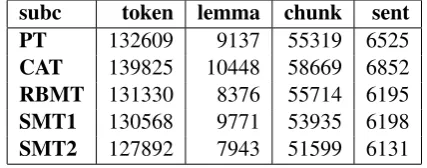
In Table 2, we outline the absolute numbers for different annotation levels per subcorpus (transla-tion variant) in VARTRA-SMALL.
VARTRA-SMALL is encoded in CWB and can be queried with the help of Corpus Query
Proces-2www.my-across.net 3SYSTRAN 6
4www.linguatec.net
5http://translate.google.com/
subc token lemma chunk sent
PT 132609 9137 55319 6525
CAT 139825 10448 58669 6852
RBMT 131330 8376 55714 6195
SMT1 130568 9771 53935 6198
[image:4.595.309.523.63.147.2]SMT2 127892 7943 51599 6131
Table 2: Annotations in VARTRA-SMALL
sor (CQP) (Evert, 2005). We also encode a part of the meta-data, such as information on regis-ter, as well as translation method, tools used and the source language. A sample output encoded in CQP format that is subsequently used for corpus query is shown in Figure 1.
In this way, we have compiled a corpus of dif-ferent translation variants, which are comparable, as they contain translations of the same texts
pro-duced with different methods and tools. Thus,
this comparable corpus allows for analysis of con-trasts in terms of (a) text typology (e.g. fiction vs. popular-scientific articles); (b) text produc-tion types (originals vs. translaproduc-tions) and (c) trans-lation types (human vs. machine and their sub-types).
Furthermore, examination of some translation phenomena requires parallel components – align-ment between originals and translations. At the moment, alignment on the sentence level (ex-ported from CroCo) is available for the EO and PT subcorpora. We do not provide any alignment for further translation variants at the moment, al-though we plan to align all of them with the origi-nals on word and sentence level.
4.3 Corpus querying
As already mentioned in 4.2, VARTRA-SMALL can be queried with CQP, which allows definition of language patterns in form of regular expressions based on string, part-of-speech and chunk tags, as well as further constraints. In Table 3, we illus-trate an example of a query which is built to ex-tract cases of processual finite passive verb con-structions in German: lines 1 - 5 are used for
pas-sive from a Verbzweit sentence (construction in
EO PT CAT RBMT SMT1 SMT2 ESSAY 15537 15574 15795 15032 15120 14746
FICTION 11249 11257 12566 11048 11028 10528
INSTR 20739 21009 19903 20793 20630 20304
POPSCI 19745 19799 22755 20894 20353 19890
SHARE 24467 24613 24764 22768 22792 22392
SPEECH 23308 23346 24321 23034 22877 22361
TOU 17564 17638 19721 17761 17768 17671
[image:5.595.135.464.60.187.2]TOTAL 132609 133236 139825 131330 130568 127892
Table 1: Tokens per register in VARTRA-SMALL
chunk type (lines 2b and 6b) information, as well as chunk (lines 2a, 2c, 6a and 6c) and sentence (lines 1 and 10) borders.
query block example
1. <s>
2a. <chunk>
2b. [ .chunk type=“NC”]+ Ein Chatfenster
2c. </chunk>
3a. [pos=“VAFIN”&
3b. lemma=“werden”] wird
4. [word!=“.”]* daraufhin
5. [pos=“V.*PP”]; angezeigt
6a. <chunk>
6b. [ .chunk type=“NC”]+ das Transportgut
6c. </chunk>
7. [word!=“.”]* nicht
8. [pos=“V.*PP”] akzeptiert
9a. [pos=“VAFIN”&
9b. lemma=“werden”] wird
[image:5.595.319.514.232.342.2]10. </s>
Table 3: Example queries to extract processual fi-nite passive constructions
CQP also allows us to sort the extracted infor-mation according to the metadata: text registers and IDs or translation methods and tools. Table 4 shows an example of frequency distribution ac-cording to the metadata information. In this way, we can obtain data for our analyses of translation variation.
5 Preliminary Analyses
5.1 Profile of VARTRA-SMALL in terms of shallow features
We start our analyses with the comparison of translation variants only saved in our subcorpora: PT, CAT, RBMT, SMT1 and SMT2. The structure
method tool register freq
CAT Across POPSCI 101
CAT Across SHARE 90
CAT Across SPEECH 89
CAT Across INSTR 73
RBMT SYSTRAN SHARE 63
RBMT SYSTRAN POPSCI 62
[image:5.595.73.295.284.517.2]CAT Across TOU 58
Table 4: Example output of V2 processual pas-sive across translation method, tool and text regis-ter (absolute frequencies)
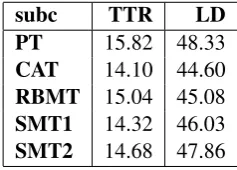
of the corpus, as well as the annotations available already allow us to compare subcorpora (transla-tion variants) in terms of shallow features, such as type-token-ration (TTR), lexical density (LD) and part-of-speech (POS) distributions. These fea-tures are among the most frequently used variables which characterise linguistic variation in corpora, cf. (Biber et al., 1999) among others. They also deliver the best scores in the identification of trans-lationese features. We calculate TTR as the per-centage of different lexical word forms (types) per subcorpus. LD is calculated as percentage of content words and the percentages given in the POS distribution are the percentages of given word classes per subcorpus, all normalised per cent. The numerical results for TTR and LD are given in Ta-ble 5.
subc TTR LD
PT 15.82 48.33
CAT 14.10 44.60
RBMT 15.04 45.08
SMT1 14.32 46.03
SMT2 14.68 47.86
[image:5.595.356.475.656.741.2]<translation method=“CAT” tool=“Across” sourceLanguage=“English”> <text “CAT ESSAY 001.txt” register=“ESSAY”>
<s>
<chunk type=“NC”>
Die ART d
weltweiten ADJA weltweit
Herausforderungen NN Herausforderung </chunk>
<chunk type=“PC”>
im APPRART im
Bereich NN Bereich
</chunk>
<chunk type=“NC”>
der ART d
Energiesicherheit NN Energiesicherheit </chunk>
<chunk type=“VC”>
erfordern VVFIN erfordern </chunk>
<chunk type=“PC”>
¨uber APPR ¨uber
einen ART ein
Zeitraum NN Zeitraum
</chunk>
<chunk type=“PC”>
von APPR von
vielen PIAT viel
Jahrzehnten ADJA jahrzehnte nachhaltige ADJA nachhaltig Anstrengungen NN Anstrengung </chunk>
<chunk type=“PC”>
[image:6.595.167.367.67.393.2]auf APPR auf
Figure 1: Example of an annotated sample from VARTRA-SMALL
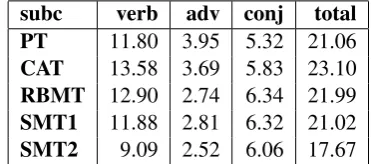
For the analysis of POS distribution, we de-cide to restrict them to nominal and verbal word classes. Tables 6 and 7 illustrate distribution of nominal – nouns, pronouns (pron), adjectives (adj) and adpositions (adp), and verbal word classes – verbs, adverbs (adv) and conjunctions (conj) – across different translation variants.
subc noun pron adj adp total
PT 27.18 8.23 9.38 8.31 53.10
CAT 24.80 8.53 8.08 9.52 50.93
RBMT 24.80 8.61 8.91 9.01 51.32
SMT1 27.18 8.04 8.67 9.02 52.89
SMT2 29.78 7.28 10.42 8.64 56.11
Table 6: Nominal word classes in % in VARTRA-SMALL
5.2 Interpretation of results
According to Biber (1999), high proportion of variable lexical words in a text is an indicator of richness and density of experiential meanings. This characterises the field of discourse (see
sec-subc verb adv conj total
PT 11.80 3.95 5.32 21.06
CAT 13.58 3.69 5.83 23.10
RBMT 12.90 2.74 6.34 21.99
SMT1 11.88 2.81 6.32 21.02
[image:6.595.322.508.437.519.2]SMT2 9.09 2.52 6.06 17.67
Table 7: Verbal word classes in % in VARTRA-SMALL
tion 2.2 above), and TTR, thus, indicates infor-mational density. In terms of translationese (see section 2.1), TTR reveals simplification features of translations. Translations always reveal lower TTR and LD than their originals, cf. (Hansen, 2003).
The highest TTR, thus, the most lexically rich translation variant in VARTRA is the one
pro-duced by human translators: PT > RBMT >
SMT2> SMT1>CAT. It is interesting that the
[image:6.595.72.292.544.627.2]translators). Another reason could be the strength of pronominal cohesion and less explicit specifica-tion of domains. However, the comparison of the distribution of pronouns (devices for pronominal cohesion) does not reveal big differences between PT and CAT, cf. Table 6.
Another simplification feature is LD, which is also the lowest in CAT-subcorpus of
VAR-TRA: PT > SMT2 > SMT1 > RBMT > CAT.
Steiner (2012) claims that lower lexical density can indicate increased logical explicitness (in-creased use of conjunctions and adpositions) in translations. CAT does demonstrate the highest number of adpositions in the corpus, although the difference across subcorpora is not high, see Ta-ble 6.
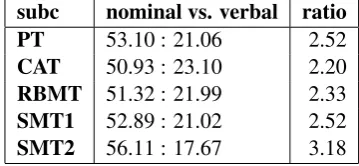
The overall variation between the subcorpora in terms of TTR and LD is not high, which can be in-terpreted as indicator of levelling out (see section 2.1 above): translations are often more alike in terms of these features than the individual texts in a comparable corpus of source or target language. In terms of nominal vs. verbal word classes, there seems to be a degree of dominance of nom-inal classes (56.11% vs. 17.67%) in SMT2 result-ing in a ratio of 3.18 compared to other subcor-pora, cf. Table 8.
subc nominal vs. verbal ratio
PT 53.10 : 21.06 2.52
CAT 50.93 : 23.10 2.20
RBMT 51.32 : 21.99 2.33
SMT1 52.89 : 21.02 2.52
[image:7.595.90.270.442.525.2]SMT2 56.11 : 17.67 3.18
Table 8: Proportionality of nominal vs. verbal op-position in VARTRA-SMALL
The greatest contributors to this dominance are nouns and adjectives (Table 6 above). For CAT, we again observe the lowest numbers (the lowest noun vs. verb ratio) which means that this translation variant seems to be the most “verbal” one. Ac-cording to Steiner (2012), German translations are usually more verbal than German originals. Com-paring German and English in general, the author claims that German is less “verbal” than English. Thus, a higher “verbality” serves as an indicator of “shining though” (see 2.1 above), which we ob-serve in case of CAT. However, to find this out, we would need to compare our subcorpora with their originals, as well as the comparable German
orig-inals.
5.3 First statistical experiments
We use the extracted shallow features for the first steps in feature evaluation. As our aim is to inves-tigate the relations between the observed feature frequencies and the respective translation variants,
we decide for correspondence analysis, a
multi-variate technique, which works on observed fre-quencies and provides a map of the data usually plotted in a two dimensional graph, cf. (Baayen, 2008).
As input we use the features described in 5.1 above: TTR, LD, nouns, adjectives (adj), ad-positions (adp), verbs, adverbs (adv),
conjunc-tions (conj). Additionally, we divide the class
of pronouns into two groups: personal (pers.P) and demonstrative (dem.P) – devices to express pronominal cohesion. We also extract frequency information on modal verbs which express modal-ity.
The output of the correspondence analysis is plotted into a two dimensional graph with arrows representing the observed feature frequencies and points representing the translation variants. The length of the arrows indicates how pronounced a particular feature is. The position of the points in relation to the arrows indicates the relative impor-tance of a feature for a translation variant. The ar-rows pointing in the direction of an axis indicate a high contribution to the respective dimension. Fig-ure 2 shows the graph for our data.
In Table 9, we present the Eigenvalues calcu-lated for each dimension to assess how well our
data is represented in the graph6. We are able to
obtain a relatively high cumulative value by the
first two dimensions (representingxandy-axis in
Figure 2), as they are the ones used to plot the two-dimensional graph. The cumulative value for the first two dimensions is 94,3%, which indicates that our data is well represented in the graph.
If we consider the y-axis in Figure 2, we see
that there is a separation between human and ma-chine translation, although SMT2 is on the bor-derline. CAT is also closer to MT, as it is plotted much closer to 0 than PT. Conjunctions, personal pronouns and adverbs seem to be most prominent contributors to this separation, as their arrows are
6’dim’ lists dimensions, ’value’ – Eigenvalues converted
Figure 2: Graph for correspondence analysis on translation variants
dim value % cum% scree plot
1 0.005939 73.0 73.0 *************************
2 0.001726 21.2 94.3 *******
3 0.000352 4.3 98.6 *
4 0.000114 1.4 100.0
——– —–
[image:8.595.147.445.67.342.2]Total: 0.008131 100.0
Table 9: Contribution of dimensions
the longest ones, and they point in the direction of they-axis.
Verbs, adjectives and nouns seem to be most prominent contributors to the other division
(con-sidering the x-axis). Here, we can observe three
groups of subcorpora: CAT and RBMT share cer-tain properties which differ them from SMT2. PT remains on the borderline, whereas SMT1 tend slightly to SMT2.
6 Conclusion and Future Work
In this paper, we presented a comparable corpus of translations from English into German, which contains multiple variants of translation of the same texts. This corpus is an important resource for the investigation of variation phenomena re-flected in linguistic features of translations. The
corpus architecture allows us to extract these fea-tures automatically. Our preliminary results show that there are both similarities and differences be-tween translation variants produced by humans and machine systems. We expect even more vari-ation, if we compare the distribution of these fea-tures across text registers available in all subcor-pora.
However, there is a need to inspect the reasons for this variation, as they can be effected by trans-lator experience, restrictions of the CAT system applied or the training material used in MT.
but on the other, it can be used for the develop-ment, optimisation and evaluation of MT systems, as well as CAT tools (e.g. translation memories).
In the future, we aim at expanding it with more data: (1) more texts for the existing registers (each register should contain around 30,000 words), (2) further text registers (e.g. academic, web and news texts). We also plan to produce further human and machine-generated translations, i.e. (3) ma-chine translations post-edited by humans, as well as translation outputs of (4) further MT systems. Moreover, we aim at adding translations from Ger-man into English to trace variation influenced by language typology.
As the automatic tagging of part-of-speech and chunk information might be erroneous, we plan to evaluate the output of the TreeTagger and com-pare it with the output of further tools available,
e.g. MATE dependency parser, cf. (Bohnet,
2010). Furthermore, the originals will be aligned with their translations on word and sentence level. This annotation type is particularly important for the analysis of variation in translation of certain lexico-grammatical structures.
A part of the corpus (CAT, RBMT and SMT subcorpora) will be available to a wider academic public, e.g. via the CLARIN-D repository.
Acknowledgments
The project “VARTRA: Translation Variation” was supported by a grant from Forschungsauss-chuß of the Saarland University. We are espe-cially grateful to Anne-Katrin Schumann, Elke Te-ich and Noam Ordan for their comments. Also, we wish to thank the anonymous reviewers for their suggestions for improving our paper. All remain-ing errors remain ours.
References
Across Personal Edition: Free CAT Tool for Freelance Translators. http://www.my-across.net/
en/translation-workbench.aspx.
Harald Baayen. 2008. Analyzing Linguistic Data. A Practical Introduction to Statistics Using R. Cam-bridge University Press.
Bogdan Babych and Anthony Hartley. 2004. Mod-elling legitimate translation variation for automatic evaluation of MT quality. Proceedings of LREC-2004, Vol. 3.
Mona Baker. 1995. Corpora in Translation Studies: An Overview and Some Suggestions for Future Re-search. Target, 7(2):223–43.
Mona Baker. 1996. Corpus-based translation studies: The challenges that lie ahead. Harold Somers (ed.). Terminology, LSP and Translation. Studies in lan-guage engineering in honour of Juan C. Sager. Am-sterdam and Philadelphia: Benjamins: 175–186.
Marco Baroni and Silvia Bernardini. 2005. A New Approach to the Study of Translationese: Machine-learning the Difference between Original and Trans-lated Text. Literary and Linguistic Computing, 21 (3): 259–274.
Marco Baroni, Silvia Bernardini, Adriano Ferraresi and Eros Zanchetta. 2009. The WaCky Wide Web: A Collection of Very Large Linguistically Processed Web-Crawled Corpora. Language Resources and Evaluation, 43(3): 209–226.
Douglas Biber. 1988. Variation across speech and writing. Cambridge: Cambridge University Press.
Douglas Biber. 1995. Dimensions of Register Vari-ation. A Cross-linguistic Comparison. Cambridge: Cambridge University Press.
Douglas Biber, Stig Johansson, Geoffrey Leech, Su-san Conrad and Edward Finegan. 1999. Longman Grammar of Spoken and Written English. Longman, London.
Bernd Bohnet. 2010. Top Accuracy and Fast Depen-dency Parsing is not a Contradiction. The 23rd In-ternational Conference on Computational Linguis-tics (COLING 2010). Beijing, China.
Susan Conrad and Douglas Biber (eds.). 2001. Varia-tion in English: Multi-Dimensional studies. Long-man, London.
The IMS Open Corpus Workbench. 2010. http://www.cwb.sourceforge.net
Stefan Evert. 2005. The CQP Query Language Tuto-rial. IMS Stuttgart, CWB version 2.2.b90.
Google Translate. Accessed July 2012. http://translate.google.com
Michael A.K. Halliday. 1985.Spoken and written lan-guage. Deakin University Press, Victoria.
Michael A.K. Halliday, and Riquaya Hasan. 1989. Language, context and text: Aspects of language in a social semiotic perspective. Oxford University Press.
Michael A.K. Halliday. 2004. An Introduction to Functional Grammar, 3. edition. Hodder Education.
Silvia Hansen. 2003. The Nature of Translated Text – An Interdisciplinary Methodology for the Investiga-tion of the Specific Properties of TranslaInvestiga-tions. Ph.D. Theses.
Juliane House. 1997. Translation Quality Assessment: A Model Revisited. Ph.D. Thesis.
Stig Johansson. Towards a multilingual corpus for con-trastive analysis and translation studies. Language and Computers, 43 (1): 47–59.
Adam Kilgariff. 2010. Comparable Corpora Within and Across Languages, Word Frequency Lists and the KELLY Project. BUCC, 6th Workshop on Building and Using Comparable Corpora, Valletta, Malta.
Phillip Koehn. 2005 Europarl: A Parallel Corpus for Statistical Machine Translation. MT Summit.
Moshe Koppel and Noam Ordan. 2011. Translationese and its dialects. Proceedings of the 49th Annual Meeting of the Association for Computational Lin-guistics (ACL11).
David Kurokawa, Cyril Goutte and Pierre Isabelle. 2009. Automatic Detection of Translated Text and its Impact on Machine Translation. Proceedings of MT-Summit-XII.
Ekaterina Lapshinova-Koltunski, Kerstin Kunz and Marilisa Amoia. 2012. Compiling a Multilingual Spoken Corpus. Proceedings of the VIIth GSCP International Conference : Speech and Corpora. Firenze : Firenze University Press.
Sara Laviosa. 1997. How Comparable Can ’Compara-ble Corpora’ Be? Target, 9(2): 289–319.
Gennady Lembersky, Noam Ordan and Shuly Wint-ner. 2012. Language models for machine transla-tion: Original vs. translated texts. Computational Linguistics.
Linguatec Personal Translator 14.
http://www.linguatec.net/products/tr/pt
Christian M.I.M. Matthiessen. 2001. The environ-ment of translation. Erich Steiner and Colin Yallop (eds). Exploring Translation and Multilingual Text Production: Beyond Content. Berlin and New York: Mouten de Gruyter.
Christian M.I.M. Matthiessen. 2006. Frequency pro-files of some basic grammatical systems: an in-terim report. Geoffrey Thompson and Susan Hun-ston (eds). System and Corpus: Exploring connec-tions. Equinox, London.
Tony McEnery. 2003. Oxford Handbook of Computa-tional Linguistics, chapter Corpus Linguistics: 448– 463. Oxford: Oxford University Press.
Stella Neumann. 2011. Contrastive Register Varia-tion. A Quantitative Approach to the Comparison of English and German. Berlin and New York: de Gruyter.
Kishore Papineni, Salim Roukus, Todd Ward and Wei-Jing Zhu. 2002. BLEU: a method for automatic evaluation of machine translation Proceedings of the 40th annual meeting on association for compu-tational linguistics, 311–318.
Maja Popovi´c and Aljoscha Burchardt. 2011. From Human to Automatic Error Classification for Ma-chine Translation Output. 15th International Con-ference of the European Association for Machine Translation (EAMT 11).
Randolph Quirk, Sidney Greenbaum, Geoffrey Leech and Jan Svartvik. 1985. A Comprehensive Gram-mar of the English Language. Longman, London.
Helmut Schmid. 1994. Probabilistic Part-of-Speech Tagging Using Decision Trees. International Con-ference on New Methods in Language Processing, Manchester (UK): 44–49.
Lucia Specia. 2011. Exploiting objective annotations for measuring translation post-editing effort. Pro-ceedings of the 15th Conference of the European As-sociation for Machine Translation: 73–80.
Lucia Specia, Najeh Hajlaoui, Catalina Hallett and Wilker Aziz. 2011. Predicting machine translation adequacy. Machine Translation Summit XIII (2011): 19–23.
Ralf Steinberger, Bruno Pouliquen, Anna Widiger, Camelia Ignat, Tomaz Erjavec, Dan Tufis and Daniel Varga. 2006. The JRC-Acquis: A multilingual aligned parallel corpus with 20+ languages. Pro-ceedings of the 5th International Conference on Language Resources and Evaluation (LREC’2006). Genoa, Italy, 24-26 May 2006.
Erich Steiner. 2001. Translations English-German: Investigating the Relative Importance of Sys-temic Contrasts and of the Text Type translation. SPRIKreports7:1–49.
Erich Steiner. 2004.Translated texts: Properties, Vari-ants, Evaluations. Frankfurt a.Main: Peter Lang.
Erich Steiner. 2012. A characterization of the resource based on shallow statistics. Hansen-Schirra, Silvia, Stella Neumann and Erich Steiner (eds). Cross-linguistic Corpora for the Study of Translations. Insights from the Language Pair English-German. Berlin, New York: de Gruyter.
SYSTRAN Enterprise Server 6. Online Tools User Guide.
Elke Teich. 2003. Cross-linguistic Variation in Sys-tem and Text. A Methodology for the Investigation of Translations and Comparable Texts. Berlin and New York: Mouton de Gruyter.