UZH in the BioNLP 2013 GENIA Shared Task
Gerold Schneider, Simon Clematide, Tilia Ellendorff, Don Tuggener, Fabio Rinaldi,
{rinaldi,gschneid,siclemat,ellendorff,tuggener}@cl.uzh.ch
Institute of Computational Linguistics, University of Zurich, Switzerland
Gintar˙e Grigonyt˙e
Stockholm University, Department of Linguistics, Section for Computational Linguistics
Abstract
We describe a biological event detec-tion method implemented for the Genia Event Extraction task of BioNLP 2013. The method relies on syntactic depen-dency relations provided by a general NLP pipeline, supported by statistics derived from Maximum Entropy models for can-didate trigger words, for potential argu-ments, and for argument frames.
1 Introduction
The OntoGene team at the University of Zurich has developed text mining applications based on a combination of deep-linguistic analysis and ma-chine learning techniques (Rinaldi et al., 2012b; Clematide and Rinaldi, 2012; Rinaldi et al., 2010). Our approaches have proven competitive in sev-eral shared task evaluations (Rinaldi et al., 2013; Clematide et al., 2011; Rinaldi et al., 2008). Addi-tionally, we have developed advanced systems for the curation of the biomedical literature (Rinaldi et al., 2012a).
Our participation in the Genia Event Extraction task of BioNLP 2013 (Kim et al., 2013) was moti-vated by the desire of testing our technologies on a more linguistically motivated task. In the course of our participation we revised several modules of our document processing pipeline, however we did not have sufficient resources to completely revise the final module which generates the event struc-tures, and we still relied on a module which we had developed for our previous participation to the BioNLP shared task.
The final submission was composed by our standard preprocessing module (described briefly in section 2) and novel probability models (section 3), combined within the old event generator (sec-tion 4).
2 Preprocessing
The OntoGene environment is based on a pipeline of several NLP tools which all operate on a com-mon XML representation of the original docu-ment.
Briefly, the pipeline includes modules for sentence-splitting, tokenization, part-of-speech tagging, lemmatization, stemming, term-recognition (not used for the BioNLP shared task), chunking, dependency-parsing and event generation. Different variants of those modules have been used in different instantiations of the pipeline. For the BioNLP 2013 participation, lingpipe was used for sentence splitting, tok-enization and PoS tagging, morpha (Minnen et al., 2001) was used for lemmatization, a python implementation of the Porter stemmer for stem-ming, LTTT (Grover et al., 2000), was used for chunking, and the Pro3Gres parser (Schneider, 2008) for dependency analysis.
As we have made good experiences with a rule based system for anaphora resolution in the BioNLP 2011 shared task (Tuggener et al., 2011), we implemented a similar approach that resolves anaphors to terms identified during preprocessing. Rules contain patterns like “X such as Y” or “X is a Y”, and pronouns are resolved to the nearest grammatical subject or object. Anaphora resolu-tion led to an improvement of 0.2% recall on the development set, while precision was hardly af-fected.
3 Probability models
Several probability models have been computed from the training data in order to be used to score and filter candidate events generated by the sys-tem. The following models played a role in the final submission:
P(eventT ype|trigger candidate) (1)
P(f rame ∧ eventT ype|trigger candidate) (2) P(role ∧ eventT ype|protein) (3) P(role(t, d)|synpath(t, d)) (4)
For all of them we computed global Maximum Likelihood Estimations (MLE), using the training and development datasets from the 2013 and 2011 challenges. For all of the models above, except for the last one, we also estimated the probabili-ties by a Maximum Entropy (ME) approach. The
MegaMtool (Daum´e III, 2004) allows for a super-vised training of binary classifiers where theclass probability is optimized by adjusting the feature weights and not just the binaryclassification deci-sionitself. This helps to deal with the imbalanced classes such as the distribution of true or false trig-gerword candidates.
For the classification of trigger candidates
(Equation 1), a binary ME classifier for each event type is separately trained, based on local and global features as described below. The trigger-word candidates are collected from the training data using their stemmed representation as a selec-tion criterion. We generally exclude triggerword candidates that occur in less than 1% as true trig-gers in the training set. Within the data, we found that triggers that consist of more than one word are rather rare (less than 5% of all triggers, most of them occurring once). However, we transformed these multiword triggers to singleword triggers, replacing them by their first content word.
The choice of ME features, partly inspired by (Ekbal et al., 2013), can be grouped into features derived from the triggerword itself (word), fea-tures from the sentence of the triggerword (con-text), and features from article-wide information (global).
Word features: (1) The text, lemma, part of speech (PoS), stem and local syntactic dependency of the triggerword candidate as computed by the Pro3Gres parser. (2) Information whether a trig-gerword candidate is head of a chunk as well as whether the chunk is nominal or verbal
Context features: Unigrams and bigrams in a window of variable size to left and right of the trig-gerword candidate; three types of uni- and bigrams are used: PoS, lemmas and stems; for unigrams we also include the lower-cased words; for bigrams, the triggerword candidate itself is included in the first bigram to either side.
Global features: (1) Presence or absence of a protein in a window of a given size around the triggerword candidate (Boolean feature); only the most frequent proteins of an article are considered. (2) The zone in an article where the triggerword candidate appears, e.g. Title/Abstract, Introduc-tion, Background, Material and Methods, Results and Discussion, Caption and Conclusion.
Feature engineering was done by testing differ-ent combinations of settings (window size, thresh-olds) with the aim of finding an optimal overall ME model which reaches the lowest error rates for all event types. The error rate of the candidate set was measured as the cumulative error mass com-puted from the assigned class probability as fol-lows: if the trigger candidate is a true positive, the error is 1 minus the probability assigned by the classifier. If the candidate is a false positive, the error is the probability assigned by the classifier. Our approach does not allow us to compute an er-ror rate for false negatives, because we simply rely on the set of trigger words seen in the training data as possible candidates.
In these experiments, we discovered that for most event types an optimal setting for the context features considers a wide span of about 20 tokens to the left and right of the triggerword. Includ-ing bigrams of lemmas, stems and PoS delivered the best results compared to including only one or two of these bigram types. Context features can be parameterized according to how much positional information they contain: the distance of a word to the right and left of the trigger, only the direc-tion (left or right) or no posidirec-tion informadirec-tion at all (bag of unigrams/bigrams). We found that the ex-act positional information is only important for the first word to the left and right (adjacent to the trig-gerword), whereas for all words that are further away it is favorable to only use the direction in re-lation to the trigger. A window size of 10 words within which proteins are found in the context of a triggerword gave the best results. The optimal number of the most frequent proteins considered within this window was found to be the 10 most frequent proteins within an article.
real-ized as proteins or subevents.
For the classification of proteins(Equation 3), again separate binary ME classifiers were built in order to estimate the probability that a protein has a role (theme or cause) in an event of a given type.
4 Event Generation
We tested two independent event generation mod-ules, one based on a revision of our previous 2009 submission (Kaljurand et al., 2009) and one which is a totally new implementation. We could do only preliminary tests with the second module, which however showed promising results, in particular with much better recall than the older module (up to 65.23%), despite the very little time that we could invest in its development. The best F-score that we could reach was still slightly inferior to the one of the old module at the deadline for submis-sion of results. In the rest of this paper we will describe only the module which was used in the official submission.
The event extraction process consists of three phases. First, event candidates are generated, based on trigger words and their context, using the ME and MLE probabilitiespT (equation 1).
Second, individual arguments of an event are generated. We calculate the MLE probability pR
of an argument role (e.g. Theme) to occur as part of a given event type, as follows:
pR(Role|EventT ype) =
f(Role∧EventT ype)
f(EventT ype) (5) We obtained the best results on the development corpus when combining the probabilities as:
pA=
pT∗pT∗pR
pT+pT+pR
(6) We generate arguments, using an MLE syntac-tic path and an ME argument model, as follows. The syntactic path between the trigger word and every term (protein or subordinate event) is con-sidered. If they are syntactically connected, and if the probability of a syntactic path to express an event is above a threshold, it is selected. As this is a filtering step, it negatively affects recall.
We calculate the MLE probability ppath that
a syntactic configuration fills an argument slot. Syntactic configurations consist of the head word (trigger)HWord, the head event type HType, the dependent wordDWord, the dependent event type
DType, and the syntactic pathPathbetween them. In order to deal with sparse data, we use a smoothed model.
ppath(Arg|HWord, HType, DWord, DType, Path) =
1
w1+w2+w3 ∗(
w1∗f(HWord, HType, DWord, DType, Path∧Arg)
f(HWord, HType, DWord, DType, Path) + w2∗f(HType, DType, Path∧Arg)
f(HType, DType, Path) + w3∗f(HType, DType∧Arg)
f(HType, DType) ) (7)
The weights were emprically set as w1 = 4, w2 = 2andw3 = 1.5. The fact that the weights decrease approximates a back-off model. The final probability had to be larger than0.2.
We have also used an ME model which delivers the probabilitypargthat a term is the argument of
a specific event, see formula 3. If this ME model predicts with a probability of above 80% that the term is not an argument, the search fails. Other-wise, the probabilities are combined. On the de-velopment corpus, we achieved best results when using the harmonic mean:
pargument= 2∗
ppath∗parg
ppath+parg
(8) As a last step, the several arguments of an event are combined into a frame. We have tested mod-els predicting an entire frame directly, and modmod-els combining the individual arguments generated in the previous step. The latter approach performed better. Any permutation of the argument candi-dates could constitute a frame. Only frames seen in the training corpus for a given event type are considered. We have again used an ME and an MLE model for predicting frames.
The ME model predicts pf rame.M E, see
for-mula 2. We have also used two MLE models: the first one delivers the probabilitypf rame.M LE
based on the event type only, the second one pf rameword.M LE also considers the trigger word
and is much sparser (a low default is thus used for unseen words). The probability of the individual arguments also needs to be taken into considera-tion. We used the mean of the individual argu-ments’ probabilities (pargs0mean).
5 Evaluation
Event Class gold (match) answer (match) recall prec. fscore SVT-TOTAL 1117 ( 619) 851 ( 619) 55.42 72.74 62.91
EVT-TOTAL 1490 ( 698) 1103 ( 698) 46.85 63.28 53.84
REG-TOTAL 1694 ( 168) 618 ( 168) 9.92 27.18 14.53
[image:4.595.150.445.61.114.2]All events total 3184 ( 866) 1721 ( 866) 27.20 50.32 35.31
Table 1: Results on the development set, measured using “strict equality”.
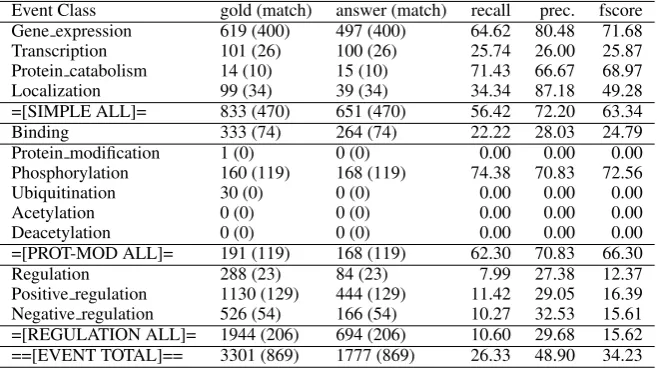
Event Class gold (match) answer (match) recall prec. fscore Gene expression 619 (400) 497 (400) 64.62 80.48 71.68 Transcription 101 (26) 100 (26) 25.74 26.00 25.87 Protein catabolism 14 (10) 15 (10) 71.43 66.67 68.97
Localization 99 (34) 39 (34) 34.34 87.18 49.28
=[SIMPLE ALL]= 833 (470) 651 (470) 56.42 72.20 63.34
Binding 333 (74) 264 (74) 22.22 28.03 24.79
Protein modification 1 (0) 0 (0) 0.00 0.00 0.00
Phosphorylation 160 (119) 168 (119) 74.38 70.83 72.56
Ubiquitination 30 (0) 0 (0) 0.00 0.00 0.00
Acetylation 0 (0) 0 (0) 0.00 0.00 0.00
Deacetylation 0 (0) 0 (0) 0.00 0.00 0.00
=[PROT-MOD ALL]= 191 (119) 168 (119) 62.30 70.83 66.30
Regulation 288 (23) 84 (23) 7.99 27.38 12.37
Positive regulation 1130 (129) 444 (129) 11.42 29.05 16.39 Negative regulation 526 (54) 166 (54) 10.27 32.53 15.61 =[REGULATION ALL]= 1944 (206) 694 (206) 10.60 29.68 15.62 ==[EVENT TOTAL]== 3301 (869) 1777 (869) 26.33 48.90 34.23
Table 2: Results on the test data, measured using “strict equality”.
We have added a number of heuristics to boost multi-argument frames. Multiplying the probabil-ity of a frame by its cubed length (giving two-argument slots 9 times higher probability), and giving Cause-slots 50% higher scores globally led to best results.
We mainly trained and evaluated using the “strict equality” evaluation criteria as our refer-ence. The results on the development data are shown in table 1. With more relaxed equality def-initions, the results were always a few percentage points better. Our results in the official test run are shown in table 2. In sum, our submitted system has good performance for simple events, bad per-formance forBinding events, and a bias towards precision due to a syntactic-based filtering step.
6 Conclusions and Future work
Our participation in the 2013 BioNLP shared task was a useful opportunity to revise components of the OntoGene pipeline and begin the implemen-tation of a novel event generator. Due to lack of time, it was not completed in time for the official submission. We will continue its development and use the BioNLP datasets.
Acknowledgments
This research is partially funded by the Swiss National Science Foundation (grant 105315 130558/1).
References
[Clematide and Rinaldi2012] Simon Clematide and Fabio Rinaldi. 2012. Ranking relations between diseases, drugs and genes for a curation task.
Journal of Biomedical Semantics, 3(Suppl 3):S5.
[Clematide et al.2011] Simon Clematide, Fabio Ri-naldi, and Gerold Schneider. 2011. Ontogene at calbc ii and some thoughts on the need of document-wide harmonization. InProceedings of the CALBC II workshop, EBI, Cambridge, UK, 16-18 March.
[Daum´e III2004] Hal Daum´e III. 2004. Notes on CG and LM-BFGS optimization of logistic regres-sion. Paper available at http://pub.hal3. name#daume04cg-bfgs, implementation avail-able athttp://hal3.name/megam/, August.
[image:4.595.135.464.151.335.2][Grover et al.2000] Claire Grover, Colin Matheson, An-drei Mikheev, and Marc Moens. 2000. Lt ttt - a flex-ible tokenisation tool. InProceedings of Second In-ternational Conference on Language Resources and Evaluation (LREC 2000).
[Kaljurand et al.2009] Kaarel Kaljurand, Gerold Schneider, and Fabio Rinaldi. 2009. UZurich in the BioNLP 2009 Shared Task. In Proceedings of the BioNLP workshop, Boulder, Colorado.
[Kim et al.2013] Jin-Dong Kim, Yue Wang, and Ya-mamoto Yasunori. 2013. The genia event extraction shared task, 2013 edition - overview. InProceedings of BioNLP Shared Task 2013 Workshop, Sofia, Bul-garia, August. Association for Computational Lin-guistics.
[Minnen et al.2001] Guido Minnen, John Carroll, and Darren Pearce. 2001. Applied morphological pro-cessing of English. Natural Language Engineering, 7(3):207–223.
[Rinaldi et al.2008] Fabio Rinaldi, Thomas Kappeler, Kaarel Kaljurand, Gerold Schneider, Manfred Klen-ner, Simon Clematide, Michael Hess, Jean-Marc von Allmen, Pierre Parisot, Martin Romacker, and Therese Vachon. 2008. OntoGene in BioCreative II.Genome Biology, 9(Suppl 2):S13.
[Rinaldi et al.2010] Fabio Rinaldi, Gerold Schneider, Kaarel Kaljurand, Simon Clematide, Therese Va-chon, and Martin Romacker. 2010. OntoGene in BioCreative II.5. IEEE/ACM Transactions on Com-putational Biology and Bioinformatics, 7(3):472– 480.
[Rinaldi et al.2012a] Fabio Rinaldi, Simon Clematide, Yael Garten, Michelle Whirl-Carrillo, Li Gong, Joan M. Hebert, Katrin Sangkuhl, Caroline F. Thorn, Teri E. Klein, and Russ B. Altman. 2012a. Using ODIN for a PharmGKB re-validation experiment.
Database: The Journal of Biological Databases and Curation.
[Rinaldi et al.2012b] Fabio Rinaldi, Gerold Schneider, and Simon Clematide. 2012b. Relation mining ex-periments in the pharmacogenomics domain. Jour-nal of Biomedical Informatics, 45(5):851–861.
[Rinaldi et al.2013] Fabio Rinaldi, Simon Clematide,
Simon Hafner, Gerold Schneider, Gintare
Grigonyte, Martin Romacker, and Therese Va-chon. 2013. Using the ontogene pipeline for the triage task of biocreative 2012. The Journal of Biological Databases and Curation, Oxford Journals.
[Schneider2008] Gerold Schneider. 2008. Hy-brid Long-Distance Functional Dependency Pars-ing. Doctoral Thesis, Institute of Computational Linguistics, University of Zurich.
[Tuggener et al.2011] D Tuggener, M Klenner, G Schneider, S Clematide, and F Rinaldi. 2011. An incremental model for the coreference resolution