Using Grammar Rule Clusters for Semantic Relation Classification
Emily Jamison Independent Scholar Los Alamos, NM 87544, USA [email protected]
Abstract
Automatically-derived grammars, such as the split-and-merge model, have proven helpful in parsing (Petrov et al., 2006). As such grammars are refined, latent information is recovered which may be usable for linguis-tic tasks besides parsing. In this paper, we present and examine a new method of seman-tic relation classification: using automaseman-tically- automatically-derived grammar rule clusters as a robust knowledge source for semantic relation clas-sification. We examine performance of this feature group on the SemEval 2010 Relation Classification corpus, and find that it improves performance over both more coarse-grained and more fine-grained syntactic and colloca-tional features in semantic relation classifica-tion.
1 Introduction
In the process of discovering a refined grammar starting from rules in the original treebank gram-mar, latent-variable grammars recover latent infor-mation. Intuitively, the new split grammar states should reflect linguistic information that has been generalized from the lexical level but is not so gen-eral as the original syntactic level. While the in-tended use of this information is to improve syntac-tic parsing, the lexically-derived nature of the split grammar states suggests it may contain semantic in-formation as well.
Petrov et al. (2006) note that while some of these split grammar states reflect true linguistic informa-tion, such as the clustering of verbs with similar
de-pendencies, other grammar states may reflect use-less information, such as a split between rules that each terminate in a comma. However, it is the auto-matic nature of grammar splitting which shows po-tential for deriving semantic knowledge; such split grammar states may reflect statistical and linguistic observations not noticed by humans.
In this paper, we use this recovered latent infor-mation for the classification of semantic relations. Our goal is to determine whether recovered latent grammatical information is capable of contributing to the real-world linguistic task of relation classifica-tion. We will compare the feature performance of re-covered latent information with that of other syntac-tic and collocational features to determine whether or not the recovered latent information is helpful in semantic relation classification.
2 Task Description
We performed the task of classifying semantic rela-tions from SemEval 2010 Task 8: Multi-way Clas-sification of Semantic Relations between Pairs of Nominals. Each instance consists of a sentence, marked with two nominals,e1ande2. One of 19 possible direction-sensitive relations is annotated for each pair of nominals. Two examples are shown be-low.
• The <e1>author</e1> of a keygen uses a <e2>disassembler</e2> to look at the raw assembly code.
Relation:Instrument-Agency(e2,e1)
• Their <e1>knowledge</e1> of the power and rank symbols of the Continental
pires was gained from the numerous Germanic <e2>recruits</e2> in the Roman army, and from the Roman practice of enfeoffing various Germanic warrior groups with land in the im-perial provinces.
Relation:Entity-Origin(e1,e2)
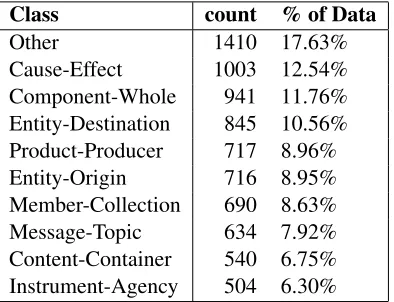
We classified the semantic relations using a Maximum Entropy classifier. In our system, classification was 19-way, direction-sensitive1 between the classifications: Origin, Entity-Destination, Cause-Effect, Product-Producer, Content-Container, Instrument-Agency, Member-Collection, Component-Whole, Message-Topic, and Other (non-directional). The model was trained on the 8000-instance training section of the Se-mEval 2010 Task 8 Semantic Relations Corpus. Distribution of the training data is shown in Table 1 (Hendrickx et al., 2010).
Class count % of Data
Other 1410 17.63%
Cause-Effect 1003 12.54%
Component-Whole 941 11.76% Entity-Destination 845 10.56% Product-Producer 717 8.96%
Entity-Origin 716 8.95%
Member-Collection 690 8.63%
Message-Topic 634 7.92%
[image:2.612.89.286.320.471.2]Content-Container 540 6.75% Instrument-Agency 504 6.30%
Table 1: Class distribution in the training section of Se-mEval 2010 Task 8 Semantic Relations Corpus.
We tested the model on the 2717-instance testing section of the same corpus. For each instance, the user was provided with a sentence containing two marked entities,e1ande2. We structured the task such that, for each instance, we chose the best se-mantic relation out of the 19 available.
In this paper, we use grammatical cluster infor-mation (i.e., recovered latent inforinfor-mation) from the Berkeley Parser (Petrov 2006) as semantic features of syntactic origin to classify semantic relations in the SemEval 2010 Semantic Relations corpus, in a
1i.e., with a Content-Container relation, the nominal that is the container and the nominal that is the content cannot be re-versed.
Maximum Entropy model. We conduct two sets of experiments. In the first experiment, we examine the effect of using Berkeley Parser latent cluster features to enhance specificity over more general features (POS tags and others), where the cluster features are inherently more closely tuned with the data than the other features, and more likely to lead to an over-fitted model. In the second experiment, we examine the effect of using cluster features to enhance gener-alizability over more specific features (the words of the cluster features’ terminal nodes), in which case the cluster features generalize over othe more spe-cific features, but are more likely to miss detailed patterns.
2.1 Previous Work
The classification of semantic relations has been proposed to help NLP tasks ranging from word sense disambiguation, language modelling, paraphrasing, and recognising textual entailment (Hendrickx et al., 2010).
Semantic world knowledge is crucial for accurate semantic classification of many types, and sources range from the hand-crafted-yet sparse (such as WordNet) to the robust-yet-noisy (such as the In-ternet). For this community task, teams proposed a variety of knowledge sources and other fea-tures for their relation classification, from knowl-edge databases (Tymoshenko and Giuliano, 2010), WordNet (Rink and Harabagiu, 2010), Wikipedia (Szarvas and Gurevych, 2010), to formal linguistic Levin classes (Rink and Harabagiu, 2010), to col-locational metrics (Rink and Harabagiu, 2010) and stems (Chen et al., 2010).
2.2 Grammatical cluster information
For our investigations, we used the Berkeley Parser (Petrov et al 2006, Petrov and Klein 2007) as a source of grammar rule clusters. We used the eng sm6.gr off-the-shelf model.
The Berkeley Parser starts with an initial gram-mar extracted from Wall Street Journal corpus sec-tions 2-22. The parser then tries to learn a set of rule probabilities over latent annotations to maximize the likelihood of the training trees using Expectation-Maximization (EM).
Consider a sentencewand its unannotated treeT, a non-terminalAspanning (r,t), and its childrenB
andCspanning (r,s) and (s,t).Ax is a subsymbol
ofA,BxofB, andCxofC. We calculate the
poste-rior probability of all annotated rules and positions for each training set tree T in the Expectation step (Petrov et al., 2006):
(1)
P((r, s, t, Ax →ByCz)|w, T)∝POUT(r, t, Ax)
×β(Ax→ByCz)PIN(r, s, By)PIN(s, t, Cz)
The probabilities from the Expectation step act as weighted observations to update the rule probabili-ties in the Maximization step:
β(Ax→ByCz) :=
#{Ax →ByCz}
Σy0,z0#{Ax→By0Cz0} (2)
In each cycle of EM, the grammar is split ran-domly in halves, and some halves are merged back together. The grammar is retrained, and the results are used to initialize the next round of EM.
In the splitting step, all grammatical nodes are split in two. Although the grammar grows more finely fitted to the training data with each splitting step, its size quickly becomes unmanageable, its rules become overfitted, and because the splits are not a result of likelihood calculation, many unhelp-ful rules are produced. The merging step functions to remove unhelpful rules. In the merging step, each split is examined for the loss of likelihood removing it would cause; splits whose likelihood contribution is below a cutoff are re-combined.
The experiments we perform in this paper are a gamble on the possibility that the saved splits are picking up semantic information from the rule struc-ture they reflect in the increased likelihood. We use
the final split cluster ID’s (PP-5, PP-8, etc.) as fea-tures in our experiments.2
2.3 Features
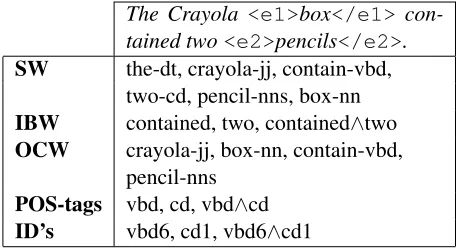
We used several sets of features in our experi-ments. All POS-tags, syntactic structure, and Clus-ter ID features come from the Berkeley Parser. The lemmatization comes from Morpha (Minnen et al., 2001). All features occurring less than two times in the training data were discarded, for ease of process-ing. A sample sentence and the resulting features are shown in Table 2. Note that all features, col-locational and syntactic, were used for discovering semantic knowledge.
The Crayola <e1>box</e1> con-tained two<e2>pencils</e2>.
SW the-dt, crayola-jj, contain-vbd, two-cd, pencil-nns, box-nn
IBW contained, two, contained∧two
OCW crayola-jj, box-nn, contain-vbd, pencil-nns
POS-tags vbd, cd, vbd∧cd
[image:3.612.312.541.257.381.2]ID’s vbd6, cd1, vbd6∧cd1
Table 2: A sample sentence and its accompanying fea-tures.
Collocational Features:
• Surrounding Words (SW): From Ye and Baldwin’s (2007) preposition sense disam-biguation system, this set of features consists of lemmas of all of the words within a window of seven words before and after each ofe1and
e2. Features are not, however, marked with rel-ative location, as we found that this reduced ac-curacy.
• In-Between Words (IBW): This bag of fea-tures consists of the string of words occuring in the sentence in betweene1ande2, exclusive, as well as all the substrings of those consecutive words. We tried marking each feature with its relative location, but we found that results im-proved without location marking, and so we do not use location marking in these experiments.
2
Syntactic Features:
• Open Class Words (OCW): from Ye and Baldwin’s (2007) preposition sense disam-biguation system, this set of features consists of the lemmas of all of the open-class words in the sentence (i.e., NP, VP, ADJP, ADVP).
• POS-tags:The POS tags of the words (i.e., ter-minal nodes) and all consecutive strings of POS tags in betweene1 ande2, exclusive. Tags are from the Berkeley Parser.
• Cluster ID’s: The Berkeley Parser syntactic rule cluster ID’s and POS-tags of the termi-nal nodes in betweene1 ande2. ID numbers are only relevant when comparing ID’s with the same POS tag.
3 Experiment: Cluster ID’s as more spcific features
In our first experiment, we compared two sys-tems of Surrounding Words, Open-Class Words, and Between Terminal Tags, with and without In-Between Terminal Cluster ID’s. The results are shown in Table 3.
3.1 Results and Analysis
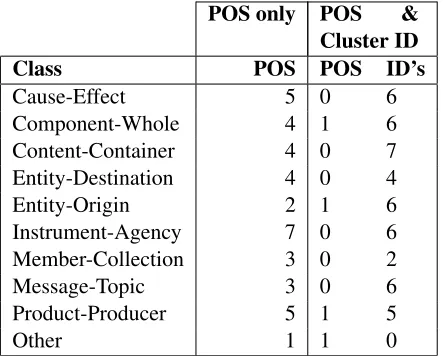
Table 3 shows the results of adding more spe-cific Cluster ID features to the more general POS-tag, Open-Class, and Surrounding-Words features. While this could have led to an over-fitted model, ap-parently it did not. Overall precision increased from 66.60% to 68.62%, an increase of 2.02%, yet recall also increased, from 64.26% to 65.33%, an increase of 1.07%. The more precise, more closely-fitted features did not harm performance, but actually en-hanced it. The Maximum Entropy learner itself pre-ferred the Cluster ID features: Table 4 shows per-class POS-tag and Cluster-ID features with a lambda value over 0.25, comparing when both POS-tag fea-tures and Cluster ID tags are available, versus just POS-tags (all among other features used in Experi-ment 1). When given the opportunity, the MaxEnt learner considered the Cluster ID features more im-portant than the POS-tag features.
As shown in Table 3, we can see that adding the Cluster ID’s did mildly increase F-measure
(by 1.41 %, from 65.01% to 66.42%3. How-ever, when viewed on a class-by-class basis, some classes show great improvement with the addition of Cluster ID’s while others remain unchanged. The classes Cause-Effect, Component-Whole, Content-Container, Instrument-Agency, and Message-Topic all gained significantly with the addition of cluster ID features. We investigated important features of these classes more carefully.
Classes that significantly improved with Cluster ID’s:
• Cause-Effect: Cluster ID features that cor-related highly with Cause-Effect, besides keyword-type single word clusters (from,that), were a cluster of certain occurances of the prepositions by, from, of, in; and a cluster of cause-type verbs (shown in Table 5) plus the phraseby.
• Content-Container: Features positively corre-lated with Content-Container, besides some keywords and phrases such asfull of, was, in, andthe/a, included a Cluster ID feature with a number of verbs commonly used to refer to containers and the processes of filling and emp-tying them, such asleaked,contained,poured, stuffed,took,injected,inserted, andfound. The verbs from this feature are listed in Table 6. • Instrument-Agency: Several Cluster ID
fea-tures of verbs correlate with this class. Al-though it is not as obvious as the verb list with
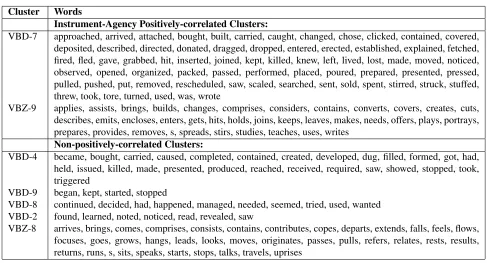
Cause-Effect, Table 7 compares several verb clusters that did have a noticeable positive cor-relation withInstrument-Agencywith several verb clusters of the same POS-tags that did not correlate.
• Component-Whole: Notable keyword and key phrase features includeof the/a/an,has a, and has. One Cluster ID feature is a cluster of third-person, possessive, and reflexive pronouns.
Al-3
Precision Recall F-measure Class no ID w/ ID diff no ID w/ ID diff no ID w/ ID diff
Cause-Effect 79.43 82.62 3.19 76.52 76.83 0.31 77.95 79.62 1.67
Component-Whole 56.58 61.86 5.28 55.13 57.69 2.56 55.84 59.70 3.86
Content-Container 74.37 77.04 2.67 77.08 78.65 1.57 75.70 77.84 2.14
Entity-Destination 73.30 72.60 -0.70 88.36 88.01 -0.35 80.12 79.57 -0.55 Entity-Origin 67.42 66.67 -0.75 69.77 69.77 0.00 68.57 68.18 -0.35 Instrument-Agency 55.73 56.30 0.57 46.79 48.72 1.93 50.87 52.23 1.36
Member-Collection 68.40 67.57 -0.83 73.39 75.11 1.72 70.81 71.14 0.33 Message-Topic 65.95 70.47 4.52 46.74 52.11 5.37 54.71 59.91 5.20
Product-Producer 58.19 62.50 4.31 44.59 41.13 -3.46 50.49 49.61 -0.88
Other 30.97 28.65 -2.32 36.56 35.46 -1.10 33.54 31.69 -1.85
[image:5.612.90.529.53.234.2]Total, Macro-Avg 66.60 68.62 2.02 64.26 65.33 1.07 65.01 66.42 1.41
Table 3: Comparison of Open-Class Words, Surrounding Words, and POS-tags, with and without Cluster ID features. Per SemEval2010 task standards, total does not include ’Other’. Directionality is evaluated, but results are combined for viewability. Bold-font differences are most notable.
POS only POS & Cluster ID
Class POS POS ID’s
Cause-Effect 5 0 6
Component-Whole 4 1 6
Content-Container 4 0 7
Entity-Destination 4 0 4
Entity-Origin 2 1 6
Instrument-Agency 7 0 6
Member-Collection 3 0 2
Message-Topic 3 0 6
Product-Producer 5 1 5
Other 1 1 0
Table 4: Number of POS-tag and Cluster ID features with a lambda value over 0.25, with and without Clus-ter ID features being available. High lambda values are assigned when a classifier finds the features has a high positive correlation with correct examples in the training data.
though it is a somewhat rare feature, when it occurs it is positively-correlated. An example of aComponent-Wholepronoun is below:
He stopped rowing when the boat was opposite to the paddle wheel of the steamer, and the <e1>steamer</e1> stopped her
<e2>engine</e2> at the same time.
accompanied, affected, built, caused, completed, composed, contained, cooked, covered, created, derived, developed, discovered, distilled, driven, enclosed, fabricated, followed, founded, generated, given, known, led, made, manufactured, obtained, offered, produced, published, raised, represented, run, shared, supported, transmitted, triggered, used, wrapped, written
Table 5: Contents of the VBN-12 Cluster that occurred 3 or more times in the Relational Semantics corpus training data. Many of the verbs denote a cause-effect relation-ship.
• Message-Topic: Some helpful keyword fea-tures werein,to, andthat. A helpful Cluster ID feature was a cluster of the prepositionsabout, over, upon, around, andbetween. The model also ranked highly a Cluster ID feature contain-ing a number of ‘discussion’ and ‘document’ verbs, shown in Table 8.
Classes that did not significantly improve with Cluster ID’s:
[image:5.612.76.298.295.473.2]adjusted, applied, became, brought, built, caused, contained, created, described, did, established, examined, featured, followed, formed, found, gave, included, injected, inserted, introduced, involved, joined, leaked, made, marked, posted, poured, produced, released, reported, saw, sent, spotted, stuffed, took, used, was, were, won, wrote, wrapped, written
Table 6: Contents of the VBD-5 Cluster that occurred 3 or more times in the Relational Semantics corpus training data. A number of the verbs can refer to actions involving containers and their contents.
consisting of mostly made, kept, and left; and a cluster of verbs consisting mostly of made, left,kept,departed,arrived,travelled, and con-sisted.
• Entity-Destination: The Cluster ID features that correlated highly with this class mark in-dividual key words and phrases:for the,on the, to the, andto. Clusters of words were not help-ful for this class.
• Product-Producer: The Cluster ID features that strongly correlated with this class con-sisted mostly of the wordswho/whomandby; individual key word features would have been just as good. Several clusters of verbs were highly correlated as well, but apparently there was too much noise in the clusters for them to be effective.
• Member-Collection: This class used the ‘jj-24’ POS cluster, which contains the wordother among other adjectives. This is probably from the classicMember-Collectionphrase “Y and other X’s”. However, this features, along with a feature mostly consisting ofof, was not enough to make much difference (0.33%) over POS features.
• Other: The class Other decreased in F-measure with the addition of cluster ID fea-tures. Combined with the overall F-measure increase for all the regular classes, we inter-pret this decrease in F-measure as an increase in entropy, as more examples with identifiable
useful features are removed from theOther cat-egory, and the MaxEnt learner has fewer accu-rate patterns with which to cluster this diverse group of examples. In order words, we actually desire to see a decrease inOtherF-measure, as the examples inOther have almost nothing in common with eachother and should be hard to identify.
Overall, some of the semantic relation classes were correlated with features of syntactic clusters, and the clusters boosted scores, while other classes weren’t, and their scores remained roughly the same. The results of this experiment show that syntactic clusters did not lead to overtraining of data, and were helpful with semantic relation classification.
4 Experiment: Cluster ID’s as more general features
In our second experiment, using the same experi-mental set-up but different features, we compared In-Between Words (IBW), IBW Plus POS-tags, and IBW Plus POS-tags Plus Cluster ID features. The results are shown in Table 9. The goal of this exper-iment is to compare Cluster ID features to an even more fine-grained feature, the words themselves. The words, POS-tags, and Cluster ID tags all con-cern the same nodes in the sentence.
4.1 Results and Analysis
Table 9 shows the results of adding coarser-grained Cluster ID features to the more specific In-Between-Words features, as well as to the POS-tag features. The addition of Cluster ID features improved clas-sification over IBW plus POS-tags, as well as IBW alone. While the previous experiment showed that Cluster ID features were not too specific to be help-ful, this experiment shows that they are also not too general as to blur lexical patterns. While overall F-measure increased 2.13% from IBW with the addi-tion of POS-tag features, from 63.35% to 65.48%, F-measure also increased further by the addition of Cluster ID features to IBW plus POS-tags, with a to-tal increase of 2.72% over IBW features alone, from 63.35% to 66.07%.
base-Cluster Words
Instrument-Agency Positively-correlated Clusters:
VBD-7 approached, arrived, attached, bought, built, carried, caught, changed, chose, clicked, contained, covered, deposited, described, directed, donated, dragged, dropped, entered, erected, established, explained, fetched, fired, fled, gave, grabbed, hit, inserted, joined, kept, killed, knew, left, lived, lost, made, moved, noticed, observed, opened, organized, packed, passed, performed, placed, poured, prepared, presented, pressed, pulled, pushed, put, removed, rescheduled, saw, scaled, searched, sent, sold, spent, stirred, struck, stuffed, threw, took, tore, turned, used, was, wrote
VBZ-9 applies, assists, brings, builds, changes, comprises, considers, contains, converts, covers, creates, cuts, describes, emits, encloses, enters, gets, hits, holds, joins, keeps, leaves, makes, needs, offers, plays, portrays, prepares, provides, removes, s, spreads, stirs, studies, teaches, uses, writes
Non-positively-correlated Clusters:
VBD-4 became, bought, carried, caused, completed, contained, created, developed, dug, filled, formed, got, had, held, issued, killed, made, presented, produced, reached, received, required, saw, showed, stopped, took, triggered
VBD-9 began, kept, started, stopped
VBD-8 continued, decided, had, happened, managed, needed, seemed, tried, used, wanted VBD-2 found, learned, noted, noticed, read, revealed, saw
[image:7.612.70.557.50.313.2]VBZ-8 arrives, brings, comes, comprises, consists, contains, contributes, copes, departs, extends, falls, feels, flows, focuses, goes, grows, hangs, leads, looks, moves, originates, passes, pulls, refers, relates, rests, results, returns, runs, s, sits, speaks, starts, stops, talks, travels, uprises
Table 7: Some positively-correlating and non-correlating verb clusters forInstrument-Agency. Verbs occurred at least 3 times in the Relational Semantics corpus training data. Many verbs from positively-correlating Cluster ID features may occur with mention of a tool or object to be used to carry out the action.
attaches, builds, carries, causes, combines, comprises, contains, creates, describes, discusses, encloses, gives, holds, includes, keeps, makes, manipulates, means, needs, offers, performs, presents, processes, provides, represents, requires, s, shows, takes, wears, writes
Table 8: Contents of the VBZ-11 Cluster that occurred 3 or more times in the Relational Semantics corpus training data. Many of the verbs are associated with documents or speaking.
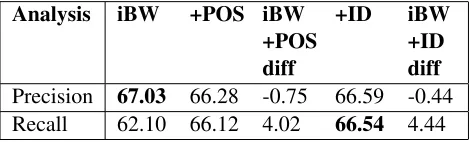
line, IBW features, and adding coarser grained fea-tures, POS-tags and Cluster IDs, we might expect to see a simultaneous decrease in precision and in-crease in recall from the baseline IBW to the en-hanced, POS-tag and Cluster ID versions. As can be seen in Table 10, this is exactly what happens. How-ever, Cluster ID features are found to be helpful to the overall goal of semantic relation classification, because they increase recall by much more (4.44%) than they decrease precision (-0.44%).
Classes for which the Cluster ID plus POS-tag plus IBW combo was highest in-clude Content-Container, Entity-Destination,
Member-Collection, Message-Topic, and Other.
Component-Whole, Instrument-Agency, and
Product-Producerall showed gains over just IBW, but had lower scores than IBW plus just POS-tags. Only Cause-Effect and Entity-Origin failed to show any improvement with POS-tags or Cluster ID’s over the baseline IBW features.
A comparison of features between Experiments 1 and 2 showed that nearly all of the significantly helpful positive-corellated Cluster ID features (with lambda greater than 0.25) in Experiment 2 were also important in Experiment 1. Some cluster ID features in Experiment 1 that isolated out a single word were replaced in Experiment 2 by a more-accurate indi-vidual IBW word feature.
5 Conclusion
F-measure
Class IBW +POS IBW+POS diff +ID IBW+ID diff
Cause-Effect 83.39 80.19 -3.20 81.55 -1.84
Component-Whole 52.50 56.07 3.57 55.06 2.56
Content-Container 73.79 73.27 -0.52 75.19 1.40
Entity-Destination 77.98 80.06 2.08 81.49 3.51
Entity-Origin 68.56 67.21 -1.35 67.33 -1.23
Instrument-Agency 54.29 56.43 2.14 55.63 1.34 Member-Collection 73.22 75.30 2.08 75.50 2.28
Message-Topic 39.59 47.06 7.47 49.45 9.86
Product-Producer 46.88 53.77 6.89 53.46 6.58
Other 27.69 30.08 2.39 30.63 2.94
[image:8.612.118.496.52.234.2]Total, Macro-Avg 63.35 65.48 2.13 66.07 2.72
Table 9: F-measure comparison of In-Between Words, IBW plus POS-tags, and IBW plus POS-tags plus Cluster ID features. Per SemEval2010 task standards, total does not includeOther. Bold-font differences are the highest improvements (or baseline, whichever is higher).
Analysis iBW +POS iBW +POS diff
+ID iBW +ID diff
Precision 67.03 66.28 -0.75 66.59 -0.44 Recall 62.10 66.12 4.02 66.54 4.44
Table 10: Comparison of IBW, IBW plus POS-tags, and IBW plus POS-tags plus Cluster ID features. Per SemEval2010 Task 8 standards, total does not include
Other. Bold-font differences are the highest
improve-ments (or baseline).
and more fine-grained syntactic and collocational features in semantic relation classification.
Acknowledgments
The author wishes to thank William Schuler and Yannick Versley for their advice and support on this project.
References
Yuan Chen , Man Lan , Jian Su , Zhi Min Zhou , Yu Xu 2010. ECNU: Effective Semantic Relations Classifi-cation without Complicated Features or Multiple Ex-ternal Corpora. Proceedings of the 5th International Workshop on Semantic Evaluation.
Iris Hendrickx , Su Nam Kim , Zornitsa Kozareva , Preslav Nakov , Diarmuid O Seaghdha , Sebastian Pado, Marco Pennacchiotti , Lorenza Romano, Stan Szpakowicz. 2010. SemEval-2010 Task 8: Multi-Way
Classification of Semantic Relations Between Pairs of Nominals.Proceedings of the 5th International Work-shop on Semantic Evaluation.
Guido Minnen, John Carroll, and Darren Pearce. 2001. Applied morphological processing of English. Natu-ral Language Engineering, 7(3):207223.
Slav Petrov, Leon Barrett, Romain Thibaux, and Dan Klein. 2006. Learning Accurate, Compact, and Inter-pretable Tree Annotation. InProceedings of the 21st International Conference on Computational Linguis-tics and the 44th Annual Meeting of the Association of Computational Linguistics.
Slav Petrov and Dan Klein. 2007. Improved Inference for Unlexicalized Parsing. Proceedings of NAACL 2007.
Bryan Rink and Sanda Harabagiu 2010. UTD: Classi-fying Semantic Relations by Combining Lexical and Semantic Resources. Proceedings of the 5th Interna-tional Workshop on Semantic Evaluation.
Gyorgy Szarvas and Iryna Gurevych 2010. TUD: seman-tic relatedness for relation classification Proceedings of the 5th International Workshop on Semantic Evalu-ation.
Kateryna Tymoshenko and Claudio Giuliano. 2010.
FBK-IRST: Semantic Relation Extraction using Cyc.
Proceedings of the 5th International Workshop on Se-mantic Evaluation.
[image:8.612.72.307.299.370.2]