Overview of the Epigenetics and Post-translational Modifications (EPI) task
of BioNLP Shared Task 2011
Tomoko Ohta∗ Sampo Pyysalo∗ Jun’ichi Tsujii†
∗
Department of Computer Science, University of Tokyo, Tokyo, Japan †Microsoft Research Asia, Beijing, China
{okap,smp}@is.s.u-tokyo.ac.jp, [email protected]
Abstract
This paper presents the preparation, resources, results and analysis of the Epigenetics and Post-translational Modifications (EPI) task, a main task of the BioNLP Shared Task 2011. The task concerns the extraction of detailed representations of 14 protein and DNA modifi-cation events, the catalysis of these reactions, and the identification of instances of negated or speculatively stated event instances. Seven teams submitted final results to the EPI task in the shared task, with the highest-performing system achieving 53% F-score in the full task and 69% F-score in the extraction of a simpli-fied set of core event arguments.
1 Introduction
The Epigenetics and Post-translational Modifica-tions (EPI) task is a shared task on event extrac-tion from biomedical domain scientific publicaextrac-tions, first introduced as a main task in the BioNLP Shared Task 2011 (Kim et al., 2011a).
The EPI task focuses on events relating to epige-netic change, including DNA methylation and hi-stone methylation and acetylation (see e.g. (Hol-liday, 1987; Jaenisch and Bird, 2003)), as well as other common protein post-translational modi-fications (PTMs) (Witze et al., 2007). PTMs are chemical modifications of the amino acid residues of proteins, and DNA methylation a parallel mod-ification of the nucleotides on DNA. While these modifications are chemically simple reactions and can thus be straightforwardly represented in full de-tail, they have a crucial role in the regulation of
gene expression and protein function: the modifi-cations can alter the conformation of DNA or pro-teins and thus control their ability to associate with other molecules, making PTMs key steps in protein biosynthesis for introducing the full range of protein functions. For instance, protein phosphorylation – the attachment of phosphate – is a common mecha-nism for activating or inactivating enzymes by alter-ing the conformation of protein active sites (Stock et al., 1989; Barford et al., 1998), and protein ubiq-uitination – the post-translational attachment of the small protein ubiquitin – is the first step of a major mechanism for the destruction (breakdown) of many proteins (Glickman and Ciechanover, 2002).
Many of the PTMs targeted in the EPI task in-volve modification of histone, a core protein that forms an octameric complex that has a crucial role in packaging chromosomal DNA. The level of methy-lation and acetymethy-lation of histones controls the tight-ness of the chromatin structure, and only “unwound” chromatin exposes the gene packed around the hi-stone core to the transcriptional machinery. Since histone modification is of substantial current inter-est in epigenetics, we designed aspects of the EPI task to capture the full detail in which histone mod-ification events are stated in text. Finally, the DNA methylation of gene regulatory elements controls the expression of the gene by altering the affinity with which DNA-binding proteins (including transcrip-tion factors) bind, and highly methylated genes are not transcribed at all (Riggs, 1975; Holliday and Pugh, 1975). DNA methylation can thus “switch off” genes, “removing” them from the genome in a way that is reversible through DNA demethylation.
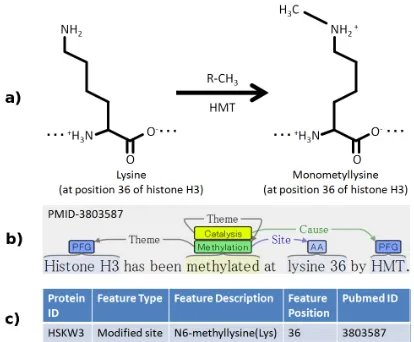
Figure 1: Three views of protein methylation. a) chemical formula b) event representation c) modification database entry.
The BioNLP’09 Shared Task on Event Extrac-tion (Kim et al., 2009), the first task in the present shared task series, involved the extraction of nine event types including one PTM type, PHOSPHORY-LATION. The results of the shared task showed this PTM event to be the single most reliably extracted event type in the task, with the best-performing system for the type achieving 91% precision and 76% recall (83% F-score) in its extraction (Buyko et al., 2009). The results suggest both that the event representation is well applicable to PTM ex-traction and that current exex-traction methods are ca-pable of reliable PTM extraction. The EPI task follows up on these opportunities, introducing spe-cific, strongly biologically motivated extraction tar-gets that are expected to be both feasible for high-accuracy event extraction, relevant to the needs of present-day molecular biology, and closely appli-cable to biomolecular database curation needs (see Figure 1) (Ohta et al., 2010a).
2 Task Setting
The EPI task is anevent extraction taskin the sense popularized by a number of recent domain resources and challenges (e.g. (Pyysalo et al., 2007; Kim et al., 2008; Thompson et al., 2009; Kim et al., 2009; Ana-niadou et al., 2010)). In broad outline, the task fo-cuses on the extraction of information on statements regarding change in the state or properties of (physi-cal) entities, modeled using anevent representation.
Figure 2: Illustration of the event representation. An event of type METHYLATION(expressed through the text “methylation”) with two participants of the types PRO
-TEIN(“histone H3”) and ENTITY(“Lys9”), participating in the event inThemeandSiteroles, respectively.
In this representation, events are typed n-ary asso-ciations of participants (entities or other events) in specific roles. Events are bound to specific expres-sions in text (theevent trigger ortext binding) and are primary objects of annotation, allowing them to be marked in turn e.g. as negated or as participants in other events. Figure 2 illustrates these concepts.
In its specific formulation, EPI broadly follows the definition of the BioNLP’09 shared task on event extraction. Basic modification events are defined similarly to the PHOSPHORYLATIONevent type tar-geted in the ’09 and the 2011 GE and ID tasks (Kim et al., 2011b; Pyysalo et al., 2011b), with the full task extending previously defined arguments with two additional ones,SidechainandContextgene.
2.1 Entities
The EPI task follows the general policy of the BioNLP Shared Task in isolating the basic task of named entity recognition from the event extraction task by providing task participants with manually annotated gene and gene product entities as a start-ing point for extraction. The entity types follow the BioNLP’09 Shared Task scheme, where genes and their products are simply marked as PROTEIN.1
In addition to the given PROTEIN entities, some events involve other entities, such as the modifica-tionSite. These entities are not given and must thus be identified by systems targeting the full task (see Section 4). In part to reduce the demands of this entity recognition component of the task, these ad-ditional entities are not given specific types but are generically marked as ENTITY.
1
While most of the modifications targeted in the task involve proteins, this naming is somewhat inaccurate for theThemes of
DNAMETHYLATIONand DNADEMETHYLATIONevents and
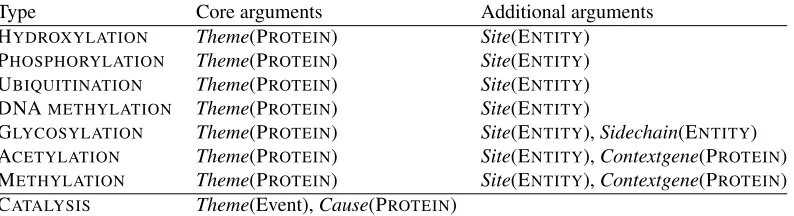
Type Core arguments Additional arguments HYDROXYLATION Theme(PROTEIN) Site(ENTITY) PHOSPHORYLATION Theme(PROTEIN) Site(ENTITY) UBIQUITINATION Theme(PROTEIN) Site(ENTITY) DNAMETHYLATION Theme(PROTEIN) Site(ENTITY)
[image:3.612.110.507.60.168.2]GLYCOSYLATION Theme(PROTEIN) Site(ENTITY),Sidechain(ENTITY) ACETYLATION Theme(PROTEIN) Site(ENTITY),Contextgene(PROTEIN) METHYLATION Theme(PROTEIN) Site(ENTITY),Contextgene(PROTEIN) CATALYSIS Theme(Event),Cause(PROTEIN)
Table 1: Event types and their arguments. The type of entity allowed as argument is specified in parenthesis. For each event type except CATALYSIS, the reverse reaction (e.g. DEACETYLATIONfor ACETYLATION) is also defined, with identical arguments. The total number of event types in the task is thus 15.
2.2 Relations
The EPI task does not define any explicit relation extraction targets. However, the task annotation in-volves one relation type, EQUIV. This is a binary, symmetric, transitive relation between entities that defines two entities to be equivalent (Hoehndorf et al., 2010). The relation is used in the gold annota-tion to mark local aliases such as the full and abbre-viated forms of a protein name as referring to the same real-world entity. While the ’09 task only rec-ognized equivalent PROTEIN entities, EPI extends on the scope of EQUIVannotations in allowing enti-ties of any type to be marked equivalent. In evalua-tion, references to any of a set of equivalent entities are treated identically.
2.3 Events
While the EPI task entity definition closely follows that of the previous shared task, the task introduces considerable novelty in the targeted events, adding a total of 14 novel event types and two new participant roles. Table 1 summarizes the targeted event types and their arguments.
As in the BioNLP’09 shared task, Theme argu-ments identify the entity that the event isabout, such as the protein that is acetylated in an acetylation event. AThemeis always mandatory for all EPI task events. Sitearguments identify the modification site on theThemeentity, such as a specific residue on a modified protein or a specific region on a methylated gene. TheSidechainargument, specific to GLYCO-SYLATIONand DEGLYCOSYLATIONamong the tar-geted events, identifies the moiety attached or
re-moved in the event (in glycosylation, the sugar).2 Fi-nally, theContextgeneargument, specific to ACETY-LATION and METHYLATION events and their re-verse reactions, identifies the gene whose expression is controlled by these modifications. This argument applies specifically for histone protein modification: the modification of the histones that form the nu-cleosomes that structure DNA are key to the epige-netic control of gene expression. TheSite,Sidechain andContextgene arguments are not mandatory, and should only be extracted when explicitly stated.
For CATALYSIS events, representing the cataly-sis of protein or DNA modification by another pro-tein, both ThemeandCauseare mandatory. While CATALYSIS is a new event type, it is related to the ’09 POSITIVE REGULATION type by a class-subclass relation: any CATALYSIS event is a POS-ITIVE REGULATIONevent in the ’09 task terms (but not vice versa).
2.4 Event modifications
In addition to events, the EPI task defines two event modification extraction targets: NEGATION and SPECULATION. Both are represented as simple binary “flags” that apply to events, marking them as being explicitly negated (e.g.H2A is not methylated) or stated in a speculative context (e.g.H2A may be methylated). Events may be both negated and spec-ulated.
2
3 Data
The primary EPI task data were annotated specifi-cally for the BioNLP Shared Task 2011 and are not based on any previously released resource. Before starting this annotation effort, we performed two preparatory studies using in part previously released related datasets: in (Ohta et al., 2010a) we consid-ered the extraction of four protein post-translational modifications event types with reference to annota-tions originally created for the Protein Information Resource3 (PIR) (Wu et al., 2003), and in (Ohta et al., 2010b) we studied the annotation and extraction of DNA methylation events with reference to anno-tations created for the PubMeth4 (Ongenaert et al., 2008) database. The corpus text selection and anno-tation scheme were then defined following the un-derstanding formed in these studies.
3.1 Document selection
The texts for the EPI task corpus were drawn from PubMed abstracts. In selecting the primary cor-pus texts, we aimed to gather a representative sam-ple of all PubMed documents relevant to selected modification events, avoiding bias toward, for ex-ample, specific genes/proteins, species, forms of event expression, or subdomains. We primarily tar-geted DNA methylation and the “prominent PTM types” identified in (Ohta et al., 2010a). We de-fined the following document selection protocol: for each of the targeted event types, 1) Select a ran-dom sample of PubMed abstracts annotated with the MeSH term corresponding to the target event (e.g. Acetylation) 2) Automatically tag protein/gene entities in the selected abstracts, removing ones where fewer than a specific cutoff are found 3) Per-form manual filtering removing documents not rele-vant to the targeted topic (optional).
MeSH is a controlled vocabulary of over 25,000 terms that is used to manually annotate each docu-ment in PubMed. By performing initial docudocu-ment retrieval using MeSH terms it is possible to se-lect relevant documents without bias toward specific expressions in text. While search for documents tagged with e.g. theAcetylationMeSH term is sufficient to select documents relevant to the
modi-3
http://pir.georgetown.edu
4
http://www.pubmeth.org/
fication, not all such documents necessarily concern specifically protein modification, necessitating a fil-tering step. Following preliminary experiments, we chose to apply the BANNER named entity tagger (Leaman and Gonzalez, 2008) trained on the GENE-TAG corpus (Tanabe et al., 2005) and to filter docu-ments where fewer than five entities were identified. Finally, for some modification types this protocol se-lected also a substantial number of non-relevant doc-uments. In these cases a manual filtering step was performed prior to full annotation to avoid marking large numbers of non-relevant abstracts.
This primary corpus text selection protocol does not explicitly target reverse reactions such as deacetylation, and the total number of these events in the resulting corpus was low for many types. To be able to measure the extraction performance for these types, we defined a secondary selection pro-tocol that augmented the primary propro-tocol with a regular expression-based filter removing documents that did not (likely) contain mentions of reverse re-actions. This protocol was used to select a secondary set of test abstracts enriched in mentions of reverse reactions. Performance on this secondary test set was also evaluated, but is not part of the primary task evaluation. Due to space considerations, we only present the primary test set results in this paper, re-ferring to the shared task website for the secondary results.
3.2 Annotation
Annotation was performed manually. The gene/protein entities automatically detected in the document selection step were provided to annotators for reference for creating PROTEIN annotations, but all entity annotations were checked and revised to conform to the specific guidelines for the task.5 For the annotation of PROTEIN entities, we adopted the GENIA gene/gene product (GGP) annotation guidelines (Ohta et al., 2009), adding one specific exception: while the primary guidelines require that only specific individual gene or gene product names are annotated, we allowed also the annotation of mentions of groups of histones or
5
the entire histone protein family to capture histone modification events also in cases where only the group is mentioned.
All event annotations were created from scratch without automatic support to avoid bias toward spe-cific automatic extraction methods or approaches. The event annotation follows the GENIA event cor-pus annotation guidelines (Kim et al., 2008) as they apply to protein modifications, with CATALYSIS be-ing annotated followbe-ing the criteria for the POSI-TIVE REGULATION event type with the additional constraints that theCauseof the event is a gene or gene product entity and the form of regulation is catalysis of a modification reaction.
The manual annotation was performed by three experienced annotators with a molecular biology background, with one chief annotator with extensive experience in domain event annotation organizing and supervising the annotator training and the over-all process. After completion of primary annotation, we performed a final check targeting simple human errors using an automatic extraction system.6 This correction process resulted in the revision of approx-imately 2% of the event annotations. To evaluate the consistency of the annotation, we performed inde-pendent event annotation (taking PROTEIN annota-tions as given) for a random sample of 10% of the corpus documents. Comparison of the two manually created sets of event annotations under the primary task evaluation criteria gave an F-score of 82% for the full task and 89% for the core task.7 We found that CATALYSIS events were particularly challeng-ing, showing just 65% agreement for the core task.
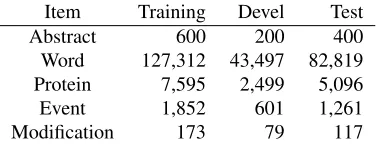
Table 2 shows the statistics of the primary task data. We note that while the corpus is broadly com-parable in size to the BioNLP’09 shared task dataset (Kim et al., 2009) in terms of the number of ab-stracts and annotated entities, the number of anno-tated events in the EPI corpus is approximately 20% of that in the ’09 dataset, reflecting the more focused event types.
6
High-confidence system predictions differing from gold annotations were provided to a human annotator, not used di-rectly to change corpus data. To further reduce the risk of bias, we only informed the annotator of the entities involved, not of the predicted event structure.
7
Due to symmetry of precision/recall and the applied crite-ria, this score was not affected by the choice of which set of annotations to consider as “gold” for the comparison.
[image:5.612.333.522.60.133.2]Item Training Devel Test Abstract 600 200 400 Word 127,312 43,497 82,819 Protein 7,595 2,499 5,096 Event 1,852 601 1,261 Modification 173 79 117
Table 2: Statistics of the EPI corpus. Test set statistics shown only for the primary test data.
4 Evaluation
Evaluation is instance- and event-oriented and based on the standard precision/recall/F-score8 metrics. The primary evaluation criteria are the same as in the BioNLP’09 shared task, incorporating the “approx-imate span matching” and “approx“approx-imate recursive matching” variants to strict matching. In brief, un-der these criteria text-bound annotations (event trig-gers and entities) in a submission are considered to match a corresponding gold annotation if their span is contained within the (mildly extended) span of the gold annotation, and events that refer to other events as arguments are considered to match if the Themearguments of the recursively referred events match, that is, non-Themearguments are ignored in recursively referred events. For a detailed descrip-tion of these evaluadescrip-tion criteria, we refer to (Kim et al., 2009).
In addition to the primary evaluation criteria, we introduced a new relaxed evaluation criterion we termsingle partial penalty. Under the primary cri-teria, when a predicted event matches a gold event in some of its arguments but lacks one or more guments of the gold event, the submission is ar-guably given a double penalty: the predicted event is counted as a false positive (FP), and the gold event is counted as a false negative (FN). Under the single partial penalty evaluation criterion, predicted events that match a gold event in all their arguments are not counted as FP, although the corresponding gold event still counts as FN (the “single penalty”). Analogously, gold events that partially match a pre-dicted event are not counted as FN, although the cor-responding predicted event with “extra” arguments counts as FP. This criterion can give a more nuanced view of performance for partially correctly predicted events.
8
NLP Events Other resources
Rank Team Org word parse trigger arg group modif. corpora other
1 UTurku 1BI Porter McCCJ + SD SVM SVM SVM SVM - hedge words
2 FAUST 3NLP CoreNLP,
SnowBall McCCJ + SD (UMass+Stanford as features) - - word clusters 3 MSR-NLP 1SDE,
3NLP
Porter, custom
McCCJ + SD,
Enju SVM SVM SVM -
-triggers, word clusters
4 UMass 1NLP CoreNLP,
SnowBall McCCJ + SD Joint, dual decomposition - -
-5 Stanford 3NLP custom McCCJ + SD MaxEnt Joint, MSTParser - - word clusters 6 CCP-BTMG 3BI Porter,
WN-lemma Stanford + SD Graph extraction & matching - -
-7 ConcordU 2NLP - McCCJ + SD Dict Rules Rules Rules - triggers and
[image:6.612.75.551.60.215.2]hedge words
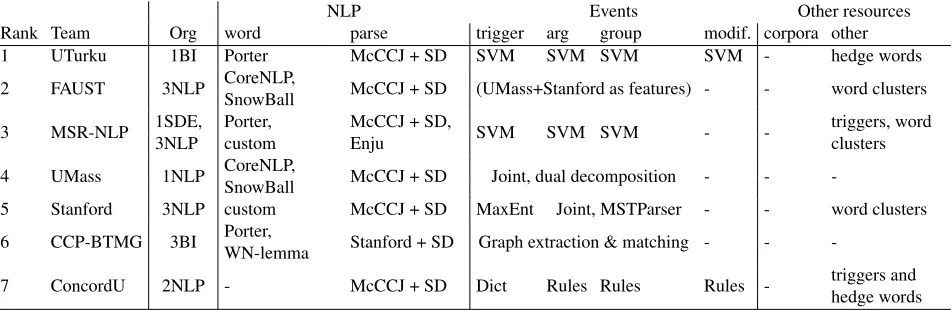
Table 3: Participants and summary of system descriptions. Abbreviations: BI=Bioinformatician, NLP=Natural Lan-guage Processing researcher, SDE=Software Development Engineer, CoreNLP=Stanford CoreNLP, Porter=Porter stemmer, Snowball=Snowball stemmer, WN-lemma=WordNet lemmatization, McCCJ=McClosky-Charniak-Johnson parser, Charniak=Charniak parser, SD=Stanford Dependency conversion, Dict=Dictionary
The full EPI task involves many partially indepen-dent challenges, incorporating what were treated in the BioNLP’09 shared task as separate subtasks: the identification of additional non-Themeevent partic-ipants (Task 2 in ’09) and the detection of negated and speculated events (Task 3 in ’09). The EPI task does not include explicit subtasks. However, we specifies minimalcoreextraction targets in addition to the full task targets. Results are reported sepa-rately for core targets and full task, allowing partic-ipants to choose to only extract core targets. The full task results are considered the primary evalua-tion for the task e.g. for the purposes of determining the ranking of participating systems.
5 Results
5.1 Participation
Table 3 summarizes the participating groups and the features of their extraction systems. We note that, similarly to the ’09 task, machine learning-based systems remain dominant overall, although there is considerable divergence in the specific methods ap-plied. In addition to domain mainstays such as sup-port vector machines and maximum entropy mod-els, we find increased application of joint models (Riedel et al., 2011; McClosky et al., 2011; Riedel and McCallum, 2011) as opposed to pure pipeline systems (Bj¨orne and Salakoski, 2011; Quirk et al., 2011) . Remarkably, the application of full
pars-ing together with dependency-based representations of syntactic analyses is adopted by all participants, with the parser of Charniak and Johnson (2005) with the biomedical domain model of McClosky (2009) is applied in all but one system (Liu et al., 2011) and the Stanford Dependency representation (de Marn-effe et al., 2006) in all. These choices may be mo-tivated in part by the success of systems using the tools in the previous shared task and the availability of the analyses as supporting resources (Stenetorp et al., 2011).
Despite the availability of PTM and DNA methy-lation resources other than those specifically intro-duced for the task and the PHOSPHORYLATION an-notations in the GE task (Kim et al., 2011b), no par-ticipant chose to apply other corpora for training. With the exception of externally acquired unlabeled data such as PubMed-derived word clusters applied by three groups, the task results thus reflect a closed task setting in which only the given data is used for training.
5.2 Evaluation results
MSR-NLP
CCP-BTMG
Con-cordU UTurku FAUST UMass Stanford Size HYDROXYLATION 42.25 10.26 10.20 12.80 9.45 12.84 6.32 139
DEHYDROXYLATION - - - 1
PHOSPHORYLATION 67.12 51.61 50.00 49.18 40.98 47.06 44.44 130 DEPHOSPHORYLATION 0.00 0.00 0.00 0.00 0.00 50.00 0.00 3 UBIQUITINATION 75.34 72.95 67.88 72.94 67.44 70.87 69.97 340 DEUBIQUITINATION 54.55 40.00 0.00 31.58 0.00 42.11 14.29 17 DNAMETHYLATION 60.21 31.21 34.54 23.82 31.02 15.65 8.22 416 DNADEMETHYLATION 26.67 0.00 0.00 0.00 0.00 0.00 0.00 21
Simple event total 63.05 45.17 44.97 43.01 40.96 40.62 37.84 1067
GLYCOSYLATION 49.43 41.10 38.87 40.00 37.22 25.62 25.94 347 DEGLYCOSYLATION 40.00 35.29 0.00 38.10 30.00 35.29 26.67 27 ACETYLATION 57.22 40.00 41.42 40.25 35.12 37.50 38.19 337 DEACETYLATION 54.90 28.00 31.82 29.17 21.74 24.56 27.27 50 METHYLATION 57.67 24.82 19.57 23.67 18.54 16.99 15.50 374 DEMETHYLATION 35.71 0.00 0.00 0.00 0.00 0.00 0.00 13
Non-simple event total 54.36 33.86 31.85 33.07 29.28 25.06 25.10 1148
CATALYSIS 7.06 6.58 7.75 5.00 2.84 7.58 1.74 238
Subtotal 55.02 36.93 36.17 35.30 32.85 30.58 28.92 2453
NEGATION 18.60 0.00 0.00 0.00 0.00 0.00 26.51 149 SPECULATION 37.65 0.00 0.00 0.00 0.00 0.00 6.82 103
Modification total 28.07 0.00 0.00 0.00 0.00 0.00 16.37 252 Total 53.33 35.03 34.27 33.52 31.22 28.97 27.88 2705
[image:7.612.109.503.58.378.2]Addition total 59.33 40.27 39.05 38.65 36.03 32.75 31.50 2038 Removal total 44.29 22.41 15.73 22.76 14.41 23.53 17.48 132
Table 4: Primary evaluation F-scores by event type. The “size” column gives the number of annotations of each type in the given data (training+development). Best result for each type shown in bold. For DEHYDROXYLATION, no examples were present in the test data and none were predicted by any participant.
[image:7.612.100.271.440.537.2]Team recall prec. F-score UTurku 52.69 53.98 53.33 FAUST 28.88 44.51 35.03 MSR-NLP 27.79 44.69 34.27 UMass 28.08 41.55 33.52 Stanford 26.56 37.85 31.22 CCP-BTMG 23.44 37.93 28.97 ConcordU 20.83 42.14 27.88
Table 5: Primary evaluation results
only the core task. For the full task, this differ-ence in approach is reflected in the substantial per-formance advantage for the UTurku system, which exhibits highest performance overall as well as for most individual event types.
Extraction performance for simple events tak-ing only Themeand Sitearguments is consistently higher than for other event types, with absolute F-score differences of over 10% points for many
sys-tems. Similar notable performance differences are seen between the addition events, for which am-ple training data was available, and the removal types for which data was limited. This effect is particularly noticeable for DEPHOSPHORYLATION, DNA DEMETHYLATION and DEMETHYLATION, for which the clear majority of systems failed to pre-dict any correct events. Extraction performance for CATALYSIS events is very low despite a relatively large set of training examples, indicating that the extraction of nested event structures remains very challenging. This low performance may also be re-lated to the fact that CATALYSIS events are often triggered by the same word as the catalysed mod-ification (e.g. Figure 1b), requiring the assignment of multiple event labels to a single word in typical system architectures.
crite-Team recall prec. F-score ∆
[image:8.612.321.529.60.156.2]UTurku 54.79 58.42 56.55 3.22 FAUST 28.88 72.05 41.24 6.21 MSR-NLP 27.79 66.72 39.24 4.97 UMass 28.08 63.28 38.90 5.38 Stanford 26.56 56.83 36.20 4.98 CCP-BTMG 23.44 50.79 32.08 3.11 ConcordU 20.83 60.55 30.99 3.11
Table 6: Full task evaluation results for primary criteria and with single partial penalty. The∆column gives F-score difference to the primary results.
rion are on average over 4% points higher than un-der the primary criteria, with the most substantial increases seen for high-ranking participants only ad-dressing the core task: for example, the precision of the FAUST system (Riedel et al., 2011) is nearly 30% higher under the relaxed criterion. These re-sults provide new perspective deserving further de-tailed study into the question of what are the most meaningful criteria for event extraction system eval-uation.
Table 7 summarizes the core task results. While all systems show notably higher performance than for the full task, high-ranking participants focusing on the core task gain most dramatically, with the FAUST system core task F-score essentially match-ing that of the top system (UTurku). For the core task, all participants achieve F-scores over 50% – a result achieved by only a single system in the ’09 task – and the top four participants average over 65% F-score. These results confirm that current event extraction technology is well applicable to the core PTM extraction task even when the number of tar-geted event types is relatively high and may be ready to address the challenges of exhaustive PTM extrac-tion (Pyysalo et al., 2011a). The best core tasks re-sults, approaching 70% F-score, are particularly en-couraging as the level of performance is comparable to or better than state-of-the-art results for many ref-erence resources for protein-protein interaction ex-traction (see e.g. Tikk et al. (2010))) using the simple untyped entity pair representation, a standard task that has been extensively studied in the domain.
6 Discussion and Conclusions
This paper has presented the preparation, resources, results and analysis of the BioNLP Shared Task
Team recall prec. F-score ∆1 ∆2
[image:8.612.87.289.60.157.2]UTurku 68.51 69.20 68.86 15.53 12.31 FAUST 59.88 80.25 68.59 33.56 27.35 MSR-NLP 55.70 77.60 64.85 30.58 25.61 UMass 57.04 73.30 64.15 30.63 25.25 Stanford 56.87 70.22 62.84 31.62 26.64 ConcordU 40.28 76.71 52.83 24.95 21.84 CCP-BTMG 45.06 63.37 52.67 23.70 20.59
Table 7: Core task evaluation results. The ∆1 column
gives F-score difference to primary full task results,∆2
to full task results with single partial penalty.
2011 Epigenetics and Post-translational modifica-tions (EPI) main task. The results demonstrate that the core extraction target of identifying statements of 14 different modification types with the modified gene or gene product can be reliably addressed by current event extraction methods, with two systems approaching 70% F-score at this task. Nevertheless, challenges remain in detecting statements regarding the catalysis of these events as well as in resolving the full detail of such modification events, a task at-tempted by only one participant and at which perfor-mance remains at somewhat above 50% in F-score.
Detailed evaluation showed that the highly com-petitive participating systems differ substantially in their relative strengths, indicating potential for fur-ther development at protein and DNA modification event detection. The task results are available in full detail from the shared task webpage, http: //sites.google.com/site/bionlpst/.
In the future, we will follow the example of the BioNLP’09 shared task in making the data and re-sources of the EPI task open to all interested par-ties to encourage further study of event extraction for epigenetics and post-translational modification events, to facilitate system comparison on a well-defined standard task, and to support the develop-ment of further applications of event extraction tech-nology in this important area of biomolecular sci-ence.
Acknowledgments
References
Sophia Ananiadou, Sampo Pyysalo, Jun’ichi Tsujii, and Douglas B. Kell. 2010. Event extraction for sys-tems biology by text mining the literature. Trends in Biotechnology, 28(7):381–390.
D. Barford, A.K. Das, and M.P. Egloff. 1998. The struc-ture and mechanism of protein phosphatases: insights into catalysis and regulation. Annual review of bio-physics and biomolecular structure, 27(1):133–164. Jari Bj¨orne and Tapio Salakoski. 2011.
Generaliz-ing biomedical event extraction. In Proceedings of the BioNLP 2011 Workshop Companion Volume for Shared Task, Portland, Oregon, June. Association for Computational Linguistics.
Ekaterina Buyko, Erik Faessler, Joachim Wermter, and Udo Hahn. 2009. Event extraction from trimmed de-pendency graphs. InProceedings of BioNLP Shared Task 2009, pages 19–27.
Eugene Charniak and Mark Johnson. 2005. Coarse-to-Fine n-Best Parsing and MaxEnt Discriminative Reranking. In Proceedings of ACL’05, pages 173– 180.
Marie-Catherine de Marneffe, Bill MacCartney, and Christopher D. Manning. 2006. Generating Typed Dependency Parses from Phrase Structure Parses. In
Proceedings of the Fifth International Conference on Language Resources and Evaluation (LREC’06), pages 449–454.
M.H. Glickman and A. Ciechanover. 2002. The ubiquitin-proteasome proteolytic pathway: destruction for the sake of construction. Physiological reviews, 82(2):373.
R. Hoehndorf, A.C.N. Ngomo, S. Pyysalo, T. Ohta, A. Oellrich, and D. Rebholz-Schuhmann. 2010. Applying ontology design patterns to the imple-mentation of relations in GENIA. In Proceedings of the Fourth Symposium on Semantic Mining in Biomedicine SMBM 2010.
Robin Holliday and JE Pugh. 1975. Dna modification mechanisms and gene activity during development.
Science, 187:226–232.
Robin Holliday. 1987. The inheritance of epigenetic de-fects. Science, 238:163–170.
Rudolf Jaenisch and Adrian Bird. 2003. Epigenetic reg-ulation of gene expression: how the genome integrates intrinsic and environmental signals. Nature Genetics, 33:245–254.
Halil Kilicoglu and Sabine Bergler. 2011. Adapting a general semantic interpretation approach to biological event extraction. InProceedings of the BioNLP 2011 Workshop Companion Volume for Shared Task, Port-land, Oregon, June. Association for Computational Linguistics.
Jin-Dong Kim, Tomoko Ohta, and Jun’ichi Tsujii. 2008. Corpus annotation for mining biomedical events from literature.BMC Bioinformatics, 9(10).
Jin-Dong Kim, Tomoko Ohta, Sampo Pyysalo, Yoshi-nobu Kano, and Jun’ichi Tsujii. 2009. Overview of BioNLP’09 Shared Task on Event Extraction. In Proceedings of Natural Language Processing in Biomedicine (BioNLP) NAACL 2009 Workshop, pages 1–9.
Jin-Dong Kim, Sampo Pyysalo, Tomoko Ohta, Robert Bossy, and Jun’ichi Tsujii. 2011a. Overview of BioNLP Shared Task 2011. In Proceedings of the BioNLP 2011 Workshop Companion Volume for Shared Task, Portland, Oregon, June. Association for Computational Linguistics.
Jin-Dong Kim, Yue Wang, Toshihisa Takagi, and Aki-nori Yonezawa. 2011b. Overview of the Genia Event task in BioNLP Shared Task 2011. In Proceedings of the BioNLP 2011 Workshop Companion Volume for Shared Task, Portland, Oregon, June. Association for Computational Linguistics.
R. Leaman and G. Gonzalez. 2008. Banner: an exe-cutable survey of advances in biomedical named entity recognition. Proceedings of the Pacific Symposium on Biocomputing (PSB’08), pages 652–663.
Haibin Liu, Ravikumar Komandur, and Karin Verspoor. 2011. From graphs to events: A subgraph matching approach for information extraction from biomedical text. In Proceedings of the BioNLP 2011 Workshop Companion Volume for Shared Task, Portland, Oregon, June. Association for Computational Linguistics. David McClosky, Mihai Surdeanu, and Christopher
Man-ning. 2011. Event extraction as dependency parsing for bionlp 2011. InProceedings of the BioNLP 2011 Workshop Companion Volume for Shared Task, Port-land, Oregon, June. Association for Computational Linguistics.
David McClosky. 2009. Any Domain Parsing: Auto-matic Domain Adaptation for Natural Language Pars-ing. Ph.D. thesis, Department of Computer Science, Brown University.
Tomoko Ohta, Jin-Dong Kim, Sampo Pyysalo, Yue Wang, and Jun’ichi Tsujii. 2009. Incorporating GENETAG-style annotation to GENIA corpus. In
Proceedings of BioNLP’09, pages 106–107.
Tomoko Ohta, Sampo Pyysalo, Makoto Miwa, Jin-Dong Kim, and Jun’ichi Tsujii. 2010a. Event extraction for post-translational modifications. InProceedings of BioNLP’10, pages 19–27.
Tomoko Ohta, Sampo Pyysalo, Makoto Miwa, and Jun’ichi Tsujii. 2010b. Event extraction for dna methylation. InProceedings of SMBM’10.
Van Criekinge. 2008. PubMeth: a cancer methy-lation database combining text-mining and expert annotation. Nucl. Acids Res., 36(suppl 1):D842–846. Sampo Pyysalo, Filip Ginter, Juho Heimonen, Jari
Bj¨orne, Jorma Boberg, Jouni J¨arvinen, and Tapio Salakoski. 2007. BioInfer: A corpus for information extraction in the biomedical domain. BMC Bioinfor-matics, 8(50).
Sampo Pyysalo, Tomoko Ohta, Makoto Miwa, and Jun’ichi Tsujii. 2011a. Towards exhaustive protein modification event extraction. In Proceedings of the BioNLP 2011 Workshop, Portland, Oregon, June. As-sociation for Computational Linguistics.
Sampo Pyysalo, Tomoko Ohta, Rafal Rak, Dan Sul-livan, Chunhong Mao, Chunxia Wang, Bruno So-bral, Jun’ichi Tsujii, and Sophia Ananiadou. 2011b. Overview of the Infectious Diseases (ID) task of BioNLP Shared Task 2011. In Proceedings of the BioNLP 2011 Workshop Companion Volume for Shared Task, Portland, Oregon, June. Association for Computational Linguistics.
Chris Quirk, Pallavi Choudhury, Michael Gamon, and Lucy Vanderwende. 2011. Msr-nlp entry in bionlp shared task 2011. InProceedings of the BioNLP 2011 Workshop Companion Volume for Shared Task, Port-land, Oregon, June. Association for Computational Linguistics.
Sebastian Riedel and Andrew McCallum. 2011. Ro-bust biomedical event extraction with dual decompo-sition and minimal domain adaptation. InProceedings of the BioNLP 2011 Workshop Companion Volume for Shared Task, Portland, Oregon, June. Association for Computational Linguistics.
Sebastian Riedel, David McClosky, Mihai Surdeanu, An-drew McCallum, and Chris Manning. 2011. Model combination for event extraction in bionlp 2011. In
Proceedings of the BioNLP 2011 Workshop Compan-ion Volume for Shared Task, Portland, Oregon, June. Association for Computational Linguistics.
A.D. Riggs. 1975. X inactivation, differentiation, and dna methylation. Cytogenetic and Genome Research, 14:9–25.
Pontus Stenetorp, Goran Topi´c, Sampo Pyysalo, Tomoko Ohta, Jin-Dong Kim, and Jun’ichi Tsujii. 2011. BioNLP Shared Task 2011: Supporting Resources. In
Proceedings of the BioNLP 2011 Workshop Compan-ion Volume for Shared Task, Portland, Oregon, June. Association for Computational Linguistics.
JB Stock, AJ Ninfa, and AM Stock. 1989. Protein phosphorylation and regulation of adaptive responses in bacteria. Microbiology and Molecular Biology Re-views, 53(4):450.
Lorraine Tanabe, Natalie Xie, Lynne Thom, Wayne Mat-ten, and John Wilbur. 2005. Genetag: a tagged cor-pus for gene/protein named entity recognition. BMC Bioinformatics, 6(Suppl 1):S3.
Paul Thompson, Syed Iqbal, John McNaught, and Sophia Ananiadou. 2009. Construction of an annotated corpus to support biomedical information extraction.
BMC Bioinformatics, 10(1):349.
Domonkos Tikk, Philippe Thomas, Peter Palaga, J¨org Hakenberg, and Ulf Leser. 2010. A comprehen-sive benchmark of kernel methods to extract protein-protein interactions from literature. PLoS Comput Biol, 6(7):e1000837, 07.
Yue Wang, Jin-Dong Kim, Rune Sætre, Sampo Pyysalo, and Jun’ichi Tsujii. 2009. Investigating heteroge-neous protein annotations toward cross-corpora uti-lization. BMC Bioinformatics, 10(403), Dec. ISSN: 1471-2105.
Eric S Witze, William M Old, Katheryn A Resing, and Natalie G Ahn. 2007. Mapping protein post-translational modifications with mass spectrometry.
Nature Methods, 4:798–806.