Situated Reference in a Hybrid Human-Robot Interaction System
Manuel Giuliani1 and Mary Ellen Foster2 and Amy Isard3 Colin Matheson3 and Jon Oberlander3 and Alois Knoll1
1Informatik VI: Robotics and Embedded Systems, Technische Universit¨at M¨unchen
2School of Mathematical and Computer Sciences, Heriot-Watt University, Edinburgh
3Institute for Communicating and Collaborative Systems, School of Informatics, University of Edinburgh
Abstract
We present the situated reference genera-tion module of a hybrid human-robot in-teraction system that collaborates with a human user in assembling target objects from a wooden toy construction set. The system contains a sub-symbolic goal in-ference system which is able to detect the goals and errors of humans by analysing their verbal and non-verbal behaviour. The dialogue manager and reference genera-tion components then use situated refer-ences to explain the errors to the human users and provide solution strategies. We describe a user study comparing the results from subjects who heard constant refer-ences to those who heard referrefer-ences gener-ated by an adaptive process. There was no difference in the objective results across the two groups, but the subjects in the adaptive condition gave higher subjective ratings to the robot’s abilities as a conver-sational partner. An analysis of the objec-tive and subjecobjec-tive results found that the main predictors of subjective user satisfac-tion were the user’s performance at the as-sembly task and the number of times they had to ask for instructions to be repeated.
1 Introduction
When two humans jointly carry out a mutual task for which both know the plan—for example, as-sembling a new shelf—it frequently happens that one makes an error, and the other has to assist and to explain what the error was and how it can be solved. Humans are skilled at spotting errors committed by another, as well as errors which they made themselves. Recent neurological stud-ies have shown that error monitoring—i.e., ob-serving the errors made by oneself or by others—
plays an important role in joint activity. For ex-ample, Bekkering et al. (2009) have demonstrated that humans show the same brain activation pat-terns when they make an error themselves and when they observe someone else making an error. In this paper, we describe a human-robot inter-action (HRI) system that is able both to analyse the actions and the utterances of a human part-ner to determine if the human made an error in the assembly plan, and to explain to the human what went wrong and what to do to solve the prob-lem. This robot combines approaches from sub-symbolic processing and sub-symbolic reasoning in a hybrid architecture based on that described in Fos-ter et al. (2008b).
During the construction process, it is frequently necessary to refer to an object which is being used to assemble the finished product, choosing an un-ambigious reference to distinguish the object from the others available. The classic reference gen-eration algorithm, on which most subsequent im-plementations are based, is the incremental algo-rithm of Dale and Reiter (1995), which selects a set of attributes of a target object to single it out from a set of distractor objects. In real-world tasks, the speaker and hearer often have more con-text in common than just the knowledge of object attributes, and several extensions have been pro-posed, dealing with visual and discourse salience (Kelleher and Kruijff, 2006) and the ability to pro-duce multimodal references including actions such as pointing (van der Sluis, 2005; Kranstedt and Wachsmuth, 2005).
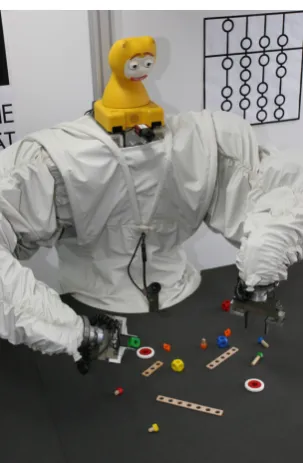
in-Figure 1: The dialogue robot
dicate the increased accessibility of the referent. This type of reference is similar to theplacing-for actions noted by Clark (1996).
An initial approach for generating referring ex-pressions that make use of haptic-ostensive refer-ence was described in (Foster et al., 2009a). With this system, a study was conducted comparing the new reference strategy to the basic Dale and Reiter incremental algorithm. Na¨ıve users reported that it was significantly easier to understand the instruc-tions given by the robot when it used references generated by the more sophisticated algorithm. In this paper, we perform a similar experiment, but making use of a more capable human-robot in-teraction system and a more complete process for generating situated references.
2 Hybrid Human-Robot Dialogue
System
The experiment described in this paper makes use of a hybrid human-robot dialogue system which supports multimodal human-robot collaboration on a joint construction task. The robot (Figure 1) has a pair of manipulator arms with grippers, mounted in a position to resemble human arms, and an animatronic talking head (van Breemen, 2005) capable of producing facial expressions, rigid head motion, and lip-synchronised synthe-sised speech. The subject and the robot work to-gether to assemble wooden construction toys on a common workspace, coordinating their actions
through speech (English or German), gestures, and facial expressions.
The robot can pick up and move objects in the workspace and perform simple assembly tasks. In the scenario considered here, both of the partici-pants know the assembly plan and jointly execute it. The robot assists the human, explains necessary assembly steps in case the human makes an error, and offers pieces as required. The workspace is di-vided into two areas—one belonging to the robot and one to the human—to make joint action nec-essary for task success.
The system has components which use both sub-symbolic and symbolic processing. It in-cludes a goal inference module based on dynamic neural fields (Erlhagen and Bicho, 2006; Bicho et al., 2009), which selects the robot’s next actions based on the human user’s actions and utterances. Given a particular assembly plan and the knowl-edge of which objects the user has picked up, this module can determine when the user has made an error. The system also incorporates a dialogue manager based on the TrindiKit dialogue manage-ment toolkit (Larsson and Traum, 2000), which implements the information-state based approach to dialogue management. This unique combina-tion of abilities means that when the robot detects that its human partner has made an error—for ex-ample, picking up or requesting an assembly piece that is not needed in the current step of the building plan—it can explain to the human what the error was and what can be done to correct the mistake— for example by picking up or indicating the correct assembly piece.
Messages from all of the system’s input chan-nels (speech, object recognition, and gesture recognition) are processed and combined by a multimodal fusion component based on (Giuliani and Knoll, 2008), which is the link between the symbolic and the sub-symbolic parts of the sys-tem. The fusion component then communicates with the goal inference module, which calculates the next action instructions for the robot and also determines if the user made an error. From there, fusion combines the information from goal infer-ence with the input data and sends unified hy-potheses to the dialogue manager.
[image:2.595.105.257.58.290.2]de-1. System First we will build a windmill.
2. User Okay.
3. User {picks up a yellow cube, unnecessary piece for a windmill}
4. System You don’t need a yellow cube to build a windmill.
5. System To build a windmill, you first need to build a tower.
6. System [picking up and holding out red cube]To build the tower, insert the green bolt through the end of this red cube and screw it into the blue cube.
7. User [takes cube, performs action]Okay.
Figure 2: Sample human-robot dialogue, showing adaptively-generated situated references
sired response to the output planner, which in turn sends commands to each output channel: linguis-tic content (including multimodal referring ex-pressions), facial expressions and gaze behaviours of the talking head, and actions of the robot ma-nipulators. The linguistic outputs are realised us-ing the OpenCCG surface realiser (White, 2006).
3 Reference Generation
In this system, two strategies were implemented for generating references to objects in the world: a constant version that uses only the basic incre-mental algorithm (Dale and Reiter, 1995) to se-lect properties, and an adaptive version that uses more of the physical, dialogue and task context to help select the references. The constant sys-tem can produce a definite or indefinite reference, and the most appropriate combination of attributes according to the incremental algorithm. The adap-tive system also generates pronominal and deictic references, and introduces the concept of multiple types of distractor sets depending on context.
Figure 2 shows a fragment of a sample interac-tion in which the user picks up an incorrect piece: the robot detects the error and describes the correct assembly procedure. The underlined references show the range of output produced by the adap-tive reference generation module; for the constant system, the references would all have been “the red cube”. The algorithms used by the adaptive reference generation module are described below.
3.1 Reference Algorithm
The module stores a history of the referring ex-pressions spoken by both the system and the user, and uses these together with distractor sets to se-lect referring expressions. In this domain there are two types of objects which we need to refer to: concrete objects in the world (everything which is on the table, or in the robot’s or user’s hand), and objects which do not yet exist, but are in the pro-cess of being created. For non-existent objects we do not build a distractor set, but simply use the name of the object. In all other cases, we use one of three types of distractor set:
• all the pieces needed to build a target object;
• all the objects referred to since the last men-tion of this object; or
• all the concrete objects in the world.
The first type of set is used if the object under consideration (OUC) is a negative reference to a piece in context of the creation of a target object. In all other cases, the second type is used if the OUC has been mentioned before and the third type if it has not.
When choosing a referring expression, we first process the distractor set, comparing the proper-ties of the OUC with the properproper-ties of all distrac-tors. If a distractor has a different type from the OUC, it is removed from the distractor set. With all other properties, if the distractor has a different value from the OUC, it is removed from the dis-tractor set, and the OUC’s property value is added to the list of properties to use.
We then choose the type of referring expression. We first look for a previous reference (PR) to the OUC, and if one exists, determine whether it was in focus. Depending on the case, we use one of the following reference strategies.
No PR If the OUC does not yet exist or we are making a negative reference, we use an indef-inite article. If the robot is holding the OUC, we use a deictic reference. If the OUC does exist and there are no distractors, we use a definite; if there are distractors we use an in-definite.
the robot is holding the OUC we use a deictic reference, and if the robot is not holding it, we use a pronoun.
PR was not focal If the robot is holding the OUC, we make a deictic reference. Other-wise, if the PR was a pronoun, definite, or de-ictic, we use a definite article. If the PR was indefinite and there are no distractors, we use a definite article, if there are distractors, we use an indefinite article.
If there are any properties in the list, and the reference chosen is not a pronoun, we add them.
3.2 Examples of the Reference Algorithm
We will illustrate the reference-selection strategy with two cases from the dialogue in Figure 2.
Utterance 4 “a yellow cube”
This object is going to be referred to in a negative context as part of a windmill under construction, so the distractor set is the set of objects needed to make a windmill:{red cube, blue cube, small slat, small slat, green bolt, red bolt}.
We select the properties to use in describing the object under consideration, processing the distrac-tor set. We first remove all objects which do not share the same type as our object under considera-tion, which leaves{red cube, blue cube}. We then compare the other attributes of our new object with the remaining distractors - in this case “colour”. Since neither cube shares the colour “yellow” with the target object, both are removed from the dis-tractor set, and “yellow” is added to the list of properties to use.
There is no previous reference to this object, and since we are making a negative reference, we automatically choose an indefinite article. We therefore select the reference “a yellow cube”.
Utterance 6 “it” (a green bolt)
This object has been referred to before, earlier in the same utterance, so the distractor set is all the references between the earlier one and this one—
{red cube}. Since this object has a different type from the bolt we want to describe, the distractor set is now empty, and nothing is added to the list of properties to use.
There is a previous definite reference to the ob-ject in the same utterance: “the green bolt”. This reference was focal, so we are free to use a pro-noun if appropriate. Since the previous reference
was definite, and the object being referred to does exist, we choose to use a pronoun. We therefore select the reference “it”.
4 Experiment Design
In the context of the HRI system, a constant refer-ence strategy is sufficient in that it makes it possi-ble for the robot’s partner to know which item is needed. On the other hand, while the varied forms produced by the more complex mechanism can in-crease the naturalness of the system output, they may actually be insufficient if they are not used in appropriate current circumstances—for exam-ple, “this cube” is not a particularly helpful refer-ence if a user has no way to tell which “this” is. As a consequence, the system for generating such references must be sensitive to the current state of joint actions and—in effect—of joint attention. The difference between the two systems is a test of the adaptive version’s ability to adjust expressions to pertinent circumstances. It is known that peo-ple respond well to reduced expressions like “this cube” or “it” when another person uses them ap-propriately (Bard et al., 2008); we need to see if the robot system can also achieve the benefits that situated reference could provide.
To address this question, the human-robot di-alogue system was evaluated through a user study in which subjects interacted with the complete sys-tem. Using a between-subjects design, this study compared the two reference strategies, measuring the users’ subjective reactions to the system along with their overall performance in the interaction. Based on the findings from the user evaluation de-scribed in (Foster et al., 2009a)—in which the pri-mary effect of varying the reference strategy was on the users’ subjective opinion of the robot—the main prediction for this study was as follows:
• Subjects who interact with a system using adaptive references will rate the quality of the robot’s conversation more highly than the subjects who hear constant references.
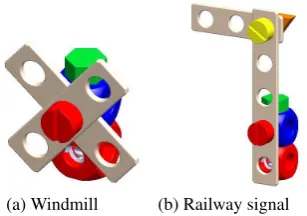
(a) Windmill (b) Railway signal
Figure 3: Target objects for the experiment
no objective difference would demonstrate that the adaptive references did not harm the users’ ability to interact with the system, as long as it was ac-companied by the predicted improvement in sub-jective judgements.
4.1 Subjects
41 subjects (33 male) took part in this experiment. The mean age of the subjects was 24.5, with a min-imum of 19 and a maxmin-imum of 42. Of the subjects who indicated an area of study, the two most com-mon areas were Mathematics (14 subjects) and In-formatics (also 14 subjects). On a scale of 1 to 5, subjects gave a mean assessment of their knowl-edge of computers at 4.1, of speech-recognition systems at 2.0, and of human-robot systems at 1.7. Subjects were compensated for their participation in the experiment.
4.2 Scenario
This study used a between-subjects design with one independent variable: each subject interacted either with a system that used a constant strategy to generate referring expressions (19 subjects), or else with a system that used an adaptive strategy (22 subjects).1
Each subject built two objects in collaboration with the system, always in the same order. The first target object was the windmill (Figure 3a); after the windmill was completed, the robot and human then built a railway signal (Figure 3b). For both target objects, the user was given a building plan (on paper). To induce an error, both of the plans given to the subjects instructed them to use an incorrect piece: a yellow cube instead of a red cube for the windmill, and a long (seven-hole) slat instead of a medium (five-hole) slat for the
rail-1The results of an additional three subjects in the
constant-reference condition could not be analysed due to technical difficulties.
way signal. The subjects were told that the plan contained an error and that the robot would cor-rect them when necessary, but did not know the nature of the error.
When the human picked up or requested an in-correct piece during the interaction, the system de-tected the error and explained to the human what to do in order to assemble the target object cor-rectly. When the robot explained the error and when it handed over the pieces, it used referring expressions that were generated using the constant strategy for half of the subjects, and the adaptive strategy for the other half of the subjects.
4.3 Experimental Set-up and Procedure
The participants stood in front of the table facing the robot, equipped with a headset microphone for speech recognition. The pieces required for the target object—plus a set of additional pieces in or-der to make the reference task more complex— were placed on the table, using the same layout for every participant. The layout was chosen to ensure that there would be points in the interaction where the subjects had to ask the robot for build-ing pieces from the robot’s workspace, as well as situations in which the robot automatically handed over the pieces. Along with the building plan men-tioned above, the subjects were given a table with the names of the pieces they could build the ob-jects with.
4.4 Data Acquisition
At the end of a trial, the subject responded to a usability questionnaire consisting of 39 items, which fell into four main categories: Intelligence of the robot (13 items), Task ease and task suc-cess (12 items), Feelings of the user (8 items), and Conversation quality (6 items). The items on the questionnaire were based on those used in the user evaluation described in (Foster et al., 2009b), but were adapted for the scenario and research questions of the current study. The questionnaire was presented using software that let the subjects choose values between 1 and 100 with a slider. In addition to the questionnaire, the trials were also video-taped, and the system log files from all tri-als were kept for further analysis.
5 Results
Table 1: Overall usability results
Constant Adaptive M-W
Intell. 79.0 (15.6) 74.9 (12.7) p=0.19, n.s. Task 72.7 (10.4) 71.1 (8.3) p=0.69, n.s. Feeling 66.9 (15.9) 66.8 (14.2) p=0.51, n.s. Conv. 66.1 (13.6) 75.2 (10.7) p=0.036, sig. Overall 72.1 (11.2) 71.8 (9.1) p=0.68, n.s.
to the questionnaire items were compared to de-termine if there was a difference between the re-sponses given by the two groups. A range of sum-mary objective measures were also gathered from the log files and videos—these included the dura-tion of the interacdura-tion measured both in seconds and in system turns, the subjects’ success at build-ing each of the target objects, the number of times that the robot had to explain the construction plan to the user, and the number of times that the users asked the system to repeat its instructions. Finally, we compared the results on the subjective and ob-jective measures to determine which of the objec-tive factors had the largest influence on subjecobjec-tive user satisfaction.
5.1 Subjective Measures
The subjects in this study gave a generally positive assessment of their interactions with the system on the questionnaire—with a mean overall satisfac-tion score of 72.0 out of 100—and rated the per-ceived intelligence of the robot particularly highly (overall mean of 76.8). Table 1 shows the mean results from the two groups of subjects for each category on the user-satisfaction questionnaire, in all cases on a scale from 0–100 (with the scores for negatively-posed questions inverted).
To test the effect of reference strategy on the usability-questionnaire responses, we performed a Mann-Whitney test comparing the distribution of responses from the two groups of subjects on the overall results, as well as on each sub-category of questions. For most categories, there was no sig-nificant difference between the responses of the two groups, with p values ranging from 0.19 to 0.69 (as shown in Table 1). The only category where a significant difference was found was on the questionnaire items that asked the subjects to assess the robot’s quality as a conversational part-ner; for those items, the mean score from sub-jects who heard the adaptive references was sig-nificantly higher (p<0.05) than the mean score from the subjects who heard references generated by the constant reference module. Of the six
ques-Table 2: Objective results (all differences n.s.)
Measure Constant Adaptive M-W
Duration (s.) 404.3 (62.8) 410.5 (94.6) p=0.90 Duration (turns) 29.8 (5.02) 31.2 (5.57) p=0.44 Rep requests 0.26 (0.45) 0.32 (0.78) p=0.68 Explanations 2.21 (0.63) 2.41 (0.80) p=0.44 Successful trials 1.58 (0.61) 1.55 (0.74) p=0.93
tions that were related to the conversation quality, the most significant impact was on the two ques-tions which assessed the subjects’ understanding of what they were able to do at various points dur-ing the interaction.
5.2 Objective Measures
Based on the log files and video recordings, we computed a range of objective measures. These measures were divided into three classes, based on those used in the PARADISE dialogue-system evaluation framework (Walker et al., 2000):
• Twodialogue efficiencymeasures: the mean duration of the interaction as measured both in seconds and in system turns;
• Twodialogue qualitymeasures: the number of times that the robot gave explanations, and the number of times that the user asked for instructions to be repeated; and
• Onetask successmeasure: how many of the (two) target objects were constructed as in-tended (i.e., as shown in Figure 3).
For each of these measures, we tested whether the difference in reference strategy had a significant effect, again via a Mann-Whitney test. Table 2 il-lustrates the results on these objective measures, divided by the reference strategy.
5.3 Comparing Objective and Subjective Measures
In the preceding sections, we presented results on a number of objective and subjective measures. While the subjects generally rated their experi-ence of using the system positively, there was some degree of variation, most of which could not be attributed to the difference in reference strat-egy. Also, the results on the objective measures varied widely across the subjects, but again were not generally affected by the reference strategy. In this section, we examine the relationship be-tween these two classes of measures in order to determine which of the objective measures had the largest effect on users’ subjective reactions to the HRI system.
Being able to predict subjective user satisfac-tion from more easily-measured objective proper-ties can be very useful for developers of interac-tive systems: in addition to making it possible to evaluate systems based on automatically available data without the need for extensive experiments with users, such a performance function can also be used in an online, incremental manner to adapt system behaviour to avoid entering a state that is likely to reduce user satisfaction (Litman and Pan, 2002), or can be used as a reward function in a reinforcement-learning scenario (Walker, 2000).
We employed the procedure used in the PAR-ADISE evaluation framework (Walker et al., 2000) to explore the relationship between the sub-jective and obsub-jective factors. The PARADISE model uses stepwise multiple linear regression to predict subjective user satisfaction based on mea-sures representing the performance dimensions of task success, dialogue quality, and dialogue effi-ciency, resulting in a predictor function of the fol-lowing form:
Satisfaction = n
∑
i=1wi∗N (mi)
Themiterms represent the value of each measure,
while the N function transforms each measure into a normal distribution using z-score normali-sation. Stepwise linear regression produces coef-ficients (wi) describing the relative contribution of
each predictor to the user satisfaction. If a predic-tor does not contribute significantly, itswivalue is
zero after the stepwise process.
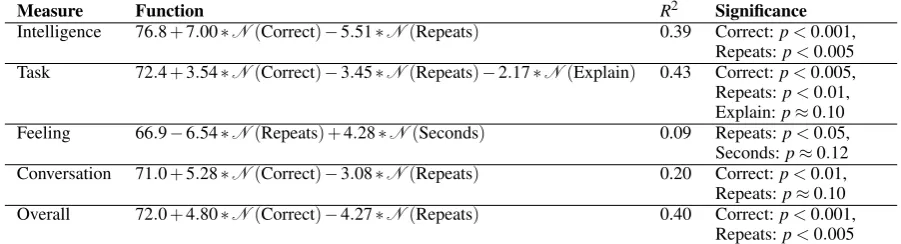
Table 3 shows the predictor functions that were derived for each of the classes of subjective
sures in this study, using all of the objective mea-sures from Table 2 as initial factors. TheR2 col-umn indicates the percentage of the variance in the target measure that is explained by the predictor function, while theSignificancecolumn gives sig-nificance values for each term in the function.
In general, the two factors with the biggest in-fluence on user satisfaction were the number of repetition requests (which had a uniformly neg-ative effect on user satisfaction), and the num-ber of target objects correctly built by the user (which generally had a positive effect). Aside from the questions on user feelings, theR2values are generally in line with those found in previous PARADISE evaluations of other dialogue systems (Walker et al., 2000; Litman and Pan, 2002), and in fact are much higher than those found in a pre-vious similar study (Foster et al., 2009b).
6 Discussion
The subjective responses on the relevant items from the usability questionnaire suggest that the subjects perceived the robot to be a bet-ter conversational partner if it used contextually varied, situationally-appropriate referring expres-sions than if it always used a baseline, constant strategy; this supports the main prediction for this study. The result also agrees with the findings of a previous study (Foster et al., 2009a)—this sys-tem did not incorporate goal inference and had a less-sophisticated reference strategy, but the main effect of changing reference strategy was also on the users’ subjective opinions of the robot’s inter-active ability. These studies together support the current effort in the natural-language generation community to devise more sophisticated reference generation algorithms.
Table 3: PARADISE predictor functions for each category on the usability questionnaire
Measure Function R2 Significance
Intelligence 76.8+7.00∗N(Correct)−5.51∗N(Repeats) 0.39 Correct:p<0.001, Repeats:p<0.005 Task 72.4+3.54∗N(Correct)−3.45∗N(Repeats)−2.17∗N(Explain) 0.43 Correct:p<0.005, Repeats:p<0.01, Explain:p≈0.10 Feeling 66.9−6.54∗N(Repeats) +4.28∗N(Seconds) 0.09 Repeats:p<0.05,
Seconds:p≈0.12 Conversation 71.0+5.28∗N(Correct)−3.08∗N(Repeats) 0.20 Correct:p<0.01, Repeats:p≈0.10 Overall 72.0+4.80∗N(Correct)−4.27∗N(Repeats) 0.40 Correct:p<0.001,
Repeats:p<0.005
all cases, though circumstances may dictate what strategies they use to do this. Combined with the subjective findings, this lack of an objective effect suggests that the references generated by the adap-tive strategy were both sufficient and more natural than those generated by the constant strategy.
The analysis of the relationship between the subjective and objective measures analysis has also confirmed and extended the findings from a similar analysis (Foster et al., 2009b). In that study, the main contributors to user satisfaction were user repetition requests (negative), task suc-cess, and dialogue length (both positive). In the current study, the primary factors were similar, although dialogue length was less prominent as a factor and task success was more prominent. These findings are generally intuitive: subjects who are able to complete the joint construction task are clearly having more successful interac-tions than those who are not able to complete the task, while subjects who need to ask for instruc-tions to be repeated are equally clearly not hav-ing successful interactions. The findhav-ings add ev-idence that, in this sort of task-based, embodied dialogue system, users enjoy the experience more when they are able to complete the task success-fully and are able to understand the spoken contri-butions of their partner, and also suggest that de-signers should concentrate on these aspects of the interaction when designing the system.
7 Conclusions
We have presented the reference generation mod-ule of a hybrid human-robot interaction system that combines a goal-inference component based on sub-symbolic dynamic neural fields with a natural-language interface based on more tradi-tional symbolic techniques. This combination of approaches results in a system that is able to work
together with a human partner on a mutual con-struction task, interpreting its partner’s verbal and non-verbal behaviour and responding appropri-ately to unexpected actions (errors) of the partner. We have then described a user evaluation of this system, concentrating on the impact of different techniques for generating situated references in the context of the robot’s corrective feedback. The results of this study indicate that using an adaptive strategy to generate the references significantly in-creases the users’ opinion of the robot as a con-versational partner, without having any effect on any of the other measures. This result agrees with the findings of the system evaluation described in (Foster et al., 2009a), and adds evidence that so-phisticated generation techniques are able to im-prove users’ experiences with interactive systems. An analysis of the relationship between the ob-jective and subob-jective measures found that the main contributors to user satisfaction were the users’ task performance (which had a positive ef-fect on most measures of satisfaction), and the number of times the users had to ask for instruc-tions to be repeated (which had a generally neg-ative effect). Again, these results agree with the findings of a previous study (Foster et al., 2009b), and also suggest priorities for designers of this type of task-based interactive system.
Acknowledgements
This research was supported by the Euro-pean Commission through the JAST2 (IST-FP6-003747-IP) and INDIGO3(IST-FP6-045388) projects. Thanks to Pawel Dacka and Levent Kent for help in running the experiment and analysing the data.
References
E. G. Bard, R. Hill, and M. E. Foster. 2008. What tunes accessibility of referring expressions in task-related dialogue? In Proceedings of the 30th Annual Meeting of the Cognitive Science Society (CogSci 2008). Chicago.
E. G. Bard, R. L. Hill, M. E. Foster, and M. Arai. In prep. How do we tune accessibility in joint tasks: Roles and regulations.
H. Bekkering, E.R.A. de Bruijn, R.H. Cuijpers, R. Newman-Norlund, H.T. van Schie, and R. Meulenbroek. 2009. Joint action: Neurocog-nitive mechanisms supporting human interac-tion. Topics in Cognitive Science, 1(2):340– 352.
E. Bicho, L. Louro, N. Hipolito, and W. Erlhagen. 2009. A dynamic field approach to goal infer-ence and error monitoring for human-robot in-teraction. InProceedings of the Symposium on “New Frontiers in Human-Robot Interaction”, AISB 2009 Convention. Heriot-Watt University Edinburgh.
H. H. Clark. 1996. Using Language. Cambridge University Press.
R. Dale and E. Reiter. 1995. Computational inter-pretations of the Gricean maxims in the genera-tion of referring expressions.Cognitive Science, 19(2):233–263.
W. Erlhagen and E. Bicho. 2006. The dynamic neural field approach to cognitive robotics. Journal of Neural Engineering, 3(3):R36–R54.
M. E. Foster, E. G. Bard, R. L. Hill, M. Guhe, J. Oberlander, and A. Knoll. 2008a. The roles of haptic-ostensive referring expressions in co-operative, task-based human-robot dialogue. In Proceedings of HRI 2008.
M. E. Foster, M. Giuliani, A. Isard, C. Matheson, J. Oberlander, and A. Knoll. 2009a. Evaluating description and reference strategies in a coop-erative human-robot dialogue system. In Pro-ceedings of IJCAI-09.
M. E. Foster, M. Giuliani, and A. Knoll. 2009b. Comparing objective and subjective measures of usability in a human-robot dialogue system. InProceedings of ACL-IJCNLP 2009.
M. E. Foster, M. Giuliani, T. M¨uller, M. Rickert, A. Knoll, W. Erlhagen, E. Bicho, N. Hip´olito, and L. Louro. 2008b. Combining goal inference
and natural-language dialogue for human-robot joint action. InProceedings of the 1st Interna-tional Workshop on Combinations of Intelligent Methods and Applications at ECAI 2008.
M. Giuliani and A. Knoll. 2008. MultiML: A general-purpose representation language for multimodal human utterances. InProceedings of ICMI 2008.
J. D. Kelleher and G.-J. M. Kruijff. 2006. Incre-mental generation of spatial referring expres-sions in situated dialog. In Proceedings of COLING-ACL 2006.
A. Kranstedt and I. Wachsmuth. 2005. Incremen-tal generation of multimodal deixis referring to objects. InProceedings of ENLG 2005.
S. Larsson and D. Traum. 2000. Information state and dialogue management in the TRINDI dia-logue move engine toolkit. Natural Language Engineering, 6(3&4):323–340.
D. J. Litman and S. Pan. 2002. Designing and evaluating an adaptive spoken dialogue system. User Modeling and User-Adapted Interaction, 12(2–3):111–137.
A. J. N. van Breemen. 2005. iCat: Experimenting with animabotics. InProceedings of AISB 2005 Creative Robotics Symposium.
I. F. van der Sluis. 2005. Multimodal Reference: Studies in Automatic Generation of Multimodal Referring Expressions. Ph.D. thesis, University of Tilburg.
M. Walker, C. Kamm, and D. Litman. 2000. To-wards developing general models of usability with PARADISE. Natural Language Engineer-ing, 6(3–4):363–377.
M. A. Walker. 2000. An application of reinforce-ment learning to dialogue strategy selection in a spoken dialogue system for email. Journal of Artificial Intelligence Research, 12:387–416.