On the Parameterized Complexity of
Linear Context-Free Rewriting Systems
Martin Berglund Ume˚a University, Sweden
Henrik Bj¨orklund Ume˚a University, Sweden
Frank Drewes Ume˚a University, Sweden
Abstract
We study the complexity of uniform mem-bership for Linear Context-Free Rewriting Systems, i.e., the problem where we are given a stringwand a grammarGand are asked whetherw ∈ L(G). In particular, we use parameterized complexity theory to investigate how the complexity depends on various parameters. While we focus primarily on rank and fan-out, derivation length is also considered.
1 Introduction
Linear Context-Free Rewriting Systems (LCFRS) were introduced by Vijay-Shanker et al. (1987) with the purpose of capturing the syntax of nat-ural language.1 It is one of several suggested ways
of capturing Joshi’s concept of mildly context-sensitive languages (Joshi, 1985). As such, it strengthens the expressive power of context-free grammars, while avoiding the full computational complexity of context-sensitive grammars.
One of the defining features of mildly context-sensitive languages is that they should be decid-able in polynomial time. This is indeed true for ev-ery language that can be generated by an LCFRS. Unlike the case for context-free grammars, how-ever, theuniversal oruniformmembership prob-lem for LCFRSs, where both the grammar and the string in question are considered as input, is known to be PSPACE-complete (Kaji et al., 1992), making a polynomial time solution very improba-ble.
The best known algorithms for the problem have a running time ofO(|G| · |w|f·(r+1)), where
Gis the grammar,wis the string,f is thefan-out andris therankof the grammar (Seki et al., 1991; Burden and Ljungl¨of, 2005; Boullier, 2004). (For
1Seki et al. (1991) independently suggested the nearly
identical Multiple Context-Free Grammars.
a definition of fan-out and rank, see Section 2.) Unlike the rank of a context-free grammar, the fan-out and rank of an LCFRS cannot in general be re-duced to some fixed constant. Increasing the fan-out always gives more generative power, as does increasing the rank while keeping the fan-out fixed (Satta, 1998). The rank can be reduced to two, but at the price of an exponential increase in the fan-out.
Research into algorithms for LCFRS parsing that are efficient enough for practical use is quite active. For example, algorithms for restricted cases are being studied, e.g., by G´omez-Rodr´ıguez et al. (2010), as well as rank reduction, primarily in special cases, where the fan-out is not affected; see, e.g., Sagot and Satta (2010).
This article is a first step towards a finer com-putational complexity analysis of the membership problem for LCFRSs. Specifically it asks the question “could there exist an algorithm for the uniform LCFRS membership problem whose run-ning time is a fixed polynomial in|w|times an ar-bitrary function inf andr?” By employing pa-rameterized complexity theory, we show that such an algorithm is very unlikely to be found. Fix-ing the rank of the grammar to one, the mem-bership problem, parameterized by the fan-out, is W[SAT]-hard. Fixing the fan-out to two and tak-ing the rank as the parameter, the problem is W[1]-hard. Finally, if the fan-out, rank,and derivation lengthare included in the parameter, the problem is W[1]-complete. These results help guide future work, suggesting other types of parameters and grammar restrictions that may yield more favor-able complexity results.
2 Preliminaries
For n ∈ N, we write[n]for{1, . . . , n}and[n]0 for{0} ∪[n]. Given an alphabet Σwe writeΣ∗
for all strings over Σ and Σ+ for all non-empty strings. The empty string is denoted byε.
2.1 Linear context-free rewriting systems
Let Σ be an alphabet, x1, . . . , xn variables, and
w1, . . . , wkstrings overΣsuch that
w1· · ·wk=α0·xπ(1)·α1· · ·xπ(n)·αn
for some permutation π and some strings
α0, . . . , αn ∈ Σ∗. Then define f as a function over tuples of strings such that
f((x1, . . .), . . . ,(. . . , xn)) = (w1, . . . , wk).
A function is linear regular if and only if it can be described in this way. For example
f((x1),(x2)) = (a, bx2x1c)is linear regular, and
f((aaa),(bc)) = (a, bbcaaac).
Definition 2.1. ALinear Context-Free Rewriting Systemis a tupleG= (N,Σ, F, R, S), whereNis an alphabet ofnonterminals, where eachA ∈ N
has an associated fan-out #(A); S ∈ N is the initial nonterminal with #(S) = 1; Σ is an al-phabet of terminals; F is a set of linear regu-lar functions; and R is a set of rules of the form
A → g(B1, . . . , Bn), whereA, B1, . . . , Bn ∈ N
andgis a function inF of type
(Σ∗)#(B1)× · · · ×(Σ∗)#(Bn)→(Σ∗)#(A).
For rules A → g(), where g has arity 0 and
g() = (α1, . . . , α#(A)), we often simply write
A→(α1, . . . , α#(A)).
The rank of a rule is the number of nontermi-nals on the right-hand side. The rank ofGis the maximal rank of any rule inR. Thefan-outofG
is the maximal fan-out of any nonterminal inN. The language generated by a nonterminalAis a set ofn-tuples, wheren= #(A).
Definition 2.2. Let G = (N,Σ, F, R, S) be a linear context-free rewriting system. Let LA⊆(Σ∗)#(A)denote the tuples that a
nontermi-nalA ∈ N can generate. This is the smallest set such that ifA → f(B1, . . . , Bn)is inRthen, for
allbi ∈ LBi wherei ∈ [n],f(b1, . . . , bn) ∈ LA.
The language ofGisL(G) =LS.
For i ∈ N, we writei-LCFRS for the class of all LCFRSs of rank at mosti and LCFRS(i) for the class of all LCFRSs of fan-out at mosti. We also writei-LCFRS(j)fori-LCFRS∩LCFRS(j).
2.2 Parameterized complexity theory
We only reproduce the most central definitions of parameterized complexity theory. For a more thor-ough treatment, we refer the reader to (Downey and Fellows, 1999; Flum and Grohe, 2006).
A parameterized problem is a language L ⊆ Σ∗ ×N, where Σis a finite alphabet. The
second component is called theparameter. An al-gorithm forLisfixed-parameter tractableif there is a computable function f and a polynomial p
such that for every(x, k)∈Σ∗×N, the algorithm decides in timef(k)·p(|x|) whether(x, k) ∈ L. The problem of deciding L is fixed-parameter tractable if there is such an algorithm. If so, L belongs to the class FPT.
A parameterized problem L ⊆ Σ∗ × N is fpt-reducible to another parameterized prob-lem K ⊆ Γ∗ × N if there is a mapping
R: Σ∗×N→Γ∗×Nsuch that
1. for all(x, k) ∈Σ∗×N, we have(x, k) ∈ L if and only ifR(x, k)∈ K,
2. there is a computable functionf and a poly-nomialpsuch thatR(x, k)can be computed in timef(k)·p(|x|), and
3. there is a computable functiongsuch that for every(x, k)∈ Σ∗ ×N, ifR(x, k) = (y, k0),
thenk0 ≤g(k).
Note that several parameters may be combined into one by taking their maximum (or sum).
The most commonly used hierarchy of parame-terized complexity classes is the following.
FPT⊆W[1]⊆W[2]⊆ · · · ⊆
⊆W[SAT]⊆W[P]⊆XP
The classes W[1],. . . ,W[P] are defined using cir-cuits or, alternatively, logic. None of the inclu-sions is known to be strict, except that FPT is a strict subclass of XP. It is widely believed, how-ever, that each of them is strict. The class XP is the class of all parameterized problems for which there is a computable functionf such that every instance(x, k)can be decided in time|x|f(k).
2.3 Problems of interest
We know from Kaji et al. (1992) that the universal membership problem for 1-LCFRSs is PSPACE-complete. Satta (1992) has further shown that LCFRS(2)-MEMBERSHIPis NP-hard.
We study the following decision problems, where the symbolPis used to indicate what the parameter is:
• P-LCFRS(j)-MEMBERSHIP, wherej ∈ N
• i-LCFRS(P)-MEMBERSHIP, where i ∈ N is the membership problem fori-LCFRS, pa-rameterized by the fan-out.
• P-LCFRS(P)-MEMBERSHIP is the mem-bership problem for LCFRS parameterized by the rank and the fan-out.
• SHORT P-LCFRS(P)-DERIVATION is the
membership problem for LCFRS parameter-ized by the rank, the fan-out, and the deriva-tion length.
Since there are algorithms that solve the member-ship problem for LCFRSs with rankr and fan-out
t and string w in time |w|(r+1)t (see, e.g., (Seki
et al., 1991; Burden and Ljungl¨of, 2005; Boul-lier, 2004)), we can immediately conclude that
P-LCFRS(P)-MEMBERSHIP, as well as every other parameterized membership problem men-tioned above, belongs to XP.
3 Fixed rank grammars
The following theorem establishes a lower bound for1-LCFRSs parameterized by the fan-out.
Theorem 3.1. 1-LCFRS(P)-MEMBERSHIP is W[SAT]-hard.
The proof of Theorem 3.1 is by reduction from WEIGHTED MONOTONE SATISFIABILITY. Be-fore we get into the actual proof, we discuss some properties of this problem.
Definition 3.1. Amonotone Boolean formulais a Boolean formula that contains only conjunctions, disjunctions, and variables. In particular, there are no negations. An instance of WEIGHTEDMONO
-TONE SATISFIABILITY is a pair(φ, k), where φ
is a monotone Boolean formula and k ∈ N. The question is whetherφhas a satisfying assignment of weight k, i.e., an assignment that sets exactly
kof the variables that occur inφto true. The pa-rameter isk. WEIGHTEDMONOTONESATISFIA
-BILITYis W[SAT]-complete (Abrahamson et al., 1993; Abrahamson et al., 1995; Downey and Fel-lows, 1999).
We can view a monotone Boolean formula φ
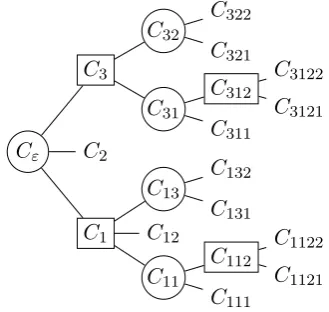
as an unranked tree, where the root node sponds to the top level clause and the leaves corre-spond to bottom level clauses, i.e., variable occur-rences. The setpos(φ)ofpositionsofφis defined as usual, consisting of strings of natural numbers that indicate how to navigate to the clauses in a tree representation ofφ. We denote each subclause ofφbyCs, wheres∈pos(φ)is its position. Thus
φ= (((x1∧(x2∨x3))∨x3∨(x3∧x4))∧ ∧x2∧((x1∧(x2∨x4))∨(x1∧x3)))
Cε
C1
C11
C111
C112
C1121
C1122
C12
C13
C131
C132
C2
C3
C31
C311
C312
C3121
C3122
C32
C321
[image:3.595.331.496.110.266.2]C322
Figure 1: A formula φ and its tree representa-tion. Conjunctive clauses are round and disjunc-tive rectangular. For example,C111is the leftmost occurrence ofx1andC13the clause(x3∧x4).
Cεdenotes the whole ofφ, while, e.g.,Cijl is the
lth clause of thejth clause of theith clause ofφ. See Figure 1 for an example. We useCfor the set of all clauses of φand C∧,C∨, and CVar for the
sets of conjunctive, disjunctive, and bottom level clauses, respectively. For allc ∈ CVar let Var(c)
denote the variable inc, and letVar(φ)denote the set of all variables inφ.
Given a monotone Boolean formula φ and a variable assignment ρ: Var(φ) → B, we de-fine averification tour for φand ρ. Such a tour moves through the tree representation ofφ, start-ing at the root node, and verifies that ρ satis-fies φ. To this end, we first define the function
Next : pos(φ) → pos(φ) ∪ {True} as follows. For the root clause letNext(ε) = True. For all
si∈pos(φ), wheres∈N∗andi∈
N, ifCs∈ C∧
ands(i+ 1) ∈ pos(φ) letNext(si) = s(i+ 1), otherwise letNext(si) =Next(s).
A verification tour overφ, given a variable as-signmentρis constructed by the following proce-dure. Set the initial positionp=ε, then
• IfCp ∈ C∧ set p ← p1 (i.e., go to the first
subclause).
• IfCp ∈ C∨ set p ← pifor any i(i.e.
non-deterministically pick a subclause).
• IfCp∈ CVar verify thatρ(Var(Cp)) =true.
If so, set p ← Next(p) and repeat. Other-wise, the verification tour fails.
The following lemma can be proved by straight-forward induction on the structure ofφ.
Lemma 3.2. If a verification tour forφand vari-able assignmentρsucceeds, thenρsatisfiesφ.
We are now ready to prove Theorem 3.1.
Proof of Theorem 3.1. Let(φ, k)be an instance of WEIGHTED MONOTONE SATISFIABILITY. Let
{x1, . . . , xn}be the variables that appear inφ. In
particular, n is the number of distinct variables. Letmbe the number of bottom level clauses.
Intuitively, the LCFRS we will construct will guess a weight kvariable assignment ρ and then simulate a verification tour forφandρ.
Basically, we will use one nonterminal per clause and use the structure of the grammar to sim-ulate a verification tour. In order to verify that the necessary bottom level clauses can all be satisfied through the samektrue variables, we will use the input string to be parsed. The stringwwill con-sist of bracketed sequences ofmcopies of each of the n variables, i.e., w = [xm1 ]· · ·[xmn]. To un-derstand the construction of the grammar, please keep in mind that the only derivations that matter are those generating this particular input string.
The grammar will guess which k variables should be set to true and disregard the other vari-ables. Technically, this is done by first letting a nonterminal F generate a tuple of k + 1 strings
s0, . . . , sk such that each si consists of zero or
more of the bracketed sequences of variables to be disregarded. The rest of the grammar generates exactly k bracketed sequences that will be inter-leaved withs0, . . . , sk. During the generation of thesekbracketed sequences it is nondeterministi-cally verified that the corresponding truth assign-ment satisfiesφ.
We use the following set of nonterminals:
{S, F} ∪ {Cs|s∈pos(φ)∪ {True}}
For S, there is only one rule: S → fS(F). The
function fS places brackets around the k vari-ables that are guessed to be true, represented by the strings t1, . . . , tk, and interleaves them with
the remaining variables, represented by the strings
s0, . . . , sk:
fS(s0, . . . , sk, t1, . . . , tk) = (s0[t1]s1· · ·[tk]sk)
The nonterminalFhas rulesF →fF,i,j(F)for
alli ∈ [n]andj ∈ [k]0. These rules produce the bracketed sequences of copies of the variablesxi
to be disregarded, as can be seen from the corre-sponding function:
fF,i,j(s0, . . . , sk, t1, . . . , tk) =
(s0, . . . , sj[xmi ], . . . , sk, t1, . . . , tk)
Moreover, there is a single rule
F →fF(Cε)
with
fF(t1, . . . , tk) = (ε, . . . , ε, t1, . . . , tk)
The rules for the nonterminals that represent clauses differ according to the type of the clause, i.e., if the nonterminal represents a conjunctive clause, a disjunctive clause, or a variable. For each conjunctive clause Cs there is exactly one rule, representing a move to its first subclause. Here,
fid is the identity function.
Cs→fid(Cs1)
For every disjunctive clauseCs and everyisuch thatCsiis a subclause ofCsthere is one rule.
Cs→fid(Csi)
For every bottom level clause, i.e., Cs ∈ CVar,
everyi∈[k]and everyj∈[m]there is one rule.
Cs→fs,i,j(CNext(s))
Intuitively, such a rule corresponds to producingj
copies of the variable of clauseCsin componenti
of the tuple and moving on to the next clause that should be visited in a verification tour. This can be seen from the corresponding function.
fs,i,j(t1, . . . , tk) = (t1, . . . ,Var(Cs)jti, . . . , tk)
The reason that the function producesjcopies of the variable, rather than just one, is that it is un-known beforehand how many times a bottom level clause that represents that particular variable will be visited. Thus the number of copies to be pro-duced has to be guessed nondeterministically in order to make sure that a total ofmcopies of each variable set to true are eventually produced.
The reduction is polynomial and the fan-out of the resulting grammar is2k+ 1. Thus it is an FPT-reduction. It remains to argue that the grammar can produce w if and only if φ has a satisfying assignment of weightk.
We first note that whatever tuple is derived from
F, the first k+ 1 entries in the tuple consist of bracketed sequences of the form [xml ]. If the grammar can producew, it follows that the tuple
(t1, . . . , tk) produced from Cε must be such that eachtiequalsmcopies of the same variable name. Any successful derivation of a string by the grammar corresponds to a verification tour of φ
and the variable assignment that sets the variables that appear in(t1, . . . , tk)to true and all other
vari-ables to false. Thusφhas a satisfying assignment of weightk.
For the other direction, assume thatφhas a sat-isfying assignment of weightk. Then the grammar can guess this assignment and a corresponding successful verification tour, thus producingw.
Note that Theorem 3.1 can easily be strength-ened to grammars with a binary terminal alphabet. It is enough to represent each variable name by a bitstring of length dlog2(m)e in the above re-duction. We also note that Theorem 3.1 immedi-ately implies that P-LCFRS(P)-MEMBERSHIP
is W[SAT]-hard.
4 Fixed fan-out grammars
We next turn to the case where the fan-out is fixed to two, while the rank is treated as a parameter.
Theorem 4.1. P-LCFRS(2)-MEMBERSHIP is W[1]-hard.
Proof. We reduce fromk-CLIQUE, the problem of
deciding whether a given graph has a clique of size
k, withkas the parameter. This problem is known to be W[1]-complete (Flum and Grohe, 2006). Let
G = (V,E)be an undirected graph. We assume, without loss of generality, that V = {1, . . . , n} and that an edge connecting nodesi, j∈Vis rep-resented as the ordered pair(i, j)such thati < j, i.e., E ⊆ {(i, j) ∈ V×V | i < j}. To find out whetherGhas a clique of sizekwe construct an instance of the membership problem for LCFRSs. The input alphabet isΣ ={0,1}. Construct the input string as
w= 0n10n10n1· · ·10n
| {z }
(3k+ 2)(k−1)/2ones .
The nonterminals areN = {A, E, C, S}, withS
being the initial nonterminal. The rules are the fol-lowing.
{A→0i |i∈ {1, . . . , n}}. {E →0n−i10n−j |(i, j)∈E}. {C →(0i,0n−i10i)|i∈ {1, . . . , n}}.
Handling S is a bit more complex. Let
φ=k(k−1)/2, the number of edges in ak-clique. Then the unique rule forSis:
S →f(E, . . . , E
| {z }
φ
, C, . . . , C
| {z }
2φ
, A, . . . , A
| {z }
2k ).
Now we need to definef. Consider the following application off.
f(e1, . . . , eφ,(c1,cˆ1), . . . ,(cφ,ˆcφ),
(d1,dˆ1), . . . ,(dφ,dˆφ), a1, . . . , a2k).
The application above evaluates to the string
c1e1d11c2e2d21· · ·
· · ·1cφeφdφ1a1θ1a21a3θ2a41s1a2k−1θka2k.
The substrings θ1 through θk are left to be de-fined, and will contain all the ˆcanddˆarguments in a careful configuration derived from the struc-ture of a clique. Let(π1, π10), . . . ,(πφ, π0φ)be the
lexicographically sorted sequence of edges in a
k-clique with nodes numbered 1 throughk. For example, (π1, π10) = (1,2), (π2, π20) = (1,3),
(πk, π0k) = (2,3), and (πφ, π0φ) = (k −1, k).
Then, for each l, find the longest subsequences
i1, . . . , ip and j1, . . . , jq of 1, . . . , φ for which
πi1 =· · ·=πip =landπ
0
j1 =· · ·=πjq =l, and
letθl= ˆci1· · ·ciˆpdjˆ1· · ·djˆq.
This construction is simpler than it may at first appear. Basically, the clique is found by generat-ingk(k−1)/2copies ofE, each of which will be placed so that it has no choice but to generate an edge in ak-clique. Looking at the first part of the string, each1cleldl1must generate a string of the
form10n10n1: e
lwill generate some0n−i10n−j,
were(i, j)is an edge inG, which forcesclto
gen-erate0i anddlto generate0j. The trick is thatcl
anddlyield the first string in apair generated by
node (number of zeros) to generate. These are then placed in such a way that the edges picked by the instances ofE all belong to the same clique. For example, for k = 3 the result of f will be c1e1d11c2e2d21c3e3d31a1c1c2a21c3d11d2d3, where the latter part ensures that c1 andc2 have to pick the same node (lowest-numbered node in the clique), as doc3andd1, andd2andd3.
5 Short derivations
In this section, we consider the length of deriva-tions as an additional parameter. As usual, the length of a derivation is the number of derivation steps it consists of. (In a derivation of an LCFRS
(N,Σ, F, R, S), this is the same as the number of applications of functions inF.)
Let G = (N,Σ, F, R, S) be an LCFRS in the following. Consider the following problem:
Definition 5.1. An instance of the SHORT P -LCFRS(P) DERIVATION problem consists of a LCFRSG, somew ∈ Σ∗ and a constantd ∈ N. The question asked is: canwbe derived by Gin at mostdsteps? The parameter isk =d+r+f
whereris the maximum rank andfthe maximum fanout.
Lemma 5.1. SHORT P-LCFRS(P) DERIVA
-TIONisW[1]-hard.
Proof. The W[1]-hardness of the problem follows immediately from the reduction in the proof of Theorem 4.1, since k-Clique is reduced to an in-stance of LCFRS membership withO(k2) deriva-tion steps, rankO(k2), and fixed fan-out.
We next demonstrate that SHORT P -LCFRS(P) DERIVATION is in W[1] (and is therefore W[1]-complete) by reducing to SHORT
CONTEXT-SENSITIVE DERIVATION, shown to be W[1]-complete by Downey et al. (1994). Let H = (NH,ΣH, RH, SH) be an arbitrary context-sensitive grammar in the following. A context-sensitive grammar has nonterminals, terminals and a starting nonterminal just like a LCFRS, but the rules are of the formα → β for stringsα, β ∈(ΣH ∪NH)∗ where0<|α| ≤ |β|.
A derivation starts with the string SH. A string
w ·α ·w0 can be turned into w ·β ·w0 in one derivation step if(α, β)∈RH.
Definition 5.2. An instance of the SHORT
CONTEXT-SENSITIVE DERIVATION problem consists of a context-sensitive grammar H, a
string w ∈ Σ∗H, and a constant dH ∈ N. The
question is: canwbe derived byHin at mostdH
steps? The parameter isdH.
We are now ready to prove membership in W[1] by a FPT-reduction from(G, w, d)to(H, w, dH).
Lemma 5.2. The SHORT P-LCFRS(P) DERIVATIONproblem isin W[1].
Proof. We can restrict ourselves to the case where no nonterminal appears twice in a right-hand side of any rule in G. This is because, e.g., a rule of the form A → f(B, B) can be turned into
A → f(B, B0), using a fresh copy B0 ofB that has the same rules asB(except for having the left-hand sideB0rather thanB). Note that this modifi-cation does not affect the parameter, and increases the size of the grammar only polynomially.
The complete reduction is somewhat lengthy, but the core intuition is very simple. The string is kept the same, and a context-sensitive gram-mar H is constructed such that L(H) = L(G).
H simulates Gby maintaining a string serializa-tion of the current “configuraserializa-tion” ofG, walking through the whole string rewriting the appropriate non-terminal for every rule application in G. A configuration ofGcan be viewed in this way,
aa•b• • •b•ba
A B A
where the derivation has, so far, generated some terminal symbols (the lower-case letters), two in-stances of the non-terminalAand one instance of
B. The configuration keeps track of where the symbols generated by the non-terminals should go in the string, so #(A) = 2, #(B) = 1, and if (c, d) ∈ LA and e ∈ LB this derivation can generate the final stringaacbeddbcba. These intermediary configurations are in H serialized into strings of nonterminals, with a “nonterminal marker” symbol in each position where a non-terminal is referred to (i.e.,Hgenerates a symbol stating “theith string generated by instancej of the nonterminalA goes here”). H then operates like a Turing machine. A special nonterminal, the rewriting head, picks a rule fromGto apply, and walks through the string replacing the nonterminal markers that are affected by that rule. This proce-dure is then repeateddtimes.
Pr1,1→2XS,1,1=⇒ XA,1,2XA,2,2Pr1,1→2 =⇒ XA,1,2XA,2,2R =⇒ XA,1,2RXA,2,2 =⇒
RXA,1,2XA,2,2 =⇒ Pr2,2→3XA,1,2XA,2,2
∗
=⇒ XA,1,3XB,1,3XA,2,3B2,3R
∗ =⇒
Pr2,3→4XA,1,3XB,1,3XA,2,3XB,2,3
∗
=⇒ XA,1,4XB,1,4XB,1,3XA,2,3XB,2,4XB,2,3R
∗ =⇒
Pr6,3→1XA,1,4XB,1,4XB,1,3XA,2,3XB,2,4XB,2,3
∗
=⇒ Pr3,4→1XA,1,4XB,1,4bXA,2,3XB,2,4b
∗ =⇒
Pr5,4→1aXB,1,4baXB,2,4b
∗
=⇒aabaabR=∗⇒aabaab
Figure 2: A derivation in the context-sensitive grammar constructed to simulate an LCFRS. All steps in the application of the first rule,r1 =S →f(A), are given, the rest is abbreviated.
G= ({S, A, B},{a, b}, F, R, S)whereF is
{f(x, y) =xy, ha() = (a, a), hb() = (b, b), g((x, y),(x0, y0)) = (xx0, yy0)},
andRcontains the following
r1 =S→f(A) r2 =A→g(A, B)
r3 =A→ha() r4 =A→hb()
r5 =B →ha() r6=B →hb()
Notice that L(G) = {ww | w ∈ {a, b}+}. We now describe howH is constructed by the reduc-tion, after which the more general description fol-lows. A derivation inGstarts with the nontermi-nal S and must then apply r1. H is constructed to start with the stringPr1,1→2XS,1,1(all these symbols are nonterminals,H has the same termi-nal alphabet as G). The symbols and mark the beginning and end of the string. The nonter-minal XS,1,1 is a “nonterminal marker” and de-notes the location where thefirst string generated by instance 1 of the nonterminalSis to be placed. Since#(S) = 1the first string is the only string generated fromS. The last subscript, the instance number, is there to differentiate markers belong-ing to different instances of the same nonterminal. The rewriting head non-deterministically picks an instance number for a round of rewriting (single rule application) from a pool sufficiently large to differentiate between the maximal number of non-terminals (since the rank of G is at most k, no more thank2 nonterminals can be generated ink
rule applications).Pr1,1→2is the “rewriting head”, the anchor for rule applications. The subscripts on
P determines that it will apply the ruler1, rewrit-ing nonterminal markers correspondrewrit-ing to the left hand side nonterminal of r1 which have instance number 1. Applying the rule may create new non-terminal markers, all of which get the instance number 2, also determined by the subscript.
That is, the rules for Pr1,i→j in H will be Pr1,i→jXS,1,i → XA,1,jXA,2,jPr1,i→j, for
i, j ∈ [2k2], and Pr1,i→jx → xPr1,i→j for all otherx 6= . Pr5,i→jXB,1,i → aPr5,i→j is an-other example of a rule corresponding to rule r5 ofG. When a rewriting head hitsit is replaced by a nonterminal R which reverses through the string (with rules of the form xR → Rx for all
x 6=), after which a new rewriting head is non-deterministically picked using one of the rules in {R → Pr,i→j | r ∈ R, i, j ∈ [2k2]}, after
which the string is rewritten once more. Finally, there are rules → ε, → ε andR → ε, to remove all nonterminals once rewriting has termi-nated. A derivation is demonstrated in Figure 2.
By induction on the length of derivations, one can show thatL(H) = L(G). Now we need to modify the construction slightly to ensure thatH
can simulatedsteps ofGindH steps.
Limiting steps in G. Construct a SHORT P-LCFRS(P) DERIVATION instance (G0, w, d)
from(G, w, d)whereG0is such that itcannot per-form more thandderivation steps. Let
N0={Ai |A∈N, i∈[d]},
and let
Ai →f(Bj1, Cj2, . . .)∈R
0
for all A → f(B, C, . . .) ∈ R, i ∈ [d] and
j1+j2+· · ·=i−1. ThenG0 = (N0,Σ, R0, S1). This reduction is somewhat heavy-handed, but is in FPT since it leaveskunchanged and each rule is replaced by less thankk rules (since dand the rank of the grammar are part of the parameterk).
Deferring terminals. A problem in completing the reduction from(G, w, d)to(H, w, dH)is that
easily be fixed by a polynomial-time rewriting of
H. For any rulew → w0 inH such thatw0 con-tains at least one terminal, replace every maximal substring α ∈ Σ∗ by a new nonterminal Tα, a
“terminal place-holder”.The rewriting headP and reversal nonterminal R just walk over the place-holders without changing them. Now add the rule
Tα → α for each Tα. For example, where a rewriting head inHmight have replacedXA,1,1by
abcXB,1,1baXB,2,1ccit will now instead replace it byTabcXB,1,1TbaXB,2,1Tcc, and can defer replac-ing the place-holder nonterminals until the end.
Completing the reduction. Now we are ready to put all the pieces together. Given the SHORT P-LCFRS(P) DERIVATION instance (G, w, d), apply the limiting steps reduction to construct
(G0, w, d0). Apply the rewriting construction to
Gto get the context-sensitive grammar H. Now L(H) equals the language G can generate in d
steps. Apply the deferring terminals construction to H to get H0. All that remains is to calcu-late dH, the number of steps that H0 may take. For an FPT-reduction this number may only de-pend on the parameter k of (G0, w, d0). Picking
dH =k5+103is sufficient. Each rule inG0 gener-ates less thanknonterminals (since the maximum rank is at most k), each of which will generate at mostk markers in the derivation in H0 (since the fanout is at most k). The rule may in addi-tion generate(k+ 1)kterminal place-holders (the
k2nonterminal markers and string ends separating maximal terminal substrings). Afterkrule appli-cations, without replacing terminal placeholders, the intermediary string in a derivation inHis less thank(k2+(k+1)k)+3symbols long. Simulating a rule application inH0 entails walking the string twice (forward and then reversing), andkrules are applied, giving2k(k(k2+(k+1)k)+3)steps. An-otherk(k+ 1) + 3steps at the end replace the ter-minal place-holders and remove markers and the rewriting head. Adding things up we arrive at a polynomial of degree 4 that can be rounded up to
k5+ 103.
Theorem 5.3. SHORT P-LCFRS(P) DERIVA
-TIONisW[1]-hard.
Proof. This combines Lemmas 5.1 and 5.2.
The result of Theorem 5.3 also trivially applies to another natural choice of parameters, the depth
of acyclic LCFRS, since they can naturally only take a limited number of derivation steps.
Definition 5.3. A LCFRS isacyclicof depthdifd
is the smallest integer such that there is a function
φ:N →[d]such that for allA→f(B1, . . . , Bn)
inRandi∈[n]it holds thatφ(A)< φ(Bi).
Corollary. The membership problem for acyclic LCFRS where the rank, fan-out, and depth are taken as the parameter isW[1]-complete.
6 Discussion
We have shown that the 1-LCFRS(P )-MEMBERSHIP problem is W[SAT]-hard, but we have no upper bound, except for the trivial XP membership. A conjecture of Pietrzak (2003) may help explain the difficulty of finding such an upper bound. It states that any parameterized problem that has a property that Pietrzak calls additiveis either in FPT or not in W[P]. Basically, additivity says that any number of instances, sharing a parameter value, can in polynomial time be combined into one big instance, with the same parameter. While 1-LCFRS(P)-MEMBERSHIP
is not additive, it has subproblems that are. This means that if Pietrzak’s conjecture is true (and FPT6=W[P]), then1-LCFRS(P)-MEMBERSHIP
cannot belong to W[P].
While our results are mostly intractability re-sults, we see them as a first step towards a more finely grained understanding of the complexity of LCFRS parsing. Ruling out simple parameteri-zation by fan-out or rank as a road towards effi-cient algorithms lets us focus on other possibili-ties. Many possible parameterizations remain un-explored. In particular, we conjecture that param-eterizing by string length yields FPT membership. In the search for features that can be used in algo-rithm development, it may also be useful to inves-tigate other formalisms, such as e.g., hypergraph replacement and tree-walking transducers.
Acknowledgments
We acknowledge the support of the Swedish Re-search Council grant 621-2011-6080.
References
K. A. Abrahamson, R. G. Downey, and M. R. Fellows. 1995. Fixed-parameter tractability and complete-ness IV: On completecomplete-ness for W[P] and PSPACE-analogues. Annals of Pure and Applied Logic, 73:235–276.
P. Boullier. 2004. Range concatenation grammars. InNew Developments in Parsing Technology, pages 269–289. Kluwer Academic Publishers.
H. Burden and P. Ljungl¨of. 2005. Parsing linear context-free rewriting systems. In Proceedings of 9th International Workshop on Parsing Technolo-gies.
R. G. Downey and M. R. Fellows. 1999. Parameter-ized Complexity. Springer-Verlag.
R. G. Downey, M. R. Fellows, B. M. Kapron, M. T. Hallett, and H. T. Wareham. 1994. The parameter-ized complexity of some problems in logic and lin-guistics. InLogical Foundations of Computer Sci-ence, pages 89–100. Springer.
J. Flum and M. Grohe. 2006.Parameterized Complex-ity Theory. Springer-Verlag.
C. G´omez-Rodr´ıguez, M. Kuhlmann, and G. Satta. 2010. Efficient parsing of well-nested linear context-free rewriting systems. InHuman Language Technologies: The 2010 Annual Conference of the North American Chapter of the ACL, pages 276– 284.
A. Joshi. 1985. Tree adjoining grammars: How much context-sensitivity is required to provide reasonable structural descriptions. InNatural Language Pars-ing, pages 206–250. Cambridge University Press.
Y. Kaji, R. Nakanisi, H. Seki, and T. Kasami. 1992. The universal recognition problem for multiple context-free grammars and for linear context-free rewriting systems. IEICE Transactions on Informa-tion and Systems, E75-D(1):78–88.
K. Pietrzak. 2003. A conjecture on the parameterized hierarchy. Notes on a talk given at Dagstuhl Seminar 03311. Unpublished manuscript.
B. Sagot and G. Satta. 2010. Optimal rank reduction for linear context-free rewriting systems with fan-out two. In Proceedings of the 48th Annual Meet-ing of the Association for Computational LMeet-inguistics (ACL’10), pages 525–533.
G. Satta. 1992. Recognition of linear context-free rewriting systems. In Proceedings of the 30th An-nual Meeting of the Association for Computational Linguistics (ACL’92), pages 89–95.
G. Satta. 1998. Trading independent for synchronized parallelism in finite copying parallel rewriting sys-tems. J. Computer and System Sciences, 56(1):27– 45.
H. Seki, T. Matsumura, M. Fujii, and T. Kasami. 1991. On multiple context-free grammars. Theoretical Computer Science, 88(2):191–229.