Comparative Evaluation of Argument Extraction Algorithms in Discourse
Relation Parsing
Evgeny A. Stepanov
and
Giuseppe Riccardi
Department of Information Engineering and Computer Science,
University of Trento, Trento, Italy
{
stepanov,riccardi
}
@disi.unitn.it
Abstract
Discourse relation parsing is an important task with the goal of understanding text beyond the sentence boundaries. One of the subtasks of discourse parsing is the extraction of argument spans of discourse relations. A relation can be either intra-sentential – to have both arguments in the same sentence – or inter-sentential – to have arguments span over different sentences. There are two approaches to the task. In the first approach the parser decision is not condi-tioned on whether the relation is intra- or inter-sentential. In the second approach relations are parsed separately for each class. The paper eval-uates the two approaches to argument span ex-traction on Penn Discourse Treebank explicit re-lations; and the problem is cast as token-level sequence labeling. We show that processing intra- and inter-sentential relations separately, reduces the task complexity and significantly outperforms the single model approach.
1 Introduction
Discourse analysis is one of the most challenging tasks in Natural Language Processing, that has appli-cations in many language technology areas such as opinion mining, summarization, information extrac-tion, etc. (see (Webber et al., 2011) and (Taboada and Mann, 2006) for detailed review). With the avail-ability of annotated corpora, such as Penn Discourse Treebank (PDTB) (Prasad et al., 2008), statistical discourse parsers were developed (Lin et al., 2012;
Ghosh et al., 2011;Xu et al., 2012).
PDTB adopts non-hierarchical binary view on dis-course relations: Argument 1 (Arg1) and Argument 2 (Arg2), which is syntactically attached to a discourse
connective. Thus, PDTB-based discourse parsing can be roughly partitioned into discourse relation detec-tion, argument position classificadetec-tion, argument span extraction, and relation sense classification. For dis-course relations signaled by a connective (explicit re-lations), discourse relation detection is cast as classifi-cation of connectives as discourse and non-discourse. Argument position classification involves detection of the location ofArg1with respect toArg2: usually ei-ther the same sentence (SS) or previous ones (PS).1 Argument span extraction, on the other hand, is ex-traction (labeling) of text segments that belong to each of the arguments. Finally, relation sense classifica-tion is the annotaclassifica-tion of relaclassifica-tions with the senses from PDTB.
Since arguments of explicit discourse relations can appear in the same sentence or in different ones (i.e. relations can be intra- or inter-sentential); there are two approaches to argument span extraction. In the first approach the parser decision is not conditioned on whether the relation is intra- or inter-sentential (e.g. (Ghosh et al., 2011)). In the second approach rela-tions are parsed separately for each class (e.g. (Lin et al., 2012;Xu et al., 2012)). In the former approach ar-gument span extraction is applied right after discourse connective detection, while the latter approach also re-quires argument position classification.
The decision on argument span can be made on dif-ferent levels: from token-level to sentence-level. In (Ghosh et al., 2011) the decision is made on token-level, and the problem is cast as sequence labeling using conditional random fields (CRFs) (Lafferty et
1We use the terminter-sententialto refer to a set of relations
al., 2001). In this paper we focus on argument span extraction, and extend the token-level sequence label-ing approach of (Ghosh et al., 2011) with the separate models for arguments of intra-sentential and inter-sentential explicit discourse relations. To compare to the other approaches (i.e. (Lin et al., 2012) and (Xu et al., 2012)) we adopt the immediately previous sentence heuristic to select a candidateArg1sentence for the inter-sentential relations. Additionally to the heuristic, we train and test CRF argument span ex-traction models to extractexactargument spans.
The paper is structured as follows. In Section 2
we briefly present the corpus that was used in the ex-periments – Penn Discourse Treebank. Section3 de-scribes related works. Section4defines the problem and assesses its complexity. In Section5we describe argument span extraction cast as the token-level se-quence labeling; and in Section6we present the eval-uation of the two approaches – either single or sepa-rate processing of intra- and inter-sentential relations. Section7provides concluding remarks.
2 The Penn Discourse Treebank
The Penn Discourse Treebank (PDTB) (Prasad et al., 2008) is a corpus that contains discourse relation an-notation on top of WSJ corpus; and it is aligned with Penn Treebank (PTB) syntactic tree annotation. Dis-course relations in PDTB are binary: Arg1andArg2, whereArg2 is an argument syntactically attached to a discourse connective. With respect toArg2, Arg1 can appear in the same sentence (SS case), one of the preceding (PS case) or following (FS case) sentences. A discourse connective is a member of a well de-fined list of 100 connectives and a relation expressed via such connective is anExplicitrelation. There are other types of discourse and non-discourse relations annotated in PDTB; however, they are out of the scope of this paper. Discourse relations are annotated us-ing 3-level hierarchy of senses. The top level (level 1) senses are the most general: Comparison, Contin-gency,Expansion, andTemporal(Prasad et al., 2008).
3 Related Work
Pitler and Nenkova (2009) applied machine learn-ing methods uslearn-ing lexical and syntactic features and achieved high classification performance on discourse connective detection task (F1:94.19%, 10 fold
cross-validation on PDTB sections 02-22). Later, Lin et al. (2012) achieved an improvement with additional lexico-syntactic and path features (F1: 95.76%).
After a discourse connective is identified as such, it is classified into relation senses annotated in PDTB.
Pitler and Nenkova (2009) classify discourse connec-tives into 4 top level senses –Comparison, Contin-gency, Expansion, and Temporal – and achieve ac-curacy of94.15%, which is slightly above the inter-annotator agreement. In this paper we focus on the parsing steps after discourse connective detection; thus, we use gold reference connectives and their senses as features.
The approaches used for the argument position classification even though useful, are incomplete as they do not make decision on argument spans. ( Well-ner and Pustejovsky, 2007) and (Elwell and Baldridge, 2008), following them, used machine learning meth-ods to identify head words of the arguments of explicit relations expressed by discourse connectives. (Prasad et al., 2010), on the other hand, addressed a more dif-ficult task of identification of sentences that contain Arg1for cases when arguments are located in differ-ent sdiffer-entences.
Dinesh et al. (2005) andLin et al. (2012) approach the problem of argument span extraction on syntactic tree node-level. In the former, it is a rule based sys-tem that covers limited set of connectives; whereas in the latter it is a machine learning approach with full PDTB coverage. Both apply syntactic tree subtrac-tion to get argument spans.Xu et al. (2012) approach the problem on a constituent-level: authors first de-cide whether a constituent is a valid argument and then whether it isArg1,Arg2, or neither. Ghosh et al. (2011) (and further (Ghosh et al., 2012a;Ghosh et al., 2012b)), on the other hand, cast the problem as token-level sequence labeling. In this paper we follows the approach of (Ghosh et al., 2011).
4 Problem Definition
SingFull SingPart MultFull MultPart Total ARG1
IPS 3,192 (44.2%) 1,880 (26.0%) 370 (5.1%) 107 (1.5%) 5,549 (76.8%)
NAPS 993 (13.8%) 551 (7.6%) 71 (1.0%) 51 (0.7%) 1,666 (23.1%)
FS 2 (0.0%) 0 (0.0%) 1 (0.0%) 5 (0.0%) 8 (0.1%)
Total 4,187 (58.0%) 2,431 (33.7%) 442 (6.1%) 163 (2.3%) 7,223 (100%)
ARG2
[image:3.595.71.507.105.219.2]SS/Total 5,181 (71.7%) 1,936 (26.8%) 84 (1.2%) 22 (0.3%) 7,223 (100%)
Table 1: Distribution ofArg1with respect to the location (rows) and extent (columns) (partially copied from (Prasad et al., 2008)); and distribution ofArg2with respect to extentin inter-sentential explicit discourse relations.
SS = same sentence as the connective; IPS = immediately previous sentence; NAPS = non-adjacent previous sentence; FS = some sentence following the sentence containing the connective; SingFull = Single Full sentence; SingPart = Part of single sentence; MultFull = Multiple full sentences; MultPart = Parts of multiple sentences.
4.1 Immediately Previous Sentence Heuristic According toPrasad et al. (2008)’s analysis of explicit discourse relations annotated in PDTB, out of 18,459 relations, 11,236 (60.9%) have both of the arguments in the same sentence (SS case), 7,215 (39.1%) have Arg1 in the sentences preceding theArg2 (PS case), and only 8 instances haveArg1 in the sentences fol-lowing Arg2 (FS case). Since FS case has too few instances it is usually ignored. For the PS case, the Arg1 is located either in Immediately Previous Sen-tences (IPS: 30.1%) or in some Non-Adjacent Previ-ous Sentences (NAPS: 9.0%).
CRF-based discourse parser ofGhosh et al. (2011), which processes SS and PS cases with the same model, uses ±2 sentence window as a hypothesis space (5 sentences: 1 sentence containing the con-nective, 2 preceding and 2 following sentences). The window size is motivated by the observation that it entirely covers arguments of 94% of all explicit rela-tions. The authors also report that the performance of the parser on inter-sentential relations (i.e. mainly PS case) has F-measure of 36.0. However, since in 44.2% of inter-sentential explicit discourse relations Arg1 fully covers the sentence immediately preced-ingArg2(see Table1partially copied from (Prasad et al., 2008)), the heuristic that selects the immediately previous sentence and tags all of its tokens as Arg1 already yields F-measure of 44.2 over all PDTB (the performance on the test set may vary).
The same heuristic is mentioned in (Lin et al., 2012) and (Xu et al., 2012) as a majority classifier for the relations withArg1in previous sentences.
Compared to the ±2 window, the heuristic cov-ers Arg1 of only 88.4% explicit discourse relations (60.9% SS + 27.5% PS); since it ignores all the rela-tions withArg1in Non-Adjacent Previous Sentences (NAPS) (9.0% of all explicit relations), and does not accommodate Arg1 spanning multiple immediately preceding sentences (2.6% of all explicit relations). Nevertheless, 70.2% of all PS explicit relations have Arg1 entirely inside the immediately previous sen-tence. Thus, the integration of the heuristic is ex-pected to improve the argument span extraction per-formance for inter-sententialArg1.
In 98.5% of all PS casesArg2is within the sentence containing the connective (remaining 1.5% are multi-sentenceArg2); and in 71.7% of all PS cases it fully covers the sentence containing the discourse connec-tive (see Table1). Thus, similar heuristic forArg2is to tag all the tokens of the sentence except the connec-tive asArg2.
For the heuristics to be applicable, a discourse con-nective has to be classified as requiring itsArg1in the same sentence (SS) or the previous ones (PS), i.e. it requires argument position classification.
4.2 Argument Position Classification
po-Sentence Initial Sentence Medial
SS PS SS PS
Coordinating 10 (0.05%) 2,869 (15.54%) 3,841 (20.81%) 202 (1.09%)
Subordinating 1,402 (7.60%) 114 (0.62%) 5,465 (29.61%) 83 (0.45%)
[image:4.595.66.514.105.173.2]Discourse Adverbial 13 (0.07%) 1,632 (8.84%) 495 (2.68%) 2,325 (12.60%)
Table 2: Distribution of discourse connectives in PDTB with respect to syntactic category (rows) and position in the sentence (columns) and the location ofArg1as in the same sentence (SS) as the connective or the previous sentences (PS). The case whenArg1appears in some following sentence (FS) is ignored, since it has only 8 instances.
sition ofArg1, depending on whether the connective appears sentence-initially or sentence-medially. Here, a connective is considered sentence-initial if it appears as the first sequence of words in a sentence. Table2
presents the distribution of discourse connectives in PDTB with respect to the syntactic categories, their position in the sentence, and havingArg1in the same or previous sentences. The distribution of sentence-medial discourse adverbials, which is the most am-biguous class, between SS and PS cases is 17.5% to 82.5%; for all other classes it higher than 90% to 10%. Thus, the overall accuracy of the SS vs. PS majority classification using just syntactic category and posi-tion informaposi-tion is already 95.0%.
When analyzed on per connective basis, the obser-vation is that some connectives require Arg1 in the same or previous sentence irrespective of their po-sition in the sentence. For instance, sentence-initial subordinating conjunctionso always has its Arg1 in the previous sentence; and the parallel sentence-initial subordinating conjunction if..then in the same sen-tence. Others, such as sentence-medial adverbials howeverandmeanwhilemainly require theirArg1in the previous sentence. Even though low, there is still an ambiguity: e.g. for sentence-medial adverbials also, therefore, still, instead, in fact, etc. Arg1 ap-pears in SS and PS cases evenly. Consequently, as-signing the position of theArg1considering the dis-course connective, together with its syntactic category and its position in the sentence, for PDTB will be cor-rect in more than 95% of instances.
In the literature, the task of argument position clas-sification was addressed by several researchers (e.g. (Prasad et al., 2010), (Lin et al., 2012)). Lin et al. (2012), for instance, reportF1 of 97.94% for a clas-sifier trained on PDTB sections 02-21, and tested on section 23. The task has a very high baseline and even higher performance on supervised machine learning,
Feature ABBR Arg2 Arg1
Token TOK Y Y
POS-Tag POS
Lemma LEM Y Y
Inflection INFL Y Y
IOB-Chain IOB Y Y
Connective Sense CONN Y Y
Boolean Main Verb BMV Y
Prev. Sent. Festure PREV Y
Arg2 Label ARG2 Y
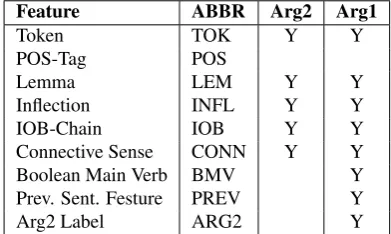
Table 3: Feature sets forArg2andArg1argument span ex-traction in (Ghosh et al., 2011)
which is an additional motivation to process intra- and inter-sentential relations separately.
5 Parsing Models
We replicate and evaluate the discourse parser of (Ghosh et al., 2011), then modify it to process intra-and inter-sentential explicit relations separately. This is achieved by integrating Argument Position Classi-fication and Immediately Previous Sentence heuristic into the parsing pipe-line.
Since the features used to train argument span ex-traction models for both approaches are the same, we first describe them in Subsection5.1. Then we pro-ceed with the description of the single model course parser (our baseline) and separate models dis-course parser, Subsections5.2and5.3, respectively.
5.1 Features
The features used to train the models for Arg1 and Arg2 are given in Table 3. Besides the token itself (TOK), the rest of the features is described below.
[image:4.595.313.509.235.352.2]features are ‘flash’ and ‘+ed’, respectively.
IOB-Chain(IOB) is the path string of the syntactic tree nodes from the root node to the token, prefixed with the information whether a token is at the begin-ning (B-) or inside (I-) the constituent. The feature is extracted using thechunklinktool (Buchholz, 2000). For example, the IOB-Chain ‘I-S/B-VP’ indicates that a token is the first word of the verb phrase (B-VP) of the main clause (I-S).
PDTB Level 1 Connective sense (CONN) is the most general sense of a connective in PDTB sense hierarchy: one ofComparison, Contingency, Expan-sion, or Temporal. For instance, a discourse connec-tivewhen might have the CONN feature ‘Temporal’ or ‘Contingency’ depending on the discourse relation it appears in, or ‘NULL’ in case of non-discourse us-age. The value of the feature is ‘NULL’ for all tokens except the discourse connective.
Boolean Main Verb(BMV) is a feature that indi-cates whether a token is a main verb of a sentence or not (Yamada and Matsumoto, 2003). For instance in the sentencePrices collapsed when the news flashed, the main verb iscollapsed; thus, its BMV feature is ‘1’, whereas for the rest of tokens it is ‘0’.
Previous Sentence Feature(PREV) signals if a sen-tence immediately precedes the sensen-tence starting with a connective, and its value is the first token of the con-nective (Ghosh et al., 2011). For instance, if some sentenceAis followed by a sentenceBstarting with discourse connectiveOn the other hand, all the tokens of the sentenceAhave thePREVfeature value ‘On’. The feature is similar to a heuristic to select the sen-tence immediately preceding a sensen-tence starting with a connective as a candidate forArg1.
Arg2 Label(ARG2) is an output of Arg2 span ex-traction model, and it is used as a feature for Arg1 span extraction. Since for sequence labeling we use IOBE (Inside, Out, Begin, End) notation, the possible values ofARG2are IOBE-tagged labels, i.e. ‘ ARG2-B’ – if a word is the first word ofArg2, ‘ARG2-I’ – if a word is inside the argument span, ‘ARG2-E’ – if a word is in the last word ofArg2, and ‘O’ otherwise.
CRF++2 – conditional random field implementa-tion we use – allows definiimplementa-tion of feature templates. Via templates these features are enriched with n-grams: tokens with 2-grams in the window of±1
to-2https://code.google.com/p/crfpp/
Discourse Connective
Detection
Candidate Window (±2sent.)
Arg2
Extraction ExtractionArg1
Figure 1: Single model discourse parser architecture of (Ghosh et al., 2011). CRF argument span extraction mod-els are in bold.
kens, and the rest of the features with 2 & 3-grams in the window of±2tokens.
For instance, labeling a token as Arg2 is an as-signment of one of the four possible labels: ARG2-B, ARG2-I, ARG2-E and O (ARG2 with IOBE nota-tion). The feature set (token, lemma, inflection, IOB-chain and connective sense (see Table3)) is expanded by CRF++ via template into 55 features (5∗5 uni-grams,2token bigrams,4∗4 bigrams and4∗3 tri-grams of other features).
5.2 Single Model Discourse Parser
The discourse parser of (Ghosh et al., 2011) is a cas-cade of CRF models to sequentially label Arg2 and Arg1 spans (since Arg2 label is a feature for Arg1 model) (see Figure1). There is no distinction between intra- and inter-sentential relations, rather the single model jointly decides on the position and the span of an argument (eitherArg1orArg2, not both together) in the window of±2sentences (the parser will be fur-ther abbreviated asW5P– Window 5 Parser).
The single model parser achieves F-measure of 81.7 forArg2and 60.3 forArg1using CONNL evaluation script. The performance is higher than (Ghosh et al., 2011) – Arg2: F1 of 79.1 and Arg1: F1 of 57.3 – due to improvements in feature and instance extrac-tion, such as the treatment of multi-word connectives. These models are the baseline for comparison with separate models architecture. However, we change the evaluation method (see Section6).
5.3 Separate Models Discourse Parser
[image:5.595.315.508.106.138.2]Discourse Connective
Detection
Argument Position
Classif.
SS Arg2
Extraction ExtractionSS Arg1
PS Arg1 Candidate
Heuristic
PS Arg2 Extraction
PS Arg1 Extraction
SS
[image:6.595.70.265.103.205.2]PS
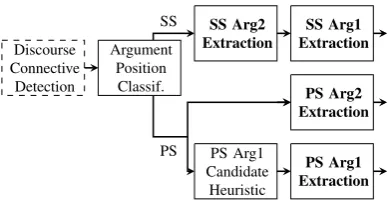
Figure 2: Separate models discourse parsing architecture. CRF argument span extraction models are in bold.
baseline single model parser, Arg2 label is a feature forArg1span extraction. These SS models are trained using exactly the same features, with the exception of PREV feature: since we consider only the sentence containing the connective, it naturally falls out.
For the PS case, we apply a heuristic to select can-didate sentences. Based on the observation that in PDTB for the PS case Arg2 span is fully located in the sentence containing the connective in 98.5% of in-stances; andArg1span is fully located in the sentence immediately preceding Arg2 in 71.7% of instances; we select sentences in these positions to train and test respective CRF models. The feature set forArg2 re-mains the same, whereas, from Arg1 feature set we removePREVandArg2label (since in PS caseArg2 is in different sentence, the feature will always have the same value of ‘O’).
ForArgument Position Classificationwe train uni-gram BoosTexter (Schapire and Singer, 2000) model with 100 iterations3on PDTB sections 02-22 and test on sections 23-24; and, similar to other researchers, achieve high results: F1 = 98.12. The features are connective surface string, POS-tags, and IOB-chains. The results obtained using automatic features (F1 = 97.87) are insignificantly lower (McNemar’s
χ2(1,1595) = 0.75, p = 0.05); thus, this step will not cause deterioration in performance with automatic features. Here we used Stanford Parser (Klein and Manning, 2003) to obtain POS-tags and automatic constituency-based parse trees.
Since both argument span extraction approaches are equally affected by the discourse connective de-tection step, we use gold reference connectives. As an alternative, discourse connectives can be detected 3The choice is based on the number of discourse connectives
defined in PDTB.
with high accuracy using addDiscourse tool (Pitler and Nenkova, 2009).
In the separate models discourse parser, the steps of the process to extract argument spans given a dis-course connective are as follows:
1. Classify connective as SS or PS; 2. If classified as SS:
(a) Use SS Arg2 CRF model to label the sen-tence tokens forArg2;
(b) Use SS Arg1 CRF model to label the sen-tence tokens forArg1usingArg2label as a feature;
3. If classified as PS
(a) Select the sentence containing the connec-tive and use PS Arg2 CRF model to label Arg2span;
(b) Select the sentence immediately preceding theArg2 sentence and use PS Arg1 CRF model to labelArg1span.
The separate model parser with CRF models will be further abbreviated asSMP; and with the heuristics for PS case ashSMP.
6 Experiments and Results
We first describe the evaluation methodology. Then present evaluation of PS case CRF models against the heuristic. In subsection6.3 we compare the perfor-mance of the single and separate model parsers on SS and PS cases of the test set separately and together. Finally, we compare the results of the separate model parser to (Lin et al., 2012) and (Xu et al., 2012).
6.1 Evaluation
in-terested in. Unless stated otherwise, all the results for Arg1are reported for automaticArg2labels as a fea-ture. Following (Ghosh et al., 2011) PDTB is split as Sections 02-22 for training, 00-01 for development, and 23-24 for testing.
6.1.1 CONLL vs. String-based Evaluation
Ghosh et al. (2011) report using CONLL-based eval-uation script. However, it is not well suited for the evaluation of argument spans because the unit of eval-uation is a chunk – a segment delimited by any out-of-chunk token or a sentence boundary. However, in PDTB arguments can (1) span over several sentences, (2) be non-contiguous in the same sentence. Thus, CONLL-based evaluation yields incorrect number of test instances: Ghosh et al. (2011) report 1,028 SS and 617 PS test instances for PDTB sections 23-24 (see caption of Table 7 in the original paper), which is 1,645 in total; whereas there is only 1,595 explicit relations in these sections.
In this paper, the evaluation is string-based; i.e. an argument span is correct, if it matches the whole ref-erence string. Following (Ghosh et al., 2011) and (Lin et al., 2012), argument initial and final punctuation marks are removed; and precision (p), recall (r) and
F1score are computed using the equations1–3.
p = Exact Match
Exact Match+No Match (1)
r = Exact Match
References in Gold (2)
F1 =
2∗p∗r
p+r (3)
In the equations,Exact Matchis the count of correctly tagged argument spans;No Matchis the count of ar-gument spans that do not match the reference string exactly (even one token difference is counted as an error); andReferences in Goldis the total number of arguments in the reference.
String-based evaluation of the single model dis-course parser with gold features reducesF1 forArg2 from 81.7 to 77.8 and forArg1from 60.33 to 55.33.
6.1.2 Error Propagation
Since the single model parser applies argument span extraction right after discourse connective detection,
Arg2 Arg1
P R F1 P R F1
[image:7.595.303.526.104.153.2]hSMP 74.19 74.19 74.19 39.19 39.19 39.19 SMP 78.61 78.23 78.42 46.81 37.90 41.89
Table 4: Argument span extraction performance of the heuristics (hSMP) and the CRF models (SMP) on inter-sentential relations (PS case). Results are reported as pre-cision (P), recall (R) and F-measure (F1)
whereas in the separate model parser there is an addi-tional step of argument position classification; for the two to be comparable an error from the argument po-sition classification is propagated. Even though, the performance of the classifier is very high (98.12%) there are still some misclassified instances. These in-stances are propagated to the counts ofExact Match andNo Matchof the argument span extraction. For example, if the argument position classifier misclassi-fied an SS connective as PS; in the SS evaluation its Arg1andArg2are considered as not recalled regard-less of argument span extractor’s decision (i.e. neither Exact MatchnorNo Match); and in the PS evaluation, they are both considered asNo Match.
The separate model discourse parser results are re-ported without error propagation for in-class compar-ison of the heuristic and CRF models, and with error propagation for cross-class comparison with the sin-gle model parser.
6.2 Heuristic vs. CRF Models
The goal of this section is to assess the benefit of train-ing CRF models for the extraction of exact argument spans of PS Arg1and Arg2 on top of the heuristics. The performance of the heuristics (immediately previ-ous sentence forArg1and the full sentence except the connective forArg2) and the CRF models is reported in Table4. CRF models perform significantly better forArg2(McNemar’sχ2(1,620) = 7.48,p = 0.05). Even though, they perform 2.7% better forArg1, the difference is insignificant (McNemar’sχ2(1,620) = 0.66,p= 0.05). For both arguments, the CRF model results are lower than expected.
6.3 Single vs. Separate Models
Arg2 Arg1
P R F1 P R F1
[image:8.595.338.486.103.166.2]W5P 87.57 84.51 86.01 71.73 62.97 67.07 SMP 90.36 87.49 88.90 70.27 66.67 68.42
Table 5: Performance of the single±2window (W5P) and separate model (SMP) parsers on argument span extraction of SS relations; reported as precision (P), recall (R) and F-measure (F1). For theSMPresults are with error propa-gation from argument position classification.
Arg2 Arg1
P R F1 P R F1
[image:8.595.57.278.103.155.2]W5P 71.12 59.19 64.61 40.06 22.74 29.01 hSMP 74.67 72.23 73.94 38.98 38.23 38.60 SMP 79.01 77.10 78.04 46.23 36.61 40.86
Table 6: Performance of the single model parser (W5P) and the separate model parser with the heuristics (hSMP) and CRF models (SMP) on argument span extraction of PS re-lations; reported as precision (P), recall (R) and F-measure (F1). For the separate model parsers, results include error propagation from argument position classification.
error from the argument position classification step. For the PS case we also report the performance of the heuristic with error propagation.
Table5reports the results for the SS case, and Ta-ble6reports the results for the PS case. In both cases the separate model parser with error propagation from argument position classification step significantly out-performs the single model parser.
The performance of the separate model parsers (re-ported in Table 7) with heuristics and CRF models on all relations (SS + PS) both are significantly bet-ter than the performance of single±2window model parser (forSMPMcNemar’sχ2(1,1595) = 17.75for Arg2andχ2(1,1595) = 19.82forArg1,p= 0.05).
Arg2 Arg1
P R F1 P R F1
W5P 81.47 74.42 77.79 61.90 46.96 53.40 hSMP 84.21 81.94 83.06 57.86 55.61 56.71 SMP 85.93 83.45 84.67 61.94 54.98 58.25
Table 7: Performance of the single model parser (W5P) and the separate model parser with the heuristics (hSMP) and CRF models (SMP) on argument span extraction of all re-lations; reported as precision (P), recall (R) and F-measure (F1). For the separate model parsers, results include error propagation from argument position classification.
Arg2 Arg1
Lin et al. (2012) 82.23 59.15 Xu et al. (2012) 81.00 60.69
hSMP 80.04 54.37
SMP 82.35 57.26
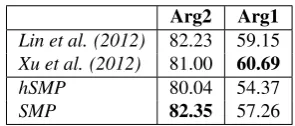
Table 8: Comparison of the separate model parsers (with heuristics (hSMP) and CRFs (SMP)) to (Lin et al., 2012) and (Xu et al., 2012) reported as F-measure (F1). Trained on PDTB sections 02-21, tested on 23.
6.4 Comparison of Separate Model Parser to (Lin et al., 2012) and (Xu et al., 2012)
The separate model parser allows to compare argu-ment span extraction cast as token-level sequence la-beling to the syntactic tree-node level classification approach of (Lin et al., 2012) and constituent-level classification approach of (Xu et al., 2012); since now the complexity and the hypothesis spaces are equal. For this purpose we train models on sections 02-21 and test on 23.
Unfortunately, the authors do not report the results on SS and PS cases separately, but only the combined results that include the heuristic. Moreover, the per-formance of the heuristic is mentioned to be 76.9% in-stead of 44.2% for the exact match (see IPS x SingFull cell in Table 1 or Table 1 in (Prasad et al., 2008)). Thus, the comparison provided here is not definite. Since all systems have different components up the pipe-line, the only possible comparison is without er-ror propagation.
From the results in Table8, we can observe that all the systems perform well onArg2. As expected, for the harder case ofArg1, performances are lower.
7 Conclusion
[image:8.595.57.278.232.294.2] [image:8.595.58.278.598.660.2]References
Sabine Buchholz. 2000. Readme for perl script chun-klink.pl.
Nikhil Dinesh, Alan Lee, Eleni Miltsakaki, Rashmi Prasad, Aravind Joshi, and Bonnie Webber. 2005. Attribution and the (non)-alignment of syntactic and discourse argu-ments of connectives. InProceedings of the ACL Work-shop on Frontiers in Corpus Annotation II: Pie in the Sky.
Robert Elwell and Jason Baldridge. 2008. Discourse con-nective argument identification with concon-nective specific rankers. InProceedings of the IEEE International Con-ference on Semantic Computing (ICSC 2008).
Sucheta Ghosh, Richard Johansson, Giuseppe Riccardi, and Sara Tonelli. 2011. Shallow discourse parsing with conditional random fields. InProceedings of the 5th In-ternational Joint Conference on Natural Language Pro-cessing (IJCNLP 2011).
Sucheta Ghosh, Richard Johansson, Giuseppe Riccardi, and Sara Tonelli. 2012a. Improving the recall of a discourse parser by constraint-based postprocessing. In Proceedings of the Eighth International Conference on Language Resources and Evaluation (LREC-2012). Sucheta Ghosh, Giuseppe Riccardi, and Richard
Johans-son. 2012b. Global features for shallow discourse pars-ing. InProceedings of the SIGDIAL 2012 Conference, The 13th Annual Meeting of the Special Interest Group on Discourse and Dialogue.
Dan Klein and Christopher D. Manning. 2003. Fast ex-act inference with a fex-actored model for natural language parsing. InAdvances in Neural Information Processing Systems 15 (NIPS 2002).
Alistair Knott. 1996.A Data-Driven Methodology for Mo-tivating a Set of Coherence Relations. Ph.D. thesis, Uni-versity of Edinburgh.
John Lafferty, Andrew McCallum, and Fernando C. N. Pereira. 2001. Conditional random fields: Probabilis-tic models for segmenting and labeling sequence data. InProceedings of 18th International Conference on Ma-chine Learning.
Ziheng Lin, Hwee Tou Ng, and Min-Yen Kan. 2012. A pdtb-styled end-to-end discourse parser. Natural Lan-guage Engineering, 1:1 – 35.
Guido Minnen, John Carroll, and Darren Pearce. 2001. Applied morphological processing of english. Natural Language Engineering.
Emily Pitler and Ani Nenkova. 2009. Using syntax to dis-ambiguate explicit discourse connectives in text. In Pro-ceedings of the ACL-IJCNLP Conference.
Rashmi Prasad, Nikhil Dinesh, Alan Lee, Eleni Miltsakaki, Livio Robaldo, Aravind Joshi, and Bonnie Webber. 2008. The penn discourse treebank 2.0. In Proceed-ings of the 6th International Conference on Language Resources and Evaluation (LREC 2008).
Rashmi Prasad, Aravind Joshi, and Bonnie Webber. 2010. Exploiting scope for shallow discourse parsing. In Pro-ceedings of the Seventh International Conference on Language Resources and Evaluation (LREC-2010). Robert E. Schapire and Yoram Singer. 2000. Boostexter:
A boosting-based system for text categorization. Ma-chine Learning, 39(2/3):135–168.
Maite Taboada and William C. Mann. 2006. Applica-tions of rhetorical structure theory. Discourse Studies, (8):567–88.
Bonnie L. Webber, Markus Egg, and Valia Kordoni. 2011. Discourse structure and language technology. Natural Language Engineering, pages 1 – 54.
Ben Wellner and James Pustejovsky. 2007. Automatically identifying the arguments of discourse connectives. In Proceedings of the 2007 Joint Conference on Empirical Methods in Natural Language Processing and Compu-tational Natural Language Learning (EMNLP-CoNLL 2007).
Fan Xu, Qiao Ming Zhu, and Guo Dong Zhou. 2012. A unified framework for discourse argument identification via shallow semantic parsing. In Proceedings of 24th International Conference on Computational Linguistics (COLING 2012): Posters.