A YEAR OF CHANGE
RTB
ANNUAL
REPORT
The Residential Tenancies Board (RTB) is a public body
established to support and develop a well-functioning
rental housing sector. In operation since 2004, the RTB is
one of the only rental housing regulators in Europe and
plays a significant role in the provision of services and
information to support those who live and work in the
sector and to the public.
The RTB provides the following services to support and develop a well-functioning
rental housing sector.
Maintaining a published register of rented tenancies. Registration of a tenancy is an essential part of tenancy management, and a key element in regulating and supporting the rental sector.
Dispute Resolution Service offers options of resolution – mediation and adjudication – to those with issues relating to a rented tenancy. The provision of
information and education on the rights and responsibilities to support those living and working in the rental sector is an important role of the RTB.
Registration compliance and
Determination Order
Enforcement to ensure compliance with legal obligations.
RESIDENTIAL TENANCIES BOARD
Chairperson and Director’s Message
2
2017 at a glance
6
01 |
Delivering our Services – Connecting with our customers
7
02 |
Policy and Legislative Change
15
03 |
A picture of the Rental Sector
21
04 |
Registration and Compliance
27
05 |
Dispute Resolution Services and Enforcement
33
06 |
Rent Tribunal
59
07 |
RTB Governance
65
08 |
Report and Financial Statements
83
CONTENTS
2017 was another year of change for the rental sector and
those living and working within it. For many, affordability
pressures will have been a significant issue as demand
for rental accommodation continued to grow, supply has
remained restricted and rents have increased.
In December 2016, with the publication of the Strategy for the Rental Sector, the regulatory
framework evolved and expanded further. One of the most significant policy and legislative changes was the introduction of Rent Pressure Zones which, by the end of 2017, covered Dublin, Cork city and 16 local electoral areas affecting 57% of tenancies and an estimated 95,000 landlords. One of the key priorities for the RTB in 2017 was on education, awareness and dispute prevention through supporting people to understand these complex changes and what is required of them.
By April 2017, Approved Housing Bodies, who came under the remit of the RTB in 2016 were required to register their tenancies. This is an important step in breaking down the traditional distinction in the rental sector between social and private rented housing. The RTB worked closely with the sector to support AHBs through the process resulting in nearly 27,000 tenancies being registered by year end.
At the end of 2017 there were approximately 340,000 tenancies registered with the RTB which encompassed over 714,000 occupants. Of these 313,000 were private tenancies with the remainder made of up tenancies managed by Approved Housing Bodies. Our data showed a slight contraction of the number of private rental tenancies from 319,000 in 2016 to 313,000 tenancies in 2017
indicating that some landlords may be leaving the market. The overall landlord profile has remained relatively stable with the majority of the 174,000 landlords (86%) owning 1-2 properties.
CHAIRPERSON AND
3
RESIDENTIAL TENANCIES BOARD These figures show that despite a small decline in the
number of private tenancies, the overall size and scale of the sector is still larger than ever before and makes up a significant component of housing tenures in Ireland. With the rate of home ownership at 67.6%, a level last seen in 1971, more than a third of the population are now renting. With the rental sector now being home to so many of the population, demand for our services has never been higher. Against this backdrop, the RTB received nearly 170,000 calls in 2017 which is an increase of 30% since 2016. The volume of queries was driven mainly by calls relating to the introduction of Rent Pressure Zones measures and other legislative change. The continued increase in queries reflects the need and appetite for information on what is a very complex regulatory framework with fast paced developments that both landlords and tenants can at times find difficult to understand and keep up with.
We are responding to this increasing demand for our services by changing the way we engage with our customers through new initiatives and technology to deliver a more flexible and responsive service. The RTB established a Communications and Research unit in 2017 under which a range of initiatives were rolled out throughout the year. An important milestone was the development of the RTB One Stop Shop which as well as a new user-friendly website, incorporated a new webchat service, extended opening hours and a new partnership with Citizens Information to host clinics for people and to train staff.
A core part of the work in 2017 was to improve how we listen, promote awareness and improve understanding of rights and responsibilities with the aim of empowering landlords and tenants with knowledge and preventing disputes.
In 2017, there were nearly 6,000 applications for our dispute resolution service, which is a 20% increase on the number of applications since 2016, and the most received since the establishment of the RTB in 2004. However, it is important to note that the majority of landlord/tenant relationships are working well, with only 1-2% of tenancies accessing our dispute resolution service.
One of
the most
significant
policy and
legislative
changes
was the
introduction of
Rent Pressure
Zones which,
by the end of
2017, affected
57% tenancies.
The RTB plays an important role in compliance, whether this is ensuring that landlords register their tenancies, or where determination orders have issued following the dispute resolution process. In 2017 we contacted 20,400 landlords who had not registered their tenancies after which the majority registered.
Enforcement was a key focus of the debate on the rental sector throughout 2017. In September 2017, the Minister for Housing announced changes to give the RTB new powers to take action directly and investigate and sanction contraventions to the law. The development of a structure and systems to implement these new changes will be a priority for the RTB throughout 2018.
A strategic priority of the RTB is to deepen our
understanding of the sector through monitoring trends and providing evidence based research. The RTB continued to develop the Quarterly Rent Index which is the most accurate and authoritative rental report in Ireland. It is based on actual rents and provides information at a Local Electoral Area level as well analysing trends by county and in our cities. The Rent Index has taken on a more critical role as it is now used by the RTB to confirm if an area qualifies as a Rent Pressure Zone.
In 2017, work began on a major digital transformation project from an infrastructure and systems perspective and is a significant investment for the RTB. These projects will fundamentally change how we work as an organisation, how we interact with our customers and how they can interact with us. These systems will be designed from a smart regulation perspective, and will concentrate on data analytics and auto-reporting as key tools in allowing for more effective and efficient regulation.
The RTB is committed to the highest standards of governance, consistent with our position as a public body and our important mandate. Efforts continued in 2017 to progress to full compliance with the 2016 Code of Practice for the Governance of State Bodies. This annual report includes our Governance Statement for 2017 and full compliance with the Code of Practice is expected in 2018.
A core part of
the work in
2017 was to
improve how we
listen, promote
awareness
and improve
understanding
of rights and
responsibilities
with the aim
of empowering
landlords and
tenants with
knowledge
We would like to acknowledge and thank landlords, tenants, their advocates and all our stakeholders for their ongoing input and engagement. We would also like to thank our Board members, committee members, staff, independent adjudicators, mediators, and tribunal members for their continued hard work and dedication in what has been another busy year.
We began 2017 with a new Strategy for the Rental Sector and significant legislative change with the introduction of Rent Pressure Zones, changes to security of tenure and other important amendments. The RTB played a significant role in the development of the Strategy and will be critical to its implementation. The pace of change is fast and we are conscious of the need to support the sector through information, education and awareness. What has not changed is our strong commitment to what we were set up to do which is to support the development of a well functioning rental sector that is fair and beneficial to all.
5
RESIDENTIAL TENANCIES BOARD
ANNUAL REPORT 2017 A YEAR OF CHANGE
Catriona Walsh
Chairperson
Rosalind Carroll
We received
5,823
applications for
dispute resolution
services
339,447
registered
tenancies with
714, 000
occupants
and
174,000
landlords
We receved
170,000
calls and
61,000
emails
13,161
webchats
an average of
1,100
per month
Extended our
opening hours from
8.30
am to
6.30
pm
20,469
notices
and enforcement
letters issued
Approx
27,000
Approved Housing
Body tenancies
registered
500,000
visits to
the RTB website
On average
646
calls a day
DELIVERING
OUR SERVICES
CONNECTING WITH
OUR CUSTOMERS
In 2017, nearly 170,000 calls were received by
our customer service centre which is an increase
of 31% since 2016.
Many of these calls in the first quarter of the year were driven by the changes in legislation commenced in late 2016 with both landlords and tenants seeking information on the new Rent Pressure Zones. In addition, Approved Housing Bodies (AHBs) which came under the remit of the RTB in April 2016, increased our customer base and further expanded the demand for our services. In 2017, as well as responding to a record number of calls, we extended our opening hours from 8.30am – 6.30pm and introduced the RTB One Stop Shop.
The rental sector is now home to so many of the population and we have a large and diverse group of landlords. A core part of our focus in 2017 was on improving how we listen to and engage with our customers and also trying to promote awareness and improve access to information on rights, obligations and our services.
Call volume
increased
from
130,000
to
170,000
Email queries
increased
from
51,777
to
61,000
9
RESIDENTIAL TENANCIES BOARD
Engaging with our customers
In 2017, we made significant changes to our services for customers to improve and expand the channels available for customers so that information is more accessible. Throughout 2017, new initiatives and technology were introduced to deliver a more flexible and responsive service to landlords, tenants, agents and the public. The development of the RTB One Stop Shop was an important milestone in improving and expanding our services for customers. This encompassed the launch of a new user-friendly website with a webchat service, and the extension of our opening hours. This is reflective of the society we live in where many people are working or want to communicate in different ways. The RTB are aware of the importance of using plain english to ensure information is clear and easy to understand. Staff were trained in the use of plain english in 2017 to improve customer communications and our resources were reviewed and improvements made. We also formed a new partnership with Citizens Information to host clinics in their offices where people can come in and discuss any queries as well as accessing information on rights and responsibilities.
Our callers and queries
Call volumes in general continue to increase year on year with a 76% increase in calls since 2013. In 2017, the average number of calls a day was 646, with an annual total of nearly 170,000. 82% of these calls were answered within 20 seconds. Email queries also increased to over 60,000, an increase of 18% from 2016. Online registration activity increased as did our engagement with the webchat service.
Of the calls made, 54% related to registration queries such as landlords registering new tenancies or updating information on existing tenancies. A further 44% related to our dispute resolution services and would include people seeking information on their rights and responsibilities, as well as queries relating to cases submitted to the RTB. Part of the strategy for dispute prevention is to ensure that those contacting the RTB at this point have all the information they need to understand their rights and responsibilities before they submit a dispute.
Calls relating to registration enforcement and determination order enforcement include queries relating to referrals for unregistered tenancies, responses to official notices and queries on court proceedings and enforcement policy. In 2017, an average of 125 calls per week were received by the Registration Enforcement section with an estimated total of 6,500 per year and the Determination Order section received 76 per week, an estimated 3,900 per year. These calls are in addition to those received by the customer service centre.
ANNUAL REPORT 2017 A YEAR OF CHANGE
On
average
646 calls
a day
82%of calls
were
answered within 20
Who called us?
In 2017, 66% of our calls were from landlords, down slightly from 67% in 2016, and 21% were from tenants which was up by 1% from 2016. The calls from agents and third parties remained consistent at 9% and 4%, respectively.
Online services
Online support for our customers is an
important element of our service to assist with tenancy registration, submissions for dispute resolution services and other general queries. The web chat facility allows customers to communicate in real time with agents who can access and assist with the online portal. Online engagement increased by 11% in 2017 with 13,161 webchats, an average of 1,097 per month. This has resulted in an increase in online registrations.
A new website
The RTB website is the primary source of up-to-date information on renting in Ireland, and in 2017 had nearly 500,000 visitors, which is up 41% from 2016. In September 2017, the RTB launched the One Stop Shop. A significant part of this was the launch of a new, easy to navigate website with all the forms, tools and templates that customers need in one place to access information on their rights and responsibilities. Since the launch of the One Stop Shop, there have been over 24,000 visitors to the website. A full transition from www.rtb.ie will conclude in 2018.
Following the launch of the new One Stop Shop website, in November an additional general webchat service was introduced for customers who have a query or are looking for information on the main website. For the six weeks until the end of 2017, over 900 webchats were initiated, averaging about 35 per day. In this period, customers were happy with the facility, which received a 75% satisfaction rating. This is a useful rating to work with and we will continue to work on improving our services. The majority of queries related to tenancy renewal or registration, with the second most frequent relating to rent reviews, notices of termination, and rights and responsibilities.
500,000
RTB website
visits in
2017
up 41%
from 2016
Caller
types
Agents
9%
Tenants
21%
3rd Parties
4%
Landlords
11
RESIDENTIAL TENANCIES BOARD
ANNUAL REPORT 2017 A YEAR OF CHANGE
Measuring customer satisfaction
Putting our customer first starts with listening to what they think about their interactions with us. The RTB has a robust quality assurance process and reporting structure to monitor and review customer engagement and ensure that the service to customers is supportive, efficient and respectful. In August 2017, the RTB introduced a new initiative to allow us to proactively engage with customers. The ‘Voice of the Customer’ is a new regular customer survey that allows customers to provide feedback to the RTB. It was introduced to encourage feedback from customers which the RTB can review and respond to with a view to improving our services.
From its introduction in August until December 2017, a total of 1,895 responses were received, a response rate of 9%, which is within industry norms. A total of 74% of customers surveyed reported that their query was resolved to their satisfaction. Through the verbatim responses, the RTB also gained useful insight into areas for improvement and requests for additional guidance and information.
Customer complaints
The RTB makes every effort to ensure that the services provided to our customers fully meets their needs and expectations and are delivered in a courteous, fair and efficient manner. However, we accept that on occasion a customer may feel dissatisfied with the level of service provision and delivery they have received. If any customer feels dissatisfied, they can complain directly to the RTB where we hope that any problems can be investigated and resolved. The Customer Charter available on the RTB website sets out how to make a complaint. In 2017, the RTB received 93 complaints.
Information, education and
awareness
An important role of the RTB is to improve access to information for landlords and tenants on their rights and responsibilities, and the services we provide. A section dedicated to communications and research was established in March 2017. Its work is underpinned by the objective of expanding provision of information to tenants, landlords, people working in
the sector and the wider public to improve understanding of the sector and create a culture of knowledge around rights and responsibilities. The RTB had a strong media presence
throughout 2017, responding to media queries as well as proactively creating opportunities to provide information to the public. The launch of the quarterly Rent Index reports, the 2016 Annual Report and guidance on substantial change were reported extensively across national and regional media.
We had
13,161
webchats
in 2017 – an
increase of 11%
A section dedicated
to Communications
and Research was
established in
Four advertising campaigns were run in 2017 across print, broadcast and social media. The aims of the campaigns were to share information on Rent Pressure Zone rent restrictions for landlords and tenants, raise awareness of the RTB and publicise the services offered. Significantly, in August 2017 following the tragic fire in Grenfell Tower in London, the RTB issued correspondence to 175,000 landlords to remind them of their responsibilities
in relation to Fire Safety and the updated Minimum Standards for Rented Accommodation. The RTB is committed to meaningful
engagement with our stakeholders to improve our understanding, gain insights through consultation and disseminate information. A programme of stakeholder events was undertaken throughout the year, which involved information sessions, presentations, contributions to conferences and the roll-out of partnership events with Citizens Information. A strategic priority for the RTB is to use data and research to promote a better understanding of the rental sector, monitor trends, assess their impact, and inform policy. Throughout 2017 work progressed on expanding and improving the RTB Rent Index and developing a programme for research. One of the central pillars of this will be the introduction of annual surveys of landlords and tenants which was set out in ‘Rebuilding Ireland’. This will be significant in creating a better understanding of the profile of the sector, changes to supply and the impact of new policy. The annual survey will be a vehicle for enhancing
the knowledge of the sector, hearing from stakeholders and understanding the changing profile of the sector. It will be a
central pillar of the research programme and a major project for the RTB from 2018.
RTB Publications
In 2017 we continued to produce information, updates and publications to assist landlords and tenants. The Good Landlord / Tenant guide is sent to all landlords and tenants when a tenancy is registered and includes important information on rights and responsibilities, as well as how to prevent disputes throughout a tenancy. This was updated in 2017.
For the first time, the RTB produced guidelines for good practice on the substantial change exemption in Rent Pressure Zone areas. The aim of this guide was to support landlords, tenants, agents and other stakeholders in understanding the requirements:
if a landlord is intending to rely on an
exemption from a Rent Pressure Zone 4% rent cap by reason of a substantial change to the nature of the rental property, or
if a landlord intends to terminate a
tenancy for the purpose of a substantial refurbishment or renovation of a rental property.
13
RESIDENTIAL TENANCIES BOARD
A Digital Transformation
In 2017, following a detailed procurement process, the RTB embarked on a significant digital transformation programme which involves the innovative use of technology to radically change the way we work and how we interact with our customers. The RTB is a relatively small organisation comparative to the population it serves with nearly 340,000 tenancies and 174,000 landlords as well as supporting those working in the sector. The size and scale of the sector has been a challenge with an ageing ICT infrastructure and a key priority for the organisation has been replacing this. The RTB undertook two major ICT procurements which will enable the delivery of new services.
The strategy behind the programme has a number of components, which include:
Moving all RTB ICT services into the Cloud. This means that the RTB applications, data, and other systems will move from ageing and ‘one size fits all’ onsite servers and computers to the Cloud where there are no such limitations and a more flexible model can be implemented. This is underpinned by new security models, systems and networks to drive and support this change. Ultimately over 80 servers are being replaced or migrated so this is a substantial and ambitious project.
The replacement of the existing Tenancy
Management System with a more customer friendly and intuitive system which will improve delivery of our services. This will be known as RTB360 and will be the core system for the organisation. It will incorporate integrated registration and case management systems with a huge emphasis being placed on the online aspects to leverage a better interaction for customers with the RTB. Key in this
implementation is the capture of accurate data to inform critical statistical reporting and ultimately national housing policy.
The new support model was implemented in Q4 2017. Phase 1 of the Cloud Project also commenced in Q4. This phase is scheduled for completion in Q3 2018. Phase 2, which is currently aspirational, will be costed and a business case made in late 2018. Phase 2 will comprise new applications that sit in the Cloud which can complement and enhance the RTB360 application.
The RTB360 application should begin development in 2018 with an implementation in Quarter 2 2019. This is a major undertaking and investment by the RTB, involving many stakeholders and cross linkages between a range of systems in other Government departments and external services. By reshaping the RTB’s approach to technology, connectivity and access to information and systems will improve across the organisation. Communication and consultation with our
Looking ahead, new digital platforms, data sources and analytics, integrated with existing systems, will reduce inefficiencies and duplication. The envisioned digital workplace and data architecture will incorporate, transform, store, archive, share and ensure the quality of internal administrative data. The new systems allow connectivity and access to information and systems, regardless of location, and create opportunities to build and strengthen our digital engagement.
Overall the RTB will be investing over €5 million over the next two years to help work better for and with our customers.
Resources and External support
The number of RTB staff has increased from 35 in 2013 to 53 in 2017. This reflects the organisational supports required to support delivery of the day-to-day services of the RTB and carry out its functions. The RTB engages external legal, ICT and customer service supports, which provide the flexibility to respond to increasing demand for services and additional expertise where required. A total of 74 independent panel members are contracted by the RTB for Dispute Resolutions Services which include mediations, adjudications and tribunals.
In 2017, the Minister for Housing announced that the RTB would move to a more proactive, regulatory role for the rental sector. This is to include investigatory and enforcement powers with a focus in the first instance on rent pressure zone rent restrictions. In order to ensure that the RTB has the appropriate staff, structures, systems and resources required, a two year change management plan is underway which will include a detailed workforce plan.
The RTB will
be
investing
over €5m
in
new systems
over the
next two
years
To help work better for and with our customers
In 2017, the
Minister for
Housing
announced
that the RTB
would move to a
more proactive,
regulatory role
for the rental
sector. This
is to include
investigatory
POLICY AND
LEGISLATIVE
CHANGE
The publication of the Strategy for the Rental
Sector in December 2016 provided the backdrop to
the work of the RTB throughout 2017. The Strategy
signalled a step change in moving to a rental sector
that is fit for purpose and attractive to both
landlords and tenants.
The Strategy is a significant milestone and sets out a road map for the long-term development of a well-functioning rental sector through the introduction of a range of short-, medium-, and long-term measures relating to supply, security, services and standards. The RTB played a critical role in the development of the Strategy and will be key in its implementation.
One of the most significant legislative changes enacted by Government on 26th December 2016 through the Planning and Development (Housing) and Residential Tenancies Act (2016) was the introduction of Rent Pressure Zones. Under this system, those areas that have experienced the most significant increases in rent can be designated as Rent Pressure Zones, the effect of which is to limit rental increases, both within existing tenancies and between tenancies, to 4% per annum for a specified period. Properties new to the rental market or those that have not been let in the previous two years and properties that have undergone a substantial change in the nature of the accommodation may be exempt from this measure.
This, combined with changes introduced in 2015, are intended to make rent more predictable and limit increases for tenants, while landlords will have a predictable return in respect of any rental property within a Rent Pressure Zone.
At the end
of 2017
57%
of tenancies
were in Rent
Pressure
Zones
The
Strategy
for the Rental
Sector
sets
out a road map
for long term
development
17
RESIDENTIAL TENANCIES BOARD With the enactment of the legislation, Dublin
and Cork City and a further 12 local electoral areas (LEAs) were designated in January, with the measure further extended to Maynooth and Cobh local LEAs in March 2017 and to Drogheda and Greystones LEAs in September 2017. The RTB, following a request from the Minister for Housing confirms to the Minister, whether an area meets the criteria to become a Rent Pressure Zone. The RTB Rent Index plays a critical role in this confirmation by verifying data for rent pressure zones.
The annual average rent for new tenancies in quarter 4 2017 had increased by 6.4%. This is down from the equivalent 2016 figure of 7.3% and the 2015 year end figure of 9.3%. Within the national numbers for 2017, the figure for Dublin was 5.3%, the lowest such figure since 2013, and outside the Greater Dublin Area (GDA) the level of annualised increase at the end of 2017 was the lowest since Q1 2016.
This could suggest that one of the major policy interventions implemented in 2017 has started to have a modifying effect on new tenancies. However, it is still too early for the policy impact to be fully assessed. It is important to note that the RPZs apply to new registrations in designated locations but not to new properties that come on the market or ones where there has been a substantial change. For 2018 the continuing impact of this, and other policy measures will be monitored closely.
The introduction of Rent Pressure Zones was a prominent feature of the discussion and debate on the sector throughout 2017 however there were several other important legislative changes and measures in the Strategy that have not had the same level of discussion. These measures included:
The Tyrellstown amendment – this changes the obligations of landlords who are selling multiple units in a development at the same time. The change means that if a landlord is selling 10 or more units in a single development within a six month period, they will be restricted to selling with tenants in situ. This enhances the security of tenure and protections in place for existing tenants.
Improved security of tenure – through the extension of the Part 4 tenancy cycle from four years to six years (with effect from 24 December 2016).
Encouraging longer-term renting by amending standards regulations to allow for unfurnished lettings – this is an important option for both landlords and tenants who sign up to long-term leases. For many tenants the accommodation they rent will be their long term home and this measure allows them more flexibility in their rented home; on the other hand, providing unfurnished accommodation reduces the costs for landlords.
ANNUAL REPORT 2017 A YEAR OF CHANGE
The RTB Rent
Index plays
a critical
role in this
confirmation
by verifying
data for Rent
Pressure
Structural changes aimed at streamlining dispute resolution for landlords, tenants and third parties – reducing the appeal period on an Adjudication report from 21 days to 10 days, introducing One Person Tribunals and moving the issuing of Determination Orders to the Director of the RTB rather than the Board.
Guidance on ‘Substantial Refurbishment’ and ‘Substantial Change’ – the RTB published a comprehensive set of guidelines during the year for landlords and tenants as to what constitutes substantial change and substantial refurbishment. The rationale for this was an increase in disputes relating to landlords increasing the rent on a property above the 4% threshold that applies to the Rent Pressure Zones.
New Minimum Standards for Rented
Accommodation – there was increased focus on the minimum standards required in rental properties following on from several high profile articles and TV news reports on the rental market. The reports highlighted the different roles of the local authorities and the RTB - with inspections of minimum standards in rental accommodation the responsibility of the local authority. The RTB undertook a comprehensive communications campaign in August 2017 by writing to 175,000 landlords to remind them of their responsibilities in relation to Fire Safety and Minimum Standards.
By the end of 2017, the RTB had implemented and started work on a wide range of measures from the Strategy. Along with the smooth roll out of the legislative measures, a central focus was on supporting both landlords, tenants, agents and the public in understanding the complex regulatory framework, the range of changes and how this affects them.
Throughout 2017 the RTB focussed on improving access to information for landlords, tenants and other interested parties through education and awareness campaigns, stakeholder
engagement and the development of the online solutions to help make it easier to comply with responsibilities.
Progress was also made on the development of the Voluntary Landlord Accreditation Scheme. As the rental sector continues to change and develop, the RTB recognises the important role landlords have in providing homes to tenants. In order to best support landlords the RTB will offer a mechanism through an accreditation scheme which will be rolled out in 2018.
Guidelines for good practice on:
The Substantial Chang
e
Exemption in R
Research
A strategic priority for the RTB is to use data and research to promote a better understanding of the rental sector, monitor trends, assess their impact, and influence policy and outcomes. In 2017, the RTB established a communications and research team, which will focus on delivery of a comprehensive research programme. To support this, a decision was taken to establish a Research Committee to provide strategic direction and oversight of the research programme.
One of the key roles that the RTB plays in housing policy in Ireland is providing an ‘understanding of the rental market’. On foot of this there is a commitment in ‘Rebuilding Ireland’ that the RTB will introduce annual surveys of tenants and landlords to understand better the profile of the sector, changes to supply and the impact of new policy.
The annual survey will be a vehicle for
enhancing the knowledge of the sector, hearing from stakeholders and understanding the changing profile of the sector. It will be a cornerstone of the research programme and a major project for the RTB.
The RTB Quarterly Rent Index was expanded and improved in 2017, with new geographical divisions including counties and cities, making the data more accessible to readers. To further enhance the geographic presentation of rental data for Ireland, this report provides a further breakdown of standardised average rents by county as well as presenting a number of higher level aggregation indices which present rents for major cities (see Chapter 4 for more detail).
19
RESIDENTIAL TENANCIES BOARD
ANNUAL REPORT 2017 A YEAR OF CHANGE
The RTB Rent Index
Quarter 4
2017
The RTB Rent Index2018 and beyond
In September 2017, the Minister for Housing, Eoghan Murphy TD, announced a two-year change management plan that would see the RTB move to become a proactive rental sector regulator with new powers and resources to take on this new regulatory responsibility. The RTB continues to work closely with the Department of Housing to plan the roll-out and effective implementation of new measures with appropriate resources and systems to support the new functions. Some of the measures announced include:
proactive investigation and enforcement of
Rent Pressure Zone rent restrictions by the RTB.
a move towards annual registration, rather
than one-off registration when a tenancy is registered.
In 2017 the Minister for Housing
announced a two year change
21
RESIDENTIAL TENANCIES BOARD
ANNUAL REPORT 2017 A YEAR OF CHANGE
A PICTURE
OF THE RENTAL
SECTOR
Registration trends in the sector
Apart from a small decrease in 2010, the number of new tenancies and the overall number of
[image:24.595.70.559.221.393.2]tenancies has continued to grow since 2008. Although there has been more fluctuation in the number of landlords, there has nevertheless been a 75% increase in the number of landlords since 2008. Table 1: Tenancy Registration 2008-2017
Profile of the sector
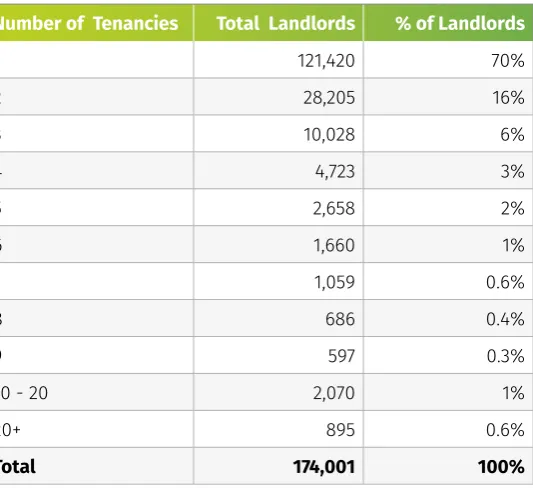
The profile of landlords has remained consistent with 2016 trends, with the majority of tenancies being managed by landlords with only one property. While landlords managing between one and five tenancies account for the vast majority, it is worth noting that, as was the case in 2016, the data shows a small spike in landlords managing between 10 and 20 properties, which could indicate that more large-scale, professional landlords are entering the sector.
Table 2: Landlords and Tenancies (2017)
Year 2008 2009 2010 2011 2012 2013 2014 2015 2016 2017
New
Tenancies 85,904 95,969 101,888 99,914 97,181 111,778 109,162 105,566 106,075 124,732 Total
Registered 206,054 234,582 231,818 260,144 264,434 282,918 303,574 319,609 325,372 339,447 % Change 2% 13.8% -1.2% 12.2% 1.6% 7% 7.3% 5.3% 1.8% 4.3% Number of
landlords registered
100,819 116,577 145,021 182,800 212,306 179,026 160,160 170,282 175,250 174,001
% Change 9.2% 15.6% 24.4% 26.1% 16.1% -15.7% -10.5% 6.3% 2.9% -0.7%
Number of Tenancies Total Landlords % of Landlords
1 121,420 70%
2 28,205 16%
3 10,028 6%
4 4,723 3%
5 2,658 2%
6 1,660 1%
7 1,059 0.6%
8 686 0.4%
9 597 0.3%
10 - 20 2,070 1%
20+ 895 0.6%
Total 174,001 100%
[image:24.595.79.346.534.778.2]23
RESIDENTIAL TENANCIES BOARD
The year in Rents
Rents across the country, particularly in Dublin, the Greater Dublin Area (GDA), and other cities continued to increase, however the rate of increase slowed down compared to 2016. The RTB Quarterly Rent Index showed rents rising steadily in 2017, with the national
standardized average rent increasing from €988 in Q1 to €1054 in Q4.
The Rent Index report is produced in association with the Economic and Social Research Institute (ESRI) and provides rental indicators generated to track price developments in the Irish rental sector. It is the most accurate and authoritative rent report of its kind as it is based on actual rents for new tenancies in a particular quarter. The introduction of legislation to set Rent Pressure Zones and the requirement for the RTB to confirm if an area qualifies using the Rent Index figures highlights the critical role it plays. Since Q4 of 2016, the Rent Index report has grown extensively in scope and content to provide new and additional insight across areas in Ireland. A range of new geographic indicators provide standardised rents at the regional, county and local electoral area level so that
renters, landlords and other stakeholders can follow trends in local markets. New individual level data with Eircode mapping for nearly 1,000,000 registrations has increased the possible scope of analysis and guided the development of new material.
The standardised average rent for 2017 was €1025 per month; this compares to €954 in 2016. While rents remained high, growth rates have begun to moderate, with 6.4% annual growth in Q2 and Q4 2017 representing the lowest growth rate since Q4 2014.
ANNUAL REPORT 2017 A YEAR OF CHANGE
Chart 1: Tenancies and landlords
Tenancies and Landlords
Average rent
for 2017 was
€1,025
per
month
Thiscompares to €954 in 2016
140,000 120,000 100,000 80,000 60,000 40,000 20,000 0
80% 70% 60% 50% 40% 30% 20% 10% 0%
Total Landlords
1 2 3 4 5 6 7 8 9 10+ 20+
Dublin
In Dublin the standardised average monthly rent for 2017 was €1,470, compared to €1,381 in 2016, representing an increase of over 6.4%. Rents in Dublin increased from €1,416 in Q1 to €1,511 in Q4, which is over 9% above 2007 peak levels. In the period since Q4 2012 rents in Dublin increased by over 46%.
Greater Dublin Area Excluding
Dublin (GDA excl Dublin)
The standardised average monthly rent for the GDA excluding Dublin was €1,066, compared to €1,005 in 2016, which represents an increase of 6% year on year. Rents in the GDA excluding Dublin increased from €1,035 in Q1 to €1103 in Q4, which is 6% above 2007 peak levels. In the period since Q4 2012 rents have increased by over 46% in GDA excluding Dublin. This level of growth suggests that rent pressures are spilling outwards from Dublin to surrounding counties.
Ireland excluding the Greater
Dublin Area (GDA)
In the rest of the country outside the Greater Dublin Area rents have also been increasing, from a standardised average of €731 per month in 2016 to €777 per month in 2017, which represents an increase of 6%. During the year, rents increased from €744 to €793 per month between Q1 and Q4 2017. At €803 in quarter 2 2017, rents outside the GDA surpassed their previous peak of €802 in Q4 2007
Overview of growth rates
An overview of data from 2017, shows that rents in Dublin and surrounding commuter counties were among the highest relative to the national average, with Cork City and Galway City also above average. However, data from 2017 compared to 2016 shows a reversal in terms of annualised growth rates.
Growth in Dublin fell from an annualised average of 7.5% in 2016 to 6.8% in 2017, while growth in the GDA excluding Dublin fell from 9.3% in 2016 to 6.1% in 2017. Conversely, outside the GDA growth rates saw a small increase from 7.6% in 2016 to 7.7% in 2017.
Overall annual data for 2017 showed that growth in rents outside the GDA outpaced growth in the GDA as demand for rented accommodation increased in the commuter regions around other cities. However, in Q4 2017, this trend was changing with growth in the GDA excluding Dublin rents exceeding growth in rents both in Dublin and outside the GDA. The ongoing volatility in growth between regions suggests that it would be premature to identify trends. The RTB Rent Index will therefore be instrumental in monitoring whether these trends continue during 2018.
€1,022
€1,470
€1,066
€777
Standardised
25
RESIDENTIAL TENANCIES BOARD
Developing the Rent Index
The RTB, through its registration data, has unique access to the most comprehensive data set on the rental sector in Ireland. The use of this data is crucial to understanding and planning for the rental sector.
New divisions
To further enhance the geographic presentation of our rental data, as of Q3 2017 the Rent Index provides a further breakdown of standardised average rents by county as well as presenting several higher level aggregation indices showing rents for major cities (Dublin, Cork, Galway, Limerick and Waterford). These estimates further enhance the scope and accessibility of the information provided in the Rent Index. The RTB will continue to develop the Rent Index so that it gives a comprehensive overview of not just rents on a quarterly basis, but the evolving profile of the sector.
Location
Based on 2017 data, Dublin was the largest rental market accounting for around 38% of the total market. At the previous peak of the market, this number was closer to 41% of the total.
Annual Growth Rates
While standardised average rents are on an upward trend throughout the country, the annual growth rates of rents displayed considerable volatility in 2017, with many areas seeing a reduction in growth compared to 2016.
Dublin
The annualised growth rate for Dublin rents decreased from an average of 7.5% in 2016 to 6.8% in 2017.
GDA excluding Dublin
In the GDA (excluding Dublin), annualised growth rates for rents decreased from an average of 9.3% in 2016 to 6.1% in 2017.
Ireland outside the GDA
Outside the GDA, the annualised growth rate for rents saw a marginal increase from 7.6% in 2016 to 7.7% in 2017.
Cities Section
Many Irish renters live in urban centres and demand accommodation close to jobs and amenities. To provide more insight into rental developments across cities in Ireland, from Q3 2017 a new cities model was introduced which provides for standardisation of rents for each of the cities.
ANNUAL REPORT 2017 A YEAR OF CHANGE
Galway City
€1,022
Cork City
€1,075
Dublin City
€1,480
Limerick City
€844
Waterford City
€635
In Q4 2017, of all the cities presented, rents are highest in Dublin City and stood at €1,474.
Galway City standardised average rents stood
at €1,022;
Cork City rents were €1,083; Limerick City rents were €869; and
Waterford City rents were €633.
On an annualised basis from Q4 2017 rents in Dublin City grew at 5.9% year-on-year, with a similar 5.2% change for Cork City. Galway City rents were up 8.5% on an annualised basis but this area displays a high degree of seasonality which must be considered when interpreting this trend. Limerick City rents increased by 10% on an annualised basis while Waterford City rents increased by 7.4%.
Rental Developments Across
Counties
To provide a much more granular disaggregation of rental data across Ireland, from Q3 2017 we presented standardised average rents, indices and percentage changes for each county. Rents are highest in Dublin, the surrounding counties and larger urban counties such as Cork, Galway and Limerick. As of Q4 2017, there were four counties where the average rent exceeds €1,000 per month (Dublin, Kildare, Meath and Wicklow). Relative to Q3 2017, Galway and Cork rents have tipped back under €1,000. However, strong seasonal factors often lead to third quarter spikes in Galway from which some pull back is to be expected. The highest standardised average rents were in Dublin at €1,511. The county with the lowest standardised average rent was Leitrim at €476 per month. The rate of rental growth on an annualised basis was fastest in Sligo at 29.1% per annum, followed by Louth and Meath at 11% and 10.6% respectively. No other counties registered double digit annual growth rates. Strong annual growth was also found in Laois, Roscommon, Wicklow, Wexford and Waterford. The slowest
growing rents were in Carlow which grew at 0.6% on an annualised basis. Rents in Monaghan also grew relatively slowly at 2.2% per annum.
Average Rent Dataset
The RTB also produces an average rent dataset which reports on the average rent in several locations around the country. Users can select up to five different property types and any quarter from the end of 2007 onwards to see the average rent for a selected location.
27
RESIDENTIAL TENANCIES BOARD
ANNUAL REPORT 2017 A YEAR OF CHANGE
27
RESIDENTIAL TENANCIES BOARD
ANNUAL REPORT 2017 A YEAR OF CHANGE
REGISTRATION
AND COMPLIANCE
The registration of tenancies enables the RTB to
collect accurate and authoritative data on the rental
sector, while registration fees fund the majority of
activities of the RTB. Ultimately, the registration
process is crucial in allowing the RTB to regulate and
support the sector and ensure that landlords and
tenants are aware of their rights and responsibilities.
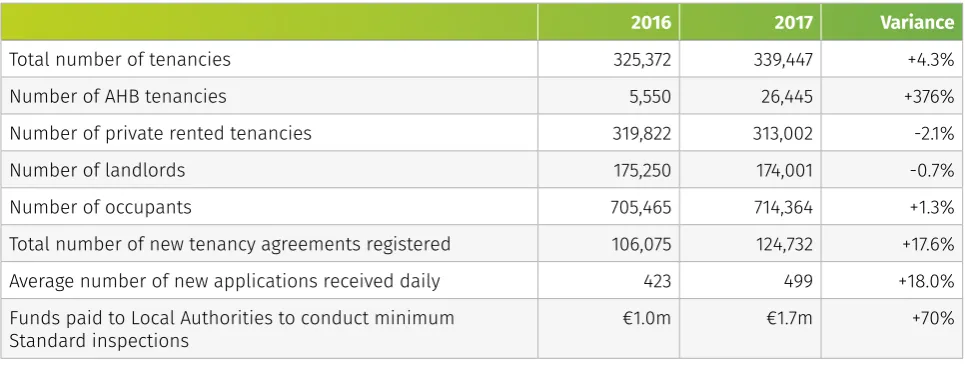
The total number of registered tenancies at the end of 2017 was 339,447. This encompassed nearly 715,000 occupants and some 174,000 landlords. This compares with 325,372 tenancies registered at the end of 2016, comprising approximately 705,000 occupants and 175,000 landlords. This represents a 4.3% increase in the total number of tenancies in the rental sector, and a 6.2% increase compared with 2015. However, it is important to note that with Approved Housing Bodies coming under the remit of the RTB, these tenancies will have accounted for all of the growth in tenancy numbers in 2017. Apart from new AHB tenancies registered for the first time, the number of private rental tenancies actually reduced slightly compared to 2016. This represents the first annual reduction in the total number of private rental tenancies registered with the RTB since 2010. It is too early to say that these figures point to an overall trend in the reduction of the number of tenancies in the private rental sector however, it would be confirmation of a discernible trend of stabilisation; representing a reversal of a trend of rapid growth in the private rental sector from the middle of the last decade.
339,447
tenancies
registered at the
end of 2017
20,409 notices
and enforcement
letters
were
issued to landlords
in 2017
124,732 new
tenancy
29
RESIDENTIAL TENANCIES BOARD
Approved housing bodies
From 7th April 2016, Approved Housing Bodies, also known as housing associations, came under the remit of the RTB. There are an estimated 32,000 homes owned and managed by Housing Associations.
AHBs had one year to register their tenancies following commencement of the legislation in April 2016 at a reduced fee of €45. Since April 2017 the standard fee for each tenancy of €90 has applied. Housing associations were required to register all their tenancies within 12 months of 7th April 2017. The RTB worked closely with representative bodies and the sector throughout year to communicate the requirements of the legislation and ensure a smooth transition for the registration of tenancies. From Q4 2016 and Q1 2017, before the April deadline, tenancy registrations increased from 902 to 17,236. Bringing housing associations under the remit of the RTB aligns the rights of Approved Housing Body tenants and tenants in the private rented sector. The move also provides housing
associations and their tenants with access to RTB’s services including independent dispute resolution services such as free mediation services. By the end of 2017, over 28,000 AHB tenancies had been registered with the RTB.
About tenancy registration
Registration lasts for the length of the tenancy but is subject to a maximum duration of six years. Registration lasts the length of the tenancy but it is subject to a maximum duration of 6 years.
The information on the RTB’s register of tenancies is used to provide aggregate data on the private rented sector, and the RTB Quarterly Rent Index is built from data on the register. The RTB also maintains a published register, which is available to view on the RTB website. The published register lists the addresses of all tenancies registered with the RTB. Personal details such as the tenant name, landlord name and rent amount are not made public.
ANNUAL REPORT 2017 A YEAR OF CHANGE
[image:31.595.42.525.497.680.2]The number of new tenancies registered with the RTB also increased in 2017. However, again this increase was a result of new AHB tenancy registrations. In fact excluding AHBs, there was a reduction in new private rental tenancies registered with the RTB. This continues the trend in reduction in new registrations since the peak number of registrations in 2013. The reduction in new tenancies registered reflects the limited supply of new properties and also indicates that tenants are staying longer in existing tenancies.
Table 3: 2017 Tenancy Registration activity
2016 2017 Variance
Total number of tenancies 325,372 339,447 +4.3% Number of AHB tenancies 5,550 26,445 +376% Number of private rented tenancies 319,822 313,002 -2.1% Number of landlords 175,250 174,001 -0.7% Number of occupants 705,465 714,364 +1.3% Total number of new tenancy agreements registered 106,075 124,732 +17.6% Average number of new applications received daily 423 499 +18.0% Funds paid to Local Authorities to conduct minimum
Improving customer experience
The marked growth of the rental sector brings challenges in terms of providing quality customer service to almost a million tenants and landlords. In order to meet this challenge the RTB embraces a variety of media to support our interaction with customers.
Improving customer interaction by enhancing our technology infrastruture has always been a key organisational goal and was prioritised in 2017. The award of a contract to our new system development partners represents significant progress in delivering a new tenancy management software system, which will allow for a more user friendly and effective service, as well as more accurate gathering of data.
Development work has already commenced on the new tenancy management system (RTB360) and over the next 12-18 months, our customers will experience much improved web enabled and user-friendly tenancy registrations and tenancy management. Significant investment will also improve the quality, reliability and validity of RTB data, and increase the reporting capabilities and capacity of the system.
The role of registration in financing
the RTB
The work of the RTB to regulate the rental sector is primarily financed through
registration fees. As seen in Table 4 the value of tenancy registrations income has been stabilising or reducing since 2013. The total value of registration applications received in 2017 amounted to just over €11.9 million, representing an increase on 2016 income of approximately €900k. However, this increase was due completely to the contribution from AHBs, without which income would have remained at a similar level to 2016.
It is expected that the underlying trend of decreasing registration income will continue as more and more tenants are staying in their properties for longer and there are fewer new registrations each year. This combined with restricted supply will result in a decrease in registration fees. As a result, RTB financing is now made up of a combination of registration feeds and funding from the Department of Housing, Planning and Local Government.
[image:32.595.322.552.308.532.2]1 | The requirement to set aside 20% of registration fees for this purpose was suspended from 1 July 2016. However, the RTB set aside funding from previous years and through this was in a position to provide just over €1.7 million in funding for the local authority inspection programme in 2017.
Table 4: Total Value of Registrations
Year Value applic.
(millions) % Change in Year
2009 8.4 6.3%
2010 8.3 -1.2%
2011 9.6 15.7%
2012 9.3 -3.1%
2013 11.8 26.9%
2014 11.8 0.0%
2015 11.2 -5.1%
2016 11.0 -1.8%
31
RESIDENTIAL TENANCIES BOARD
RTB funding of local authorities to
enforce minimum standards
The Minister for Housing, Planning and Local Government has previously directed that one- fifth of RTB registration fee income should be allocated to local authorities to enable them to meet the cost of inspections of private rented residential accommodation. However, this was suspended from 1 July 2016 in light of the RTB’s decreasing registration income.
Despite this suspension the RTB had already set aside funding from previous years in a trustee capacity for inspections, through which just over €1.7 million funding for the local authority inspection programme was provided in 2017. This brings the total distributed to local authorities by the RTB to enforce minimum standards to over €34.5 million since 2004. The RTB holds another €1.2 million available to be drawn down for this purpose in 2018 as required.
[image:33.595.292.526.383.650.2]ANNUAL REPORT 2017 A YEAR OF CHANGE
Table 4: Total Value of Registrations
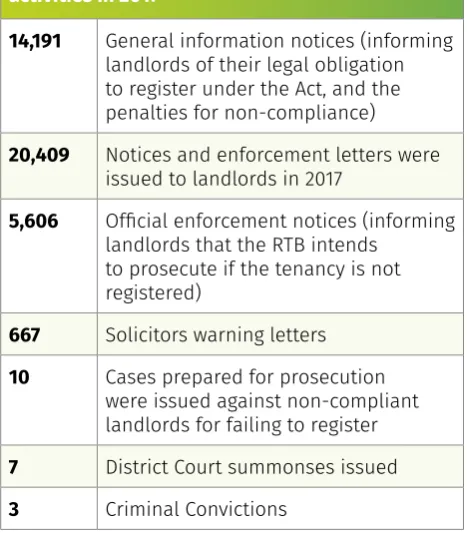
In 2017, a total of 20,409 notices and enforcement letters were issued to landlords, which is slightly higher than the 2016 figure of 20,131.
Failure to register a tenancy is a very serious matter and may result in a criminal conviction, something the RTB would like to avoid where possible. If convicted, a landlord faces a fine and/or imprisonment, along with a daily fine of €250 for a continuing offence. The current fine is up to €4,000 and/or six months imprisonment. In addition, where a tenancy is not registered, the landlord cannot avail of the dispute resolution services of the RTB should an issue arise in the tenancy.
To pursue non-compliant landlords, the RTB receives information on residential rented dwellings from several sources named below. Where noncompliance is identified, notice and warning letters are sent to the landlord. If the landlord still fails to register, enforcement action is taken through the courts.
The RTB continues to work closely with landlords to facilitate the registration of tenancies, and we have seen a decrease in prosecutions in 2017, with just three criminal convictions as opposed to 20 in 2016. This is an indication that despite sending out more first notices, landlords are engaging and complying with us at this stage.
Registration Compliance
Summary of registration enforcement activities in 2017
14,191 General information notices (informing landlords of their legal obligation to register under the Act, and the penalties for non-compliance)
20,409 Notices and enforcement letters were issued to landlords in 2017
5,606 Official enforcement notices (informing landlords that the RTB intends
to prosecute if the tenancy is not registered)
667 Solicitors warning letters
10 Cases prepared for prosecution were issued against non-compliant landlords for failing to register
7 District Court summonses issued
Sources of information
The RTB receives information on rental
properties from several sources as outlined in the chart below.
The following chart shows the breakdown of the 20,409 enforcement notices and solicitor’s letters issued to non-compliant landlords in 2017 by source of information.
The large increase in referrals from the Local Authorities and corresponding decrease in referrals from the Department of Social Protection is directly linked with the move of some tenants in receipt of Rent Supplement from the Department of Social Protection to the Housing Assistance Payment (HAP), which is administered by the Local Authorities.
Cases enforced through the courts
In 2017, 10 cases were prepared for the prosecution of landlords who had failed to register their tenancies. This resulted in seven District Court summonses being issued. In addition, 10 cases were carried forward for hearing/sentencing from 2016. Of the 17 cases for hearing/sentencing in 2017, the outcomes at year-end are as follows:
The RTB does its utmost to facilitate landlords to register their tenancies and give several warnings of the consequences of non-registration.
The RTB made 34 appearances in court in 2017 in relation to the enforcement of tenancy registrations (most cases require more than one appearance). In addition to receiving a conviction, or in some cases the Probation Act and being ordered to make a contribution to a charity, the landlords involved were also ordered to pay court fines and the legal costs of the RTB. These costs, contributions and fines came to more than €32,000, which demonstrates both the courts’ attitude to non-registration of tenancies and the very serious consequences to landlords of failing to register.
Court Action – Appeals
All convictions can be appealed in the Circuit Court. In 2017 we dealt with seven appeals, including one case that was carried forward from 2016.
Case Outcomes 2016 2017
Summons issued 14 7
Cases carried over from
previous year 5 10
Cases for hearing or sentencing
(not including appeals) 19 17
Struck out 1 9
Probation Act applied 8 2
Convictions 5 3
Awaiting hearing or sentencing
(cases to be carried forward) 5 3
Chart 4: Sources of information on rental properties
RESIDENTIAL TENANCIES BOARD
33
RESIDENTIAL TENANCIES BOARD
ANNUAL REPORT 2017 A YEAR OF CHANGE
33
RESIDENTIAL TENANCIES BOARD
ANNUAL REPORT 2017 A YEAR OF CHANGE
DISPUTE
RESOLUTION
SERVICES AND
ENFORCEMENT
With nearly 340,000 registered tenancies in Ireland,
there will be times when an issue or problem arises
within a tenancy. In the majority of cases, these issues
will be resolved by the landlord, tenants or third
parties themselves. However, in some cases, a more
formal resolution service, offered by the RTB, will
be required.
The percentage of applications received for dispute resolution has remained steady at 1-2% of the total number of registered tenancies. This shows that the majority of tenancies are working well, and that when issues arise within a tenancy, landlords, tenants and third parties are able to resolve them informally through open lines of communication.
Empowering landlords and tenants with information on their rights and responsibilities in the rental sector is also a significant contributory factor to the overall low number of applications for dispute resolution that the RTB receives. Ensuring that those living and working in the sector have access to this information is also important for them to determine if their rights in the tenancy have been breached.
In 2017,
5,823
new applications
for dispute
resolution services
were received
Only 1-2%
of registered
tenancies access
our Dispute
Resolution Service
35
RESIDENTIAL TENANCIES BOARD
Dispute Resolution Process
The dispute resolution service offers an informal method of resolving issues that have arisen within a tenancy. The dispute resolution service offers resolution via mediation or adjudication, and an appeal process by tribunal. In 2013, the RTB introduced a telephone mediation option in addition to the mediation meetings already offered, to provide a more convenient option for those using the mediation service. Mediation is a confidential, non-adversarial method of dispute resolution which aims to assist those involved in gaining a shared understanding of the issue in order to work towards reaching a mutually satisfactory outcome and agreement. Those applying for dispute resolution can choose to enter into the mediation process or request an adjudication hearing. Mediation involves parties working together to resolve an issue, whereas adjudication is a formal process where an independent decision-maker makes a determination on the issue based on the evidence presented. The outcomes of both mediation and adjudication are binding and result in a Determination Order being issued to those involved. Either side can appeal the outcome of the mediation process or the determination of an adjudicator. An appeal involves a complete re-hearing of the case by a three-person tenancy tribunal, which offers both sides the opportunity to present their case again. Tenancy tribunals are more formal than mediation or adjudication and are public hearings. The outcomes of adjudication and tribunal hearings are made public, whereas the outcomes reached in mediation are confidential between parties involved.
Telephone mediation is a free, convenient and efficient dispute resolution option offered by the RTB. An independent and trained mediator works with both parties separately to reach a mutually acceptable agreement. Most issues are resolved quickly and without hassle in the telephone mediation process.
All those who apply for dispute resolution are offered telephone mediation in the first instance. Where both parties are agreeable to telephone mediation, an appointed mediator facilitates the parties coming to an agreed resolution in a non-adversarial way. Both parties are contacted individually and are not in direct communication with each other. Mediation is completely confidential between parties.
Trends in 2017
Applications
In 2017, the RTB received 5,823 new applications for our dispute resolution services. This is a 20% (986) increase on the number of applications received in 2016, which is the highest amount of applications the RTB has received in a given year since it was established in 2004.
In 2017, 63% of cases were taken by tenants, followed by 35% by landlords. Third parties, who are generally neighbours, or persons affected by a tenancy, accounted for just 2% of all cases. ANNUAL REPORT 2017 A YEAR OF CHANGE
Landlords
35%
3rd Parties
2%
Tenants
63%
As demonstrated in Table 5, a significant number of applications are settled or withdrawn before ever reaching a hearing stage. It is often the case that through the engagement with the RTB, parties learn more about their rights and responsibilities which allows them to resolve the dispute without the formal hearing. Receiving a confirmation letter with a hearing date can also prompt parties to engage with each other and resolve the issue, resulting in the case being withdrawn.
Table 5: Breakdown of disputes 2015-2017
Figure 1: Application submitted: by region where RTB hearings are held.
2015 2016 2017
Adjudication and Mediation applications 4,023 4,837 5,823 Adjudication and Mediation hearings 2,704 3,324 4,638 Applications withdrawn or settled 1,775 2,026 2,527 Tribunal applications 575 630 627 Tribunal hearings 436 513 457
Athlone
279
5%
Wexford
363
6%
Cork
717
12%
Limerick
326
5%
Galway
287
5%
Sligo
188
3%
Dublin