Detecting Dependency Parse Errors with Minimal Resources
Markus Dickinson and Amber Smith Indiana University
Bloomington, IN USA
{md7,smithamj}@indiana.edu
Abstract
To detect errors in automatically-obtained dependency parses, we take a grammar-based approach. In particular, we develop methods that incorporaten-grams of differ-ent lengths and use information about pos-sible parse revisions. Using our methods allows annotators to focus on problematic parses, with the potential to find over half the parse errors by examining only 20% of the data, as we demonstrate. A key result is that methods using a small gold gram-mar outperform methods using much larger grammars containing noise. To perform annotation error detection on newly-parsed data, one only needs a small grammar.
1 Introduction and Motivation
There is a need for high-quality dependency an-notation for the training and evaluation of depen-dency parsers (Buchholz and Marsi, 2006), ideally large amounts of annotated data. This is a lofty goal for any language, especially languages with few, if any, annotated resources. Citing Abeill´e (2003), Hwa et al. (2005) say: “it appears that ac-quiring 20,000-40,000 sentences — including the work of building style guides, redundant manual annotation for quality checking, and so forth – can take from four to seven years.” As pointed out by Dickinson (2010), a major bottleneck in obtain-ing annotation involves the need for human correc-tion, leading to the following process: 1) automati-cally parse corpora (van Noord and Bouma, 2009), which will contain errors, and 2) identify prob-lematic parses for human post-processing. We de-velop this second step of detecting errors.
In particular, there is the problem of hav-ing little annotated data to work with, as in the cases of: lesser-resourced languages (e.g., Ambati et al., 2010; Simpson et al., 2009), new annotation schemes, and new domains with limited in-domain
annotated data (e.g., Plank and van Noord, 2010). In these situations, there is a large cost to annotate data, and parsing results are worse than in cases with more annotated training data (Nivre, 2010).
We develop error detection methods based on a coarse grammar, comparing parsed rules to rules in a grammar in order to identify anomalies, as outlined in section 2. This is akin to theoretically-driven work in treebanking, where a grammar is used to guide treebank annotation (e.g., Oepen et al., 2004; Ros´en et al., 2005; Bond et al., 2004), but it shares an insight with work incorporat-ing grammatical information to improve parsincorporat-ing, namely that even simple grammatical information can inform parse output (e.g., Plank and van No-ord, 2010; Ambati, 2010; Seeker et al., 2010).
Our methods are simple and efficient, requir-ing no additional parsrequir-ing technology. This is es-pecially beneficial for lesser-resourced languages, and, as we describe in section 3, makes the meth-ods applicable to any treebanking scenario. Also, we want to know “which linguistic constructs are hard to analyze” (Goldberg and Elhadad, 2010a). Framing parse failures in terms of grammatical anomalies makes them easily interpretable, lead-ing to quicker annotation decisions, as systematic problems can be seen at a glance (cf. Wallis, 2003; Hara et al., 2009) and perhaps also helping unearth latent theoretical decisions (cf., e.g., Leech, 2004). We improve upon previous methods in two ways, as described in section 4. First, we stream-line the different sources of information by adding the counts for all n-grams within a rule: this balances concerns over sparse data for longer n-grams with the fact that longern-grams are more informative. Secondly, taking the scores initially assigned by our methods, we compare them with scores for possible parse revisions. This checks whether the parser could have made a better deci-sion and more directly connects to parse revideci-sion work (e.g., Attardi and Ciaramita, 2007). As we
show in section 5, these methods have the potential to help annotation quality go from, e.g., 65% ac-curacy to 85% by presenting annotators with cases highly likely to be erroneous. Based on the results using a noisy grammar in section 6, we also con-clude that a small gold grammar is more effective than a large noisy one, a useful result since such resources can quickly be developed manually.
2 Error Detection
We build from methods for detecting ad hoc, or anomalous, rules in dependency parses (Dickin-son, 2010). Dependency rules represent a head with its arguments and adjuncts, and ad hoc rules are “used for specific constructions and unlikely to be used again,” indicating annotation errors and rules for ungrammaticalities (Dickinson, 2011).
To understand a dependency rule, consider fig-ure 1 from the Talbanken05 corpus (Nilsson and Hall, 2005), for the Swedish sentence in (1).1
(1) Det it
g˚ar goes
bara just
inte not
ihop together
.
‘It just doesn’t add up.’
SS MA NA PL
Det g˚ar bara inte ihop
PO VV AB AB AB
Figure 1: Dependency graph example
A grammar ruleis comprised of a dependency relation rewriting as a head with its sequence of POS-dependent pairs, as in figure 2.
1. TOP→root ROOT:VV
2. ROOT→SS:PO VV MA:AB NA:AB PL:AB
3. SS→PO 5. NA→AB
4. MA→AB 6. PL→AB
Figure 2: Rule representation for (1)
The error detection methods work by compar-ing an individual parsed rule to rules in a (traincompar-ing) grammar. Based on comparisons to similar rules, a score is assigned to each individual element of a rule, and elements with the lowest scores are
1Category definitions are in appendix A.
flagged. The intuition is that there should be reg-ularities in dependency structure; non-conformity to regularities indicates a potential problem.
Dickinson (2010) compares pairs of depen-dency relations and POS tags (instead of using only, e.g., dependencies), and we follow suit. Re-latedly, although scores can be obtained for each unit in its role as a dependent or as a head, we score elements based on how they function as de-pendents (see also section 2.1). In figure 2, for instance, the PO position is scored with respect to its role in rule #2, where it is a dependent, and not rule #3, where it is a head.
As Dickinson (2010) says, “We do not want to compare a rule to all grammar rules, only to those whichshouldhave the same valents.” For a given parse rule, we can compare it to rules with the same head or rules which have the same “mother” (left-hand side (LHS)) dependency relation. We follow Dickinson (2010) in comparing to rules ei-ther with the same LHS or with the same head, taking the greater value of scores; this gives a rule more chances to prove its validity. The formula is given in (2), whereeirefers to theithelement in a
rule (r =e1...em) and the score is based on having
the same head (h) or the same LHS (lhs).
(2) S(ei) = max{s(ei, h), s(ei, lhs)}
Most importantly, there is the method of com-parison itself. Dickinson (2010) explores the bi-gramandwhole rulemethods. To see how these work, consider the bigram method for the rule in (3), with implicit START and END tags. To score AT:AJ, the bigram method counts up how often the bigrams DT:PO AT:AJ and AT:AJ VN appear in all OO (LHS) or VN (head) rules in the gram-mar. The whole rule method works similarly, but comparing full subsequences. We develop more general methods in section 4, with the same rough idea: rules with low scores are likely errors.
(3) OO→DT:POAT:AJVN
The formula for the bigram method is given in (4), wherec= comparable item (head or LHS), and C(x, c)refers to the count ofx, cin the grammar. Which grammar we use is discussed in section 3.
(4) s(ei, c) =C(ei−1ei, c) +C(eiei+1, c)
2.1 Unary Rules
e.g., PO has no dependents. However, for the way rules are scored, we can remove these unary rules. Because unary rules only contain heads, only items which are the heads in rules are actually af-fected by such rules. For example, with SS →
PO, only PO-headed rules will be affected. But, as mentioned above, we score elements by how they functionas dependents. We can thus ignore such rules. Removing them from a grammar also gives a better indication of the size of a rule set.
3 Scenarios
As there are different scenarios for building an-notated corpora—corpora for new languages, cor-pora of a much larger nature than previously cre-ated, corpora in a new domain, etc.—the assump-tions of one’s resources can be quite different. We sketch different possibilities here.
3.1 Types of Grammars
Our methods are based on having a grammar to compare parse rules to. Automatically-parsed data can be obtained in different ways, affecting gram-mar resources. First, parsed data can be obtained from a parser trained on gold data. In this case, a
GOLD GRAMMAR can be extracted from the gold data. For error detection, we can then compare the parsed data to this fixed grammar (section 5).
One subtype of this is the situation where the gold grammar is small (SMALL GRAMMAR). To be in this situation, one could develop a small tree-bank and extract a grammar from it, or one could manually write (coarse) grammar rules. We work with corpus-extracted grammars, but one advan-tage of the type of approach we take—unlike more theoretically grammar-driven ways of treebanking (e.g., Oepen et al., 2004; Ros´en et al., 2005; Bond et al., 2004)—is that grammar-writing is simpler, using only very coarse categories.
The second type of situation (NOISY GRAM
-MAR) arises when not all the rules in the grammar
are valid, as when rules are extracted straight from automatically-parsed data. If the data has been parsed, some parser exists, but it may be the case that: a) data is exchanged, but the technology is not; or b) the data is partially hand-corrected. In either case, aNOISY GRAMMARcan be extracted from the parsed data (section 6).
This leads to the possibility of hybrid gram-mars, where some rules have been hand-checked and others have not—i.e., a concatenation of a
gold and a noisy grammar. Since gold and noisy grammars are more primary, we focus on them.
Finally, there may be a hand-crafted or spe-cialized parser, tuned to a particular annotation scheme. This can arise from continual develop-ment in a large project (e.g., the Alpino project (Plank and van Noord, 2010)) or when one uses a parser without having access to the corpus it was trained on. If the parser has an accessible gram-mar, there is a GOLD GRAMMAR; otherwise, a
NOISY GRAMMARcan be extracted.
3.2 Grammar-Based Error Detection
The reason we phrase error detection in terms of grammars is that some grammar is always avail-able, whereas we cannot always assume a mod-ifiable parser. Error detection based on coarse grammars is applicable to any of these scenar-ios, as opposed to, e.g., methods which rely on details of how a parser is likely to fail (e.g., At-tardi and Ciaramita, 2007; Goldberg and Elhadad, 2010b).2 Additionally, because we can always ob-tain a grammar from parsed data, we will have ac-cess to the frequency of occurrence of each rule.3
4 Methods of Comparison
In this section, we develop the best methods of rule comparison (section 4.1) and introduce a new, orthogonal way of flagging possible errors (sec-tion 4.2). In order to compare directly to the pre-vious work, we use the Swedish Talbanken corpus (Nilsson and Hall, 2005) with the same data split as in the CoNLL-X Shared Task (Buchholz and Marsi, 2006); in section 5 and beyond, we switch the training and testing data. In all experiments, we use gold standard POS tags.
To keep the data sets clear across different train-ing regiments, we refer to them as thelarge and
small Talbanken data sets. The large Talbanken data has 11,042 sentences, 191,467 words, 96,517 (non-unary) rule tokens and 26,292 rule types. The small data set has 389 sentences, 5,656 words, 3,107 rule tokens and 1,284 rule types. As we show in section 5, even such a small grammar can be highly effective in detecting parse errors.
2
Those methods are of course well-suited to the issue of improving parsing technology.
3
4.1 Method Improvement
As discussed in section 2, the main previous meth-ods of flagging errors look for anomalous bigrams or anomalous “whole rules.” Each method has its limitations, looking only at local context (bigram) or only at the whole context (whole rule). Yet there is a straightforward, principled way to combine the methods: add together all n-gram parts of a rule (cf. Zhao et al., 2010; Bergsma et al., 2009).
To do this, during training we break a rule down into its componentn-grams (cf. steps 1 and 2 be-low) and store the frequency of the rule for each n-gram. For rule scoring, we then:
1. Add START and END context tags to the list of elements in a rule.
2. Calculate all (contiguous) bigrams, trigrams, etc., up to the length of the whole rule.
3. Calculate the frequency of alln-grams (based on a training set) containing a given element.
This is encapsulated in the formula in (5).
(5) s(ei, c) = P
ngram:ei∈ngram∧n≥2
C(ngram, c)
For example, focusing on AT:AJ back in rule (3) with the head VN as the comparable item (c), we count up the grammar frequencies ofn-grams, as in (6). A benefit of this method is that, by using lo-cal and global contexts, equally-frequent bigrams, for example, are sorted out by whether they con-tinue to occur in longer forms.
(6) s(AT:AJ, VN) =C(DT:POAT:AJ, VN)
+C(AT:AJVN, VN)
+C(START DT:POAT:AJ, VN) +C(DT:POAT:AJVN, VN)
+C(AT:AJVN END, VN)
+C(START DT:POAT:AJVN, VN) +C(DT:POAT:AJVN END, VN)
+C(START DT:POAT:AJVN END, VN)
We refer to the new method as the all-gram
(All.) method, and results are reported in table 1 using MaltParser (Nivre et al., 2007). Our goal is to improve annotation post-editing, and so we report precision (P) and recall (R) of error detec-tion, for positions below the threshold. Either an attachment or labeling error counts as an error. Precision is thus the complement of a labeled at-tachment score (LAS); for example, by using no score, the parser has an LAS of 82.0% and error
detection precision of 18.0%. Two F-scores are provided—F1 and F0.5, which weights precision twice as much—and the best value of each is re-ported. We favor precision, so as to prevent anno-tators from sorting through false positives.
Score Thr. pos. P R F1 F0.5
None n/a 5,656 18.0% 100% 30.5% 21.5%
All. 0 56 92.9% 5.1% 9.7% 21.0%
60 479 61.8% 29.1% 39.6% 50.5%
390 1,234 42.5% 51.7% 46.7% 44.1%
Tri. 0 215 77.2% 16.3% 27.0% 44.2%
5 478 66.3% 31.2% 42.4% 54.1%
49 1,202 44.1% 52.2% 47.8% 45.5%
High. 0 215 77.2% 16.3% 27.0% 44.2%
5 424 69.6% 29.0% 41.0% 54.4%
90 1,373 42.2% 57.0% 48.5% 44.5%
Table 1: Talbanken error detection results for different scores: parser = MaltParser trained on large data; gram-mar = large gold; evaluation data = small data (pos. = positions below threshold (Thr.))
Comparing the results here on the same data in Dickinson (2010), we have a slightly higher F1 score than the previous best method (46.7% vs. 46.4% [whole rule]) and a higher F0.5than the best method (50.5% vs. 49.9% [bigram]).
4.1.1 Excluding Bigrams
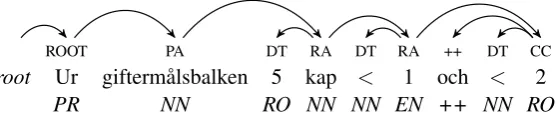
The methods are still very close, so we attempt to improve further. Consider the tree in figure 3, for the example in (7), where there is no verb, and a preposition (PR) is the sentence’s root. The re-sulting rule, which occurs 79 times in the training data, is TOP→rootROOT:PR.
(7) Ur From
gifterm˚alsbalken marriage act
5 5
kap ch.
< < 1 1
och and
< < 2 2
‘From the marriage act, ch. 5, para. (?) 1 and 2’
When bigram information is included in calcu-lating scores, bothrootROOT:PR and ROOT:PR END get counted 79 times, leading to high scores for both PRs in (8), when only the first is cor-rect. Bigrams do not distinguish the correct first PR from the incorrect second PR attachment in (8): both have 79 pieces of supporting evidence.
(8) TOP→rootROOT:PR ROOT:PR
ROOT PA DT RA DT RA ++ DT CC
root Ur gifterm˚alsbalken 5 kap < 1 och < 2
[image:5.595.161.440.69.129.2]PR NN RO NN NN EN ++ NN RO
Figure 3: Preposition-rooted sentence (from large Talbanken data set)
same as (5), but withn≥3), which we refer to as thehigh-grammethod (High.). These are included in table 1, where we can see improvements in pre-cision and recall. For example, with a threshold of 5, we find 29% of all errors by examining 424 instances (i.e., 7.5% of the parsed corpus).
Trigrams are the minimum length to obtain con-textual information on each side, and longer n-grams (for the high-gram method) give more pre-cise indication that the rule context is valid. Even though long n-grams are rare, they are useful, leading to a positive, albeit small, improvement.
4.1.2 Notes on Evaluation
The intended use of the scores is for annotators to start with the lowest-scoring positions (i.e., to-kens) and work upwards. The F-measures give some sense of this, but we need a way to evalu-ate across different corpora. To account for this, we do two things: first, we report the values for the lowest threshold, so that one can get a sense of the precision for the highest-priority cases. Sec-ondly, we use Talbanken for development, find-ing the best F0.5score and calculating the percent-age of the test corpus that the threshold identifies. In the case of evaluating on the small test corpus,
424
5,656 = 7.5%, so other experiments with a similar large/small split would be evaluated with a thresh-old identifying as close to 7.5% of the evaluation corpus as possible. We reset thresholds for ex-periments where the large corpus is the test cor-pus, as these behave differently, due to differing parser quality; in section 5.1, we will set this at 23%. The bottom two lines of table 7, for instance, present results for the lowest threhold (0) and the one which identifies as close to 23% of the tokens as possible (25). Also, as we emphasize precision, in future tables we report F0.5and ignore F1.
4.2 Revision Checking
The n-gram models discussed so far are not very sophisticated. Low scores conflate two issues: 1) the element in question is anomalous, or 2) there
was no better attachment or labeling for this ele-ment, i.e., the parser could not have made a better decision. Identifying the latter cases could reduce false positives, i.e., correct low-scoring positions.
For example, for (9), the parser correctly at-taches h˚allas (‘hold’) tom˚aste (‘must’) in a VG relation, as in figure 4. The high-gram scoring method assigns a score of 0, because UK:UK MV VG:VV and MV VG:VV END were never ob-served in the grammar, but there is no better tachment in this instance. By determining that at-taching tosomorhemligtis no better, we can over-come some limitations of the original scoring. We refer to the process of checking for a better-scoring attachment or labeling as arevision check.
(9) Du You
kommer come
under under
din your
utbildning education
att to
f˚a get se
see och and
h¨ora hear
s˚adant such
som as
m˚aste must
h˚allas be held hemligt
secret . .
‘You will during your education see and hear things that must be kept secret.’
UK VG SP
... som m˚aste h˚allas hemligt
UK MV VV AJ
Figure 4: Correct low-scoring dependency structure
a better revision are ones which may represent new types of constructions. Thus, the parser may do worse if there are no reasonable revisions—just the opposite of the expectation for a small corpus.
4.2.1 Revision Checking Algorithm
For an elementei in a ruler(lhs→e1e2, ..., en),
whereeiis a (posi, depi) pair:
1. Scoreei,ei−1(left context), andei+1(right
con-text) withinr, using, e.g., the high-gram method.
2. Check a different labeling in the original rule.
(a) Replace (posi, depi) with all relevant (posi, depj) pairs (wheredepi6=depj)
• Relevantdependency labels occurred in training withposi; other labels will re-sult in a score of 0.
(b) Score the modified rule.
(c) Flag the rule if a different labeling results in animprovement, namely:
i. The modified element’s score increases, and left/right context scores improve or stay the same.
ii. The modified element’s score stays the same, and context scores increase.
3. Check different re-attachments (and re-labelings) by placing the element in question (ei) into other rules (x), if appropriate.
(a) Removeeifrom the original rule:
i. Removeeifromrto obtainr0.
ii. Scorer0and extract scores for positions to the left/right of whereeiused to be. iii. Ifei−1orei+1 is worse than originally
scored, skip next step and do not flag.
(b) Modify and score other rules (x):
i. Insert element into the appropriate posi-tion withinx, following linear ordering. ii. Determine whether this is an
appropri-atecandidate attachment site: A. Inserting ei does not introduce a
cyclic structure.
B. Inserting ei does not create a non-projective structure.
iii. Try all relevant dependency labelings for this element to obtain differentx0. iv. Score each modified rulex0, in
particu-lare0,e0−1, ande0+1.
v. Flag the original rule if a different atttachment+labeling results in an im-provement(as defined above).
While the idea is straightforward, there are sev-eral points to note. First, the output is that we flag an element ifanyrevision shows improvement, but
do not keep track of which revision is better. Sec-ondly, in step #3bii we use a strict notion of where an element may be inserted—ensuring no cyclicity or non-projectivity—but either of these conditions may be relaxed. Further, we do not check root-edness, as we do not enforce a globally optimal tree. Finally, the algorithm can check any element in any order; if one were to perform rule revision, the ordering of elements would matter, as scores would change based on previous revisions.
4.2.2 Using the Flagged Elements
Once rules are flagged as having a better-scoring revision or not, we can use: a) the original (high-gram) score, and b) the revision check flag (yes = a better revision exists). These can be used indepen-dently or in conjunction. We will evaluate by re-porting error detection precision and recall for the lowest-scoring flagged and unflagged positions, as well as for all flagged and unflagged positions. We can also view the process as: correct all the flagged positions and then move to the unflagged ones, and so we report combinations of all flagged positions plus some amount of unflagged positions.
In table 2, we report results using the large gold grammar on the small parsed data. We note first that the highest precision is recorded for the low-est unflagged position (82.8% vs. 77.2% without the flagged/unflagged distinction). As mentioned, when the parser is high quality, the cases where we cannot find a better attachment or labeling may be the most difficult. This gives us some promise of being able to use these techniques for active learning (e.g., Sassano and Kurohashi, 2010). Sec-ondly, the F-scores are lower than the best ones obtained on this data ignoring the revision flag-ging. Thus, when the parser is of a high quality, we want to prioritize the initial high-gram scores over a revision check. As we will see in section 5.2, smaller grammars present a different picture.4
5 Small Gold Grammars
Turning to a small gold grammar, we perform two sets of experiments: in the first, we use MaltParser5 on the Swedish Talbanken data (sec-tions 5.1 and 5.2). Then, in section 5.3, we use MSTParser (McDonald et al., 2006)6 on the
4
Determining at what point one switches from “low qual-ity” to “high qualqual-ity” is a question for future research.
5
http://maltparser.org/ 6
Score Thr. pos. P R F0.5
L 0 215 77.2% 16.3% 44.2%
LF 0 70 65.7% 4.5% 17.7%
AF 1,269 670 43.1% 28.4% 39.1%
LU 0 145 82.8% 11.8% 37.6%
AU 31,987 4,986 14.6% 71.6% 17.3%
AF+U0 n/a 815 50.2% 40.3% 47.8%
[image:7.595.74.288.62.161.2]AF+U5 n/a 931 51.5% 47.1% 50.5%
Table 2: Revision checking: same set-up as in table 1, using high-gram method for checking. (L=lowest, A=all,F=flagged, U=unflagged,U x=unflagged up to thresholdx)
dependency-converted English Wall Street Journal (WSJ) data (Marcus et al., 1993),7 and we vary the size and appropriateness of the gold grammar. With these permutations, we demonstrate the wide applicability of our methods. With little annotated training data, parser results are worse than before, placing more priority on error detection.
5.1 Working with a Small Gold Grammar
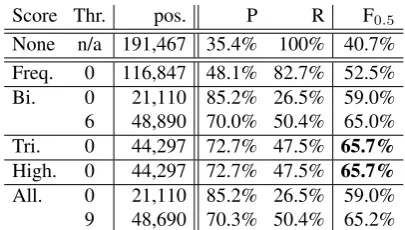
Swapping the Talbanken data, the training data is now approximately 10% of the corpus (small data) and the test data 90% (large data). The results are given in table 3, where the first thing to note is the overall worse parser performance, reflected in a much higher baseline precision (None) of 35.4% (=64.6% LAS), significantly higher then with the normal split (P=18.0%, LAS=82.0%, table 1).
Score Thr. pos. P R F0.5
None n/a 191,467 35.4% 100% 40.7%
Freq. 0 116,847 48.1% 82.7% 52.5%
Bi. 0 21,110 85.2% 26.5% 59.0%
6 48,890 70.0% 50.4% 65.0%
Tri. 0 44,297 72.7% 47.5% 65.7%
High. 0 44,297 72.7% 47.5% 65.7%
All. 0 21,110 85.2% 26.5% 59.0%
9 48,690 70.3% 50.4% 65.2%
Table 3: Talbanken error detection results for differ-ent scores: parser = MaltParser trained on small data; grammar = small gold; evaluation data = large data
With low parser accuracy, baseline F measures are higher: by going over every instance, an an-notator will, in principle, find every error (100% recall), with 35% precision. However, that means going through over 190,000 words by hand. To
7We used the LTH Constituent-to-Dependency
Conver-sion Tool (Johansson and Nugues, 2007), selecting options for CoNLL 2007 format and no NP rebracketing.
improve the corpus with less effort, we want to identify errors with high precision. Indeed, in the results in table 3, we find precision around 70% with recall around 50%.8
Consider the high-gram method, which has the highest F0.5, 65.7%, at a score of 0—i.e., no rules in the grammar with any trigrams or longer n-grams supporting a given rule.9 First, this is much higher than the 54.4% for the standard data split (table 1), partly due to the fact that the parser ac-curacy is lower. Secondly, 44,297 positions are flagged—23% of the corpus—with 32,209 erro-neous; annotators could correct nearly 3 out of every 4 flagged dependencies, fixing 47% of the errors. We will use 23% of the corpus for other experiments with large data (cf. section 4.1.2). Fi-nally, if 32,209 corrections are added to the origi-nal 123,595 correct positions, the resulting corpus will have correct dependencies 81.4% of the time (vs. 64.6% LAS), making the corpus more suit-able for, e.g., training parsers (cf. Nivre, 2010).
Note also that at the lowest threshold, the bi-gram method is the most precise (85.2%). What we observed before (cf. example (8) in sec-tion 4.1.1) is true—positive evidence of bigrams may be misleading—but negative evidence from bigrams may be useful (cf. Dickinson, 2011). If a position has no bigram support, this is worse than no trigrams. One can thus consider splitting the zero high-gram elements into two classes: those which never occurred as bigrams (more likely to be erroneous) and those which did.
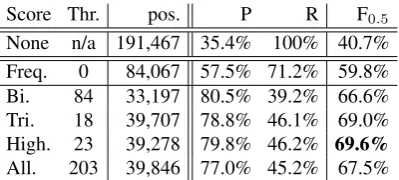
To gauge an upper bound on error detection, we use the large gold grammar for an oracle experi-ment. This helps sort out the effect of the gram-mar (and its size) from the effect of the compari-son methods. We can see the results in table 4.
In comparing to table 3, we see that the results with the much larger grammar are a few points bet-ter. The best F0.5 measure goes from 65.7% to 69.6%, despite the grammar sizes being 1,284 and 26,292 rule types, respectively (section 4). Even a small gold grammar is extremely useful for error detection. Furthermore, the small grammar here is based on data which is disjoint from the evalua-tion data, whereas the large grammar comes from (gold) annotation for the evaluation data.
8Since errors are often inter-related (Hara et al., 2009), it
is likely an annotator would actually have a higher recall, but we do not explore inter-relatedness here.
9
[image:7.595.79.282.480.595.2]Score Thr. pos. P R F0.5
None n/a 191,467 35.4% 100% 40.7%
Freq. 0 84,067 57.5% 71.2% 59.8%
Bi. 84 33,197 80.5% 39.2% 66.6%
Tri. 18 39,707 78.8% 46.1% 69.0%
High. 23 39,278 79.8% 46.2% 69.6%
[image:8.595.82.282.61.151.2]All. 203 39,846 77.0% 45.2% 67.5%
Table 4: Talbanken oracle error detection results: same set-up as table 3, but grammar = large gold
5.2 Small Gold Grammar Revision Checking
Turning to flagging positions by whether they have better-scoring possible revisions, we report the re-sults for Talbanken in table 5. With a previous best F0.5of 65.7% for all zero-scoring element, we ob-serve improvement here (68.2%), obtained by go-ing over all (21,670) flagged positions and then in-cluding the (34,343) lowest unflagged positions.
Score Thr. pos. P R F0.5
L 0 44,297 72.7% 47.5% 65.7%
LF 0 9,954 73.8% 10.8% 34.1%
AF 72 21,670 69.1% 22.0% 48.4%
LU 0 34,343 72.4% 36.6% 60.5%
AU 1233 169,797 31.2% 77.9% 35.4%
[image:8.595.73.288.333.421.2]AF+U0 n/a 56,013 71.1% 58.7% 68.2%
Table 5: Revision checking: same set-up as in table 3, using high-gram method for checking
This matches the intuition that, when the qual-ity of the parse is low, such a sanqual-ity check can im-prove parse error detection. Note in this case that 69.1% of all flagged (AF) cases need revision, not much lower than the overall (lowest) precision of 72.7%. No matter the rule score, if it is flagged, then it is quite likely to be in need of revision. To evaluate in other situations with large evaluation corpora, we will take all flagged positions and then the lowest-scoring unflagged positions.
Consider the practical effect: 56,013 positions are identified, with 39,825 (71.1%) erroneous. Fixing these cases would correct 58.7% of the er-rors, resulting in 85.4% corpus accuracy (163191,,420467).
False Negatives We investigate some of the
false negatives—i.e., cases which the revision check does not flag but which are low-scoring— in order to discover the limitations of the method. In general, the underflagging often results from the conservative nature of candidate selection. Be-cause we do not allow cycles to be introduced, for
example, it is nearly impossible to revise a ROOT element. The most frequent false negatives are those with multiple ROOTs, e.g., the erroneous IP position in TOP→root ROOT:NN ROOT:IP (not flagged 82 times). Extremely long rules (e.g., over 10 dependents) are also underflagged. Because we do not permit non-projectivity, if an element is be-tween two sister elements, those are often theonly
positions which can serve as alternate heads; oth-erwise, branches have to cross. This is schema-tized in figure 5, where revisions for D could only include C and E as heads.
... A B C D E F ...
Figure 5: Schematic for sister relations
5.3 Grammar Size and Quality
[image:8.595.330.500.480.530.2]As with the Talbanken data, we want to test these methods on English data using a small amount of training data and a large amount of test data. To do this, we train different parser models. We use the default training options for MSTParser and train one model on section 00 of the WSJ data, one on section 24, and one on both. All three models are then used to parse sections 02-21, with results in table 6. We use the default settings, as this is a good fit for using the methods in the real world.10
Par. Tokens Size UAS LAS
00 46,451 7,250 81.7% 73.4%
24 32,853 5,797 80.5% 71.8%
0024 79,304 11,095 83.5% 76.0%
Table 6: Parser accuracies for WSJ models with dif-ferent training data (Par.), including number of training
TokensandSizeof grammar (non-unary rule types)
In addition to varying the parser, we also vary the grammar, running tests for each model us-ing gold standard grammars derived from differ-ent sections. This set-up allows us to see the ef-fect of varying the size of the parser training data, the size of the grammar, and the different gram-mars across data sets—i.e., error detection using a grammar from a different section than the one the parser is trained on. The results are in table 7.
10
Par. Gram. Thr. pos. P R F0.5
00 None n/a 950,022 26.6% 100% 31.2%
00 0 143,365 79.5% 45.1% 68.9%
9 217,804 70.8% 61.0% 68.6%
24 0 152,281 78.0% 47.0% 68.9%
6 219,712 69.4% 60.2% 67.3%
0024 0 130,724 81.0% 41.9% 68.3%
16 217,628 70.7% 60.9% 68.5%
24 None n/a 950,022 28.2% 100% 32.9%
00 0 155,889 79.7% 46.4% 69.7%
6 218,227 73.4% 59.8% 70.2%
24 0 157,733 79.1% 46.6% 69.4%
5 217,751 72.6% 59.0% 69.4%
0024 0 139,604 81.3% 42.3% 68.6%
12 218,207 73.3% 59.7% 70.1%
0024 None n/a 950,022 24.0% 100% 28.3%
00 0 127,667 77.7% 43.6% 67.2%
14 219,362 64.6% 62.3% 64.1%
24 0 133,596 76.3% 44.8% 66.9%
9 216,826 64.0% 60.9% 63.3%
0024 0 114,486 79.7% 40.1% 66.5%
[image:9.595.70.292.61.333.2]25 218,731 64.4% 61.9% 63.9%
Table 7: WSJ: high-gram scores for lowest and 23% thresholds: parser = default MST trained on differ-ent data (Par.); grammar = gold from section listed
(Gram.); evaluation data = sections 02-21
Looking at the results for the parser trained on section 00, there are 252,700 errors (26.6%) in over 950,000 words. By using the high-gram method and a grammar extracted from the gold data for section 00, we obtain a precision of 70.8% and recall of 61.0% at the 23% threshold: thus, one could correct 61% of the errors by looking at only 23% of the corpus (217,804 positions, with about 154,000 of them erroneous). Alternatively, using a threshold score of zero on the same data results in higher precision (79.5%) and lower re-call (45.1%). This pattern of higher precision at the lowest threshold and higher recall for the 23% threshold is consistent across all testing scenarios, showing the effectiveness of correcting by work-ing up from the lowest-scorwork-ing items.
Within the results for each parser, the grammar based on section 00 is more effective at sorting out the errors (i.e., has a higher F0.5 score) than the other grammars—although the differences are small. This is true even for the parser trained on section 24 (70.2% vs. 69.4%), and the reverse situ-ation (parser=00, grammar=24) even performs on a par with the other grammars. This indicates that a grammar from a different (albeit, related) corpus
can be effective in error detection. Future work can explore applying this work across domains.
As for grammar size, the differences in F0.5 between the smallest (section 24) and the largest (both sections) for all experiments is<1%. Even with a small gold grammar, we again conclude that this method can effectively sort out a majority of the errors with high precision.
5.3.1 Revision Checking
To gauge the results of revision checking, we re-port results for the WSJ parser trained only on sec-tion 00, as shown in table 8. The results for the other two parsers are not shown for space reasons, but they follow exactly the same trends, namely a consistent improvement, verifying the Talbanken results (section 5.2). For example, comparing to the 00 parser results without revision checking in table 7, we observe a greater F0.5 value for all grammars by taking all flagged positions and the lowest-scoring unflagged positions (AF+U0). With the section 00 grammar, for instance, we see an improvement in F0.5from 68.9% to 71.6%.
Gr. Score Thr. pos. P R F0.5
00 LF 0 78,805 92.2% 28.8% 66.4%
AF 1,325 141,914 79.7% 44.8% 68.9% AF+U0 n/a 206,474 74.8% 61.1% 71.6%
24 LF 0 79,755 91.9% 29.0% 64.1%
AF 1,167 138,912 79.4% 43.6% 68.2% AF+U0 n/a 211,438 73.7% 61.6% 70.9%
0024 LF 0 76,570 92.0% 28.0% 63.3%
AF 3,200 144,041 80.3% 45.8% 69.8% AF+U0 n/a 198,195 76.1% 59.7% 72.1%
Table 8: WSJ revision checking results, using the high-gram method, for the parser trained on section 00; same set-up as in table 7
Perhaps the most notable feature of these results is the precision of the lowest-scoring flagged po-sitions, around 92% for all grammars. This means that for this type of data, annotators could go over 80,000 positions, with very few false positives, providing much potential for efficient correction.
6 Noisy Grammar
[image:9.595.308.524.383.507.2]the parsed rules are from the grammar, this can be seen as an internal consistency check.
Score Thr. pos. P R F0.5
None n/a 191,467 35.4% 100% 40.7%
No-Rev. 3 267 88.4% 0.3% 1.7%
76 44,274 68.4% 44.6% 61.8%
AF 2,784 12,769 67.9% 12.8% 36.4%
[image:10.595.317.516.62.149.2]AF+U55 n/a 44,155 68.8% 44.7% 62.1%
Table 9: Talbanken error detection results for the high-gram method: parser = MaltParser trained on small data; grammar = large noisy; evaluation data = small data (No-Rev.= No revision checking)
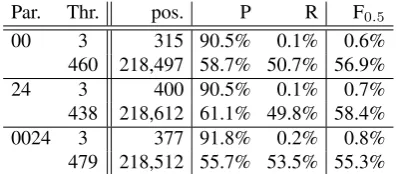
These results are noticably lower than when us-ing a small gold grammar (tables 3 and 5). With-out revision checking, the high-gram F0.5 score goes from 65.7% to 61.8%, in spite of the fact that the noisy grammar has 95,900 rule tokens and 25,904 types, compared to 3,107/1,284 in the gold grammar. That is, a small set of high-quality rules outperforms a large set of more questionable rules, possibly because of parser bias in the grammar.
As for the impact of revision checking, the pre-cision for all 12,769 flagged positions is 67.9%— on a par with the precision without revision check-ing. Indeed, for all flagged positions combined with many lowest-scoring unflagged positions (up to the 55 threshold, or 23% of the corpus), the F0.5 score is slightly improved, though still well below the small gold grammar case.
Comparing the noisy grammar in table 10 to the small gold grammars in table 7, the trend in En-glish is more pronounced. For example, for the parser trained on section 00 (and the 00 grammar), the F0.5 goes from 68.9% to 56.9%. Each noisy WSJ grammar has over 85,000 rules, yet the noise greatly pulls down the accuracy, thereby confirm-ing our preference for (small) gold grammars.11
7 Summary and Outlook
Taking into account different ways in which au-tomatic dependency parses are obtained, we have advocated for a grammar-based method of detect-ing parse errors and have illustrated the gains that can be made by using such methods, including the incorporation of revision checking. Methods us-ing a small gold grammar outperform the meth-ods using much larger grammars with noise in
11We also tried concatenating the small gold and large
noisy grammars to make a hybrid grammar (section 3), but the results were hardly better than in tables 9 and 10.
Par. Thr. pos. P R F0.5
00 3 315 90.5% 0.1% 0.6%
460 218,497 58.7% 50.7% 56.9%
24 3 400 90.5% 0.1% 0.7%
438 218,612 61.1% 49.8% 58.4%
0024 3 377 91.8% 0.2% 0.8%
479 218,512 55.7% 53.5% 55.3%
Table 10: WSJ: high-gram scores: parser = default MST trained on different data (Par.); grammar = ex-tracted from appropriate parsed 02-21; evaluation data = 02-21
them. Thus, to employ such methods on new data, one needs a small grammar, perhaps from a small hand-annotated corpus. Using our methods can improve the resulting annotation of large amounts of parsed data, allowing annotators to focus on problematic parses and not correct ones.
In the future, one can test these methods on real-world corpus-building efforts, integrating them into a particular annotation workflow. Because the method of scoring parses is very general, one can also explore using the scores in different contexts, such as scoring the validity of parse structures in a parser combination model (e.g., Surdeanu and Manning, 2010; Sagae and Tsujii, 2007; Sagae and Lavie, 2006); sorting sentences for active learning (cf. Sassano and Kurohashi, 2010); or selecting parse structures for parsing (Chen et al., 2009).
Acknowledgments
We would like to thank Jennifer Foster, the IU CL discussion group, and the three anonymous re-viewers for useful feedback.
A Some Talbanken05 categories
POS tags ++ coord. conj. AB adverb AJ adjective EN indef. article FV f˚a(get) NN noun PO pronoun PR preposition RO numeral VN verbal noun VV verb
Dependencies ++ coord. conj.
AT nominal pre-modifier CC sister of first conjunct (binary branching co-ordination)
[image:10.595.71.291.98.177.2]References
Abeill´e, Anne (ed.) (2003). Treebanks: Building and using syntactically annoted corpora. Dor-drecht: Kluwer Academic Publishers.
Ambati, Bharat Ram (2010). Importance of Lin-guistic Constraints in Statistical Dependency Parsing. InProceedings of the ACL 2010 Stu-dent Research Workshop. Uppsala, Sweden, pp. 103–108.
Ambati, Bharat Ram, Mridul Gupta, Samar Hu-sain and Dipti Misra Sharma (2010). A high re-call error identification tool for Hindi treebank validation. In Proceedings of The 7th Interna-tional Conference on Language Resources and Evaluation (LREC). Valletta, Malta.
Attardi, Giuseppe and Massimiliano Ciaramita (2007). Tree Revision Learning for Dependency Parsing. In Proceedings of NAACL-HLT-07. Rochester, NY, pp. 388–395.
Bergsma, Shane, Dekang Lin and Randy Goebel (2009). Web-Scale N-gram Models for Lexical Disambiguation. In Proceedings of the Inter-national Joint Conference on Artificial Intelli-gence (IJCAI). Pasadena, California, pp. 1507– 1512.
Bond, Francis, Sanae Fujita et al. (2004). The Hi-noki Treebank: Toward Text Understanding. In
Proceedings of the 5th International Workshop on Linguistically Interpreted Corpora (LINC-04). Geneva, pp. 7–10.
Buchholz, Sabine and Erwin Marsi (2006). CoNLL-X Shared Task on Multilingual Depen-dency Parsing. In Proceedings of CoNLL-X. New York City, pp. 149–164.
Chen, Wenliang, Jun’ichi Kazama, Kiyotaka Uchimoto and Kentaro Torisawa (2009). Im-proving Dependency Parsing with Subtrees from Auto-Parsed Data. In Proceedings of EMNLP-09. Singapore, pp. 570–579.
Dickinson, Markus (2010). Detecting Errors in Automatically-Parsed Dependency Relations. InThe 48th Annual Meeting of the Association for Computational Linguistics (ACL-10). Upp-sala, Sweden.
Dickinson, Markus (2011). Detecting Ad Hoc Rules for Treebank Development.Linguistic Is-sues in Language Technology4(3).
Goldberg, Yoav and Michael Elhadad (2010a). An Efficient Algorithm for Easy-First Non-Directional Dependency Parsing. In Human Language Technologies: The 2010 Annual Con-ference of the North American Chapter of the Association for Computational Linguistics. Los Angeles, California, pp. 742–750.
Goldberg, Yoav and Michael Elhadad (2010b). In-specting the Structural Biases of Dependency Parsing Algorithms. In Proceedings of the Fourteenth Conference on Computational Nat-ural Language Learning. Uppsala, Sweden, pp. 234–242.
Hara, Tadayoshi, Yusuke Miyao and Jun’ichi Tsujii (2009). Effective Analysis of Causes and Inter-dependencies of Parsing Errors. In
Proceedings of the 11th International Confer-ence on Parsing Technologies (IWPT’09). Paris, France: Association for Computational Lin-guistics, pp. 180–191.
Hwa, Rebecca, Philip Resnik, Amy Weinberg, Clara Cabezas and Okan Kolak (2005). Boot-strapping parsers via syntactic projection across parallel texts. Natural Language Engineering
11, 311–325.
Johansson, Richard and Pierre Nugues (2007). Ex-tended Constituent-to-dependency Conversion for English. In Proceedings of NODALIDA 2007. Tartu, Estonia.
Leech, Geoffrey (2004). Adding Linguistic An-notation. In Martin Wynne (ed.), Developing Linguistic Corpora: a Guide to Good Practice, Oxford: Oxbow Books, pp. 17–29.
Marcus, M., Beatrice Santorini and M. A. Marcinkiewicz (1993). Building a large anno-tated corpus of English: The Penn Treebank.
Computational Linguistics19(2), 313–330.
McDonald, Ryan, Koby Crammer and Fernando Pereira (2005). Online Large-Margin Training of Dependency Parsers. In Proceedings of the 43rd Annual Meeting of the ACL. AnnArbor, pp. 91–98.
Nilsson, Jens and Johan Hall (2005). Recon-struction of the Swedish Treebank Talbanken. MSI report 05067, V¨axj¨o University: School of Mathematics and Systems Engineering.
Nivre, Joakim (2010). Harvest Time - Explo-rations of the Swedish Treebank. The Ninth Treebanks and Linguistic Theories Workshop, Invited Talk. Tartu, Estonia. December 4, 2010.
Nivre, Joakim, Johan Hall, Jens Nilsson, Atanas Chanev, Gulsen Eryigit, Sandra K¨ubler, Sve-toslav Marinov and Erwin Marsi (2007). Malt-Parser: A language-independent system for data-driven dependency parsing. Natural Lan-guage Engineering13(2), 95–135.
Oepen, Stephan, Dan Flickinger and Francis Bond (2004). Towards holistic grammar engineer-ing and testengineer-ing—graftengineer-ing treebank maintenance into the grammar revision cycle. In Beyond Shallow Analyses—Formalisms and Statistical Modelling for Deep Analysis (Workshop at The First International Joint Conference on Natural Language Processing (IJCNLP-04)). Hainan, China.
Plank, Barbara and Gertjan van Noord (2010). Grammar-Driven versus Data-Driven: Which Parsing System Is More Affected by Domain Shifts? InProceedings of the 2010 Workshop on NLP and Linguistics: Finding the Common Ground. Uppsala, Sweden, pp. 25–33.
Ros´en, Victoria, Koenraad de Smedt, Helge Dyvik and Paul Meurer (2005). TREPIL: Develop-ing Methods and Tools for Multilevel Treebank Construction. In Proceedings of the Fourth Workshop on Treebanks and Linguistic Theories (TLT 2005). Barcelona, Spain, pp. 161–172.
Sagae, Kenji and Alon Lavie (2006). Parser Combination by Reparsing. InProceedings of the Human Language Technology Conference of the NAACL, Companion Volume: Short Papers. New York City, USA, pp. 129–132.
Sagae, Kenji and Jun’ichi Tsujii (2007). De-pendency Parsing and Domain Adaptation with LR Models and Parser Ensembles. In Pro-ceedings of the CoNLL Shared Task Session of EMNLP-CoNLL 2007. Prague, Czech Republic, pp. 1044–1050.
Sassano, Manabu and Sadao Kurohashi (2010). Using Smaller Constituents Rather Than Sen-tences in Active Learning for Japanese
Depen-dency Parsing. In Proceedings of the 48th An-nual Meeting of the Association for Computa-tional Linguistics. Uppsala, Sweden, pp. 356– 365.
Seeker, Wolfgang, Ines Rehbein, Jonas Kuhn and Josef Van Genabith (2010). Hard Constraints for Grammatical Function Labelling. In Pro-ceedings of the 48th Annual Meeting of the As-sociation for Computational Linguistics. Upp-sala, Sweden, pp. 1087–1097.
Simpson, Heather, Kazuaki Maeda and Christo-pher Cieri (2009). Basic Language Resources for Diverse Asian Languages: A Streamlined Approach for Resource Creation. In Proceed-ings of the 7th Workshop on Asian Language Resources. Suntec, Singapore, pp. 55–62.
Surdeanu, Mihai and Christopher D. Manning (2010). Ensemble Models for Dependency Parsing: Cheap and Good? In Human Lan-guage Technologies: The 2010 Annual Con-ference of the North American Chapter of the Association for Computational Linguistics. Los Angeles, pp. 649–652.
van Noord, Gertjan and Gosse Bouma (2009). Parsed Corpora for Linguistics. In Proceed-ings of the EACL 2009 Workshop on the In-teraction between Linguistics and Computa-tional Linguistics: Virtuous, Vicious or Vacu-ous?. Athens, pp. 33–39.
Wallis, Sean (2003). Completing Parsed Corpora. In Abeill´e (2003), pp. 61–71.