Master Thesis
Automated ANTLR Tree walker
Generation
Author: A.J. Admiraal Email: [email protected] Institute: University of Twente
Automated ANTLR Tree walker
Generation
Supervisors dr. ir. Theo Ruys
Abstract
ANTLR is a parser generator that allows the user to write exible multi-pass language parsers. It can generate a parser that builds an abstract syntax tree from the parsed text, and it can generate tree walkers that can parse this tree. A typical ANTLR multi-pass language parser consists of one or more tree walkers, which can be used as checker, optimiser and/or code generator. Ensuring a tree walker correctly matches the abstract syntax trees produced by the parser is a manual task. When a change in the parser specication aects the abstract syntax tree, all tree walkers need to be inspected and changed accordingly. Mistakes can lead to nontrivial errors and may therefore be hard to nd and solve. This can be a signicant problem, both for experienced and inexperienced users, both during development and maintenance of a language parser. The root-cause of this problem lies in the redundancy between the ANTLR parser and tree walker specications. Both specify the syntax of the abstract syntax tree; the parser species how it is to be created and the tree walker how it is to be parsed.
This thesis introduces ANTLRT G, an extension for ANTLR that allows the user to automatically
generate a matching tree walker based on the specication of an ANTLR parser. An algorithm has been created, using a tree pattern algebra, that can determine a tree walker that is able to parse all possible tree walkers that can be generated by a given parser. ANTLRT G has been
The past few years, I have used ANTLR to build several parsers and compilers. Several times I ran into the problem that I have identied in this thesis, but it was only during the rst months of my master project that I found a potential solution for it. After discussing this with Theo Ruys, my primary supervisor, we decided to change the scope of the project and I started implementing and formalising the algorithm.
This is when I learned that writing an algorithm in code is one thing, but writing an algorithm on paper is something completely dierent. It took me quite some time to get the algorithm from the idea and the proof-of-concept in code to what it is today on paper, and I learned a lot of new skills along the way.
Halfway through my project, I got a job oer at Philips Healthcare. As part of my Bachelor degree, I have done several projects at the Academic Medical Center in Amsterdam, which built up my anity with Healthcare. Therefore, Philips Healthcare was, and had been for a while, on the top of my list of companies where I would like to work, I therefore decided I should accept this oer and continue my project part-time.
Contents
1 Introduction 1
1.1 ANTLR . . . 1
1.1.1 Compilation phases . . . 2
1.1.2 Abstract syntax trees . . . 3
1.1.3 EBNF . . . 3
1.1.4 Concrete Syntax Trees . . . 5
1.2 Problem description . . . 6
1.3 Overview of the thesis . . . 7
2 Preliminaries and related work 9 2.1 Language parsing . . . 9
2.1.1 Grammars . . . 9
2.1.2 Abstract Syntax Trees . . . 10
2.2 Tree representation . . . 11
2.2.1 Classical notation . . . 11
2.2.2 First-child, next-sibling notation . . . 12
2.2.3 Linear notation . . . 13
2.2.4 Properties of FCNS trees . . . 13
2.3 Related work . . . 15
3 Generating the tree grammar 17 3.1 Rationale . . . 17
3.2 Tree pattern algebra . . . 17
3.2.1 Tree patterns . . . 18
3.2.2 Operations on tree patterns . . . 19
3.3 The context-free tree grammar . . . 23
3.4 Building the AST . . . 24
3.4.1 Rewriting production rules . . . 24
3.4.2 Single carets . . . 26
3.4.3 Normal-form . . . 26
3.5 Modelling an annotated context-free grammar . . . 27
3.5.1 Overview . . . 28
3.5.2 Patterns that provide the root . . . 28
3.5.3 Iterating through the rule . . . 29
3.6 Constructing the context-free tree grammar . . . 33
3.6.1 Overview . . . 34
3.6.2 Start symbol . . . 35
3.6.3 Pattern rules . . . 36
4 Optimisation of the tree grammar 41 4.1 Macro expansion . . . 41
4.2 Rule merging . . . 42
4.2.1 Limitations to rule merging . . . 43
4.3 Further optimisations . . . 45
5 Implementation of ANTLRT G 47 5.1 Architectural overview . . . 48
5.1.1 Integrated parser specication . . . 48
5.1.2 Walker generator . . . 48
5.2 Design . . . 49
5.2.1 Algorithm . . . 49
5.2.2 Grammar . . . 50
5.3 Usage . . . 51
5.3.1 Action annotations . . . 51
5.3.2 Invocation . . . 53
6 Case study: Triangle 55 6.1 Design of the Triangle compiler . . . 56
6.1.1 Lexical analyser and parser . . . 56
6.1.3 Generator . . . 60 6.2 Generated C code . . . 60 6.3 Evaluation . . . 62
7 Conclusions 65
7.1 Summary . . . 65 7.2 Evaluation of ANTLRT G . . . 65
7.3 Future work . . . 66
A ANTLRT G sources 69
A.1 FCNSTree class . . . 69 A.2 TreePattern class . . . 75 A.3 ANTLRT G grammar . . . 82
B Triangle compiler sources 97
B.1 Integrated parser specication for Triangle . . . 97 B.2 Generated checker . . . 106 B.3 Generated generator . . . 113
Software licenses 121
List of Figures
1.1 Several phases of a compiler . . . 2
1.2 An AST for the assignment statement a = 1 + 2 . . . 3
1.3 An example ANTLR parser specication . . . 4
1.4 An EBNF grammar fragment with tree shaping operators . . . 5
1.5 A tree walker specication . . . 5
1.6 An AST for the sentence 1 + -(a + b) . . . 5
1.7 A CST for the sentence 1 + -(a + b) as parsed by the grammar of gure 1.3 6 2.1 A context-free grammar . . . 10
2.2 An annotated context-free grammar, based on gure 2.1 . . . 10
2.3 The sentenceS1 parsed by the grammarGfrom gure 2.2 . . . 11
2.4 A subsection of1≤depth≤2 . . . 12
2.5 A subsection of1≤depth≤2, using the Filial-Heir notation . . . 12
2.6 The linear notation of a tree . . . 13
2.7 The dierences between ordinary trees and FCNS-trees . . . 14
3.1 The tree pattern template . . . 18
3.2 Some example tree patterns . . . 19
3.3 Examples for the stacking operator:F+→ F+ . . . . 21
3.4 Template for the functionT op:F+→ F+ . . . . 21
3.5 Template for the functionBottom:F+→ F+ . . . . 21
3.6 Examples for the functionsT op:F+→ F+andBottom:F+→ F+ . . . . 22
3.7 Example for the functionCollapse:F+→ F . . . . 22
3.8 The elementary tree patterns . . . 23
3.9 Two example trees. . . 25
3.11 The context-free tree grammar from gure 3.10 using the linear notation . . . 25
3.12 The AST for the rule A B C^^ D E^^ F G!, given the sentence A B C D E F G 25 3.13 A production rule. . . 25
3.14 The production rule from gure 3.13 written down using tree patterns . . . 26
3.15 The production rule from gure 3.14 in normal-form . . . 27
3.16 A formula for all possible ASTs of gure 3.15. . . 27
3.17 The dierent trees generated by the formula of gure 3.16. . . 28
3.18 An automaton for the grammar from gure 3.15. . . 29
3.19 Pseudo-code for obtaining the setRT from an automaton. . . 30
3.20 Pseudo-code for obtaining the setCH+(p)from an automaton for a given pattern. 31 3.21 Pseudo-code for obtaining the setCH−(p)from an automaton for a given pattern. 32 3.22 An example production rule. . . 34
3.23 The setsRT,CH+ andCH− for the production rule from gure 3.22. . . 34
3.24 An AST generated by the production rule of gure 3.22. . . 34
3.25 A tree grammar that can parse the tree from gure 3.24. . . 35
3.26 A tree grammar that can parse any tree from the production rule from gure 3.22. 36 3.27 Denitions 3.6.1 and 3.6.2 applied to all patterns from gure 3.23. . . 37
3.28 Denitions 3.6.3 and 3.6.4 applied to all patterns from gure 3.23. . . 39
3.29 The results from gures 3.27 and 3.28 in one grammar. . . 40
4.1 An example of Macro expansion . . . 42
4.2 A trivial mergable context-free tree grammar . . . 43
4.3 The context-free tree grammar from gure 4.2 merged according to denition 4.2.1 43 4.4 A context-free tree grammar with rules that can not be merged . . . 44
4.5 The result of a merge of rules start and ruleA from 4.4 . . . 44
4.6 The result of a merge of rules start and ruleB from 4.4 . . . 44
4.7 An unoptimised context-free tree grammar . . . 46
4.8 The optimisations from section 4.3 applied to the tree grammar from gure 4.7 . 46 5.1 Architectural overview . . . 47
5.2 Walker generator . . . 48
5.3 The dependencies between packages in org.antlrtg.* . . . 49
5.4 The simplied UML class diagram for org.antlrtg.algo . . . 49
5.5 The simplied UML class diagram for org.antlrtg.grammar . . . 50
5.7 The generated tree walker for gure 5.6. . . 52
5.8 Some action annotation examples. . . 53
5.9 Adding ANTLRT Gto an ANT build script . . . 54
6.1 A simple Triangle example . . . 55
6.2 Triangle compiler overview . . . 56
6.3 ANTLR/EBNF specication of the parser . . . 57
6.4 Additional AST annotations follow the declarations and denitions. . . 57
6.5 Figure 6.3 annotated with the checker code. . . 58
6.6 The checker code generated by ANTLRT G for gure 6.5. . . 59
6.7 Figure 6.3 annotated with the generator code. . . 61
6.8 Compiling the generated C code. . . 62
[image:11.595.84.488.92.318.2]Chapter 1
Introduction
Ever since the rst compiler was created by Grace Hopper in 1952 for the A-0 programming language [1], compilers have become more and more prominent tools for writing computer soft-ware. Over the years the responsibilities of a compiler have been extended signicantly. The early compilers simply translated a piece of human readable source code into a machine language, where the higher level programming languages were relatively close to the machine languages. Modern compilers have to parse signicantly more complex languages, do contextual analysis to provide the programmer with helpful error and warning messages and do complex optimisations. Today, the divide and conquer paradigm [2] is used on many large-scale compilers; the compilation task is split up into a series of simple tasks, or phases, which can be executed separately. This design strategy was adopted by the Production Quality Compiler-Compiler Project (PQCC) at Carnegie Mellon University [3]. Due to the separation of the dierent responsibilities of the compiler, it becomes possible to develop complex compilers for complex languages such as C++, Java and C#. Today there are many compiler-compilers, or parser generators, available. This thesis focuses on one specic parser generator: ANTLR [4]. One of the key features of ANTLR is that the format it uses to specify the syntax of a language is very similar to EBNF [5]. This chapter will briey introduce ANTLR and then states the problem that we are going to solve.
1.1 ANTLR
1.1.1 Compilation phases
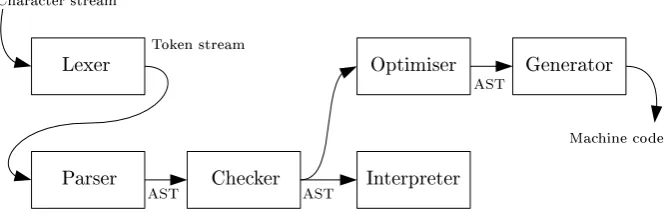
A typical compiler rst uses the lexical analyser, or Lexer, to analyse the input le. The lexical analyser is responsible for grouping the characters from the input le, or character stream, into a stream of words or tokens. Using the token stream as an input; the parser then parses this token stream and creates a tree of tokens, called an Abstract Syntax Tree or AST. After this phase, one or more tree walking phases can use and modify this AST. Figure 1.1 schematically demonstrates this concept. Modication of the AST is an important part of the tree walking phases, for example the phase that checks the logical correctness, or Checker, might annotate all variables with a reference to their declaration. And the optimisation phase might change a construction that models a = 1 + 2 into a = 3.
Character stream
Lexer Token stream
Parser
AST Checker AST
Optimiser
AST Generator
Machine code
[image:14.595.150.485.248.358.2]Interpreter
Figure 1.1: Several phases of a compiler
The lexical analyser
The lexical analyser is responsible for converting the character stream into a token stream. For ANTLR, the EBNF specication of the lexical analyser species exactly how tokens can be recognised. Lexical analysis is a well understood process, more information on this can be found in many places, for example in [7]. This thesis will focus mainly on the parsing and tree walking phases and the AST data structures in between. For more information on the lexical analyser as provided by ANTLR, please refer to [8].
The parser
The parser is responsible for creating the initial AST from the token stream that the lexical analyser has produced. The EBNF specication of the language is used to determine the structure of the tree, it can be annotated with special tree shaping operators to control the shape of the AST. An example parser specication is demonstrated in gure 1.3.
The tree walkers
by the parser. Because the shape of the AST depends on the input sentences and the parser specication, writing a tree walker specication requires specic knowledge on both. An example tree walker specication is demonstrated in gure 1.5.
1.1.2 Abstract syntax trees
An Abstract Syntax Tree, or AST, is a nite, directed, labelled tree, where each node repre-sents a programming language construct, the children of each node represent components of the construct. Figure 1.2 demonstrates a simple AST for the assignment statement a = 1 + 2.
= a @
+ 1 @
2
Figure 1.2: An AST for the assignment statement a = 1 + 2
When the compiler tasks are separated by multiple phases, an AST is often used as an interme-diate structure between the parsing phase and the other phases. The AST should only contain relevant information, where relevant is determined by the language that is being parsed. For example, for the programming language C, semicolons and commas are discarded, where paren-theses can usually only be recognised by the shape of the tree. For example a = 1 + 2; and a = (1 + 2); would most likely be parsed to the same AST as depicted in gure 1.2.
1.1.3 EBNF
Extended Backus-Naur form, or EBNF, is a commonly used notation for context-free grammars and is an ISO/IEC standard [5]. EBNF was originally developed by Niklaus Wirth [9] based on the Backus-Naur form, or BNF, notation that was developed by John Backus and Peter Naur. EBNF is intended to be extensible, this means that many variants of EBNF currently exist.
EBNF syntax for ANTLR parsers
ANTLR uses a specialised variant of EBNF, where the operators for repetition, concatenation, option, etc. have been replaced by operators that are more commonly used in regular expressions. This variant of EBNF is very similar to the variant of EBNF that the W3C uses to specify the XML syntax [10]. Table 1.1 explains the operators that ANTLR uses in its EBNF syntax. All references to EBNF hereafter refer to the ANTLR specic version of EBNF, unless otherwise noted. Please refer to [8] for all details on this version of EBNF. Figure 1.3 shows a fragment of an EBNF specication for a simple language. Assuming that value matches decimal numbers and identifier literal identiers, the grammar fragment matches sentences like: a + b + 3 + -c" and 1 + -(a + b)".
ANTLR EBNF Explanation
A B A, B Matches A followed by B. A | B A | B Matches A or B.
A? [A] Matches zero or one occurrences of A. A+ A, {A} Matches one or more occurrences of A. A* {A} Matches zero or more occurrences of A.
Table 1.1: ANTLR EBNF operators versus the original EBNF operators
expression
: operand ("+" operand)* ;
operand
: ("-")? operand | "(" expression ")" | value
| identifier ;
Figure 1.3: An example ANTLR parser specication
that is generated by the parser, as input for a tree walker, it may be desirable to use these tree shaping operators provided by ANTLR. Figure 1.4 demonstrates the grammar from gure 1.3 annotated with the tree shaping operators provided by ANTLR. In this grammar the add (+) and invert (-) operators have been annotated with a double-caret (^^) denoting that they should form a node in the AST, the other elements shall form leafs. The parentheses have been annotated with an exclamation mark (!) to indicate that they are not relevant and should not be taken into the AST at all.
Operator Explanation
A^^ A becomes the parent node for this EBNF rule. A^ A becomes the parent node for this section. A! A should not be taken into the AST.
Table 1.2: ANTLR tree shaping operators
If the sentence 1 + -(a + b) were to be parsed by a parser generated from the EBNF grammar from gure 1.4, the AST from gure 1.6 would be generated.
EBNF syntax for ANTLR tree walkers
expression
: operand ("+"^^ operand)* ;
operand
: ("-"^^)? operand | "("! expression ")"! | value
| identifier ;
Figure 1.4: An EBNF grammar fragment with tree shaping operators
or non-terminals are considered to be the children of this parent. Figure 1.5 shows the EBNF specication for the tree walker that is able to parse all ASTs that can be generated by the parser specication of gure 1.4.
expression
: ^("+" expression expression) | ^("-" expression)
| value | identifier ;
Figure 1.5: A tree walker specication
For example, consider the AST of gure 1.6 with the tree walker specication of gure 1.5. The root of the AST res the rst alternative of the tree walker specication. This rule demands a node + with two children conforming to the alternative expression, in this case the left child is a value and the right child is a node - with one child. This child is again a node + with two children, both conforming to the alternative identifier.
+ 1 @
-+ a @
b
Figure 1.6: An AST for the sentence 1 + -(a + b)
1.1.4 Concrete Syntax Trees
to parse a sentence. The leafs consists of all terminals that were encountered while parsing a sentence. The paths from the leafs to the root in the CST contain all encountered non-terminals that were found while parsing the sentence. The CST is also known as a parse tree.
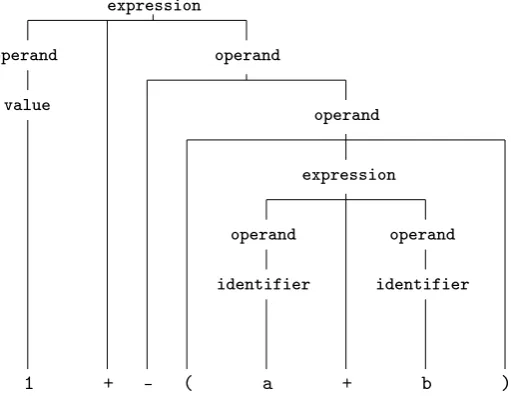
A CST is useful for demonstrating how a sentence is related to a grammar. For example, gure 1.7 demonstrates a CST for the sentence 1 + -(a + b) as parsed by the grammar of gure 1.3. For every terminal one can trace back all non-terminals to the start symbol. More information on CSTs can be found in any compiler construction textbook, such as [7].
expression
operand
value
1 +
operand
-operand
(
expression
operand
identifier
a +
operand
identifier
[image:18.595.192.448.209.411.2]b )
Figure 1.7: A CST for the sentence 1 + -(a + b) as parsed by the grammar of gure 1.3
1.2 Problem description
Language parsers and translators are widely used software components; from relatively simple parsers for conguration les to extremely complex parsers such as C++ compilers. For many languages, one or two phases, or passes, are sucient. ANTLR excels in ease of use for these kinds of languages. There is a group of languages that need many dierent passes over the AST. For example, highly optimised C or C++ compilers. For this approach, using ANTLR is not ideal.
As explained in section 1.1.1, the tree walker can be seen as a parser for the AST that was produced by the previous phase. While writing the tree walker specication, the developer needs to know exactly how the AST is shaped with respect to the language specication. Which requires detailed knowledge on the parser specication and the way tree shaping operators behave. This leads to several research questions:
• A parser specication holds all information on the Abstract Syntax Trees that can be generated. Is it possible to automatically generate the ANTLR tree walker specication, given the ANTLR parser specication?
• A parser specication should precisely dene the sentences of the source language. A tree walker, on the other hand, does not have to follow the source language precisely. Consequently, it is common practise to create tree walker specications that are much more generic and concise than the corresponding parser specication. Is it possible to automate this simplication process?
All information that is needed to build a tree walker specication is already present in the parser specication. Therefore it should be possible to automatically generate a bare tree walker specication based on the parser specication. This thesis will try to create an algorithm to generate a skeleton tree walker specication from a parser specication.
1.3 Overview of the thesis
Chapter 2 will introduce some necessary background information and introduce some related work. Chapter 3 will provide an algorithm that is able to extract one or more tree walkers from an ANTLR parser specication. This chapter will provide a detailed overview of the issues that arise when extracting the required information from the parser specication and formalises the algorithm using a tree pattern algebra. Chapter 4 will introduce several methods that can be used to generalise the generated tree walker specications to improve their practical usability. Chapter 5 will introduce an implementation for the solution mentioned in chapters 3 and 4. This solution will then be evaluated for its practical usability in the case study described in chapter 6. This case study involves the implementation of a simple translator which consists of a parser and two tree walkers.
Chapter 2
Preliminaries and related work
2.1 Language parsing
2.1.1 Grammars
Ever since the Algol project [11], the formal specication of a language almost always involves some form of a context-free grammar [12]. The context-free grammar is usually used to specify the syntax of a language, constructions that can not be specied using a context-free grammar are usually considered the semantics of a language. For example the sentence a = 1; is for many languages a syntactical correct sentence. However, if the variable a is not dened within the scope of the statement; the sentence is semantically incorrect for many languages, because a was not dened.
Denition 2.1.1 presents the context-free grammar as dened by [12] with some minor adapta-tions to suit the context-free grammars dened in ANTLR. Figure 2.1 demonstrates an example context-free grammar.
Denition 2.1.1 A context-free grammarGis denoted by a 4-tuple(N , T, R, S), whereN is a nite nonempty set of non-terminals,T a nite, nonempty set of terminals and S∈N the start symbol. The alphabet of G is denoted byN ∪T. R is a nite set of production rules: for each r∈R:n→α, wheren∈N. Hereαcan be dened using EBNF:
α = a | A | (α)op | α1α2 | α1|α2. op = * | + | ? | .
with a∈N andA∈T.
To accommodate the tree shaping operators, as explained in section 1.1.3, the denition of the context-free grammar will be extended with the annotations in denition 2.1.2. Any reference hereafter to a parser specication will refer to an annotated context-free grammar. Figure 2.2 annotates the context-free grammar of gure 2.1 with tree shaping operators.
start
: ((A B C)* D rule)* (K L M)? ;
rule
: (E F G (rulesub)*)+ | K L M
;
rulesub : H I J ;
Figure 2.1: A context-free grammar
production rules: for eachr∈R:n→α, wheren∈N. Eacht∈T0 can optionally be annotated with either ! or ^^. αcan be dened using EBNF:
α = a | A | (α)op | α1α2 | α1|α2. op = * | + | ? | .
witha∈N andA∈T0. The annotations ^^ and ! on terminals declare the following behaviour: ! Each terminal that is annotated with an exclamation mark will not be present in the
AST.
^^ When parsing from left to right, any terminal that is annotated by a double-caret (^^) becomes the root node of the section that has formed until there. Any subsequent termi-nals and non-termitermi-nals become children of the last terminal annotated with a double-caret.
start
: ((A B^^ C)* D rule)* (K^^ L M)? ;
rule
: (E! F^^ G (rulesub)*)+ | K L^^ M
;
rulesub : H I^^ J ;
Figure 2.2: An annotated context-free grammar, based on gure 2.1
2.1.2 Abstract Syntax Trees
Syntax Trees, for example in [7]. Denition 2.1.3 is used as the denition of an AST in this thesis.
Denition 2.1.3 An Abstract Syntax Tree, or AST is a nite, directed, labelled tree, where each node represents a programming language construct, the children of each node represent components of the construct. An AST section is a part of the AST that was formed by exactly one rule of a grammar.
An AST that is produced by a grammar consists of several sections, or sub-trees. Every rule in a grammar produces one or more sections, they are interconnected by the section of the rule associated with the start symbol. A basic AST is build up by processing a grammar specication Gwith an input sentenceS, denoted byG↑S. Every terminal parsed by a rule ofGresults in a node in the section for that rule. Every non-terminal parsed by a rule of Gresults in a new section, which is connected to the section of the rule containing the non-terminal by its root. When a grammar is unambiguous, every sentence parsed by the grammar results in a unique AST.
Consider the annotated context-free grammarG0 from gure 2.2 and sentenceS
1=A B C A B C D E F G H I J K L M. While parsingS1, the start rule accepts the terminals A, B^^, C, ..., D, rule, K, L^^, M. The rule rule accepts the terminals E, F^^, G and the rulesub rule accepts the terminals H, I^^, J. Figure 2.3 demonstrates the parse tree for this.
G↑S1=
start
A B^^C A B^^C D
rule
[image:23.595.136.414.392.469.2]E F^^G H I^^J K L^^M
Figure 2.3: The sentence S1parsed by the grammarGfrom gure 2.2
2.2 Tree representation
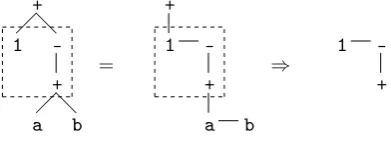
This thesis will present algorithms to process an AST, several of these algorithms rely on breaking down the AST into several small subtrees. These subtrees are sections of trees consisting of nodes with a common depth, or distance from the root. For example; in gure 2.4 all nodes with 1≤depth≤2 are selected in a subtree.
2.2.1 Classical notation
notation is that the relationship of children at the same level in the tree is not modelled. For an AST however, the relationship of the children can be very important; a - b is usually not the same as b - a.
+ 1 @
-+ a @
b
⇒ 1
[image:24.595.254.366.152.222.2]-+
Figure 2.4: A subsection of1≤depth≤2
2.2.2 First-child, next-sibling notation
Because of the ambiguities with the classical tree notation, this thesis will also use the Filial-Heir notation [13]. This is also known as the First-child, next-sibling notation, or the child-sibling tree implementation. In this notation, the root is at the top of the tree and has an edge pointing downwards to its rst child. The rst child has an edge pointing right to its next sibling, which recurses until the last sibling. Each of the siblings can have an edge pointing downwards to their rst child. Denition 2.2.1 denes the FCNS-tree, for an example see gure 2.5. Note that in this notation it is also legal for the root node to have a sibling, this represents a forest where the roots have a sequential relationship.
Denition 2.2.1 A rst-child, next-sibling tree, or FCNS-tree,F is a nite acyclic directed connected graph denoted by a tuple (V, E). Where V(F) is a nite nonempty set of labelled vertexes andE(F)is a set of ordered pairs{u, v, l} withu, v∈V(F)where{u, v, l} is a labelled edge in the graph from vertexuto vertexv with label l∈ {fc",ns"}. In this graph every vertex has a maximum of two outgoing edges: an edge labelled: fc" (rst-child) and an edge labelled: ns" (next-sibling), every vertex has exactly one incoming edge except for the root vertex.
+ 1 @
-+ a @
b =
+
1
-+
a b
⇒ 1
-+
Figure 2.5: A subsection of1≤depth≤2, using the Filial-Heir notation
[image:24.595.213.409.532.603.2]2.2.3 Linear notation
Next to the graphical notations demonstrated in the previous sections, a linear notation is also used in this thesis. The benet of a linear notation is that it is very compact and can therefore easily be used in formulae and code. The linear tree notation used is deliberately chosen to be an abstracted form of the linear notation used in ANTLR [8]. This notation is based on the tree operator ^() introduced in section 1.1.3. The rst element between the parentheses of the tree operator is considered to be a parent node in the tree, the other elements are considered to be the children of this parent. Denition 2.2.2 denes the linear notation, gure 2.6 presents an example.
Denition 2.2.2 A vertex v ∈V(F)is denoted as: ˆ(v C1...Cn) where C1...Cn represents
the ordered set of children of v , which are recursively denoted in the same way. When the set of children of the vertex v is empty, the parentheses andˆsign may be discarded.
+
1
-+
a b
=^(+ 1 ^(- ^(+ a b)))
Figure 2.6: The linear notation of a tree
2.2.4 Properties of FCNS trees
A number of properties can be dened for FCNS-trees. These properties are used in the algo-rithms dened further on in this thesis. These properties are the root, the stem, levels and the depth.
Denition 2.2.3 Any non-empty FCNS-tree always has exactly one root vertex. This is the vertex with an in-degree of 0, i.e. the vertex without incoming edges.
This basically follows immediately from denition 2.2.1. Please note that the root node does not always follow the standard intuition for a root node. For example, it can have siblings. In gure 2.6, the topmost + is the root node.
Denition 2.2.4 A set of stem vertexes can be determined for any non-empty FCNS-tree: the root vertex is a stem vertex. Any vertex that can be reached via an edge labelled fc" from another stem vertex is also a stem vertex. All other vertexes are not stem vertexes.
Denition 2.2.5 A non-empty FCNS-tree can be subdivided into one or more stem-subgraphs. These stem-subgraphs consist of one stem vertex and the entire subgraph connected to the next-sibling" edge of that stem vertex.
Denition 2.2.6 The depth of an FCNS-tree is equal to the number of nodes in the stem.
In gure 2.6, the depth of the FCNS-tree is 2. Please note that the denition of the depth of an FCNS tree is not equal to the denition of the depth of an ordinary tree. For example; in the ordinary tree representation in gure 2.5, the depth is 4.
Any ordinary forest of trees can be rewritten as an FCNS-tree and vice versa [13], as demonstrated in gure 2.7. The algorithms dened in this chapter strongly rely on the ordering of the child nodes inside a tree, therefore these FCNS-trees are used to represent them as they provide a more intuitive explanation of the algorithms.
A
B C ⇔
A B @
C A
B C
D E ⇔
A B @
C D @
E
A B C
D E ⇔
A D @
E
B C
[image:26.595.119.442.288.365.2]^(A B C) ^(A ^(B D E) C) ^(A D E) B C
Figure 2.7: The dierences between ordinary trees and FCNS-trees
Functions on FCNS trees
A number of functions can be dened for FCNS-trees. These functions are used in the algorithms dened further on in this document.
The root node of any FCNS-tree ucan be selected by the function: Root :F → V. The next sibling vertex of any vertex from any FCNS-tree can be selected by the function: N extSibling: V → V ∪ {⊥}. Similarly, the rst child vertex can be selected by the function: F irstChild : V → V ∪ {⊥}. The previous sibling vertex of any vertex can be selected by the function: P reviousSibling: V → V ∪ {⊥}. Similarly, the parent vertex of any vertex can be selected by the function P arent : V → V ∪ {⊥}. The depth of any FCNS-tree can be retrieved with the functionDepth:F →N.
For some operations the last sibling is required, the last sibling is the vertex that can be found by following the edges labelled as next-sibling recursively from the current vertex until the last vertex has been found (i.e. without a next-sibling edge). This process is represented by the functionLastSibling:V → V.
2.3 Related work
Not many solutions for the problems identied in section 1.2 exist, most of them try to circumvent the problem by not using the tree walkers or taking a slightly dierent approach to the tree walking. Terence Parr explains in an article on his website [14] why he thinks tree walkers should be used by translators. In a response to this article, Andy Tripp wrote a white-paper that advocates hand-written code for walking an AST using the visitor pattern [15] rather than using ANTLR Tree Grammars [16]. This white-paper mainly focuses on the mixing of dierent languages and not so much on the maintenance issues, nevertheless a hand-written tree walker can potentially be easier to debug since hand-written code is usually better readable compared to generated code.
In 2008, Terence Parr introduced rewrite rules for ANTLR version 3 [17]. These rewrite rules allow the user to directly specify the desired shape of the AST, instead using the ! and ^ operators, this makes the shape of the AST that is generated by the parser more transparent. A more complete solution is ANTLRWorks [18] by Jean Bovet. ANTLRWorks is a development environment for ANTLR grammars which is able to help the user build and debug a grammar. It provides a grammar editor, various visualisation methods for grammars and an integrated debugger.
Chapter 3
Generating the tree grammar
This thesis will present an algorithm for extracting one or more tree walkers from a parser specication. The input for this algorithm is the EBNF parser specication, similar to gure 1.4. The output will be a skeleton EBNF tree walker specication, similar to gure 1.5. The goal is to create a practically useful human-readable tree walker. This chapter will present the algorithm that handles the conversion from a parser specication to a tree walker specication. The algorithm is designed around grammars, ASTs and trees as introduced in chapter 2. For each of them a formal denition is given and examples are provided to understand them.
3.1 Rationale
The research questions in section 1.2 follow from a redundancy issue within the ANTLR parser and tree walker specications. Usually, within models and specications, redundancy is regarded as a bad thing as it implies more eort to implement and maintain. Furthermore, the behaviour of the tree building operators provided by ANTLR can become rather involved, especially when multiple of them are used in the same rule.
To address the redundancy issues while leaving the ANTLR paradigm intact, the solution is either to generate a tree walker specication or to validate a manually written tree walker specication against the parser specication. Although validation has some benets over generation, in the sense that it gives the programmer more freedom in dening the tree walker; this would imply that an algorithm needs to be created that validates whether two algorithms generate the same language, which is impossible according to Rice's theorem [19]. When leaving the ANTLR paradigm, one can choose to use the visitor pattern [15] to accommodate the tree walkers. The downside of this is that the parser and the tree walkers will then use very dierent mechanisms. Because of the considerations mentioned above, the choice has been made to automatically generate a tree walker specication from the parser specication.
3.2 Tree pattern algebra
AST generated by that rule. This section presents an algebra to help solve this problem. The basic idea behind this algebra is to use atomic building blocks to build up an AST. These build-ing blocks represent atomic operations on the AST construction and are called Tree Patterns. Similar methods to use an algebra to have been presented in [20] and [21], the dierence here is that the algebra is used to build a tree and not to match a tree.
3.2.1 Tree patterns
The FCNS-tree (as dened in section 2.2.2) forms the basis for tree patterns. Tree patterns are FCNS-trees labelled with terminals and/or non-terminals from the input context-free grammar and contain two connection points: a root connector and a child connector.
Denition 3.2.1 A tree patternF+ is an FCNS-tree such that: the last two stem vertexes are labelled with a root connector ( t) and a child connector ( d) in that order. The other vertexes, if any, are labelled with terminals or non-terminals.
α
t β
d γ
Figure 3.1: The tree pattern template
Figure 3.1 demonstrates the tree pattern template according to denition 3.2.1. Note that α , β and γ represent FCNS trees with zero or more vertexes labelled with terminals and/or non-terminals. The root connector of any tree pattern p can be selected by the function: Rootconnector : F+ → V, the child connector of any tree pattern p can be selected by the function: Childconnector:F+→ V.
Denition 3.2.2 A minimal tree pattern is dened as the null pattern, also denoted by⊥. This is the smallest tree pattern conforming to denition 3.2.1:
t d
Denition 3.2.3 The two elementary tree patterns are shown below:
t
d α
α
t d
t
d A
A
t d
A
t B
d
A
t
d B
A
t B
d C
A
B C
t D
d
A
B C
t D
[image:31.595.124.434.104.181.2]d E
Figure 3.2: Some example tree patterns
The elements of the tree pattern algebra are dened as the innite set of all possible tree patterns. Figure 3.2 presents some example tree patterns, the linear representation of these patterns is (from left to right):
^(t dA) ^(A ^(t d)) ^(A ^(t d)B) ^(A ^(t dB)) ^(A ^(t dC)B) ^(A ^(B ^(t d)D)C) ^(A ^(B ^(t dE)D)C)
3.2.2 Operations on tree patterns
The tree pattern algebra denes a limited set of operations. The most signicant one is a binary operation called Stacking, which combines two tree patterns. Furthermore, we dene three unary operations called Top, Bottom and Collapse.
Stacking
Tree patterns are designed to be building blocks for an AST, these building blocks can be stacked on top of each other to form an AST. Tree pattern stacking is explicitly denoted by p q, the root connector and child connector of the second pattern are used as connection points between the two patterns. The root ofpbecomes the rst child of the parent of the root connector ofq and the siblings of the root connector of q become the siblings of the root of p, the root connector ofq itself is discarded. Furthermore, the siblings of the child connector ofq will be appended to the set of children of the root ofp, also the child connector ofqis discarded. Denition 3.2.4 denes how stacking works.
Denition 3.2.4 Stacking of tree patterns is denoted by : F+ × F+ → F+. This operator stacks two patterns and results in a new tree pattern.
r=pq, where:
V(r) = V(p)∪(V(q)− {Rootconnector(q), Childconnector(q)}) E(r) = E(p)∪E(q)∪ {
(LastSibling(Root(p))→nsN extSibling(Rootconnector(q))), (LastSibling(F irstChild(Root(p)))→ns
N extSibling(Childconnector(q))),
Any dangling edges will be discarded. Note that the root connector and child connector of the second pattern are not part of the new pattern.
The stacking operator is also implicit; writing down two tree patterns next to each other,
without parentheses separating them, implies stacking. The stacking of two patterns forms a new pattern, meaningpqresults in a new patternr. Furthermore, stacking is left-associative: (p q r) ⇔ ((p q) r). From denition 3.2.4 it can be derived that stacking is not commutative: (p q) 6= (q p). Figure 3.3 demonstrates three examples for tree pattern stacking.
The name of the root connector refers to the fact that in p q, the root connector of q is connected to the root ofp. The child connector ofqconnects to the last child of the root ofp.
Top and Bottom
Patterns can be subdivided into a top and a bottom part. The root connector and child connector are the separators in this process; everything above and to the right of the root connector is considered to be the top part, everything below and to the right of the child connector is considered to be the bottom part. To ensure that the top and bottom parts are both valid tree patterns, the root connector and child connector are present in both parts. The functions T op:F+ → F+ andBottom :F+ → F+, as dened in denitions 3.2.5 and 3.2.6, are used to split a pattern this way. Figure 3.6 demonstrates these functions.
Denition 3.2.5 The functionT op:F+→ F+ selects the top part of a tree pattern. q=T op(p), where:
V(q) = V(p)−(AllSiblings(Childconnector(p))−Childconnector(p)) E(q) = E(p)
Any dangling edges will be discarded.
Denition 3.2.6 The functionBottom:F+→ F+ selects the bottom part of a tree pattern. q=Bottom(p), where:
V(q) = V(p)−((V(T op(p))−Rootconnector(p))−Childconnector(p)) E(q) = E(p)
Any dangling edges will be discarded.
Collapsing
The root connector and child connector can be removed from the tree pattern by collapsing it. Collapsing appends all siblings of the root connector to the set of siblings of the child connector and makes the next sibling of the child connector the rst child of the parent of the root connector. The functionCollapse:F+→ F, as dened in denition 3.2.7, is designed to do this, gure 3.7 demonstrates this.
Denition 3.2.7 The function Collapse : F+ → F collapses the root connector and child connector from the tree pattern.
A
t B
d
C
t D
d E =
A
t B
d
C
t D
d E
= C
A D
t B E
d
Or linear: ^(A ^(t d)B) ^(C ^(t dE)D) = ^(C ^(A ^(t d)B E)D)
A
t
d
t
d B C =
A
t d
t
d B C
= A
t B C
d
Or linear: ^(A ^(t d)) ^(t dB C) = ^(A ^(t d)B C)
t
d B C
A
t
d =
t
d B C
A
t
d =
A
t
d B C
[image:33.595.109.417.112.429.2]Or linear: ^(t dB C) ^(A ^(t d)) = ^(A ^(t dB C))
Figure 3.3: Examples for the stacking operator:F+→ F+
α
t β
d γ
Figure 3.4: Template for the functionT op:F+→ F+
α
t β
d γ
T op G H E t F d D = G H E t F d
Or linear: T op(^(G ^(H ^(t dD)F)E) ) =^(G ^(H ^(t d)F)E)
Bottom B t C d A = t d A
[image:34.595.155.426.96.289.2]Or linear: Bottom(^(B ^(t dA)C) ) =^(t dA)
Figure 3.6: Examples for the functionsT op:F+ → F+ andBottom:F+→ F+
V(v) = V(p)−Rootconnector(p)−Childconnector(p) E(v) = E(p)∪ {
(P arent(Rootconnector(p))→f cN extSibling(Childconnector(p))), (LastSibling(Childconnector(p))→nsN extSibling(Rootconnector(p)))} Any dangling edges will be discarded.
Collapse G H E t F
d D I
= G H E
D I F
Or linear: Collapse(^(G ^(H ^(t dD I)F)E)) =^(G ^(H D I F)E)
Figure 3.7: Example for the functionCollapse:F+→ F
3.2.3 Master and slave patterns
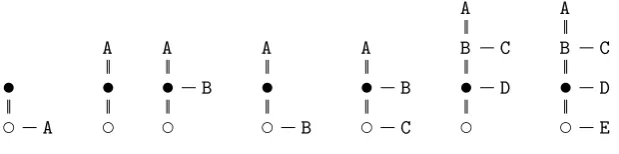
[image:34.595.183.456.429.527.2]Denition 3.2.8 A slave tree pattern is a tree pattern where (i) the root connector is the root and (ii) the root connector and/or the child connector has siblings. Otherwise, it is a master tree pattern.
Consider the examples in gure 3.3; in the rst and third examples, q is a master pattern and provides the new root in the stacking. For the second example,qis a slave and does not provide the root. Figure 3.8 demonstrates the elementary tree patterns.
t
d α ⇒slave α
t
d ⇒master t
d ⇒master
Figure 3.8: The elementary tree patterns
Parent-child relations in stacking
When stacking two patterns, one of the patterns usually dominates the other pattern in the sense that it provides the topmost or leftmost nodes in the resulting pattern. Which pattern will be the dominant pattern depends on the order in which they are stacked and whether the patterns are master or slave . The dominant pattern is referred to as the parent pattern, the other pattern is referred to as the child pattern.
Denition 3.2.9 For pq, The child pattern can be determined as follows: If q is master; p will become the child ofq, otherwiseq will become the child ofp.
For example, consider gure 3.3. The patterns ^(A ^(t d) B) , ^(t dB C) and ^(t dB C) become the child patterns in these operations.
3.3 The context-free tree grammar
The output for the algorithm is a context-free tree grammar. Instead of parsing sentences, a context-free tree grammar parses trees generated by an annotated context-free grammar. De-nition 3.3.1 denes a context-free tree grammar.
Denition 3.3.1 A context-free tree grammar T is denoted by a 4-tuple(N , F, R, S), whereN is a nite nonempty set of non-terminals,F a nite nonempty set of FCNS trees andS∈N the start symbol. The alphabet of T is denoted by N∪F. R is a nite set of production rules: for each r∈R:n→α, wheren∈N. Hereαcan be dened using EBNF:
α = A | (α)op | α1+α2 op = * | + | ? |
For example, consider the two FCNS trees from gure 3.9. The context-free tree grammar from gure 3.10 is able to parse both trees. When this grammar is written using the linear notation described in denition 2.2.2, it becomes much more compact as demonstrated in gure 3.11. The context-free tree grammar in linear notation is very similar to a tree walker specication of ANTLR.
3.4 Building the AST
When parsing a sentence with an annotated context-free grammar, an AST is built up. The exact shape of the AST depends on the placement of the double-caret annotations within the production rules. To build the corresponding AST, one has to parse the sentence from left to right and obey the following rules:
• Every unannotated terminal becomes either a child of the last terminal annotated with a double-caret or, if there is no such terminal, a sibling of the previous unannotated terminal.
• Every terminal annotated with a double-caret becomes the root of the tree as parsed until there.
• Every terminal annotated with a exclamation mark is not taken into the tree.
For example, consider the following annotated context-free grammar rule: start: A B C^^ D E^^ F G!;. Parsing a sentence using this rule, from left to right; (i) the rst terminal is A, which becomes the rst node in the tree. (ii) B becomes a sibling of A. (iii) C becomes the parent of both A and B. (iv) D becomes the child of C and thus siblings of A and B. (v) E becomes the parent of C. (vi) F becomes the child of E and thus a sibling of C. Finally, (vii) G is not taken into the tree. Resulting in the tree depicted in gure 3.12.
3.4.1 Rewriting production rules
Now assume that instead of the rule A B C^^ D E^^ F G! the rule of gure 3.13 is used, meaning that the resulting tree consists of n·(A B C^^)+m·(D E^^)+(F G!), with n, m∈ N. This section will demonstrate how to use tree patterns to determine the resulting AST for any nite value ofnandm. First, denition 3.4.1 will show how to write an annotated context-free grammar using tree patterns instead of annotations.
A
B C
D E
A
B D E
Figure 3.9: Two example trees. start
: A
B tail ;
tail
: C
D E
| D E
;
Figure 3.10: A context-free tree grammar that is able to parse the trees from gure 3.9. start
: ^(A B tail) ;
tail
: ^(C D E) | D E ;
Figure 3.11: The context-free tree grammar from gure 3.10 using the linear notation
E
C F
A B D
Figure 3.12: The AST for the rule A B C^^ D E^^ F G!, given the sentence A B C D E F G rule
: (A B C^^)* (D E^^)* (F G!) ;
Terminal/Non-Terminal Pattern Linear
α
t
d α ^(t dα)
α!
t
d ^(t d)
α^^
α
t
d ^(α^(t d))
Figure 3.14 shows the application of denition 3.4.1 on the production rule from gure 3.13. Considering gure 3.14 and the stacking operator from section 3.2.2; one can immediately recog-nise the rules for building an AST presented earlier in this section. For example, B becomes a sibling of A and C becomes the parent of A and B.
rule
: (
t
d A
t
d B
C
t
d )* (
t
d D
E
t
d )* (
t
d F
t
d )
;
Figure 3.14: The production rule from gure 3.13 written down using tree patterns
3.4.2 Single carets
The algorithm only considers double caret operators in a grammar. The reason for this is that the behaviour of single caret operators can be modelled using double caret operators. The single caret operator behaves exactly like the double caret operator, with the exception that its eect stays limited to the nearest set of parentheses. Furthermore, single caret and double caret operators are not allowed to be used together in one rule. Therefore, moving all terminals and non-terminals between these parentheses to a new rule and replacing the single carets by double carets will generate the same AST.
3.4.3 Normal-form
Denition 3.4.2 A production rule in an annotated context-free grammar written down using tree patterns is in normal-form i the right-hand side of the rule only contains a stacking operator between EBNF sections. If all rules of an annotated context-free grammar are in normal-form, the grammar itself is said to be in normal-form.
rule
: ( C
t
d A B )* (
E
t
d D )* ( t
d F )
[image:39.595.93.320.185.262.2];
[image:39.595.122.443.407.473.2]Figure 3.15: The production rule from gure 3.14 in normal-form
Figure 3.16, depicts the production rule from gure 3.15 as a formula. In this formula the operator·:N0× F+→ F+ is dened as stacking the pattern repetitively on top of itself, where the number of repetitions is equal to the natural number minus one and ⊥is the result if the natural number equals zero. When using the value 1for nandmin this formula; the resulting tree is equal to the tree from gure 3.12. Please note that the collapse is required to remove the root connector and child connector from the nal tree pattern. Figure 3.17 shows several trees for dierent values ofnandm.
Collapse n· C t
d A B
m· E t d D t d F
Figure 3.16: A formula for all possible ASTs of gure 3.15.
3.5 Modelling an annotated context-free grammar
values for nandm Produced tree n= 0, m= 0 F
n= 1, m= 0
C
A B F
n= 1, m= 1
E
C F
A B D
n= 2, m= 1 E
C F
C D
[image:40.595.235.393.100.284.2]A B A B
Figure 3.17: The dierent trees generated by the formula of gure 3.16.
3.5.1 Overview
This part of the algorithm extracts the sequential order in which the tree patterns of a production rule can be used to form an AST. For example, consider the production rule from gures 3.15 and 3.16, where the patterns are labelled p, q andr from left to right. Figure 3.17 shows that patternsp, qandrcan all potentially provide the root of the AST. Furthermore, patternpcan have the patternspand ras a child and patternqcan have the patternsp,qandr as a child. These possible constructions have to be allowed by the corresponding context-free tree grammar. For example, an abstract representation of the rule representing the start symbol would be start: p|q|r;. For the rules representing p, q andr they would be p: p|r;, q: p|q|r; and r:;.
The other paragraphs of this section explain in detail how this structure and information is extracted, section 3.6 explains how this information is combined to generate the actual context-free tree grammar.
3.5.2 Patterns that provide the root
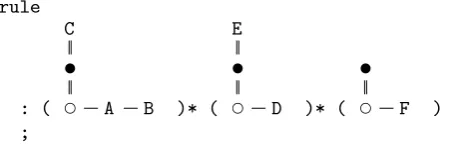
A context-free tree grammar, as dened in section 3.3, parses a tree from top to bottom. However, section 3.4 demonstrated that, if it is annotated with a double-caret, the root node may be the last node that has been parsed by the parser. To build the context-free tree grammar from tree patterns, one has to start with the tree pattern that provided the root of the AST section produced by the production rule. To determine which patterns will provide the root of the AST section, a minimal deterministic automaton is used. Figure 3.18 shows an automaton for the production rule from gure 3.15;p, q andr represent respectively the leftmost, centre and rightmost patterns from gure 3.15.
p q
q
r
[image:41.595.210.357.112.164.2]r
Figure 3.18: An automaton for the grammar from gure 3.15.
pattern; if it is stacked on another pattern, that pattern will provide the root of the resulting pattern. This means that the pattern that is parsed beforer is relevant. The automaton has a path wherer is the only pattern to be parsed and hence provides the root, there are also paths where either pattern por pattern q precedesr; as both pandq are master patterns, they will provide the root of the AST section. For this grammar, patternsp,qandrcan provide the root node of the AST section, hence they are in the set of root patternsRT. Denition 3.5.1 denes this set.
Denition 3.5.1 For each production rule ρ∈R(G) of an annotated context-free grammarG we dene the set of root patterns RT. A pattern p is member of RT if an AST section P can be produced by ρ where the root node ofP is provided byp, as dened by denition 2.2.3. The null-pattern ⊥ is included in the setRT if an AST section P can be produced by ρwhere P is empty.
To obtain the complete set of root patterns RT one has to consider every path through the automaton for ρ. For each path with master patterns, the last master pattern in the path is member of this set. For each path without master patterns, the rst pattern is member of this set. Finally, if there exists a path without patterns, the null-pattern⊥is included in the set (i.e. the initial state is also an accepting state).
Figure 3.19 presents pseudo-code for obtaining the setRT given a minimal deterministic automa-ton for the rule. The algorithm traverses the automaautoma-ton backwards, starting at the accepting states and working towards the initial state, using the recursive function obtainIn at line 11. To prevent innite loops, the states are marked once visited so they are not visited again using the code at lines 2, 13 and 27. The loop on line 3 calls the function obtainIn for each accepting state in the specied automaton A, it also adds⊥to the set RT if an accepting state is also an initial state. The function obtainIn analyses all incoming edges of a state. If one of those edges is labelled with a master pattern; it is added to the setRT. If one of those edges is labelled with a slave pattern; the function obtainIn is called recursively on the source state of the edge, the slave pattern is added to the set if the source state of the edge is an initial state.
3.5.3 Iterating through the rule
A : The automaton to obtain the set from RT: The resulting setRT
RT :=∅;
1
Set all states∈A to not-visited;
2
foreach state ∈A do
3
if state is accepting state then
4
RT := RT ∪obtainIn(state);
5
if state is an initial state then
6
RT := RT ∪ {⊥};
7 end 8 end 9 end 10
function obtainIn(S) : RT begin
11
RT :=∅;
12
if S has not been visited then
13
foreach edge ∈incoming edges of S do
14
pattern := label of edge;
15
if pattern is a master pattern then
16
RT := RT ∪ {pattern};
17
end
18
else
19
state := source state of edge;
20
RT := RT ∪obtainIn(state);
21
if state is an initial state then
22
RT := RT ∪ {pattern};
23 end 24 end 25 end 26
Set S to visited;
27
end
28
end
[image:42.595.106.328.172.577.2]29
A : The automaton to obtain the set from P : The pattern to obtain the set for CH+: The resulting setCH+
CH+ :=∅;
1
Set all states∈A to not-visited;
2
if P is a master pattern then
3
foreach edge ∈edges of A with label P do
4
CH+ :=CH+ ∪obtainIn(source state of edge);
5
end
6
end
7
function obtainIn(S) :CH+ begin
8
CH+ :=∅;
9
if S has not been visited then
10
foreach edge ∈incoming edges of S do
11
pattern := label of edge;
12
if pattern is a master pattern then
13
CH+:=CH+ ∪ {pattern};
14
end
15
else
16
CH+:=CH+ ∪obtainIn(source state of edge);
17
end
18
end
19
if S is an initial state then
20
CH+ :=CH+ ∪ {⊥};
21
end
22
Set S to visited;
23
end
24
end
[image:43.595.78.413.139.546.2]25
A : The automaton to obtain the set from P : The pattern to obtain the set for CH−: The resulting setCH−
CH− :=∅;
1
foreach edge ∈edges of A with label P do
2
state := destination state of edge;
3
foreach edge ∈ outgoing edges of state do
4
pattern := label of edge;
5
if pattern is a slave pattern then
6
CH− :=CH− ∪ {pattern};
7
end
8
end
9
if state is an accepting state then
10
CH− :=CH− ∪ {⊥};
11
end
12
end
13
if P is a master pattern then
14
Set all states∈A to not-visited;
15
foreach edge ∈ edges of A with label P do
16
CH− :=CH− ∪obtainIn(source state of edge, P);
17
end
18
end
19
function obtainIn(S, P) :CH− begin
20
CH− :=∅;
21
if S has not been visited then
22
foreach edge ∈incoming edges of S do
23
pattern := label of edge;
24
if pattern is a slave pattern then
25
CH− :=CH− ∪obtainIn(source state of edge, pattern);
26
end
27
end
28
if S is an initial state then
29
CH− := P;
30
end
31
Set S to visited;
32
end
33
end
[image:44.595.111.457.102.613.2]34
incoming edge labelled withp, meaning thatpcan be stacked on itself andpcan become a child ofp. Furthermore, the left state in this automaton has an outgoing edge labelled withr, meaning that rcan be stacked onpand, asris a slave pattern,rcan become a child ofp.
Now, for each pattern two sets can be dened; the set of master patterns that can become children of the pattern and the set of slave patterns that can become children of the pattern, respectively CH+ andCH−, dened in denitions 3.5.2 and 3.5.3.
Denition 3.5.2 For each master patternpwithin a ruleρ∈R(G)of an annotated context-free grammar Gwe dene the set of master child patterns CH+(p). A master pattern p0 is member
of this set if an AST section can be produced byρwherep0 is a child ofp, as dened in denition 3.2.9. If an AST section can be produced where there is no pattern p0, the null-pattern ⊥ is included in the setCH+(p).
For the production rule from gure 3.15, the sets areCH+(p) ={p,⊥}andCH+(q) ={p, q,⊥}. Figure 3.20 presents pseudo-code for obtaining the setCH+for an active pattern given a minimal deterministic automaton for the rule. The algorithm traverses the automaton backwards, starting at the source states of edges labelled with the master pattern, using the recursive function obtainIn at line 8. To prevent innite loops, the states are marked once visited so they are not visited again using the code at lines 2, 10 and 23. The loop on line 3 calls the function obtainIn for each source state of edges labelled with the master pattern in the specied automaton A. The function obtainIn analyses all incoming edges of a state. If one of those edges is labelled with a master pattern; it is added to the setCH+. If one of those edges is labelled with a slave pattern; the function obtainIn is called recursively on the source state of the edge. On line 20 ⊥is added to the setCH+ if the state provided to the function obtainIn is the initial state.
Denition 3.5.3 For each patternpwithin a ruleρ∈R(G)of an annotated context-free gram-marGwe dene the set of slave child patternsCH−(p). A slave patternp0 is member of this set if an AST section can be produced byρwherep0 is a child ofp, as dened in denition 3.2.9. If an AST section can be produced where there is no pattern p0, the null-pattern ⊥is included in the setCH−(p).
For the production rule from gure 3.15, the sets areCH−(p) ={r,⊥}, CH−(q) ={r,⊥}and CH−(r) ={⊥}. Figure 3.21 presents pseudo-code for obtaining the setCH− for a pattern given a minimal deterministic automaton for the rule. In the loop at line 2, the algorithm looks one step forward in the automaton for slave child patterns. In case the pattern under investigation is a master pattern; the algorithm also traverses the automaton backwards, starting at the source states of edges labelled with the master pattern, using the recursive function obtainIn at line 20. To prevent innite loops, the states are marked once visited so they are not visited again using the code at lines 15, 22 and 32.
3.6 Constructing the context-free tree grammar
Section 3.5 dened how to extract the potential roots of an AST section into the setRT and to extract the potential paths through the automaton in the setsCH+andCH−. This information
3.6.1 Overview
This section will generate the context-free tree grammar using the information modelled in the setsRT,CH+andCH−. This information has been summarised in gure 3.23 for the examples
of the previous section. rule
: ( C
t
d A B )* (
E
t
d D )* ( t
d F )
[image:46.595.129.475.176.459.2];
Figure 3.22: An example production rule.
Designation Pattern Type RT CH+ CH−
p
C
t
d A B master ∈RT {p,⊥} {r,⊥}
q
E
t
d D master ∈RT {p, q,⊥} {r,⊥}
r
t
d F slave ∈RT Not Applicable {⊥}
Figure 3.23: The sets RT,CH+ andCH− for the production rule from gure 3.22. Figures 3.10 and 3.11 illustrated that a context-free tree grammar traverses the stem of the AST from top to bottom. For example, consider gure 3.24; in this gure all nodes are marked with subscripts 1 - 4, grouping them by the original instance of the pattern that provided these nodes. Figure 3.25 presents a context-free tree grammar that is able to parse this AST.
E1 C3 F2 C4 D1
A4 B4 A3 B3
Figure 3.24: An AST generated by the production rule of gure 3.22.
start
: ^(E ch+q F)
; ch+q
: ^(C ch+p D)
; ch+p
: ^(C ch+p A B)
| A B ;
Figure 3.25: A tree grammar that can parse the tree from gure 3.24.
and the line where the siblings of the child connector are placed. That means that, ignoring slave tree patterns for now, every horizontal line except for the bottom line in an AST takes the following form: A root node of a tree pattern, followed by zero or more siblings of the root connector of the pattern above it, followed by zero or more siblings of the child connector of the pattern above that pattern.
The context-free tree grammar of gure 3.25 is designed such that every rule parses a root node of a tree pattern and all nodes that are a direct child of it. The rst child of the root node, i.e. next stem node, is always referenced with a non-terminal to a rule that models the next line in the AST. This non-terminal is followed by any siblings of the root connector of the tree pattern. The siblings of the child connector of the pattern are placed on the next line in the AST and are therefore taken to the rule specied by the non-terminal that models the rst child of the root node. Therefore the rule ch+q also contains the siblings of the child connector of q. The rule
ch+phas one alternative A B which is the result of the very rst instance of pattern p, modelled
as A4, B4 and C4 in gure 3.24, has no master child patterns and therefore the siblings of the child connector of the pattern are not appended to the siblings of the root connector of another parent, but remain as direct children of their own parent.
Extending the context-free tree grammar of gure 3.25 to a context-free tree grammar that can parse any AST produced by the production rule from gure 3.22 can be realised by extending the rules such that they model all entries in the setsRT,CH+ andCH−. Figure 3.26 presents this grammar; the start rule has been extended with the patternspandrand patternqhas been added as a potential child ofqin the rule ch+q.
The rest of this section will formalise the process described in this overview using the tree pattern algebra presented in section 3.2. Also the process will be extended to include of slave tree patterns.
3.6.2 Start symbol
start
: ^(C ch+p F)
| ^(E ch+q F)
| F ; ch+q
: ^(C ch+p D)
| ^(E ch+q D)
| D ; ch+p
: ^(C ch+p A B)
| A B ;
Figure 3.26: A tree grammar that can parse any tree from the production rule from gure 3.22.
formulæ for the patterns from gure 3.23.
Denition 3.6.1 For each master patternpiin the setRT for a ruleρof an annotated
context-free grammarG, an alternativeap
i exists in the ruleρ
0 in its counterpart context-free tree
gram-marG0, where:
api =Collapse
t
d ch+p
i
T op(pi)
t
d ch-p
i
Denition 3.6.2 For each slave patternpiin the setRT for a ruleρof an annotated context-free grammar G, an alternative ap
i exists in the rule ρ
0 in its counterpart context-free tree grammar
G0 where: api =Collapse
pi
t
d ch-p
i
3.6.3 Pattern rules
The rule representing the start symbol models the set RT, the sets CH+ and CH− for each
pattern are modelled by pattern rules. Two rules exist for each patternpi∈ρ, designated by the non-terminals ch+pi and ch-pi. The tree pattern formulæ from denition 3.6.3 and 3.6.4 abstract the alternatives for master patterns and slave patterns respectively. Figure 3.28 demonstrates these formulæ for the patterns from gure 3.23.
Denition 3.6.3 For each master patternpi in a ruleρ of an annotated context-free grammar G, a rule ch+pi exists in its counterpart context-free tree grammar G0. For each pattern qj in the setCH+(p
ap=Collapse t
d ch+p T op
C t
d A B
t
d ch-p
=Collapse t
d ch+p
C
t d
t
d ch-p
=Collapse C
t ch-p
d ch+p
= ^(C ch+pch-p) (linear notation)
aq=Collapse
t
d ch+q T op
E t d D t
d ch-q
=Collapse t
d ch+q
E
t d
t
d ch-q
=Collapse E
t ch-q
d ch+q
= ^(E ch+q ch-q) (linear notation)
ar=Collapse
t
d F
t
d ch-r
[image:49.595.68.357.171.589.2]= F ch-r (linear notation)
aqj =Collapse
t
d ch+q
j
T op(qj)
t
d ch-q
j
Bottom(pi)
Any reference to ch+⊥ or ch-⊥ will be discarded.
Denition 3.6.4 For each slave patternpiin a ruleρof an annotated c