The influence of functional and symbolic metaphors on product perception
Mike S. Walpuski (S0123919)
Department of Psychology
Twente University
22.10.2010, Enschede, The Netherlands
First supervisor: Thomas J. L. van Rompay
Abstract
This study is about the perception of abstract product properties like a product’s personality and the possible influence of metaphorical contexts and regulatory focus. In two experiments participants evaluated pictures of products via an online questionnaire in one of three context conditions, featuring a functional metaphor, a symbolic metaphor or a control condition. In the first experiment metaphorical context information with symbolically or functionally related content showed different effects for utilitarian and symbolic products. Functional metaphors enhanced perceived sincerity and competence in symbolic products while symbolic metaphors enhanced sophistication in utilitarian products. In a second experiment the effects of functional and symbolic metaphors on the perception of product personality and product attitude of a neutral product was investigated while controlling for the regulatory focus of participants. The results showed that regulatory focus had no effect on product personality perceptions.
The influence of functional and symbolic metaphors on product perception
Metaphorical advertising is a frequently used tool in contemporary product marketing (Agarwall, 2008; McQuarrie & Phillips, 2005). Whenever we watch an advertisement clip, in which the repairing agents of a vanishing crème or the cleaning particles of toothpaste are visualized ‘at work’, to give us an idea of how this new product benefits us, a metaphorical reference is drawn. The same applies to shampoo bottles which introduce themselves to be ‘attitude for your hair’ or barbecue sauces that are labelled to contain an ‘African safari’. Metaphors are often used in advertisement and have been shown to be beneficial on extensive ad processing (Toncar & Munch, 2001), dimensional thinking (MacInnis, 2004) and ad responses (McQuarrie & Mick, 1999; McQuarrie & Phillips, 2005; Tom & Eves, 1999).
of the product beyond taste dimensions (e.g. sweet or hot) such as being exciting, or expressing an adventurous character. 1
Although vastly applied by advertisements, only recently the importance of metaphors in human reasoning has been elaborated (Lakoff & Johnson, 1980, 1999). Metaphors are essential building blocks of cognition and enable us to creatively comprehend an ever changing world with what we have already experienced and give us new insights and ideas (Lakoff & Johnson, 1980, 1999; Inkson, 2006). An important implication of this notion is that completely non metaphorical reasoning is not likely. Consequently, even plain descriptions which are semantically not metaphorical are supposed to be unconsciously interpreted according to their sense-based association – which is a metaphorical process.
Thus, the context and individual knowledge decide or influence which features of a source domain are transferred or ‘mapped’ onto the understanding of the target source (Forceville, 1996; Inkson, 2006). The process by which meaning is created and the possible interpretations seem to depend on the concepts someone has about the target and the source domain of a metaphor and also the degree of abstractness of a given metaphors (Crilly, Good, Matraverse, & Clarkson, 2008; Inkson 2006).
This research wants to combine findings from brand personality research regarding different product types and metaphorical advertisement (Ang & Lim, 2006) while focusing on product perception and integrating insights from metaphorical reasoning. It focuses on product perception and specifically product personality, because the concept was found to be a crucial antecedent and part of the perceived brand personality (Brunel & Kumar, 2007). Furthermore, the understanding of metaphors as building blocks of our cognition adds the assumption, that
1
findings regarding metaphorical versus non-metaphorical contexts of prior research should also be receivable using functional versus symbolic related metaphors. It is assumed that influencing factors known from brand personality research will elicit similar effects to the perception of a product’s personality.
The personality of brands and persons
product variants of a same type and brand may elicit different product personality perceptions each (Govers & Schoormans, 2005). Changes in brand personality resulting from brand extension which means the introduction of new product lines for an existing brand (Sheinin, 2000), also indicate the close relation between both concepts.
Interestingly, the use of metaphorical advertisement seems to influence these brand personality perceptions. Brands of products which were introduced with a metaphorical context (advertisement), were seen as being more sophisticated and exciting, while brands of products with non-metaphoric context were seen as competent and sincere (Ang & Lim, 2006). This study assumes, that factors which have been found to influence brand personality, should also have an impact on product personality. Consequently, a similar relationship should be observed, when the product personality is assessed.
Hypothesis 1: Products introduced with metaphorical context information will be perceived as
more sophisticated and exciting, but as less sincere and competent than products in the control
group without metaphorical context information.
However, the underlying motivation of the aforementioned study was that metaphors are per se cryptic and indirect while non-metaphoric descriptions are plain and straight (Ang & Lim, 2006). So experimental metaphors were deliberately unspecific about how the metaphorical content should be evaluated, while non-metaphoric descriptions were always unambiguous.2 So
2 For example, the non-metaphoric description for a mineral water was “This mineral water is natural and
the possible impact of metaphorical content might be underestimated so far. But what kind of content could lead to a change towards a more sincere and competent product personality? Symbolic value and utilitarian value and product type
How consumers perceive and experience products is of interest for several fields such as marketing, consumer research and product design (Desmet & Hekkert, 2007). Because of modern production methods and increasing similarity in functions, quality, and price, the experiential aspects of consumer products gain continuously more importance (Bardill, Karamanoglu & Herd, 2005; Brunel & Kumar, 2007). And when two products are similar in functioning and price, it can be assumed that consumers will prefer the one that communicates more symbolic value to them (Creusen & Schoormans, 2005).
The term ‘symbolic value’ can be used as a concept to refer to perceived abstract product properties like aesthetic qualities (Hekkert, 2006; Leder, Belke, Oeberst & Augustin, 2004), its personality (Govers, 2004), the social identity and the self-expression possibilities the product expresses to the consumer (Creusen & Schoormans, 2005). For example, the sauce mentioned before is judged by its package, scent and taste, while the ‘African safari’ label suggests associations with a distinct personality and lifestyle and therefore identifies its consumer as possibly being a part of that style.
gratification and affective purposes or for fun and enjoyment (e.g. jewelry). Some researchers also refer to those as ‘hedonic products’ instead. They may also give consumers the possibility to express their personality or to generate emotional arousal (Ang & Lim, 2006).
But utilitarian products may also express personality characteristics of their consumers (e.g. being pragmatic), while symbolic products may also be consumed for a distinct purpose (e.g. looking good). Therefore products are mostly distinguished by comparing their utilitarian and symbolic values as measured by different product attitude scales (Hassenzahl et al., 2008; Voss et al., 2003). Consequently, utilitarian value is associated with functionality, pragmatism and being straight and simple, while symbolic value is associated with hedonism, affect and being abstract and complex.
Research showed recently that both product types are related to a distinct pattern of associated brand personality traits each (Ang & Lim, 2006; Lim & Ang, 2008). Brands of utilitarian products are perceived as sincere and competent, while symbolic products make a brand exciting and sophisticated.
Returning to the issue of which metaphorical content to choose to change the perceived product personality towards a specific direction, this research suggests a distinction between metaphors with functional and symbolic content. Considering the associated personality pattern of utilitarian versus symbolic product types, introducing products with clear functional or symbolic related metaphors might shift the perception of these products in a similar way. The importance of perceived fit between presented context information and the product must also be considered (van Rompay, Pruyn & Tieke, 2009).
result in personality perceptions associated with this product type (e.g. sincere and competent). Symbolic metaphors on the other hand may communicate aspects of the product which are considered to categorize it as belonging to the symbolic category (e.g. relating the product to something affectionate, emotional, hedonic or simply beautiful) and result in a more sophisticated and exciting product personality perception.
Hypothesis 2: Products introduced with symbolic metaphorical context information will be
perceived as more sophisticated and exciting, but as less sincere and competent than products introduced with functional metaphorical context.
Hypothesis 3: Symbolic metaphors enhance perceived symbolic value of products and functional
metaphors enhance perceived utilitarian value.
Hypothesis 4: Utilitarian products with symbolic metaphors are perceived as more
sophisticated and exciting, but less sincere and competent than utilitarian products of the control
group
As stated before, it is assumed that functional metaphors will accentuate utilitarian aspects of products while symbolic metaphors accentuate symbolic aspects. But if a utilitarian product is presented with a functional metaphor, there might be a ceiling effect, because the functional aspect of the product was already identified. A symbolic metaphor on the other hand would add informational value. In line with prior research only utilitarian products are expected to benefit from symbolic metaphors while symbolic products are not expected to gain from functional metaphors.
Hypothesis 5: Symbolic metaphors enhance perceived symbolic value of utilitarian products
while functional metaphors have no effect on perceived utilitarian value of symbolic product.
Method
Stimuli development
A total of 31 undergraduate students from the same subject pool as those in the main experiment participated in two short pretests. Both pretests were conducted in the library of the University of Twente on pen and paper questionnaires.
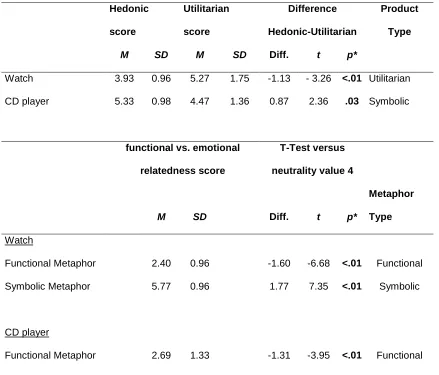
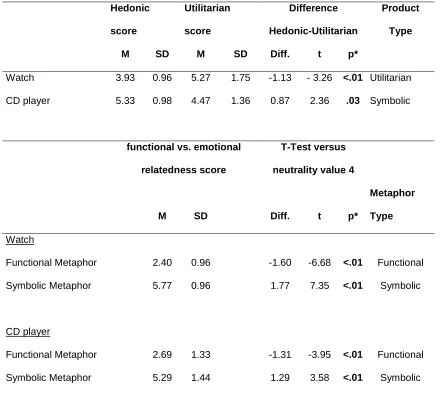
A designer watch with a relatively high utilitarian score but low hedonic score was chosen as the utilitarian product (hedonic – utilitarian difference = -1.13, t(14) = - 3.26, p < .01). A wall mounted cd player on the other hand received a high hedonic score but a low utilitarian score and was chosen as a symbolic product (hedonic-utilitarian difference= 0.87, t(14) = 2.36, p < .03).
[image:11.612.70.509.341.716.2]In a second pretest another 16 students evaluated metaphorical comparisons for these products on three 7-point semantic differential scales (all Cronbach’s Alphas >.74). Functional metaphors were described as addressing usefulness and being functional and logical. Symbolic metaphors were described as addressing feelings and being emotional and artistic instead. Accompanying pictures were explicitly chosen to resemble the respective product.
Table 1. Pretest Stimuli Study1
Hedonic score
Utilitarian score
Difference Hedonic-Utilitarian
Product Type
M SD M SD Diff. t p*
Watch 3.93 0.96 5.27 1.75 -1.13 - 3.26 <.01 Utilitarian
CD player 5.33 0.98 4.47 1.36 0.87 2.36 .03 Symbolic
functional vs. emotional relatedness score
T-Test versus neutrality value 4
M SD Diff. t p*
Metaphor Type
Watch
Functional Metaphor 2.40 0.96 -1.60 -6.68 <.01 Functional
Symbolic Metaphor 5.77 0.96 1.77 7.35 <.01 Symbolic
CD player
Symbolic Metaphor 5.29 1.44 1.29 3.58 <.01 Symbolic Notes. *Statistical significant values (p<.05) are boldfaced.
Because of the semantic differential scale, mean scores significantly greater than the neutrality value 4 indicated emotional relatedness, while scores significantly below 4 indicated functional relatedness. T-tests against the neutrality value 4 identified corresponding symbolic metaphors (‘This designer watch is elegant and exclusive just like a butterfly3’ t(15)=7.35, p<.01 / ‘This cd player expresses that music can be just like a source of light’, t(15) = 3.58, p<.01) as
well as functional metaphors (‘This designer watch is reliable and versatile just like a multi-tool’,
t(15) = -6.68, p<.01 / ‘This cd player works simple and intuitive just like a stringswitch lamp’,
t(15) = -3.95, p<.01) for each product. All used scales can be found in Appendix A1.
Participants and experimental design
For the main study, a 2 x 3 between-subjects factorial design was chosen with product type (symbolic vs. utilitarian) and metaphorical context information (symbolic vs. functional vs. no context/control) as independent factors. Dependent variables were dimensions of product personality (sophistication, sincerity, excitement and competence) and product attitude (symbolic value, utilitarian value).
Overall 141 participants, 57 males and 84 females, ranging from 17 to 58 years (M=24.03,
SD=5.37) took part in an online questionnaire. Most participants were students of the Twente
University with German (69.5%) or Dutch (28.4%) nationality. As an incentive a lottery for an actual mp3-player was offered.
3
Procedure
The study was realized in an online survey environment hosted by www.thesistools.nl. All constructs were measured on 7-point Likert-scales. First, participants were informed about the purpose and length of the study, the whereabouts of the experimenter and were asked for their informed consent to participate. Then a short instruction screen followed with some demographical questions.
Each participant had to evaluate a product presented with an accompanying metaphor. Participants in the control groups saw the product design without any metaphorical context information just with a minimal description of the product (e.g. “This is a watch design.”).
After presenting the stimulus picture, participants evaluated the product on dimensions of product personality and product attitude. In the experimental conditions the perceived product-metaphor-fit was also measured as a possible covariate. In the control condition this scale was replaced with three open questions about functional, emotional and objects related associations with the presented product. Finally participants had the opportunity to describe their own associations with the product and to write a comment. The product picture was visible in each screen of the questionnaire. After completion participants were thanked, debriefed and invited to participate in a lottery for an mp3-player.
Dependent Variables
sophistication). It is interesting to note that the study of Ang and Lim (2006) also found ‘cheerful’ a weak contributor to the sincerity scale.
The resulting scales yielded Cronbach’s Alphas of α =.64 for sophistication, α =.72 for
sincerity, α =.74 for excitement and α =.85 for competence. The mean scores were calculated for
each scale and served as dependent variables.
Product attitude was measured with a 10-item scale as modified and validated by Voss et al. (2003). The reliability of this scale was α =.89, with the subscales for symbolic value and
utilitarian value yielding α =.91 and α =.89 respectively.
Content relatedness of the metaphor was checked by 2 items, one for functional relatedness and one for emotional relatedness.
The perceived product-metaphor-fit was measured by 4 items that were already used in the pretest and yielded α =.93. All used stimuli and items can be found in APPENDIX A 2&3.
Results
Manipulation Check
Product Type. Utilitarian products were supposed to score high on utilitarian product values and symbolic products were supposed to score high on hedonic product values.
The overall effect for product type with F(12, 98) = 14.96, (p<.01) was found to be significant. In the control group, utilitarian products indeed scored higher on utilitarian values than symbolic products (M = 5.04, SD = 1.09 versus M = 4.38, SD = 1.25, F(1, 42) = 5.77,
p<.02). Symbolic products on the other hand received higher scores in symbolic values than
Metaphorical context information. Perceived product – metaphor – fit did not differ between functional and symbolic metaphors (symbolic: M = 3.91, SD = 1.06 versus functional:
M = 4.39, SD = 1.27), F(1,72) = 2.61, ns. Participants indicated whether they perceived the
presented metaphor as explaining a function or communicating something emotional related. Over all products, symbolic metaphors received higher emotional ratings (M = 4.57, SD = 1.62) than functional ratings (M = 3.60, SD = 1.81), F(1,87) = 4.36, p < .04. Separated for product type, this also holds for symbolic (M = 4.52, SD = 1.86 versus M = 3.67, SD = 2.03) and utilitarian products (M = 4.63, SD = 1.34 versus M = 3.53, SD = 1.58), F(1,72) = 3.28, p < .07. Functional metaphors were perceived as more functional (M = 5.55, SD = 1.50) than emotional (M = 4.95, SD = 1.64) for symbolic products only. For utilitarian products the functional metaphors were perceived as neither functional (M = 3.37, SD = 1.59) nor emotional (M = 3.69,
SD = 1.66). Metaphor relatedness was overall successfully manipulated, excepting the functional
metaphors for utilitarian products. Hypotheses testing
A multiple analysis of variance (MANOVA) was conducted with product type (symbolic, utilitarian) and context metaphor (none, symbolic, functional) as independent factors. Dimensions of product personality (sophistication, sincerity, excitement, competence), dimensions of product attitude (symbolic value, utilitarian value) and manipulation checks (functional
Table 2. Analysis of statistical significance for multivariate effects
MANOVA
Source df Error F p*
Product Type (A) 8 102 15.18 <.01
Metaphor (B) 16 204 24.81 <.01
A X B 16 204 4.01 <.01
Notes. *Statistical significant values (p<.05) are
relatedness, emotional relatedness) were used as dependent variables.
Significant effects were further scrutinized with corresponding follow-up ANOVAS.
Multivariate statistics corrected for multiple testing indicated the significance of all effects for product type, F(8, 102) = 15.18, p < .01, metaphor, F(16, 204) = 24.81, p < .01, and corresponding interaction effects, F(16, 204) = 4.01, p < .01 (see table 4).
Effects on product personality: sophistication. There was no main effect of product type on sophistication F(1, 109) = 1.17, ns..
The metaphorical context was hypothesized to increase perceived product sophistication, but there was also no main effect of metaphor, F(2, 109) = 0.10, ns. Therefore the sophistication part of hypotheses 1 and 2 could not be supported.
An interaction effect of product type and metaphor on sophistication was well significant, F(2, 109) = 5.62,
p < .01. For utilitarian products this result did not reach significance, F(2, 62) = 2.35, ns.
[image:16.612.83.520.295.547.2](control: M = 3.41, SD = 1.21; symbolic: M = 4.28, SD = 1.07; functional: M = 3.91, SD = 1.23). Symbolic metaphorical context showed an expected increasing effect on sophistication when compared to the control group F(1, 34) = 5.17), p < .03, but not compared to functional metaphors, F(1, 33) = 0.91, ns. Within the symbolic metaphor condition the difference between
symbolic (M = 3.09, SD = 1.28) and utilitarian M = 4.28, SD = 1.07) products was also significant F(1, 47) = 10.97, p < .01. Functional metaphors did not significantly differ from the control group, F(1, 31) = 1.35, ns., as expected. Therefore hypotheses 5 was weakly supported.
Symbolic products significantly differed in perceived sophistication when introduced with metaphorical context information, F(2, 69) = 4.53, p < .01 (control: M = 4.03, SD = 1.00; symbolic: M = 3.09, SD = 1.28; functional: M = 3.68, SD = 1.17). However, this effect was found to be significant only for the difference between symbolic metaphors and the control group
F(1, 44) = 7.63, p < .01. The difference between symbolic and functional metaphors was not
significant F(=1, 43) = 2.54, ns., neither was the difference between functional metaphors and the control group, F(1, 41) = 1.15, ns.
Effects on product personality: sincerity. There was a main effect of product type on sincerity, F(1, 109) = 14.58, p < .01. Utilitarian products were significantly perceived as more sincere than symbolic products as hypothesized (utilitarian: M = 4.17, SD = 0.99; symbolic: M = 3.47, SD = 1.25). There was no main effect of metaphor on sincerity, F(2, 109) = 2.06, ns., rejecting hypotheses 1 and 2. Yet, significant interaction effects of product type and metaphor could be found for sincerity, F(2, 109) = 13.49, p
< .01. This was mainly
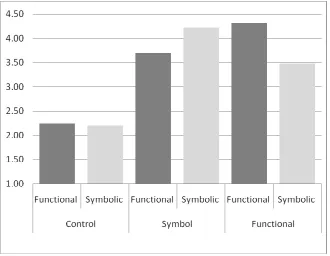
[image:17.612.83.381.467.697.2]caused by significantly higher sincerity scores of utilitarian products within the symbolic Figure 2. Perceived sincerity of symbolic and utilitarian products between
metaphor context F(1, 46) = 53.22, p < .01 (utilitarian: M = 4.58, SD = 0.99; symbolic: M = 2.58, SD = 0.91). Furthermore perceived sincerity of symbolic products significantly changed between metaphorical contexts F(2, 68) = 12.98, p < .01 (control: M = 3.99, SD = 1.31; symbolic: M = 2.58, SD = 0.91; functional: M = 3.94, SD = 0.99). The effect depended on a significantly lower sincerity score of products with symbolic metaphors, compared to the control group F(1, 44) = 18.13, p < .01, as well as compared to functional metaphors, F(1, 43) = 22.92,
p < .01. There was no significant difference between functional metaphors and control group
F(1, 41) = 0.02, ns.
Against expectations for utilitarian products scores of sincerity were significantly higher for symbolic (M = 4.58, SD = 0.99) than for functional (M = 3.89, SD = 0.81) metaphors F(1, 33) = 4.96, p < .03, rejecting hypotheses 4 for sincerity.
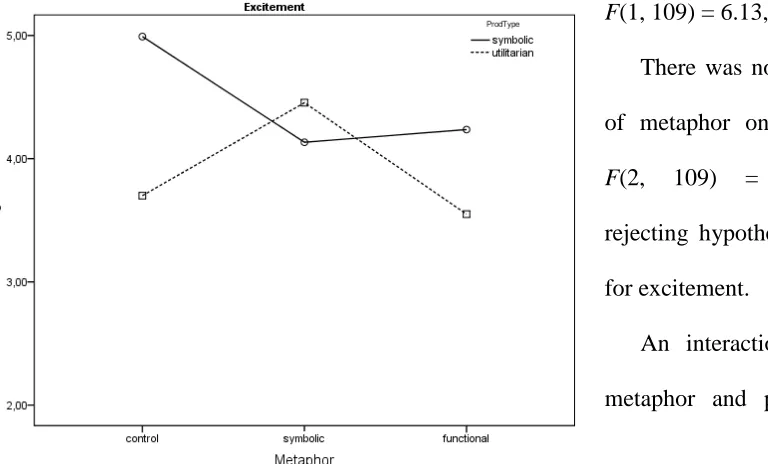
Effects on product personality: excitement. A main effect of product type on excitement was significant, F(1, 41) = 21.26, p < .00. As predicted, symbolic products were found more exciting than utilitarian products (M = 4.99, SD = 0.75 vs M = 3.70, SD = .92) in the control group and over all conditions, (symbolic: M = 4.43, SD = 1.21; utilitarian: M = 3.94, SD = 1.03,
F(1, 109) = 6.13, p < .02.
There was no main effect of metaphor on excitement,
F(2, 109) = 2.35, ns.,
rejecting hypotheses 1 and 2 for excitement.
[image:18.612.92.476.487.719.2]An interaction effect of metaphor and product type
was well significant, F(2, 109) = 5.79, p < .01. Symbolic products were overall perceived less exciting in both metaphorical contexts (control: M = 4.99, SD = 0.75; symbolic: M = 4.13, SD = 1.37; functional: M = 4.17, SD = 1.24), F(2, 69) = 4.36, p < .02. Significant were the differences between control group and both metaphors, with F(1, 44) = 6.76, p < .01 for the difference between control group and symbolic metaphors and with F(1, 41) = 6.93, p < .01 for the difference between control group and functional metaphors. Symbolic products with functional metaphors did not differ in perceived excitement to symbolic products with symbolic metaphors,
F(1, 43) = 0.01, ns.
Perceived excitement of utilitarian products also significantly differed between metaphorical context conditions, F(2, 57) = 3.45, p < .04 (control: M = 3.70, SD = 0.92; symbolic: M = 4.48,
SD = 1.00; functional: M = 3.55, SD = 0.97). Symbolic metaphors significantly raised
excitement compared to the control group F(1, 34) = 6.07, p < .02 as well as compared to functional metaphors F(1, 33) = 7.82, p < .01, confirming hypothesis 4.
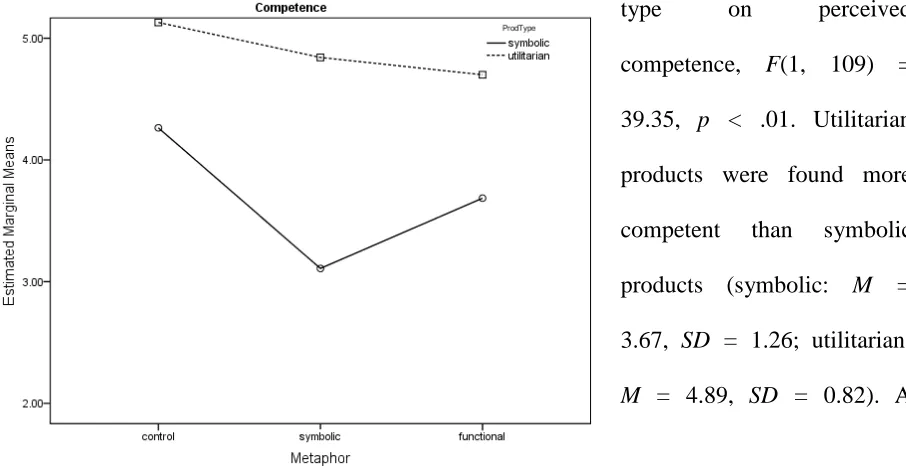
Effects on product personality: competence. There was a significant main effect of product
type on perceived
competence, F(1, 109) = 39.35, p < .01. Utilitarian products were found more competent than symbolic products (symbolic: M = 3.67, SD = 1.26; utilitarian:
[image:19.612.84.537.461.694.2]M = 4.89, SD = 0.82). A
main effect of metaphor on competence was also significant F(2,109) = 5.05, p < .01. In the control condition products were seen as more competent (M = 4.64, SD = 1.14) than with symbolic (M = 3.93, SD = 1.42), F(1, 75) = 8.62, p < .01, or with functional metaphors (M = 4.10, SD = 1.06), F(1, 71) = 5.31, p < .02. Hypothesis 1 was supported.
Products with functional metaphors were not significantly more competent than products with symbolic metaphors, F(1, 72) = 0.64, ns., so hypothesis 2 was rejected for competence.
Interaction effects of metaphor and product type on competence did not reach significance,
F(2,109) = 1.89, ns.
Effects on product attitude: symbolic value. The main effect of product type was significant for symbolic value F(1, 109) = 7.17, p < .01, showing that symbolic products had more perceived symbolic value than utilitarian products (symbolic: M = 4.27, SD = 1.26; utilitarian: M = 3.74, SD = 1.14).
There was also a main effect of metaphorical context condition on perceived symbolic value F(2, 109) = 5.97, p < .01. Products presented with symbolic metaphors (M = 4.41, SD = 1.16) had a higher perceived symbolic value than products presented with functional metaphors (M = 3.56, SD = 1.12),
F(1, 72) = 11.30, p < .01,
[image:20.612.55.354.421.652.2]supporting hypothesis 3. Compared Figure 5. Symbolic value of symbolic and utilitarian products between
to the control group (M = 4.06, SD = 1.29) symbolic metaphors scored only marginally higher,
F(1, 75) = 3.29, p < .07, while functional products scored only marginally lower, F(1, 71) =
2.90, p < .09.
Furthermore, product type and metaphor showed a significant interaction effect, F(2, 109) = 6.86, p < .01. For symbolic products both metaphors diminished symbolic value F(2, 68) = 1.93,
ns. Compared to the control condition (M = 4.72, SD = 1.10), symbolic value marginally
decreased with symbolic metaphors (M = 4.31, SD = 1.30), F(1, 44) = 1.36, ns. while with functional metaphors is significantly decreased (M = 3.79, SD = 1.15), F(1, 41) = 7.38, p <.01. For utilitarian products the symbolic metaphors enhanced symbolic value F(2, 60) = 11.53, p < .01. The symbolic value of the product with the symbolic metaphor (M = 4.59, SD = 0.87) was higher compared to the control group (M = 3.21, SD = 0.98), F(1, 34) = 20.15, p < .01, as well as compared to products with functional metaphors (M = 3.28, SD = 1.02), F(1, 33) = 16.86, p < .01, supporting hypothesis 5 for symbolic value.
Effects on product attitude: utilitarian value. A significant main effect of product type was found for utilitarian
value, F(1, 109) = 26.69, p < .01, showing that utilitarian products over all conditions gained more utilitarian value than symbolic products (symbolic: M = 3.92, SD = 1.21; utilitarian: M = 4.94,
[image:21.612.230.533.467.700.2]SD = 0.98).
There was no main effect of metaphorical context condition on perceived utilitarian value
F(2, 109) = 2.11 , ns. leaving hypothesis 3 unsupported for symbolic value.
There was a significant interaction effect of product type and metaphor, F(2, 109) = 3.30, p < .04. For symbolic products utilitarian value decreased under symbolic and functional metaphors,
F(2, 70) = 3.11, p < .05. Compared to the control group (M = 4.38, SD = 1.25) symbolic
products with symbolic metaphors (M = 3.41, SD = 1.28) significantly lost utilitarian value F(1, 44) = 6.82, p < .01. There was no gain of utilitarian value for symbolic products with functional metaphors (M = 4.01 SD = 0.87), compared to the control group, F(1, 41) = 1.28, ns., confirming hypothesis 5 for utilitarian value.
For utilitarian products further no significant change was found F(2, 60) = 1.79, ns. However, products with symbolic metaphors (M = 5.15, SD = 0.71) tended to gain higher scores of utilitarian value than products with functional metaphors (M = 4.61, SD = 1.07), F(1, 33) = 3.12, p < .09, or than products of the control group (M = 5.01, SD = 1.12), F(1, 34) = 0.19, ns. Summary and discussion of study 1
The results mainly confirm that the perceived personality of a product follows patterns known from the perceived personality of brands. For one, perceived product personality traits were related to the perceived product type (being utilitarian or symbolic) of a product. Utilitarian products were seen as more competent and sincere while symbolic products were more exciting. However, sophistication was not perceived to be significantly different between both product types.
symbolic metaphors make it more symbolic, resulting in increased sophistication and excitement. The results show weak evidence for these exploratory claims. A main effect of metaphor was significant for the personality dimension of perceived competence and marginally for excitement. Overall, products introduced with symbolic metaphors were perceived as less competent than the same products without any context or with functional metaphors. Products with functional metaphors were perceived as less exciting, while products with symbolic metaphors did not differ over all from the control group. The content of the metaphors was therefore important for the effects.
The metaphors further showed different effects for utilitarian and symbolic products. Symbolic metaphors did enhance sophistication, excitement and sincerity in utilitarian products, while having no or a decreasing effect on these personality perceptions of symbolic products. Functional metaphors had no strong effect on symbolic products, but significantly decreased the excitement of utilitarian products. These asymmetric effects are in line with prior findings of Lim and Ang (2008), who also found only utilitarian products to profit from symbolic advertisement. While the found results were not strictly in line with all expectations, they still suggest that functional and symbolic metaphors indeed have an own impact on product perception.
online environment. Perhaps due to this manipulation difficulty the postulated hypotheses for metaphors could not be strongly confirmed in this experiment.
The difference between the products was also maybe too strong. While the utilitarian watch was a familiar, quite common design, the wall mounted cd player was rather strange and uncommon. Differences in perceived originality or product aesthetics may also have influenced the subtle effects of presented metaphors. Also, the artwork of the stimuli was quite simple, because they were only supposed to communicate the metaphor. This could also be a factor for the lower ratings on excitement in comparison to the control condition, which depicted only the product.
Finally, individual differences between subjects have not been assessed, which may have a major impact on how context information is processed and evaluated.
Study 2
Self-Regulatory Focus
Regulatory focus theory states that two different motivational systems regulate the way an individual evaluates information and accomplishes goals (Higgins et al., 2001). These motivational systems are distinguished into a promotion focus and a prevention focus. Individuals in a promotion focus concentrate on goals, ideals and possible gains and try to approach towards positive outcomes. Individuals in a prevention focus, concentrate on obligations, responsibilities and possible threads and try to avoid negative outcomes. The preferred focus of an individual, with regard to an individual’s past experience of success to avoid negative or approach positive outcomes is called chronic regulatory focus. The second study introduces regulatory focus to examine the influence of an individual’s psychological status on product perception. Specifically it is assumed that the proposed effect of the metaphorical context on product perception is moderated by the chronic regulatory focus of participants.
Several studies investigated the fit of effects of regulatory focus with the attitude towards messages and products (Hassenzahl et al., 2008; Aaker & Lee, 2001; Wang and Lee, 2006) but scarcely on product personality perception.
Also, experienced regulatory focus fit with a message or brand leads to higher persuasiveness and liking of that message or brand (Aaker & Lee, 2001) and increases the perceived value of objects (Wang & Lee, 2006). Message features that appeal to the different foci (promotion versus prevention) are for example win versus loss frames, evoked independency versus interdependency (Aaker& Lee, 2001), abstract versus concrete (Keller, Lee & Sternthal 2004), context related versus item-specific (Zhu & Meyers-Levy, 2007) complexity versus simplicity, hedonic attributions versus pragmantic attributions, and proposed be-goals versus proposed do-goals (Hassenzahl et al., 2008). Finally, when confronted with mixed information, people tend to express a confirmation bias based on their regulatory focus and judge information which fits into their focus as more important (Wang and Lee, 2006).
Product Personality, Metaphorical Context and Regulatory Focus
An enhancing effect of regulatory focus fit on the persuasiveness and liking of corresponding metaphors is expected. In detail, individuals with a chronic promotion(prevention) focus should be more attracted and persuaded by a symbolic(functional) metaphors and perceive the product as more exciting (sincere), sophisticated(competent) and symbolic (utilitarian) than those with a prevention (promotion) focus. The effects of metaphors on product perception are therefore supposed to be moderated by the chronic regulatory focus of each subject.
Hypothesis 6: For subjects with a relatively strong promotion focus, symbolic metaphors
Hypothesis 7: For subjects with a relatively strong prevention focus, symbolic metaphors
should result in decreasing scores for sophistication, excitement, and symbolic values.
Functional metaphors for those subjects should result in increasing scores for sincerity, competence and utilitarian values.
Finally, product attitude as measured by appeal, consuming intention and pricing should be higher in the fitting conditions.
Hypothesis 8: Product Appeal and Consuming intention receive increasing ratings when a
product is introduced to promotion focused individuals with a symbolic metaphor and to prevention focused individuals with a functional metaphor.
Hypothesis 9: Expected pricing of the product is higher when it is introduced to promotion
focused individuals with a symbolic metaphor and to prevention focused individuals with a
functional metaphor.
Method
Stimuli development.
product and whether it relates to distinct functional or experience oriented benefits of the product.
Participants evaluated 3 functional and 3 symbolic intended metaphors consisting of a headline with an accompanying picture, displaying the product and a pictorial cue for the metaphor. As a control condition the product was presented with a headline featuring redundant non-metaphorical information. Pictures were counterbalanced over all participants to control for effects of serial order. Finally participants were thanked.
To find significant functional versus symbolic metaphors, a paired sample t-test was conducted on the difference score between the symbolic and functional relatedness score of each metaphor.
For the significantly functional and symbolic metaphors, relative fit and understanding scores were taken into further consideration.
Table 3 Stimuli Development Study 2
Descriptives
Functional Metaphor Control Symbolic Metaphor
Scale M SD M SD M SD N
Functional score 4.75 2.17 2.80 1.82 3.20 1.61 20
Symbolic score 2.80 1.82 2.15 1.57 5.00 1.52 20
Fit 3.65 1.95 3.90 2.13 4.00 1.78 20
Understanding 4.85 2.08 4.00 2.08 4.55 1.73 20
Paired Sample T-test Statistics
Functional Metaphor Control Symbolic Metaphor
t(19) p* t(19) p* t(19) p*
T-test func-symb 3.35 <0.01 1.66 0.11 -4.28 <0.01
Notes. *Significant results (p<.01) are boldfaced.
Experimental design and participants
The second study used a two factor between-subjects design with metaphorical context information (symbolic vs. functional vs. no context/control) as independent factor. The chronic regulatory focus of participants (promotion vs. prevention) was measured and used as a second factor via a median split. Dependent variables were dimensions of product personality (sophistication, sincerity, excitement and competence), pricing and 3 scales for product attitude (I: appeal, utilitarian value, symbolic value/ II: utilitarian value, hedonic value / III: price, consume intention, utilitarian value, symbolic value).
Procedure
The study was realized like the first study in a web environment hosted by www.thesistools.nl. Participants were told that an advertising campaign for an Aloe Vera drink was being developed and that the researchers were interested in learning how the target groups may perceive the product within the campaign. The chronic regulatory focus of participants was assessed first using the regulatory focus questionnaire. Afterwards they were presented an advertisement of the Aloe Vera drink and were instructed to evaluate the product on dimensions of product personality and product attitude. Manipulation checks with regard to the metaphor relatedness were assessed at the end of the study. Finally, participants were thanked and debriefed. All used scales and the actual used web-versions can be found in the Appendix.
Dependent variables
Regulatory Focus. To assess the chronic regulatory focus of participants the 11 items 7-point Likert Regulatory Focus Questionnaire (RFQ, Higgins et al., 2001) was used in a Dutch and German translation as validated in the pretest. A median split was used on the difference between participant’s promotion and prevention scores to classify them into relatively more promotion or relatively more prevention oriented (Higgins et al. 2001; Lockwood & Jordan 2002).
Fantasievol, Pittig, Uitdagend, Interessant), and Competence (Betrouwbaar, Efficiënt, Vertrouwd, Veraantwoord, Successvol).
Product Attitude. Attitude towards the product was measured in three different ways to account for the diversity of functional versus symbolic product properties.
First, by using a 23 item 7-point semantic differential scale adapted from Hassenzahl et al. (2008) which differentiates appeal, pragmatic and hedonic value. The pragmatic score was counted as the utilitarian value and the hedonic score was counted as the symbolic value within this scale.
Second, by using 8 additional items from the previously used hedonic / utilitarian scale as validated by Voss et al. (2003). In this scale, the utilitarian score was used as the utilitarian value and the hedonic score again represented the symbolic value.
Finally 12 new items, tailored for the product at hand, were used to assess each functional (5) and symbolic (5) properties of the product, pricing (1) and consuming intention (1). The functional score represented utilitarian value, while the symbolic score was used as the symbolic value. All items were presented in Dutch or German.
Results
Measures and Manipulation Checks
Regulatory Focus. To investigate the influence of regulatory focus, participants were segregated into relatively more promotion or prevention focused by using a median split technique (Higgins et al., 2001). First the chronic RFQ Promotion and RFQ Prevention scores of participants were assessed by the regulatory focus questionnaire (RFQ). Scores of the promotion scale (α = .63, 6 items) and the prevention scale (α = .73, 5 items) had no significant
Prevention score) was 0.60 (M = 0.51, SD = .92, ranging from -2.50 to 3.20), so all individuals with a score equal or below 0.60 were classified as prevention focused (N = 84) while individuals with a higher score were labeled promotion focused (N = 85).
Product Personality. Dimensions of product personality were assessed with 5 items each. Reliablity statistics showed a very low item-to-scale correlation for the ‘pretentious’ item of the sophistication scale (r = .08) and the ‘childish’ item of the sincerity scale (r = .18), so these items were removed for the calculations of the dependent variable means. Cronbach’s Alpha’s for the final scales were α = .71 for Sophistication (4 items), α = .68 for sincerity (4 items), α = .75 for
excitement (5 items) and α = .89 for competence (5 items).
Product Symbolism, Utilitarism and Attitude. Attitude I: The measure adapted from Hassenzahl et al. (2008) with 3 subscales yielded α = .94 for appeal (8 items), α = .88 for symbolic value (‘hedonic’, 7 items) and α = .76 for utilitarian product value (‘pragmatism’, 8 items).
Attitude II: The hedonic / utilitarian scale (Hed/Ut) as validated by Voss et al. (2003) yielded α = .86 for the utilitarian value (5 items) and α = .90 for the symbolic value (‘hedonic’, 5 items) subscale.
Attitude III: The 5 questions regarding functional aspects of the product yielded α = .83 as scale for utilitarian value and the 5 questions regarding symbolic value gained α = .69 as a scale. Additionally the intention to consume the product and the estimated product price were assessed.
was seen as more symbolic (M = 4.23, SD = 1.90) than functional (M = 3.70, SD = 1.91), t(56) = -2.78, p < .01. For the functional metaphor, functional relatedness was perceived higher (M = 4.31, SD = 1.81) than symbolic relatedness (M = 3.48, SD = 1.87), t(53) = 3.21, p < .01. The content relatedness of the metaphors was therefore successfully manipulated.
Figure 7. Manipulation Check: functional versus symbolic metaphor relatedness per conditions
Analysis of variance and hypotheses testing
F(13, 151) = 0.83, p < .63, ns., and interaction effects between context and focus F(26, 302) =
1.33, p < .14, ns. are might accusable to chance.
Effects of metaphorical context and regulatory focus on product perception
Effects on product personality: sophistication. There was no main effect of metaphor for sophistication, F(2, 163) = 1.11, p < .33. Therefore hypotheses 3 and 4 could not be confirmed. There was also no main effect of regulatory focus F(1, 163) = 0.25, ns., nor an interaction effect of focus and context F(2, 163) = 1.01, ns. For sophistication, hypotheses 6 and 7 were not supported.
Effects on product personality: sincerity. The main effect of metaphor on perceived sincerity of the product was marginally significant F(2, 163) = 2.46, p < .09. The product was seen as slightly more sincere in the control condition (M = 3.43, SD = 1.14) than with the symbolic metaphor (M = 3.19, SD = 1.19), F(1, 111) = 1.28, ns., but as significantly more sincere than with the functional metaphor (M = 2.94,
SD = 1.15), F(1, 108) = 5.09, p < .03.
The difference in perceived sincerity between symbolic and functional metaphor was not significant F(1, 107) = 1.17, ns. Therefore hypotheses 2 and 3 were not supported for sincerity.
No main effect of regulatory focus F(1, 163) = 0.36, ns., was found. Figure 8. Perceived sincerity of the product by promotion and
An interaction effect of focus and metaphor F(2, 163) = 2.81, p < .06, was marginally significant. With the symbolic metaphor, promotion focused people evaluated the product as less sincere than prevention focused people (M = 3.38, SD = 1.17 vs. M = 3.03, SD = 1.20), F(1, 55) = 1.27, ns. With the functional metaphor, promotion focused people perceived more product sincerity than prevention focused people (M = 3.21, SD = 1.21 vs. M = 2.72, SD = 1.07), F(1, 52) = 2.50, ns. While subjects with a promotion focus did not significantly differ in their perception of sincerity between the symbolic and the functional metaphor (M = 3.03, SD = 1.20 vs M = 3.21, SD = 1.21), F(1, 52) = 0.31, ns., subjects with a prevention focus evaluated the product significantly less sincere with the functional metaphor (M = 3.38, SD = 1.17 vs. M = 2.72, SD = 1.07), F(1, 55) = 5.00, p < .03. For sincerity hypotheses 6 and 7 were therefore rejected.
Effects on product personality: Excitement. There was no main effect of metaphor on perceived excitement of the product, F(2, 163) = 0.83, ns. Hypothesis 2 and 3 were not supported.
There was no main effect of regulatory focus on excitement F(1, 163) = 0.36, ns. and no interaction effect was found F(2, 163) = 0.08, ns. For excitement hypotheses 6 and 7 were therefore rejected for excitement.
Effects on product personality: Competence. No main effect of metaphor on perceived competence of the product was found F(2, 163) = 0.71, ns. Hypotheses 2 and 3 were not supported for competence.
The interaction effect of regulatory focus and metaphorical context on competence did not reach significance F(2, 163) = 1.40, ns. For competence hypotheses 6 and 7 did not hold.
Effects on product attitude I: Appeal. There was no main effect of metaphor on perceived appeal of the product, F(2, 163) = 0.53, ns.
Regulatory focus of the subjects also showed no main effect on perceived product appeal
F(1, 163) = 0.28, ns.
Interaction effects of metaphorical context and regulatory focus did not reach statistical significance F(2, 163) = 1.91, ns.
A marginal effect could be traced back to the point that only for prevention focused subjects the product in the symbolic context was found more appealing (M = 4.17, SD = 1.40) than in the functional context (M = 3.51, SD = 1.11), F(1, 55) = 3.93, ns. and more appealing than for promotion focused subjects (M = 3.52, SD = 1.35), F(1, 55) = 3.18, p < .08.
This is the opposite of what has been expected so hypothesis 8 was rejected.
Effects on product attitude I: Symbolic value. There was no main effect of metaphor on the symbolic value of the product as measured by the first attitude scale, F(2, 163) = 1.77, ns.
There was also no main effect of the regulatory focus on the symbolic value perception F(1, 163) = .002, ns. Interaction between metaphor and regulatory focus did not occur F(2, 163) = 0.16, ns. Hypotheses 7 and 8 could not be confirmed for symbolic value (I).
F(1, 108) = 1.44, ns. The product with the functional metaphor was not found more utilitarian
than in the symbolic context, F(1, 107) = 0.93, ns.
There was no main effect of regulatory focus on perceived utilitarian value F(1, 163) = 0.56,
ns. An interaction effect of metaphor and regulatory focus did not reach significance F(2, 163) =
0.97, ns. Hypothesis 6 and 7 were not supported for utilitarian value (I).
As measured by the first attitude scale, the metaphor a product was presented with had only a marginal impact on symbolic value and did not change the perceived utilitarian value of the product.
Effects on product attitude II: Symbolic value. There was no main effect of metaphor on symbolic value of the product as measured by the Hed/Ut scale, F(2, 163) = 0.99, ns.
The regulatory focus of subjects had no main effect on the symbolic value F(1, 163) = 0.06,
ns. either.
Effects on product attitude II: Utilitarian value. There was no main effect of metaphor on utilitarian value of the product as measured by the Hed/Ut scale, F(2, 163) = 0.44, ns.
There was no main effect of regulatory focus on perceived utilitarian value, F(1, 163) = 2.03,
ns.
There was no interaction effect between regulatory focus and metaphor F(2, 163) = 0.90, ns. Hypotheses 6 and 7 were not supported for utilitarian value (II).
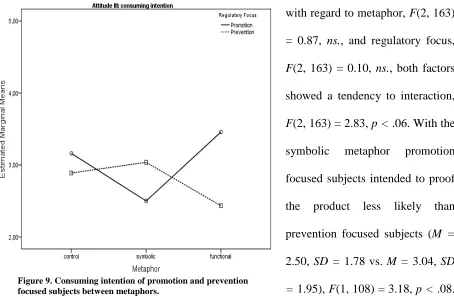
Effects on product attitude III: Consuming intention. Participants were asked whether they would intend to proof the product. While there was no main effect on consuming intention with regard to metaphor, F(2, 163) = 0.87, ns., and regulatory focus,
F(2, 163) = 0.10, ns., both factors
showed a tendency to interaction,
F(2, 163) = 2.83, p < .06. With the
symbolic metaphor promotion focused subjects intended to proof the product less likely than prevention focused subjects (M = 2.50, SD = 1.78 vs. M = 3.04, SD
= 1.95), F(1, 108) = 3.18, p < .08.
[image:38.612.85.539.287.583.2]With the functional metaphor however, promotion focused subjects liked it more than prevention focused subjects (M = 3.46, SD = 1.96 vs. M = 2.43, SD = 1.85), F(1, 52) = 3.89, p < .05. Hypothesis 8 was rejected for consuming intention.
Effects on product attitude III: Symbolic value. Finally the symbolic value of the product was assessed by 5 specific questions. Metaphor had a main effect on this perceived symbolic value F(2, 163) = 5.64, p < .01. As expected, subjects who saw the product with the symbolic metaphor judged it to be more symbolic (M = 4.09, SD = 1.12) than those that saw it with the functional metaphor (M = 3.31, SD = 1.23), F(1, 107) = 11.16, p < .01 or those in the control condition (M = 3.58, SD = 1.24), F(1, 111) = 5.25, p < .02. Functional metaphor and control condition did not differ, F(1, 108) = 1.05, ns. Hypothesis 3 was confirmed for symbolic value (III).
The regulatory focus of subjects had no main effect on the perception of the product’s symbolic value, F(1, 163) = 0.76, ns., nor was an interaction of regulatory focus and metaphor significant F(2, 163) = 0.54, ns. Hypotheses 6 and 7 were not confirmed for symbolic value (III). Effects on product attitude III: Utilitarian value. There was no main effect of metaphor on the perceived utilitarian value regarding to the specific product related questions, F(2, 163) = 0.29, ns. Worth mentioning however is that participants across all conditions disagreed that the function of the product is measurable (M = 2.47, SD = 1.50), while strongly agreeing that it is consumed for the effect of its ingredients (M = 4.26, SD = 1.76).
Effects on product attitude III: Price. The final measure of product attitude was the estimated price for the product. Participants were asked to name a price they would consider adequate for the product. Product pricing ranged from 0.20 Eurocent to 6.00 Euro per bottle with a mean of 1.35 Euro (SD = 0.81) The most quoted (mode) price was 1.50 Euro and was named 18 times followed by 1.00 Euro and 2.00 Euro (both 17 times).
There was no main effect of metaphor on estimated price F(2, 163) = 0.87, ns., and no main effect of regulatory focus, F(1, 163) = 0.10, ns. An interaction effect of metaphor and regulatory focus was significant for the estimated price, F(2, 163) = 2.83, p < .06. While promotion focused subjects in the control condition chose higher prices for the product than prevention focused individuals (M = 1.41, SD = 0.96 vs. M = 1.05, SD = 0.50), F(1, 56) = 3.06, p < .09, this pattern changed with symbolic metaphors (M = 1.23, SD = 0.61 vs. M = 1.56, SD = 0.77), F(1, 55) = 3.21, p < .08 and functional metaphors (M = 1.34, SD = 1.08 vs. M = 1.49, SD = 0.79),
F(1, 52) = 0.34, ns. Furthermore, while individuals with a promotion focus gave quite equal
prices over all conditions, F(2, 82) = 0.33, p < .72, ns., individuals with a prevention focus chose significantly lower prices in the control condition compared to those who saw symbolic metaphors (M = 1.05, SD = 0.50 vs. M = 1.56, SD = 0.77), F(1, 52) = 8.16, p < .01, of
functional metaphors (vs. M = 1.49, SD = 0.79), F(1, 55) = 6.09, p < .02. There was no difference between the two metaphors though, F(1, 55) = 0.11, ns. Hypothesis 9 was only slightly confirmed for prevention focused individuals. While promotion focused individuals found the product more valuable in the control condition, prevention focused subjects attributed greater value in both metaphorical context conditions.
Product type perception across the context conditions. To test whether the product was perceived relatively more symbolic or utilitarian, in each condition a paired sample t-test was conducted, comparing the utilitarian vs. symbolic value of each attitude scale. In the control condition, attitude I (Pragmatic/Hedonic) would categorize the product to be significantly utilitarian (t(57) = 3.66, p < .01), for its pragmatic value was higher than its hedonic value, while attitude II (Hed/Ut scale) (t(57) = 0.36, p < .72, ns.) and III (own questions) (t(57) = -0.50, p < .96, ns.) found the product not to be more functional or symbolic.
In the symbolic condition, all attitude scales indicated higher symbolic than utilitarian value for the product. The hedonic value assessed by the attitude I scale however was not significantly higher than the utilitarian value (t(56) = -0.59, p < .56, ns. The attitude II measure (Hed/Ut scale) would only label the product symbolic in one sided testing (t(56) = -1.75, p < .09(.045 one-sided)), while attitude III would categorize it to be significantly symbolic (t(56) = -3.56, p < .01).
Summary and discussion of study 2
In contrast to the first study, no significant changes in any of the personality perceptions occurred across metaphorical context conditions. However this also means that no decreasing effects of metaphor per se occurred, what might be accredited to the content relatedness.
In the second study the regulatory focus of participants was measured and taken as an explanatory variable and only one product was assessed with different metaphors. In contrast to what was expected from the literature, subjects with a relatively high prevention focus, who are keen to prevent losses and tend to prefer utilitarian products and concrete practical features were more positive about the product when it was presented with a symbolic metaphor. They found the product more sincere and symbolic than their promotion focused fellows and judged it more appealing and expensive and were more likely to intend to consume the product. Promotion focused individuals on the other hand who are generally known to be more attracted towards symbolic products and personal development oddly gave much higher intentions to consume the product when it was presented with the functional metaphor. On all other measures promotion focused subjects made no differences between the context conditions. A possible interpretation is that for prevention focused subjects symbolic metaphors added a value to the product that they did not see before. On the other hand for promotion focused subjects the benefit of using the product was obviously most clear with the functional metaphor.
General discussion and conclusion
to influence product perception. Apart from that, personality perceptions of products tend to react in a similar way as known from brands.
The first study found that utilitarian products were more sophisticated, exciting and sincere, when introduced with a symbolic metaphor, while symbolic products with a symbolic metaphor were only less exciting. Functional metaphors had no significant effects on the perception of symbolic products, but significantly decreased the excitement of utilitarian products.
The second study additionally assessed the regulatory focus of participants but found no major influence of this psychological state on the perception of a product presented with different metaphors. Furthermore the featured product was neither symbolic nor utilitarian and functional versus symbolic metaphors had no significant influence on perceived product personality or symbolic and utilitarian value. Only for one measure of product attitude, the symbolic metaphor changed the perception of the product from neutral to symbolic. Looking at the specific questions, subjects in the symbolic metaphor condition especially agreed that the product is consumed to enjoy its taste and atmosphere, that it can show who you are and that it evokes emotions. They did not differ with subjects in the other conditions about the statement that the product design gives the product a distinct personality or that the product is trendy.
product design succeeds in the enterprise of ‘applied object-based phrenology’, assuming that distinct groups of people indeed draw stable implicit connections between physical form and personality traits. Consequently, and in line with prior research, a distinct pattern of perceived product personality seems to be grounded in the visual product design. So if the design does not already communicate the desired attributes of a product, it will be difficult to alter the first impression by placing the product in different contexts or marketing claims. For product marketing these findings give a clear direction. It is more important to carefully design a product beforehand, than trying to shape its perception in advertisement campaigns afterwards.
famous ‘greenhouse effect’ or the idea of ‘hair repair’ - shampoos, to stay at consumer products. This study tried to account for this kind of metaphors while still relating its stimuli to that of comparable studies (e.g. Ang & Lim, 2006). This study suggested the distinction between functionally versus symbolic related metaphors, having the personality associations with utilitarian versus symbolic products in mind. Maybe this distinction is not appropriate to receive the wanted results, but it may also be that the used stimuli did not work properly, despite the pre-testing. Pairing a product only with a metaphorical headline and a reference picture might not be sufficient to communicate the desired kind of serious functional metaphors. Participants try to make sense of the given stimuli with regard to the questions they have to fill in and the possibility remains that they just perceive it as somehow odd. Another problem with involving graphical stimuli may be that participants tend to judge their quality in place of their meaning. So careful and professional crafting of stimuli is important to avoid negative aesthetic based influences.
of the findings. Finally, all experimental measures were conducted in a web environment, leaving unclear how, where and when participants participated in the study.
References
Aaker, J. L. (1997). Dimensions of Brand Personality. Journal of Marketing Research, 34, 347– 356.
Aaker, J. & Lee, A. Y. (2001). ‘I’ Seek Pleasures and ‘We’ Avoid Pains: The Role of Self-Regulatory Goals in Information Processing and Persuasion. Journal of Consumer Research, 28 (June), 33–49.
Agarwal, N. (2008). A study of metaphors in advertising in Indian and UK editions of Elle and Vogue. Unpublished article. University of Nottingham
Ang S. H. & Lim E. A. C. (2006). The influence of metaphors and product type on brand personality perceptions and attitudes. Journal of Advertising, 35, 39–53.
Bardill, A., Karamanoglu, M., & Herd, K. (2005). Pleasure-based design approaches to the built environment. Municipal Engineer 158 Issue ME3, 183–193.
Brunel, F. F. & Kumar, R. (2007). Design and the Big Five: linking visual product aesthetics to product personality. In G Fitzsimons and V Morwitz (eds) Advances in consumer research, Association for Consumer Research, 34, 238-239.
Creusen, M. E. H. and Schoormans, J. P. L. (2005). The Different Roles of Product Appearance in Consumer Choice. Journal of Product Innovation Management, 22:63–81.
Demirbilek, O. & Sener, B., 2003. Product design, semantics, and emotional response.
Ergonomics 46 (13&14), 1346–1360.
Desmet, P. M. A. & Hekkert, P. (2007). Framework of product experience. International Journal
of Design, 1, 1, 57-66.
Desmet, P.M.A., Nicolás, J.C.O., & Schoormans, J.P. (2008). Product Personality in physical interaction. Design Studies, 29 (2008) 458-477.
Forceville, C. (1996). Pictorial metaphor in advertising. Routledge: London. Govers, P. C. M. (2004) Product personality. Ph.D. Thesis, Delft: TU
Govers, P. C. M. & Schoormans, J. P. L. (2005). Product personality and its influence on consumer preference., Journal of Consumer Marketing, 22, 4, 189-197.
Hassenzahl, M., Schöbel M. & Trautmann, T.(2008). How motivational orientation influences the evaluation and choice of hedonic and pragmatic interactive products: The role of regulatory focus. Interacting with Computers, 20, 473–479.
Hekkert, P. (2006). Design aesthetics: Principles of pleasure in product design. Psychology
Science, 48(2), 157-172.
Hey, J. H. G. & Agogino, A. M. (2007). Metaphors in Conceptual Design. ASME Design
Engineering Technical Conferences, Las Vegas, Nevada, in review, 2007.
Higgins, E. T., Friedman, R. T., Harlow, R. E., Idson, L. C., Ayduk, O. N. & Taylor, A. (2001). Achievement orientations from subjective histories of success: promotion pride versus prevention pride. European Journal of Social Psychology, 31, 3-23.
Inkson, K. (2006). Protean and boundaryless careers as metaphors. Journal of Vocational
Jordan, P. W. (1997). Products as Personalities. In Robertson, S. A. (Ed.), Contemporary
Ergonomics, London: Taylor & Francis, 73-78.
Keller, P., Lee, A. Y. & Sternthal, B. (2004). Construing Fit to Judgment: The Effects of Regulatory Focus and Level of Construal. working paper, Kellogg School of Management, Northwestern University.
Lakoff, G., & Johnson, M. (1980). Metaphors we live by. Chicago: University of Chicago Press. Lakoff, G. & Johnson, M. (1999). Philosophy in the Flesh: The Embodied Mind and Its
Challenge to Western Thought, Basic Books, New York, 1999.
Leder, H., Belke, B., Oeberst, A., & Augustin, D. (2004). A model of aesthetic appreciation and aesthetic judgments. British Journal of Psychology, 95, 489-508.
Lim E.A.C. & Ang S.H. (2008). Hedonic vs. utilitarian consumption: A cross-cultural perspective based on cultural conditioning. Journal of Business Research, 61, 3, 225-232. Lockwood, P. & Jordan, C. H. (2002). Motivation by Positive or Negative Role Models:
Regulatory Focus Determines Who Will Best Inspire Us. Journal of Personality and Social
Psychology, Vol. 83, No. 4, 854–864.
MacInnis, D. J. (2004). Crystal Clear Concepts: Using Metaphors to Expand Dimensional Thinking. ACR News (Winter), 1–4.
McQuarrie, E. F. & Mick, D. G. (1999). Visual Rhetoric in Advertising: Text-Interpretative, Experimental, and Reader-Response Analyses. Journal of Consumer Research, 26, 37–54. McQuarrie, E. F. & Phillips, B. J. (2005). Indirect Persuasion in Advertising: How Consumers
Process Metaphors Presented in Pictures and Words. Journal of Advertising, 34 (2), 7–20. Sheinin D.A. (2000). The effects of experience with brand extensions on parent brand
Tom, G. & Eves, A. (1999). The Use of Rhetorical Devices in Advertising. Journal of
Advertising Research, 39, 39–43.
Toncar, M. & Munch, J. (2001). Consumer Responses to Tropes in Print Advertising. Journal of
Advertising, 30 (1), 55–65.
Van Rompay, T. J., Pruyn, A. T., & Tieke,