Slaying the Demon
The Dementia Challenge: Progress and
Achievements
Melanie Henwood OBE, Terry Butler CBE, and Dr Katherine Pollard
January 2015
University of the West of England
Frenchay Campus
This review was undertaken by Terry Butler CBE, Adviser in Health and Social Care; Melanie Henwood OBE, Independent Health and Social Care Research Consultant, and Dr Katherine Pollard, Senior Research Fellow, University of the West of England. The views expressed are those of the authors.
Thanks are due to many people who assisted with this review of the Dementia Challenge Fund. First, we are grateful to NHS South of England for commissioning us to undertake the review and for supporting us to do so. In particular we would like to thank: Dr Geoff Harris OBE Chair, and Sir Ian Carruthers, Chief Executive of the former NHS South of England, Strategic Health Authority who initiated the Dementia Challenge Programme and its Review. Similarly Richard Gleave former Director of Programmes and Patient Experience; Duncan Goodes, Head of Innovation Promotion, NHS South of England, who led the DCF programme in its early stages and subsequently provided helpful material and insight to the Review Team, and Kate Schneider, Deputy Associate Director, Strategic Clinical Networks and Clinical Senate, South West Programme Lead for SCN mental health, dementia and neurological conditions. We are particularly grateful to all Members of the Review Reference Group listed in Appendix 1 for their guidance and observations on our work. Thanks also to Professor Steve West, Vice Chancellor, University of West of England who hosted the Review and provided invaluable support and guidance.
We are very grateful to Jean Alger-Green who provided invaluable administrative support to the review, particularly in liaising on our behalf with project leads and developing a database across the programme. Thanks also to Rowan Purdy who worked with us to design and administer the on-line DCF questionnaire, and to update the website.
Our special thanks to Linda Christie and to Jensia Augustinussen for valuable support in transcribing and writing up interviews and fieldwork notes.
We are, above all, grateful to the DCF project leads and other personnel who were overwhelmingly positive and cooperative in enabling us to undertake the review and to share their experiences and insights with us. We would particularly like to acknowledge the cooperation of the projects we examined in greater depth, and the willingness of interviewees to make time to speak to us, and to enable us to visit projects in some instances. We are grateful to all those who helped us to achieve greater understanding of the projects and their achievements, and we are especially grateful to people who had lived experience of dementia for allowing us access to their lives.
Melanie Henwood: [email protected]
Terry Butler: [email protected]
Foreword
Executive Summary ... i
1 Introduction ... 1
NHS South of England: Dementia Challenge Fund ... 3
2 The DCF projects: snapshot and overview... 6
Overview of the projects... 7
Focus and approach ... 11
Evaluation and Outcomes ... 13
Dissemination: sharing and spreading learning ... 23
Conclusions ... 25
3 Fieldwork Findings ... 27
Dementia Friendly Communities ... 29
Living well at home ... 37
Living Well in Care Homes & Reducing Anti-psychotic Prescribing ... 38
Better Care in Hospitals ... 41
Improving Diagnosis ... 45
End of Life Care ... 47
Better Support for Carers ... 49
4. Overview and Conclusions ... 51
Appendix 1 ... 55
NHS South of England Review of Dementia Challenge Fund: ... 55
Reference Group ... 55
Appendix 2 ... 56
Fieldwork: site selection and methodology ... 56
Foreword
There can be no doubt that the delivery of high quality care and support for patients and families living with dementia is a major challenge for health and social care services. As a nation we are living longer and we are seeing more people living with co-morbidities including dementia. Whilst our effort must remain on improving diagnostic and therapeutic interventions to treat and manage dementia, we must also be focused on supporting patients, families and carers who are living and coping with dementia on a daily basis. They need co-ordinated support and high quality services now, not the promise of improvements in the future. It was within this context that the NHS South Strategic Health Authority invested and commissioned work to advance innovation and
identification of best practice across provider services in the South of England. We recognised that there was much to be proud of, but our challenge was to highlight best practice and innovation and share that with wider audiences and encourage adoption of excellence.
This important report provides a valuable window on the work that is currently being developed across the South of England and in a wide range of services. The projects and programmes are extremely diverse, and are at different stages of development. We are continuing to learn about what works and what doesn’t. Many of the projects are multi-agency and all are actively engaged in partnership working across disciplines and - importantly - are working closely with patients and carers. The work is not easy, and unfortunately structural re-organisations and reform of the NHS and Social Care, and continuing funding challenges, have caused some delays in progressing the projects. However, the commissioners and authors of the report believe it is of vital importance to share the findings thus far, whilst recognising that many of the projects are still on-going and will continue to develop. Our aim is simple – we want to encourage dialogue and sharing in a field of research and practice that is engaging with one of the greatest health and social care challenges of our time. We believe that further investment and research is clearly needed but we also recognise that by adopting best practice now across all organisations we can also help those patients, families and carers who need high quality services and support today and tomorrow. We must continue to invest, research and advance our knowledge and understanding in the dementia field, but as we do we must apply our findings to our daily practice and not ignore the small interventions that can improve the lives of so many on a daily basis. This report is designed to support
practitioners, commissioners, delivery agents, patients and carers by shining a light on the best practice and innovations we have found today. Please engage with it, share it, and adopt the best.
Professor Steven West DL: Vice-Chancellor UWE, Bristol
Chair of the West of England Academic Health Science Centre
Executive Summary
Slaying the Demon
1: The Dementia Challenge Fund:
Progress and Achievements
1. The Dementia Challenge was launched by the Prime Minister in March 2012 with the objective of “delivering major improvements in dementia care and research by 2015.” Progress reports published in May 2013 and 2014 highlighted the momentum the challenge had generated, and the step-change in response. Nonetheless, the transformation is far from complete, and a continued national focus will be required to maintain and develop responses to the biggest health challenge facing the country.
2. In responding to the Dementia Challenge, NHS South of England established its own Dementia Challenge Fund (DCF) of £9 m - allocated across almost 70 projects - to drive local improvements and to identify and implement practical solutions to the problems faced by people living with dementia. Projects addressed one or more of 8 key themes:
Dementia friendly communities.
Living well at home.
Better care in hospitals.
Improving diagnosis.
End of Life care.
Reducing anti-psychotic prescribing.
Better support for carers.
Living well in care homes.
3. NHS South of England commissioned an independent review of the programme. Many of the projects are ‘work in progress’ and it would be inappropriate and premature to talk about evaluation of final outcomes. Nonetheless, it is clear that the programme has generated a great deal of activity, considerable innovation and real achievements.
4. The review adopted an approach that combined breadth and depth. Contact was
attempted with all the projects through an on-line questionnaire; further in-depth work was then undertaken through follow up with a sample of more than 30% of the projects. A very high completion rate was obtained to the questionnaire and returns were received from more than 91% of projects. The questionnaire returns indicated that projects were
addressing multiple themes. Better support for carers, living well at home, and promoting a dementia friendly community were the themes most likely to be identified.
1 Sir Terry Pratchett was diagnosed with Alzheimer’s in 2007. He has said: “The first step is to talk openly
Outcomes and Achievements
5. At the time the questionnaire was completed most projects were clear that it was far too soon to judge what had been achieved. Many projects had experienced delays in getting underway, and at the time of the survey (Autumn 2013) were still in very early days of operation. Nonetheless, on the basis of progress to-date, there was a sense that projects were on-track and were achieving about the same or more than had been expected at the outset. Almost all projects indicated that evaluation processes were in place, although some of this was monitoring rather than evaluation as such. However, a range of approaches were in use including satisfaction surveys; pre and post-intervention questionnaires; qualitative feedback; and KPIs.
6. It was not possible in practical or logistical terms within the parameters of the review to have further detailed contact with all projects. An approach was developed to allow further exploration of experience with a sample of 21 projects. The fieldwork (undertaken in Spring 2014) involved visits to four locations (and discussions with 47 individuals across these sites), alongside semi-structured telephone interviews with the remaining 17 projects (involving 31 interviews).
7. We analysed the 21 projects using the classification of the 8 major themes of the DCF (although recognising that in practice projects often ranged across several of these). We identified a number of recurrent cross-cutting conclusions and messages including:
Cultural change
Start-up and sustainability challenges
Organisational reform and disruption
Importance of strong and inspirational leadership
Importance of wide public engagement
Empowerment through new skills and knowledge.
8. It was apparent that in many projects, and especially those developing Dementia Friendly Communities, multiple stakeholders were involved and activity was usually much wider than would be anticipated in conventional health care initiatives. Interviewees typically spoke glowingly about the flourishing community enthusiasm and engagement that had been achieved.
9. DCF projects were funded for 12 months and most projects were acutely aware of the constraints this entailed and were careful to avoid establishing reliance on particular appointments that could not be sustained.
10. Improving care for people with dementia in residential homes and in hospitals was a focus of several of the projects, and included attention to both the physical environment, and improving the skills and understanding of care staff. Empowering staff has enabled greater continuity of care to be achieved, and improved personalisation to address individual needs. This has included reduced reliance on anti-psychotic drugs to manage the behaviour of people with dementia, and greater confidence of care staff to understand and meet complex needs.
solutions to the problems faced by people living with dementia.” The cultural change that is required to establish genuinely inclusive dementia friendly communities is profound. This has implications not only for the health and social care economy, but for a breadth and depth of vision that embraces all aspects of society. This can include, for example, the built environment; public transport; high street shops and services; and schools and colleges. The experience of the projects has underlined both the challenges that this entails, but also the potential for transformation when the agenda is embraced across agencies and organisations. Successful innovation typically requires partnership between many different agencies, as this project lead observed:
“We can’t do it on our own. This is a cross-partnership commitment, and we need to move from the bio-medical model, which doesn’t work in this arena, to a psychosocial model (...) It’s all down to the passion and commitment of a whole series of people – all I’ve done is to galvanise them and pull them together.”
12. A key part of the cultural change is often around how an organisation views dementia, and moving this from being a separate specialism to a dimension which crosses all aspects of care and support, since people with dementia are likely to use a range of services.
13. Projects that were concerned with living well in care homes, with reduced prescribing, and with End of Life care also illustrated the cultural change that was particularly associated with empowering care staff through better understanding of dementia, and equipping them to continue to support people in place rather than to refer them to inappropriate or unnecessary hospital care. Such empowerment reflected the wider cultural shift within organisations and how they view and understand dementia. Increased job satisfaction was identified frequently, with the added potential benefit of reduced staff turnover, particularly in the care home sector.
14. The achievements of projects have often far surpassed expectations. An intergenerational project found children and young people having completely different attitudes to dementia as a result of a short intervention and engagement with care home residents. In other projects too, interviewees commented frequently on their surprise at the level of interest and engagement of other organisations and agencies across the community. Active engagement with people who live with dementia and with their families and carers, and with the wider community have been distinguishing features of successful projects, particularly in tackling stigma and misunderstandings of dementia.
15. On the national stage, the Prime Minister’s Challenge on Dementia set the target of achieving 20 cities, towns and villages signed up to be Dementia Friendly Communities by 2015. In fact, the second year progress report on the Dementia Challenge highlighted the achievement that 50 communities had already signed up to become dementia friendly, and the target for 2015 had been revised to 75.2 There is considerable interest and enthusiasm for developing local dementia strategies throughout the country, and there is much in the DCF with the potential to inspire and stimulate wider developments.
16. Embedding cultural change will be vital if the achievements of the DCF are to be sustained and built upon. Many project leads and coordinators commented on their concern to avoid establishing practices and models that would be reliant on appointments that would end with the DCF funding. In many instances, as we have reported, projects were being brought within core budgets and being developed further by organisations that recognised their value.
Start-up and Sustainability
17. The DCF was launched at a time of considerable turbulence and change in the structure of the NHS. The disappearance of Strategic Health Authorities and Primary Care Trusts in April 2013 brought massive changes of personnel and local organisational arrangements. The impact of these on networks and on continuity was substantial, and the challenges of responding to the new environment were identified repeatedly.
18. Start-up difficulties were reported by many of the projects, and typically these were associated with frustrated efforts to recruit and appoint project staff. Sometimes this had been avoided by people incorporating the project within their work remit, or by organising internal secondments. With projects that were funded for only 12 months, any delays in getting underway impacted significantly on achievements within that time frame. Many projects argued that it would have made more sense to have a longer lead time, and it was too soon to judge achievements in many cases, and evaluation data was incomplete or still in development. Nonetheless, it was also evident that even within a short time scale projects had succeeded in delivering tangible outcomes and in opening local debates that were likely to continue.
19. People who had been involved in putting together the original bids for DCF projects had sometimes moved to other posts and responsibilities by the time funding was awarded and projects needed to commence. For the review team this brought its own significant challenges in tracking and tracing projects, and for the projects themselves there was an inevitable hiatus.
20. Gathering evidence on achievement and outcomes was ongoing for most projects. This reflected the slow start that many had experienced in getting projects off the ground. It was also the case that projects needed to adjust their success criteria as they evolved, particularly when other achievements were identified. Because so many of the projects are concerned with developing approaches that require cultural change and new ways of thinking and operating, their achievements are not readily measured by KPIs or similar. Such projects were gathering qualitative evidence and were able to point to significant shifts in ways of working and approaches to dementia. Clearly, other projects do lend themselves more readily to quantitative assessment and measurement (for example, reducing the prescribing of anti-psychotic medication to patients with dementia).
21. Most projects were developing plans and making a business case for their continued existence, and in some instances CCGs and partners had committed to taking the work forward. Securing ongoing support for work (beyond another 12 months for example) will continue to be challenging in a climate of economic restraint. However, in many instances projects had developed a momentum and had expanded the partners they were working with; had equipped a wide range of people with skills and knowledge, all of which created a likelihood of sustainability that was not reliant on the continued presence of a project manager or coordinator – other people had taken ownership.
Conclusions
23. As with much innovation, the success and momentum of many of the DCF projects owed a great deal to the passion, drive, vision and persistence of project leaders. Such enthusiasm was infectious and inspirational, and was tangible, as this EOL care practitioner observed:
“We love what we do and (...) we will finish knowing that we have made a difference. Most people – it doesn’t matter what you do, like to feel that you’ve made a positive difference, and we know that we have.”
24. The review did not set out to compare the additional value of the DCF in supporting a programme of development compared to other areas that were not adopting a similar strategic approach. In the light of the PM’s challenge on dementia, there is arguably greater awareness of dementia matters throughout the NHS in England. Some of the initiatives supported under the DCF might have developed without the additional funding, but others would definitely not have done. Certainly many of the projects were believed both to have been possible because of the DCF, but also to have established a foundation for future development, as this project leader concerned with dementia awareness training in hospitals observed:
“The fund has allowed us to begin transforming care for those living with dementia; this is just the beginning.”
25. We believe therefore that the DCF generated considerable added value by investing in the strategic development of services and initiatives to better support people with dementia and their families. If a similar approach were to be followed again we would recommend
particular attention be paid to the following:
Developing a new initiative during a period of major organisational change introduces various risks and delays which require mitigation if programmes are to be delivered appropriately.
Ensure that governance arrangements are fit for purpose and consider the balance between accountability requirements and project support.
Recognise that sometimes ‘less is more’ and relatively modest amounts of additional funding can make a considerable difference (such as to cultural change and the built environment), while changing the model of care (reducing prescribing and retraining care and health staff with alternative skills, for example) is likely to demand
considerably more investment.
Recognise that project start-up typically takes longer than expected particularly when staff need to be recruited, and factor this into timescales.
Encourage projects to network and share experience, both by making use of a
dedicated website, and by facilitating regional and local events, enabling people to pool experience and share challenges and solutions as they emerge.
Disseminate findings widely, recognising that the experience of developing projects can be as valuable as the outcomes delivered. Projects that may not have appeared to achieve as much as others may nonetheless have learnt a great deal through the process and be well placed for developing new approaches in the longer term.
Avoid adopting a hierarchical approach to outcomes and recognise that ‘softer’
qualitative measures and quality of life dimensions are important, and as valid as harder financial measures and value for money indicators.
Slaying the Demon: The Dementia Challenge
Progress and achievements
1
Introduction
1.1 The Dementia Challenge was launched by the Prime Minister in March 2012, with the central objective of ‘delivering major improvements in dementia care and research by 2015.’1 Speaking at the launch event, David Cameron observed:
“One of the greatest challenges of our time is what I’d call the quiet crisis, one that steals
lives and tears at the hearts of families, but that relative to its impact is hardly
acknowledged.
We’ve got to treat this like the national crisis it is. We need an all-out fight-back against this
disease; one that cuts across society."
1.2 The PM’s Challenge on Dementia built upon the National Dementia Strategy established in 2009, and focused on three key areas:
Driving improvements in health and care
Creating dementia friendly communities
Better research.2
1.3 The document contained 14 ‘key commitments’ (see Box 1 below) and an extended list of actions. The overall ambition with dementia was stated succinctly:
“Through research, we will in time find a cure. But until we do, every effort must and will be made to improve the lives of people with dementia and their families and carers.”3
1
Department of Health (2012), Prime Minister’s challenge on dementia. Delivering major improvements in dementia care and research by 2015.
2
Department of Health (2012), Op Cit. P.5.
3
Box 1: The Prime Minister’s Challenge on Dementia: Key commitments
DRIVING IMPROVEMENTS IN HEALTH AND CARE
1. Increased diagnosis rates through regular checks for over-65s. We will ensure that GPs and other health
professionals will make patients aged 65 and older aware of memory clinics and refer those in need of assessment. From April 2013, there will be a quantified ambition for diagnosis rates across the country, underpinned by robust and affordable local plans.
2. Financial rewards for hospitals offering quality dementia care From April 2012, £54m will be available
through the Dementia Commissioning for Quality and Innovation (CQUIN) to hospitals offering dementia risk assessments to all over-75s admitted to their care. From April 2013, this will be extended to the quality of dementia care delivered. Also for April 2013, access to all CQUIN rewards will be dependent on delivering support for carers in line with the National Institute for Health and Clinical Excellence (NICE)/Social Care Institute for Clinical Excellence (SCIE) guidelines.
3. An Innovation Challenge Prize of £1m NHS staff can win up to £1m for innovative ideas for transforming
dementia care.
4. A Dementia Care and Support Compact signed by leading care home and home care providers Ten
leading organisations have set out their commitment to deliver high-quality relationship-based care and support for people with dementia, and to engage and involve the wider community in this work.
5. Promoting local information on dementia services We will promote the information offer pioneered by NHS
South West, which will be launched on 28 March 2012 and rolled out across the south by the end of 2012. From April 2013, similar information will be available in all other parts of the country. We will also be setting out in the Care and Support White Paper further steps to ensure that all people receiving care and support get better information to support their care choices.
CREATING DEMENTIA FRIENDLY COMMUNITIES THAT UNDERSTAND HOW TO HELP
6. Dementia-friendly communities across the country By 2015, up to 20 cities, towns and villages will have
signed up to become more dementia-friendly.
7. Support from leading businesses for the PM’s Challenge on Dementia Leading national organisations
have already pledged to look at how they and others can play a part in creating a more dementia friendly society and raising awareness of dementia.
8. Awareness-raising campaign From autumn 2012, we will invest in a nationwide campaign to raise
awareness of dementia, to be sustained to 2015. This will build on lessons learned from previous campaigns and will inform future investment.
9. A major event over the summer, bringing together UK leaders from industry, academia and the public
sector, to take forward the PM’s Challenge on Dementia.
BETTER RESEARCH
10. More than doubling overall funding for dementia research to over £66m by 2015 The combined value of
the National Institute for Health Research (NIHR), Medical Research Council (MRC) and Economic and Social Research Council (ESRC) funding for research into dementia will increase from £26.6m in 2009/10 to an estimated £66.3m in 2014/15.
11. Major investment in brain scanning. MRC will make a major additional investment in dementia research
using the BioBank. MRC anticipates piloting the brain scanning of a subset of this national cohort, with a view to rolling out to 50,000–100,000 participants.
12. £13m funding for social science research on dementia (NIHR/ESRC).
13. £36m funding over 5 years for a new NIHR dementia translational research collaboration to pull discoveries into real benefits for patients. Four new NIHR biomedical research units in dementia and biomedical research centres which include dementia-themed research will share their considerable resources and world-leading expertise to improve treatment and care.
14. Participation in high-quality research Offering people the opportunity to participate in research will be
1.4 As the Challenge document highlighted, tackling dementia has implications which go beyond health and social care, and indeed beyond government and “is a challenge to the whole of society.” Each of the three themes has an associated ‘champions group’ bringing together leading organisations and groups to support delivery and take the work forward and deliver major improvements by 2015. The first annual progress report was published on 15 May 2013, and a further update was provided in a letter from the Champion Groups to the PM on 7 May 2014. The 2013 report observed that the Challenge on Dementia
“..has created a new momentum in health and social care, research and across society as a whole to do more to help and support people with dementia, their carers and families.” 4
1.5 The report identified some important shared themes emerging across the three Champion Groups including:
Increased public and professional awareness and understanding.
A drive towards making integrated care and support the norm.
1.6 The updated report in May 2014 observed:
“We are clear that dementia will still remain the biggest health challenge facing the country today and in the future – with still much more to do. It is our view that the timescale and parameters set out in the Prime Minister’s Challenge document have driven a step-change
in responding to dementia, not a completed transformation. A continued national focus and drive will still be necessary beyond the life time of the Prime Minister’s Challenge on Dementia.”5
NHS South of England: Dementia Challenge Fund
1.7 In responding to the Dementia Challenge, NHS South of England6 established a Dementia Challenge Fund of £9m to drive improvements. The SHA Board asked one of its Non- Executive Directors, Terry Butler CBE, to chair a staff group to steer the Programme and recommend projects for funding. These were then signed off by the Board. Guidance for
4
Department of Health (2013), The Prime Minister’s Challenge on dementia. Delivering major improvements in dementia care and research by 2015. Annual report of progress. P.4.
5
http://dementiachallenge.dh.gov.uk/2014/05/07/champion-groups-letter/ P.9.
6
applicants was published in June 2012 inviting expressions of interest. Initial submissions were received from 165 applicants, and 129 full applications were received. Applications were considered by sub-regional panels and scored against agreed criteria, and funding was agreed for 69 projects in November 2012 “to identify and implement practical solutions to the problems faced by people living with dementia.” The projects addressed one or more of eight key themes:
Dementia friendly communities
Living well at home.
Better care in hospitals
Improving diagnosis
End of life care
Reducing anti-psychotic prescribing
Better support for carers
Living well in care homes
Review of the programme
1.8 The SHA Board recognised that it would be important to review the progress of all the projects within the programme and to do so beyond the closure of the SHA and Primary Care Trusts in March 2013. Terry Butler agreed to oversee this and another SHA Non Executive Member, Professor Steve West, Vice Chancellor of the University of the West of England, offered the resources of the University to host the Review.
1.9 Terry Butler invited Melanie Henwood7, a highly experienced independent health and social care analyst and researcher, with particular expertise in personalisation, care and support for older people and adults with disabilities and their carers, to assist him and to write this report. Prof Steve West then appointed Dr Katherine Pollard, Senior Research Fellow as the third member of the Review Team, on behalf of the University, given her extensive experience in managing and conducting qualitative research and evaluation. The work was commissioned on 1st June 2013, and in many respects the review was taking place at a relatively early stage of implementation and in real time. It cannot be regarded as a final
7
‘evaluation’ given the ongoing nature of the projects, but it is intended to provide an overview of progress and to highlight emerging good practice and innovation, as well as to identify any matters of concern.
1.10 The overarching Terms of Reference agreed for the review were as follows:
To draw out the learning from the initiatives in order to promote good practice and
innovation in delivering better outcomes and value for money for people living with
dementia and their carers.
To sample the projects to:
- explore how people have used the dementia money; - identify best practice and learning for a wide audience;
- shine a light on dementia and the work needed to meet the challenge;
- highlight best practice for the future.
2
The DCF projects: snapshot and overview
2.1 An on-line questionnaire was developed to capture some standard information and activity data across the Dementia Challenge Fund (DCF) projects. The questionnaire was tested and went live on 9th September 2013 with a completion deadline of 27th September. Reminder emails were sent at intervals to non-responders and deadlines extended for those unable to meet the completion requirement. It became apparent that some projects are ‘phantoms’ in as much as they were listed as part of the successful DCF programme, but in practice do not appear to exist or to have been funded. Some projects that appeared as separate items in the database had merged in practice, for example where there were a number of projects that operate under a county-wide banner.1 This meant that some projects appeared to be unresponsive to our communications but in reality were picked up by other respondents providing an overview of a cluster of projects.
2.2 Returns were collated from 63 projects out of a potential list of 69 (which may in fact be 68 or fewer). This represented an exceptionally high response rate of 91%, and the few returns that were outstanding were chased on multiple occasions without success. The responses were variable in quality and comprehensiveness but they provided an excellent foundation for understanding and analysing the programme as a whole.
2.3 Before examining the findings in detail it is worth making some introductory observations. It is striking that many of the projects were slow to get started, and a small minority had still not got underway at the time of our survey. Projects often require a longer lead time than is assumed and problems with recruitment or unplanned absences can introduce significant implementation difficulties. Delays in getting started inevitably mean that for many projects it is premature to expect clear evidence of outcomes and achievement. The second observation is that the organisational churn that has been experienced as a result of NHS structural reform has had a profound impact on the projects. There have been changes of lead personnel which have added to delays, and there remains confusion or uncertainty about governance and reporting approaches that are or should be in place for the projects since April 2013. However, most project leads were extremely cooperative in complying with our requests for information and many were enthusiastic about their projects and eager to share their experiences.
1
Overview of the projects
2.4 The graphs and figures below present some key basic data about the projects and their operation.
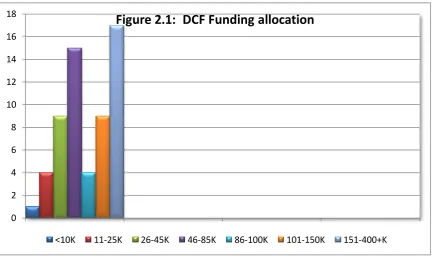
2.5 Figure 2.1 summarises the distribution of funding across the projects; a small number of projects had funding of £25K or less, with a larger clustering between £46,000-85,000, and the largest number of responding projects funded in excess of £150K. The smallest funding allocated to a project was £8,000 to support a training course for carers around understanding dementia. The largest allocations (above £400K) were for £445,744 (Innovative care across the community and care home in Cornwall); £415,000 (supporting dementia friendly communities in Somerset); reducing the prescription of anti-psychotic drugs in Kent and Medway (£405,000). In all cases, applications were only funded with “an expectation” that there would be at least an element of local resourcing, either in cash or in kind. Some of the larger projects were typically multi-dimensional or umbrellas for a number of separate but linked initiatives.
[image:16.595.82.516.178.434.2]0 2 4 6 8 10 12 14 16 18
Figure 2.1: DCF Funding allocation
On track?
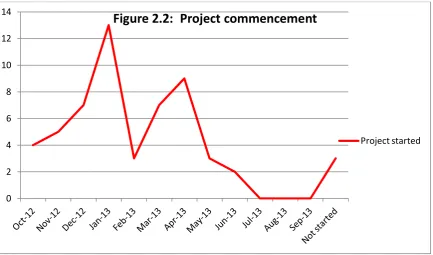
2.6 Figure 2.2 demonstrates the spread of projects’ experience in getting underway. Several respondents distinguished between beginning work and getting funding allocated. In some projects different components of the project had to start at different times largely because of issues with staff recruitment. As the graph indicates, the dates when projects got underway were extremely variable, but most had not begun work until well into 2013, and at the time of our survey (August/September 2013) a small minority had yet to start.
2.7 Questionnaire respondents offered a range of comments and further information about their projects. Where projects had been delayed in getting underway, respondents highlighted the difficulties in setting up a new project and the ‘time lag’ that is often experienced in bringing plans to fruition. Some of the following comments underline the problems encountered:
“Been some delay in recruiting people. Access to surgeries and venues has been difficult, but they now have four courses set up.” (C017, ‘Understanding Dementia – a training course for carers’)
“[project has] yet to start due to difficulties recruiting to the post.” (C045, ‘Training for domiciliary care providers in Berkshire.’)
[image:17.595.82.516.256.511.2]0 2 4 6 8 10 12 14
Figure 2.2: Project commencement
“The project is at the planning stage.” (C051, ‘Dementia friendly ward environment at Frimley Park Hospital’)
2.8 All of the projects that responded appeared to be continuing to operate. A small number of respondents (9) acknowledged that there were risks to their project delivery. Where a project is reliant on recruiting specific personnel, managing timescales can be especially challenging, for example:
“We were unable to recruit for the secondment post for the medication review pharmacist role so an existing member of staff has taken this on in addition to her existing workload.”
(C025, ‘Medicines optimisation in East Berkshire care homes’)
Some projects had decided to reconsider their approach because of recruitment issues:
“Due to issues with recruiting to the Admiral Nursing Service (because of the one year
fixed term) we have taken the opportunity to re-model and expand the service to include a
greater range of professionals. We have also committed to extending the project to 3 years.” (E002, ‘Sussex Admiral Nurses’)
And:
“The focus of the bid is being reviewed as the initial bid was to recruit 3 mental health
nurses to work in primary care. But after two recruitment attempts only one has been
recruited. The current consideration is piloting the voluntary sector to support patients and carers to prevent crisis.” (E027, ‘Early diagnosis and post-diagnostic support in West Kent’)
2.9 Other projects similarly reported HR-related difficulties, such as W008 (‘End of life care planning for patients with dementia in Dorset’) around their inability to backfill nursing time to free up capacity:
“The nurses are still managing to do the project but spending less time than anticipated on the project. We have only managed to recruit one person to do advance care planning.”
2.10 One project attributed delays to structural changes impacting on the hospital where they had planned to focus their work:
“Due to the imminent move to the new hospital, the bedbase for people with dementia has
not been finalised. We have plans for the areas that may be chosen but cannot complete
2.11 Two projects that were both operating in Kent and Medway highlighted the problems they experienced following NHS reorganisation:
“An element of funding to support the projects is still being held in legacy funds, but there is
currently no guarantee that this money will transfer to CCGs. This has been highlighted to the CCGs and the potential shortfall in funding identified.” (E038, ‘Improving community care and reducing anti-psychotic prescribing’, and E040 ‘Improving the patient experience in acute hospital settings in Kent and Medway.’)
2.12 Some other projects indicated that there had previously been risks to delivery but that these had been addressed. For example, C009 (‘Dementia friendly communities’) remarked that risks were no longer significant “now that we have been able to recruit to the second half of the project.” However, this position had only been filled in the previous month and it was recognised that part of the project was “well behind” as a consequence.
2.13 In addition to the snapshot of progress that we wanted to obtain from the questionnaire, we also planned to analyse quarterly reports that the projects were required to submit as part of the governance arrangements for the programme. However, we were unable to collate a comprehensive set of such reports and there were major gaps in the information available. In particular, almost all the reports relating to South Central projects (those prefixed with ‘C’) were not available to us. It is understood that these were ‘archived’ and despite attempts to locate them and cooperation from local personnel, their whereabouts remained unknown. Other report sets were also incomplete, and very few reports later than March 2013 could be obtained.
Focus and approach
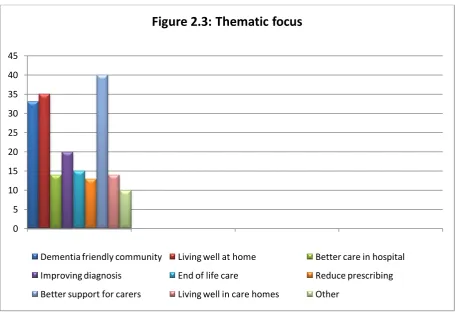
2.15 The DCF programme was designed to address a range of themes and broad objectives that had been targeted as ‘priority areas for consideration’.2 Eight such topics were identified and projects were asked through the questionnaire to indicate which of these they believed they were addressing (since many were addressing more than one theme). The distribution of responses is summarised in Figure 2.3.
2.16 As the chart demonstrates, the great majority of respondents to this question (40 out of 60) selected ‘Better support for carers’ as an objective of their project, and this was the highest scoring theme, closely followed by ‘Living well at home’ (35), and promoting a ‘Dementia friendly community’ (33). A small number of projects (10) also indicated a further theme for their work (the ‘other’ category) which were:
2
NHS South of England (2012), NHS South of England Dementia Challenge 2012: Guidance for applicants.
[image:20.595.70.526.233.547.2]0 5 10 15 20 25 30 35 40 45
Figure 2.3: Thematic focus
Dementia friendly community Living well at home Better care in hospital
Improving diagnosis End of life care Reduce prescribing
Better inclusion for people with dementia (W023)
Better use of resources and independent living in the community (W028)
Dementia friendly care homes (W029)
Inter-generational work (C009)
Improving access to dementia support, and reducing hospital stays (C056)
Listening to needs of people with dementia and their carers through story telling (E007)
Reduce carers’ stress, and improve health, wellbeing and knowledge (C017)
Improving access to dementia support and information, reducing hospital stays (C056)
Listening to the needs of people with dementia and their carers, through a variety of storytelling mediums (E007)
Reduce carer stress; improve carers’ health, wellbeing and knowledge (C016).
2.17 The Bristol dementia inclusion programme (W023) regarded its particular approach as distinctive from a conventional ‘Dementia-friendly communities model’, as they explained:
“[this movement] tends to perpetuate the traditional view of dementia but campaigns for increased ‘friendliness’ and support whilst continuing to frame people in terms of worsening symptoms and inevitable need for services.”
2.18 By contrast, the Bristol dementia inclusion programme was explicitly based around principles of social inclusion:
“Working to develop a social inclusion approach to dementia that recognizes it as an illness
that occurs in a wider social and relational context. Encouraging the citizenship of people with dementia where they are valued and continue to have things to offer.”
2.19 W028 (‘Keeping track of dementia in Torbay’) was distinctive for focusing on demonstrating the effectiveness of Global Positioning System (GPS) tracking devices for people with dementia at risk of getting lost. The project was addressing the experience of service users and their carers, and exploring the impact on the use of health and social care services, particularly whether the use of GPS can delay admission to residential care.
2.21 The emphasis on inter-generational work by C009 was a theme that featured in a small number of projects. C009 (Dementia friendly community) was deliberately involving young people as volunteers in supporting people with dementia.
2.22 Better support for carers was identified as the sole focus of only one project (C017 ‘Understanding dementia – training course for carers’), but featured repeatedly as an additional theme across other projects that recognised the wider benefits of their approach for carers. For example, projects focusing on promoting Dementia friendly communities, Living well at home, or End of Life Care were also likely to recognise that this would be of benefit to carers, and similarly this was true of those projects concerned primarily with improving diagnosis and reducing the prescription of anti-psychotic drugs.
Evaluation and Outcomes
2.23 Projects were asked about their approach to evaluation and how they would know if they were successful. Almost all the responding projects (57 out of 63, or 90%) stated they were undertaking some evaluation of their approach. A small number (7, or just 11%) indicated that they were carrying out economic analysis of the value of the project. We turn now to explore these responses in further detail.
2.24 The half dozen projects that indicated they are not currently conducting any evaluation need to be seen in context. Some of the projects have nothing to evaluate at present owing to delays with getting started, for example:
“Projects are not yet at the stage where anyone has benefited as the directories are still in production.” (C023, ‘East Berkshire dementia services directory’)
“Not applicable as project is yet to start.” (C045, ‘Training for domiciliary care providers in Berkshire’)
“The project has not yet started due to issues with recruiting into posts.” (E002, ‘Sussex Admiral Nurses’)
“The changes to the environment are dwarfed by the other major staffing and environment
changes from the new hospital building and it will be impossible to compare to previous stage.” (W021, ‘Delivering a stimulating hospital environment in Bristol’)
Evaluation Methods
2.26 Projects varied enormously in the detail they provided about the methods they were adopting for evaluation. Some projects had conflated monitoring and evaluation; one project, for example cited the quarterly project monitoring reports as their evaluation method. The applications that projects submitted to the DCF required them to identify ‘quantifiable benefits’ that would be achieved for people with dementia and their carers, and to state ‘how and when’ these would be measured. A number of projects indicated that their methodology was largely around ‘feedback’ received, but others cited more specific approaches including:
Pre and post-training questionnaire for staff.
Satisfaction surveys for people with dementia and their carers.
Simple data collection based on diaries, care plans and goal attainment scores.
Mood scoring, patient feedback.
Health and wellbeing questionnaires.
Audit of KPIs (including reduced use of antipsychotic medication and reduced admissions to secondary health care).
Monitoring diagnosis rates, admission rates, health check rates etc.
Social return on Investment (SROI).
2.27 Several projects described the anticipated outcomes of their project rather than providing an account of their methods. For example, “staff will feel more confident in managing people with dementia; the use of volunteers has increased and staff have a sense of satisfaction.”
2.28 Many projects indicated that while they would be evaluating the project, it was too soon to offer anything substantive. For example, W023 (‘Bristol as a dementia friendly city’) observed:
2.29 Seven projects (11% of respondents) indicated that they had commissioned external evaluation from academic institutions. The findings from such evaluations will not be available in the immediate future and certainly not during the course of our review. Two other projects (E006 and E007) referred to work being undertaken by Professor Judith Holton of Mount Allison University, New Brunswick, Canada “looking at 3 projects in the UK who have or are using social movement to make a change”. However, this did not seem to have been commissioned by the projects.
2.30 It is important to acknowledge that the range and type of projects funded under the DCF programme means that outcomes and evaluation will be similarly diverse. Projects that are focused on promoting a dementia-friendly community, for example, are likely to employ qualitative evaluation tools. Qualitative dimensions are also likely to be a feature of a number of other thematic priorities (such as better support for carers, living well at home etc), while some of the other themes are likely to be more suited to quantifiable data (such as reduced prescribing or reduced residential placements). What is important is that appropriate measures are developed and employed. Some projects indicated that because they were working on improving dementia awareness in the community, and although it is “likely” that many people have benefited “It’s not able to be quantified.” Appropriate evaluation techniques should, however, be able to demonstrate whether the project has had an impact. Another respondent commented:
“The programme is beginning to take hold, but to be able to count numbers of people who
have benefited is not yet possible as the kind of work involved is developmental and will
take time to show tangible benefits. We are concerned about the expectation of measurement of social inclusion work in such a short timeframe.” (W023, ‘Bristol as a dementia-friendly city’)
2.31 The projects including economic analysis of their impact did not generally provide further detail about their approach, but most were monitoring quantifiable data. As one responde d observed:
“This is very early days for this kind of work. Economic benefits are hard to measure in the
short term. Some of the methodology from SROI (Social Return on Investment) might be able to help us with this later on.”
Achievements
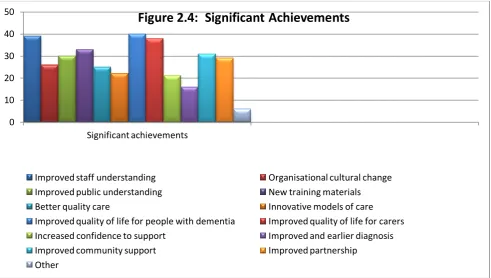
2.32 In addition to project-specific objectives and evaluation of their achievement, projects were asked to indicate if they believed they were achieving significant benefits against a number of dimensions. Figure 2.4 summarises the responses.
2.33 The highest scoring areas of achievement were identified by respondents as:
Improved quality of life for people with dementia (40).
Improved staff understanding and awareness of dementia (39).
Improved quality of life for carers of people with dementia (38).
2.34 As the chart demonstrates, several dimensions clustered closely together and were rated by at least 25 (45%) respondents as significant achievements. In descending order these were:
Development of new training materials (33)
Improved community based support (31)
Improved wider public understanding and awareness of dementia (30)
Improved partnership working between health and social care (29)
Organisational cultural change (26)
Better quality care (25) 0
10 20 30 40 50
[image:25.595.59.551.169.447.2]Significant achievements
Figure 2.4: Significant Achievements
Improved staff understanding Organisational cultural change Improved public understanding New training materials Better quality care Innovative models of care Improved quality of life for people with dementia Improved quality of life for carers Increased confidence to support Improved and earlier diagnosis Improved community support Improved partnership
2.35 The three remaining dimensions were rated as follows:
Introduced or spread innovative models of care (22)
Increased confidence to support people in the community (21)
Improved and earlier diagnosis (16)
2.36 Finally, 6 respondents also identified ‘other’ dimensions including improved end of life care, improved voluntary support for people with dementia, and improved choice of services and support for people with dementia and their families and carers.
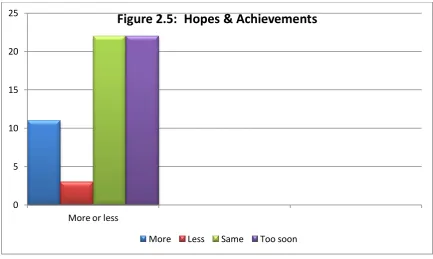
2.37 Respondents were asked whether the projects had achieved (or were achieving) more or less than had been hoped. Figure 2.5 summarises responses.
2.38 It is striking that the most common response (from 38% of respondents) was that it is simply too soon to judge what has been or is being achieved; the same proportion indicated that they thought the project was achieving about the same as they expected. However, it is also clear that very few respondents (just 5% or 3 out of 58) indicated that the projects were achieving less than hoped. The fact that many respondents believed it is too soon to know what is being achieved is entirely consistent with the delays that many projects 0
5 10 15 20 25
[image:26.595.80.514.321.580.2]More or less
Figure 2.5: Hopes & Achievements
reported in getting underway. Some projects were cautious in making judgements about their achievements at this stage, as these comments indicate:
“The project is only half way through delivery, the evaluation of outcomes will not be
completed until later in the year. We do know the numbers of people that have taken part in many of the elements of our project but we can’t evidence the difference it has made at this stage.” (W004, ‘Dementia friendly Plymouth’)
“1st quarterly carer survey very encouraging, length of stay falling but variable by month, so
still work in progress.” (W016, ‘Integrating hospital and community care pathways in Bath’)
2.39 Furthermore, where projects were operating across a wide geographical area and involved different trusts, progress may be at different stages, as this project respondent observed:
“The project is being implemented across four acute trusts in Kent and Medway which are at slightly different stages of implementation.” (E040, ‘Improving dementia care in hospitals across Kent and Medway’)
“Different communities will all progress at different rates and in different directions to suit the needs and aspirations of that community – our role is to facilitate that progress.” (E037, ‘Dementia friendly communities in Kent’)
2.40 Some projects acknowledged that it is difficult to interpret evidence or to determine cause and effect, for example:
“In some ways the team has exceeded expectations. Feedback from homes and partner
agencies is very positive and other homes are seeking to become involved. However, the
rate of change has varied from home to home; some homes are more receptive and open
to new ideas than others. We have no clear data to evidence a reduction in unplanned admissions to hospital – this will probably take longer to show. Training has been delivered but there is not always a clear correlation to changed practice.” (C007, ‘West Berkshire Care Home In-Reach team’)
2.41 The projects had clearly evolved as they have gone along and many had needed to adapt their focus or methods depending on experience. Similarly, projects may be achieving outcomes on some dimensions but not on others. A project working on providing individualised care using reminiscence environments commented:
mood although it is too soon to judge regarding the reduction in the use of antipsychotic medication and reduction in the number of falls.” (C024, ‘Reminiscence and individualised care therapies in Windsor)
2.42 Projects that were particularly focused on achieving cultural change and winning hearts and minds emphasised that such changes take time to be realised, for example:
“Project started slowly and as it involves cultural change, this takes time to implement.”
(W024, ‘Enhanced, more responsive and preventative community based care in Gloucestershire’)
And
“This is inevitably an experiment, changing people’s attitudes and their behaviour is challenging. A lot will depend on what is sustained afterwards.” (W034, ‘Dementia Action Alliance for Pathway and Cribbs Causeway’)
2.43 Some respondents were clear that they were putting in place the necessary foundation to secure continued expansion, for example:
“The purpose of this project is to serve as a facilitator and enabler. When this funding ends
the necessary framework will have been put in place to enable the baton to be passed to
the community of Hampshire to take this work forward for themselves. In order to achieve sustainability we need to build strong foundations.” (C046, ‘Dementia friendly communities in Hampshire’)
2.44 Around one in five of the responding projects indicated that achievements were above their expectations, and many were clearly enthusiastic about their experiences:
“Excellent to see how personal ‘hands on’ training can make a difference in care homes – who really value this training.” (C011, ‘Achieving excellence in end of life for people with dementia in North Hampshire’)
“The project has been a great example of how to break away from the traditional top-down
PCT-led decision making and give real ownership and creativity to patients and GP practices.” (C026, ‘Enhancing the early diagnosis of dementia across East Berkshire’)
“The project continues to surpass expectations, largely due to the good work of the
Sustainability
2.45 When evaluating applications and deciding which would be funded, projects were judged against a number of criteria including how improvements would be sustained over time. We asked projects therefore if and how their project would be continuing beyond the period of funding. Of the 57 respondents who answered this question, all but 4 (7%) indicated that the project would be continuing (although some qualified their response and indicated that this was an aspiration rather than necessarily a firm commitment). Two other projects were unsure if the project would continue (C016 and C017). The 4 who said they did not expect the project to have a continued existence were:
C009 (‘Dementia friendly communities’)
C025 (‘Medicines optimisation in East Berkshire care homes’)
E023 (‘Specialist link nurses in Surrey Downs’)
W020 (‘Volunteering and dementia in Bristol’)
2.46 However, comments offered by these respondents indicated that the situation was not necessarily fixed. The respondent for C009, for example, commented:
“We will be looking to persuade the council to continue the project in some form. We also plan to explore other funding streams.”
E023 similarly explained:
“CCG is to be provided with business case to continue funding as it has been so well received by GPs and patients and the local mental health trust.”
While C017 remarked:
“Not sure about funding.”
And W020 also observed that the funding position was “unknown as yet.”
“Yes, probably, in some form, too early to judge. Steering Group are however keen to learn from this ‘experiment’ and see what can be maintained in the longer term, whether
specifically for people with dementia or in terms of social inclusion more generally. The
CCG leads on the commissioning of dementia services but this work fits well with the Council’s work on community capacity building and reducing isolation and loneliness.”
(W034, ‘Dementia Action Alliance for Patchway and Cribbs Causeway’)
2.48 One way in which projects might be sustainable is if they are scalable and offer a foundation on which to build. Project respondents were also asked for their reflections on scope and scale. Of the 58 respondents who addressed this question, 43 (74%) believed the model was scalable, and many offered extensive comments on how this could be approached. For some, this would begin with expanding the geographical area; for example, an approach currently being undertaken in West Berkshire could be extended:
“The approach could be replicated in other areas. Once fully evaluated we hope to replicate in Berks East.” (C004, ‘Cognitive stimulation therapy training in West Berkshire’)
“If the training is successful the model could be rolled out throughout the community and throughout other LA areas.” (C042, ‘Dementia awareness in the community’)
And
“Move the pilot to project status across a larger area.” (C033, ‘Collaborative dementia care in Oxfordshire’)
2.49 One of the projects promoting the dementia friendly community described how success was likely to continue to build:
“We are rolling out the library health work across all 17 of our libraries and there will be a permanent post of ‘health librarian’ created to take the work forward. We anticipate that
more schools will take up the dementia work that has been demonstrated to be so successful in our pilot school.” (W004, ‘Dementia friendly Plymouth’)
2.50 Another project (using GPS devices to track people with dementia) believed that the work provided a foundation not only for local expansion but nationally:
“The project will enable this type of service to be delivered at scale by offering it to both
2.51 As one respondent commented with enthusiasm “good practice is contagious!” (C015, ‘Diverse communities engaged with dementia in North Hampshire’); further evidence that this is true was provided in this response:
“Another area in Somerset has approached us to help support them with becoming a Dementia Friendly Community.” (W017, ‘Dementia Friendly Community in Somerset’)
Some of those who did not think the model was scalable commented that they were already
applying it on a county-wide or authority-wide basis.
2.52 In some situations the next phase of expansion was already underway. This respondent described how a six month initiative to extend the model had begun in September 2013:
“A 6 month development opportunity for a new GP to lead the full implementation of the
project across all CCG member practices, with a pathway redesign on how to expand the memory clinic services has been defined.” (C026, ‘Enhancing the early diagnosis of dementia across East Berkshire’)
2.53 Others indicated that they would be focusing on the evaluation of their projects in order to develop a business case for further expansion, or that successful approaches would become part of normal mainstream activity where possible. Evidence of effectiveness is clearly key to enabling scaling up to take place, as this respondent commented:
“Evaluation data being used to open conversations with commissioners across neighbouring areas.” (W020, ‘Volunteering and dementia in Bristol’)
2.54 Some respondents also highlighted the legacy that they were trying to create through their project, for example:
“We are trying to build a strong base of thinking to the programme that will outlive it. The
work is seen as providing a series of starting points and in most cases, we are encouraging
change rather than the purchase of new services/interventions. Every piece of work is designed to be able to continue autonomously beyond the life of the 2 year programme.”
(W023, ‘Bristol as a dementia friendly city’)
widely adopted”3, it is clear that there remain risks of gains being lost at the end of project funding. Some projects alluded to this volatility, for example:
“Unclear – they need more money as they are a small charity and I am not sure the CCG can support it long term.” (C014, ‘Diverse communities engaged with dementia in North Hampshire’)
2.56 A project that had difficulties in recruiting to a project post concluded that this constrained future extension or expansion:
“We were unable to recruit for the secondment post for the medication review pharmacist
role so an existing member of staff has taken this on in addition to her existing workload (...) do not have the resources to continue.” (C025, ‘Medicines optimisation in East Berkshire care homes’)
2.57 Another project similarly commented on circumstances that had apparently frustrated the ability to take forward the project. The project was focusing on delivering a stimulating hospital environment but was doing so at a time when the hospital was moving to a new site:
“New hospital is PFI build and we will be unable to transfer good practice and environment changes across to it.” (W021, ‘Delivering a stimulating hospital environment in Bristol’)
Dissemination: sharing and spreading learning
2.58 Capturing and sharing the learning from the DCF initiative was a requirement for all projects from the outset. Sharing experience (good and bad) is central to spreading good practice and enabling innovation to become widely adopted and mainstreamed. Respondents were asked about their approach to dissemination; of the 58 respondents who replied, 54 (more than 93%) indicated they were taking steps to share experience and disseminate findings. The four who were not (W021; E027; E024; E002) included the following comments illustrating both optimism and pessimism:
“Not applicable at the moment but we will in due course. The project has not yet got
underway because of recruitment issues but we have taken this opportunity to re-model
3
and extend the scope of the project to 3 years which we believe will deliver greater benefits.” (E002, ‘Sussex Admiral Nurses’)
“Have not had the experience of change yet and all we could share is frustration at not being able to get started at present.” (W021, ‘Delivering a stimulating hospital environment in Bristol’)
“I envisage this will happen but it is too early to say.” (E027, ‘Early diagnosis and post-diagnosis support in West Kent)
2.59 Respondents who are disseminating their experiences identified a number of methods and processes they are adopting including:
Newsletters and leaflets
Journal articles
Websites/webinairs
Social media
Local media and local public events
Library information and online directories
Presentations to local partners
Presentations at local and national conferences
Updates to commissioners
Presentation to Trust Board
Sharing on a whole systems group basis
Sharing with county-wide Dementia Partnership Board and local dementia implementation groups
Regional events and commissioning forums
Local stakeholder events
2.60 As many respondents recognised, dissemination is an ongoing activity rather than something that only occurs at the end of the project, for example:
“Although the project is not yet halfway through so too early to trumpet success, we have a media strategy that attempts to tell the story of the new innovations we have adopted.”
(W016, ‘Integrating hospital and community care pathways in Bath’)
This was not something that we explored in depth with the questionnaire but was something that we examined in greater detail in the next stage of the research. As the analysis presented above has highlighted, many of the projects experienced difficulties in getting of