International Student
Experience Report
Prepared for Jo Midgley
Executive Summary
The underlying information that was collected as evidence to support the recommendations of this report stemmed from a notion that was evident both in secondary research (the literature review) and in anecdotal evidence at UWE, that our overseas students perform less well than their domestic and European peers. This research project was embarked upon, therefore, with a view to investigating this claim and further to understand better the challenges faced both by international students and by staff teaching mixed cohorts. The aim is to improve the total student experience and to better support staff when working with an increasingly diverse student body.
The findings below are based on stage one of a longitudinal qualitative research study which was carried out in November and December 2014 in the students’ first semester at UWE. Interviews for Stage 2 took place in May 2015 and these results are in the process of being transcribed and analysed. Also included are the findings from the literature review, questionnaires, performance data analysis and staff surveys.
For the purpose of this study, recruitment terminology i.e. Home, EU and Overseas students is used for clarity. The researcher, however, acknowledges that none of these groups are homogenous. Furthermore, the key focus of the study is second and third year undergraduate direct entrant students although many of the recommendations made would also be valid for postgraduate students who face many similar issues to the international direct entrant students.
The paragraphs below summarise the key findings of the research to date and from this, key recommendations are drawn out.
Key findings.
Stage 1 Qualitative research interviews
: Key challenges faced by international students are listed below in order of the most significant challenge shortly after joining the university.1.
Language: this is broken down further into: academic discourse; subject specific vocabulary;
speaking in mixed groups; listening skills; and unfamiliarity with the context. I.e. European business cases or UK banking rules etc.2.
Prior academic culture: which is broken down further into: expectations; grading
system; referencing; teaching and learning styles; and taking part in seminars.3.
Integration: which breaks down further into: friendships (already cemented by time DE’s
arrive); grades matter at level 2 and 3; racism; and stereotypes.Questionnaires:
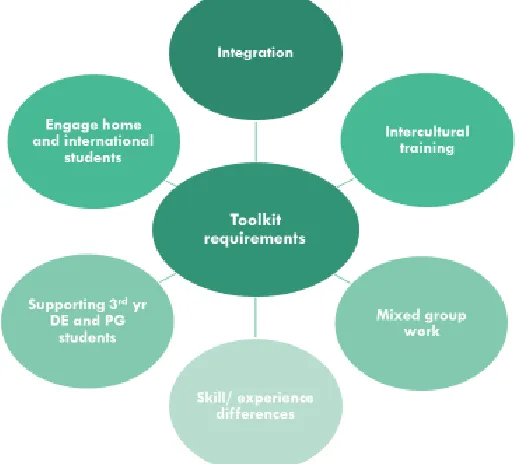
Induction questionnaires (100) and pre-sessional questionnaires (118) further back up these findings. Of note was the fact that it was not just Asian students who faced these challenges but also Brazilian and European students.Staff were asked to identify core areas where they wanted support and these discussions with staff lead to the request for a toolkit designed to meet specific staff needs in order to support them in the challenge of working with mixed cohorts. Figure 1 below shows the key areas where staff requested support.
Figure 1: FBL Staff toolkit requirements
Performance Analysis:
Performance of home, EU and overseas students was analysed from 09/10 to 13/14 using information supplied by Business Intelligence. Performance was analysed by degree classification with good honours meaning 2:1 and above. The overall summary shows that home and EU students do in fact perform better on the whole than overseas students with more home students achieving a 2:1 and above whereas overseas students tended to sit in the 2:2 and 3rd classification bracket. There were, however, notable exceptions in Accounting and Finance where overseas students outperform home students and Law (LLB). Overall, Malaysian students from Taylors and HELP achieve better results than students coming from Vietnam and China.Recommendations:
Staff:
The following to be developed to aid staff in teaching mixed cohorts:
1.
Good Practice Toolkit: to support staff interaction with overseas students
2.
Signposting document: Detailing where to signpost students to find the support that they
might need. There is currently a considerable amount of help available, however, many members of staff are not aware of it. It is essential that academic staff know what is available to support students in order to fulfil their duty of care and also in their role as Academic Personal Tutors.4.
Staff Mobility:
Encourage staff mobility to increase understanding of different education systems.International students:
The recommendation is that the student experience should be considered in its entirety from pre-arrival through to students becoming alumni. These students could be our core advocates as word of mouth is very important in our recruitment countries. With competition increasing in the UK, in other key competitor countries such as Australia and the USA and with countries such as China increasing the quality of their education and offering incentives for students to stay it is imperative that both home and international students at UWE have an excellent student experience.
The key challenge areas of language, academic culture and integration are considered at each stage of the student journey: recruitment; pre-arrival; induction; ongoing; and alumni. This ensures that support is timely and relevant and acknowledges that students’ needs are likely to be different at different stages.
Home Students:
Contents Page
1. Introduction and context to the project 1-2
2. Summary of Literature review findings 3
3. Pre-sessional student surveys 4-6
4. FBL induction session surveys 7-8
5. International student performance analysis 9 – 16
6. Summary of stage 1 qualitative research 17 - 19
7. Summary of staff research 20
8. Conclusions 21
9. Recommendations 22 - 31
Appendix 1 – Literature Review 32 - 54
Appendix 2 – Stage 1 Qualitative Research Findings 55 -67
Appendix 3 – Staff Research 68 - 72
1
1.
Introduction and context to the project.
The start of this project revolved around two areas: 1. Improving the international student experience 2. To either prove or disprove the deficit model.
Improving the international student experience focused primarily although not exclusively on academic issues and generated research to better understand what international students found particularly challenging. As this is likely to change throughout their journey at UWE, the core research is a longitudinal qualitative study following a group of students through their studies at UWE.
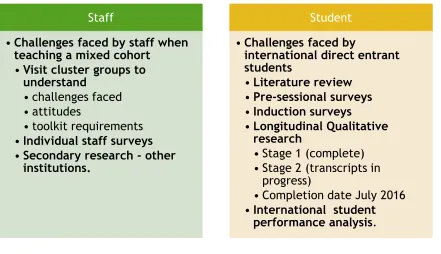
[image:6.612.75.516.277.531.2]A summary of all research in this study is shown in figure 2 below
Figure 2 – Summary of Research.
The research focused on second and third year international direct entrant students but also included some first year and postgraduate students. The students were primarily based in FBL as the highest number of international students are to be found within this faculty and although this report has wider reaching implications, the report is primarily intended for FBL. Three Brazilian students from HAS were also included in order to consider whether the needs of Brazilian students and the challenges they faced were different or similar to the predominantly Asian research group.
Other research was carried out prior to the start of the longitudinal study and this informed the discussion guide used for the main study. This prior research included a full literature review of current thought in the area; and pre-sessional and induction surveys to measure student concerns prior to formal studies commencing; and an analysis of student performance over the last 5 years.
Staff
•
Challenges faced by staff when
teaching a mixed cohort
•
Visit cluster groups to
understand
• challenges faced
• attitudes
• toolkit requirements
•
Individual staff surveys
•
Secondary research - other
institutions.
Student
•
Challenges faced by
international direct entrant
students
•
Literature review
•
Pre-sessional surveys
•
Induction surveys
•
Longitudinal Qualitative
research
• Stage 1 (complete)
• Stage 2 (transcripts in
progress)
• Completion date July 2016
•
International student
2
The deficit model mentioned in research refers to the attitude of staff and home students to international students. It includes stereotypes such as: “All international students struggle;” “All Asian students learn by rote;” “All Asian students are passive;” and “All international students plagiarise.” International students are aware of these stereotyping attitudes, (which are not restricted to UWE) and state. “They think we are Chinese;” “The home students do not want to work with us;” and “They look at me strangely because I wear a headscarf.”
3
2.
Summary of literature review findings
The literature review discusses the benefits of welcoming an international cohort and highlights the importance of not just recruitment but also of considering the cultural and educational experience that overseas students will have on arrival. It also acknowledges the challenges in providing a curriculum that suits the needs of both home and international students. With numbers of international students coming to the UK to study increasing, this becomes ever more essential. The UK faces competition from the USA and Australia and so it is important to have satisfied alumni in order to compete effectively.
The increasing concern regarding the performance of international students is also discussed within the literature showing that Chinese students in particular are underperforming against home students. A deficit model is discussed within the context of uncritically lumping together international students attributing problems of language, cultural adaptation and study skills to them.
The literature draws out the challenges resulting from the impact of poor language skills and core differences in culture and academic culture. Poor language skills are shown to have an impact on the speed of transition and on student performance. Again Chinese students are seen to be those that struggle most. Language skills are broken down further into spoken English, listening skills, reading skills, written English and academic discourse. The impact of poor skills in these areas is discussed. Academic culture is also shown to have a large impact on the successful transition and levels of performance of international students. The crux of the academic culture debate is divided down into didactic versus participative teaching styles (Confucian versus Socratic). The debate stresses the fact that for overseas students who have spent their formative years learning in a certain education system, adapting to a different style in a very short time frame can be very tough. It should, however, be noted that with Western Universities, setting up university campuses overseas and with partner institutions growing in numbers, teaching styles are likely to become more similar.
Finally, culture was seen to be less important in impacting international students and the message was that the oversimplification of any cultural issues should be avoided. The literature warns against perceiving Asian students as a homogeneous group highlighting the fact that different cultures even within the same area have differences and should not be stereotyped. The role of staff in avoiding stereotypical generalisations is stressed.
4
3.
Pre-sessional student surveys
3.1: Background
As part of the pre-sessional programme for international students, several lecturers are asked to deliver a lecture to illustrate what a typical lecture is like at UWE. During one of these lectures, a group of pre-sessional students from different faculties across UWE were surveyed in order to ascertain their rationale for studying in the UK and to discover any worries they might have prior to commencing formal subject studies. The benefit of surveying such a mixed cohort studying across different faculties at different levels from year 1 to Postgraduate and from different nations was that any trends or commonalities could be identified together with any core differences.
3.2: Respondents:
118 questionnaires were completed in total comprising 45 males and 73 females. Figure 3 below shows the breakdown by nationality and with each nationality by gender.
[image:9.612.71.506.329.588.2]The most frequently occurring nationalities were Chinese (41) Brazilians (34) and Vietnamese (27)
Figure 3 – Pre-sessional students surveyed: Nationality and gender.
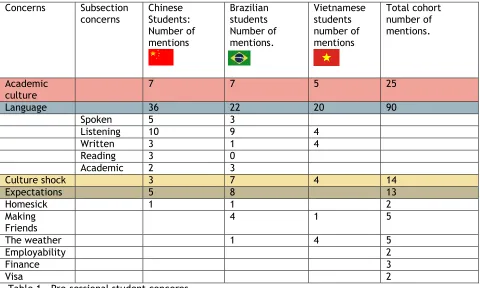
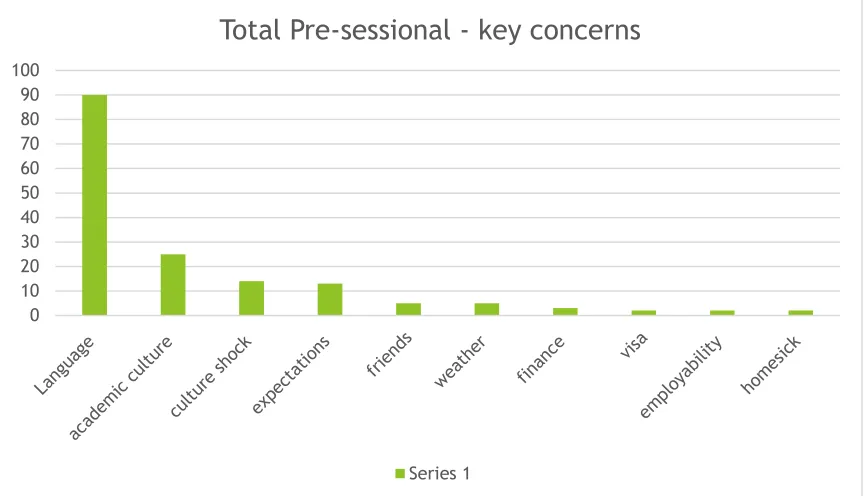
Table 1 below documents the key concerns of the pre-sessional students. Language was without a doubt the area that all students were most worried about. Just looking at Chinese, Brazilian and Vietnamese students representing 102 of the total surveys, 90 of them i.e. 88% mentioned that they were concerned about language. Some mentioned specific language concerns of which listening skills were the most mentioned which is understandable at their pre-sessional stage as they are new to the UK and as such listening to English rather than US accents often used can be problematic.
0 5 10 15 20 25 30 35 40 45
Pre-Sessional students surveyed: Nationality and
gender.
5
Academic culture and new teaching and learning styles was the second most mentioned concern. The pre-sessional survey showed limited differences between different nationalities.
The other two main concerns mentioned were culture shock and knowing what the expectations would be.
Concerns Subsection
concerns Chinese Students: Number of mentions
Brazilian students Number of mentions.
Vietnamese students number of mentions
Total cohort number of mentions.
Academic culture
7 7 5 25
Language 36 22 20 90
Spoken 5 3
Listening 10 9 4
Written 3 1 4
Reading 3 0
Academic 2 3
Culture shock 3 7 4 14
Expectations 5 8 13
Homesick 1 1 2
Making
Friends 4 1 5
The weather 1 4 5
Employability 2
Finance 3
Visa 2
[image:10.612.67.547.152.440.2]Table 1 – Pre-sessional student concerns
6 Figure 4: Total pre-sessional key concerns – unprompted.
The pre-sessional students were also asked what their impressions of UWE were and what help they might like.
It appears that the Brazilian science without borders students have had a bad start at UWE. There were some key areas that they were unsatisfied with and where they felt they needed more help:
The university is a lot more expensive than they had imagined and they feel that items such as bus passes and gym membership should be included in the accommodation costs.
They were particularly unhappy with admin and the length of time it took to return their passports.
They would like help with the transcripts for their visa application.
The general feeling was that the pre-sessional English courses were inflexible and did not change things when the students complained that the course was not suitable for them. They felt they had not been listened to.
It seems that there are some teething problems with these students and that their expectations need to be better managed pre-arrival.
0 10 20 30 40 50 60 70 80 90 100
Total Pre-sessional - key concerns
7
4.
FBL Induction session questionnaires
4.1 Background
A similar exercise was carried during FBL direct entrant induction sessions (10 tutorials) designed to introduce students to the way of studying in the UK. The forms were completed prior to the session taking place to avoid any bias. Questionnaires were handed out during induction sessions about studying in the UK to capture the key worries that students have at the beginning of their studies. These students were direct entrants into the second and third years and were solely from the Faculty of Business and Law.
[image:12.612.76.519.264.581.2]The number of surveys completed was 100 with 53 from year 2 and 47 from year three. Of these 43% were male and 57% female.
Figure 5
Figure 5 above shows that the majority of the students (44%) were Malaysian followed by Chinese students (20%) and Vietnamese students (16%). The nationality split differs from the pre-sessional nationality split as Malaysian students are generally not required to show an IELTS score because of the partnership arrangement with UWE and their generally stronger level of English .
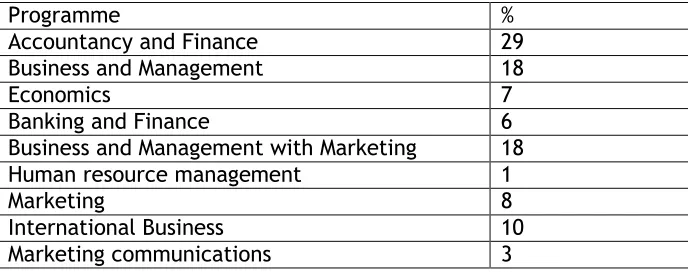
Table 2 below shows the number of students surveyed by programme with 29% studying Accountancy and Finance and 18% each studying Business and Management and Business and Management with Marketing.
% per nationality
8
Programme
%
Accountancy and Finance
29
Business and Management
18
Economics
7
Banking and Finance
6
Business and Management with Marketing
18
Human resource management
1
Marketing
8
International Business
10
Marketing communications
3
[image:13.612.68.412.71.208.2]
Table 2: Induction students by programme
9
5.
International Student Performance analysis 09/10
13/14
This section looks at an analysis of student performance between 09/10 and 13/14. This analysis was carried out using data provided by Business Intelligence in order to either prove or disprove the deficit model mentioned in the introduction. The deficit model is often applied to overseas students by some members of academic staff and home students who perceive the performance of overseas students to be lower than that of home students. Figures 5, 6 and 7 and tables 3 and 4 below consider FBL students only and cover a five year period to avoid blips and to look for trends. [image:14.612.71.510.231.486.2]5.1 Students attaining a Good Honours degree (2:1 +)
Figure 5 – FBL students achieving good honours degrees (undergraduate)
Figure 5 above shows the numbers of students broken down by home, EU and overseas to look for any differences in numbers of students achieving good honours. The 2013-14 average for FBL good honours was 66%.
5.1. i: Home student performance:
In 2009/10, 59% of home students achieved a 2:1 or higher and this has grown rapidly year on year showing a figure of 75% achieving good honours in 2013/14.
5.1. ii: EU student performance.
In 2009/10, 55% of EU students achieved a 2:1 or higher and this also showed a steep increase growing to 73% of students achieving good honours in 2013/14. These results show that the EU student performance is very close to that of home students.
59%
69% 75%
55%
61%
73%
42%
48% 46%
2009-10 2012-13 2013-14
FBL students achieving good honours
degrees (undergraduate)
10
5.1. iii: Overseas student performance:
In the case of overseas students however, just under half of them achieve good honours and the highest percentage was in 2011/12 with 48% of overseas students achieving a 2:1 or higher. The growth has been a good deal slower than that of home students moving approximately 5 percentage points. This shows that in terms of good honours overseas students are achieving less well than their European and home student peers
5.1. iv: Summary
These figures show that across the faculty students achieving good honours is increasing. For home and EU students, the increase is considerable whereas the growth rate for overseas students is much lower and overall less than 50% of FBL overseas students achieve good honours.
The analysis shows that similar levels of UK and EU students (nearly ¾) achieve good honours but that overseas students fall short of this with less than 50% achieving good honours. This initial figure suggests that international students are considerably outperformed by their home and EU peers. These results were then split down further to show the difference between BBS and Law students achieving good honours.
5.1. v: BBS student performance
In BBS the percentage of overseas students getting a good honours degree was just over 1/3 at 36%. This is lower than the faculty average results. As with the overall faculty performance, home and EU students were very similar in their performance with approximately 70% of them achieving good honours. Thus it can be seen that overall and in BBS, overseas students perform less well than their EU or home peers in terms of achieving a 2:1 or higher.
It is also of note that the home students have moved up from 58% in 2009/10 to 71% in 2013/14 showing a considerable improvement in results.
5.1. vi: Law
The difference between overseas student performance and home student performance was not significant in the Law department partially due to the fact that the students have to have studied the same modules in their home country prior to arriving in the UK. In fact in 2013/14 the overseas students outperformed the home students.
The results are very impressive in the Law department with 81% of home students achieving a 2:1 or higher and 84% of overseas students achieving the same. The figures for EU students are not included here as there are only small numbers of EU students in the department and as such the results fluctuate wildly.
The average percentage of students achieving good honours in 2013/14 is 81% and in the case of Law during this particular year, the overseas students score higher than the home students.
This analysis shows that overseas students perform less well in BBS than they do in Law, primarily due to the fact that law students are following the identical programme in their home country as they are in the UK.
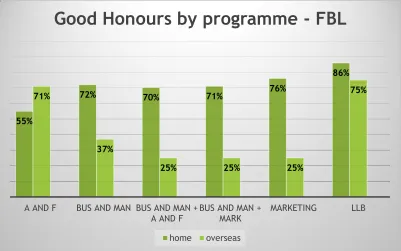
11 Figure 6 – good honours by programme
5.2. i: Accounting and Finance
The average good honours in 2013/14 was 61% with EU and overseas students exceeding this average. The numbers of EU students (8 in 2012-13 and 2 in 2013-14) are too small to be significant and so have not been included in figure 6 above. Of the overseas students however, 63% achieved good honours in 2012/13 and 71% in 2013/14. 58% of Home students (2012/13) or 55% in 13/14 achieved good honours showing that overseas students perform better than home students on this programme. This could be explained by the mathematical rather than the discursive nature of this programme.
5.2. ii: BA Hons Business and Management
On this programme, overseas students perform at a level considerably lower than the average for good honours. The average number of students achieving good honours on this programme is 60%
The figures range from 7 % in 2009/10 to highest in 2013/14 where 32% of overseas students gained good honours. Numbers of EU students are very small and so are not included here as they fluctuate considerably. Home students achieve at between about 58% and 72% (2013/14) achieving good honours.
5.2. iii: BA Business Management with Accounting and Finance.
The percentage of home students achieving good honours has increased significantly in the last two years to 70% of students achieving good honours. Prior to that 2009/10- and 2010/11 students achieved good honours at 34% and 46% respectively.
EU numbers are insignificant and not included. 55%
72% 70% 71% 76%
86%
71%
37%
25% 25% 25%
75%
A AND F BUS AND MAN BUS AND MAN + A AND F
BUS AND MAN + MARK
MARKETING LLB
Good Honours by programme - FBL
12
Only about a ¼ of overseas students achieve good honours. This is interesting as whereas international students perform well with Accounting and Finance, once you add Business Management, they do less well. It could be assumed that in this subject, students have more essay type work to do and more analytical thinking rather than number crunching?
5.2. iv: Business management with marketing
Until 2012/13 there were not significant numbers of international students studying this programme. In 2012/13, however, the numbers of students achieving good honours is 57% for home students and 34% for international students. Again the assumption being that the essay writing for overseas students may well be impeded by a different academic style and language problems.
The results for 2013/14 showed a marked improvement for home students with 71% of home students achieving good honours but the numbers of overseas students achieving good honours decreased to 25%. Again, home students significantly outperform overseas students in terms of achieving good honours.
5.2. v: BA hons marketing.
There are very few students from overseas doing this award. 8 students in 2012/13 and 41 home students. 56% of home students achieved good honours and 25% of international students achieved good honours. This is not reliable data, however, given the small numbers.
In 2013/14, 69% of home students achieved a 2:1 or above but the overseas students good honours rate remained at 25%. There were however, only 4 overseas students on this module and as such, these results should be viewed with caution.
5.2. vi: LLB
R
esults here appear to be consistently high. For the last two years, 81% of home students have achieved good honours a 10% or so increase over the previous two years. Numbers of EU students are small and so fluctuate. Over the last two years about 60% of overseas students have achieved good honours and so they are performing considerably less well than their home peers.The results for 2013/14 show a considerable improvement for international students with 75% achieving good honours and for home students 86%
The home students do perform better than the international students but both cohorts achieve very well in this programme.
5.2. vii: Summary
13
5.3: Performance by Income Status
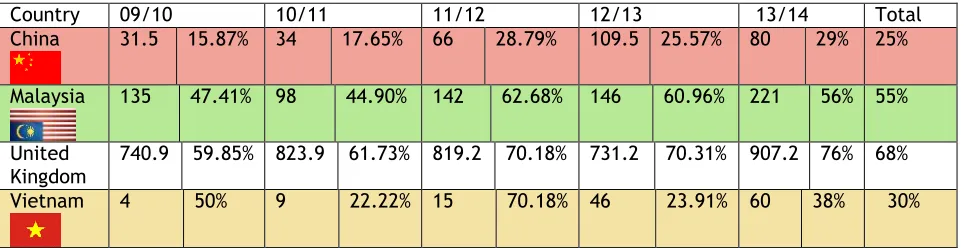
Table 3 below shows performance by income status, only countries with reasonable numbers of students i.e. 25 students or over have been accounted for and the UK students have been included in order to give a sense of perspective:
Country 09/10 10/11 11/12 12/13 13/14 Total
China 31.5 15.87% 34 17.65% 66 28.79% 109.5 25.57% 80 29% 25%
Malaysia 135 47.41% 98 44.90% 142 62.68% 146 60.96% 221 56% 55%
United Kingdom
740.9 59.85% 823.9 61.73% 819.2 70.18% 731.2 70.31% 907.2 76% 68% Vietnam 4 50% 9 22.22% 15 70.18% 46 23.91% 60 38% 30%
Table 3 – Performance by income status FBL students only.
[image:18.612.67.552.137.261.2]China is the weakest followed by Vietnam. Malaysian students are not far off the home students in terms of their results. This is shown visually in figure 7 below.
Figure 7 - Good honours by income status
16% 18%
29%
26% 29%
47% 45%
63% 61%
56% 50%
22%
13%
29% 30%
60% 62%
70%
76%
68%
2009-10 2010-11 2011-12 2012-13 2013-14
Good Honours by income status
[image:18.612.71.504.387.634.2]14
International Partner Performance FBL – 2009 /10 to 2012/13 Partner College Number of classified
awards Number of good honour degrees % Good degrees
HELP Institute (Mal) 173 116 67%
Taylors College(Mal) 141 85 60%
INTI College (Mal) 44 13 30%
Renmin University of china (CHI)
29 8 28%
Xiamen University
(CHI) 27 5 19%
International University HCM city (VIE)
17 4 24%
Beijing Normal
University (CHI) 14 3 21%
Macro System
Consultancy ATC (Mal) 14 9 64%
Shanghai University of Finance and economics (CHI)
12 1 8%
BIT Beijing inst of Tech (CHI)
[image:19.612.65.537.89.331.2]10 5 50%
Table 4 – performance by partner college:
Table 4 above includes colleges with more than 10 classified awards sending students to the UK. It is notable that the students from HELP institute and Taylors do considerably better than the other key recruitment universities of China and Vietnam. It could be assumed that this is partly to do with the stronger English skills of Malaysian students but also due to the fact that the courses certainly at Taylors are more closely aligned to the courses here at UWE and so the academic culture shock is not so great.
Having looked specifically and in detail at results for students in FBL, an overview is now given of total results across the university in figure 8 below. It can be seen that approximately 20% of home students attain a first class degree as compared with 10% of overseas students. For the failure rate, both home and overseas students are the same at 3%
15
Figure 8 – Degree classifications – Total UWE undergraduate.
Tables 5 and 6 below look at the same split by degree classification for FBL students and the key findings within FBL replicate the trend shown across the whole university with approx. 20% of home students gaining a first class degree compared with approx. 10% of overseas students and a similar failure rate of around 3 %. The numbers of home students gaining a good degree is 72% compared with 43% for overseas students and the lower second and third class honours is 52% for overseas students and 24% for home students.
FBL - HOME
Ac Year 1 U2 L2 3 FA
11/12 180 20% 424 48% 236 27% 25 3% 24 3%
12/13 162 20% 382 47% 218 27% 24 3% 33 4%
[image:20.612.71.473.473.692.2]13/14 239 24% 488 48% 222 22% 24 2% 34 3%
Table 5
FBL - OVERSEAS
Ac Year 1 U2 L2 3 FA
11/12 27 10% 101 36% 116 41% 23 8% 15 5%
12/13 25 7% 121 34% 157 44% 45 13% 8 2%
13/14 33 7% 159 36% 174 39% 59 13% 18 4%
Table 6 22%
9% 51%
37%
21%
38%
3% 3% 12% 3%
2013-14 HOME STUDENTS 2013-14 OVERSEAS STUDENTS
Degree Classifications - Total UWE
undergraduate
16
Summary of analysis of results.
From the analysis of results above, it can be seen that it is an oversimplification to state that international students do less well than home students. From a general point of view as shown in the tables above, home students do perform better than international students, there are however exceptions such as Law and in particular Accounting and Finance where it can be seen that international students actually outperform home students. When considering income status, Malaysian students perform considerably better than Vietnamese and Chinese students. This shows that it is dangerous to make assumptions. Whereas Home students tend to achieve good honours, the international students tend to be more in the 2:2 or lower bracket. Failure rates are, however, the same.
Pre-sessional students:
17
6.0 : Summary of Stage 1 Qualitative Research.
Full findings of the qualitative research stage 1 are available in Appendix 2. Stage 2 findings have been collected and will be transcribed and analysed over the next couple of months. This section forms a summary of the stage 1 research.
Firstly it should be remembered that this research took place approximately 2 months after the students had started their studies at UWE whereas the surveys took place either during the pre-sessional period or during induction week prior to the commencement of academic studies.
Secondly it should be noted that this is the first stage of the qualitative research. The second stage took place during May 2015 and then two more stages are planned in November 2015 and May 2016. The rationale for the longitudinal study is to understand whether the challenges faced by international students change at different stages in their student journey.
In stage 1 only, students were asked why they chose to study in the UK, why they chose UWE and what means they had used to help with their choice.
The key reasons for wanting to study in the UK were: High and recognized quality of education; Improve English as it is a world language;
The two factors above enhance future career prospects.
The UK was attractive to students because of its proximity to Europe which provides extensive travel options and also because it is further away from home and therefore more of a challenge than a country such as Australia which is a key competitor for international education. The challenge of coping with a very different culture a long way from home was attractive to these respondents and Malaysian students interviewed felt negative towards Australia as it is the education destination of many Asian students.
Word of mouth from direct family members, relatives, agents, local college and returning students have also ensured that the UK is seen as an attractive education destination. Word of Mouth is very important for decisions such as this education decision due to the levels of financial and personal risk involved. The reassurance of hearing from someone who has been through the process is very important. This is a good reason for considering the importance of our alumni in promoting UWE overseas. The option to be able to study in the UK for just one year, makes this an affordable and desirable option for many students. By comparison US universities often require students to study for longer than in the UK.
UWE was a chosen destination for direct entrant international students in the main owing to the fact that the partnership arrangements reduce the risk for students due to the fact that previous cohorts had already travelled to UWE and that as such UWE had a good reputation with the partner college. The type of courses available was also a frequently mentioned reason for choice and the wide range of courses available made the university attractive. Most of the students interviewed had considered the ranking of UWE amongst universities and were guided by their friends/ alumni who spoke highly of the university. Word of mouth, the ranking of UWE and the information on the website, from the agent or from the regional office was influential in guiding choice.
6.1 Challenges Faced
18
6.1. i: Language:
Students are keen to do well and often understand the expectations but not how to get there. The IELTS test does not prepare the students for the language challenges they face in the classroom environment. When quizzed about their silence in tutorials, the two most common answers were that it was not the norm in their education system to speak up in class and also that they worried that their language skills were not sufficient to have a detailed discussion. When asked a question, these students translate it back into their own language, think of an answer and then have to translate that answer back into English. By the time they have done this, the conversation has usually moved on. When asked why they had not gone to sessions either with ELAS-U to help their language or to the Academic Success Centre, lack of time was the reason given. There was also a sense that unless activities are timetabled, they are not seen to be necessary and therefore something which takes up valuable time.
At the outset several of the students interviewed mentioned that they understood less than 50% of the lectures but that the understanding was improving. The more active use of language was the real barrier whether this was spoken or written English. Timetabling issues (international students often tip into ISIS rather late) and accommodation – both of which lump international students together - exacerbate the problem as the students fail to make local friends who could help their levels of English to improve.
When it was suggested that joining clubs and societies was a good way of picking up more language and integrating into the University body, again time or rather lack of it was given as a reason for not joining the social activities.
6.1. ii Academic Culture:
The difference between academic culture in the UK and the home countries of international students was mentioned in every interview undertaken whether these were European students, Brazilian students or Asian students. The expectation for independent learning was a shock initially as overseas students are used to having full timetables and in some cases the students found that they were lacking the skills to organize their time effectively.
Furthermore, across the board, students were unused to the more interactive approach to teaching in the UK as the norm in their home countries is a more didactic lecture style with limited discussion and rote learning rather than evaluative and analytical thinking is expected. It has already been mentioned that the learning style of international students tends to be passive with a desire to be spoon-fed and they are not used to working independently. Text books are generally not required as the lecture slides are so detailed that no extra reading is required. There was very much a sense that the lecturers provide everything and all sources. Many students were unused to using libraries also. This was not confined to Asian students but was evident across the board. Learning styles are engrained since primary years and to unlearn these preconceptions of education is difficult in one year. This all shows the importance of setting expectations of learning and of what the lecturer will provide.
19
6.1. iii Integration:
In these early stages, integration was a key issue expressed by the international students researched. This is partially due to: the timetabling (late confirmation leading to international students being grouped together in international tutorials); accommodation (“high” costs of UWE accommodation drives groups of international students to moving into a “Chinese” or “Brazilian” house for example where more students can be accommodated hence bringing the price down). This inhibits integration and importantly the development of key skills which would lead to better integration. More worrying were the comments that implied that home students were less than welcoming to international students.
Some international students mentioned that they felt more accepted by students who had travelled to Asia, maybe in a gap year and that they were more willing to engage. Language appears, however, to be an inhibitor in international students having the courage to initiate discussions with home students. Conversely, international students with good language skills were more proactive in joining clubs and societies and generally felt more integrated. Both groups of students, however, appear to be guilty of sticking with those whom they know and interestingly although the assumption is that UK students do not want to take the risk of working with international students, the irony is that international students equally know who they work with well and do not want to risk their grades by working with home students whom they perceive to be lazy and to leave everything to the last minute. The workload, particularly for International third year direct entrant students tends to be the issue that prevents them from joining clubs. Having invested so much in their education, they prioritise this and as such, miss out on other opportunities the university offers.
6.2 The Best and Worst thing about studying in the UK:
When asked about the best things about studying in the UK, a sense of independence, the opportunity to experience new things and learning English were the most commonly mentioned factors.
The most commonly mentioned worst thing was the difficulty in integrating.
6.3 Advice to future students:
20
7.0 Summary of staff research
The staff research was devised to gain an insight into what staff considered to be the key issues faced by international students with a view to seeing whether this matches what students felt their challenges were. An understanding was also sought of key areas that staff find challenging in order to understand what type of help staff need when working with international students.
The research took the form of observations of guided discussions within the cluster meetings to get a general feeling for what staff felt en masse. Individual forms were also handed out in order to collect feedback about how individuals felt about working with international students.
Guided discussions were held at all cluster groups with the exception of Economics and Law and 31 individual forms were completed.
The key issues by cluster group and the resultant tool kit requirements are detailed in Appendix 3. This has been broken down by cluster group as there are subtle differences by group dependent on the nature of the subject taught and the pre-entry requirements.
It was interesting to note that challenges differed by department. Accounting and Finance is a popular course for our international students as: it leads to a good career; our courses are ACCA accredited; and is very number based. As such international students tend to outnumber home students which leads to a very different dynamic for teaching staff as the home students feel uncomfortable. For Economics on the other hand it was stated that mapping could be an issue as international students tend to choose Economics thinking it is about numeracy and are quite shocked when faced with essays in which they are expected to be critical and analytical.
Timetabling was also noted across the board as a problem. As international students, including students who come on our pre-sessional courses often do not tip into ISIS until the very last minute, staff frequently end up with a couple of tutorial groups which are exclusively direct entrant international students which is not ideal for staff or indeed the international students who come to the UK to benefit from a UK education with British students.
Finally, staff were concerned about the recruitment process for international students and were concerned that as the targets for those recruiting were numbers based, then sometimes we were not getting sufficient levels of quality. Academic staff felt that the recruitment process was “opaque” and there was a feeling that agents do not understand the programmes and that possibly courses were mis-sold. There was a sense of irritation that an agents conference was organized in the UK and that there was no academic involvement in it. Staff were also concerned that international recruitment targets were different from home recruitment targets and that this prevented effective programme planning. The example given was that home student targets are set by programme allowing planning whereas international student targets are set by region which means that effective planning cannot take place which leads to some of the timetabling issues mentioned.
21
8.0 Conclusions:
It is evident from the research and the literature review that there are three key issues faced by international students: Language; academic culture; integration. These are the elements that need to be tackled in order to raise the performance of international students that come to the UK. The focus needs to be on the entire student journey.
It is also evident that what benefits international students quite often benefits home students too. So by rethinking our assessments, our communication methods and our lectures, we have the opportunity to provide a better experience for all of our students. Admittedly, the learning curve and the challenges faced by third year direct entrant students from overseas is likely to be steeper and the challenges fiercer than those faced by home students.
It should also be clearly remembered that international students cannot be lumped together in one homogeneous group. Some students perform extremely well, others really struggle. The performance analysis showed that although overseas students on the whole performed less well than homes students, that there were areas of excellence.
22
9.0: Recommendations:
Staff
Intercultural training:
Staff have requested intercultural training and yet attendance at such lunchtime sessions tends to be somewhat patchy. It is therefore suggested that we run a compulsory away day in order to reach the maximum numbers of staff. A popular suggestion was to book the conference rooms at the Bristol Zoological Gardens. It would make sense to time this just before the start of the September 2015 term when staff are likely to be back from their holidays and before the teaching timetable commences. It is recommended that the programme could cover the following:
a. International student challenges - Top line research findings (Christine Comrie) b. Three short sessions about different education systems followed by Q and A.
1. Malaysia – Azley Abdrazak 2. Vietnam - Quyhn Tran 3. China – Jenny Chen
c. Launch staff signposting document and staff tool kit (Sophie Bishop ) d. Professional services – Visa update, international office activities. e. Session on Partnerships?
Intercultural soundbites will also be produced and would be situated in the relevant part of the Staff Tool Kit.
Staff mobility was mentioned by various members of staff as an ideal way of increasing intercultural learning. By running sessions in an overseas college, staff get the opportunity to experience first-hand different learning cultures.
Tool Kit
The staff tool kit will be developed focusing on the key areas requested by FBL academic staff. This would be an organic tool kit which will be added to over time as new resources become available. The toolkit will need to be intuitive to use and housed somewhere where staff are likely to use it. (There have been several requests for this not to be a SharePoint site). The format is likely to be a landing page with a series of buttons with an embedded link which takes the user through to materials to do with the topic on the button i.e. student integration; intercultural awareness; academic culture etc. The materials will be a variety of media: short video clips; podcasts; staff Kaltura clips of good practice; PowerPoint with voiceover; articles; top tips etc.
Staff Signposting Document
23
ADP sessions.
These were set up last year and two have run to date. The international session comprises one session running in the second semester of the Academic Development Programme and this provides new staff from across the university with some tools for working with international students and also informs them as to the challenges international students (and staff) face. The overarching message they are left with is that good practice for international students is also good practice for home students.
Where do students come from?
Currently tutors have no idea when faced with a tutorial group where they come from and at what stage they enter the university. Staff would like to have this information for all of their module lists. The recommendation is that we find a way of making this information easily available to module tutors so that they better understand the make-up of their tutorial groups.
International students.
The international students studying at UWE do not form a homogenous group and even those from the same geographical region are very diverse. Some international students face many issues and struggle with language primarily which then inhibits social interaction and also the ability to perform to the best of their ability. Others, usually those with good language skills, are better able to integrate (if they choose to) and are more likely to be able to adapt to a new set of academic expectations and to perform well. It was clear from the performance analysis and from an overall feeling having interviewed a range of different nationalities that Malaysian students adapt more easily and perform better than students from Vietnam and China. As such, it is important not to force fit solutions onto students that do not need help but rather to identify at an early stage those students who would benefit from early intervention and those students could be signposted towards the relevant support. It is strongly recommended that a form of diagnostic testing takes place pre-arrival in order to identify students who are likely to struggle. Furthermore it is clear that if activities are not timetabled, then international students are less likely to attend due to workload pressures.
24
Figure 9 – The student journey – timely and relevant support.
Figure 9 above breaks down the student journey into the stages that will be considered below. The arrow indicates the importance of satisfied alumni in influencing the recruitment of new students. A suggested time scale is given for each recommendation excluding those with a more strategic element that will need further consideration.
Recruitment:
As discussed in section 7.0 above, academic staff have concerns about the recruitment process. Clearly this is a very complex area but recommendations giving an ideal position are given below with a view to professional services considering how the UWE systems might enable this.
Expectations management is important to ensure that the students recruited know what to expect when they come to UWE. To this end, academic staff and professional services staff need to work together to ensure that all gatekeepers i.e. agents, regional offices and partner institutions understand the make-up of our programmes and are able to advise the students correctly when they are making their university choice.
RECOMMENDATION 1:
Produce programme information packs for the Gatekeepers.
2016 academic year.
In order to manage the expectations of new students and to ensure that the Gatekeepers understand our programmes, to produce programme information packs which could include the following:
25 b. Core module green screens
c. Optional module green screens
d. Studying in the UK green screen (in progress) e. Student talking heads (in progress)
The marketing field already uses green screen technology to introduce the programme and modules to students in order to aid module choice and the module green screen is also available on each module blackboard site. These have been well received by students in terms of giving clarity to what each module entails and what the requirements are for studying on this module.
Examples are embedded below: Programme information green screen:
https://www.youtube.com/watch?v=nYfMVtfQc48 Module information green screens:
https://www.youtube.com/watch?v=jH5FtMZ8-qE
https://www.youtube.com/watch?v=YwQE-zPpQ-E&app=desktop
The format of these could be changed to allow for recruitment markets where technology is insufficiently advanced.
RECOMMENDATION 2:
Programme specific targets by geography.
2016 academic year.
It is also recommended that the geographical targets are made more programme specific to allow for staff allocation planning and room planning and to avoid big groups of international students being put together at the last minute thus detracting from their UK education experience and inhibiting intercultural interaction. UWE needs to develop an understanding using past experience of likely programme choices by market and to set targets according to this.
RECOMMENDATION 3:
January starters.
If January starters are to be recruited in greater numbers in future, careful consideration will be need to be made as to how best to integrate them into the programmes so that the UWE experience meets or preferably exceeds their expectations. Should numbers increase dramatically then resource implications must be considered both in terms of designing a package suitable for these students and in terms of availability of staff to deliver this package.
Pre-Arrival
26
that international students appear not to engage with the OMC – Optional Module Choice – prior to arrival/ whilst on a pre-sessional course. It would be worth investigating this by interviewing new arrivals to understand why they do not engage with the OMC and what we can do to ensure that they do.
For the sake of this document, pre-arrival is interpreted as meaning prior to induction week and as such includes students on a pre-sessional English course. This stage deserves closer attention as it is currently underutilised as an opportunity to engage with our international students.
RECOMMENDATION 4:
Academic culture: Programme specific joining instructions:
2016 Academic Year
Programme managers and professional services could work together to produce a package similar to the gatekeeper package and which is programme specific and designed to give the student the academic and practical information they need. This could include the elements mentioned previously for the gatekeepers’ package and also include stop start animation videos about life on the campus.
RECOMMENDATION 5:
OMC research
To find out what it is that is preventing our international students from engaging with the OMC, qualitative interviews could be held by field shortly after international students arrive in the UK. This could possibly be run by the ASL’s (Assistant support Lecturers) for each subject field.
RECOMMENDATION 6:
Integration – Pre-sessional opportunity:
August 2015
The pre-sessional period could be used more effectively in order to engage with our future students. Currently faculty /pre-sessional student interaction is minimal yet it would be useful for pre-sessional students to meet programme managers in order to discuss their concerns and iron out any issues prior to starting their courses. A small scale event where they meet programme managers, module tutors, academic support centre staff would give them a sense of belonging and the opportunity to share any worries early in the day.
RECOMMENDATION 7:
Language- Diagnostic testing/ new student portfolio.
2016 Academic Year
Language has been shown to be a clear inhibitor of progression, achievement and integration. Most students would benefit from a scoping or diagnostic activity to determine any possible issues. If these issues are picked up sufficiently early, then students can be signposted to the relevant support. The recommendation is to have some form of diagnostic test to ascertain the student’s language in terms of clarity and fluency of speaking English and in written English and in listening skills. There may be existing tests that ELAS-U could recommend and run (although this would be a resource issue with only 4 permanent members of staff for the whole university) or another suggestion would be a pre-arrival submission as part of the entry requirements / joining instructions which could be linked into the APT (Academic Personal Tutor) scheme. This could take the form of a new student portfolio.
27
clip of themselves where they introduce themselves and answer 5 questions. This package could then be given to the allocated APT who can:
a. Get to know their tutee prior to arrival.
b. Consider any weaknesses and formally signpost the student to relevant support in the first APT session thus addressing any possible issues promptly. This information should be documented on the student APT profile so that it can be followed up at the second APT meeting to ensure that students are accessing the support that they need.
This student portfolio could also be used for home students on arrival as it provides a useful introduction to students and their aspirations for the APTs.
RECOMMENDATION 8:
Academic culture/ integration – use of informal networks.
2016 Academic Year
More effective use of informal networks such as the country societies to allow incoming students the opportunity to ask questions of their peers. There is a social media opportunity here for the nation societies to reach out to students coming from overseas and to encourage them to ask questions.
RECOMMENDATION 9:
Academic culture and language – progression courses.
Some universities offer pathway courses or progression courses which give students the necessary tools with which to approach their studies and succeed. A rebrand or a sub-brand of the pre-sessional courses could be introduced to focus more on study skills to give students some of the tools they need prior to starting at UWE rather than trying to pick these up whilst juggling with a heavy workload. Faculty specific packages could be developed to introduce the students to academic discourse, critical writing, reflective writing and dissertation skills etc. Clearly this raises a resource issue again.
Alternatively or in addition an online version could be produced with students being expected to complete it prior to arrival at UWE. The Southampton University Prepare for Success website gives an idea of how a UWE branded approach might look: http://www.prepareforsuccess.org.uk/
This could also be used for home students prior to arrival as home students face some of the issues faced by international students when they first arrive at university themselves.
Induction
The HEA point out the importance of a good induction programme in terms of student retention. Care must be taken, however, not to overload the students with too much information at once. As stated in the pre-arrival section, it is beneficial to have information available prior to induction and then continuing induction activities for a few weeks after starting and making that information accessible later when the student is more able to absorb it or when it is actually needed.
RECOMMENDATION 10:
Academic culture- effective use of PALs.
28
The PALS could be used in a more structured way to work as learning advisers and to support groups of students, signposting them to help and raising any concerns about specific learning or language difficulties with the student’s APT so that prompt action can be taken to support them appropriately. Dr Fay Short of Bangor University in an article on the HEA website suggests weekly timetabled meetings in the first semester to work through a booklet of activities designed to pre-empt any potential problems such as academic conduct, expectations the grading system etc. Dr Short’s booklet is in the link below.
https://www.heacademy.ac.uk/sites/default/files/resources/TDG_Fay_Short_Work_Book_0.pdf A UWE version could be developed to focus on areas such as academic conduct, (forms of address; tutorial behaviour; time keeping), expectation setting, self-directed learning skills and plagiarism. These sessions could be a resource and cost effective means of supporting students through their first few weeks at UWE. It is recommended that these sessions are timetabled.
RECOMMENDATION 11:
International direct entrant student signposting document.
September 2015
A signposting document is been developed to point international students to support. This has been logically arranged under different heading: integration; Bristol; academic culture; welfare; language; and key contacts. This will have the same format as the staff signposting document in appendix 4 but will be more informal. The signposting document will be emailed to all new international students on arrival.
Ongoing
RECOMMENDATION 12:
Academic culture – Academic Success Centre:
Make more of a formal link between the Academic Success Centre and modules that students (international or otherwise) find tricky. A module frequently cited for example as a module that students find difficult is Strategic Management. Academic staff to consider how the support available at the Academic Success Centre could be integrated into supporting students on their modules. I.e. at pinch points such as assessment time. Some modules are already doing this but others are not and their students might benefit from this support.
RECOMMENDATION 13:
Academic Culture – Academic Success Centre:
29
RECOMMENDATION 14:
Academic Culture – Academic Personal Tutors:
The second meeting between APT and their tutees could take into account the PAL sessions set up to run beyond induction and use this as a basis for discussion regarding student progress and challenges and check for engagement with the programme and progression against agreed targets.
RECOMMENDATION 15:
Academic culture – effective use of Blackboard.
2015 academic year
Blackboard can be used more effectively in order to support student learning. This has been tested in the Marketing field and has been well received by home and international students alike as an aid to their learning. It has also reduced the numbers of queries received at assessment time by using online methods to reinforce the requirements of the brief.
Examples of good practice: Revision lectures: PowerPoint with voiceover (play as slideshow); Glossary of terms; Assessment brief – green screen / PowerPoint with voiceover / Kaltura to support and clarify the written brief; FAQs; specific slides with voiceover to cover threshold concepts; in the news… More information on these and other examples will be sited within the staff toolkit.
RECOMMENDATION 16:
Integration – home student attitudes
Home students’ attitudes towards international students tend to preclude integration. Developing the importance of intercultural understanding could be introduced by collaborative assignments with partner colleges. Suitable modules for this would need to be identified at a strategic level, however, a second year 30 credit module – Engaging in Critical Business Enquiry - has been suggested as a possible candidate.
RECOMMENDATION 17:
Integration – intercultural module
With three out of four UK business leaders in a British Council report suggesting that UK graduates are insufficiently global in their outlook, there is an opportunity to give our students competitive advantage in the job market by emphasizing the importance of intercultural understanding and networking with international students. Introducing a module on intercultural understanding in the first year might help to change this view.
RECOMMENDATION 18:
Integration – Events students
2016 academic year
With a growing events programme in the faculty, there is potential to harness the skills of our events students and to task them with organising events aimed at integrating home and international students.
RECOMMENDATION 19:
Language- home students.
30
Award accreditation? Again a strategic view is needed as to where this might fit within the existing programmes.
RECOMMENDATION 20:
Language – home and international students
As there is no formal language provision at UWE, a language lab where international students can practice their speaking and listening skills and where home students can practice a foreign language would be a way of encouraging intercultural awareness and the value of knowing different languages. Some universities such as the University of Southampton use these labs very effectively for both student and staff language learning.
http://library.soton.ac.uk/lrc
RECOMMENDATION 21:
Integration – international fair
2015 academic year
The faculty has run a successful event at the ECC for the last couple of years with first year undergraduate students displaying their posters for the engaging in critical business enquiry module and third year undergraduate contemporary issues in Marketing students running stands promoting their work. The recommendation is to introduce a second year module to this which takes a more international flavour to raise awareness of intercultural communication and utilising multi-cultural groups to provide a piece of assessed work which is then judged at the event. A strategic view would be needed as to a suitable second year module but the second year marketing communications module has been suggested as a possible contender. Building an international element into the coursework encourages cross –cultural discussion.
The event includes an award ceremony and speeches in the afternoon. An external speaker on the importance of Global networks and employability and a returning ERASMUS student would be useful speakers for the international and intercultural element to the day.
RECOMMENDATION 22:
Integration- student reps
2015 academic year
To ensure that the international student voice is heard it would be advisable to have at least one international student rep alongside home student reps on a programme basis to ensure that all views are catered for.
RECOMMENDATION 23:
Integration/ language – Utilise local links.
Many international students are keen to have work experience and with small businesses in Bristol looking to expand overseas there might be an opportunity for students to provide their local knowledge, intercultural skills and language skills to small local businesses hoping to expand overseas. In return, they would gain work experience. This wold be beneficial both for students and businesses but hours worked would need to limited due to visa regulations.
31
internationally. The graduates gain experience both of customer service and working in international trade. In return they provide language and cultural skills that help create a firmer bond with clients and potential clients overseas.
Alumni
When students leave the university they become our advocates for future generations of students. The university is working hard to make sure alumni networks are maintained. As students tend to remember the last part of their time in the UK rather than the first part, having a good “send-off” may help encourage this goodwill towards the university.
RECOMMENDATION 24:
Welcoming international parents:
When students come from France on the Bristol–Bordeaux Exchange there is a reception held to welcome them to Bristol at the Lord Mayors House, an impressive mansion house.
32
Appendix 1 – Literature Review
Introduction:
International Students Nationwide.
Definition of international students:
1. International students
For the purpose of this research project an international student is defined as a student enrolled in an UK HEI who is neither a UK citizen nor an EU citizen and does not have permanent residence in the United Kingdom.
It is important to state that the researcher does not believe that international students as defined above form a homogenous group but that the term is used to categorize the boundaries of the study. As this term is in general use in the literature, the researcher will employ the term international students whilst acknowledging the diversity and variety of international students included in this descriptor.
2. Direct Entrant students
This research focuses on direct entrant international students at undergraduate level with a view to understanding the particular issues that they face. The definition of international direct entrant students refers to those whose credits for an award are partly completed at an overseas institution and are recognized by a home institution and as a result, students are able to transfer from one institution to another at the second or final year of a bachelor degree.
Quan et al., (2008) state that numbers of international direct entrants are increasing year on year as a result of articulation agreements between universities but that direct entrants are understood to have various difficulties including the difficulties in settling into and integrating with an already developed gr