New trends in manufacturing process of Down the Hole Button Bit
Koteswararao.B
1D.Mohana krishnudu
2D.Muralidhar yadav
3Abstract: Down The Hole (DTH) drilling is useful producing of either straight holes as well as direction holes. The main tools which are used in DTH drilling are and DTH button bit. Down-the-hole hammer (DTH) drilling is an air hammer drilling technique designed for drilling through bedrock and features a typical drill string length of 200 m or shorter due to its technical specifications. Generally to manufacture a button bit it takes lot of time and need different machining operations. The button bit manufacturing process contains different stages from material selection to final coating. In the previous manufacturing system we are losing material. But in this paper by changing of machining we can save material, reduce production cost and also can increase production cost. This paper deals with complete manufacturing process of 8 inch DTH button bit With the focus of study on the DTH button bit manufacturing. Generally we are using EN36C for button manufacturing. The inspection of the material done by using non destructive method.
Keywords: Button bit (1), EN36C(2) ,DTH hammer (3), Manufacturing (4) 1. INTRODUCTION
The DTH drilling method is growing in popularity, with increases in all application segments, including blast-hole, water well, foundation, oil & gas, cooling systems and drilling for heat exchange pumps. Applications were later found for the DTH method underground, where the direction of drilling is generally upwards instead of downwards.
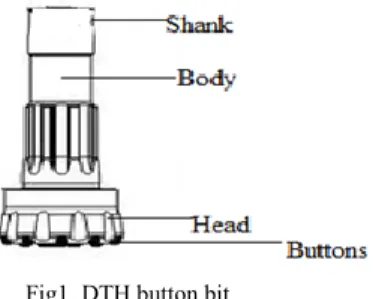
Fig1. DTH button bit
Different types of bits depending on the type of soil and the working conditions. The different types of bits are concave, convex and flat. The holes can be drilled ranging from 4 1/2 inch to 32 inch. The way to choose suitable drilling equipment is complicated and a lot of information is required to reach performance and economy in the operation.
The DTH button bit is the multi point cutting tool that cut the rocks and soil used to make holes or bores[1] in to the hard rock surfaces of the earth and to breaking the rocks and the solid masses of land in its way .
1.KOTESWARARAO.B Working as an Assistant professor in department of mechanical engineering, Gurunanak institutions technical campus, Ibrahimpatnam, Affiliated to JNTU, Hyderabad, kukatpally Hyderabad.
India.
2. D.MOHANA KRISHNUDU, Working as an Assistant professor in Department of of mechanical engineering, AVR&SVR Engineering college, kurnool, Affiliated to JNTU,Anantapuramu,Andhra Pradesh India.
3. D.MURALIDHAR YADAV Working as an Associate professor in department of mechanical engineering, Dr Samuel George institute of engineering and technology Markapur, Affiliated to jntuk Kakinada Andhra Pradesh India.
2. Material used for button bit
EN36C is a case hardening steel or nickel chromium steel.
It is low carbon steel[2] or carburizing steel that offers high core strength, high fatigue strength, high temperature resistance and high harden ability. It can achieve carburized case hardness of 60-62 HRC (comparable to conventional gear steels such as 8620, 9310, etc.) but provides ultrahigh core properties for demanding shaft and gear applications. It’s high tempering temperature (900°F) offers a 400-600°F increase in thermal stability relative to conventional gear steels[3].
2.1properties of EN36c:
i. Physical Properties:
Density = 7.85 g / cc ii. Mechanical Properties:
Hardness= 40 HRC
Ultimate tensile strength = 1238 Mpa Yield tensile strength = 993 Mpa Elongation at break = 200 Gpa Modulus of elasticity = 200 Gpa Bulk modulus = 140 Gpa Machinabilty = 50 % Shear modulus = 80 Gpa iii. Thermal Properties:
CTE = 11.5 mm/m oc Specific heat = 0.472 J/g - oc Thermal conduction = 51.9 w/n-k 2.2. Composition of en36c:
C = 0.12 % Mn = 0.30 % Si = 0.10 % Cr = 0.60 % Ni = 3.19 % Mi = 0.14 % S = 0.05 %
3. Button bit manufacturing processes 3.1. Material selection and quality checking
Fig 2. RCS bars
Round corner square bars are delivered in the as rolled stage.
These bars have rounded edges[1], the radius is approximately,15% of the side length. Round Corner Square Bars are available in standard size ranging from 20 mm to 160 mm.
3.2. Features of RCS:
Size range: 20 mm to 160 mm
Available grades: carbon steel, alloy steel and specified grade
Industrial application: engineering, power generation, aerospace, ordnance, petrochemicals, infrastructure, real estate, railways, and forgings.
4. QUALITY CHECKING:
4.1. dimesional test:
In dimensional test the physical properties such length of RCS, width, thickness of a material, physical appearance of a material, rust or corrosion on a surface, scratches, indentations, external cracks , uneven surfaces, external bending of RCS should be tested. This quality check is must be conducted by quality engineer.
4.2. ultrasonic flaws detection:
Before going to cut the round corner square material (RCS) it has to be check to detect the material defects inside of the material. For this purpose ultra sonic flaw detector[5] is used
Fig 3. Ultrasonic flaw detectors
The UDS2-RDM-22 flaw detector is designed for revealing defects along the whole length and across the rail and RCS bar sections, with continuous testing at a movement speed up to 4km/hr. The detector is also used for the selective hand testing of welded joints, separate sections and rail parts, and for the determination of the revealed defects coordinates and their conventional size.
4.3. spectro metal analysis
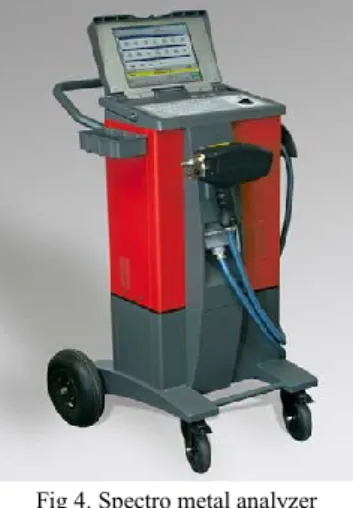
The principle of the analysis method of SPECTRO´s stationary metal analyzers is optical emission spectroscopy. Sample material is vaporized on the spark stand by an arc or spark discharge. The atoms and ions contained in the atomic vapor are excited into emission of radiation. The radiation emitted is passed to the spectrometer optics via an optical fiber, where it is dispersed into its spectral components. From the range of wavelengths emitted by each element, the most suitable line for the application is measured by means of a photomultiplier.
Fig 4. Spectro metal analyzer
The radiation intensity, which is proportional to the concentration of the element in the sample, is recalculated internally from a stored set of calibration curves and can be shown directly as percent concentration.
5. MATERIAL CUTTING
The ultrasonic flaw detector tests the RCS bar sections. If any defects are present in it must be avoided from the production. Remaining sections are passed through the cutting process
In the process the material in the form of cylinders of square blocks are cut as per the required dimensions say of 35kg. The diameter of the material will be in the range as specified by the customer. The material is cut by a Band saw with a conveyor the cutting of material is fast in the process. The pieces will be then weighed and the pieces
that are less than the given weight specified and its tolerance are rejected and the remaining are sent for further machining.
The supplier itself cuts these so this is not included in the manufacturing process carried out by the company However, this is the Basic process for the bit.
figure 5. Material cutting.
6. MANUFACTURING 6. 1.forging
Fig 6. Forging
Forging is defined as the shaping of a heated metal by hammering or pressing. In forging the metals are made plastic by heating them and then deformed by hammering when they are in red-hot.
This process usually carried above recrystalization temperature [6].
Therefore, it is called as hot working process. For our raw materials selected, the piece is kept in the furnace and heated to a temperature of 9000 C -12000 C. The different Types of forging are Open die forging
Then the piece is forged to steps. The piece will be in red hot even in these conditions. Then the piece in the form of steps is placed in the mould and they drop forged. Then the piece attains the shape of the die finally the piece is kept in air for cooling. Next, the piece will be sent for further machining. After forging, the metal will be of 34.5kg in mass.
6.2 annealing:
Annealing generally refers to any heating and cooling operation that is usually applied to induce softening. Our piece from forging reaches annealing[7]. Here the piece is heated to 9800 c and left for 10 hrs. Then it is cooled in the atmosphere air for 3hrs.Then the pieces are again heated for about 8hrs.It is left in the furnace for 2hrs and then taken out for cooling.
After annealing, the metal becomes soft for machining. Then it is sent for further machining. Then sent for further machining. Mass of the piece after annealing is 32kg.
Fig 7. Work piece after annealing.
6.3 rough turning:
The metal from forging and annealing will be brought to roughing. The piece will be totally covered will slag like material. The piece is then sent for facing, turning and the dimensions are not to be that accurate. It is the process of metal removal in the form of chips when the tool is feed against the rotating piece. The process is suitable for cylindrical jobs only. The turning is carried out by carbide tipped tool. This turning need no accuracy i.e., the dimensions may vary up to 1mm.
The mass of the piece after roughing will be 30kg. The main aim of this roughing will be removal of the top layer. After this, the dimensions are to be perfectly maintained. The piece is then sent to further machining.
Fig 8. Rough turning
6.3.1. Finish and turning:
Fig 9. Finishing machine
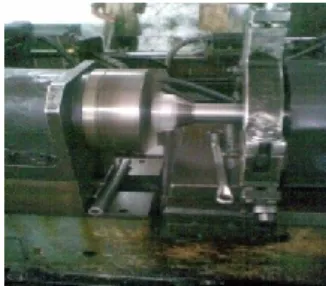
The piece from rough turning comes to C.N.C (Computer Numerical Control) to prepare a semi-finished bit. The bit is placed in the jaws are operated pneumatically and by leg pedals. Then the pneumatically operated tailstock holds the work piece by means of revolving centre.
This finishing and turning operation is performed by CNC machine. This cnc machine is already programmed by the cnc programmer.
According the given instructions the cnc performs the operations that are required to produced part. This cnc machine machine consists three cutting tips (or) carbide tool tips..these carbide tool tips posses high thermal and wear resistance and posses high toughness.
In this cnc machine three tool bits are used. First tool bit is used to produce the shank. Second tool bit is allotted for performing roughing operation and third one is for finishing. in this cnc machine to reduce the heat of working part , to reduce the temperature of tool and for cleaning purpose quacker coolant is used. Scrap is collected automatically
Fig:10 surface turning
6.4 deep hole drilling
In the process, the top surface of the bit is drilled with 30 mm to a distance 254.8 mm from the top surface. This is done by using a deep hole-drilling machine is operated hydraulically. The tool is fitted to the moving end of the machine tailstock. The oil is pumped continuously into and out of machine for tail; stock movement first drilling and then boring is done in the drilled hole.
This is a hole used to take the air into the hole to remove and sand in the way of boring it. The process is a short process and takes about 10 minutes. The piece is held in the four jaws as in the conventional lathe.
The weight of work piece at the end of this will be 25.8 kg.
During this operation head of button bit is fixed in the head stock lathe machine. Remaining portion is supported by steady rest.
Universal scriber is used to check the exact fixation of button bit in the head stock. A gun drilling cutter of 30 mm is used to produced the 32 mm through hole from the top (shank)of the button bit. The length of the hole is 280 mm from the shank.
After finishing of the hole chamfering operation is performed to the already drilled hole. The time taken to produce the hole is 10 min. in this operation feed is 120 m/min, speed is 800 rpm.
Figure 11. work piece on a deep hole drilling.
6.5. Milling:
Milling is the process of cutting away material by feeding a work piece past a rotating multiple tooth cutter. The cutting action of the many teeth around the milling cutter provides a fast method of machining.
The machined surface may be flat, angular, or curved. The surface may also be milled to any combination of shapes. The machine for holding the work piece, rotating the cutter, and feeding it is known as the Milling machine.
Splines are made on the center of body of the DTH button bit by the use of multi point cutting tool. During splline milling shank is fixed in head stock of CNC lathe. And the head of button bit is supported with center of tail stock. Three jaw chuck is used to fix the shank of button bit.
A vertical multi point cutting tool is rotated and moves towards the button bit and it removes the material up to required dimensions according to the given instructions.
Spline rough cutter is used to remove the material in huge amount. During this operation high finish cannot be obtain. The main purpose of this cutter is to remove huge amount of material within the quick time. After finishing of Spline rough cutting ,the cutter moves in to the its original place. The speed of the rough milling is 1200 rpm,feed is 380mm/min and depth of cut is 12.2 mm
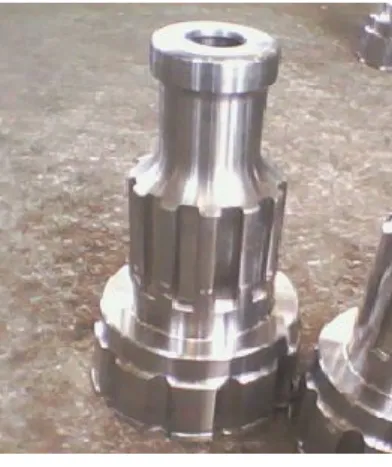
Fig 12. after spline milling
After completion of producing of spline rough cutting it has to be finish well. For that purpose Splines are cut on the body of the work piece about 12 splines are cut and the tool used for this splines are square milling cutter.
Slots are cut at the bottom surface of the bit about 10 slots are cut at regular intervals. The distance between slots in 29mm and size of slot is 24mm from cutter is used here. Speed of the finish cutter is 1400 rpm and feed is 800 mm.
6.5.1. Round milling
Fig : 13. Round milling tool
The purpose of round milling is to provide round splines on the surface of the head of the button bit Conventional horizontal milling machine is used for this purpose. After milling, the weight of work piece will be of 25 kg and it is move to heat treatment process. In wich ball nose cutter is used instead of cicular or round milling cutter. Round milling operation is performed to the head of the button bit, to produce round grooves on the head of the button bit. These round grooves are helpful to allow the air in to the field to remove soil. Totally 10 no of round grooves are provided on the peripery of the head opf the button bit.
During round milling process shank of the button bit is fixed in the head stock . head of the button bit is supported with tail stock center. A ball nose cutter, dia of 25 mm is used to produce round grooves. Width of the groove is 25 mm and depth is 12.2 mm. cycle time for this operation is 6 min. blaser cut coolant is used to remove heat and to clean surface.
Fig 14. work piece after milling.
6.6. Cutting fluid:
Cutting fluid is a type of coolant and lubricant designed specifically for metalworking and machining processes. There are various kinds of cutting fluids, which include oils, oil-water emulsions, pastes, gels, aerosols (mists), and air or other gases.
Fig 15. Cutting Fluid 6.6.1need of cutting fluids:
To improving tool life
To reducing work piece thermal deformation
To improving surface finish and flushing away chips from the cutting
zone
To keep the work piece at a stable temperature (critical when working to close tolerances). Very warm is OK, but extremely hot or alternating hot-and-cold are avoided.
To
maximize the life of the cutting tip by lubricating the working edge and reducing tip welding.
Safety
for the people handling it (toxicity, bacteria, fungi) and for the environment ensure upon disposal. Event rust on machine parts and
cutters.
6.7. Welding:
Welding is done to the top section of the round milling. The purpose of welding is to posses high strength and wear resistance to the outer surface of the head of the button bit. It provides hardness to the top of the round milling. FLUSH 6.8.hole drilling:
In flush drilling the center point of face is marked with center punch. Then a straight line is drawn though the center point of face of the button bit. Two points are marked on the line with a distance of 17 mm from the center point in opposite directions. First a 6 mm holes are made on the two marked points with 6 mm drill bit. Then a drill bit of 20 mm is used to produced a hole length of 53 mm. these holes are produced at an angle of 18 degrees.
Fig: 16.flush hole drilling
The universal drilling machine is used to produce flush or angular holes on the face of button bit. A pre angular fixture is is used to fix or hold the work rigidly. A 20 mm drill bit is attached to the sleeve; sleev is inserted in the spindle. In this process speed is 500 rpm , feed 60 mm/min and depth of cut 110. Cycle time for this operation is 15 min. Coolant is used to improve performance of the machine.
6.9. Carburising
Carburizing[8] is a case-hardening process by which carbon is added to the surface of low-carbon steel. This results in a carburized steel that has high carbon surface and a low carbon interior. When the carburized steel is heat-treated, the case becomes hardened and the core remains soft and tough. Two methods are used for carburizing steel. One method consists of heating the steel in a furnace containing a carbon monoxide atmosphere.
And the other method has the steel placed in a container packed with charcoal or some other carbon-rich material and then the container is heated to a certain temperature, then the carbon gas is induced in to the surfaces of the product. Carburizing provides a hard wear resisting outside and a tough shock resisting core.
6.9.1. Need of carburizing:
To improve case hardness
To improve hardness of a product
To control grain size
To improve mechanical properties 6.9.2. Carburization of dth button bit:
In this process carbon is added to the surface of the button bit. Before carburization of button bit the percentage of button bit material is 0.16 to 0.4 %. During carburizing carbon is induced in to the surfaces of button bit. Due to this the carbon percentage of the button bit is increased to 0.4- 0.6 %
In carburizing process button bits are kept in closed and air tiet container . before carburizing anti carburizing paste is applied to the face of the button bit . other wise the face of the button bit gets hardened.
Due to this button hole drilling is not possible for inserting tungsten carbide buttons.
The gas furnace is rounded with induction coils. These induction coils are used to heat the container up to required temperature. In this process electrical energy is used as a heating source, to heat the product of the product up to 925 degree centigrade. During heating of the buttons bits the oxygen is removed from the container by the vacuum pump. Then the carbon gas is forced in to the chamber. In this process we use mixture of LPG + Methanol as a carbon gas. This carbon carbon gas is circulated in the container by the help of circulating fan. Due this circulation of gas carbon is equally distributed in chamber.
Both methanol and LPG gasses are stored in a two different cylinders. Flow meters and cyanide valves are used to control the percentages of gasses. Auxiliary probe is used to control the temperature of inside chamber. After carburizing the products are removed from the furnace and allowed to air cooling to lower the temperature and further use.
Fig 17. carburizing.
6.9.3. Carbon test:
After carburizing the products are removed from the furnace and allowed to air cooling to lower the temperature and further testing of percentage of carbon induced in it. A sample piece of (0.5 milli grams ) is taken from button bit. Then the percentage of carbon is tested which is induced in to the surface of button bit. Carbon and Surface apparatus is used to test the how much percentage of carbon is increased . The sample chips are heated in a furnace up to 1180 degree centigrade.
Pure oxygen is supplied to the samples to divide carbon and other gasses. If the percentage of carbon is increased in the button bit it has to be normalized. For the button bits 0.8 - 0.9 % range of carbon should be maintained. If the range of the carbon is exceeds in the button bit it leads to high hardness and breakage of button is takes place. If the range of the carbon is decreased in button bit it leads to low hardness and wear of button bit takes place.
6.9.4. Hardening:
In hardenining process the button bits are heated to the 860 degree centigrade temperature, after that it is held at that temperature until the desired internal structural changes take place. This process is called soaking. The length of time held at temperature is called the soaking period.
The oil mixtures are more suitable for metals that need a soaking period depends on the chemical analysis of the slower rate of cooling. Generally, carbon steels are water-hardened and alloy steels are oil-hardened. soaking period is determined by the largest section .During the soaking stage, the temperature of the button bit is slowly brought down to the room temperature. The Electrical furnace is used to heat the salt bath 800 degree centigrade. The soaking temperature is 800 degree centigrade and soaking time is 1.5 hr .
After soaking is completed the button bits are allowed for servo quenching in a servo tub. A rotating fan is used to cool the servo oil and also air cooling is provided to cool the oil sump. The cooling time for button bits are 1hr.
6.9.5. Advantages of hardening:
To develop hardness.
To improve strength and toughness.
To increase the wear resistance to cut other materials.
6.10. Tempering:
Tempering is a process done subsequent to quench hardening.
Quench-hardened parts are often too brittle. This brittleness is caused by a predominance of Martine site. This brittleness is removed by tempering.
Tempering results in a desired combination of hardness, ductility, toughness, strength, and structural stability.
During this Tempering process the button bits the button bits are heated to a 180 degree centigrade for 4 hrs to a temperature below that of critical temperature followed by air cooling. The tempering renders the steel tough and ductile. After finishing of tempering the part mus-+t be inspected and hardness must be tested.
6.11 Grinding:
Grinding is required to produce the finishing operation on the body of the button bit, to insert the button bit in to the front chuck. The body diameter up to 106.55 mm drilling is carried out. Bit head is fixed in the head stock.
Grinding is carried out inside , the face of the head, body, and shank face.
7. DRILLING 7.1. face drilling:
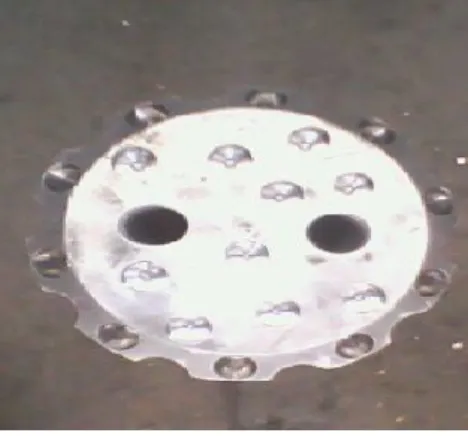
In face drilling 10 no of holes are to be produced on the face of the button bit, to insert the tungsten buttons on the face of the button bit. The diameter of the button is 16.7 mm. Depth of the face hole is 16.8 mm. Air hole is also provided at the center of face drilled hole with a diameter of 6 mm and depth of air hole is 5mm.the purpose of providing air hole to the drill hole is to tap the excess air during insertion of buttons. The depth of the air hole for face drilling is (16.8 + 5) mm.
7.2 periphery drilling:
10 no of holes are to be produced on the periphery of the button bit, to insert the tungsten buttons on the periphery of the button bit. The diameter of the button is 16.7 mm. Depth of the periphery hole is 22.2 mm.
Air hole is also provided at the center of periphery drilled hole with a diameter of 6 mm and depth of air hole is 5mm.the purpose of providing air hole to the drill hole is to tap the excess air during insertion of buttons. The depth of the air hole for periphery drilling is (22.5 + 5) mm.
A vertical CNC drilling machine is used to produced holes on the face and periphery of the bit. Speed is 500 rpm for face drilling, 600 rpm for periphery drilling. Drilled hole tolerance is 10 microns for both periphery and face drilling holes.
Fig 18. drilling and periphery drilling 7.3. Inspecton of bores:
A digital bore gauge is used to measure or check the accuracy of the diameter of a bore to eliminate the wastage of a time during checking. Bore gauge consisting of two jaws. Before going to check the hole the pressure of bore gauge is set as 16.70 for the hole which is to be checked. when the jaws are inserted in the hole it shows the difference between the standard hole to the existing hole . It consist of digital screen, on digital screen it shows the readings of particular hole. Blaso cut 4000 coolant is used to remove heat and to clean the work place.
Fig 19. Bore gauge 8. BUTTON PRESSING
8.1 buttons
Tungsten Carbide buttons has its unique performance and are widely applied to oil filed drilling and snow removal. According to the different oil-field drilling machinery such as roller cone bits,DTHbits,geotechnical drilling tools, etc.
Carbide buttons are used in the coal cutter drilling tools, mine machinery tools and road maintenance tools for snow clearing and road cleaning. Carbide mining button bits are widely applied for rock tools, mining tools for use in quarrying and mining, tunneling, and civil constructions.
These are generally made of tungsten carbide, which is imported from West china .These are pressed into the holes of the bit. As this is a interference fit. The buttons once in cannot be removed out.
Fig 20..buttons with copper washer.
20 buttons are required for each button bit. 10 buttons needed for periphery and other 10 buttons needed for face.
8.2 specifications of button:
Fig 21. specification of button Table: 1.button specifications Model basic dimension
D H R A0 β0
Q1625 16.78 21.5 8.8 20 16
8.3 material of button:
Tungsten carbide (WC) is an inorganic chemical compound containing equal parts of tungsten and carbon atoms. Colloquially, tungsten carbide is often simply called carbide. In it is most basic form, it is a fine gray powder, but it can be pressed and formed into shapes for use in industrial machinery, tools, abrasives, as well as jewelry. Tungsten carbide is approximately three times stiffer than steel, with a Young's modulus of approximately 550 Gap, and is much denser than steel or titanium. It is comparable with corundum (α-Al2O3) or sapphire in hardness and can only
be polished and finished with abrasives of superior hardness such as cubic boron nitride and diamond amongst others, in the form of powder, wheels, and compounds.
8.4 properties of tungsten carbide:
8.4.1 Physical properties:
Density = 15.7 g/cc
Molecular weight 195.85 g/m
8.4.2 Mechanical properties:
Hardness = 90 HRC
Ultimate tensile strength = 344 Mpa Modulus of elasticity = 696 Gpa Compressive strength = 2683 Mpa
8.4.3Thermal Properties:
CTE = 5.20
Melting point temperature = 2870 oc
This is a domed button with an additional, smaller dome on top of it. The 2nd dome provides additional carbide thus extending the life of the button.
The 2nd dome also keeps the button sharp longer thus providing better penetration and an extended drilling distance before the first sharpening is required.
9. BUTTON PRESSING:
9.1 Periphery button pressing:
During periphery button pressing 10 buttons are to be pressed in to the periphery holes of the button bit. For perfect sitting of buttons in to the hole copper washers are used. The diameter and thickness of the washer are 16.5mm and 2 mm respectively. Before going to press the buttons in to the hole copper washers are placed in the hole. For perfect sitting of buttons in to the hole copper washers are used. Air hole is provided to the copper washer, to tap extra amount of air during pressing button.
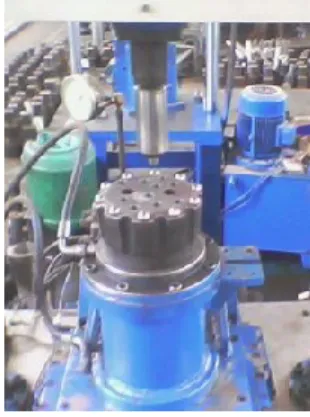
The DTH button bit is loaded on the button pressing machine at 30 degrees angle. Then the button bit is fixed rigidly by the help of fixtures, clamps and bit clamp. Punching pin hole is used to locate the hole for checking purpose. Button is placed in the hole then the button is pressed by the hydraulic machine. 60 bar pressure is used to press the button in to the hole.
Button fixtures are used to provide required movement to the button bit for fixation of buttons. After completion of button pressing the button bit is shifted to another machine.
9.2 Face button pressing:
Fig 22. button pressing by hydraulic machine
During face button pressing 10 buttons are to be pressed in to the face holes of the button bit. For perfect sitting of buttons copper washers are used. The diameter and thickness of the washer are 16.5mm and 2 mm respectively.
Before going to press the buttons in to the hole copper washers are placed in the hole. For perfect sitting of buttons in to the hole copper washers are used. Air hole is provided to the copper washer, to tap extra amount of air during pressing button.
The DTH button bit is loaded on the button pressing machine at.
Then the button bit is fixed rigidly by the help of fixtures, clamps and bit clamp. Punching pin hole is used to locate the hole for checking purpose.
Button is placed in the hole then the button is pressed by the hydraulic
machine. 60 bar pressure is used to press the button in to the hole. Button fixtures are used to provide required movement to the button bit for fixation of buttons. After completion of button pressing the button bit is shifted to checking of button height[4].
9.3 checking of button hieght:
Button height gauge is used to check the height of the buttons during pressing of buttons. The button height gauge is set in the range of 0.77-0.8. Then the height gauge is placed on the periphery of the button bit .and the it gives the readings or height of buttons from the face surface of button bit.
9.4. shot blasting:
Shot blasting is a technology which directs blast media onto a parts surface at speed of up to 120 m/sec. The media is accelerated either by blast wheels (airless), compressed air, or electric pumps (water jet cleaning). The blast results tdepends up on the type of blast machine, processing parameters and selected blast media. Steel shot blasting is the most widely used process for cleaning, stripping and improving a metal surface. Smaller steel shot will result in a smoother and more polished surface. Larger shot will clean more aggressively but produce a rougher surface. Both air powered and wheel blast systems can be used to accelerate the steel shot onto the surface of the part. Due to the hardness and density of steel shot, it can be recycled as much as 3000 times before replacement.
Since steel shot does not use an abrasive process, a minimal amount of dust.
Steel shots are non-toxic and non-hazardous product. No special disposal precautions are required for the product, once it has been used for blast finishing purposes. However, contamination from a specific application or process must also be considered prior to disposal.
9.5. Chemical composition of shots:
Cr : 16 - 18 % Ni : 8 - 9%
Cr/Ni is used for manufacturing of shot balls. Cr/Ni improves corrosion resistance of a metal. Cr is harder and it is more suited to improves the mechanical properties like surface hardness, wear resistances and ability to withstand shock and impact loads
9.6. Principle of shot blasting:
Products are placed on the or loaded on the bed of the machine . Shot blasting is gift of paint it provide high harness the surface of button bit and gives long life to paint of button bit. In shot blasting steel shots are placed in sump in huge amount. A small openining is provided for the steel shot sump. And the openining is attached to the a narrow passage of air with high pressure towards the direction of button bit, to hit the button bit
with high velocity, to give required finishining of product.
During shot blasting Centrifugal wheel and compressed air systems is used to carry the steel shots to hit the target with high velocity.
Horizon air compressor is used for this process. It supplies high pressure of air with in quick time. After finishing of shot blasting a magnetic collector is used to collect all the shot balls. the cycle time for this operation is 1.5 hrs.
10. PAINTING:
Painting is process of finishing of materials with scientific reliability. In witch coating is applied to a product as a layer to protect the product from deferent atmospheric conditions.
10.1. Need of painting:
To improve corrosion resistance
To improve life time of component
For good appearance of product 10.2. Mist coating:
It also called as first coating in this processes thinner is added to the paint to reduce the viscosity of paint. A thin coat with pressure of 40 PSI is applied to the button bit and then allow to dry over night after drying wet cut with 400grade paper
10.3. Full coating:
This is also called as second coating . in which the coating viscosity is reduced by mixing 100 parts of paint with15-20parts of super set thinner . a coating is applied on the button bit at 3 kg / cm 2. Allow to dry 96 hrs.
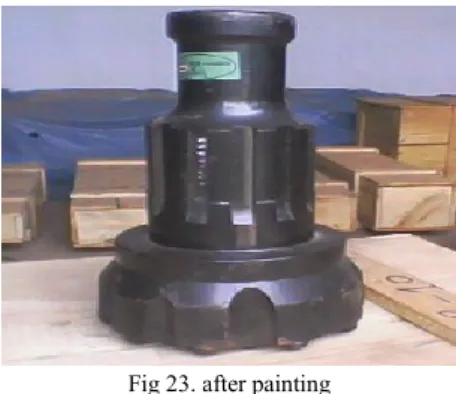
Fig 23. after painting Conclusion
To with stand vibrations and impact loads generally manufacturing industry apply welding. Due to welding application the hard material become brittle.
For the remedy of that problem I preferred instead of welding applying ceramic coating on the periphery of button bit .due to this ceramic coating the periphery of button bit gets hardened, and it improves the wear and tear resistance of button bit.
I hope that in future there is chance of implement my suggestion to overcome the above problem i also suggested that by decreasing rough turning about 2mm there is a possibility for saving of materials about 2kgs .instead of rough turning if we can use exact dimensions of bit from the forging .It leads to availability of button bit at lower cost and also profits for the management.
In future there is a scope for reducing the weight of button bit and increase the strength by the using of different new trend materials like aluminum alloys and other type of materials.
Acknowledgment
This paper is based on our research carried out by the faculty of Gurunanak institutions technical campus, Hyderabad.The research had been completed by Mr. KOTESWARARAO.B , D.Mohana Krishnudu and D.Murali Dhar yadav.
I am very much grateful to Mr.K.SATISH, Associate professor, SMGOIH for his necessary technical support and stimulated guidance throughout the research work.
I take this opportunity to record our obligation to my parents.
For their encouragement and blessings for the development of this paper.
References
[1] Teale, R.: “The Concept of Specific Energy in Rock Drilling,”
International Journal of Rock Mechanics and Mining Science (1965) vol. 2, 711-725.
[2] Finger J T.investigation of percussion drills for geothermal applications [J], journal of Petroleum Technology, 1989: 2128-2136.
[3] www.drillingrigsindia.com.
[4] R. Hamilton P.Makulsawatudum, & D. Meckenzie, “Stress concentration On Dth Button Bit”, Journal of Strain Analysis, Vol 4, pp 415-421, 2009.
[5] H. Wang and B. H. Shan, “Development of a real-time ultrasonic phased array detection system”, Journal of Harbin Institute of Technology, vol. 40, (2008), pp. 771-774.
[6] T. Altan, V. Vazqes, Numerical process simulation for tool and process design in bulk metal forming, Annals of CIRP 45/2 (1996) 599-607.
[7] Ardia, K. Boudt, P. Carl, K. M. Mullen, and B. G. Peterson. Differential evolution with DEoptim. The R Journal, 3, 2011.
[8] Ihom, A.P., Nyior, G.B., Nor, I.J., Ogbodo, N.J. (2013) Investigation of Egg Shell Waste as an Enhancer in the Carburisation of Mild Steel , American Journal of Material Science and Engineering Vol. 1 No 2, 29-33
272 ISSN: 2278 – 7798 All Rights Reserved © 2015 IJSETR
KOTESWARARAO.B was born in yedlurupadu, India, in 1990. He received the B.Tech. Degree in Mechanical Engineering from the JNTU Technological University Kakinada, India, in 2011, and the M.Tech. Degree in thermal Engineering from the university college of Kakinada, India, in 2014.
From May 2011 to December 2012, he has been with the Department of mechanical Engineering, RVR Institute of Engineering &
Technology. Where he was an Assistant Professor. His current research interests include alternative fuels, automobile emission reduction , and power plant optimization.
D.MURALIDHAR YADAV was born in markapur prakasam dist Andhra Pradesh , India, in 1969. He received the B.Tech.
Degree in Mechanical Engineering from the BIET DAVANAGERE KUVEMPU UNIVERSITY Karnataka state , India, in 1999, and the M.Tech. Degree in Machine design from the jntu college of Kakinada
from the university JNTU
HYDERABAD , India, in 2001. From july 2001 on words joined as a Assistant professor in Department of mechanical Engineering in Dr Samuel George institute of engineering and technology markapur and promoted as Associate professor from 2007- 2014. His current research interests include , automobile engineering , design and production engineering