Aspect Oriented Software Fault Tolerance
Kashif Hameed, Rob Williams, Jim Smith
University of the West of England, Bristol Institute of Technology
ColdHarbour Lane Bristol, BS16 1QY
[email protected], [email protected], [email protected]
Abstract
Software fault tolerance demands additional tasks like error detection and recovery through executable assertions, exception handling, diversity and redundancy based mechanisms. These mechanisms do not come for free, rather they introduce additional complexity to the core functionality. This paper presents light weight error detection and recovery mechanisms based on the rate of change in signal or data values. Maximum instantaneous and mean rates are used as plausibility checks to detect erroneous states and recover. These plausibility checks are exercised in a novel aspect oriented software fault tolerant design framework that reduces the additional logical complexity. A Lego NXT Robot based case study has been completed to demonstrate the effectiveness of the proposed design framework.
Keywords: aspect oriented design and programming,
executable assertions, exception handling, fault tolerance, plausibility checks.
1.Introduction
Adding fault tolerance measures to safety critical and mission critical applications introduces additional complexity to the core application. By incorporating handler code, for error detection, checkpointing, exception handling, and redundancy/diversity management, the additional complexity may adversely affect the dependability of a safety critical or mission critical system.
One of the solutions to reduce this complexity is to separate and modularize the extra, cross-cutting concerns from the true functionality.
At the level of design and programming, several approaches have been utilized that aim at separating functional and non-functional aspects. Component level approach like IFTC [5], computational reflection and meta-object protocol based MOP [6] have shown that dependability issues can be implemented independently of functional requirements.
The evolving area of Aspect-Oriented Programming & Design (AOP&D) presents the same level of independence by supporting the modularized implementation of crosscutting concerns. Aspect-oriented
language extensions, like AspectJ[7] and AspectC++[1] provide mechanisms like Advice (behavioural and structural changes) that may be applied by a pre-processor at specific locations in the program called join point. These aredesignated by pointcut expressions. In addition to that, static and dynamic modifications to a program are incorporated by slices which can affect the static structure of classes and functions.
In the context of fault tolerance, an induced fault can activate an error that changes the behaviour of the program and may lead to system failure. In order to tolerate a fault, abnormal behaviour must be detected and transformed back by introducing additional behaviour changes (Exception Handler) or alternate structure adoption (Recovery Blocks, N-Version Programming) strategies.
The rate of change (ROC) of signals or data can be used to detect erroneous conditions that can help in tolerating faults and avoiding failures by triggering appropriate recovery mechanisms. ROC-based plausibility checks for error detection and recovery in the form of executable assertions have been addressed by [2] [3]. In [4] the author utilizes dynamic signal values for modeling and predicting future sensor values. Unfortunately, these mechanisms will add to the complexity of the true functionality that could affect the overall dependability of the system. None of the previous studies propose the separation of these error handling concerns from true functionality. However Aspect Oriented Design and Programming approaches may be used to separate out these concerns from the true functionality of a computer based system.
In this paper the rate of change based executable assertions have been extended with more refined time bounded instantaneous and mean rate checks that reduce false positives and false negatives. Secondly an empirical method for determining the maximum instantaneous and mean rates of change has been devised.
2.ROC Plausibility Checks & Recovery
In order to apply various plausibility checks, it is first necessary to determine the characteristic range of values for key variables/signals. Most real-time sensors monitor continuous signals that may be monotonic or random. Further more, the monotonic signals may have static or dynamic rates. Continuous signals can be classified on the basis of the above criteria, as tabulated below. The characteristic parameters have also been assigned to various classes of signals for clarity and differentiation. The characteristic parameters of variables assigned here are ymax(maximum value), ymin (minimum value), r max-incr(maximum increase/sample time), rmin-incr(minimum
increase/sample time), rmax-decr(maximum decrease/sample
[image:2.612.315.556.194.401.2]time), rmin-decr(minimum decrease/sample time). Table 1 Signal Parameters
Signal Type Parameters
Static monotonic (↑)
0 , 0 min max min max decr decr incr incr r r r r
Static monotonic (↓)
0 , 0 min max min max decr decr incr incr r r r r
Dynamic monotonic (↑)
0 , 0 min max min max decr decr incr incr r r r r
Dynamic monotonic (↓)
0 , 0 min max min max decr decr incr incr r r r r Random 0 , 0 min max min max decr decr incr incr r r r r
3.ROC Plausibility based Executable Assertions
Error detection is the basic step in deploying any fault tolerance strategy. Executable assertions are often utilized as one error detection mechanism. ROC-based plausibility checks on input signals may be used to detect some erroneous conditions that could lead to failure. Although ROC-based executable assertions have been addressed in [2], these constraints are based on changes in variable values but without time boundedness. However the true rate of change should employ the change in variable values in a specified time interval. Without considering a time boundary, there are more chances to have false positives and false negatives. Thus for bounded
dt
dy there exists dt
dy such that
max
min
dt dy dt dy dt dy [4].Moreover the signal configuration parameters like rmax and
rmin should also be calculated keeping in view the time
consideration. The set of plausibility checks exercised in our study are tabulated below.
4.ROC Plausibility Based Recovery
When an error is detected a recovery mechanism is brought into service to avoid a failure and so tolerate the fault. The recovery mechanisms employed here are managed on the basis of running trends. The faulty data is replaced by computed values derived from past values and some increment based on the maximum and minimum rates of change. However, the forcefully assigned values are kept within the maximum and minimum data ranges.
Table 2 Rate of Change Recovery Mechanism
ROC Assertion (PC) Recovery Mechanism
Case: yiyi1(Increase)
PC1: incr i i i i r t t y y max 1
1 yr yi1rmaxincrTi1i
If PC1 && yiymaxthen
PC2: incr
i i i i r t t y y min 1 1
if ymaxyi1rminincrTi1i
then yryi1rminincrTi1i
elseyrymax
Case:yiyi1(Decrease)
PC3: decr
i i i i r t t y y max 1
1 yryi1rmaxdecrTi1i
If PC3 &yiyminthen
PC4: decr
i i i i r t t y y min 1 1
if yminyi1rmindecrTi1i then
i i decr i
r y r T
y 1min 1 elseyrymin
5.Aspect Oriented Exception Handling Patterns
Exception handling has been deployed as a key mechanism in implementing software fault tolerance through forward and backward error recovery mechanisms. It provides a convenient means of structuring software that has to deal with erroneous conditions [11]. In [8], author addresses the weaknesses of exception handling mechanisms provided by mainstream programming languages like Java, Ada, C++, C#. In his experience exception handling code is inter-twined with the normal code. This hinders maintenance and reuse of both normal and exception handling code.
Moreover as argued by [9], exception handling is difficult to develop and has not been well understood. This is due to the fact that it introduces additional complexity and has been misused when applied to a novel application domain. This has further increased the ratio of system failures due to poorly designed fault tolerance strategies.
[image:2.612.88.288.267.418.2]In this respect, [6] has proposed an architectural pattern for exception handling. They address the issues like specification and raising of exceptions, specification and invocation of handlers and searching of handlers. These architectural and design patterns have been influenced by computational reflection and meta-object protocol. However, most meta-programming languages suffer performance penalties due to the increase in meta-level computation at run-time. This is because most of the decisions about semantics are made at run-time by the meta-objects, and the overhead to invoke the meta-objects reduces the system performance [10].
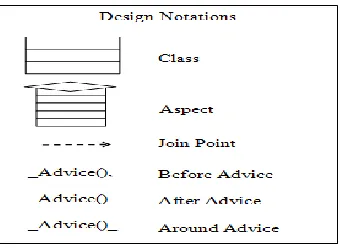
[image:3.612.318.550.109.308.2]Therefore we propose generalized aspect based patterns for monitoring, error detection, exception raising and exception handling using a static aspect weaver. These patterns would lead to integration towards a robust and dependable aspect based software fault tolerance. The following design notations have been used to express aspect-oriented design patterns.
Figure 1 Aspect Oriented Design Notations
5.1.Error Detection and Exception Throwing Aspect
Error detection and throwing exceptions has been an anchor in implementing any fault tolerance strategy. This aspect detects faults and throws range, input and output type of exceptions. The overall structure of this aspect is shown below. The GenThrowAspect join points the NormalClassvia three pointcut expressions for each type of fault tolerance case.
RangeErrPc: it join points the contexMethod() only. It
initiates a before advice to check the range type errors before executing the contextMethod().. Incase the assertions don’t remain valid or acceptable behavior constraints are not met, RaneErrExcexception is raised.
InputErrPc: it join points the contextMethod() further
scoped down with input arguments of the contextMethod(). It initiates a before advice to check the valid input before the execution of the context method. Incase the input is not valid it raises InputErrExc.
OutputErrPc: it join points the contextMethod() further
scoped down with results as output of the contextMethod(). It initiates an after advice to check the
[image:3.612.93.263.305.429.2]valid output after the execution of the context method. Incase the output is not valid it raises OutputErrExc.
Figure 2 Error Detection, Exception Throwing
5.2.Rate of Change Plausibility Check Aspect
This aspect is responsible for checking the erroneous state of the system based on the rate of change in critical signal/data values. Once an erroneous state is detected, the respective exception is raised. Various exceptions are also defined and initialized in this aspect. The pointcut GetSensorData defines the location where error checking plausibility checks are weaved whenever a critical data/sensor reading function is called. The light weight ROC-based plausibility assertions are executed in the advicepart of this aspect.
[image:3.612.317.551.469.662.2]:ClientClass :NormalClass
contextMethod()
Execute Fault Injection Advice()_
<<injects>>
Execute Rate of Change Plausibility Advice()_ Generate Faults & Modify the Sensor
Data
<<uses>>
:FaultInjection :ROCPlausibility
[image:4.612.64.283.82.227.2]Control Flow: Pointcut: GetSensorData
Figure 4 Rate of Change Aspect Pattern Dynamics
5.3.Catcher Handler Aspect
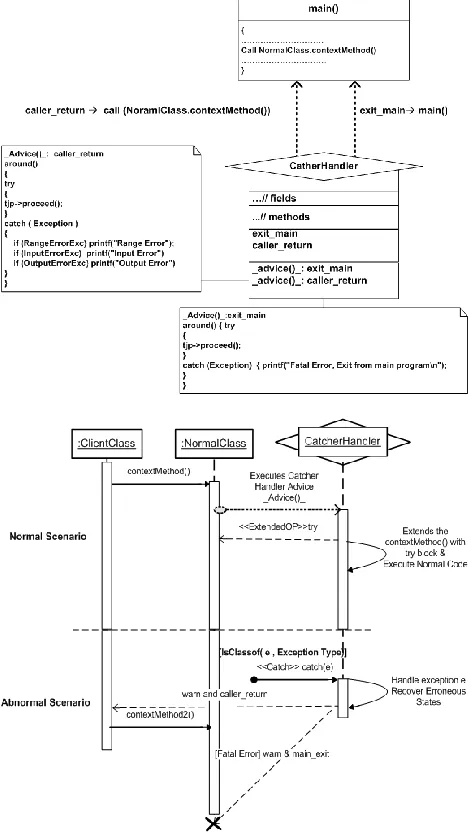
The CatcherHandleraspect as shown below is responsible for identifying and invoking the appropriate handler. This pattern addresses two run-time handling strategies. The first strategy is designated by an exit_main pointcut expression. It checks the run-time main() function for various fatal error exceptions and finally aborts or exits the main program upon error detection. This aspect may be used to implement safe shut-down or restart mechanisms in safety critical systems to ensure safety, if a fatal error occurs or safety is breached.
The second strategy returns from the called function as soon as the error is detected. The raised exception is caught after giving warning or doing some effective action in the catch block. This can help in preventing error propagation. Using this aspect, every call to critical functions is secured under a try/catch block to ensure effective fault tolerance against an erroneous state. It can be seen in the diagram below that exit_main pointcut expression join points the main() run-time function. Whereas caller_return pointcut expression join points every call to the contextMethod(). Moreover exit_main and caller_return pointcut expressions are associated with an around advice to implement error handling. The tjpproceed() allows the execution run-time main() and called functions in the try block.
The advice block of the catcher handler identifies the
exception raised as a result of in-appropriate changes in the rate of signal or data. Once the exception is identified, the recovery mechanism is initiated that assign new values to signal or data variables based on previous trends or history of the variable.
5.4.Dynamics of Exception Handling Aspect
This scenario shows an error handling aspect. It simulates two error handling strategies. In the first case, control is returned from the caller to stop the propagation of errors along with a system warning. In the second case the program exits due to a fatal error. This may be used to
extension of a class member function with a try block is also explained.
1. A client object invokes the contextMethod() on an instance of NormalClass.
2. The control is transferred to CatcherHandler aspect that extends the contextMethod() by wrapping it in a try block and executes the normal code.
3. In case an exception is raised by previous aspect, the exception is catch by the CatcherHandler aspect. This is shown by the catch message. The condition shows the type of exception e to be handled by the handler aspect.
4. CatcherHandler aspect handles the exception e. the caller_return strategy warns or signals the client about the exception and returns from the caller. The client may invoke the contextMethod2() as appropriate. In exit_main strategy, the control is retuned to client that exits the current instances as shown by the life line end status.
[image:4.612.317.553.274.693.2]6.Case Study
In order to validate aspect oriented fault tolerance patterns for exception handling and executable assertions as proposed earlier, a case study has been carried out using a LEGO NXT Robot (Tribot). This uses an Atmel 32-bit ARM processor running at 48 MHz. Our development environment utilizes AspectC++ 1.0pre3 as aspect weaver [1].
The Tribot has been built consisting of two front wheels driven by servo motors, a small rear wheel and an arm holding a hockey stick with the help of some standard Lego parts. Ultrasonic and light sensors are also available for navigation and guidance purposes.
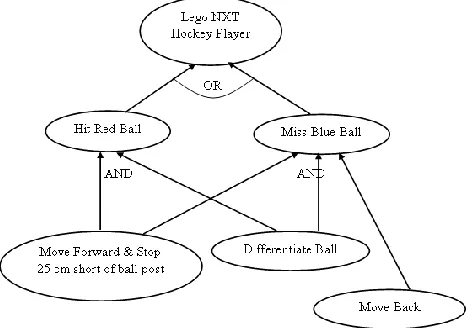
[image:5.612.61.294.309.473.2]An interesting task has been chosen to validate our design. In this example Tribot hits a red ball with its hockey stick avoiding the blue ball placed on the same ball stand. It makes use of the ultrasonic and light sensors to complete this task. This task is mapped on a goal-tree diagram as shown below.
Figure 6 Lego NXT Robot Case Study: Goal Tree Diagram
Any deviation in full-filling the OR goals and corresponding AND sub-goals is considered as a mission failure.
6.1.Calculating ROC Plausibility Parameters
rmax ,rmin correspond to maximum and minimum rate of
change of a signal value. These are directly related to the time constant (τ) of the signal/variable under test. The physical environment of the system also dictates these parametric values. Since the behavior of a signal may vary during different modes of operation of a system as argued by [2], it necessary to identity the characteristics (rmax ,
rmin) for every such mode of operation. A generalized
mechanism has been formalized as discussed below: Suppose y(t) is the single/variable value at any sampling time instant t. Then the rate of change of the signal/variable value over a sampling time interval
]
[ti1 ti is represented by the slope of signal between
these consecutive time intervals. This can be expressed formally as:
Wherei2...N, N=total signal samples From the above it follows:
0 ,
max 1
1
max
yt ty dydt
r
i i
i i
incr ……….. (1)
0 ,
min 1
1
min
yt ty dydt
r
i i
i i
incr ……… (2)
0 ,
max 1
1
max
yt ty dydt
r
i i
i i
decr ……… (3)
0 ,
min 1
1
min
yt ty dydt
r
i i
i i
decr ………. (4)
Applying the above formalism to ultrasonic sensor data, the following set of ROC parameters have been determined. They will be used during the plausibility checks.
Parameter Value
rmax-incr 40 cm/sec
rmin-incr 0 cm/sec
rmax-decr 30 cm/sec
rmin-decr 0 cm/sec
ymax 255 cm
ymin 0 cm
7.Results & Discussion
The dependability assessment of the proposed scheme has been done via fault injection. All the faults are injected into the most critical functionality of the system, that is reading the ultrasonic sensor, light sensor, motor speed sensor and writing motor servo commands. The faults are injected by supplementary code in an aspect oriented way using AspectC++ [1]. The faults injected are permanent stuck, noise bursts and random spikes at pre-defined or random locations.
These faulty data scenarios may simulate both permanent and transient faults originating in a faulty hardware, software or corrupted environment within or outside a computer-based system.
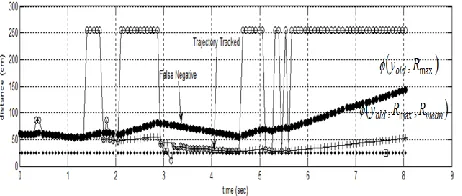
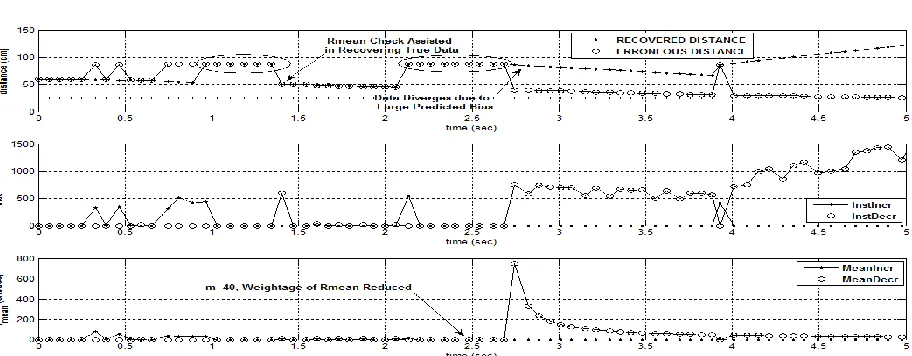
Although ROC-based plausibility checks are very effective in detecting faulty data values, yet a number of false positives and false negatives were generated. The proposed recovery mechanism deviates if faults persist for a longer duration as shown in figure 7.
1 1 0 lim ) ( i i i i t
i t t
Figure 7 Limitations of Rmax Check and Rmean Proposal
Sinceyr
yold,rmax
, it can be seen in the figure above that the scheme deviates if the faulty data persists for longer time duration. This is due to the fact that more positive or negative bias equivalent rmaxT orT
rmin has is added to or remove from the previous data values. Suppose the fault persists for n data samples, the predicted bias added to the previous stable non faulty value yold isnrmaxT. Now if next sample contains a non faulty data value. The check yiyi1rmaxis satisfied and new data value is marked faulty resulting in a false negative.
Solution: We propose an rmean constraint apart from
instantaneous rmax check. The mean or average rate rmean is
measured from a fixed point or moving point on the trajectory.
) ( ) (
) ( ) (
k t i t
k y i y rmean
, ki………. (5)
In order to attain rmean for ultrasonic sensor data/variable,
autoregressive moving average with exogenous inputs (ARMAX) parametric model is used. This has been done by best fit of Tribot speed as input and ultrasonic distance (range) as output. Finally the average distance and average velocity profiles are obtained as shown below.
[image:6.612.63.294.502.611.2]
Figure 8 ARMAX Based Mean Rate
The recover mechanism as proposed earlier has also been modified keeping in view that yr (yold,rmax)is not the true representation of previous trends. We can make much better estimates if we at least take into account the rate of the last stable check-pointed data. Thus we propose: (a) Case; rold 0 ↑, yr yi1rmeanincrTi1i
) ( ) 1 (
) ( ) 1 (
n i t i t
n i y i y rold
, measured from last nth sample.
7.1.Fixed First Point of Slope
If rmean is measured from the fixed point say the initial
starting point then from equation (5) it follows:
) 1 ( ) (
) 1 ( ) (
t i t
y i y rmean
………. (6)
Now y(1) and t(1) are constants and if y(i)y(1) <<
) 1 ( ) (i t
t , rmean reduces with time. This can be expressed
more formally as: If T rmean0 .
It postulates that a fixed point of slope is feasible for faulty data values closer to the starting point of slope. This is demonstrated in the Lego NXT Case as shown in figure 8.
Figure 9 Fixed First Point of Slope, Rmean Reduces
7.2.Moving First Point of Slope
In this rmean is measured from first point of slope moved
after m samples thus the first point of slope consists of set {y(0),y(m),y(2m)…}. Here m is the size of the window for calculating rmean . Thus the first point of slope for rate
measurement is shifted every m samples.
Generally the first point of the slope for rate measurement consists of a set y(k) such that k is an integral multiple of m i.e. k=jm, where j = {0,1,2…}.
m
k
i
k
i
:
,)
(
)
(
)
(
)
(
k
t
i
t
k
y
i
y
r
mean
………. (6)Inserting,
k
jm
, from equation (6) it follows:m
mj
i
mj
i
:
,)
(
)
(
)
(
)
(
jm
t
i
t
jm
y
i
y
r
mean
…. (7)For every
j
th window of size m, rmean is calculated usingFigure 10 Moving Window Concept, Rmean Enhanced
Next we discuss some special cases in the proposed recovery mechanism.
Case i=k
For every first sample in a window, it can be seen that i=k; Inserting i=k in equation (6), it follows:
0 ) ( ) (
) ( )
(
k t i t
k y k y rmean
Thus the weight age of rmean is reduced in error detection
and recovery. So rmean is calculated as follows:
) 2 ( ) (
) 2 ( ) (
m k t i t
m k y i y rmean
………. (8)
Minimum and Maximum Window Size
From equation 7, if m=2, the rmean ≈ rinst, thus we can
expect a large estimated bias in the presence of a large faulty band.
If moving window size (m), is very large, first point of slope for rmean remains constant for a large duration. Thus:
const i
t
const i
y rmean
) (
)
( ……… (9)
Thus from equation (9), it can be inferred that as ti
increases rmean reduces and again the weight age of rmean is
reduced in the error detection and recovery mechanism. There are chances that more faulty data is used in the true functionality that may lead to failure.
Figure 11 Moving Window Size Constraints
Hence the choice of window size m is a trade off between avoiding faulty data and reducing too much estimation bias if fault bandwidth is large. For the ultra sonic sensor
[image:7.612.80.536.466.644.2]In order to provide better test coverage, the ultrasonic sensor data has been injected with periodic noisy bursts and random spikes. The frequency of these noisy spikes is controlled by modulo-n of a random number. It has been observed that mission critical failures are avoided using the proposed strategy with much higher confidence level.
Figure 12 Mission Failure without Recovery Aspect in Place
Figure 13 Periodic Bursts with Error Recovery
Figure 14 Random Spikes with Error Recovery
8.Conclusions & Future Work
The current work proposes an aspect oriented error detection and exception handling design framework. The aspect oriented design patterns under this framework bring additional benefits like the localization of error handling code in terms of definitions, initializations and implementation. Thus error handling code is not duplicated since the same error detection and handling aspect is responsible for all the calling contexts of a safety critical function. Reusability has also been improved because different error handling strategies can be plugged in separately. In this way, aspect and functional code may both be ported more easily to new systems.
The current work also investigated the use of maximum instantaneous and mean rate plausibility checks to detect
that mission critical variables which have monotonically increasing or decreasing trends can be augmented with carefully designed maximum instantaneous and mean rate plausibility checks to detect and recover from erroneous states.
The feedback from this initial case-study has led us to apply the same strategy to more complex applications involving the university’s Merlin 521 Flight simulator. The intention is now to design and implement an aspect oriented protective wrapper that will allow students to experience physical motion within the flight simulator, under the control of their own designed autopilot, with much reduced physical risk.
This further probes the need for incorporating an error masking strategy like Recovery Blocks and N-Version Programming. An aspect oriented design version of these strategies is also under consideration.
9.References
[1] AspectC++ project homepage: http://www.aspectc.org.
[2] Martin Hiller, et. al., ‘Executable Assertions for Detecting Data Errors in Embedded Control Systems”, In
Proceedings of the International Conference on Dependable Systems & Networks, 2000.
[3] Martin Hiller. "Error Recovery Using Forced Validity Assisted by Executable Assertions for Error Detection: An Experimental Evaluation", In 25th EUROMICRO 1999, Milan, Italy, 1999.
[4] Matthew Clegg and Keith Marzullo. "Predicting Physical Processes in the Presence of Faulty Sensor Readings." Department of Computer Science and Engineering, University of California, San Diego, 1997.
[5] Paulo Asterio, et al. "Structuring Exception Handling for Dependable Component-Based Software Systems”, In Proceedings of the 30th EUROMICRO Conference (EUROMICRO'04), 2004.
[6] Alessandro F. Garcia, Delano M. Beder, Cecilia M. F. Rubira. "An Exception Handling Software Architecture for Developing Fault-Tolerant Software." Proceedings of the 5th IEEE HASE USA, November: 2000. pp. 311-32. [7] AspectJ project homepage: http://eclipse.org/aspectj/ [8] Fernando Castor filho, et al. "Error Handling as an
Aspect", In Workshop BPAOSD '07, 12-13 March, Vancouver, BC, Canada, 2007.
[9] Alexander Romanovsky. "A Looming Fault Tolerance Software Crisis.", In ACM SIGSOFT Software Engineering Notes Volume 32.No. 2, March (2007): page 1.
[10] Kenich Murata, R. Nigel Horspool, Eric G. Manning, Yasuhkio Yokote, and Mario Tokoro, Unification of Compile-time and Run-time Metaobject Protocols, SCSL-TR-095-026, appeared in ECOOP Workshop in Advances in Meta object Protocols and Reflection (Meta'95), Aug., 1995.