Automatic Extraction of Implicit Interpretations from Modal Constructions
Jordan Sanders and Eduardo Blanco Human Intelligence and Language Technologies Lab
University of North Texas Denton, TX, 76203
[email protected],[email protected]
Abstract
This paper presents an approach to extract implicit interpretations from modal construc-tions. Importantly, our approach uses a de-terministic procedure to normalize eventuali-ties and generate potential interpretations. An annotation effort demonstrates that these in-terpretations are intuitive to humans and most modal constructions convey at least one inter-pretation. Experimental results show that the task is challenging but can be automated.
1 Introduction
People use language to communicate not only facts, but also intentions, uncertain information and points of view. Modality can be broadly defined as a gram-matical phenomenon used to express the speaker’s opinion or attitude towards a proposition (Lyons, 1977). Modality has also been defined as “the cate-gory of meaning used to talk about possibilities and necessities, essentially, states of affairs beyond the actual.” (Hacquard, 2011). Within computational linguistics, processing modality has proven useful for, among others, recognizing textual entailment (Snow et al., 2006; MacCartney et al., 2006), ma-chine translation (Murata et al., 2005; Baker et al., 2012), and sentiment analysis (Wiebe et al., 2005).
In the absence of modality markers, it is un-derstood that the author of a proposition agrees with it (Hengeveld and Mackenzie, 2008). Adding a modality marker—also referred to as cue—casts doubt on the truth of the proposition, e.g.,Mary got a new job last weekvs. Mary likely got a new job last week. Modality is surprisingly common (Morante
and Sporleder, 2012), and notoriously difficult to an-notate and process automatically (Rubinstein et al., 2013; Vincze et al., 2011). In MEDLINE, 11% of sentences contain speculative language (Light et al., 2004) and in biomedical abstracts, 18% (Vincze et al., 2008). Rubin (2006) reports that 59% of state-ments in 80 New York Times articles include epis-temic modality. Despite modality being ubiquitous, there is not an agreed upon annotation schema.
In this paper, we extract implicit interpretations intuitively understood by humans when reading modal constructions. We do not follow any specific theory of modality. Instead, we manipulate modal constructions to automatically generate potential in-terpretations, and then assign factuality scores to them. Consider statement (1) below:
1. John likely contracted the disease when a mouse bit him in the Adirondacks.
Even though likely syntactically attaches to con-tracted, a natural reading suggests that John con-tracted the disease is factual; the only bit of un-certain information is how (or when) he contracted the disease. In other words, assuming that the au-thor of statement (1) is truthful, event contracted
occurred withAGENTJohnand THEMEthe disease,
but theMANNER(orTIME) may not have beenwhen
a mouse bit him in the Adirondacks.
A key feature of the work presented in this paper is that the interpretations extracted from modal con-structions are not tied to any syntactic or semantic representation. Given modal constructions in plain text, we extract implicit interpretations in plain text, and these interpretations can be processed with any existing NLP pipeline. The main contributions of
this paper are: (1) procedure to automatically gen-erate potential interpretations from modal construc-tions; (2) annotations assessing the factuality of po-tential interpretations generated from OntoNotes;1
and (3) experimental results using several features.
2 Previous Work
Theoretical works in philosophy and linguistics have studied modality for decades (Palmer, 2001; Jes-persen, 1992). Morante and Sporleder (2012) sum-marize some of these works and related phenom-ena, e.g., evidentiality, certainty, factuality, subjec-tivity. There are several expressions that have modal meanings (Fintel, 2006), including auxiliaries (must, should, etc.), adverbs (perhaps, possibly, etc.) nouns (possibility, chance, etc.) adjectives (necessary, pos-sible, etc.) and conditionals (e.g., If the light is on, Sandy is home). Most previous works in computa-tional linguistics target modal adverbs (Rubinstein et al., 2013; Carretero and Zamorano-Mansilla, 2013; de Waard and Maat, 2012), and some also target other modal triggers such as reporting verbs (e.g., The evidence suggeststhat he caused the fire), ref-erences, or all verbs (Diab et al., 2009). Following these previous works, we focus on modal adverbs.
Beyond theoretical works, there are many propos-als to annotate modality. Doing so has proven chal-lenging: following different annotations schemas on the same source text yields little overlap (Vincze et al., 2011), and Carretero and Zamorano-Mansilla (2013) present an analysis of disagreements when targeting modal adverbs. Annotation schemas typi-cally include 3 tasks: identifying modality triggers, their scopes, and sources (Quaresma et al., 2014; S´anchez and Vogel, 2015). Many also classify the modality into several types (epistemic, circumstan-tial, ability, deontic, etc.) or a fine-grained taxonomy (Rubinstein et al., 2013; Nissim et al., 2013). In this paper, we are not concerned with modeling modal-ity per se, or classifying instances of modalmodal-ity into predefined classes or hierarchies. Instead, we extract implicit interpretations from modal constructions in order to mirror intuitive readings.
FactBank is probably the best-known corpus for event factuality (Saur´ı and Pustejovsky, 2009). It was created following carefully crafted annotation
1Available at www.sanders.tech
guidelines and examples comprising 34 pages.2 The
guidelines detail a manual normalization step to “identify the full event that needs to be assessed in terms of its factuality” (p. 12), and the anno-tation process includes identifying the sources that are assessing factuality (p. 15). de Marneffe et al. (2012) reannotate a subset of FactBank with factual-ity values from the reader’s perspective—they call it veridicality—using crowdsourcing. Both FactBank and de Marneffe et al. (2012), rely on manual nor-malization to identify the eventuality whose factual-ity is being annotated. Instead, we present an auto-mated approach: we manipulate semantic roles and syntactic dependencies deterministically to generate several potential interpretations per modal construc-tion, and then assess their factuality.
Many other efforts expand on FactBank us-ing crowdsourced annotations, different annotation schemas (usually simpler) or other domains. Prab-hakaran et al. (2012) use crowdsourcing to classify propositions into 5 modalities: ability, effort, inten-tion, success and want. Soni et al. (2014) target the factuality of quotes (direct and indirect) in Twit-ter. Lee et al. (2015) detect events and assess fac-tuality using easy-to-understand short instructions to crowdsource annotations. Unlike us, they anno-tate factuality at the individual token level, where annotated tokens are deemed events by annotators. Prabhakaran et al. (2015) define and annotate propo-sitional heads with four categories: (1) non-belief propositions, or (2) committed, non-committed or reported belief. Instead of assessing factuality only for propositional heads (usually verbs, one assess-ment per proposition), we do so for potential inter-pretations automatically generated by manipulating verbs and their arguments deterministically.
All works cited in the previous two paragraphs either manually normalize text prior to assess-ing factuality—makassess-ing automation from plain text impossible—or assess factuality for tokens deemed events (ordered, delay, agreed, etc.) or full propo-sitions (a verb and all its arguments). Unlike them, we automatically generate potential interpretations from a single modal construction—or, equivalently, automatically generate several normalizations—and then assess their factuality.
2https://catalog.ldc.upenn.edu/docs/
3 Terminology and Background
We use the termmodal constructionto refer to verb-argument structures modified by a modal adverb (possibly, probably, etc.). We use the termimplicit interpretation, or interpretation to save space, to refer to meaning intuitively understood by humans when reading a modal construction. Potential in-terpretations are interpretations automatically gen-erated whose factuality has yet to be determined. The factuality of an interpretation is a score indi-cating its likelihood—whether it is true, false or un-known given the modal construction.
We work on top of OntoNotes (Hovy et al., 2006) because it includes text from several genres (news, broadcast and telephone conversations, weblogs, etc.) and includes part-of-speech tags, parse trees, PropBank-style semantic roles and other linguistic information.3 Very briefly, PropBank (Palmer et
al., 2005) has two kinds of semantic roles: num-bered roles (ARG0, ARG1, etc.), which are defined
in verb-specific framesets, and argument modifiers (ARGM-TMP, ARGM-LOC, etc.), we refer the reader
to the aforementioned reference, and the guidelines and framesets4for more details. We transformed the
parse trees in OntoNotes into syntactic dependencies using Stanford CoreNLP (Manning et al., 2014).
4 Corpus Creation
We define a two-step procedure to create a corpus of modal constructions and the implicit interpreta-tions intuitively understood by humans when read-ing them. First, we automatically generate potential interpretations from modal constructions by manip-ulating syntactic dependencies and semantic roles. Second, we manually score potential interpretations according to their likelihood. These interpretations and scores are later used to learn how to score po-tential interpretations automatically (Section 6).
4.1 Generating Potential Interpretations Selecting Modal Constructions. OntoNotes is a large corpus containing 63,918 sentences. Creating a corpus of interpretations for all modal construc-tions is outside the scope of this paper. In order 3We use the CoNLL-2011 Shared Task distribution (Pradhan
et al., 2011),http://conll.cemantix.org/2011/
4http://propbank.github.io/
to alleviate the annotation effort, we focus on se-lected modal constructions. Specifically, we select verb-argument structures that have oneARGM-ADV
orARGM-MNR role, and that role is one of the
fol-lowing modal adverbs: certainly, clearly, definitely, likely, obviously, possibly, probably, surely, or un-likely. These adverbs are the most frequent that sat-isfy the above filter. Additionally, we discard verb-argument structures with to be as the main verb. These rules retrieve 324 modal constructions.
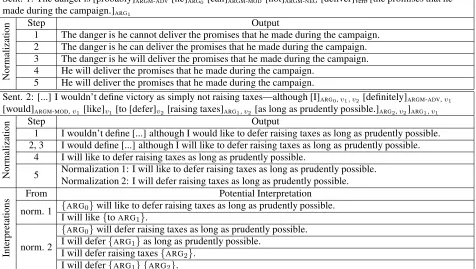
Automatic Normalization. Modal constructions often occur in long multi-clause sentences. In order to identify the eventuality from which potential in-terpretations should be generated, we automatically normalize the original sentence. Normalizing con-sists of a battery of deterministic steps implemented using syntactic dependencies and semantic roles. In contrast with previous work (Section 2), our normal-ization is fully automated. Hereafter, we use verb
to refer to the main verb in the modal construction,
adverbto the modal adverb, andsem rolesto all se-mantic roles in the modal construction.
1. Removeadverb.
2. Convert negated verb-argument structures into their positive counterparts. We follow 3 steps inspired by the rules to form negation proposed by (Huddleston and Pullum, 2002):
(a) Remove the negation mark by deleting the token whose syntactic dependency isneg. (b) Remove auxiliaries, expand contractions, and fix third-person singular and past tense. For example (before: after),doesn’t go: goes, didn’t go: went,won’t go: will go. To implement this step, we loop through tokens whose head is the negated verb with dependency aux, and use a list of irregular verbs5 and grammar rules to
convert to third-person singular and past tense based on orthographic patterns. (c) Rewrite negatively-oriented
polarity-sensitive items. For example (before: after), anyone: someone, any longer:
still, yet: already. at all: somewhat. We use the correspondences between negatively-oriented and positively-5https://en.wikipedia.org/wiki/English_
Sent. 1: The danger is [probably]ARGM-ADV[he]ARG0 [can]ARGM-MOD [not]ARGM-NEG[deliver]verb[the promises that he made during the campaign.]ARG1
N
or
m
al
iz
at
io
n Step Output
1 The danger is he cannot deliver the promises that he made during the campaign. 2 The danger is he can deliver the promises that he made during the campaign. 3 The danger is he will deliver the promises that he made during the campaign. 4 He will deliver the promises that he made during the campaign.
5 He will deliver the promises that he made during the campaign.
[image:4.612.74.550.65.334.2]Sent. 2: [...] I wouldn’t define victory as simply not raising taxes—although [I]ARG0,v1, v2[definitely]ARGM-ADV,v1 [would]ARGM-MOD,v1 [like]v1[to [defer]v2[raising taxes]ARG1,v2[as long as prudently possible.]ARG2,v2]ARG1,v1
N
or
m
al
iz
at
io
n Step Output
1 I wouldn’t define [...] although I would like to defer raising taxes as long as prudently possible. 2, 3 I would define [...] although I will like to defer raising taxes as long as prudently possible.
4 I will like to defer raising taxes as long as prudently possible.
5 Normalization 1: I will like to defer raising taxes as long as prudently possible.Normalization 2: I will defer raising taxes as long as prudently possible.
In
te
rp
re
ta
tio
ns From Potential Interpretation
norm. 1 {ARG0}will like to defer raising taxes as long as prudently possible.
I will like{toARG1}.
norm. 2
{ARG0}will defer raising taxes as long as prudently possible.
I will defer{ARG1}as long as prudently possible.
I will defer raising taxes{ARG2}.
I will defer{ARG1} {ARG2}.
Table 1:Step-by-step execution of the procedure to automatically normalize modal constructions (Sentences 1 and 2) and generate potential interpretations (Sentence 2).
oriented polarity-sensitive items by (Huddleston and Pullum, 2002, pp. 831). 3. Fix modal verbs and tense. If a modal verb
(can, could, may, would, should, must, etc.) has as syntactic head verb, we transform the modal construction into past or future depend-ing on the modal and tense ofverb. For exam-ple: could go: went, can go: will go, should have gone: went. We use the same grammar rules and list of irregular verbs as in Step (2b). 4. Select relevant tokens. We remove all tokens
in the original sentence exceptverband tokens belonging to the roles insem roles. Addition-ally, we fix phrasal verbs by adding tokens with the part-of-speech tag RP whose syntactic head isverband dependency typeprt (semantic roles in OntoNotes are annotated for verb tokens, missing the preposition whenverbis a phrasal verb would inadvertently change meaning). We also add all tokens to the left ofverbuntil we find the first token whose part-of-speech tag does not start with VB, MD, RB or EX (verbs, modals, adverbs and existentialthere).
5. Generate additional normalizations. If verbis
followed by TO +verb2 (e.g., want to go, like
to play, intend to pass), we generate an addi-tional normalization forverb2after merging the
semantic roles ofverbandverb2.
Table 1 exemplifies the automatic normalization step by step with 2 modal constructions.
Generating Potential Interpretations in Plain Text.Inspired by the rules Blanco and Sarabi (2016) used to generate interpretations from negation, we generate potential interpretations from modal con-structions by toggling off combinations of roles in
sem roles. We consider numbered roles (ARG0– ARG5), and argument modifiers (ARGM-) ending in LOC,TMP,MNR,PRP,CAU,EXT,PRDorDIR.
Table 1 lists some potential interpretations gener-ated from a sample modal construction. The total number of potential interpretations for the 324 se-lected modal construction is 1,756 (average: 5.4).
We recognize that our procedure to generate im-plicit interpretations is unable to generate some use-ful interpretations. For example, from This is [a person who]ARG1[likely]ARGM-ADV[died]verb [on
generate This is a person who died{ARGM-MNR}, which is factual: the only uncertain information is the manner in which the person died. Since we tog-gle off semantic roles ofverb, our procedure is un-able to generateA person died on impactandA per-son died freezing to death; the former interpretation would receive a higher factuality score than the lat-ter. We argue that automation is preferable, and re-serve for future work generating interpretations that require splitting semantic roles.
4.2 Scoring Potential Interpretations
After automatically generating potential interpreta-tions, we collected manual annotations to determine their factuality. The annotation interface showed the original sentence containing the modal construction, the previous and next sentences as context, and no additional information. Following previous work (Saur´ı and Pustejovsky, 2009; de Marneffe et al., 2012), we found it useful not to restrict answers to yes orno, but to allow for degrees of certainty. Specifically, we asked “Given the 3 sentences above, do you believe that the statement [potential interpre-tation] below is true?”. Answers are a score ranging from−5to5, where−5indicatesCertainly no,5
in-dicatesCertainly yes, and the scores in between indi-cate a continuum of certainty (0indicatesunknown).
After pilot annotations, we examined disagree-ments and defined the following simple guidelines:
1. Context (previous sentence, target sentence, and next sentence) is taken into account. 2. World knowledge available at the time the
orig-inal sentence was authored—not new knowl-edge available after—is taken into account. 3. Semantic roles toggled off are replaced with
a semantically related substitute (Turney and Pantel, 2010) for the original role, e.g., give: take, customer: sales associate.
5 Corpus Analysis
The total number of modal constructions selected is 324 and the number of potential interpretations au-tomatically generated in 1,756 (average: 5.4 pretation per modal construction). 39.4% of inter-pretations are scored with a high degree of certainty. We definehigh certaintyas a score below−3
(inter-pretation is false) or larger than 3(interpretation is
# roles toggled off # %6= 0 Mean score >0 <0
0 345 87.25 3.96 -3.94
1 800 48.50 3.67 -3.90
2 479 20.46 3.55 -4.03
[image:5.612.312.540.57.143.2]3 120 5.83 3.50 -3.00
Table 2:Number of interpretations generated by toggling off 0, 1, 2 or 3 roles (#), percentage of interpretations not scored zero (%6= 0), and mean scores of interpretations with positive and negative scores.
Role # %6= 0 Mean score
>0 <0
None 345 87.25 3.96 -3.94
ARG1 671 30.40 3.60 -3.92
ARG0 604 25.50 3.72 -3.94
ARG2 140 28.57 3.85 -3.84
ARGM-MNR 271 32.84 3.40 -3.85 ARGM-TMP 231 28.57 3.71 -3.84 ARGM-LOC 82 23.17 3.43 -4.60
[image:5.612.322.528.210.357.2]Other 290 20.00 3.38 -3.87
Table 3: Number of interpretations generated by toggling off each semantic role (#), percentage of interpretations not scored zero (%6= 0), and mean score of interpretations with positive and negative scores.
true). Importantly, on overage, modal constructions have 2.13 interpretations scored with high certainty, and 1.23 scored3or higher. In other words, on
av-erage, our procedure generates over 2 interpretation that are either true or false, and over 1 interpretation that is true per modal construction.
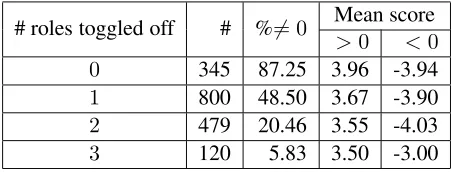
Tables 2 and 3 present basic corpus statistics. The percentage of interpretations annotated with a score different than 0 depends greatly on the number of roles toggled off (Table 2): 0: 87.25%, 1: 48.50%, 2: 20.46%, 3: 5.83%. Note that the number of roles toggled off does not significantly affect the mean score of interpretations not scored 0 (Table 2, last 2 columns). Most interpretations have eitherARG0
orARG1 toggled off (Table 3), and the percentages
Original sentence and sample of automatically generated potential interpretations Score
1
Context, previous sentence: The last thing we want to do is react to every wild statement that they make. Original sentence: [But]ARGM-DIS [they]ARG0 [certainly]ARGM-ADV [chose]verb [that]ARG1 [to get our attention and that of the international community.]ARGM-PRP
Context, next sentence: Uh but what they’ve got to realize is there is no magic bullet here.
- Interpretation 1.1: But they chose that to get our attention and that of the international community. 5 - Interpretation 1.2: But they chose{ARG1}to get our attention and that of the international community. -5
2
Context, previous sentence: Saddam Hussein (interrupting): Before you offer me your rotten goods, I ask you did you find weapons of mass destruction in Iraq or not?
[image:6.612.72.548.56.334.2]Original sentence: Rumsfeld (disconcerted): We haven’t found them yet, but [we]ARG0 [will]ARGM-MOD [surely]ARGM-ADV[find]verb[them]ARG1 [one day]ARGM-TMP.
Context, next sentence: Do you deny that you had intentions to manufacture a nuclear bomb?
- Interpretation 2.1: We will find them one day. 4
- Interpretation 2.2: We will find them{ARGM-TMP}. -3
3
“This is a rare case of [a company with a big majority holder which]ARG0 [will]ARGM-MOD [probably]ARGM-ADV [act]verb[in the interests of the minority holders]ARG1”, one investor says.
- Interpretation 3.1:{ARG0}will act in the interests of the minority holders. 4
- Interpretation 3.2: A company with a big majority holder will act{ARG1}. 4
4
I wouldn’t define victory as simply not raising taxes—although [I]ARG0,v1,v2 [definitely]ARGM-ADV,v1 [would]ARGM-MOD,v1[like]v1[to [defer]v2[raising taxes]ARG1,v2[as long as prudently possible.]ARG2,v2]ARG1,v1 - Interpretation 4.1: I will like to defer raising taxes as long as prudently possible. 5 - Interpretation 4.2: I will defer raising taxes as long as prudently possible. 1 Table 4: Annotation Examples. For each example, we show the original sentence containing the modal construction, context if helpful to determine scores, and 2 selected interpretations and their scores. Square brackets indicate semantic roles.
5.1 Annotation Quality
The annotation guidelines (Section 4.2) to score po-tential interpretations were defined after examin-ing disagreements in pilot annotations. After defin-ing the guidelines, inter-annotator agreement was 0.92 on 18% of randomly selected interpretations.6
Agreement measures designed for categorical labels are unsuitable, as not all disagreements are equal, e.g., 4 vs. 5, -2 vs. 5. Because of the high agreement and following previous work (Agirre et al., 2012), the rest of interpretations were annotated once.
5.2 Annotation Examples
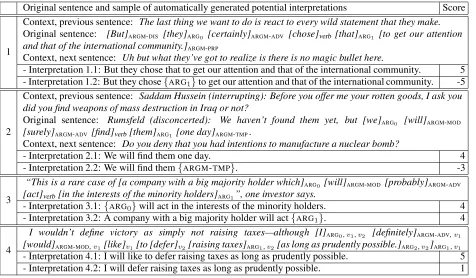
Table 4 presents annotation examples. For each ex-ample, we include the original sentence containing a selected modal construction, its context (previous and next sentence) if helpful for scoring, and 2 au-tomatically generated potential interpretations with their annotated scores.
Example (1) shows that context helps in determin-ing the factuality of potential interpretations (item (1) in the guidelines). After reading the three sen-6We set an internal deadline of 3 days after agreeing on the
guidelines, and we could annotate 18% of instances in that time.
tences, it is clear that they are making wild state-ments, and are hoping to getattentionfor it. Inter-pretation 1.1 removes adverbcertainlyand receives the highest score,5. Interpretation 1.2 is obtained
af-ter toggling offARG1, and receives the lowest score,
−5. This low score is justified by item (3) in our
an-notation guidelines: replacingwild statements with a semantically (different but) related substitute, e.g.,
But they chose reasonable statements / good man-ners to get our attention and that of the international community, yields an unlikely interpretation.
The interpretations in Example (2) show again the importance of context, and also exemplify item (2) in the annotation guidelines. Interpretation 2.1, We will find them one dayreceives a high score (4/5),
descrip-Type Feature Description
baseline
adverb Word form of adverb adverb pos Part-of-speech of adverb
verb Word form of verb
verb pos Part-of-speech of verb
distance Number of tokens between adverb and verb direction Whether adverb occurs before or after verb
adverb and verb
adverb rel pos Part-of-speech tags of the parent, and left and right siblings of adverb adverb subcat Concatenation of part-of-speech tags of all siblings of adverb
verb rel pos Part-of-speech tags of the parent, and left and right siblings of verb adverb subcat Concatenation of part-of-speech tags of all siblings of verb
path, path l Syntactic path between adverb and verb, and length of the path ancestor POS tag of the lowest common ancestor between verb and adverb has sem role Flags indicating whether a semantic role is in the modal construction
interpretation
num roles int Number of roles toggled off in the potential interpretation sem roles int Flags indicating which roles are toggled off in the interpretation roles distance Number of tokens between each semantic role and verb
roles direction Whether each semantic role occurs before or after verb roles path Syntactic path between each role and verb
[image:7.612.80.536.57.330.2]roles path l Length of syntactic path between each role and verb
Table 5: Features used to predict factuality scores to automatically generated potential interpretations. Features extracted from semantic role are extracted forARG0–ARG5and modifiers (ARGM-) ending inLOC,TMP,MNR,PRP,CAU,EXTandPRD.
tion of these scores could be “almost certainly true” (4 out of 5), and “most probably false” (-3 out of -5). We see scores as a continuum of certainty, but tex-tual description may help understand the examples.
Example (3) demonstrates the usefulness of the normalization process—specifically, Step 4, select-ing relevant tokens—and the importance of replac-ing roles with semantically related substitutes (item (3) in the guidelines). In interpretation 3.1,{ARG0} will act in the interests of the minority holders,ARG0
can be replaced witha company with several minor-ity holders, yielding a valid interpretation scored 4 (out of 5). Similarly, in interpretation 3.2, A com-pany with a big majority holder will act {ARG1}, ARG1 can be replaced with in the interests of the big majority holder, yielding another valid interpre-tation also scored 4 (out of 5).
Finally, Example (4) shows Step 5 in the auto-matic normalization procedure (Section 4). By cre-ating an additional verb-argument structure, we are able to differentiate between liking to do something (Interpretation 4.1, score 5/5) and actually doing that something (Interpretation 4.2, score 1/5).
6 Learning to Score Potential Interpretations
In order to automatically score potential interpre-tations, we follow a standard supervised machine learning approach. Each potential interpretation be-comes an instance, and we split modal construc-tions (and their potential interpretaconstruc-tions) into train-ing (80%) and test (20%). When splitttrain-ing, we make sure that the amount of modal constructions for each adverb in each split is proportional, i.e., 80% of modal constructions with each adverb are in the train split and the rest in the test split. Splitting in-stances randomly would assign interpretations gen-erated from the same modal construction to the train and test splits, and bias the results.
We trained a Support Vector Machine (SVM) for regression with RBF kernel using scikit-learn (Pe-dregosa et al., 2011), which uses LIBSVM (Chang and Lin, 2011). The SVM parameters (C and γ)
Features Pearson
baseline -0.029
adverb and verb 0.025
interpretation 0.494
[image:8.612.72.301.57.163.2]baseline + adverb and verb -0.013 baseline + interpretation 0.463 adverb and verb + interpretation 0.465 baseline + adverb and verb + interpretation 0.468
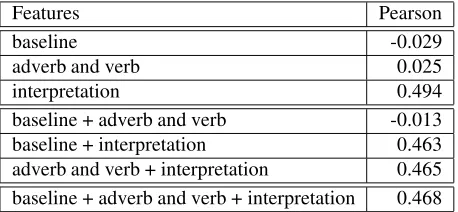
Table 6:Pearson correlations obtained with test instances and several feature combinations.
6.1 Feature Selection
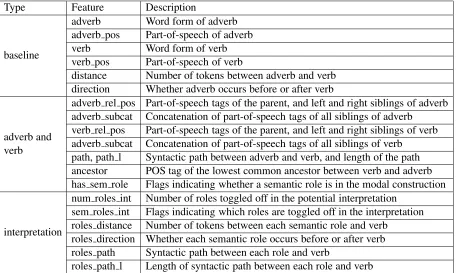
The full set of features is detailed in Table 5. Base-line features are simple features characterizing ad-verb and verb and we do not elaborate on them.
Adverb and verb features are extracted from the modal construction (constituent tree and semantic roles) and provide additional information about the modal construction. Interpretation features charac-terize the potential interpretation whose factuality is being scored, and are also derived from the con-stituent tree and semantic roles.
Mostadverb and verbfeatures are standard in se-mantic role labeling (Gildea and Jurafsky, 2002). We include the part-of-speech tags of the parent, and left and right siblings ofadverbandverb, as well as their subcategorization, i.e., the concatenation of the sibling’s part-of-speech tags. We also include syn-tactic path betweenadverband verb, and its length. Additionally, we include the common ancestor, i.e., the syntactic node of the lowest common node that is an ancestor of bothadverband verb, and use bi-nary features to indicate whether each semantic role is present in the modal construction.
Finally, interpretation features characterize the semantic roles toggled off to generate the potential interpretation. We include the number of roles tog-gled off to generate the potential interpretation, and binary flags indicating which roles. Additionally, for each role toggled off, we include the distance from the verb (number of tokens), whether it occurs be-fore or after the verb, the syntactic path to the verb and the length of the path.
7 Experimental Results
Table 6 details results obtained with test instances using several feature combinations derived from
gold linguistic information (POS tags, parse trees, semantic roles, etc.). Baselineandadverb and verb
features, which characterize the modal construction from which potential interpretation are extracted, are virtually useless. They yield Pearson correlations of −0.029 and 0.025 individually, and −0.013
com-bined. These results suggest that the verb and ad-verb in the modal construction (word forms, syntac-tic paths, etc.) are insufficient to rank potential inter-pretations generated from the modal construction.
Interpretation features, which capture differ-ences between potential interpretations being scored (number of roles toggled off, roles toggled off, etc.), obtain a modest Pearson correlation of 0.494. Combining interpretation features with other fea-tures proved detrimental, Pearson correlations are between0.463and0.468.
8 Conclusions
Modality is a pervasive phenomenon used to talk about what is not factual. In this paper, we have pre-sented a methodology to extract implicit interpreta-tions from modal construcinterpreta-tions. First, we automati-cally generate potential interpretations using syntac-tic dependencies and semansyntac-tic roles, and then assign to them a factuality score.
The most important conclusion of the work pre-sented here is that several interpretations automati-cally generated from a single modal construction of-ten receive scores indicating high certainty. Indeed, on average, modal constructions have 2.13 interpre-tations scored lower or equal than −3, or higher
or equal than3. This contrast with previous work,
which only assess factuality of one normalization per proposition.
References
Eneko Agirre, Daniel Cer, Mona Diab, and Aitor Gonzalez-Agirre. 2012. Semeval-2012 task 6: A pilot on semantic textual similarity. InProceedings of the Sixth International Workshop on Semantic Evaluation (SemEval 2012), pages 385–393, Montr´eal, Canada, 7-8 June.
Kathryn Baker, Michael Bloodgood, Bonnie J. Dorr, Chris Callison-Burch, Nathaniel W. Filardo, Christine Piatko, Lori Levin, and Scott Miller. 2012. Use of Modality and Negation in Semantically-Informed Syn-tactic MT. Comput. Linguist., 38(2):411–438, June. Eduardo Blanco and Zahra Sarabi. 2016. Automatic
generation and scoring of positive interpretations from negated statements. InProceedings of the 2016 Con-ference of the North American Chapter of the Associa-tion for ComputaAssocia-tional Linguistics: Human Language Technologies, pages 1431–1441, San Diego, Califor-nia, June. Association for Computational Linguistics. Marta Carretero and Juan Rafael Zamorano-Mansilla.
2013. An analysis of disagreement-provoking factors in the analysis of epistemic modality and evidentiality: the case of english adverbials. InProceedings of IWCS 2013 Workshop on Annotation of Modal Meanings in Natural Language (WAMM), pages 16–23, Potsdam, Germany, March.
Chih-Chung Chang and Chih-Jen Lin. 2011. Libsvm: A library for support vector machines. ACM Trans. Intell. Syst. Technol., 2(3):27:1–27:27, May.
Marie-Catherine de Marneffe, Christopher D. Manning, and Christopher Potts. 2012. Did it happen? the prag-matic complexity of veridicality assessment. Comput. Linguist., 38(2):301–333, June.
Anita de Waard and Henk Pander Maat. 2012. Epis-temic modality and knowledge attribution in scientific discourse: A taxonomy of types and overview of fea-tures. InProceedings of the Workshop on Detecting Structure in Scholarly Discourse, ACL ’12, pages 47– 55, Stroudsburg, PA, USA.
Mona Diab, Lori Levin, Teruko Mitamura, Owen Ram-bow, Vinodkumar Prabhakaran, and Weiwei Guo. 2009. Committed belief annotation and tagging. In Proceedings of the Third Linguistic Annotation Work-shop, pages 68–73, Suntec, Singapore, August. Kai Von Fintel. 2006. Modality and language. In
D. Borchert, editor, Encyclopedia of Philosophy, pages 20–27. Macmillan Reference.
Daniel Gildea and Daniel Jurafsky. 2002. Auto-matic labeling of semantic roles. Comput. Linguist., 28(3):245–288, September.
Valentine Hacquard. 2011. Modality. In C. Maienborn, K. von Heusinger, and P. Portner, editors, Seman-tics: An International Handbook of Natural Language Meaning, pages 1484–1515. Mouton de Gruyter.
Kees Hengeveld and J. Lachlan Mackenzie. 2008. Func-tional Discourse Grammar: A Typologically-Based Theory of Language Structure. Oxford University Press.
Eduard Hovy, Mitchell Marcus, Martha Palmer, Lance Ramshaw, and Ralph Weischedel. 2006. OntoNotes: the 90% Solution. In NAACL ’06: Proceedings of the Human Language Technology Conference of the NAACL, Companion Volume: Short Papers on XX, pages 57–60, Morristown, NJ, USA.
Rodney D. Huddleston and Geoffrey K. Pullum. 2002. The Cambridge Grammar of the English Language. Cambridge University Press, April.
Otto Jespersen. 1992.The philosophy of grammar. Uni-versity of Chicago Press, Chicago.
Kenton Lee, Yoav Artzi, Yejin Choi, and Luke Zettle-moyer. 2015. Event detection and factuality assess-ment with non-expert supervision. InProceedings of the 2015 Conference on Empirical Methods in Natu-ral Language Processing, pages 1643–1648, Lisbon, Portugal, September.
Marc Light, Xin Ying Qiu, and Padmini Srinivasan. 2004. The language of bioscience: Facts, spec-ulations, and statements in between. In Lynette Hirschman and James Pustejovsky, editors, HLT-NAACL 2004 Workshop: BioLINK 2004, Linking Bi-ological Literature, Ontologies and Databases, pages 17–24, Boston, Massachusetts, USA, May 6.
John Lyons. 1977. Semantics. Cambridge University Press. Cambridge Books Online.
Bill MacCartney, Trond Grenager, Marie-Catherine de Marneffe, Daniel Cer, and Christopher D. Man-ning. 2006. Learning to recognize features of valid textual entailments. InProceedings of the Main Con-ference on Human Language Technology ConCon-ference of the North American Chapter of the Association of Computational Linguistics, HLT-NAACL ’06, pages 41–48, Stroudsburg, PA, USA.
Christopher D Manning, Mihai Surdeanu, John Bauer, Jenny Finkel, Steven J Bethard, and David McClosky. 2014. The stanford corenlp natural language process-ing toolkit. InProceedings of 52nd Annual Meeting of the Association for Computational Linguistics: System Demonstrations, pages 55–60.
Roser Morante and Caroline Sporleder. 2012. Modal-ity and negation: An introduction to the special issue. Comput. Linguist., 38(2):223–260, June.
Masaki Murata, Masao Utiyama, Kiyotaka Uchimoto, Hitoshi Isahara, and Qing Ma. 2005. Correction of er-rors in a verb modality corpus for machine translation with a machine-learning method. 4(1):18–37, March. Malvina Nissim, Paola Pietrandrea, Andrea Sanso, and
modality: a data-driven hierarchical model. In Pro-ceedings of the 9th Joint ISO - ACL SIGSEM Work-shop on Interoperable Semantic Annotation, pages 7– 14, Potsdam, Germany, March.
Martha Palmer, Daniel Gildea, and Paul Kingsbury. 2005. The Proposition Bank: An Annotated Cor-pus of Semantic Roles. Computational Linguistics, 31(1):71–106.
F. R. Palmer. 2001. Mood and Modality. Cambridge University Press, second edition. Cambridge Books Online.
F. Pedregosa, G. Varoquaux, A. Gramfort, V. Michel, B. Thirion, O. Grisel, M. Blondel, P. Prettenhofer, R. Weiss, V. Dubourg, J. Vanderplas, A. Passos, D. Cournapeau, M. Brucher, M. Perrot, and E. Duches-nay. 2011. Scikit-learn: Machine learning in Python. Journal of Machine Learning Research, 12:2825– 2830.
Vinodkumar Prabhakaran, Michael Bloodgood, Mona Diab, Bonnie Dorr, Lori Levin, Christine D. Piatko, Owen Rambow, and Benjamin Van Durme. 2012. Sta-tistical modality tagging from rule-based annotations and crowdsourcing. InProceedings of the Workshop on Extra-Propositional Aspects of Meaning in Com-putational Linguistics, pages 57–64, Jeju, Republic of Korea, July.
Vinodkumar Prabhakaran, Tomas By, Julia Hirschberg, Owen Rambow, Samira Shaikh, Tomek Strzalkowski, Jennifer Tracey, Michael Arrigo, Rupayan Basu, Micah Clark, Adam Dalton, Mona Diab, Louise Guthrie, Anna Prokofieva, Stephanie Strassel, Gregory Werner, Yorick Wilks, and Janyce Wiebe. 2015. A new dataset and evaluation for belief/factuality. In Proceedings of the Fourth Joint Conference on Lexical and Computational Semantics, pages 82–91, Denver, Colorado, June.
Sameer Pradhan, Lance Ramshaw, Mitchell Marcus, Martha Palmer, Ralph Weischedel, and Nianwen Xue. 2011. Conll-2011 shared task: Modeling unrestricted coreference in ontonotes. In Proceedings of the Fif-teenth Conference on Computational Natural Lan-guage Learning: Shared Task, pages 1–27, Portland, Oregon, USA, June.
P. Quaresma, A. Mendes, I. Hendrickx, and T. Gon?alves. 2014. Automatic tagging of modality: identifying trig-gers and modal value. InProceedings of the 10th Joint ACL SIGSEM - ISO Workshop on Interoperable Se-mantic Annotation.
Victoria L. Rubin. 2006. Identifying certainty in texts. Ph.D. thesis, Syracuse University, Syracuse, NY. Aynat Rubinstein, Hillary Harner, Elizabeth Krawczyk,
Daniel Simonson, Graham Katz, and Paul Portner. 2013. Toward fine-grained annotation of modality in text. InProceedings of IWCS 2013 Workshop on
Annotation of Modal Meanings in Natural Language (WAMM), pages 38–46, Potsdam, Germany, March. Liliana Mamani S´anchez and Carl Vogel. 2015. A
hedg-ing annotation scheme focused on epistemic phrases for informal language. InProceedings of the Work-shop on Models for Modality Annotation.
Roser Saur´ı and James Pustejovsky. 2009. Factbank: a corpus annotated with event factuality. Language Resources and Evaluation, 43(3):227–268.
Rion Snow, Lucy Vanderwende, and Arul Menezes. 2006. Effectively using syntax for recognizing false entailment. In Proceedings of the Main Conference on Human Language Technology Conference of the North American Chapter of the Association of Compu-tational Linguistics, HLT-NAACL ’06, pages 33–40, Stroudsburg, PA, USA.
Sandeep Soni, Tanushree Mitra, Eric Gilbert, and Jacob Eisenstein. 2014. Modeling factuality judgments in social media text. InProceedings of the 52nd Annual Meeting of the Association for Computational Linguis-tics (Volume 2: Short Papers), pages 415–420, Balti-more, Maryland, June.
Peter D. Turney and Patrick Pantel. 2010. From fre-quency to meaning: Vector space models of semantics. J. Artif. Int. Res., 37(1):141–188, January.
Veronika Vincze, Gy¨orgy Szarvas, Richard Farkas, Gy¨orgy M´ora, and J´anos Csirik. 2008. The Bio-Scope corpus: biomedical texts annotated for uncer-tainty, negation and their scopes. BMC Bioinformat-ics, 9((Suppl 11)):S9.
Veronika Vincze, Gy¨orgy Szarvas, Gy¨orgy M´ora, Tomoko Ohta, and Rich´ard Farkas. 2011. Linguis-tic scope-based and biological event-based specula-tion and negaspecula-tion annotaspecula-tions in the bioscope and ge-nia event corpora. Journal of Biomedical Semantics, 2(5):1–11.