Language as a Latent Variable:
Discrete Generative Models for Sentence Compression
Yishu Miao1, Phil Blunsom1,2 1University of Oxford,2Google Deepmind
{yishu.miao, phil.blunsom}@cs.ox.ac.uk
Abstract
In this work we explore deep generative mod-els of text in which the latent representation of a document is itself drawn from a discrete language model distribution. We formulate a variational auto-encoder for inference in this model and apply it to the task of compressing sentences. In this application the generative model first draws a latent summary sentence from a background language model, and then subsequently draws the observed sentence con-ditioned on this latent summary. In our em-pirical evaluation we show that generative for-mulations of both abstractive and extractive compression yield state-of-the-art results when trained on a large amount of supervised data. Further, we explore semi-supervised compres-sion scenarios where we show that it is possi-ble to achieve performance competitive with previously proposed supervised models while training on a fraction of the supervised data.
1 Introduction
The recurrent sequence-to-sequence paradigm for natural language generation (Kalchbrenner and Blun-som, 2013; Sutskever et al., 2014) has achieved re-markable recent success and is now the approach of choice for applications such as machine transla-tion (Bahdanau et al., 2015), captransla-tion generatransla-tion (Xu et al., 2015) and speech recognition (Chorowski et al., 2015). While these models have developed so-phisticated conditioning mechanisms, e.g. attention, fundamentally they are discriminative models trained only to approximate the conditional output distribu-tion of strings. In this paper we explore modelling the
joint distribution of string pairs using a deep genera-tive model and employing a discrete variational auto-encoder (VAE) for inference (Kingma and Welling, 2014; Rezende et al., 2014; Mnih and Gregor, 2014). We evaluate our generative approach on the task of sentence compression. This approach provides both alternative supervised objective functions and the opportunity to perform semi-supervised learning by exploiting the VAEs ability to marginalise the latent compressed text for unlabelled data.
Auto-encoders (Rumelhart et al., 1985) are a typi-cal neural network architecture for learning compact data representations, with the general aim of perform-ing dimensionality reduction on embeddperform-ings (Hinton and Salakhutdinov, 2006). In this paper, rather than seeking to embed inputs as points in a vector space, we describe them with explicit natural language sen-tences. This approach is a natural fit for summarisa-tion tasks such as sentence compression. According to this, we propose a generativeauto-encoding sen-tence compression(ASC) model, where we intro-duce a latent language model to provide the variable-length compact summary. The objective is to perform Bayesian inference for the posterior distribution of summaries conditioned on the observed utterances. Hence, in the framework of VAE, we construct an in-ference network as the variational approximation of the posterior, which generates compression samples to optimise the variational lower bound.
The most common family of variational auto-encoders relies on the reparameterisation trick, which is not applicable for our discrete latent language model. Instead, we employ the REINFORCE al-gorithm (Mnih et al., 2014; Mnih and Gregor, 2014)
s
0s
1s
2s
1s
3s
2s
4s
3h1
d
h2
d
h3
d
h4
d
Decoder
s
1s
2s
3s
4h1e
c
1c
2c
3c
1c
2c
0h1c
h2e h
3
e h
4
e
h2c h
3
c
Encoder Compressor
h0c Compression (PointerNetworks)
3
α
2
α
1
α ^
h2
c h^
3
c
^
h1
c
[image:2.612.93.528.66.266.2]Reconstruction (Soft Attention)
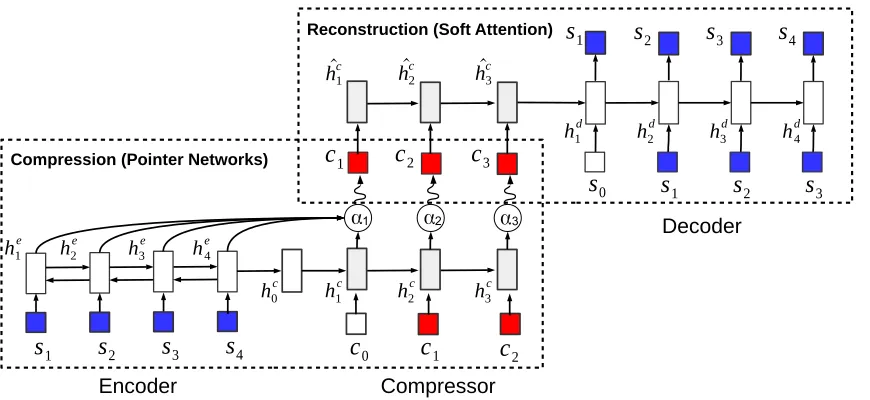
Figure 1: Auto-encoding Sentence Compression Model
to mitigate the problem of high variance during sampling-based variational inference. Nevertheless, when directly applying the RNN encoder-decoder to model the variational distribution it is very difficult to generate reasonable compression samples in the early stages of training, since each hidden state of the se-quence would have|V|possible words to be sampled from. To combat this we employ pointer networks (Vinyals et al., 2015) to construct the variational dis-tribution. This biases the latent space to sequences composed of words only appearing in the source sentence (i.e. the size of softmax output for each state becomes the length of current source sentence), which amounts to applying an extractive compression model for the variational approximation.
In order to further boost the performance on sen-tence compression, we employ a supervised forced-attention sentence compression model (FSC) trained on labelled data to teach the ASC model to generate compression sentences. The FSC model shares the pointer network of the ASC model and combines a softmax output layer over the whole vo-cabulary. Therefore, while training on the sentence-compression pairs, it is able to balance copying a word from the source sentence with generating it from the background distribution. More importantly, by jointly training on the labelled and unlabelled datasets, this shared pointer network enables the model to work in a semi-supervised scenario. In
this case, the FSC teaches the ASC to generate rea-sonable samples, while the pointer network trained on a large unlabelled data set helps the FSC model to perform better abstractive summarisation.
In Section 6, we evaluate the proposed model by jointly training the generative (ASC) and discrimina-tive (FSC) models on the standard Gigaword sentence compression task with varying amounts of labelled and unlabelled data. The results demonstrate that by introducing a latent language variable we are able to match the previous benchmakers with small amount of the supervised data. When we employ our mixed discriminative and generative objective with all of the supervised data the model significantly outperforms all previously published results.
2 Auto-Encoding Sentence Compression
In this section, we introduce the auto-encoding sen-tence compression model (Figure 1)1in the frame-work of variational auto-encoders. The ASC model consists of four recurrent neural networks – an en-coder, a compressor, a decoder and a language model. Letsbe the source sentence, andcbe the compres-sion sentence. The compression model (encoder-compressor) is the inference networkqφ(c|s) that
takes source sentences s as inputs and generates extractive compressions c. The reconstruction
1The language model, layer connections and decoder soft
model (compressor-decoder) is the generative net-work pθ(s|c) that reconstructs source sentences s
based on the latent compressionsc. Hence, the for-ward pass starts from the encoder to the compressor and ends at the decoder. As the prior distribution, a language modelp(c)is pre-trained to regularise the
latent compressions so that the samples drawn from the compression model are likely to be reasonable natural language sentences.
2.1 Compression
For the compression model (encoder-compressor),
qφ(c|s), we employ a pointer network consisting of a
bidirectional LSTM encoder that processes the source sentences, and an LSTM compressor that generates compressed sentences by attending to the encoded source words.
Letsibe the words in the source sentences,hei be
the corresponding state outputs of the encoder.hei are the concatenated hidden states from each direction:
hei =f−→enc(~hei−1,si)||f←−enc(h~ ei+1,si) (1)
Further, letcj be the words in the compressed
sen-tences,hcjbe the state outputs of the compressor. We construct the predictive distribution by attending to the words in the source sentences:
hcj =fcom(hcj−1,cj−1) (2)
uj(i) =wT3tanh(W1hcj+W2hei) (3)
qφ(cj|c1:j−1,s) = softmax(uj) (4)
where c0 is the start symbol for each compressed sentence andhc0is initialised by the source sentence vector ofhe|s|. In this case, all the wordscj sampled
from qφ(cj|c1:j−1,s) are the subset of the words appeared in the source sentence (i.e.cj ∈s).
2.2 Reconstruction
For the reconstruction model (compressor-decoder)
pθ(s|c), we apply a soft attention
sequence-to-sequence model to generate the source sentence s based on the compression samplesc∼qφ(c|s).
Letskbe the words in the reconstructed sentences
and hdk be the corresponding state outputs of the decoder:
hdk=fdec(hkd−1,sk−1) (5)
In this model, we directly use the recurrent cell of the compressor to encode the compression samples2:
ˆ
hcj =fcom(ˆh c
j−1,cj) (6)
where the state outputsˆhc
j corresponding to the word
inputs cj are different from the outputs hcj in the
compression model, since we block the information from the source sentences. We also introduce a start symbol s0 for the reconstructed sentence and hd0 is initialised by the last state outputˆhc
|c|. The soft
attention model is defined as:
vk(j) =wT6 tanh(W4hdk+W5ˆh c
j) (7)
γk(j) = softmax(vk(j)) (8)
dk=
X|c|
j γk(j)
ˆ
hcj(vk(j)) (9)
We then construct the predictive probability distribu-tion over reconstructed words using a softmax:
pθ(sk|s1:k−1,c) = softmax(W7dk) (10)
2.3 Inference
In the ASC model there are two sets of parameters,φ
andθ, that need to be updated during inference. Due
to the non-differentiability of the model, the repa-rameterisation trick of the VAE is not applicable in this case. Thus, we use the REINFORCE algorithm (Mnih et al., 2014; Mnih and Gregor, 2014) to reduce the variance of the gradient estimator.
The variational lower bound of the ASC model is:
L=Eqφ(c|s)[logpθ(s|c)]−DKL[qφ(c|s)||p(c)]
6log
Z q
φ(c|s) qφ(c|s)
pθ(s|c)p(c)dc= logp(s) (11)
Therefore, by optimising the lower bound (Eq. 11), the model balances the selection of keywords for the summaries and the efficacy of the composed com-pressions, corresponding to the reconstruction error and KL divergence respectively.
In practise, the pre-trained language model prior
p(c)prefers short sentences for compressions. As
one of the drawbacks of VAEs, the KL divergence term in the lower bound pushes every sample drawn
2The recurrent parameters of the compressor are not updated
s
1s
2s
3s
4 h1ec
1c
2c
3c
1c
2c
0 h1c
h2e h
3
e h
4
e
h2
c
h3
c
Encoder Compresser
h0
c
α1 β1 α2 β2 α3 β3
Compression (Combined Pointer Networks)
[image:4.612.148.463.53.220.2]Selected from
V
Figure 2: Forced Attention Sentence Compression Model
from the variational distribution towards the prior. Thus acting to regularise the posterior, but also to restrict the learning of the encoder. If the estimator keeps sampling short compressions during inference, the LSTM decoder would gradually rely on the con-texts from the decoded words instead of the informa-tion provided by the compressions, which does not yield the best performance on sentence compression.
Here, we introduce a co-efficient λto scale the
learning signal of the KL divergence:
L=Eqφ(c|s)[logpθ(s|c)]−λDKL[qφ(c|s)||p(c)] (12)
Although we are not optimising the exact variational lower bound, the ultimate goal of learning an effec-tive compression model is mostly up to the recon-struction error. In Section 6, we empirically apply
λ= 0.1for all the experiments on ASC model.
In-terestingly,λ controls the compression rate of the
sentences which can be a good point to be explored in future work.
During the inference, we have different strategies for updating the parameters ofφandθ. For the
pa-rametersθin the reconstruction model, we directly
update them by the gradients:
∂L
∂θ =Eqφ(c|s)[
∂logpθ(s|c)
∂θ ]
≈ 1
M X
m
∂logpθ(s|c(m))
∂θ (13)
where we drawM samplesc(m)∼q
φ(c|s)
indepen-dently for computing the stochastic gradients. For the parametersφin the compression model,
we firstly define the learning signal,
l(s,c) = logpθ(s|c)−λ(logqφ(c|s)−logp(c)).
Then, we update the parametersφby:
∂L
∂φ =Eqφ(c|s)[l(s,c)
∂logqφ(c|s)
∂φ ]
≈ M1 X m
[l(s,c(m))∂logqφ(c
(m)|s)
∂φ ] (14)
However, this gradient estimator has a big variance because the learning signall(s,c(m)) relies on the samples fromqφ(c|s). Therefore, following the
RE-INFORCE algorithm, we introduce two baselines
b and b(s), the centred learning signal and
input-dependent baseline respectively, to help reduce the variance.
Here, we build an MLP to implement the input-dependent baselineb(s). During training, we learn
the two baselines by minimising the expectation:
Eqφ(c|s)[(l(s,c)−b−b(s))
2]. (15)
Hence, the gradients w.r.t.φare derived as,
∂L ∂φ≈
1 M
X
m
(l(s,c(m))−b−b(s))∂logqφ(c
(m)|s)
∂φ
(16) which is basically a likelihood-ratio estimator.
3 Forced-attention Sentence Compression
high-variance for the gradient estimator. Here, we introduce our supervised forced-attention sentence compression (FSC) model to teach the compression model to generate coherent compressed sentences.
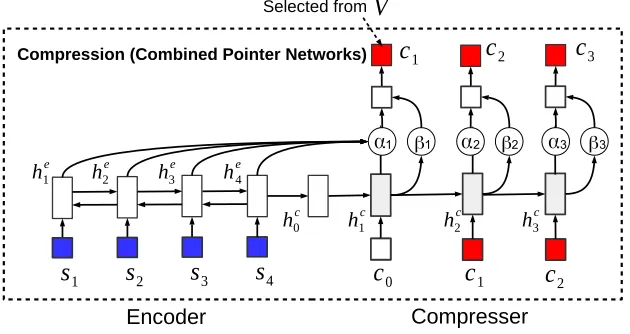
Neither directly replicating the pointer network of ASC model, nor using a typical sequence-to-sequence model, the FSC model employs a force-attention strategy (Figure 2) that encourages the com-pressor to select words appearing in the source sen-tence but keeps the original full output vocabulary
V. The force-attention strategy is basically a
com-bined pointer network that chooses whether to select a word from the source sentence sor to predict a word from V at each recurrent state. Hence, the
combined pointer network learns to copy the source words while predicting the word sequences of com-pressions. By sharing the pointer networks between the ASC and FSC model, the biased estimator obtains further positive biases by training on a small set of labelled source-compression pairs.
Here, the FSC model makes use of the compres-sion model (Eq. 1 to 4) in the ASC model,
αj = softmax(uj), (17)
whereαj(i),i∈(1, . . . ,|s|)denotes the probability
of selectingsias the prediction forcj.
On the basis of the pointer network, we further introduce the probability of predictingcj that is
se-lected from the full vocabulary,
βj = softmax(W hcj), (18)
whereβj(w), w∈(1, . . . ,|V|)denotes the
probabil-ity of selecting thewth fromV as the prediction for
cj. To combine these two probabilities in the RNN,
we define a selection factortfor each state output, which computes the semantic similarities between the current state and the attention vector,
ηj =X|s| i αj(i)h
e
i (19)
tj =σ(ηTjM hcj). (20)
Hence, the probability distribution over compressed words is defined as,
p(cj|c1:j−1,s)=
tjαj(i) + (1−tj)βj(cj), cj=si (1−tj)βj(cj), cj6∈s
(21)
Essentially, the FSC model is the extended compres-sion model of ASC by incorporating the pointer net-work with a softmax output layer over the full vocab-ulary. So we employφto denote the parameters of
the FSC modelpφ(c|s), which covers the parameters
of the variational distributionqφ(c|s).
4 Semi-supervised Training
As the auto-encoding sentence compression (ASC) model grants the ability to make use of an unla-belled dataset, we explore a semi-supervised train-ing framework for the ASC and FSC models. In this scenario we have a labelled dataset that contains source-compression parallel sentences,(s,c) ∈ L, and an unlabelled dataset that contains only source sentencess∈U. The FSC model is trained onLso that we are able to learn the compression model by maximising the log-probability,
F = X
(c,s)∈L
logpφ(c|s). (22)
While the ASC model is trained on U, where we maximise the modified variational lower bound,
L=X
s∈U
(Eqφ(c|s)[logpθ(s|c)]−λDKL[qφ(c|s)||p(c)]).
(23)
The joint objective function of the semi-supervised learning is,
J=X
s∈U
(Eqφ(c|s)[logpθ(s|c)]−λDKL[qφ(c|s)||p(c)])
+ X
(c,s)∈L
logpφ(c|s). (24)
Hence, the pointer network is trained on both un-labelled data,U, and labelled data,L, by a mixed criterion of REINFORCE and cross-entropy.
5 Related Work
attentional feed-forward decoder to generate abstrac-tive summarises, which provides the benchmark for
the Gigaword dataset. Nallapati et al. (2016)
fur-ther improves the performance by exploring multi-ple variants of RNN encoder-decoder models. The recent works Gulcehre et al. (2016), Nallapati et al. (2016) and Gu et al. (2016) also apply the similar idea of combining pointer networks and softmax output. However, different from all these discriminative mod-els above, we explore generative modmod-els for sentence compression. Instead of training the discriminative model on a big labelled dataset, our original intuition of introducing a combined pointer networks is to bridge the unsupervised generative model (ASC) and supervised model (FSC) so that we could utilise a large additional dataset, either labelled or unlabelled, to boost the compression performance. Dai and Le (2015) also explored semi-supervised sequence learn-ing, but in a pure deterministic model focused on learning better vector representations.
Recently variational auto-encoders have been ap-plied in a variety of fields as deep generative mod-els. In computer vision Kingma and Welling (2014), Rezende et al. (2014), and Gregor et al. (2015) have demonstrated strong performance on the task of im-age generation and Eslami et al. (2016) proposed variable-sized variational auto-encoders to identify multiple objects in images. While in natural language processing, there are variants of VAEs on modelling documents (Miao et al., 2016), sentences (Bowman et al., 2015) and discovery of relations (Marcheg-giani and Titov, 2016). Apart from the typical initi-ations of VAEs, there are also a series of works that employs generative models for supervised learning tasks. For instance, Ba et al. (2015) learns visual attention for multiple objects by optimising a varia-tional lower bound, Kingma et al. (2014) implements a semi-supervised framework for image classification and Miao et al. (2016) applies a conditional varia-tional approximation in the task of factoid question answering. Dyer et al. (2016) proposes a generative model that explicitly extracts syntactic relationships among words and phrases which further supports the argument that generative models can be a statistically efficient method for learning neural networks from small data.
6 Experiments
6.1 Dataset & Setup
We evaluate the proposed models on the standard
Gi-gaword3sentence compression dataset. This dataset
was generated by pairing the headline of each article with its first sentence to create a source-compression pair. Rush et al. (2015) provided scripts4 to filter out outliers, resulting in roughly 3.8M training pairs, a 400K validation set, and a 400K test set. In the following experiments all models are trained on the training set with different data sizes5and tested on a 2K subset, which is identical to the test set used by Rush et al. (2015) and Nallapati et al. (2016). We decode the sentences byk= 5Beam search and test with full-length Rouge score.
For the ASC and FSC models, we use 256 for the dimension of both hidden units and lookup tables. In the ASC model, we apply a 3-layer bidirectional RNN with skip connections as the encoder, a 3-layer RNN pointer network with skip connections as the compressor, and a 1-layer vanilla RNN with soft at-tention as the decoder. The language model prior is trained on the article sentences of the full training set using a 3-layer vanilla RNN with 0.5 dropout. To lower the computational cost, we apply different vo-cabulary sizes for encoder and compressor (119,506 and 68,897) which corresponds to the settings of Rush et al. (2015). Specifically, the vocabulary of the decoder is filtered by taking the most frequent 10,000 words from the vocabulary of the encoder, where the rest of the words are tagged as ‘<unk>’. In further consideration of efficiency, we use only one sample for the gradient estimator. We optimise the model by Adam (Kingma and Ba, 2015) with a 0.0002 learning rate and 64 sentences per batch. The model converges in 5 epochs. Except for the pre-trained language model, we do not use dropout or embedding initialisation for ASC and FSC models.
6.2 Extractive Summarisation
The first set of experiments evaluate the models on extractive summarisation. Here, we denote the joint
3https://catalog.ldc.upenn.edu/LDC2012T21 4https://github.com/facebook/NAMAS
5The hyperparameters where tuned on the validation set to
Model LabelledTraining DataUnlabelled R-1 RecallR-2 R-L R-1 PrecisionR-2 R-L R-1 R-2F-1 R-L
FSC 500K - 30.817 10.861 28.263 22.357 7.998 20.520 23.415 8.156 21.468
ASC+FSC1 500K 500K 29.117 10.643 26.811 28.558 10.575 26.344 26.987 9.741 24.874
ASC+FSC2 500K 3.8M 28.236 10.359 26.218 30.112 11.131 27.896 27.453 9.902 25.452
FSC 1M - 30.889 11.645 28.257 27.169 10.266 24.916 26.984 10.028 24.711
ASC+FSC1 1M 1M 30.490 11.443 28.097 28.109 10.799 25.943 27.258 10.189 25.148
ASC+FSC2 1M 3.8M 29.034 10.780 26.801 31.037 11.521 28.658 28.336 10.313 26.145
FSC 3.8M - 30.112 12.436 27.889 34.135 13.813 31.704 30.225 12.258 28.035
[image:7.612.73.541.58.174.2]ASC+FSC1 3.8M 3.8M 29.946 12.558 27.805 35.538 14.699 32.972 30.568 12.553 28.366
Table 1: Extractive Summarisation Performance. (1) The extractive summaries of these models are decoded by the pointer network (i.e the shared component of the ASC and FSC models). (2) R-1, R-2 and R-L represent the Rouge-1, Rouge-2 and Rouge-L score respectively.
models by ASC+FSC1and ASC+FSC2where ASC is trained on unlabelled data and FSC is trained on labelled data. The ASC+FSC1model employs equiv-alent sized labelled and unlabelled datasets, where the article sentences of the unlabelled data are the same article sentences in the labelled data, so there is no additional unlabelled data applied in this case. The ASC+FSC2model employs the full unlabelled dataset in addition to the existing labelled dataset, which is the true semi-supervised setting.
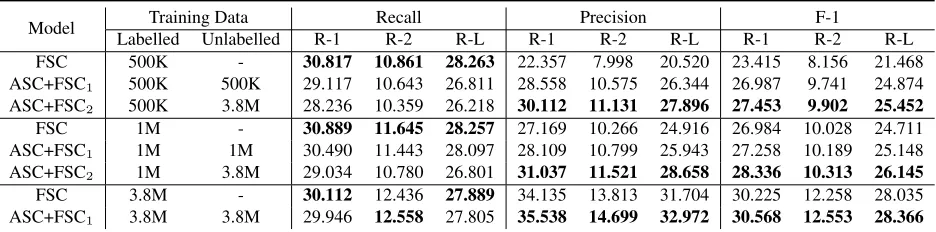
Table 1 presents the test Rouge score on extractive compression. We can see that the ASC+FSC1model achieves significant improvements on F-1 scores when compared to the supervised FSC model only trained on labelled data. Moreover, fixing the labelled data size, the ASC+FSC2 model achieves better per-formance by using additional unlabelled data than the ASC+FSC1model, which means the semi-supervised learning works in this scenario. Interestingly, learn-ing on the unlabelled data largely increases the preci-sions (though the recalls do not benefit from it) which leads to significant improvements on the F-1 Rouge scores. And surprisingly, the extractive ASC+FSC1 model trained on full labelled data outperforms the abstractive NABS (Rush et al., 2015) baseline model (in Table 4).
6.3 Abstractive Summarisation
The second set of experiments evaluate performance on abstractive summarisation (Table 2). Consistently, we see that adding the generative objective to the discriminative model (ASC+FSC1) results in a sig-nificant boost on all the Rouge scores, while em-ploying extra unlabelled data increase performance
further (ASC+FSC2). This validates the effectiveness of transferring the knowledge learned on unlabelled data to the supervised abstractive summarisation.
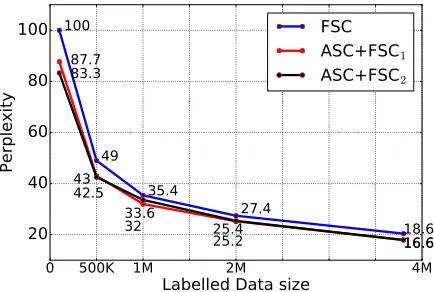
In Figure 3, we present the validation perplexity to compare the abilities of the three models to learn the compression languages. The ASC+FSC1(red) employs the same dataset for unlabelled and labelled training, while the ASC+FSC2(black) employs the full unlabelled dataset. Here, the joint ASC+FSC1 model obtains better perplexities than the single dis-criminative FSC model, but there is not much dif-ference between ASC+FSC1and ASC+FSC2when the size of the labelled dataset grows. From the per-spective of language modelling, the generative ASC model indeed helps the discriminative model learn to generate good summary sentences. Table 3 displays the validation perplexities of the benchmark models, where the joint ASC+FSC1model trained on the full labelled and unlabelled datasets performs the best on modelling compression languages.
Table 4 compares the test Rouge score on ab-stractive summarisation. Encouragingly, the semi-supervised model ASC+FSC2outperforms the base-line model NABS when trained on 500K supervised pairs, which is only about an eighth of the super-vised data. In Nallapati et al. (2016), the authors exploit the full limits of discriminative RNN encoder-decoder models by incorporating a sampled soft-max, expanded vocabulary, additional lexical fea-tures, and combined pointer networks6, which yields the best performance listed in Table 4. However, when all the data is employed with the mixed
ob-6The idea of the combined pointer networks is similar to the
Model LabelledTraining DataUnlabelled R-1 RecallR-2 R-L R-1 PrecisionR-2 R-L R-1 R-2F-1 R-L FSC 500K - 27.147 10.039 25.197 33.781 13.019 31.288 29.074 10.842 26.955 ASC+FSC1 500K 500K 27.067 10.717 25.239 33.893 13.678 31.585 29.027 11.461 27.072
ASC+FSC2 500K 3.8M 27.662 11.102 25.703 35.756 14.537 33.212 30.140 12.051 27.99
FSC 1M - 28.521 11.308 26.478 33.132 13.422 30.741 29.580 11.807 27.439 ASC+FSC1 1M 1M 28.333 11.814 26.367 35.860 15.243 33.306 30.569 12.743 28.431
ASC+FSC2 1M 3.8M 29.017 12.007 27.067 36.128 14.988 33.626 31.089 12.785 28.967
[image:8.612.73.541.58.174.2]FSC 3.8M - 31.148 13.553 28.954 36.917 16.127 34.405 32.327 14.000 30.087 ASC+FSC1 3.8M 3.8M 32.385 15.155 30.246 39.224 18.382 36.662 34.156 15.935 31.915
Table 2: Abstractive Summarisation Performance. The abstractive summaries of these models are decoded by the combined pointer network (i.e. the shared pointer network together with the softmax output layer over the full vocabulary).
Model Labelled Data Perplexity
Bag-of-Word (BoW) 3.8M 43.6
Convolutional (TDNN) 3.8M 35.9 Attention-Based (NABS) 3.8M 27.1 (Rush et al., 2015)
[image:8.612.320.537.229.375.2]Forced-Attention (FSC) 3.8M 18.6 Auto-encoding (ASC+FSC1) 3.8M 16.6
Table 3: Comparison on validation perplexity. BoW, TDNN and NABS are the baseline neural compres-sion models with different encoders in Rush et al. (2015)
Model Labelled Data R-1 R-2 R-L (Rush et al., 2015) 3.8M 29.78 11.89 26.97 (Nallapati et al., 2016) 3.8M 33.17 16.02 30.98 ASC + FSC2 500K 30.14 12.05 27.99
ASC + FSC2 1M 31.09 12.79 28.97
ASC + FSC1 3.8M 34.17 15.94 31.92
Table 4: Comparison on test Rouge scores jective ASC+FSC1model, the result is significantly better than this previous state-of-the-art. As the semi-supervised ASC+FSC2model can be trained on un-limited unlabelled data, there is still significant space left for further performance improvements.
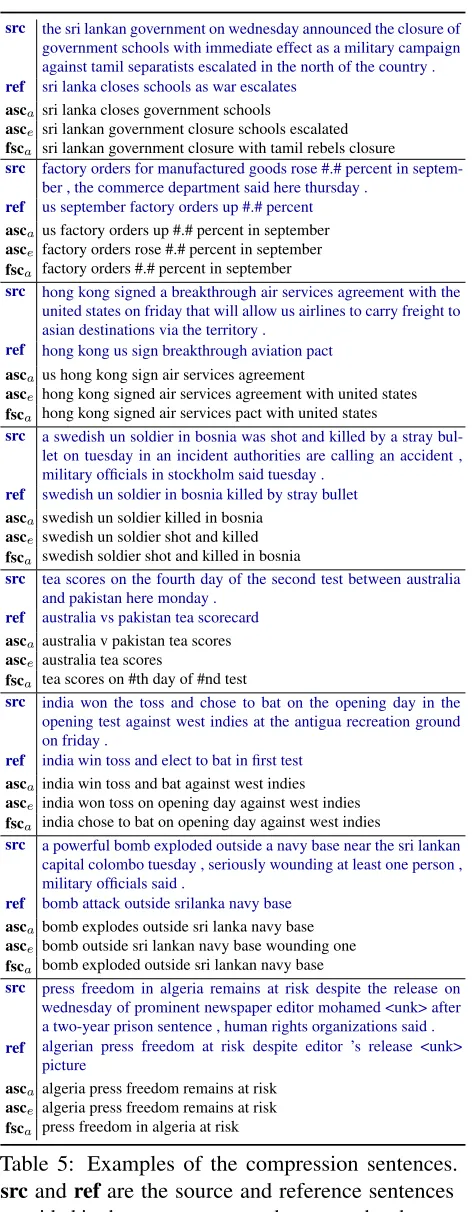
Table 5 presents the examples of the compression sentences decoded by the joint model ASC+FSC1 and the FSC model trained on the full dataset.
7 Discussion
From the perspective of generative models, a sig-nificant contribution of our work is a process for reducing variance for discrete sampling-based vari-ational inference. The first step is to introduce two baselines in the control variates method due to the fact that the reparameterisation trick is not
applica-0 5applica-0applica-0K 1M 2M 4M
Labelled Data size
20
40
60
80
100
Perplexity
100
49 35.4
27.4
18.6 87.7
43
32
25.2 16.6
83.3
42.5 33.6
25.4
16.6
FSC
ASC+FSC
1ASC+FSC
2Figure 3: Perplexity on validation dataset.
ble for discrete latent variables. However it is the second step of using a pointer network as the biased estimator that makes the key contribution. This re-sults in a much smaller state space, bounded by the length of the source sentence (mostly between 20 and 50 tokens), compared to the full vocabulary. The final step is to apply the FSC model to transfer the knowledge learned from the supervised data to the pointer network. This further reduces the sampling variance by acting as a sort of bootstrap or constraint on the unsupervised latent space which could encode almost anything but which thus becomes biased to-wards matching the supervised distribution. By using these variance reduction methods, the ASC model is able to carry out effective variational inference for the latent language model so that it learns to summarise the sentences from the large unlabelled training data.
com-pression sentence and the reconstruction model acts as the reward function evaluating the quality of the compressed sentence which is provided as a reward signal. Ranzato et al. (2016) presents a thorough empirical evaluation on three different NLP tasks by using additional sequence-level reward (BLEU and Rouge-2) to train the models. In the context of this paper, we apply a variational lower bound (mixed re-construction error and KL divergence regularisation) instead of the explicit Rouge score. Thus the ASC model is granted the ability to explore unlimited unla-belled data resources. In addition we introduce a su-pervised FSC model to teach the compression model to generate stable sequences instead of starting with a random policy. In this case, the pointer network that bridges the supervised and unsupervised model is trained by a mixed criterion of REINFORCE and cross-entropy in an incremental learning framework. Eventually, according to the experimental results, the joint ASC and FSC model is able to learn a robust compression model by exploring both labelled and unlabelled data, which outperforms the other sin-gle discriminative compression models that are only trained by cross-entropy reward signal.
8 Conclusion
In this paper we have introduced a generative model for jointly modelling pairs of sequences and evalu-ated its efficacy on the task of sentence compression. The variational auto-encoding framework provided an effective inference algorithm for this approach and also allowed us to explore combinations of dis-criminative (FSC) and generative (ASC) compression models. The evaluation results show that supervised training of the combination of these models improves upon the state-of-the-art performance for the Giga-word compression dataset. When we train the su-pervised FSC model on a small amount of labelled data and the unsupervised ASC model on a large set of unlabelled data the combined model is able to outperform previously reported benchmarks trained on a great deal more supervised data. These results demonstrate that we are able to model language as a discrete latent variable in a variational auto-encoding framework and that the resultant generative model is able to effectively exploit both supervised and unsu-pervised data in sequence-to-sequence tasks.
src the sri lankan government on wednesday announced the closure of government schools with immediate effect as a military campaign against tamil separatists escalated in the north of the country . ref sri lanka closes schools as war escalates
asca sri lanka closes government schools
asce sri lankan government closure schools escalated fsca sri lankan government closure with tamil rebels closure
src factory orders for manufactured goods rose #.# percent in septem-ber , the commerce department said here thursday .
ref us september factory orders up #.# percent
asca us factory orders up #.# percent in september asce factory orders rose #.# percent in september fsca factory orders #.# percent in september
src hong kong signed a breakthrough air services agreement with the united states on friday that will allow us airlines to carry freight to asian destinations via the territory .
ref hong kong us sign breakthrough aviation pact
asca us hong kong sign air services agreement
asce hong kong signed air services agreement with united states fsca hong kong signed air services pact with united states
src a swedish un soldier in bosnia was shot and killed by a stray bul-let on tuesday in an incident authorities are calling an accident , military officials in stockholm said tuesday .
ref swedish un soldier in bosnia killed by stray bullet
asca swedish un soldier killed in bosnia asce swedish un soldier shot and killed fsca swedish soldier shot and killed in bosnia
src tea scores on the fourth day of the second test between australia and pakistan here monday .
ref australia vs pakistan tea scorecard
asca australia v pakistan tea scores asce australia tea scores
fsca tea scores on #th day of #nd test
src india won the toss and chose to bat on the opening day in the opening test against west indies at the antigua recreation ground on friday .
ref india win toss and elect to bat in first test
asca india win toss and bat against west indies asce india won toss on opening day against west indies fsca india chose to bat on opening day against west indies
src a powerful bomb exploded outside a navy base near the sri lankan capital colombo tuesday , seriously wounding at least one person , military officials said .
ref bomb attack outside srilanka navy base
asca bomb explodes outside sri lanka navy base asce bomb outside sri lankan navy base wounding one fsca bomb exploded outside sri lankan navy base
src press freedom in algeria remains at risk despite the release on wednesday of prominent newspaper editor mohamed <unk> after a two-year prison sentence , human rights organizations said . ref algerian press freedom at risk despite editor ’s release <unk>
picture
[image:9.612.313.549.52.658.2]asca algeria press freedom remains at risk asce algeria press freedom remains at risk fsca press freedom in algeria at risk
Table 5: Examples of the compression sentences. srcandrefare the source and reference sentences provided in the test set.ascaandasceare the
abstrac-tive and extracabstrac-tive compression sentences decoded by the joint model ASC+FSC1, andfscadenotes the
References
[Ba et al.2015] Jimmy Ba, Volodymyr Mnih, and Koray Kavukcuoglu. 2015. Multiple object recognition with visual attention. InProceedings of ICLR.
[Bahdanau et al.2015] Dzmitry Bahdanau, Kyunghyun Cho, and Yoshua Bengio. 2015. Neural machine trans-lation by jointly learning to align and translate. In
Proceedings of ICLR.
[Bowman et al.2015] Samuel R Bowman, Luke Vilnis, Oriol Vinyals, Andrew M Dai, Rafal Jozefowicz, and Samy Bengio. 2015. Generating sentences from a continuous space. arXiv preprint arXiv:1511.06349. [Chorowski et al.2015] Jan K Chorowski, Dzmitry
Bah-danau, Dmitriy Serdyuk, Kyunghyun Cho, and Yoshua Bengio. 2015. Attention-based models for speech recognition. InProceedings of NIPS, pages 577–585. [Dai and Le2015] Andrew M Dai and Quoc V Le. 2015.
Semi-supervised sequence learning. InProceedings of NIPS, pages 3061–3069.
[Dyer et al.2016] Chris Dyer, Adhiguna Kuncoro, Miguel Ballesteros, and Noah A Smith. 2016. Recurrent neural network grammars. InProceedings of NAACL. [Eslami et al.2016] SM Eslami, Nicolas Heess, Theophane
Weber, Yuval Tassa, Koray Kavukcuoglu, and Geof-frey E Hinton. 2016. Attend, infer, repeat: Fast scene understanding with generative models.arXiv preprint arXiv:1603.08575.
[Filippova et al.2015] Katja Filippova, Enrique Alfonseca, Carlos A Colmenares, Lukasz Kaiser, and Oriol Vinyals. 2015. Sentence compression by deletion with lstms. In
Proceedings of EMNLP, pages 360–368.
[Gregor et al.2015] Karol Gregor, Ivo Danihelka, Alex Graves, and Daan Wierstra. 2015. Draw: A recurrent neural network for image generation. InProceedings of ICML.
[Gu et al.2016] Jiatao Gu, Zhengdong Lu, Hang Li, and Victor OK Li. 2016. Incorporating copying mecha-nism in sequence-to-sequence learning. arXiv preprint arXiv:1603.06393.
[Gulcehre et al.2016] Caglar Gulcehre, Sungjin Ahn, Ramesh Nallapati, Bowen Zhou, and Yoshua Bengio. 2016. Pointing the unknown words. arXiv preprint arXiv:1603.08148.
[Hinton and Salakhutdinov2006] Geoffrey E Hinton and Ruslan R Salakhutdinov. 2006. Reducing the di-mensionality of data with neural networks. Science, 313(5786):504–507.
[Kalchbrenner and Blunsom2013] Nal Kalchbrenner and Phil Blunsom. 2013. Recurrent continuous translation models. InProceedings of EMNLP.
[Kingma and Ba2015] Diederik P. Kingma and Jimmy Ba. 2015. Adam: A method for stochastic optimization. In
Proceedings of ICLR.
[Kingma and Welling2014] Diederik P Kingma and Max Welling. 2014. Auto-encoding variational bayes. In
Proceedings of ICLR.
[Kingma et al.2014] Diederik P Kingma, Shakir Mo-hamed, Danilo Jimenez Rezende, and Max Welling. 2014. Semi-supervised learning with deep generative models. InProceedings of NIPS.
[Marcheggiani and Titov2016] Diego Marcheggiani and Ivan Titov. 2016. Discrete-state variational autoen-coders for joint discovery and factorization of relations.
Transactions of the Association for Computational Lin-guistics, 4.
[Miao et al.2016] Yishu Miao, Lei Yu, and Phil Blunsom. 2016. Neural variational inference for text processing. InProceedings of ICML.
[Mnih and Gregor2014] Andriy Mnih and Karol Gregor. 2014. Neural variational inference and learning in be-lief networks. InProceedings of ICML.
[Mnih et al.2014] Volodymyr Mnih, Nicolas Heess, and Alex Graves. 2014. Recurrent models of visual atten-tion. InProceedings of NIPS.
[Nallapati et al.2016] Ramesh Nallapati, Bowen Zhou, Ça glar Gulçehre, and Bing Xiang. 2016. Abstrac-tive text summarization using sequence-to-sequence rnns and beyond. arXiv preprint arXiv:1602.06023. [Ranzato et al.2016] Marc’Aurelio Ranzato, Sumit
Chopra, Michael Auli, and Wojciech Zaremba. 2016. Sequence level training with recurrent neural networks. [Rezende et al.2014] Danilo J Rezende, Shakir Mohamed, and Daan Wierstra. 2014. Stochastic backpropagation and approximate inference in deep generative models. InProceedings of ICML.
[Rumelhart et al.1985] David E Rumelhart, Geoffrey E Hinton, and Ronald J Williams. 1985. Learning in-ternal representations by error propagation. Technical report, DTIC Document.
[Rush et al.2015] Alexander M Rush, Sumit Chopra, and Jason Weston. 2015. A neural attention model for abstractive sentence summarization. InProceedings of EMNLP.
[Sutskever et al.2014] Ilya Sutskever, Oriol Vinyals, and Quoc V Le. 2014. Sequence to sequence learning with neural networks. InProceedings of NIPS.
[Vinyals et al.2015] Oriol Vinyals, Meire Fortunato, and Navdeep Jaitly. 2015. Pointer networks. In Proceed-ings of NIPS, pages 2674–2682.