Original Article
Variations in mitochondrial DNA are associated with
chronic obstructive pulmonary disease
Xiang Zheng1*, Ying Feng1*, Change Zhou2, Li Chen1, Wei Chen1, Rong Wang1, Zhicheng Fang3
1Department of Intensive Care Unit, 2Renal Medicine, Taihe Hospital, Hubei University of Medicine, Shiyan, Hubei, China; 3Hubei University of Medicine, Shiyan, Hubei, China. *Equal contributors.
Received February 3, 2017; Accepted January 25, 2018; Epub April 15, 2018; Published April 30, 2018
Abstract: Individual susceptibility to chronic obstructive pulmonary disease (COPD) can be attributed to a complex interplay between genetic basis and environment. Mitochondrial respiratory function and antioxidant capability are known to be important in determining the ability to cope with the oxidative stress. Oxidant/antioxidant imbalance plays an important role in the development of COPD. However, it is still uncertain whether mitochondrial genes are correlated with COPD susceptibility. To investigate the relationship between mitochondria DNA (mtDNA) and
COPD, 60 COPD patients and 60 age-matched volunteers were recruited. Haplogroup classification was carried
out by aligning the sequences of the hyper-variable segment (HVS) region and the 10171-10659 region with the revised Cambridge Reference Sequence (rCRS) of mtDNA. The mtDNA copy number was calculated using quantita-tive real-time PCR. The results showed that peripheral leukocyte mtDNA haplogroups D and M9 might be associ-ated with a decreased risk for COPD (OR=0.353, 95% CI=0.145-0.859, p=0.033, and OR=0.110, 95% CI=0.013-0.911, p=0.038, respectively), whereas haplogroups F and M7 might be associated with an increased risk for COPD (OR=5.800, 95% CI=1.213-27.728, p=0.033, and OR=6.510, 95% CI=1.376-30.792, p=0.019, respectively).
Com-pared with the control group, the mtDNA copy number was significantly increased in the COPD group (159.57±9.96 VS 131.86±9.34, p<0.05). Taken together, these results indicate that peripheral leukocyte mtDNA is related to the
development of COPD.
Keywords: Chronic obstructive pulmonary disease, mitochondrial DNA, haplogroups, copy number
Introduction
Chronic obstructive pulmonary disease (COPD) is characterized by poorly reversible airflow restriction and abnormal lung inflammation that is induced by noxious particles or gases [1]. Epidemiological surveys show that COPD is the leading cause of death in rural areas and the fourth leading cause of mortality in urban areas in China [2]. In America, 10% of inpa-tients suffer from COPD, and COPD will become the fourth leading cause of mortality in United States by the year 2030 [3].
Tobacco smoking has been implicated as the leading factor in the etiology of COPD. The reac-tive oxygen species (ROS) present in cigarette smoke induce direct damage to airway epithe-lial cells by reacting with antioxidants in the epithelial lining fluid [4]. Additionally, lipophilic components in cigarette smoke may disturb
mitochondrial function and increase the gener-ation of mitochondrial ROS by penetrating the airway epithelial cells and entering the syste- mic circulation [5].
The potential importance of mitochondrial en- ergy metabolism in COPD may best be illustrat-ed by the fact that many antioxidants that are considered to be important in the pathophysi- ology of COPD are linked to mitochondria [6]. Mitochondria are eukaryotic organelles respon-sible for energy production. The process of ATP synthesis depends on the action of the elect- ron transfer chain (ETC). Disturbance of the mitochondrial respiratory chain induced by li- pophilic components may enhance the leaka- ge of single electrons from the ETC. These el- ectrons can be accepted by oxygen to produce O2-, a very potent free radical [7]. Mitochondria
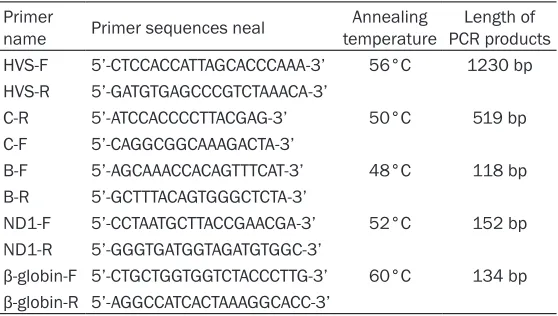
Table 2. Primer sequences Primer
name Primer sequences neal temperatureAnnealing PCR productsLength of HVS-F 5’-CTCCACCATTAGCACCCAAA-3’ 56°C 1230 bp HVS-R 5’-GATGTGAGCCCGTCTAAACA-3’
C-R 5’-ATCCACCCCTTACGAG-3’ 50°C 519 bp C-F 5’-CAGGCGGCAAAGACTA-3’
B-F 5’-AGCAAACCACAGTTTCAT-3’ 48°C 118 bp B-R 5’-GCTTTACAGTGGGCTCTA-3’
ND1-F 5’-CCTAATGCTTACCGAACGA-3’ 52°C 152 bp ND1-R 5’-GGGTGATGGTAGATGTGGC-3’
β-globin-F 5’-CTGCTGGTGGTCTACCCTTG-3’ 60°C 134 bp
β-globin-R 5’-AGGCCATCACTAAAGGCACC-3’
ROS, which can promote cellular differentiation or induce apoptosis [8].
Unlike any other organelle, mitochondria have their own DNA. Human mtDNA encodes 13 re- spiratory chain subunits that are essential for the mitochondrial surface oxidative phosphory-lation system (OXPHOS) [9]. mtDNA is particu-larly susceptible to oxidative damage and muta-tion because of the high rate of ROS produc- tion, the lack of introns and protective histones, and the limited DNA-repair capacity in mito-chondria [10]. Chronic oxidative stress induced by cigarette smoke can lead to mtDNA dama- ge, including point mutations, insertions, and deletions [11]. The accumulation of oxidative damage and the resulting sequence variations in mtDNA ultimately lead to faulty OXPHOS [12]. As such, the oxidative stress induced by ciga-rette smoking may play a substantial role in the pathogenesis of smoking-related diseases. Prior studies have demonstrated that the non-pathogenic mutations that define the various mtDNA haplogroups are associated with sus-ceptibility to metabolic and degenerative dis-eases in humans [13]. These mtDNA mutations also determine differences in OXPHOS
perfor-case-control study to investigate the associa-tion between mtDNA (including mtDNA haplo-types and mtDNA copy number) and COPD. From these results, we hoped to provide new experimental evidence to further elucidate the pathogenesis of COPD.
Materials and methods
Study participants
[image:2.612.91.370.218.376.2]The study was approved by Research Ethics Committee of Shiyan Taihe Hospital. Written in- formed consent was obtained from all partici-pants. A total of 60 COPD patients and 60 age-matched volunteers were recruited from August 2015 to August 2016. All subjects were unre-lated for at least three generations. Inclusion criteria for the COPD patients were consistent with the COPD treatment guidelines formulated by Respiratory Diseases Branch of the Chinese Medical Association. Patients were excluded if they had been diagnosed with tuberculosis, asthma, cardiac disease, lung cancer, or other diseases. Exclusion criteria for the control group were a history of lung disease, cardio- myopathy, breast cancer, or liver disease. Ac- cording to clinical symptoms and lung function Table 1. Grading standards of chronic obstructive pulmonary disease
Grade Clinical symptoms
I FEV1 ≥ 80% of predicted value. Patients usually have chronic cough and sputum, but may not show
any symptoms; patients may not be aware of pulmonary dysfunction. II 50%≤FEV1<80% of predicted value. Cough, sputum symptoms get worse.
III 30%≤FEV1<50% of predicted value. Cough, sputum symptoms get worse, accompanied by a typical
event of shortness of breath.
IV FEV1<30% of predicted value or FEV1<50% of predicted value but accompanied with respiratory fail -ure and other serious complications.
mance and ROS production. Furthermore, the mtDNA copy number is affected by oxidative stress, and the increased num-ber of mtDNA copies has been found to be positively associat-ed with an increasassociat-ed risk for lung cancer among heavy smok-ers [14].
at the time of hospital admission, patients with COPD could be divided into four grades (Table 1) [1]. Peripheral blood samples were drawn into heparinized tubes, and separation of the leukocytes was completed within 2 hours. Genomic DNA was isolated from the periphe- ral leukocytes using a QIAamp DNA Mini Kit (QIAGEN, Germany).
mtDNA haplogrouping
According to the nucleotide sequence in Ge- nebank, the primers HVS-F and HVS-R were designed to amplify the hyper-variable segment (HVS) region (Table 2). In addition to the HVS region, the 10171-10659 region was consid-ered as an auxiliary sequence for haplogroup classification because it contains substantial valuable classification information. Primers C-F and C-R were designed to amplify the 10171-10659 region. We obtained the mutation sites by aligning sequences of HVS and 10171-10659 regions with the revised Cambridge Reference Sequence (rCRS) of human mtDNA. According to the relationship between mtDNA haplogroups and phylogenetic tree for Han Chinese proposed in 2002 [15], specimens were classified into possible haplogroups. In addition to the sequencing, PCR-restriction fr- agment length polymorphism (PCR-RFLP) was considered as an adjunct experiment.
There are two tandem 9 bp (base pair) repeats in the small non-coding region between COX II and tRNAlys under normal circumstances. However, one of the two repeats may be lost during DNA replication due to slip chain mis-match. This kind of deletion is the diagnostic marker of B haplogroup. Primers B-F and B-R were designed to amplify this small non-coding region.
mtDNA copy number
Quantitative real-time PCR was used to analy- ze the mtDNA copy number. The beta globin
and inserted into the plasmid PGM-T. The recombinant vectors were used to transform competent E. coli DH5α cells to produce the recombinant bacteria PGM-β-globin-DH5α and PGM-ND1-DH5α. The recombinant plasmids were extracted from these recombinant bacte-ria and identified by digestion and sequencing. The copy number of recombinant plasmid was calculated from DNA concentration and molec-ular weight of plasmid, and the calculation for-mula is 6.02×10¹⁴×plasmid concentration (ng/
μL)/(base number of recombinant plasmid× 660). ND1 and β-globin standards were ob- tained by serial dilutions (108-103 copies). PCR
amplifications of the samples and standards were run simultaneously on an ABI Stepone- Plus fluorescence quantitative PCR instrument. The copy number of ND1 and β-globin in the samples was calculated according to standard curves. The mtDNA copy number per diploid nuclear genome was calculated according to the formula 2×ND1/β-globin.
Statistical analysis
The nucleotide sequences of HVS and 10171-10659 were edited, aligned and compared wi- th rCRS using Vector NTI Advance 11 software. Owing to the complexity and variability, length polymorphisms of the poly-A and poly-C stret- ches in 16180-16188 and 303-315 regions were disregarded in the analyses. The charac-teristics of all subjects were analyzed by Pe- arson X2 test or Fisher exact test. To assess the
[image:3.612.90.321.84.163.2]relationship between COPD and mtDNA hap-logroups, single factor analysis of variance was performed to calculate the adjusted odds ra- tios (OR) and 95% confidence intervals (CI). The significance of differences in the mtDNA copy numbers between COPD and healthy controls was determined using a Student’s t-test with two-tailed p-values. All statistical analyses we- re conducted using Statistical Package for So- cial Science, version 22.0 for Windows (SPSS, Table 3. Characteristics of the study population
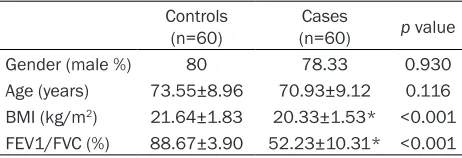
Controls
(n=60) (n=60)Cases p value
Gender (male %) 80 78.33 0.930
Age (years) 73.55±8.96 70.93±9.12 0.116 BMI (kg/m2) 21.64±1.83 20.33±1.53* <0.001 FEV1/FVC (%) 88.67±3.90 52.23±10.31* <0.001
*p<0.05 compared with control group.
Inc., Chicago, IL, USA). The values were repre-sented as the means ± SD, where p<0.05 was considered statistically significant.
Results
Subject characteristics
In this study, 60 unrelated COPD patients and 60 unrelated controls were recruited from Northwest Hubei, China. Descriptive character-istics of the study population are presented in Table 3. The variables mainly include gender, age, lung function (FEV1/FVC) and body mass index (BMI). There was no difference in gender composition between the COPD and control groups (p>0.05). For BMI and FEV1/FVC, there were extremely significant differences between the two groups (p<0.01).
mtDNA haplogroups
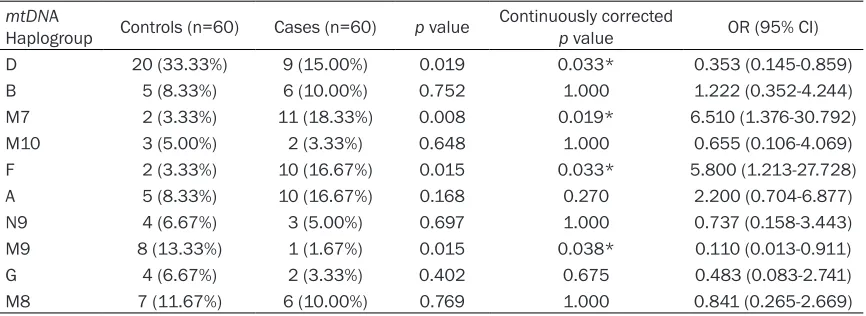
Subjects in the COPD and control groups were classified into 10 major mtDNA haplogroups: A, B, D, F, G, M7, M8, M9, M10 and N9 (Table 4). Compared with the control group, haplogroups F and M7 were significantly more prevalent (OR=5.800, 95% CI=1.213-27.728, p=0.033, and OR=6.510, 95% CI=1.376-30.792, p= 0.019, respectively) in the COPD group, where-as haplogroups D and M9 were significantly lower in the COPD group (OR=0.353, 95% CI=0.145-0.859, p=0.033, and OR=0.110, 95% CI=0.013-0.911, p=0.038, respectively). Therefore, we speculated that haplogroups F and M7 might be risk factors for COPD. In con-trast, haplogroups D, and M9 might be associ-ated with a reduced risk for COPD.
mtDNA copy number
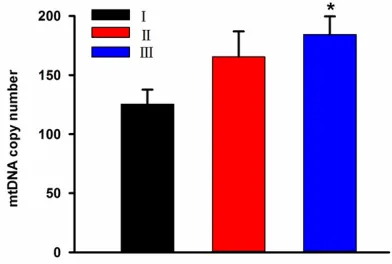
The mtDNA copy number in the control group was significantly lower than that in the COPD group (131.86±9.34 VS 159.57±9.96, p<0.05) (Figure 1). We hypothesized that the mtDNA copy number in the peripheral leukocytes in- creased with the occurrence and development of COPD. According to the grading standards presented in Table 1, the COPD patients inclu- ded in this study could be divided into 3 grad- es (grade I, II and III). The average mtDNA co- py numbers in these three grades were 125.46 ±12.25, 165.57±21.43 and 184.34±15.37, respectively (Figure 2). Our analysis showed that the difference between grade I and III was significant (p<0.05), but there were no statisti-cally significant differences between grade I and II or between grade II and III.
Discussion
[image:4.612.90.523.84.242.2]In our research, a case-control study was used to explore the relationship between peripheral leukocyte mtDNA and COPD in a Han Chinese population. Through strict case selection and a scientifically rigorous experimental process, we found that haplogroups F and M7 might be ri- sk factors for COPD, whereas haplogroups D and M9 might be associated with a reduced risk for COPD. The peripheral leukocyte mtDNA copy number in the COPD group, which in- creased with the severity of disease, was high-er than that in control group. Our results con-firmed once again that mtDNA is related to the occurrence and progression of COPD. Due to the small sample size, caution needs to be exercised in interpreting these results.
Table 4. Distribution of mtDNA haplogroups among controls and cases mtDNA
Haplogroup Controls (n=60) Cases (n=60) p value Continuously corrected p value OR (95% CI)
D 20 (33.33%) 9 (15.00%) 0.019 0.033* 0.353 (0.145-0.859)
B 5 (8.33%) 6 (10.00%) 0.752 1.000 1.222 (0.352-4.244)
M7 2 (3.33%) 11 (18.33%) 0.008 0.019* 6.510 (1.376-30.792)
M10 3 (5.00%) 2 (3.33%) 0.648 1.000 0.655 (0.106-4.069)
F 2 (3.33%) 10 (16.67%) 0.015 0.033* 5.800 (1.213-27.728)
A 5 (8.33%) 10 (16.67%) 0.168 0.270 2.200 (0.704-6.877)
N9 4 (6.67%) 3 (5.00%) 0.697 1.000 0.737 (0.158-3.443)
M9 8 (13.33%) 1 (1.67%) 0.015 0.038* 0.110 (0.013-0.911)
G 4 (6.67%) 2 (3.33%) 0.402 0.675 0.483 (0.083-2.741)
M8 7 (11.67%) 6 (10.00%) 0.769 1.000 0.841 (0.265-2.669)
and COPD, have been accumulating in recent years. However, until now, the relationship be- tween mtDNA and COPD was not very clear, and the clinical application of mtDNA remains to be explored. To elucidate the potential role of mtDNA including mtDNA haplotypes and copy number in the development of COPD, we examined the haplotype and copy number of mtDNA in the peripheral blood leukocytes fr- om COPD patients. The results suggest that only the distributions of haplogroups F, M7, D and M9 between COPD patients and controls were significantly different. Specifically, under the same conditions, mtDNA haplotypes F and M7 will increase the risk of COPD, whereas hap-logroups D and M9 will decrease the risk of COPD. In addition, we found that the mtDNA copy number was higher in the COPD patients than that in the healthy controls, and this num-ber increased with the severity of disease. Oxidative stress is known to cause mtDNA damage which in turn leads to abnormal OXPHOS. However, the mtDNA copy number will increase to compensate for this damage [18, 19]. From this point of view, both increases in the mtDNA copy number and the incidence of COPD are closely related to the accumulation of oxidative stress, and the mtDNA copy number can be used to assess the severity of COPD. Several mtDNA haplogroups have been found to participate in human longevity, carcinogene-sis, lung cancer, Leber’s hereditary optic neu-ropathy (LHON), and other metabolic and de- generative diseases. Haplotype D is defined by the specific variation C5178A in mitochondrial NADH dehydrogenase subunit 2 (ND2). Prior studies have shown that the protective effect of a Leu→Met substitution at amino acid 237 (L237M) of ND2 (C5178A) not only contributes to human longevity [13] but also decreases the risk of lung cancer and COPD [20, 21], which supports our findings that mtDNA haplotype D can reduce the risk of COPD. It has been proposed that methionine residues constitute an important antioxidant defense mechanism [22]. According to the predicted model of the human ND2 molecule [23], the Leu→Met sub-stitution at amino acid 237 of ND2 is exposed at the surface of complex I and may play an important role in the protective effect against oxidative damage to mitochondria by serving as an efficient oxidant scavenger.
[image:5.612.92.286.69.202.2]Haplotype M9 is another kind of mtDNA haplo-type. Although haplotype M9 does not corre-
Figure 1. mtDNA copy numbers in the control group and COPD group. The average copy numbers in the
two groups were 131.86±9.34 and 159.57±9.96, respectively. *p<0.05 compared with the control
group.
Figure 2. mtDNA copy numbers in various grades of COPD. The average copy numbers in grade I, II and
III disease were 125.46±12.25, 165.57±21.43 and 184.34±15.37, respectively. *p<0.05 compared
with grade I.
There is a very strong physiological link bet- ween the mitochondria and the human respira-tory system. The lungs extract oxygen which is essential for mitochondria to generate ATP. Under physiological conditions, oxygen-based radicals are byproducts of the OXPHOS pro-cess. To ensure an appropriate defense aga- inst these byproducts, the mitochondria have both enzymatic and non-enzymatic antioxidant systems. However, among COPD patients and smokers, the increased exogenous and endog-enous ROS leads to oxidant/antioxidant imbal-ance [16]. Even in respiratory diseases that are not associated with smoking, such as pulmo-nary fibrosis, the oxidant/antioxidant balance may be disturbed by other factors [17].
[image:5.612.90.286.287.419.2]late with lung cancer [20], it has been shown to be associated with resistance to COPD [21]. In this study, haplotype M9 was also identified less often in COPD cases than healthy controls, and the difference reached the level of signifi-cance. The possible reason for the different roles of haplotype M9 in susceptibility to COPD and lung cancer may be the role of chronic hypoxia in the development of COPD. Chronic hypoxia is observed not only in patients with severe COPD but also after exercise in patients with moderate COPD [24]. Hypoxia is involved in muscle dysfunction, anorexia, hormonal de- rangement, and other COPD processes [25]. Thus, chronic hypoxia may be responsible for the different roles of haplotype M9 in lung can-cer and COPD. However, the profound role of haplotype M9 in the resistance for COPD should be investigated further.
It has been reported that the haplotype F is related to a decreased risk for lung cancer and COPD [20, 21]. However, haplotype F was found to be a risk factor for COPD in this study. One hypothesis for this phenomenon is the small sample size. Although the sample size of this study was less than others, a significant dif- ference in the frequencies of the haplotype F between COPD patients and healthy controls was observed. According to phylogenetic clas-sification, Haplotype F can be divided into sub-haplotypes F1-4 in East Asians [26]. The cor- relation between these sub-haplotypes and COPD susceptibility needs to be further ex- plored. The other possible explanation for this phenomenon is that COPD risk is not influenc- ed solely by mtDNA variations. The nuclear background in which the mtDNA haplogroups are classified may also contribute to the indi-viduals’ susceptibility to COPD. Investigating the protective effect against oxidative damage to the mitochondria, the generation of endoge-nous ROS under various conditions in the dif-ferent mtDNA haplogroups with the same nuclear background, and investigating the dif-ferent nuclear background with the same mt- DNA haplogroups, may help us, at least in part, to explore the fundamental mechanisms. Haplotype M7 was also found to be a risk fac-tors for COPD in this study. Haplotype M7 is defined by a specific variation at np T9824C [15]. Previous studies have demonstrated that M7b1’2, a sub-haplotype of M7, was found to
increase the penetrance of LHON [27], and haplogroup M7 was a risk factor for mild acu- te mountain sickness (AMS), lung cancer and COPD [28]. In the present study, haplotype M7 was found to be present in 3.33% of the con-trols, but was present in the COPD cases at a frequency of 18.33%. The relationship between mtDNA deletion, mtDNA haplotype, and ciga-rette smoking indicated that haplotype M7 may better tolerate the damage by external ROS caused by cigarette smoking [20].
Mitochondria play important roles in cellular metabolism and energy production and act as a primary source of reactive oxygen species (ROS) [8, 29]. The quantity and quality of mtDNA seriously affect mitochondrial function, which remains relatively stable under physiological conditions. Alterations in mtDNA copy number have been considered to be one of the factors involved in the pathogenesis of OXPHOS disor-ders [30, 31]. Thus, the levels of antioxidants and pro-oxidants may play a role in the regu- lation of mtDNA copy number. Recently, it has been reported that an increased mtDNA copy number is associated with future development of lung cancer [14, 32], which supports our find-ings that the mtDNA copy number in the COPD patients was significantly higher than that in the healthy controls. In addition, we also found that the mtDNA copy number increased even further with increases in the severity of the ill-ness. However, these results contradict anoth-er case-control study that showed that a de- creased mtDNA copy number was associated with an increased risk of COPD [33]. There is also a study showing that the median level of mtDNA copy number may be associated with a higher risk of lung cancer than the high level among current smokers [34].
The high copy number of mtDNA in aging cells is thought to be the result of a compensatory response to the cumulative exposures to oxida-tive stress and accumulation of mtDNA muta-tions [35]. An increased mtDNA copy number in peripheral blood may reflect the increased lev-els of oxidative damage. Additionally, nuclear anomalies of some key players, such as p53 and mtDNA polymerase γ (POLG), are also associated with changes in mtDNA content in several cancer types [36, 37]. Thus, the mtDNA copy number in peripheral blood may reflect the biological processes that are relevant to COPD.
There are several limitations to our population-based case-control study design. First, due to some objective factors, patients with very severe COPD were not included in this study. Further verification with more comprehensive grouping as well as biological studies are ne- eded to confirm the relationship between the mtDNA copy number and the severity of COPD. Second, although several mtDNA haplogroups were found to be associated with COPD sus-ceptibility, the study did not analyze the patho-physiological consequences of the mtDNA va- riants that defined the mtDNA haplogroups. Nevertheless, prior studies have revealed that mtDNA variations determine differences in OX- PHOS performance and ROS production. Third, because the distribution of mtDNA haplogr- oups varies spatially in China, large-scale stu- dies are required to clarify the association of mtDNA variation with the risk of COPD in other populations.
In summary, we conducted a case-control study to investigate the relationship between mtDNA and development of COPD. Our findings sug-gested that mtDNA haplotypes F and M7 may be risk factors for COPD, whereas haplotypes D and M9 may decrease the risk of COPD. In addi-tion, the study also revealed that mtDNA copy number of eripheral leukocytes in COPD group is significantly decreased compared with the control group. Furthermore, the mtDNA copy number may be used as the assessment of severity of COPD.
Acknowledgements
This study was supported by grant from the Natural Science Foundation of Hubei Provincial Department of Education (NO. B2015485) and
the Scientific and Technological Project of Shiyan City of Hubei Province (NO. 17Y11).
Disclosure of conflict of interest
None.
Address correspondence to: Zhicheng Fang, Hubei University of Medicine, Shiyan 442000, Hubei, China. Tel: +860719-8801481; Fax: +860719-88- 83809; E-mail: [email protected]
References
[1] Vestbo J, Hurd SS, Agusti AG, Jones PW, Vogel-meier C, Anzueto A, Barnes PJ, Fabbri LM, Mar-tinez FJ, Nishimura M, Stockley RA, Sin DD and Rodriguez-Roisin R. Global strategy for the di-agnosis, management, and prevention of chronic obstructive pulmonary disease: GOLD executive summary. Am J Respir Crit Care Med 2013; 187: 347-365.
[2] Su ZG, Wen FQ, Feng YL, Xiao M and Wu XL. Transforming growth factor-beta1 gene poly-morphisms associated with chronic obstruc-tive pulmonary disease in Chinese population. Acta Pharmacol Sin 2005; 26: 714-720. [3] Mathers CD and Loncar D. Projections of
glob-al mortglob-ality and burden of disease from 2002 to 2030. PLoS Med 2006; 3: e442.
[4] Hoshino Y, Mio T, Nagai S, Miki H, Ito I and Izu-mi T. Cytotoxic effects of cigarette smoke ex-tract on an alveolar type II cell-derived cell line. Am J Physiol Lung Cell Mol Physiol 2001; 281: L509-516.
[5] van der Toorn M, Slebos DJ, de Bruin HG, Leu-venink HG, Bakker SJ, Gans RO, Koeter GH, van Oosterhout AJ and Kauffman HF. Cigarette smoke-induced blockade of the mitochondrial respiratory chain switches lung epithelial cell apoptosis into necrosis. Am J Physiol Lung Cell Mol Physiol 2007; 292: L1211-1218.
[6] Slebos DJ, Ryter SW, van der Toorn M, Liu F, Guo F, Baty CJ, Karlsson JM, Watkins SC, Kim HP, Wang X, Lee JS, Postma DS, Kauffman HF and Choi AM. Mitochondrial localization and function of heme oxygenase-1 in cigarette smoke-induced cell death. Am J Respir Cell Mol Biol 2007; 36: 409-417.
[7] Koopman WJ, Verkaart S, Visch HJ, van der Westhuizen FH, Murphy MP, van den Heuvel LW, Smeitink JA and Willems PH. Inhibition of complex I of the electron transport chain causes O2-. -mediated mitochondrial out-growth. Am J Physiol Cell Physiol 2005; 288: C1440-1450.
[9] Wallace DC. Mitochondrial diseases in man and mouse. Science 1999; 283: 1482-1488. [10] Croteau DL and Bohr VA. Repair of oxidative
damage to nuclear and mitochondrial DNA in mammalian cells. J Biol Chem 1997; 272: 25409-25412.
[11] Lee HC, Yin PH, Lin JC, Wu CC, Chen CY, Wu CW, Chi CW, Tam TN and Wei YH. Mitochondrial genome instability and mtDNA depletion in hu-man cancers. Ann N Y Acad Sci 2005; 1042: 109-122.
[12] Wallace DC. Mitochondrial DNA mutations in disease and aging. Environ Mol Mutagen 2010; 51: 440-450.
[13] Cai XY, Wang XF, Li SL, Qian J, Qian DG, Chen F, Yang YJ, Yuan ZY, Xu J, Bai Y, Yu SZ and Jin L. Association of mitochondrial DNA haplogroups with exceptional longevity in a Chinese popula-tion. PLoS One 2009; 4: e6423.
[14] Hosgood HD 3rd, Liu CS, Rothman N, Wein-stein SJ, Bonner MR, Shen M, Lim U, Virtamo J, Cheng WL, Albanes D and Lan Q. Mitochondri-al DNA copy number and lung cancer risk in a prospective cohort study. Carcinogenesis 2010; 31: 847-849.
[15] Yao YG, Kong QP, Bandelt HJ, Kivisild T and Zhang YP. Phylogeographic differentiation of mitochondrial DNA in Han Chinese. Am J Hum Genet 2002; 70: 635-651.
[16] Pieczenik SR and Neustadt J. Mitochondrial dysfunction and molecular pathways of dis-ease. Exp Mol Pathol 2007; 83: 84-92. [17] Domej W, Foldes-Papp Z, Flogel E and
Had-itsch B. Chronic obstructive pulmonary disease and oxidative stress. Curr Pharm Biotechnol 2006; 7: 117-123.
[18] Liu CS, Tsai CS, Kuo CL, Chen HW, Lii CK, Ma YS and Wei YH. Oxidative stress-related altera-tion of the copy number of mitochondrial DNA in human leukocytes. Free Radic Res 2003; 37: 1307-1317.
[19] Wang YC, Lee WC, Liao SC, Lee LC, Su YJ, Lee CT and Chen JB. Mitochondrial DNA copy num-ber correlates with oxidative stress and pre-dicts mortality in nondiabetic hemodialysis patients. J Nephrol 2011; 24: 351-358. [20] Zheng S, Qian P, Li F, Qian G, Wang C, Wu G, Li
Q, Chen Y, Li J, Li H, He B and Ji F. Association of mitochondrial DNA variations with lung can-cer risk in a Han Chinese population from southwestern China. PLoS One 2012; 7: e31322.
[21] Zheng S, Wang C, Qian G, Wu G, Guo R, Li Q, Chen Y, Li J, Li H, He B, Chen H and Ji F. Role of mtDNA haplogroups in COPD susceptibility in a southwestern Han Chinese population. Free Radic Biol Med 2012; 53: 473-481.
[22] Levine RL, Mosoni L, Berlett BS and Stadtman ER. Methionine residues as endogenous
anti-oxidants in proteins. Proc Natl Acad Sci U S A 1996; 93: 15036-15040.
[23] Hirokawa T, Boon-Chieng S and Mitaku S.
SO-SUI: classification and secondary structure
prediction system for membrane proteins. Bio-informatics 1998; 14: 378-379.
[24] To Y, Takezawa T, Arai T and Sasaki M. The ef-fect of tiotropium bromide on exercise-induced oxygen desaturation in patients with COPD. American Journal of Respiratory and Critical Care Medicine 2009; 179.
[25] Raguso CA and Luthy C. Nutritional status in chronic obstructive pulmonary disease: role of hypoxia. Nutrition 2011; 27: 138-143.
[26] Yao YG, Kong QP, Wang CY, Zhu CL and Zhang YP. Different matrilineal contributions to ge-netic structure of ethnic groups in the silk road region in china. Mol Biol Evol 2004; 21: 2265-2280.
[27] Ji Y, Zhang AM, Jia X, Zhang YP, Xiao X, Li S, Guo X, Bandelt HJ, Zhang Q and Yao YG. Mito-chondrial DNA haplogroups M7b1’2 and M8a affect clinical expression of leber hereditary optic neuropathy in Chinese families with the m.11778G-->a mutation. Am J Hum Genet 2008; 83: 760-768.
[28] Li FX, Ji FY, Zheng SZ, Yao W, Xiao ZL and Qian GS. MtDNA haplogroups M7 and B in south-western Han Chinese at risk for acute moun-tain sickness. Mitochondrion 2011; 11: 553-558.
[29] Chan DC. Mitochondria: dynamic organelles in disease, aging, and development. Cell 2006; 125: 1241-1252.
[30] Wei YH, Lee CF, Lee HC, Ma YS, Wang CW, Lu CY and Pang CY. Increases of mitochondrial mass and mitochondrial genome in associa-tion with enhanced oxidative stress in human cells harboring 4,977 BP-deleted mitochondri-al DNA. Ann N Y Acad Sci 2001; 928: 97-112. [31] Lee HC, Yin PH, Lu CY, Chi CW and Wei YH.
In-crease of mitochondria and mitochondrial DNA in response to oxidative stress in human cells. Biochem J 2000; 348: 425-432.
[32] Bonner MR, Shen M, Liu CS, Divita M, He X and Lan Q. Mitochondrial DNA content and lung cancer risk in Xuan Wei, China. Lung Cancer 2009; 63: 331-334.
[33] Liu SF, Kuo HC, Tseng CW, Huang HT, Chen YC, Tseng CC and Lin MC. Leukocyte mitochondrial DNA copy number is associated with chronic obstructive pulmonary disease. PLoS One 2015; 10: e0138716.
[35] Lee HC and Wei YH. Mitochondrial biogenesis and mitochondrial DNA maintenance of mam-malian cells under oxidative stress. Int J Bio-chem Cell Biol 2005; 37: 822-834.
[36] Chang SC, Lin PC, Yang SH, Wang HS, Liang WY and Lin JK. Mitochondrial D-loop mutation is a common event in colorectal cancers with p53 mutations. Int J Colorectal Dis 2009; 24: 623-628.