Creating a Large Benchmark for Open Information Extraction
Gabriel Stanovsky and Ido Dagan
Computer Science Department, Bar-Ilan University, Ramat Gan, Israel
[email protected] [email protected]
Abstract
Open information extraction (Open IE) was presented as an unrestricted variant of tra-ditional information extraction. It has been gaining substantial attention, manifested by a large number of automatic Open IE extractors and downstream applications. In spite of this broad attention, the Open IE task definition has been lacking – there are no formal guide-lines and no large scale gold standard annota-tion. Subsequently, the various implementa-tions of Open IE resorted to small scale post-hoc evaluations, inhibiting an objective and re-producible cross-system comparison. In this work, we develop a methodology that lever-ages the recent QA-SRL annotation to create a first independent and large scale Open IE an-notation,1and use it to automatically compare
the most prominent Open IE systems.
1 Introduction
Open Information Extraction (Open IE) was origi-nally formulated as a function from a document to a set of tuples indicating a semantic relation between a predicate phrase and its arguments (Banko et al., 2007). Wu and Weld (2008) further defined that an Open IE extractor should “produce one triple for ev-ery relation stated explicitly in the text, but is not required to infer implicit facts”. For example, given the sentence “John managed to open the door” an Open IE extractor should produce the tuple (John; managed to open; the door)but isnotrequired to pro-duce the extraction(John;opened; the door).
1Publicly available at http://www.cs.biu.ac.il/
nlp/resources/downloads
Following this initial presentation of the task, Open IE has gained substantial and consistent atten-tion. Many automatic extractors were created (e.g., (Fader et al., 2011; Mausam et al., 2012; Del Corro and Gemulla, 2013)) and were put to use in various downstream applications.
In spite of this wide attention, Open IE’s for-mal definition is lacking. There are no clear guide-lines as to what constitutes a valid proposition to be extracted, and subsequently there is no large scale benchmark annotation. Open IE evaluations there-fore usually consist of a post-hoc manual evaluation of a small output sample.
This evaluation practice lacks in several respects: (1) Most works provide a precision oriented metric, whereas recall is often not measured, (2) the num-bers are not comparable across systems, as they use different guidelines and datasets, and (3) the experi-ments are hard to replicate.
In this work, we aim to contribute to the standard-ization of Open IE evaluation by providing a large gold benchmark corpus. For that end, we first iden-tify consensual guiding principles across prominent Open IE systems, resulting in a clearer formulation of the Open IE task. Following, we find that the re-cent formulation of QA-SRL (He et al., 2015) in fact subsumes these requirements for Open IE. This en-ables us to automatically convert the annotations of QA-SRL to a high-quality Open IE corpus of more than 10K extractions, 13 times larger than the previ-ous largest Open IE annotation.
Finally, we automatically evaluate the perfor-mance of various Open IE systems against our cor-pus, using a soft matching criterion. This is the first
time such a comparative evaluation is performed on a large scale gold corpus.
Future Open IE systems (and its applicative users) can use this large benchmark, along with the auto-matic evaluation measure, to easily compare their performance against previous baselines, alleviating the current need for ad-hoc evaluation.
2 Background
2.1 Open IE
Open Information Extraction (Open IE) was intro-duced as an open variant of traditional Information Extraction (Etzioni et al., 2008). As mentioned in the Introduction, its primary goal is to extract coher-ent propositions from a scoher-entence, each comprising of a relation phrase and two or more argument phrases (e.g., (Barack Obama, born in, Hawaii)). Since its inception, Open IE has gained consistent attention, mostly used as a component within larger frame-works (Christensen et al., 2013; Balasubramanian et al., 2013).
In parallel, many Open IE extractors were de-veloped. TextRunner (Banko et al., 2007) and WOE (Wu and Weld, 2010) take a self-supervised approach over automatically produced dependency parses. Perhaps more dominant is the rule based ap-proach taken by ReVerb (Fader et al., 2011), OLLIE (Mausam et al., 2012), KrakeN (Akbik and L¨oser, 2012) and ClausIE (Del Corro and Gemulla, 2013).
Two recent systems take a semantically-oriented approach. Open IE-42uses semantic role labeling to extract tuples, while Stanford Open Information Ex-traction (Angeli et al., 2015) uses natural logic infer-ence to arrive at shorter, more salient, arguments.
Recently, Stanovsky et al. (2016b) presented PropS, a proposition oriented representation, ob-tained via conversion rules from dependency trees. Performing Open IE extraction over PropS struc-tures is straightforward – follow the clearly marked predicated nodes to their direct arguments.
Contrary to the vast interest in Open IE, its task formulation has been largely overlooked. There are currently no common guidelines defining a valid ex-traction, which consequently hinders the creation of an evaluation benchmark for the task. Most Open
2https://github.com/knowitall/openie
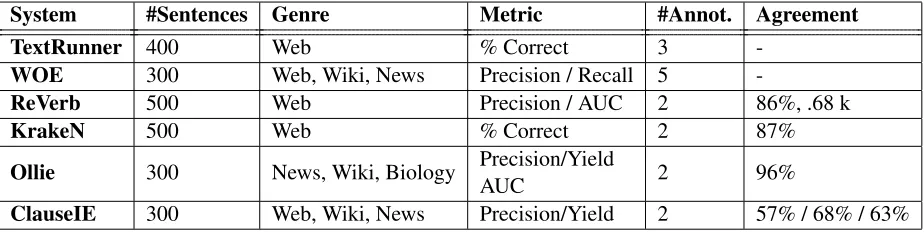
IE extractors3evaluate performance by manually ex-amining a small sample of their output. Table 1 sum-marizes the evaluations taken by the most prominent Open IE systems.
2.2 QA-SRL
Semantic Role Labeling (SRL) (Carreras and M`arquez, 2005) is typically perceived as
answer-ingargument role questions, such aswho, what, to
whom, when, orwhere, regarding a target predicate. For instance, PropBank’s ARG0 for the predicate
sayanswers the question “whosaidsomething?”. QA-SRL (He et al., 2015) suggests that answering explicit role questions is an intuitive means to solicit predicate-argument structures from non-expert an-notators. Annotators are presented with a sentence in which a target predicate4was marked, and are re-quested to annotate argument role questions and cor-responding answers.
Consider the sentence “Giles Pearman, Mi-crosoft’s director of marketing, left his job” and the target predicateleft. The QA-SRL annotation con-sists of the following pairs: (1)Who left something?
{Giles Pearman;Microsoft’s director of
market-ing}and (2)what did someone leave?his job.5 He et al. assessed the validity of QA-SRL by annotating 3200 sentences from PropBank and Wikipedia, showing high agreement with the Prop-Bank annotations. In the following section we au-tomatically derive an Open IE benchmark from this QA-SRL annotation.
3 Creating an Open IE Benchmark
3.1 Open IE Guidelines
Before creating a generic benchmark for evaluat-ing Open IE systems, it is first needed to obtain a clearer specification of the common task that they address. Despite some nuances, we identified the following core aspects of the Open IE task as con-sensual across all systems mentioned in Section 2:
3Except for (Wu and Weld, 2010) who evaluated recall. 4Currently consisting of automatically annotated verbs. 5Three cases give rise to multiple answers for the same
System #Sentences Genre Metric #Annot. Agreement
TextRunner 400 Web % Correct 3
-WOE 300 Web, Wiki, News Precision / Recall 5
-ReVerb 500 Web Precision / AUC 2 86%, .68 k
KrakeN 500 Web % Correct 2 87%
Ollie 300 News, Wiki, Biology Precision/YieldAUC 2 96%
[image:3.612.76.538.57.173.2]ClauseIE 300 Web, Wiki, News Precision/Yield 2 57% / 68% / 63%
Table 1: The post-hoc evaluation metrics taken by the different systems described in Section 2. In contrast, Stanford Open IE and PropS took an extrinsic evaluation approach.
Assertedness Extracted propositions should be
asserted by the original sentence. For example, given the sentence “Sam succeeded in convincing John”, ReVerb and ClausIE produce the extraction:
(Sam;succeeded in convincing; John). Most Open IE systems do not attempt to recover implied embedded propositions (e.g.,(Sam;convinced; John)), but rather include matrix verbs (e.g.,succeeded) in the predi-cate slot. Other elements that affect assertedness, like negations and modals, are typically included in the predicate slot as well (e.g. (John;could not join; the band)).
Minimal propositions Open IE systems aim to
”break down” a sentence into a set of small isolated propositions. Accordingly, the span of each individ-ual proposition, and hence the span of each of its predicate and argument slots, should be as minimal as possible, as long as the original information (truth conditions) is preserved. For example, this leads to splitting distributive coordination in the sentence “Bell distributes electronic and building products”, for which ClausIE produces: (Bell,distributes, elec-tronic products) and (Bell, distributes, building prod-ucts). Having shorter entities as Open IE arguments was further found to be useful in several semantic tasks (Angeli et al., 2015; Stanovsky et al., 2015).
Completeness and open lexicon Open IE systems
aim to extract all asserted propositions from a sen-tence. In practice, most current Open IE systems limit their scope to extracting verbal predicates, but consider all possible verbs without being bound to a pre-specified lexicon.
3.2 From QA-SRL to Open IE
SRL and Open IE have been defined with differ-ent objectives. Particularly, SRL iddiffer-entifies argumdiffer-ent role labels, which is not addressed in Open IE. Yet, the two tasks overlap as they both need to recover predicate-argument structures in sentences. We now examine the above Open IE requirements and sug-gest that while they are only partly embedded within SRL structures, they can be fully recovered from QA-SRL.
Asserted (matrix) propositions appear in SRL as non-embedded predicates (e.g., succeeded in the “Sam succeeded to convince John”). However, SRL’s predicates are grounded to a lexicon such as PropBank (Palmer et al., 2005) or FrameNet (Baker et al., 1998), which violates the completeness and open lexicon principle. Further, in contrast to the minimal propositions principle, arguments in SRL annotations are inclusive, each marked as full sub-trees in a syntactic parse.
3.3 Generating Open-IE Extractions
Formally, we extract an Open-IE dataset from the QA-SRL dataset by the following algorithm, which is illustrated in more detail further below:
1. Given:
• s- a sentence from the QA-SRL dataset. • p- a predicate ins.
• tq1, ..., qnu- a list of questions overp. • tta1,1, ..., a1,l1u, ...tan,1, ..., an,lnuu - a
list of sets of corresponding answers, where questionqi haslianswers.
2. Ifpis a non-embedded (matrix) verb:
(a) Remove answers which are composed only of pronouns, as these are not ex-pected to be extracted by Open-IE (and ac-cordingly adjust the li’s).
(b) Return extractions composed of p and every combination of answers in
tta1,1, ..., a1,l1u ˆ ...ˆ tan,1, ..., an,lnuu
(the Cartesian product of the answers). This process results in a list ofl1¨l2¨...¨ln
Open IE extractions.
For example, consider the sentence: “Barack Obama, the U.S. president, wasdeterminedto win the majority vote in Washington and Arizona”. The questions corresponding to the predicatedetermine
are: {who was determined?,what was someone de-termined to do?}, and the corresponding answer sets are: {{“Barack Obama”, “the U.S president”}, {“win the majority vote in Washington”, “win the majority vote in Arizona”}}.
Following, our algorithm will produce these Open IE extractions: (Barack Obama; was determined; to win the majority vote in Washington), (the U.S. presi-dent;was determined; to win the majority vote in Wash-ington), (Barack Obama; was determined; to win the majority vote in Arizona), and(the U.S. president; was determined; to win the majority vote in Arizona).
Note that we do not produce extractions for em-bedded predicates (e.g., win) to conform with the assertednessprinciple, as discussed earlier.
With respect to pronoun removal (step 2(a)), we would remove the pronoun “he” as the answer to the questionwho was tired?in “John went home,hewas
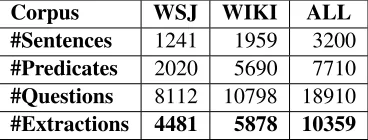
Corpus WSJ WIKI ALL
#Sentences 1241 1959 3200
#Predicates 2020 5690 7710
#Questions 8112 10798 18910
[image:4.612.335.519.58.128.2]#Extractions 4481 5878 10359
Table 2: Corpus statistics.
System WSJ WIKI#ExtractionsALL
Stanford 6423 14104 20527
ClausIE 5295 8265 13560
Open IE4 3634 5113 8747
OLLIE 2976 5250 8226
PropS 2852 4990 7842
ReVerb 1624 2552 4716
Table 3: The yield of the different Open IE systems.
tired”. Notice that in this sentence “John” would be a second answer for the above question, yielding the extraction(John;was tired). When the only answer to a question is a pronoun this question will be ignored in the extraction process, since the QA-SRL corpus does not address cross-sentence co-references. This issue may be addressed in future work.
Applying this process to the QA-SRL corpus yielded a total of 10,359 Open IE extractions over 3200 sentences from 2 domains (see Ta-ble 2). This corpus is about 13 times larger than the previous largest annotated Open IE cor-pus (Fader et al., 2011). The corpus is avail-able at: http://www.cs.biu.ac.il/nlp/
resources/downloads.
Corpus validation We assess the validity of our
[image:4.612.340.514.177.293.2]0.0 0.2 0.4 0.6 0.8 1.0 0.0
0.2 0.4 0.6 0.8 1.0
Recall
Precision OLLIE
[image:5.612.78.293.58.234.2]ReVerb ClausIE OpenIE-4 PropS Stanford
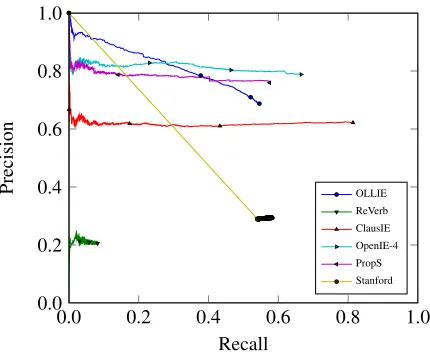
Figure 1: Precision-recall curve for the different Open IE systems on our corpus (see discussion in Section 4).
4 Comparative Evaluation
In this section, we illustrate the utility of our new corpus by testing the performance of 6 promi-nent Open IE systems: OpenIE-4, ClausIE, OLLIE, PropS, Stanford, and ReVerb (see Section 2).7
In order to evaluate these systems in terms of pre-cision and recall, we need to match between their au-tomated extractions and the benchmark extractions. To allow some flexibility (e.g., omissions of preposi-tions or auxiliaries), we follow (He et al., 2015) and match an automated extraction with a gold proposi-tion if both agree on the grammatical head of all of their elements (predicate and arguments). We then analyze the recall and precision of Open IE systems on different confidence thresholds (Figure 1). Fur-thermore, we calculate the area under the PR curve for each of the different corpora (Figure 2) and the explicit yield per system (Table 3).
To the best of our knowledge, this is the first ob-jective comparative evaluation of prominent Open-IE systems, over a large and independently created dataset. This comparison gives rise to several ob-servations; which can be useful for future research and for choosing a preferred system for a particular application setting, such as:
6Carried by the first author.
7Currently, we test only the common case of verbal
predi-cates.
Figure 2: Area Under the PR Curve (AUC) measure for the evaluated systems.
1. Open IE-4achieves best precision above 3% re-call (ě78.67) and best AUC score (54.02), 2. ClausIEis best at recall (81.38), and
3. Stanford Open IE assigns confidence of 1 to 94% of its extractions, explaining its low pre-cision.
5 Conclusions
We presented the first independent and large scale Open IE benchmark annotation, and tested the most prominent systems against it. We hope that future Open IE systems can make use of this new resource to easily and objectively measure and compare their performance.
Acknowledgments
We would like to thank Mausam for fruitful discus-sions, and the anonymous reviewers for their helpful comments.
This work was supported in part by grants from the MAGNET program of the Israeli Office of the Chief Scientist (OCS), the Israel Science Founda-tion grant 880/12, and the German Research Foun-dation through the German-Israeli Project Coopera-tion (DIP, grant DA 1600/1-1).
References
Alan Akbik and Alexander L¨oser. 2012. Kraken: N-ary facts in open information extraction. InNAACL-HLT 2012: Proceedings of the The Knowledge Extraction Workshop.
[image:5.612.312.542.60.146.2]Collin F Baker, Charles J Fillmore, and John B Lowe. 1998. The berkeley framenet project. InProceedings of ACL, pages 86–90. Association for Computational Linguistics.
Niranjan Balasubramanian, Stephen Soderland, Oren Et-zioni Mausam, and Oren EtEt-zioni. 2013. Generating coherent event schemas at scale. In EMNLP, pages 1721–1731.
Michele Banko, Michael J. Cafarella, Stephen Soderland, Matthew Broadhead, and Oren Etzioni. 2007. Open information extraction from the web. InIJCAI 2007, Proceedings of the 20th International Joint Confer-ence on Artificial IntelligConfer-ence, Hyderabad, India, Jan-uary 6-12, 2007, pages 2670–2676.
Xavier Carreras and Llu´ıs M`arquez. 2005. Introduction to the conll-2005 shared task: Semantic role labeling. InProceedings of CONLL, pages 152–164.
Janara Christensen, Stephen Soderland Mausam, Stephen Soderland, and Oren Etzioni. 2013. Towards coher-ent multi-documcoher-ent summarization. In HLT-NAACL, pages 1163–1173. Citeseer.
Luciano Del Corro and Rainer Gemulla. 2013. Clausie: clause-based open information extraction. In Proceed-ings of the 22nd international conference on World Wide Web, pages 355–366. International World Wide Web Conferences Steering Committee.
Oren Etzioni, Michele Banko, Stephen Soderland, and Daniel S Weld. 2008. Open information extrac-tion from the Web. Communications of the ACM, 51(12):68–74.
Anthony Fader, Stephen Soderland, and Oren Etzioni. 2011. Identifying relations for open information ex-traction. InProceedings of the Conference on Empiri-cal Methods in Natural Language Processing, pages 1535–1545. Association for Computational Linguis-tics.
Luheng He, Mike Lewis, and Luke Zettlemoyer. 2015. Question-answer driven semantic role labeling: Us-ing natural language to annotate natural language. In the Conference on Empirical Methods in Natural Lan-guage Processing (EMNLP).
Mausam, Michael Schmitz, Stephen Soderland, Robert Bart, and Oren Etzioni. 2012. Open language learn-ing for information extraction. InProceedings of the 2012 Joint Conference on Empirical Methods in Natu-ral Language Processing and Computational NatuNatu-ral Language Learning, pages 523–534, Jeju Island, Ko-rea, July. Association for Computational Linguistics. Martha Palmer, Daniel Gildea, and Paul Kingsbury.
2005. The proposition bank: An annotated corpus of semantic roles. Computational linguistics, 31(1):71– 106.
Gabriel Stanovsky, Ido Dagan, and Mausam. 2015. Open IE as an intermediate structure for semantic
tasks. InProceedings of the 53rd Annual Meeting of the Association for Computational Linguistics (ACL 2015).
Gabriel Stanovsky, Ido Dagan, and Meni Adler. 2016a. Specifying and annotating reduced argument span via qa-srl. In Proceedings of the 54rd Annual Meeting of the Association for Computational Linguistics (ACL 2015).
Gabriel Stanovsky, Jessica Ficler, Ido Dagan, and Yoav Goldberg. 2016b. Getting more out of syntax with props.arXiv preprint.
Fei Wu and Daniel S. Weld. 2010. Open information ex-traction using wikipedia. InProceedings of the 48th Annual Meeting of the Association for Computational Linguistics, pages 118–127, Uppsala, Sweden, July. Association for Computational Linguistics.