Abstract— As the market becomes more global, logistics is now seen as an important area where industries can cut costs and improve their customer service quality. The latest trend is to outsource logistics activities to the outside company (known as third party logistics or 3PL) to allow the outsourcing company to concentrate on the core competence, improve the service and many more. A framework is proposed to select the 3PL service provider using fuzzy Delphi method to shortlist the most important criteria and most probable service providers and fuzzy TOPSIS (technique for order performance by similarity to idea solution) to choose the best service provider by finding the closeness to the Positive Ideal Solution (PIS). A case study is conducted in an automobile company in north India to select the best suitable 3PL service provides.
Index Terms— TOPSIS, Delphi method, 3PL service provider, Fuzzy set theory.
I. INTRODUCTION
As the market becomes more global, logistics is now seen as an important area where industries can cut costs and improve their customer service quality (Yan et al., 2003). A 3PL provider (or service provider) are the companies to perform logistics functions which have been conventionally operational within an organization. The main benefits of logistics alliances are to allow the outsourcing company to concentrate on the core competence, increase the efficiency, improve the service, reduce the transportation cost, restructure the supply chains, and establish the marketplace legitimacy (Hertz & Alfredsson, 2003; Skjoett-Larsen, 2000). Hence, the selection of 3PL provider is crucial for the growth and competence of an enterprise. Recently, numerous researches have extensively discussed the relevant topics of 3PL in different perspectives (Hertz & Alfredsson, 2003; Jharkharia & Shankar, 2007; Van Laarhoven, Berglund, & Peters, 2000; Wilding & Juriado, 2004).
So far, different types of methods have already been designed and developed to address the supplier evaluation or provider selection problems.
These methods include data envelopment analysis (Liu, Ding, & Lall, 2000), analytic hierarchy process (Barbarosoglu & Yazgac, 1997), case-based reasoning (Yan et al., 2003), fuzzy TOPSIS approach (Chen and G.H. Tzeng,
Manuscript received July 9, 2010. (Write the date on which you submitted your paper for review.)
Rajesh Gupta is research Scholar in the National Institute of Technology, Jalandhar, INDIA, 144011
*Anish Sachdeva is Asst Professor in the Department of Industrial and Production Engineering at National Institute of Technology, Jalandhar, INDIA, 144011 (phone: +919915610898; e-mail: [email protected]).
Arvind Bhardwaj is Professor in the Department of Industrial and Production Engineering at National Institute of Technology, Jalandhar, INDIA, 144011.
2004), analytic network process (Jharkharia & Shankar, 2007), etc.
In the present paper, we propose an integrated fuzzy decision analysis method for provider selection that suits the different logistic needs of the outsourcing company. The proposed method integrates
1. Fuzzy logic to assign weights to the decision makers 2. Fuzzy Delphi, (for short listing the criteria)
3. Brainstorming session (for short listing the service providers)
4. Fuzzy TOPSIS (for final selection of the service providers)
5. Evaluation (of the selected service providers) The rest of the paper is organized as follows. Section 2 describes the concepts and the research steps of the proposed fuzzy decision analysis approach for the provider selection problem. Section 3 uses a real industrial case to illustrate the research steps of the proposed method. The final section 4 concludes the research paper.
II. PROPOSEDFUZZYAPPROACH
The proposed fuzzy approach is aimed to explain a systematic provider selection process which consists of five main phases. The detailed steps of each phase are discussed as follows:
A. Fuzzy logic to assign weights to the decision makers:
STEP:1 As the DMs have different experience, designation and qualification, there opinion enjoys different weights in the decision making, so the weights have been assigned to the analysts on this basis. By merging the opinions of almost everybody in the senior management, it is established that the opinion of the decision maker with more experience, higher designation and bigger qualification is more reliable. The linguistic variables for the experience, designation and qualification can be quantified using triangular fuzzy numbers as per table no: 1.
These linguistic variables can be expressed in positive triangular fuzzy numbers, as in fig:1.
Fig.1. Linguistic variables
Selection of 3pl Service Provider using
Integrated Fuzzy Delphi and Fuzzy TOPSIS
TABLE 1: LINGUISTIC VARIABLES AND FTNS FOR THE EXPERIENCE, DESIGNATION AND QUALIFICATION
experience FTN Designation Qualification
0 -<10 Low (0.0,0.2,0.4) Up to manager Under graduate
10-<20 Average (0.2,0.4,0.6) Manager to SM Graduate
20-<30 High (0.4,0.6,0.8) SM to GM Specialized graduation
30- above Very high (0.6,0.8,1.0) Sr GM and above Post graduate
B. Fuzzy Delphi, (short listing the criteria):
To shortlist the important criteria for the selection of 3PL service providers, fuzzy Delphi approach is used. In this method, the unimportant criteria can be identified and eliminated from further consideration. The detailed steps of this preliminary screening phase are described below:
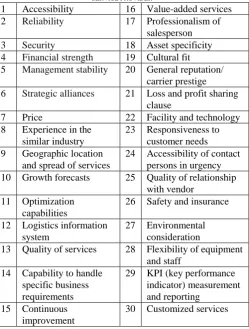
STEP 2: The team of experts from industry (Decision Makers) and academics should determine all possible evaluation criteria specific to the industry prior to provider selection which may vary dramatically from company to company.
TABLE 2: LIST OF THE CRITERIA SHORTLISTED FOR THE SELECTION OF THE SERVICE PROVIDER
1 Accessibility 16 Value-added services
2 Reliability 17 Professionalism of
salesperson
3 Security 18 Asset specificity
4 Financial strength 19 Cultural fit 5 Management stability 20 General reputation/
carrier prestige 6 Strategic alliances 21 Loss and profit sharing
clause
7 Price 22 Facility and technology
8 Experience in the similar industry
23 Responsiveness to customer needs 9 Geographic location
and spread of services
24 Accessibility of contact persons in urgency 10 Growth forecasts 25 Quality of relationship
with vendor 11 Optimization
capabilities
26 Safety and insurance 12 Logistics information
system
27 Environmental consideration
13 Quality of services 28 Flexibility of equipment and staff
14 Capability to handle specific business requirements
29 KPI (key performance indicator) measurement and reporting
15 Continuous improvement
30 Customized services
The evaluation criteria used for the provider selection problems have been widely discussed by many researches (Jharkharia & Shankar, 2007; Lynch, 2002; Razzaque & Sheng, 1998; Van Hoek, 2000). After carefully examining the relevant criteria, we select the criteria for the subsequent evaluation process as shown in Table II.
STEP 3: Each DM is asked through a questionnaire to specify the importance of the each evaluation criteria. As human judgments are often vague and cannot estimate his preference with an exact numerical number, each analyst must select the appropriate linguistic terms. Its goal is to integrate
the opinions of all the DMs to eliminate the unimportant criteria. The seven linguistic terms which can be employed in the questionnaire are as follows: very low, low, medium low, medium, medium high, high, and very high as shown in fig:2.
VL LOW (L) ML MEDIUM (M) MH HIGH(H) VH
0.0 0.1 0.3 0.5 0.7 0.9 1.0
Fig:2 Linguistic scale for relative importance
The outcome of the questionnaire is the decision matrix as follows:
1
~
X
2~
X
……
X
n~
D
1D
2… D
nC
1 11~
L
L
~
12…..
L
~
1nC
2 21~
L
L
~
22…..
L
~
2n: : : :
C
m 1~
m
L
L
~
m2….
L
~
mn……(1)
where Ci : the i th
evaluation criterion, i = 1,2,. . . ,m. Dj: the jth analyst, j = 1,2,. . . ,n.
X
~
j : weight of the jth analyst,L
~
ij: the linguistic evaluation of criterion i by the analyst j. Each elementL
~
ij in the decision matrix is represented as a triangular fuzzy number (l
aij,l
bij,l
cij).STEP 4: By using the appropriate fuzzy operators, weighted average of each criteria is calculated as follows
n
L
X
W
n
j
ij j i
1~
...
(2 )
where
W
~
i = weighted average of the ith criteria and i = 1,2,. . . ,m. This value is defuzzified using average method by the equation given as:3
ci bi ai i
W
W
W
W
…..(3)
STEP 5: Eliminate unimportant criteria.
[image:2.595.332.567.189.308.2] [image:2.595.46.296.304.634.2]analysts, we define a minimum acceptable weight
R
~
for all of the criteria which is calculated as:n R X R n j j j
1 ~ where Rj: the minimum acceptable weight for the criteria to be included for evaluation of the service provider defined by jth analyst. This value is defuzzified using average method by the equation given as:
3
c b a
R
R
R
R
…..(4)A defuzzified value of „Wi‟ is compared with the value of „R‟. The criterion Ci with „Wi‟ less than the value of „R‟ will be eliminated. The remaining criterion will be used in the final selection phase. This way Delphi assists the analysts to identify the important evaluation criteria and to obtain the weights of the criteria for the provider selection.
C. Brainstorming session (for short listing the service providers):
In the initial screening phase, most companies usually consider six to eight potential providers (Vaidyanathan, 2003). To save time and to make it cost efficient, we proposed a brainstorming session of the DM‟s in efficiently eliminating the unsuitable providers.
Step 6: Select the most probable service providers: At first, the analysts should identify all possible providers for logistic outsourcing from the internet, industrial directories, conferences, journals, self experience, personal rapport, by calling request for proposal or from any other source.
Step 7: Reject the unqualified providers: Once the list of all the probable service provider is prepared, the service providers which are evaluated average or below in the linguistic scale by any of the DM on any of the following six criteria (experience in the same field, cultural fit, quality of service, financial stability, reputation and price) are rejected.
D. Fuzzy TOPSIS (for final selection of the service providers):
Based on the results of Steps 5 and 7, we obtain the important evaluation criteria and the qualified provider candidates to form the MCDM problem. Now the ranking of the shortlisted service providers is to be done. In this paper we propose to adopt the fuzzy TOPSIS approach to address the choice of the most suitable service provider. The TOPSIS is a linear weighing technique which was first proposed in crisp version by Chen and Hwang (1992), with reference to Hwang and Yoon (1981). One of the main contributions of this paper is to present a general purpose framework for the selection of the most suitable partner for logistic outsourcing provider using fuzzy TOPSIS. The concept of this approach is to develop an aggregated weight matrix of each provider in different ranks.
Step 8: A structured “request for information” has been prepared based on the selection criteria illustrated in table no 2.and sent to all the shortlisted service providers.
Step 9: The panel of experts is introduced the fundamental of approximate reasoning, fuzzy logic and TOPSIS methodology to be adopted. All the criteria are monotonic except price which has also been converted in benefit criteria
(by low or lowest price quoted be taken as “high” or “very high”). DMs are asked to evaluate the average performance of each criterion for all the service providers on linguistic scale as shown in fig:2. The matrix we get will be as follows:
1
~
X
2~
X
……
X
n~
D
1D
2… D
nC
1 11~
O
O
~
12…..
O
~
1nC
~
1S
k= C
2 21~
O
O
~
22…..
O
~
2n=
C
~
2: : : : : .(5)
C
m 1~
m
O
O
~
m2….
O
~
mnC
~
mWhere Sk is the kth service provider, k = 1 to p where p is the total number of service providers shortlisted for evaluation.
O
~
ij is the linguistic evaluation of jth DM for ith criteria for kth service provider, Ci is the weighted average for ith (i= 1 to m) criteria of all Dj (j= 1 to n) DMs whose respective weightage is Xj,n
O
X
C
n j ij j i
1...
(6 )
Step 10: Normalization of the fuzzy decision matrix for shipper problem: The different criteria used to select potential 3PL service providers are measured in different units hence they are required to be normalized. If
R
denotes the normalized fuzzy decision matrix, then
r
ikR
~
where
i= 1,2,…..m and k=1,2,….p (p= total number of service providers)Where p k k ik k ik k ik ik
c
c
c
b
c
a
r
,... 2 , 1,
,
~
for all i=1,2,…..m. …(7)k i
k
c
c
max
, wherec
k is the maximum value for ith criteria out of all the service providers.Step 11: Considering the different weight of each criterion, the weighted normalized decision matrix can be computed by multiplying the importance weights of evaluation criteria and the values in the normalized fuzzy decision matrix as follows.
v
ikv
~
~
and
v
~
ik
~
r
ik
w
~
i wherew
~
i are the importance weight of criterion Ci obtained through equation.r
ik~
denotes the normalized fuzzy decision matrix andv
~
ikis the weighted normalized decision matrix.E. Final ranking of the service providers:
Step 12: Determination of the FPIRP and FNIRP: Because the positive triangular fuzzy numbers are included in the interval [0, 1], the fuzzy positive ideal reference point (FPIRP, A+) and fuzzy negative ideal reference point
as:
A
v
~
1,
~
v
1...
v
~
m
and(
~
1,
~
2....
~
)
m
v
v
v
A
where
~
v
i
(
1
,
1
,
1
)
andv
~
i= (0, 0, 0) i=1,2,….mStep 13: Calculation for the distances of each 3PL service providers from FPIRP and FNIRP
The distance of each 3PL service provider from fuzzy positive ideal reference point (FPIRP) and fuzzy negative ideal reference point (FNIRP) can be derived respectively as:
mi
i ik k
d
v
v
d
1
~
,
~
i=1,2,….m and k=1,2…p ….(8)
mi
i ik k
d
v
v
d
1
~
,
~
i=1,2,….m and k=1,2…p ….(9)where
d v v
(
a
,
b
)
, denotes the distance measurement between two fuzzy numbers,d
k represents the distance of alternative Sk from FPIRP, and k
d
is the distance of alternative Sk from FNIRP.STEP 14: Process to obtain the closeness coefficient and rank the order of alternatives: Once the closeness coefficient
CC
is determined, the ranking order of all alternatives can be obtained, allowing the decision-makers to select the most feasible alternative. The closeness coefficient of each alternative is calculated using equation as shownbelow:
k k
k k
d
d
d
CC
…..(10) where k=1,2,….pAn alternative with index
CC
k approaching 1 indicates that the alternative is close to the fuzzy positive ideal reference point and far from the fuzzy negative ideal reference point. A large value of closeness index indicates a good performance of the alternative.III. APPLICATION OF THE PROPOSED METHODOLOGY IN THE
CASE COMPANY:
In order to demonstrate the applicability of the proposed fuzzy decision analysis approach, it was tested on a tractor making company situated in the northern part of India and having near four decades of successful operations. Its main strength lies in the fact that the tractors manufactured by this company are based on indigenous technology. To maintain secrecy, we will address this company as ABC.
The company‟s goal is to select the best provider which can satisfy the company‟s various needs (ex. low price, good customer service, high logistics experience, etc.). To facilitate the provider selection process, an Excel- based fuzzy decision system was developed and analyzing the obtained information. In the following section, we describe the detailed provider selection process for the case company.
STEP:1 As the DMs have different experience, designation and qualification, there opinion enjoys different weights in the decision making. Three analysts who hold the right to make the final decision (one from logistics, technical and corporate departments and further to be referred as DM1,
DM2 and DM3 respectively) from the related industry are chosen to form the decision team. Refer table 1, the weights assigned to DM1(X1) = (0.08,0.24,0.48), DM2 (X2) = (0.08,0.24,0.48) and to DM3 (X3) = (0.36,0.48, 1.0).
STEP: 2 The decision team agreed to adopt the 30 criteria for selection of the logistic provider (as shown in Table 2) as the initial evaluation criteria used for the fuzzy Delphi process.
STEP 3 & 4: Each DM is asked through a questionnaire to specify the importance of the each evaluation criteria (table no. 3 shows the values for first two criteria).
STEP 5: Eliminate unimportant criteria.
It was decided to select all the criteria whose weight are more than 0.32 and eliminate the rest. The selected criteria are shown in table no 4.
Step 6 & 7: The analysts identified all possible providers for logistic outsourcing from the internet, industrial directories, conferences, journals, self experience and by personal rapport. Finally six SPs are shortlisted (further to be named as SP1 to SP6) for further evaluation.
Step 8: A structured “request for information” has been prepared based on the selection criteria illustrated in table no 4 and sent to all the shortlisted service providers.
Step 9: All the three DMs are asked to evaluate the average performance of each thirteen criterion for all the service providers using linguistic scale shown in fig:2. The results for SP1 are shown in table 5.
Step 10: Normalization of the fuzzy decision matrix for shipper problem: The above matrix is normalized by dividing each fuzzy number in criteria row of all the SPs by the maximum element of that row. The normalized fuzzy decision matrix for two criteria is shown in table 6
Step 11: As each criterion has different weight. The weighted normalized decision matrix is computed by multiplying the importance weights of evaluation criteria and the values in the normalized fuzzy decision matrix. The weighted normalized fuzzy decision matrix for first two criteria is shown in table 7.
Step 12: Determination of the FPIRP and FNIRP
Step 13: Calculation for the distances of each 3PL service providers from FPIRP and FNIRP: The distance of each SP from fuzzy positive ideal reference point (1,1,1) and fuzzy negative ideal reference point (0,0,0) is calculated as per equations (8) and (9). The values of
d
k andd
k is calculated for each SPs.TABLE 3: WEIGHTED AGGREGATE OF EACH CRITERIA
Sr. No .
Criteria DM1 DM2 DM3
DM1 DM2 DM3 Weighted Aggregate
of each criteria
n L X W
n
j
ij j
i
1
~
Defuzzified value = (a+b+c)/3
Selected or rejected Weightage of the decision makers
0.08.0.24.0.48 0.08.0.24.0.48 0.36,0.64,1.0
1 Accessibility ML L ML 0.1,0.3,0.5 0.0,0.1,0.3 0.1,0.3,0.5 0.0147,0.0960,0.294 0.1351 R 2 Reliability MH H H 0.5,0.7,0.9 0.7,0.9,1.0 0.7,0.9,1.0 0.116,0.3200,0.6373 0.3578 S
TABLE 4: THE SELECTED CRITERIA FOR FURTHER EVALUATION
Criteria Fuzzy weight of each criteria Criteria Fuzzy weight of each criteria
FS 0.0973,0.2933,0.6200 KPI 0.1160,0.3200,0.6373
R 0.1160,0.3200,0.6373 CF 0.1507,0.3653,0.6533
MS 0.1267,0.3440,0.6533 FLX 0.1267,0.3440,0.6533
P 0.1507,0.3653,0.6533 EC 0.1160,0.3200,0.6373
GL 0.0920,0.2773,0.6040 QOS 0.1507,0.3653,0.6533
VAS 0.1160,0.3200,0.6373 EXP 0.1453,0.3573,0.6533
GR 0.1320,0.3520,0.6533
TABLE 5:RESULT OF EVALUATION OF SP1ON EACH CRITERIA BY ALL DMS
Criteria Ci
Weighatage given by the DMs (
ij
O~ )
DM1 DM2 DM3
n O X
C
n
j
ij j i
1
Weightage of the decision makers Xj
DM1 DM2 DM3 0.08.0.24.0.48 0.08,0.24,0.48 0.36,0.64,1.0
FS H MH MH 0.7,0.9,1 0.5,0.7,0.9 0.5,0.7,0.9 0.0920,0.2773,0.6040
R H MH M 0.7,0.9,1 0.5,0.7,0.9 0.3,0.5,0.7 0.0680,0.2347,0.5373
MS MH MH M 0.5,0.7,0.9 0.5,0.7,0.9 0.3,0.5,0.7 0.0627,0.2187,0.5213
P MH MH M 0.5,0.7,0.9 0.5,0.7,0.9 0.3,0.5,0.7 0.0627,0.2187,0.5213
GL MH M M 0.5,0.7,0.9 0.3,0.5,0.7 0.3,0.5,0.7 0.0573,0.2027,0.4893
VAS MH M M 0.5,0.7,0.9 0.3,0.5,0.7 0.3,0.5,0.7 0.0573,0.2027,0.4893
GR M M M 0.3,0.5,0.7 0.3,0.5,0.7 0.3,0.5,0.7 0.0520,0.1867,0.4573
KPI M M M 0.3,0.5,0.7 0.3,0.5,0.7 0.3,0.5,0.7 0.0520,0.1867,0.4573
CF H MH MH 0.7,0.9,1 0.5,0.7,0.9 0.5,0.7,0.9 0.0920,0.2773,0.6040
FLX MH M M 0.5,0.7,0.9 0.3,0.5,0.7 0.3,0.5,0.7 0.0573,0.2027,0.4893
EC H MH MH 0.7,0.9,1 0.5,0.7,0.9 0.5,0.7,0.9 0.0920,0.2773,0.6040
QOS MH MH MH 0.5,0.7,0.9 0.5,0.7,0.9 0.5,0.7,0.9 0.0867,0.2613,0.5880
EXP M M M 0.3,0.5,0.7 0.3,0.5,0.7 0.3,0.5,0.7 0.0520,0.1867,0.4573
TABLE 6: NORMALIZED FUZZY DECISION MATRIX
SP1 SP2 SP3 SP4 SP5 SP6
FS 0.141,0.424,0.924 0.194,0.527,1.000 0.149,0.449,0.949 0.202,0.539,1.000 0.080,0.286,0.700 0.239,0.571,1.000 R 0.104,0.359,0.822 0.186,0.514,1.000 0.186,0.514,1.000 0.141,0.424,0.924 0.186,0.514,1.000 0.186,0.514,1.000
TABLE 7: THE WEIGHTED NORMALIZED DECISION MATRIX
SP1 SP2 SP3 SP4 SP5 SP6
FS 0.0137,0.1245,0.5732 0.0189,0.1544,0.6200 0.0145,0.1317,0.5884 0.0197,0.1580,0.6200 0.0077,0.0838,0.4340 0.0232,0.1676,0.6200
R 0.0121,0.1149,0.5242 0.0215,0.1646,0.6373 0.0215,0.1646,0.6373 0.0163,0.1358,0.5892 0.0215,0.1646,0.6373 0.0215,0.1646,0.6373
TABLE 8:THE CLOSENESS COEFFICIENT (CC) FOR THE SPS
d+ d- (d-) /( d- +d+) RANK
SP 1 10.5974 3.9664 0.2723 6
SP 2 10.0721 4.8394 0.3245 1
SP 3 10.1228 4.7592 0.3197 3
SP 4 10.0773 4.8198 0.3235 2
SP 5 10.2464 4.5375 0.3069 5
IV. CONCLUSIONS:
In this paper, a framework for ranking and selecting the most suitable service provider (SP) has been presented. The proposed methodology is easy to implement and quite reliable for ranking the alternatives. Applicability of the proposed approach has been shown in an automobile company for the selection of the third party logistic provider. We have seen that even though the price quoted by SP3 was lesser than the price quoted by SP2, the SP2 has been ranked top above SP4 and SP3. It is because SP2 has a favorable cultural fit with the outsourcing organisation. This approach can easily be used for other applications as well e.g. selecting the contractors for construction work, selection of the vendors to supply the components, selecting the partner for any services which are to be outsourced by an organization.
REFERENCES:
[1] Chen and G.H. Tzeng, “Combing grey relation and TOPSIS concepts for selecting an expatriate host country‟, Mathematical and Computer Modeling, vol.40, no.13, pp.1473–1490, 2004.
[2] Chen, S.J. and Hwang, C.L.(1992), Fuzzy Multiple Attribute Decision Making: Methods and Applications, Springer–Verlag, Berlin. [3] Hertz, S., Alfredsson, M., 2003. Strategic development of third party
logistics providers. Industrial Marketing Management 32, 139–149. [4] Jharkharia, S. and Shankar, R.(2007), “Selection of logistics service
provider: an analytic network process (ANP) approach”, Omega, Vol.35 No.3, pp.274–89.
[5] Liu, J., Ding, F.-Y., & Lall, V. (2000). Using data envelopment analysis to compare suppliers for supplier selection and performance improvement. Supply Chain Management: An International Journal, 5(3), 143–150.
[6] Lynch, C F, 2002, “3PLs: the state of outsourcing”, Logistics Management, Vol 41, No 6, T47-T50.
[7] Razzaque, M.A. and Sheng, C.C., 1998, “Outsourcing of logistics functions: a literature survey”, International Journal of Physical Distribution & Logistics Management, 26, 2, 89-107.
[8] Remko I. van Hoek, “The contribution of performance measurement to the expansion of third party logistics alliances in the supply chain”, International Journal of Operations & Production Management, Vol. 21 No. 1/2, 2001, pp. 15-29.
[9] Skjoett-Larsen, T. (2000), “Third party logistics - from an interorganisational point of view”, International Journal of Physical Distribution & Logistics Management, Vol.30 No.2, pp.112–27. [10] van Laarhoven, P., Berglund, M. and Peters, M.(2000), “Third-party
logistics in Europe - five years later”, International Journal of Physical Distribution & Logistics Management,Vol.30 No.5, pp.425–42. [11] Viswanadham N. and Roshan Gaonkar, “Leveraging Logistics To
Enhance Indian Economic Competitiveness”, CII Logistics 2003 Theme Paper
[12] Wilding, R.and Juriado, R.(2004), “Customer perceptions on logistics outsourcing in the European consumer goods industry”, International Journal of Physical Distribution & Logistics Management, Vol.34 No.8, pp.628–44.