Evaluating the Compatibility of a Tool to
Support E-Businesses’ Security Negotiations
Jason R.C. Nurse
1and Jane E. Sinclair
2 ∗Abstract—As e-businesses partner to engage in
on-line business scenarios, they face numerous challenges when considering the sharing, comparison, and ne-gotiation on their individual security needs. To aid companies in this task, in previous work we have pre-sented a security negotiations support tool, which acts as a bridge between businesses and streamlines var-ious negotiation tasks. The paper continues the re-search of that tool by evaluating its compatibility with existing security needs determination methods. Com-patibility forms a key requirement as it demonstrates feasibility and gives valuable initial feedback on the ultimate usefulness of the tool.
Keywords: security actions and requirements, risks, e-business negotiations, IT risk management systems
1
Introduction
In today’s business world, the importance of informa-tion security cannot be overlooked. Apart from self-preservation and protecting company assets, companies are expected to subscribe to various security best prac-tices (e.g. ISO 27000), and they must now implement se-curity to comply with a range of legal/regulatory require-ments (e.g. UK Data Protection Act). When consider-ing security approaches particularly across collaboratconsider-ing e-businesses, the security situation becomes exceedingly complex as partnering entities have a variety of different security needs, maintain differing security postures, may have dissimilar laws/regulations which apply, have dif-ferent skill sets/experience levels, and so on. Work in [1] supports these difficulties as the author labels the related process, “security mayhem”. To assist companies in this collaboration process, especially in terms of security ap-proaches in Web services-based interactions, in previous work we have presented BOF4WSS, a Business-Oriented Framework for enhancing Web Services Security for e-business [2]. The framework’s novelty stemmed from its focus on a cross-enterprise development methodology to help collaborating e-businesses in jointly creating secure and trusted interactions.
Having created BOF4WSS, our emphasis has shifted to providing systems and software to support it, and
as-∗Manuscript received December 17, 2009.
1,2University of Warwick, Coventry, CV4 7AL, UK. {jnurse1, jane.sinclair2}@dcs.warwick.ac.uk
sist its seamless application to business scenarios. In this paper we present the first steps of an evaluation of one of these systems, which was developed to sup-port and ease security negotiation across collaborating e-businesses. In terms of BOF4WSS, this refers specifically to easing the transition from the Requirements Elicita-tion stage to the NegotiaElicita-tions stage. Problems identified and targeted include: (i) understanding other companies’ security documentation—a variety of formats and termi-nologies are used by companies to express their security needs; (ii) understanding the motivation behind other companies’ security needs/decisions—incomplete infor-mation provided initially, usually demands that consid-erable time is spent later on determining core reasons for security needs; and (iii) being able to easily match and compare security decisions from businesses which target the same situation—to identify comparable security de-cisions involves looking through partners’ security docu-ments, and numerous tedious back-and-forth communi-cations. These problems, and the tool (as well as its un-derlying Solution model) developed to tackle them, are presented in detail in [3]. Evidence to affirm these prob-lems has been provided by relevant industry-based secu-rity professionals, and related research in [4].
As mentioned above, and mainly due to space limita-tions, this paper focuses on the first steps in the evalua-tion of the tool. Specifically, we assess the compatibility of the tool with existing Risk Management/Assessment (RM/RA) approaches; RM/RA approaches are relevant as companies typically use them to make decisions on security risks and determine their security needs. Com-patibility forms a critical requirement because the infor-mation (on threats, vulnerabilities, risks, security needs, risk treatment options, motivational factors such as laws, security policies and so on) output by these RM/RA ap-proaches in BOF4WSS’ Requirements Elicitation stage, will need to be incorporated into the tool to enable it to fulfill its purpose. If the tool can capture a majority of the security-related information output from popular RM/RA techniques, its compatibility and feasibility as a tool that can work alongside current approaches used in businesses today, will be evidenced.
the evaluation method followed. Sections 4 and 5 present compatibility tests against two well-known RM/RA ap-proaches. A reflection on the evaluation findings is cov-ered in Section 6. Conclusions are presented in Section 7.
2
Solution Model and Tool
The Solution model is the conceptual base for the soft-ware tool developed in our work. It consisted of four component stages: Security Actions Analysis, Ontology Design, Language Definition, and Risk Catalogue Cre-ation. The Security Actions Analysis stage focused on reviewing the literature in the security risk manage-ment field, and critically examining how security actions and requirements were determined. Asecurity action is broadly defined as the way in which a company handles the risk it faces (e.g. ‘maintaining availability of data centers is to be outsourced’), and asecurity requirement
is a high-to-medium level desire, expressed to mitigate a risk (e.g. ‘all connections to the database must be au-thenticated’). The key outcome of this stage was a thor-ough understanding of the relevant security domain which could then be used as a foundation for future stages.
The Ontology Design stage following, aimed to pro-duce a high-level ontology design, using the findings from the previous stage, to establish a common understanding and semantics structure of the security actions (and gen-erally security risk management) domain. This common or shared understanding was a critical prerequisite when considering the difficulties businesses faced (because of different terminologies used, RM/RA methods applied, and so on) as they tried to understand their partners’ security documentation supplied in BOF4WSS’ Negoti-ations phase. The Security Actions Analysis and On-tology Design stages (inclusive of a draft onOn-tology) were discussed in [5].
Next was the Language Definitionstage and this had two parts. First was the development of a XML-based language called Security Action Definition Markup Lan-guage (SADML). This allowed for the establishment of a common format (based on the ontology) by which secu-rity actions/requirements information provided by com-panies could be formally expressed, and also later pro-cessed by the resulting tool. Second was the proposal of a user-friendly interface such as a data entry screen or template document by which businesses’ security-related data could be entered, and subsequently marked up in SADML. This interface would act as a guide for compa-nies in prompting them to supply complete information as they prepare to come together for negotiations.
The last stage wasRisk Catalogue Creation, and that addressed the problem of matching and comparing se-curity actions/requirements across enterprises by defin-ing a shared risks catalogue. Given that businesses used risks from this shared catalogue as input to their RM/RA
methods, regardless of the security actions that they de-cided individually, the underlying risks could be used by the tool to automatically match their actions. To increase flexibility, the catalogue would feature an extensive and updatable set of security risks.
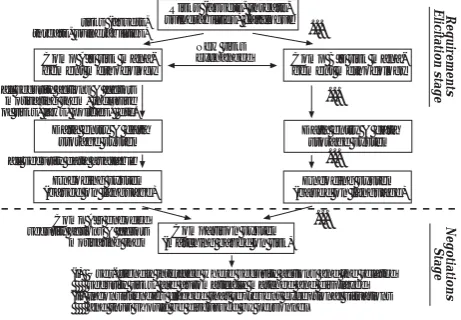
Having reviewed the Solution model, Figure 1 shows a process flow of how the implemented model i.e. the tool, works. In this diagram, Comp A and Comp B are com-panies using BOF4WSS for an online business scenario.
risks (assets, threats, vulnerabilities)
all security actions & factors motivating them, inclusive of risks, laws, policies, etc.
Comp A’s encoded security actions & factors motivating them
(i) User-friendly interface where security actions and the related security risks, are automatically matched and displayed (ii) Inconsistencies flagged that represent exceptional situations and thus should be discussed by personnel
Comp A’s risk mana-gement methodology
...
Encoding system (based on language)
Encoding system (based on language)
...
Risks (assets, threats, vulnerabilities) catalogue
New risks
exchanged Comp B’s risk
mana-gement methodology
Comparison system (matching based on risk)
...
Requirements
Elicitation stage
Negotiations
S
tage
Data entry & data storage system
Data entry & data storage system
[image:2.595.311.542.201.361.2]all security data available ...
Figure 1: Process flow of implemented Solution model
First, companies would select a set of risks from the cat-alogue that apply to the business scenario, and use these as input to their different risk management methodolo-gies/processes. Any new risks to be considered which are not available in the catalogue, can be exchanged for this scenario. After companies have used their RM/RA approaches to determine their individual security actions (inclusive of motivational factors), these are then input into the Data entry and storage system. This system uses a user-friendly interface to read in the data (as sug-gested in the Language Definition stage), and stores it to a back-end database to allow for data retrieval, updating and so on. This interface, and generally the tool, mirror the understanding of concepts defined in the ontology.
3
Evaluation Method
In evaluating the compatibility of the tool, the core ques-tion was whether informaques-tion output from typical com-pany RM/RA methodologies could be accommodated by, or mapped to the tool’s Data entry and storage system. To guide this compatibility evaluation, the method for mapping security guidelines and standards to an existing ontology (both high-level and formal) proposed in [6], was employed. This method supplied a tested technique in which a detailed assessment could be carried out to deter-mine how well the tool mapped, and thus was compatible with existing RM/RA approaches. The Solution model’s ontology was extremely useful here as it embodied all the concepts implemented in the tool. To provide the basis of the compatibility evaluation, two RM/RA methodologies were chosen, namely CORAS [7] and EBIOS [8]. These were selected because (i) they are well-known and used, (ii) there was extensive documentation openly available on each, and (iii) they had supporting softwares which generated machine-readable output (both provide XML-based documents). It is this machine-readable output that is expected to be mapped to, and ideally automat-ically read into the tool. The next section begins tool evaluation by testing compatibility with EBIOS.
4
Testing Compatibility with EBIOS
EBIOS is a risk management approach created under the French General Secretariat of National Defence. It pro-poses a methodology and supporting software, for assess-ing and treatassess-ing risks in the field of information systems security [8]. To test tool compatibility with EBIOS, our research involved traversing all the steps advocated in [6]. Due to space limitations however, this paper concentrates on the presentation of the high-level mapping completed, and the provision of an example of how security infor-mation and knowledge from EBIOS, was mapped to the tool’s data entry fields and ultimately, its database.
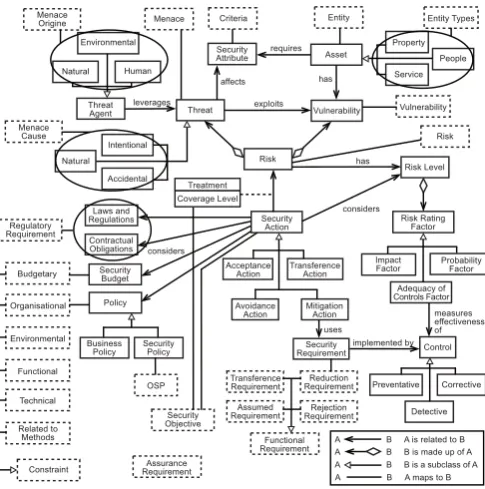
The high-level mapping of EBIOS concepts to the So-lution model’s ontology is displayed in Figure 2; ontol-ogy concepts are in boxes with unbroken lines, whereas EBIOS concepts have dashed lines. From this mapping one can easily visualize high-level similarities across mod-els and also begin to identify concepts that do not map. Ontology concepts were largely discussed in [5] with the main differences here being the use of the term security action as opposed torisk action, and the introduction of
security attribute (a property of an asset that is to be preserved e.g. confidentiality, integrity, availability and accountability),security requirement (defined prior), and
treatment (the known degree to which a security action covers a risk) concepts.
Some of the more interesting concepts covered by EBIOS include amenace, which defines a threat to an entity (or asset); aconstraint described as a limitation faced by the
Asset
has
Risk Threat Threat
Agent exploits Vulnerability
has leverages
Risk Level
Security Action Contractual
Obligations
Security Budget
Policy considers
considers
implemented by Mitigation
Action Transference
Action
Preventative
Detective Corrective Risk Rating
Factor
Impact
Factor ProbabilityFactor
Adequacy of Controls Factor
Business Policy SecurityPolicy
Avoidance Action Acceptance
Action
Control Security
Requirement uses Laws and
Regulations
measures effectiveness of
People
Service Property
Intentional
Natural
Accidental
Security Attribute
affects requires
Treatment Coverage Level Natural Human
Environmental
Menace Criteria Entity Entity Types
Vulnerability
Risk Menace
Origine
Menace Cause
Regulatory Requirement
OSP
Security Objective
Functional Requirement Assumed Requirement
Reduction Requirement Transference
Requirement
Rejection Requirement
Constraint Functional
Technical Budgetary
Organisational
Environmental
Related to
Methods A is related to B
B is a subclass of A B is made up of A
A B
A B
A B
Assurance Requirement
A maps to B
[image:3.595.307.550.70.315.2]A B
Figure 2: Mapping EBIOS concepts to the ontology
organization; asecurity objective which is the expression of the intention to counter risks or threats and/or com-ply with the organizational security policies and other as-sumptions; a security functional requirement, a security function to be implemented to contribute to the fulfill-ment of a security objective; and an assurance require-ment, defined as the specification of assurance provided by security functions implemented to cover security ob-jectives [8].
To evaluate the tool compatibility at a lower level, we now consider mapping actual output generated from a RA study conducted using EBIOS software, to the tool’s database Entity Relationship Diagram (ERD). The XML snippet below describes thesecurity objectivearising from the study, which was defined to treat a security risk.
<SecurityObjective ID="SecurityObjective.1248768933881" label= "Eavesdropping protection objective" state="" baseID="" type="EBIOS.Text.SO.Type.TOE" content="The organization must take measures to ensure there is no eavesdropping on data, persons, meetings, etc..." resistance="3"
resistance_justification="" coverLevel= "SecurityRequirementCover.1076860509716" ...> <SecurityObjectiveCovers>
<SecurityObjectiveCover ID="SecurityObjectiveCover. 1245667560533" reference="RiskScenario.1248601769338" type="Risk" />
</SecurityObjectiveCovers> </SecurityObjective>
The SecurityObjectiveCovers sub-element lists aspects (risks, constraints, regulatory requirements, and so on) addressed by the current security objective. The type
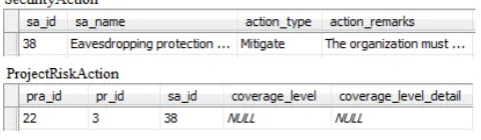
attribute of individual SecurityObjectiveCover elements marked the type of aspect addressed, here it is a Risk. In this example, a mapping was made between the risk addressed (identified by unique id ‘RiskSce-nario.1248601769338’) and a database record in the Pro-jectRiskAction table (this table holds risks which a secu-rity action addresses). Lastly, and more at a general level, because theSecurityObjective element does not define a type (i.e. whether it is geared towards risk mitigation, assumption, and so on) some manual intervention was required to complete the mapping to the SecurityAction
table and thus provide data for the record’s action type
[image:4.595.49.290.304.374.2]field. A screenshot of the actual records in their respec-tive tables within the tool database is shown in Figure 3, before general reflections on mappings done thus far.
Figure 3: Mapped SecurityObjective data
The principal aim of conducting the mapping process was to evaluate the compatibility of the tool and embodied ontology, with existing RM/RA approaches. Having com-pleted the mapping of EBIOS, it can be seen that vari-ous of the main concepts and elements could be mapped, both at ontology and ERD levels. This has demonstrated promising evidence to support the case for tool compati-bility. Of equal interest however are the concepts and ele-ment attributes that proved challenging to map, as these might indicate noteworthy shortcomings of the tool. Be-low, the primary difficulties incurred are discussed.
No consideration of assurance of security func-tions: Beyond defining security objectives, and security functional requirements that implement them, EBIOS uses security assurance requirements to provide assurance that functional requirements adequately achieve the ob-jectives they are to implement. Reflecting on the tool and ontology, while both include concepts mappable to security objective and security requirement, neither ac-commodated the security assurance concept. For EBIOS mapping, this fact acted to highlight a weakness in the tool and ontology (specifically in their ability to capture all security aspects), and hence affected compatibility.
Low-level differences between EBIOS’ Security objective and the tool’s Security action: At a high level, SecurityObjective and SecurityAction are semanti-cally similar, and thus allowed for a seamless mapping of concepts. When assessed in detail however, as seen
in the lower-level mapping attempted, a few differences emerged (related to attributes and elements) which com-plicate the process. One such difference deals with the inability to identify an appropriate action type (mitiga-tion, transference, and so on) for the corresponding Secu-rityAction database record without manual intervention. The next difference is centered around the fact that in EBIOS, a security objective can be conceived to address a range of aspects including risks, constraints, regulatory requirements, and security rules/policies. This is a novel fact because it exemplifies a direct relationship between a security objective and aspects that are not risks. This relationship was not represented in the tool or ontology. To take an example, in the tool and ontology, a Security action or risk action is conceived with the prime aim of treating a risk. Aspects such as those mentioned above i.e. constraints, regulatory requirements, and security rules/policies, are mainly viewed as constructs that in-fluence the treatment of the risk. This is as opposed to constructs which independently give rise to security ac-tions or general security needs.
With the compatibility tests with EBIOS complete, the next section considers tool compatibility with CORAS.
5
Testing Compatibility with CORAS
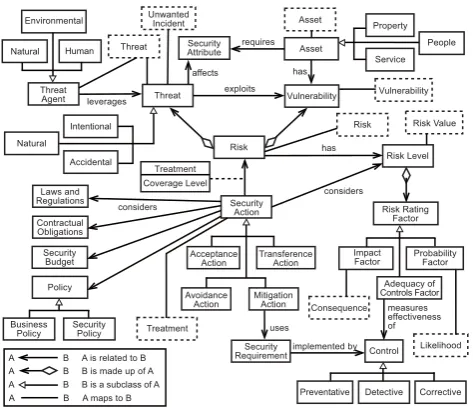
CORAS [7] is the product of an EU research project tar-geted towards creating a tool-supported methodology for model-based risk analysis of security-critical systems. To report on the evaluation in terms of CORAS, the same process (i.e. high-level mapping, and information map-ping example) used for EBIOS above is reused here. Fig-ure 4 therefore presents the high-level mapping accom-plished. As seen from the mapping, a majority of CORAS concepts are found in the ontology. Itsunwanted incident
and threat concepts proved the most intriguing during mapping, as they covered multiple concepts in the on-tology. Formally, an unwanted incident is an event that reduces the value of assets, whereas a threat, defined as a potential cause of an unwanted incident, this encom-passed the human, or non-human cause [7]. A full de-scription of all CORAS concepts can be found in [7].
Asset
has
Risk Threat Threat
Agent Vulnerability
exploits
has leverages
Risk Level
Contractual Obligations
Security Budget
Policy
considers
considers
implemented by Mitigation
Action Transference
Action
Preventative Detective Corrective Business
Policy Security
Policy
Avoidance Action Acceptance
Action
Control Security
Requirement uses Laws and
Regulations
measures effectiveness of Intentional
Natural
Accidental
Security Attribute
affects requires
Treatment
Coverage Level Natural Human
Environmental Asset
Risk Value
Likelihood Treatment
Threat Unwanted
Incident
Consequence Vulnerability
Risk
People
Service Property
Risk Rating Factor
Impact Factor
Probability Factor
Adequacy of Controls Factor
A is related to B
B is a subclass of A B is made up of A
A B
A B
A B
A maps to B
A B
[image:5.595.52.289.70.274.2]Security Action
Figure 4: Mapping CORAS concepts to the ontology
<row>
<cell columnId="riskId">RSK-1</cell> <cell columnId="assetId">Network1</cell>
<cell columnId="incident">Unauthorized disclosure of customer personal data</cell>
<cell columnId="consequenceValue">Moderate</cell> <cell columnId="frequencyValue">Likely</cell> <cell columnId="scenario"/>
</row>
To map the risk defined in the <row> element above, the ERD’s Risk and ProjectRisk tables were employed. After creating a newRisk database record, theriskId el-ement’s data was mapped to the Risk.risk id field. For the CORAS row’s assetId, the respective asset’s unique identifier (i.e. asset id in the ERD Asset table) for ‘Network1’ was copied to Risk.asset id. A similar pro-cess was adopted for theincident element as this would correspond to a record already in the ERD Threat ta-ble. The unique identifier copied was threat id, and it was copied to the Risk.threat id field. To complete the ERD Risk record, the incident’s respective vulnerabil-ity from the CORAS software Scenario Table was used. Once the incident’s vulnerability was found (note that in each row in the CORAS Scenario Table is an inci-dent and a respectivevulnerability), the ERD’s Vulnera-bility table was searched for that vulneraVulnera-bility’s name (on the Vulnerability.vulnerability name field). When the database record was identified the vulnerability id
field was copied/mapped to the respectiveRisk record’s
Risk.vulnerability id field.
The last task was mapping CORAS consequence and fre-quency data. Assuming that metrics (i.e. allowed val-ues) for these factors were set to be the same in both CORAS and the tool (note that metrics can be added to the tool using PrioritizationScheme ERD table), the ‘moderate’ consequence in CORAS mapped to ‘moderate’ value for theimpact field in the tool’s RiskEstimate ta-ble. Whereas the ‘likely’ frequency mapped to the ‘likely’
value for theprobability field in ERD’sRiskEstimate ta-ble. For the mapping above to be conducted however, a ProjectRisk database record was required first. From the ERD, it would be noted thatProjectRisk supplies the physical link between a Risk and a RiskEstimate. Once this record was created and associated with theRisk un-der analysis, the unique pr id key value generated was copied to a newRiskEstimate record. The relevant im-pact andprobabilityvalues were then copied to that new
[image:5.595.319.535.224.337.2]RiskEstimaterecord. As before, a screenshot is presented in Figure 5 to show the resulting mappings in the tool database.
Figure 5: Mapped Consequence and Frequency table
As might be noted from the mapping above, the tool does require companies to first synchronize information on el-ements such as risk and risk ids to be used (recall that tool comparison is made largely based on common risks), and the metrics for risk valuation i.e. ensuring companies use similar valuation schemes and agree on the meanings of individual metrics. Having completed the mapping of the security information from CORAS software output to the tool’s ERD and ontology, the following paragraphs discuss the more salient observations made during the general mapping process.
Reflecting on the general CORAS mapping, there were many high- and low-level concepts that evidenced com-patibility of the tool. This was so promising that an automated mapping between the CORAS software and the tool would be almost seamless. The main problems that could prohibit this are highlighted below.
(or causes) constituted a threat to an asset. The second option involved concatenating related data in the CORAS
unwanted incident and threat scenario fields, and then mapping that data to records in the ERD’sThreat table. This option however would lead to multiple threats (a new ERD Threat record for eachunwanted incident and
threat scenariopair) for a single risk. This is not a map-ping the tool’s ERD at present could accommodate. The first option was therefore preferred in most mappings.
Determining actual risk treatments: CORAS and the tool and ontology, both acknowledge the need for risk treatment concepts. In the CORAS software, they be-gin by listing all possible treatment options in the Treat-ment Identification Table. Next, in the TreatTreat-ment Eval-uation Table, they evaluate all the treatments and use priority values to rate them. The difficulty in mapping was because the tool only accommodated actual treat-ments which were chosen to address a risk. Therefore, the treatment evaluation process documented in CORAS, was taken to be complete from the tool perspective. An-other difficulty faced was the identification of the specific treatment which would handle a risk. The CORAS soft-ware and its output, maintained no data fields or facility which clearly highlighted a chosen treatment. The treat-mentPriority element in the Treatment Evaluation Ta-ble was considered to aid in mapping, however, because there was no predefined hierarchy of metrics (e.g. high, medium, low) in the CORAS software, the possibilities of values used by companies to rate their treatments was infinite, and thus not mappable. To allow for mapping therefore, a manual process was required where treat-ments (from the Treatment Identification Table) to be mapped from CORAS to the tool were identified by a user. The use of a manual means for mapping was not ideal but was necessary as it was the only way to defini-tively identify a treatment to be mapped from CORAS.
6
Reflecting on the Evaluation
From the compatibility tests conducted above, the tool has shown itself to be an adequate system, capable of working alongside common RM/RA approaches and soft-wares in use today. In the hope of increasing com-patibility even more, we are considering three changes to the tool. These are: (i) allowing a SecurityAction
to directly address aspects other than Risks, for exam-ple, laws/regulations, technical constraints, and so on— therefore its new meaning is ‘any way in which to address a risk, or a constraint to a organization or system’; (ii) introducing a generic Constraint concept which encap-sulates all constraints (e.g. security budget, contractual obligations, and so on) that affect a risk’s treatment (i.e. the Security need), or all constraints that need to be ad-dressed directly by a Security action (see point (i)); and lastly (iii) the facility to map and store risk treatment evaluation data and treatment options. This would allow
companies to state multiple security actions, which part-ners might consider if their first choice action can not be agreed across entities.
7
Conclusions and Future Work
This paper focused on evaluating the compatibility of a tool to support security negotiations across e-businesses. As shown, results thus far have proved favourable, how-ever a few improvements to the tool are envisaged to ensure compatibility with a wider range of RM/RA ap-proaches. Future work will consist of (i) further evalu-ation of the tool against other RM/RA methodologies, (ii) conducting interviews with security professionals to gather their feedback on the value of the tool from a practical perspective, and finally (iii) assessing how well the tool works when used to support companies in a real world e-business collaboration scenario.
References
[1] J. S. Tiller,The Ethical Hack: A Framework for Business
Value Penetration Testing. Boca Raton, FL: Auerbach
Publications, 2005.
[2] J. R. Nurse and J. E. Sinclair, “BOF4WSS: A Business-Oriented Framework for Enhancing Web Services Security
for e-Business,” in4th International Conference on
Inter-net and Web Applications and Services. IEEE Computer Society, 2009, pp. 286–291.
[3] ——, “A Solution Model and Tool for Supporting the Ne-gotiation of Security Decisions in E-Business
Collabora-tions,” in 5th International Conference on Internet and
Web Applications and Services. IEEE Computer
Soci-ety. (To be published), 2010.
[4] S. S. Yau and Z. Chen, “A framework for specifying and managing security requirements in collaborative systems,” inAutonomic and Trusted Computing, ser. Lecture Notes in Computer Science, L. T. Yang, H. Jin, J. Ma, and
T. Ungerer, Eds. Heidelberg: Springer, 2006, vol. 4158,
pp. 500–510.
[5] J. R. Nurse and J. E. Sinclair, “Supporting the compar-ison of business-level security requirements within
cross-enterprise service development,” in Business Information
Systems, ser. Lecture Notes in Business Information Pro-cessing, W. Abramowicz, Ed. Heidelberg: Springer, 2009, vol. 21, pp. 61–72.
[6] S. Fenz, T. Pruckner, and A. Manutscheri, “Ontological mapping of information security best-practice guidelines,” in Business Information Systems, ser. Lecture Notes in Business Information Processing, W. Abramowicz, Ed. Heidelberg: Springer, 2009, vol. 21, pp. 49–60.
[7] F. den Braber, G. Brændeland, H. E. I. Dahl, I. Engan, I. Hogganvik, M. S. Lund, B. Solhaug, K. Stølen, and F. Vraalsen, “The CORAS model-based method for secu-rity risk analysis,” SINTEF, Tech. Rep., 2006.
[8] DCSSI, “Expression des besoins et identification des
ob-jectifs de s´ecurit´e (EBIOS) – section 1–5,” Secr´etariat
g´en´eral de la d´efense nationale, Direction Centrale de la