912
A Systematic Study of Leveraging Subword Information
for Learning Word Representations
Yi Zhu, Ivan Vuli´c,andAnna Korhonen
Language Technology Lab University of Cambridge
{yz568, iv250, alk23}@cam.ac.uk
Abstract
The use of subword-level information (e.g., characters, character n-grams, morphemes) has become ubiquitous in modern word rep-resentation learning. Its importance is attested especially for morphologically rich languages which generate a large number of rare words. Despite a steadily increasing interest in such subword-informed word representations, their systematic comparative analysis across typo-logically diverse languages and different tasks is still missing. In this work, we deliver such a study focusing on the variation of two cru-cial components required for subword-level in-tegration into word representation models: 1) segmentation of wordsinto subword units, and 2)subword composition functionsto obtain fi-nal word representations. We propose a gen-eral framework for learning subword-informed word representations that allows for easy ex-perimentation with different segmentation and composition components, also including more advanced techniques based on position em-beddings and self-attention. Using the unified framework, we run experiments over a large number of subword-informed word representa-tion configurarepresenta-tions (60 in total) on 3 tasks (gen-eral and rare word similarity, dependency pars-ing, fine-grained entity typing) for 5 languages representing 3 language types. Our main re-sults clearly indicate that there is no “one-size-fits-all” configuration, as performance is both language- and task-dependent. We also show that configurations based on unsupervised seg-mentation (e.g., BPE, Morfessor) are some-times comparable to or even outperform the ones based on supervised word segmentation.
1 Introduction
Word representations are central to a wide vari-ety of NLP tasks (Collobert et al., 2011; Chen and Manning,2014;Jia and Liang,2016;Ammar et al.,2016;Goldberg,2017;Peters et al., 2018;
Kudo,2018,inter alia). Standard word representa-tion models are based on the distriburepresenta-tional hypoth-esis (Harris,1954) and induce representations from large unlabeled corpora using word co-occurrence statistics (Mikolov et al.,2013;Pennington et al., 2014; Levy and Goldberg, 2014). However, as pointed out by recent work (Bojanowski et al., 2017;Vania and Lopez,2017;Pinter et al.,2017; Chaudhary et al.,2018;Zhao et al.,2018), mapping a finite set of word types into corresponding word representations limits the capacity of these models to learn beyond distributional information, which leads to several fundamental limitations.
The standard approaches ignore the internal structure of words, that is, the syntactic or seman-tic composition from subwords or morphemes to words, and are incapable of parameter sharing at the level of subword units. Assigning only a sin-gle vector to each word causes the data sparsity problem, especially in resource-poor settings where huge amounts of training data cannot be guaran-teed. The issue is also prominent for morphologi-cally rich languages (e.g., Finnish) with productive morphological systems that generate a large num-ber of infrequent/rare words (Gerz et al., 2018). Although potentially useful information on word relationships is hidden in their internal
subword-level structure,1subword-agnostic word
represen-tation models do not take these structure features into account and are effectively unable to represent rare words accurately, or unseen words at all.
Therefore, there has been a surge of interest in
subword-informed word representation
architec-tures aiming to address these gaps. A large number of architectures has been proposed in related re-search, and they can be clustered over the two main axes (Lazaridou et al., 2013;Luong et al., 2013;
1For example, nouns in Finnish have 15 cases and 3 plural
op op op
Segmentation
dishonestly
dis honest ly
Composition function make Skip-gram
f(•)
subword
embedding position
embedding
word
embedding context
embedding
They
Skip-gram
[image:2.595.75.288.61.220.2]δ(•)
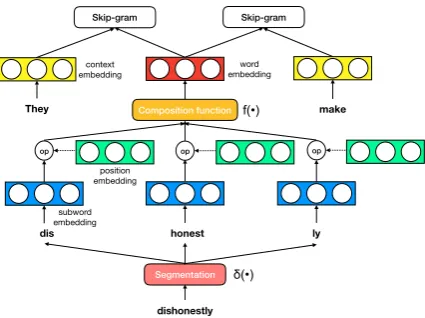
Figure 1: Illustration of the general framework for learning subword-informed word representations, with the focus on two crucial components: 1) segmentation of words and 2) subword embedding composition. By varying the two components, and optionally including or excluding position embeddings from the computa-tions, we obtain a wide spectrum of different
subword-informed configurations used in the study (see§2). Our
word-level representation model in this work is skip-gram (on the top layer of the figure), but it can be re-placed by any other distributional word-level model.
Qiu et al.,2014;Cotterell and Sch¨utze,2015; Wi-eting et al.,2016;Avraham and Goldberg,2017; Vania and Lopez, 2017;Pinter et al., 2017; Cot-terell and Sch¨utze,2018). First, the models differ in the chosen method forsegmenting words into
subwords. The methods range from fully
super-vised approaches (Cotterell and Sch¨utze, 2015) to e.g. unsupervised approaches based on BPE (Heinzerling and Strube,2018). Second, another crucial aspect is thesubword composition function
used to obtain word embeddings from the embed-dings of each word’s constituent subword units. De-spite a steadily increasing interest in such subword-informed word representations, their systematic comparative analysis across the two main axes, as well as across typologically diverse languages and different tasks is still missing.2
In this work, we conduct a systematic study of a variety of subword-informed word representation architectures that all can be described by a gen-eral framework illustrated by Figure1. The frame-work enables straightforward experimentation with prominent word segmentation methods (e.g., BPE, Morfessor, supervised segmentation systems) as well as subword composition functions (e.g., addi-tion, self-attention), resulting in a large number of
2A preliminary study ofVania and Lopez(2017) limits its
focus on the use of subwords in the language modeling task.
differentsubword-informed configurations.3 Our study aims at providing answers to the fol-lowing crucial questions:Q1)How generalizable are subword-informed models across typologically diverse languages and across different downstream tasks? Do different languages and tasks require dif-ferent configurations to reach peak performances or is there a single best-performing configuration? Q2)How important is it to choose an appropriate segmentation and composition method? How ef-fective are more generally applicable unsupervised segmentation methods? Is it always better to re-sort to a supervised method, if available?Q3)Is there a difference in performance with and without the full word representation? Can more advanced techniques based on position embeddings and self-attention yield better task performance?
We evaluate subword-informed word represen-tation configurations originating from the general framework in three different tasks using standard benchmarks and evaluation protocols: 1) general and rare word similarity and relatedness, 2) depen-dency parsing, and 3) fine-grained entity typing for 5 languages representing 3 language families (fusional, introflexive, agglutinative). We show that different tasks and languages indeed require diverse subword-informed configurations to reach peak per-formance: this calls for a more careful language-and task-dependent tuning of configuration compo-nents. We also show that more sophisticated con-figurations are particularly useful for representing rare words, and that unsupervised segmentation methods can be competitive to supervised segmen-tation in tasks such as parsing or fine-grained entity typing. We hope that this paper will provide useful points of comparison and comprehensive guidance for developing next-generation subword-informed word representation models for typologically di-verse languages.
2 Methodology
The general framework for learning subword-informed word representations, illustrated by Fig-ure1, is introduced in §2.1. We then describe its main components: segmentation of words into sub-word units (§2.2), subsub-word and position embed-dings (§2.3), and subword embedding composition
3
functions (§2.4), along with all the configurations for these components used in our evaluation.
2.1 General Framework
Formally, given a wordw, its word embeddingw can be computed by the composition of its subword embeddings as follows:
w=fΘ(δ(w),Ws,Wp), (1)
where δ(w) is a deterministic function that seg-mentswinto an ordered sequence of its constituent subword unitsSw = (swi)
n
1, withswi ∈ S being a
subword type from the subword vocabularySof size|S|. Optionally, some segmentation methods can also generate a sequence of the correspond-ing morphotactic tagsTw = (twi)
n
1. Alone or
to-gether withTw,Sw is embedded into a sequence of subword representationsSw = (swi)
n
1 from the
subword embedding matrixWs∈R|S|×d, where
dis the dimensionality of subword embeddings. Another optional step is to obtain a sequence of position embeddingsPw= (pwi)
n
1: they are taken
from the position embedding matrixWp∈Rp×d,
wherepis the maximum number of the unique po-sitions.Pw can interact with Sw to compute the final representations for subwordsRw = (rwi)
n
1
(Vaswani et al.,2017).fΘ is a composition func-tion takingRw as input and outputting a single vectorwas the word embedding ofw.
For the distributional “word-level” training, sim-ilar to prior work (Bojanowski et al., 2017), we adopt the standard skip-gram with negative sam-pling (SGNS) (Mikolov et al., 2013) with bag-of-words contexts. However, we note that other distri-butional models can also be used under the same framework. Again, following Bojanowski et al. (2017), we calculate the word embeddingwt∈Rd
for each target word wt using the formulation from Eq. (1), and parametrize context words with another word embedding matrix Wc ∈ R|V|×d,
where|V|is the size of word vocabularyV.
2.2 Segmentation of Words into Subwords
We consider three well-known segmentation meth-ods for the functionδ, briefly outlined here.
Supervised Morphological Segmentation We use CHIPMUNK (Cotterell et al.,2015) as a repre-sentative supervised segmentation system, proven to provide a good trade-off between accuracy and speed.4It is based on semi-Markov conditional
ran-4http://cistern.cis.lmu.de/chipmunk
δ δ(dishonestly)
CHIPMUNK (dis,honest,ly) (prefix,root,suffix)
Morfessor (dishonest,ly)
[image:3.595.308.525.64.128.2]BPE (dish,on,est,ly)
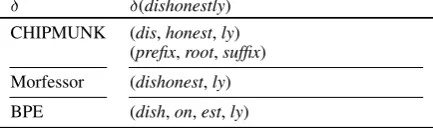
Table 1: Segmentations of the worddishonestly.
dom fields (Sarawagi and Cohen,2005). For each word, apart from generatingSw, it also outputs the corresponding morphotactic tagsTw.5In§2.3we discuss how to incorporate information fromTw into subword representations.
Morfessor Morfessor (Smit et al.,2014) denotes a family of generative probabilistic models for unsupervised morphological segmentation used, among other applications, to learn morphologically-aware word embeddings (Luong et al.,2013).
BPE Byte Pair Encoding (BPE;Gage(1994)) is a simple data compression algorithm. It has become a de facto standard for providing subword informa-tion in neural machine translainforma-tion (Sennrich et al., 2016). The input word is initially split into a se-quence of characters, with each unique character denoted as a byte. BPE then iteratively replaces the most common pair of consecutive bytes with a new byte that does not occur within the data, and the number of iterations can be set in advance to control the granularity of the byte combinations.
An example output for all three methods is shown in Table1. Note that a standard practice in subword-informed models is to also insert the en-tire word token intoSw (Bojanowski et al.,2017).6 This is, however, again an optional step and we evaluate configurations with and without the inclu-sion of the word token inSw.
2.3 Subword and Position Embeddings
The next step is to encodeSw(or the tuple (Sw,Tw) for CHIPMUNK) to construct a sequence of sub-word representationsSw. Each row of the subword embedding matrixWsis simply defined as the em-bedding of a unique subword. For CHIPMUNK, we define each row inWsas the concatenation of the subwordsand its predicted tagt. We also test
5In our experiments, we use only basic information on
af-fixes such as preaf-fixes and sufaf-fixes, and leave the integration of fine-grained information such as inflectional and derivational affixes as future work.
6We only do the insertion if|S
w|>1. For CHIPMUNK,
CHIPMUNK configurations without the use ofTw to analyze its contribution.7
After generatingSw, an optional step is to have
alearnableposition embedding sequencePw
fur-ther operate onSwto encode the order information. Similar toWs, the definition of the position em-bedding matrixWpalso varies: for Morfessor and BPE, we use the absolute positions of subwords in the sequenceSw, whereas for CHIPMUNK mor-photactic tags are encoded directly as positions.
Finally, following prior work (Gehring et al., 2017;Mikolov et al.,2018), we use addition and element-wise multiplication between each subword vectorsfromSw and the corresponding position vectorpfromPwto compute each entryrfor the final sequence of subword vectorsRw:
r=s+p or r=sp. (2)
2.4 Composition Functions
A composition functionfΘis then applied to the se-quence of subword embeddingsRwto compute the final word embeddingw. We investigate three com-position functions: 1) addition, 2) single-head and 3) multi-head self-attention (Vaswani et al.,2017; Lin et al., 2017).8 Addition is used in the origi-nalfastTextmodel ofBojanowski et al.(2017), and remains a strong baseline for many tasks. How-ever, addition treats each subword with the same importance, ignoring semantic composition and in-teractions among the word’s constituent subwords. Therefore, we propose to use a self-attention mech-anism, that is, a learnable weighted addition as the composition function on subword sequences. To the best of our knowledge, we are the first to ap-ply a self-attention mechanism to the problem of subword composition.
Composition Based on Self-Attention Our self-attention mechanism is inspired byLin et al.(2017). It is essentially a multilayer feed-forward neu-ral network without bias term, which generates a weight matrix for the variable length inputRw:
Hw =tanh(Wh1R
T
w) (3)
Aw =sof tmax(Wh2Hw) (4)
7The extra information on tags should lead to a more
ex-pressive model resolving subword ambiguities. For instance, the subwordpostinpostwarand nounpostare intrinsically different: the former is the prefix and the later is the root.
8Using more complex compositions based on CNNs and
RNNs is also possible, but we have not observed improvement in our evaluation tasks with such compositions, which is also in line with findings from recent work (Li et al.,2018).
Component Option Label Segmentation CHIPMUNK sms Morfessor morf
BPE bpe
Morphotactic tag concatenated with st subword (onlysms)
Word token exclusion
w-inclusion w+
Position embedding exclusion
p-additive pp
multiplicative mp
[image:4.595.308.525.61.223.2]Composition function addition add single head attention att multi-head attention mtx
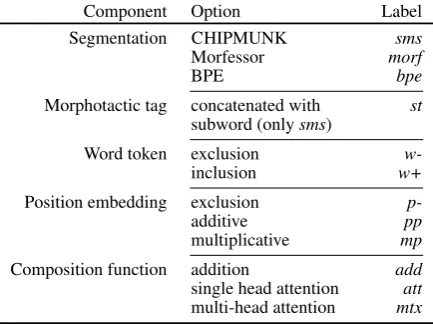
Table 2: Different components used to construct subword-informed configurations, and their labels.
Each row of Aw is a weight vector for rows of Rw, which models different aspects of seman-tic compositions and interactions. For the single-head self-attention,Aw degenerates to a row vec-tor as the final attention vecvec-toraw. For the multi-head self-attention, we average the rows of Aw to generate aw.9 Finally, w is computed as the weighted addition of subword embeddings from Rw:w=Pwn
w1 awirwi.
3 Experimental Setup
We train different subword-informed model config-urations on 5 languages representing 3 morpholog-ical language types: English (EN), German (DE),
Finnish (FI), Turkish (TR) and Hebrew (HE), see Table3. We then evaluate the resulting subword-informed word embeddings in three distinct tasks: 1) general and rare word similarity and relatedness, 2) syntactic parsing, and 3) fine-grained entity typ-ing. The three tasks have been selected in particular as they require different degrees of syntactic and semantic information to be stored in the input word embeddings, ranging from a purely semantic task (word similarity) over a hybrid syntactic-semantic task of entity typing to syntactic parsing.
Subword-Informed Configurations We train a large number of subword-informed configurations by varying the segmentation methodδ(§2.2), sub-word embeddings Ws, the inclusion of position embeddingsWpand the operations onWs(§2.3), and the composition functionsfΘ(§2.4). The con-figurations are based on the following variations of
9We have also experimented with adding an extra
constituent components: (1) For the segmentationδ, we test a supervised morphological system CHIP-MUNK (sms), Morfessor (morf) and BPE (bpe). A word token can be optionally inserted into the subword sequenceSw for all three segmentation methods (ww) or left out (w-); (2) We can only em-bed the subwordsformorf andbpe, while with
smswe can optionally embed the concatenation of the subword and its morphotactic tags:t(st);10(3) We test subword embedding learning without posi-tion embeddings (p-), or we integrate them using addition (pp) or element-wise multiplication (mp); (4) For the composition function functionfΘ, we experiment with addition (add), single head self-attention (att), and multi-head self-attention (mtx). Table 2provides an overview of all components used to construct a variety of subword-informed configurations used in our evaluation.
The variations of components from Table2yield 24 different configurations in total forsms, and 18 formorf andbpe. We use pretrained CHIPMUNK models for all test languages except for Hebrew, as Hebrew lacks gold segmentation data. Following Vania and Lopez(2017), we use the default param-eters for Morfessor, and 10k merge operations for BPE across languages. We use available BPE mod-els pre-trained on Wikipedia byHeinzerling and Strube(2018).11
Two well-known word representation models, which can also be described by the general frame-work from Figure1, are used as insightful baselines: the subword-agnosticSGNSmodel (Mikolov et al., 2013) andfastText(FT)12(Bojanowski et al., 2017).FTcomputes the target word embedding
us-ing addition as the composition function, while the segmentation is straightforward: the model simply generates all character n-grams of length 3 to 6 and adds them toSwalong with the full word.
Training Setup Our training data for all lan-guages is Wikipedia. We lowercase all text and replace all digits with a generic tag#. The statistics of the training corpora are provided in Table3.
All subword-informed variants are trained on the same data and share the same parameters for the
SGNSmodel.13Further, we useADAGRAD(Duchi 10
Oncestis applied, we do not use position embeddings anymore, because the morphotactic tags are already encoded in subword embeddings, i.e.,standppare mutually exclusive.
11https://github.com/bheinzerling/bpemb 12
https://github.com/facebookresearch/ fastText
13We rely on the standard choices:300-dimensional
sub-Typology Language #tokens #types
Fusional English (EN) 600M 900K German (DE) 200M 940K
Agglutinative Finnish (FI) 66M 600K Turkish (TR) 52M 300K
Introflexive Hebrew (HE) 90M 410K
Table 3: Statistics of our Wikipedia training corpora. For faster training, we use one third of the entire
Wikipedia corpus forENandDE.
et al.,2011) with a linearly decaying learning rate, and do a grid search of learning rate and batch size for eachδon the German14WordSim-353 data set (WS;Leviant and Reichart(2015)). The hyper-parameters are then fixed for all other languages and evaluation runs. Finally, we set the learning rate to 0.05 forsmsandbpe, and 0.075 formorf, and the batch size to 1024 for all the settings.
3.1 Evaluation Tasks
Word Similarity and Relatedness These stan-dard intrinsic evaluation tasks test the semantics of word representations (Pennington et al.,2014; Bojanowski et al.,2017). The evaluations are per-formed using the Spearman’s rank correlation score between the average of human judgement larity scores for word pairs and the cosine simi-larity between two word embeddings constituting each word pair. We use Multilingual SimLex-999 (SIMLEX;Hill et al.(2015);Leviant and Reichart (2015);Mrkˇsi´c et al.(2017)) for English, German and Hebrew, each containing 999 word pairs anno-tated for true semantic similarity. We further evalu-ate embeddings on FinnSim-300 (FS300) produced byVenekoski and Vankka(2017) for Finnish and AnlamVer (AN;Ercan and Yıldız(2018)) for Turk-ish. We also run experiments on the WordSim-353 test set (WS;Finkelstein et al.(2002)), and its
por-tions oriented towards true similarity (WS-SIM) and broader relatedness (WS-REL) portion for English and German.
Finally, to analyze the importance of subword information for learning embeddings of rare words, we evaluate on the recently released CARD-660 dataset (CARD;Pilehvar et al.(2018)) for English, annotated for true semantic similarity.
word and word embeddings, 5 training epochs, the context window size is 5, 5 negative samples, the subsampling rate of
10−5, and the minimum word frequency is 5.
14German has moderate morphological complexity among
Best 2nd Best Worst sgns ft
EN
WS .656(sms.w-.st.att) .655 (sms.w-.pp.att) .440 (bpe.w-.mp.mtx) .634 .643
WS-SIM .708(sms.ww.st.mtx) .707 (sms.w-.st.att) .475 (bpe.w-.mp.att) .702 .706
WS-REL .625(sms.w-.p-.add) .620 (sms.w-.st.att) .438 (bpe.w-.mp.mtx) .579 .586
SIMLEX .283 (sms.ww.p-.add) .282 (morf.w-.p-.add) .182 (bpe.w-.mp.add) .300 .307
DE
WS .633(sms.ww.pp.add) .633(sms.ww.p-.add) .328 (bpe.w-.mp.mtx) .596 .624
WS-SIM .673 (sms.ww.pp.add) .668 (sms.ww.p-.add) .363 (bpe.w-.mp.add) .669 .677 WS-REL .616(sms.ww.p-.add) .610 (sms.ww.pp.add) .332 (bpe.w-.mp.mtx) .530 .590
SIMLEX .401(sms.ww.p-.add) .398 (sms.ww.pp.add) .189 (bpe.w-.mp.mtx) .359 .393
FI FS300 .259 (sms.w-.p-.add) .258 (sms.w-.pp.add) .123 (morf.ww.mp.mtx) .211 .279
TR AN-SIM .355(bpe.ww.mp.add) .325 (bpe.ww.mp.att) .112 (bpe.ww.pp.mtx) .232 .271 AN-REL .459 (bpe.ww.mp.add) .444 (sms.w-.pp.add) .273 (morf.ww.mp.att) .183 .520
HE SIMLEX .338 (bpe.ww.pp.add) .338 (bpe.ww.pp.mtx) .128 (bpe.w-.mp.mtx) .379 .388
[image:6.595.76.519.62.232.2]EN CARD .370(sms.ww.pp.add) .328 (sms.w-.pp.mtx) .000 (bpe.w-.pp.add) .009 .249
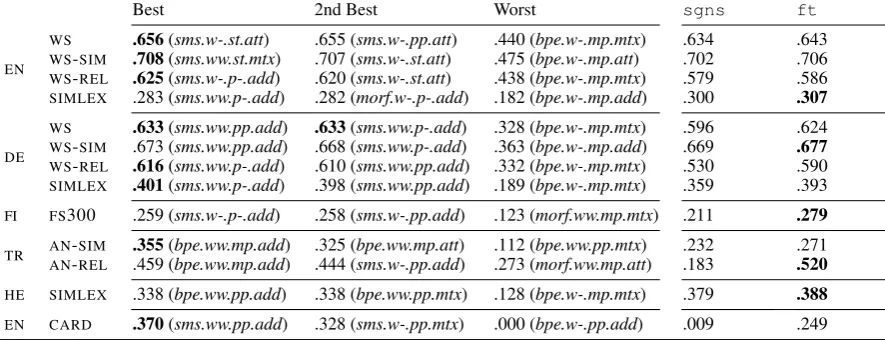
Table 4: Results on word similarity and relatedness across languages. The highest score for each row is in bold, and we choose randomly in case of a tie. All scores are obtained after computing the embeddings of OOV words.
Dev set Test set
UAS LAS UAS LAS
EN
sms.w-.mp.mtx 92.3 90.3 92.0 90.1
bpe.ww.p-.mtx 92.3 90.4 92.1 90.0
sgns 92.3 90.4 91.9 89.8
ft 92.3 90.3 92.1 90.2
DE
bpe.ww.pp.add 91.2 87.7 89.6 84.7
bpe.ww.mp.mtx 91.2 87.7 89.4 84.7
sgns 91.4 87.9 89.3 84.4
ft 91.6 87.9 89.1 84.4
FI
bpe.ww.mp.add 89.9 86.9 90.7 87.4
sms.w-.pp.add 89.3 86.1 90.5 87.1
sgns 88.9 85.6 89.5 86.2
ft 89.7 86.9 90.4 87.1
TR
sms.ww.mp.add 71.1 63.5 72.8 64.7
sms.w-.mp.att 70.5 62.5 72.7 64.5
sgns 70.5 62.5 72.2 63.5
ft 71.2 63.3 73.1 65.1
HE
morf.w-.pp.mtx 92.3 89.5 91.3 88.5
morf.ww.p-.add 92.3 89.5 91.2 88.5
sgns 92.4 89.8 91.5 88.7
ft 92.6 89.7 91.2 88.3
Table 5: Results on the dependency parsing task. The two best configurations are selected according to LAS.
Dependency Parsing Next, we use the syntactic dependency parsing task to analyze the importance of subword information for syntactically-driven downstream applications. For all test languages, we rely on the standard Universal Dependencies treebanks (UD v2.2;Nivre et al.(2016)). We use subword-informed word embeddings from differ-ent configurations to initialize the deep biaffine parser ofDozat and Manning (2017) which has shown competitive performance in shared tasks (Dozat et al.,2017) and among other parsing mod-els (Ma and Hovy,2017;Shi et al.,2017;Ma et al.,
2018).15 We use default settings for the biaffine parser for all experimental runs
Fine-Grained Entity Typing The task is to map entities, which could comprise more than one entity token, to predefined entity types (Yaghoobzadeh and Sch¨utze,2015). It is a suitable semi-semantic task to test our subword models, as the subwords of entities usually carry some semantic infor-mation from which the entity types can be in-ferred. For example,Lincolnshirewill belong to
/location/county as -shire is a suffix that strongly indicates a location. We rely on an entity typing dataset of Heinzerling and Strube (2018) built for over 250 languages by obtaining entity mentions from Wikidata (Vrandeˇci´c and Kr¨otzsch, 2014) and their associated FIGER-based entity types (Ling and Weld,2012): there only exists a one-to-one mapping between the entity and one of the 112 FIGER types.
We randomly sample the data to obtain a train/dev/test split with the size of 60k/20k/20k for all languages. For evaluation we extend the RNN-based model of Heinzerling and Strube (2018), where they stacked all the subwords of entity to-kens into a flattened sequence: we use the hierar-chical embedding composition instead. For each entity token, we first compute its word embeddings with our subword configurations,16 then feed the word embeddings of entity tokens to a bidirectional LSTM with 2 hidden layers of size 512, followed by a projection layer which predicts the entity type.
15
https://github.com/tdozat/Parser-v2
16Although it is true that case information can be very
im-portant to the task, we conform toHeinzerling and Strube
[image:6.595.76.283.278.526.2]4 Results and Analysis
To get a better grasp of the overall performance without overloading the tables, we focus on report-ing two best configurations and the worst configu-ration for each task and language from the total of 60 configurations, except for Hebrew with 36 con-figurations, where there is no gold segmentation data for trainingsmsmodel. We also analyze the effects of different configurations on different tasks based on language typology. The entire analysis revolves around the key questions Q1-Q3 posed in the introduction. The reader is encouraged to re-fer to the supplementary material for the complete results.
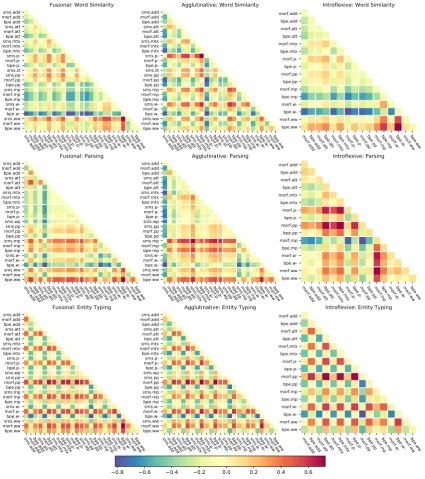
Tables 4,5, and 6summarize the main results on word similarity and relatedness, dependency parsing and entity typing, respectively. In addition, the comparisons of different configurations across tasks and language types are shown in Figure 2 (as well as Figure3to7in the supplementary ma-terial). There, we center the comparison around two crucial components: segmentation and com-position. The value in each pixel block is the per-centage rank of the row configuration minus that of column configuration. We compute such percent-age ranks by performing three levels of averaging over: 1) all related datasets for the same task; 2) all sub-configurations that entail the configuration in question; 3) all languages from the same language types.
Q1. Tasks and Languages Regarding the abso-lute performance of our subword-informed con-figurations, we notice that they outperformSGNS
and FT in 3/5 languages on average, and for 8/13 datasets on word similarity and relatedness. The gains are more prominent over the subword-agnostic SGNS model and for morphologically richer languages such as Finnish and Turkish. The results on the two other tasks are also very compet-itive, with strong performance reported especially on the entity typing task. This clearly indicates the importance of integrating subword-level informa-tion into word vectors. A finer-grained comparative analysis shows that best-performing configurations vary greatly across different languages.
The comparative analysis across tasks also sug-gests that there is no single configuration that out-performs the others in all three tasks, although cer-tain patterns in the results emerge. For instance, the supervised segmentation (sms) is very useful for
word similarity and relatedness (seen in Figure4). This result is quite intuitive:smsis trained accord-ing to the readily available gold standard morpho-logical segmentations. However,smsis less useful for entity typing, where almost all best-performing configurations are based on morf (see also Fig-ure4). This result is also interpretable:morfis a conservative segmenter that captures longer sub-words, and is not distracted by short and nonsensi-cal subwords (likebpe) that have no contribution to the prediction.17 The worst configurations on word similarity are based on bpe: its aggressive segmentation often results in non-interpretable or nonsensical subwords which are unable to recover useful semantic information. Due to the same rea-son, the results in all three tasks indicate that the best configurations withbpeare always coupled withww, and the worst are obtained withw-(i.e., without the inclusion of the full word).
The results on parsing reveal similar perfor-mances for a spectrum of heterogeneous tions. In other words, while the chosen configura-tion is still important, its impact on performance of state-of-the-art dependency parsers (Kiperwasser and Goldberg,2016;Dozat and Manning,2017) is decreased, as such parsers are heavily parametrized multi-component methods (e.g., besides word em-beddings they rely on biLSTMs, intra-sentence at-tention, character representations).18Therefore, a larger space of subword-informed configurations for word representations leads to optimal or near-optimal results. However,smsseems to yield high-est scores on average in agglutinative languages (see also Figure2).
Figure2clearly demonstrates that, apart from entity typing heatmaps (the third row) which show very similar trends over different language types, the patterns for different tasks and language types tend to vary in general. Similarly, other figures in the supplementary material also show diverging trends across languages representing different lan-guage types.
17For example,
sms and bpe both split “Val-berg” (/location/city) and “Robert Valberg” (/person/actor) with a suffix “berg”. Since “berg” could represent both a place or a person, it is not useful alone as a suffix to predict the correct entity type, whereasmorf does not split the word and makes the prediction solely based on surrounding entity tokens.
18We also experimented with removing token features such
Best 2nd Best Worst sgns ft
EN 55.70(bpe.ww.mp.add) 55.68 (morf.w-.pp.att) 51.15 (bpe.w-.p-.att) 51.00 55.15
DE 54.06 (morf.w-.pp.add) 54.01 (morf.w-.pp.att) 50.21 (bpe.w-.p-.att) 50.14 54.55
FI 57.41(morf.w-.pp.add) 57.38 (morf.w-.pp.mtx) 52.18 (bpe.w-.p-.att) 49.87 57.18
TR 56.31(morf.w-.pp.add) 56.14 (morf.w-.pp.mtx) 46.97 (bpe.w-.pp.mtx) 54.35 54.62
[image:8.595.74.524.61.135.2]HE 60.34(morf.w-.pp.att) 60.09 (morf.ww.pp.add) 51.31 (bpe.w-.p-.att) 54.55 59.09
Table 6: Test accuracy, the evaluation metric used byHeinzerling and Strube(2018), on the fine-grained entity
typing task. The results are averaged over 5 runs with random seeds.
sms.addmorf.addbpe.addsms.attmorf.attbpe.attsms.mtxmorf.mtxbpe.mtxsms.p-morf.p-bpe.p-sms.stsms.ppmorf.ppbpe.ppsms.mpmorf.mpbpe.mpsms.w-morf.w-bpe.w-sms.wwmorf.wwbpe.ww sms.add morf.add bpe.add sms.att morf.att bpe.att sms.mtx morf.mtx bpe.mtx sms.p- morf.p- bpe.p-sms.st sms.pp morf.pp bpe.pp sms.mp morf.mp bpe.mp sms.w- morf.w- bpe.w-sms.ww morf.ww bpe.ww
Fusional: Word Similarity
sms.addmorf.addbpe.addsms.attmorf.attbpe.attsms.mtxmorf.mtxbpe.mtxsms.p-morf.p-bpe.p-sms.stsms.ppmorf.ppbpe.ppsms.mpmorf.mpbpe.mpsms.w-morf.w-bpe.w-sms.wwmorf.wwbpe.ww sms.add morf.add bpe.add sms.att morf.att bpe.att sms.mtx morf.mtx bpe.mtx sms.p- morf.p- bpe.p-sms.st sms.pp morf.pp bpe.pp sms.mp morf.mp bpe.mp sms.w- morf.w- bpe.w-sms.ww morf.ww bpe.ww
Agglutinative: Word Similarity
morf.addbpe.addmorf.attbpe.attmorf.mtxbpe.mtxmorf.p-bpe.p-morf.ppbpe.ppmorf.mpbpe.mpmorf.w-bpe.w-morf.wwbpe.ww morf.add bpe.add morf.att bpe.att morf.mtx bpe.mtx morf.p- bpe.p-morf.pp bpe.pp morf.mp bpe.mp morf.w- bpe.w-morf.ww bpe.ww
Introflexive: Word Similarity
sms.addmorf.addbpe.addsms.attmorf.attbpe.attsms.mtxmorf.mtxbpe.mtxsms.p-morf.p-bpe.p-sms.wpsms.ppmorf.ppbpe.ppsms.mpmorf.mpbpe.mpsms.w-morf.w-bpe.w-sms.wwmorf.wwbpe.ww sms.add morf.add bpe.add sms.att morf.att bpe.att sms.mtx morf.mtx bpe.mtx sms.p- morf.p- bpe.p-sms.wp sms.pp morf.pp bpe.pp sms.mp morf.mp bpe.mp sms.w- morf.w- bpe.w-sms.ww morf.ww bpe.ww Fusional: Parsing
sms.addmorf.addbpe.addsms.attmorf.attbpe.attsms.mtxmorf.mtxbpe.mtxsms.p-morf.p-bpe.p-sms.wpsms.ppmorf.ppbpe.ppsms.mpmorf.mpbpe.mpsms.w-morf.w-bpe.w-sms.wwmorf.wwbpe.ww sms.add morf.add bpe.add sms.att morf.att bpe.att sms.mtx morf.mtx bpe.mtx sms.p- morf.p- bpe.p-sms.wp sms.pp morf.pp bpe.pp sms.mp morf.mp bpe.mp sms.w- morf.w- bpe.w-sms.ww morf.ww bpe.ww Agglutinative: Parsing morf.addbpe.addmorf.attbpe.attmorf.mtxbpe.mtxmorf.p-bpe.p-morf.ppbpe.ppmorf.mpbpe.mpmorf.w-bpe.w-morf.wwbpe.ww morf.add bpe.add morf.att bpe.att morf.mtx bpe.mtx morf.p- bpe.p-morf.pp bpe.pp morf.mp bpe.mp morf.w- bpe.w-morf.ww bpe.ww Introflexive: Parsing
sms.addmorf.addbpe.addsms.attmorf.attbpe.attsms.mtxmorf.mtxbpe.mtxsms.p-morf.p-bpe.p-sms.wpsms.ppmorf.ppbpe.ppsms.mpmorf.mpbpe.mpsms.w-morf.w-bpe.w-sms.wwmorf.wwbpe.ww sms.add morf.add bpe.add sms.att morf.att bpe.att sms.mtx morf.mtx bpe.mtx sms.p- morf.p- bpe.p-sms.wp sms.pp morf.pp bpe.pp sms.mp morf.mp bpe.mp sms.w- morf.w- bpe.w-sms.ww morf.ww bpe.ww
Fusional: Entity Typing
sms.addmorf.addbpe.addsms.attmorf.attbpe.attsms.mtxmorf.mtxbpe.mtxsms.p-morf.p-bpe.p-sms.wpsms.ppmorf.ppbpe.ppsms.mpmorf.mpbpe.mpsms.w-morf.w-bpe.w-sms.wwmorf.wwbpe.ww sms.add morf.add bpe.add sms.att morf.att bpe.att sms.mtx morf.mtx bpe.mtx sms.p- morf.p- bpe.p-sms.wp sms.pp morf.pp bpe.pp sms.mp morf.mp bpe.mp sms.w- morf.w- bpe.w-sms.ww morf.ww bpe.ww
Agglutinative: Entity Typing
morf.addbpe.addmorf.attbpe.attmorf.mtxbpe.mtxmorf.p-bpe.p-morf.ppbpe.ppmorf.mpbpe.mpmorf.w-bpe.w-morf.wwbpe.ww morf.add bpe.add morf.att bpe.att morf.mtx bpe.mtx morf.p- bpe.p-morf.pp bpe.pp morf.mp bpe.mp morf.w- bpe.w-morf.ww bpe.ww
Introflexive: Entity Typing
0.8 0.6 0.4 0.2 0.0 0.2 0.4 0.6
Figure 2: Comparisons of different configurations across tasks grouped by language types. The value in each pixel block is the percentage rank of the row configuration minus that of column configuration. For example, in word
similarity for fusional language, the rank for the rowsms.wwis0.787and0.071for columnbpe.w-, and the block
value is0.716. The higher the value, the better the performance of the row compared to the column configuration.
Q2 and Q3. Configurations As mentioned, dif-ferent tasks reach high scores with difdif-ferent
[image:8.595.83.509.179.659.2]ww, andsmsis generally better thanmorfandbpein fusional and agglutinative languages (see Figure4 and7). The presence ofwwis desired in this task as also found byBojanowski et al.(2017): it enhances the information provided by the segmentation. As discussed before, the best configurations withbpe
are always coupled withww, and the worst withw-.
wwis less important for the more conservativemorf
where the information stored inwwcan be fully re-covered from the generated subwords. Interestingly,
ppandmpdo not have positive effects on this task for fusional and introflexive languages, but they seem to resonate well with agglutinative languages, and they are useful for the two other tasks (seen in Figure6). In general, position embeddings have shown potential benefits in all tasks, where they selectively emphasize or filter subwords according to their positions.ppis extremely useful in entity typing for all languages, because it indicates the root position.
Concerning composition functions,addstill re-mains an extremely robust choice across tasks and languages. Surprisingly, the more sophisticated self-attention composition prevails only on a hand-ful of datasets: compare the results withaddvs.att
andmtx. In fact, the worst configurations mostly use attand mtx (see also Figure 5). In sum, our results suggest that, when unsure,addis by far the most robust choice for the subword composition function. Further, morphotactic tags encoded in subword embeddings (st) seem to be only effective combined with self-attention in word similarity and relatedness. These findings call for further investi-gation in future work, along with the inclusion of finer-grained morphotactic tags into the proposed modeling framework.
Further Discussion A recurring theme of this study is that subword-informed configurations are largely task- and language-dependent. We can ex-tract multiple examples from the reported results affirming this conjecture. For instance, in fusional and agglutinative languages mp is critical to the model on dependency parsing, while for Hebrew, an introflexive language, mp is among the most detrimental components on the same task. Further, for Turkish word similaritybpe.ww outperforms
sms.ww: due to affix concatenation in Turkish,sms
produces many affixes with only syntactic func-tions that bring noise to the task. Interestingly,
SGNS performs well in Hebrew on parsing and word similarity: it shows that it is still difficult
for linear segmentation methods to capture non-concatenative morphology.
Finally, fine-tuning subword-informed represen-tations seems especially beneficial for rare word se-mantics: our best configuration outperformsFTby 0.111 onCARD, and even surpasses all the state-of-the-art models on the rare word similarity task, as reported byPilehvar et al.(2018). We hope that our findings on theCARDdataset will motivate further work on building more accurate representations for rare and unseen words (Bhatia et al.,2016; Herbe-lot and Baroni,2017;Schick and Sch¨utze,2018) by learning more effective and more informed com-ponents of subword-informed configurations.
5 Conclusion
We have presented a general framework for learn-ing subword-informed word representations which has been used to perform a systematic analysis of 60 different subword-aware configurations for 5 typologically diverse languages across 3 diverse tasks. The large space of presented results has al-lowed us to analyze the main properties of subword-informed representation learning: we have demon-strated that different components of the frame-work such as segmentation and composition meth-ods, or the use of position embeddings, have to be carefully tuned to yield improved performance across different tasks and languages. We hope that this study will guide the development of new subword-informed word representation architec-tures. Code is available at: https://github.
com/cambridgeltl/sw_study.
Acknowledgments
This work is supported by the ERC Consolidator Grant LEXICAL (no 648909). We thank the review-ers for their insightful comments, and Roi Reichart for many fruitful discussions.
References
Waleed Ammar, George Mulcaire, Miguel Ballesteros,
Chris Dyer, and Noah A. Smith. 2016. Many
lan-guages, one parser.Transactions of the ACL, 4:431– 444.
Oded Avraham and Yoav Goldberg. 2017. The
inter-play of semantics and morphology in word embed-dings. InProceedings of EACL, pages 422–426.
Parminder Bhatia, Robert Guthrie, and Jacob
probabilis-tic neural word embeddings. In Proceedings of EMNLP, pages 490–500.
Piotr Bojanowski, Edouard Grave, Armand Joulin, and
Tomas Mikolov. 2017. Enriching word vectors with
subword information. Transactions of the ACL, 5:135–146.
Aditi Chaudhary, Chunting Zhou, Lori Levin, Graham Neubig, David R. Mortensen, and Jaime Carbonell.
2018.Adapting word embeddings to new languages
with morphological and phonological subword rep-resentations. In Proceedings of EMNLP, pages 3285–3295.
Danqi Chen and Christopher Manning. 2014. A fast
and accurate dependency parser using neural net-works. InProceedings of EMNLP, pages 740–750.
Ronan Collobert, Jason Weston, L´eon Bottou, Michael Karlen, Koray Kavukcuoglu, and Pavel Kuksa. 2011.
Natural language processing (almost) from scratch. Journal of Machine Learning Research, 12:2493– 2537.
Ryan Cotterell, Thomas M¨uller, Alexander M. Fraser,
and Hinrich Sch¨utze. 2015. Labeled
morphologi-cal segmentation with semi-Markov models. In Pro-ceedings of CoNLL, pages 164–174.
Ryan Cotterell and Hinrich Sch¨utze. 2015.
Morpholog-ical word-embeddings. InProceedings of NAACL, pages 1287–1292.
Ryan Cotterell and Hinrich Sch¨utze. 2018. Joint
se-mantic synthesis and morphological analysis of the derived word.Transactions of the ACL, 6:33–48.
Timothy Dozat and Christopher D. Manning. 2017.
Deep biaffine attention for neural dependency pars-ing. InProceedings of ICLR.
Timothy Dozat, Peng Qi, and Christopher D. Manning.
2017. Stanford’s graph-based neural dependency
parser at the CoNLL 2017 shared task. In Proceed-ings of the CoNLL 2017 Shared Task: Multilingual Parsing from Raw Text to Universal Dependencies, pages 20–30.
John Duchi, Elad Hazan, and Yoram Singer. 2011.
Adaptive subgradient methods for online learning and stochastic optimization. Journal of Machine Learning Research, 12:2121–2159.
G¨okhan Ercan and Olcay Taner Yıldız. 2018.
An-lamver: Semantic model evaluation dataset for turk-ish - word similarity and relatedness. InProceedings of COLING, pages 3819–3836.
Lev Finkelstein, Evgeniy Gabrilovich, Yossi Matias, Ehud Rivlin, Zach Solan, Gadi Wolfman, and Eytan
Ruppin. 2002. Placing search in context: The
con-cept revisited. ACM Transactions on Information Systems, 20(1):116–131.
Philip Gage. 1994. A new algorithm for data
compres-sion.C Users J., 12(2):23–38.
Jonas Gehring, Michael Auli, David Grangier, Denis
Yarats, and Yann Dauphin. 2017. Convolutional
sequence to sequence learning. In Proceedings of ICML, pages 1243–1252.
Daniela Gerz, Ivan Vuli´c, Edoardo Maria Ponti, Roi
Reichart, and Anna Korhonen. 2018. On the
rela-tion between linguistic typology and (limitarela-tions of) multilingual language modeling. InProceedings of EMNLP, pages 316–327.
Yoav Goldberg. 2017. Neural Network Methods for
Natural Language Processing. Synthesis Lectures on Human Language Technologies. Morgan & Clay-pool Publishers.
Zellig Harris. 1954. Distributional structure. Word,
10(23):146–162.
Benjamin Heinzerling and Michael Strube. 2018.
BPEmb: Tokenization-free pre-trained subword em-beddings in 275 languages. In Proceedings of LREC.
Aur´elie Herbelot and Marco Baroni. 2017. High-risk
learning: acquiring new word vectors from tiny data. InProceedings of EMNLP, pages 304–309.
Felix Hill, Roi Reichart, and Anna Korhonen. 2015.
SimLex-999: Evaluating semantic models with (gen-uine) similarity estimation. Computational Linguis-tics, 41(4):665–695.
Robin Jia and Percy Liang. 2016. Data recombination
for neural semantic parsing. InProceedings of ACL, pages 12–22.
Eliyahu Kiperwasser and Yoav Goldberg. 2016.
Sim-ple and accurate dependency parsing using bidirec-tional LSTM feature representations.Transaction of the ACL, 4:313–327.
Taku Kudo. 2018. Subword regularization: Improving
neural network translation models with multiple sub-word candidates. InProceedings of ACL, pages 66– 75.
Angeliki Lazaridou, Marco Marelli, Roberto
Zampar-elli, and Marco Baroni. 2013. Compositional-ly
de-rived representations of morphologically complex words in distributional semantics. In Proceedings of ACL, pages 1517–1526.
Ira Leviant and Roi Reichart. 2015. Judgment
lan-guage matters: Multilingual vector space models for judgment language aware lexical semantics. CoRR.
Omer Levy and Yoav Goldberg. 2014. Neural word
embedding as implicit matrix factorization. In Pro-ceedings of the NIPS, pages 2177–2185.
Omer Levy, Yoav Goldberg, and Ido Dagan. 2015.
Bofang Li, Aleksandr Drozd, Tao Liu, and Xiaoyong
Du. 2018. Subword-level composition functions
for learning word embeddings. InProceedings of the Second Workshop on Subword/Character LEvel Models, pages 38–48.
Zhouhan Lin, Minwei Feng, C´ıcero Nogueira dos San-tos, Mo Yu, Bing Xiang, Bowen Zhou, and Yoshua
Bengio. 2017. A structured self-attentive sentence
embedding. InProceedings of ICLR.
Xiao Ling and Daniel S. Weld. 2012. Fine-grained
en-tity recognition. InProceedings of AAAI, pages 94– 100.
Thang Luong, Richard Socher, and Christopher
Man-ning. 2013. Better word representations with
recur-sive neural networks for morphology. In Proceed-ings of CoNLL, pages 104–113.
Xuezhe Ma and Eduard H. Hovy. 2017. Neural
prob-abilistic model for non-projective MST parsing. In Proceedings of IJCNLP, pages 59–69.
Xuezhe Ma, Zecong Hu, Jingzhou Liu, Nanyun Peng,
Graham Neubig, and Eduard Hovy. 2018.
Stack-pointer networks for dependency parsing. In Pro-ceedings of ACL, pages 1403–1414.
Tomas Mikolov, Edouard Grave, Piotr Bojanowski,
Christian Puhrsch, and Armand Joulin. 2018.
Ad-vances in pre-training distributed word representa-tions. InProceedings of LREC.
Tomas Mikolov, Ilya Sutskever, Kai Chen, Gregory S.
Corrado, and Jeffrey Dean. 2013. Distributed
rep-resentations of words and phrases and their compo-sitionality. In Proceedings of NIPS, pages 3111– 3119.
Nikola Mrkˇsi´c, Ivan Vuli´c, Diarmuid ´O S´eaghdha, Ira
Leviant, Roi Reichart, Milica Gasic, Anna
Korho-nen, and Steve J. Young. 2017. Semantic
specializa-tion of distribuspecializa-tional word vector spaces using mono-lingual and cross-mono-lingual constraints. Transactions of the ACL, 5:309–324.
Joakim Nivre, Marie-Catherine de Marneffe, Filip Ginter, Yoav Goldberg, Jan Hajic, Christopher D. Manning, Ryan T. McDonald, Slav Petrov, Sampo Pyysalo, Natalia Silveira, Reut Tsarfaty, and Daniel
Zeman. 2016. Universal dependencies v1: A
mul-tilingual treebank collection. In Proceedings of LREC.
Jeffrey Pennington, Richard Socher, and Christopher D
Manning. 2014. Glove: Global vectors for word
rep-resentation. InProceedings of EMNLP, pages 1532– 1543.
Matthew E. Peters, Mark Neumann, Mohit Iyyer, Matt Gardner, Christopher Clark, Kenton Lee, and Luke
Zettlemoyer. 2018. Deep contextualized word
repre-sentations. InProccedings of NAACL, pages 2227– 2237.
Mohammad Taher Pilehvar, Dimitri Kartsaklis, Victor
Prokhorov, and Nigel Collier. 2018. Card-660: A
reliable evaluation framework for rare word repre-sentation models. InProceedings of EMNLP, pages 1391–1401.
Yuval Pinter, Robert Guthrie, and Jacob Eisenstein.
2017. Mimicking word embeddings using subword
RNNs. InProceedings of EMNLP, pages 102–112.
Siyu Qiu, Qing Cui, Jiang Bian, Bin Gao, and Tie-Yan
Liu. 2014. Co-learning of word representations and
morpheme representations. InProceedings of COL-ING, pages 141–150.
Sunita Sarawagi and William W Cohen. 2005.
Semi-Markov conditional random fields for information extraction. In Proceedings of NIPS, pages 1185– 1192.
Timo Schick and Hinrich Sch¨utze. 2018. Learning
se-mantic representations for novel words: Leveraging both form and context. CoRR, abs/1811.03866.
Rico Sennrich, Barry Haddow, and Alexandra Birch.
2016.Neural machine translation of rare words with
subword units. InProceedings of ACL, pages 86–96.
Tianze Shi, Liang Huang, and Lillian Lee. 2017.
Fast(er) exact decoding and global training for transition-based dependency parsing via a minimal feature set. In Proceedings of EMNLP, pages 12– 23.
Peter Smit, Sami Virpioja, Stig-Arne Grnroos, and
Mikko Kurimo. 2014.Morfessor 2.0: Toolkit for
sta-tistical morphological segmentation. InProceedings of EACL, pages 21–24.
Clara Vania and Adam Lopez. 2017. From characters
to words to in between: Do we capture morphology?
InProceedings of ACL, pages 2016–2027.
Ashish Vaswani, Noam Shazeer, Niki Parmar, Jakob Uszkoreit, Llion Jones, Aidan N. Gomez, Łukasz
Kaiser, and Illia Polosukhin. 2017. Attention is all
you need. In Proceedings of NIPS, pages 5998– 6008.
Viljami Venekoski and Jouko Vankka. 2017. Finnish
resources for evaluating language model semantics. InProceedings of NoDaLiDa, pages 231–236.
Denny Vrandeˇci´c and Markus Kr¨otzsch. 2014.
Wiki-data: A free collaborative knowledge base. Commu-nications of the ACM, 57:78–85.
John Wieting, Mohit Bansal, Kevin Gimpel, and Karen
Livescu. 2016. Charagram: Embedding words and
sentences via character n-grams. InProceedings of EMNLP, pages 1504–1515.
Yadollah Yaghoobzadeh and Hinrich Sch¨utze. 2015.
Jinman Zhao, Sidharth Mudgal, and Yingyu Liang.
2018. Generalizing word embeddings using bag of
subwords. In Proceedings of EMNLP, pages 601– 606.
A Supplemental Material
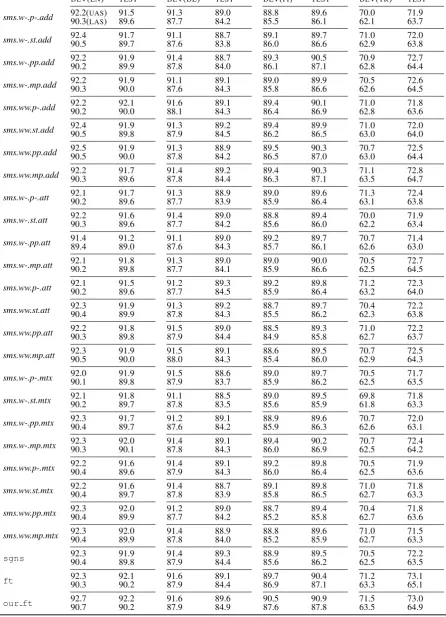
In this supplementary material we present the full results of different configurations of our subword-informed representations and baseline models in three tasks across five languages. For details and notations of different model configurations, please refer to the original paper.
SincefastText(FT) package cannot generate each subword embedding for a given word, we also implemented our own version (our ft) within the same subword-informed training framework. We trainedour fton all the five languages with the same training corpus, and kept the same hy-perparameters asFTpackage except that we used 1024 as batch size for faster training. We show that our implementation yields comparable results with the originalFTin word similarity and relatedness and parsing across languages. For entity typing, we experimented with the extended hierarchical composition architecture described in the paper on
our ft, i.e., using subword embeddings to com-pute word representations and updating subword embeddings ofour ftduring training, and only use word embeddings as input for SGNS and FT
and directly update them. Additionally, we also ex-perimented with some of our model configurations with character n-grams as our segmentation meth-ods, but did not observe performance gains. Due to its large parameter space (usually 2-4 times larger thanSGNS) and the computational limits, we leave
it as our future work.
SIMLEX WS WS-REL WS-SIM FS300 AN-REL AN-SIM CARD
sms.w-.p-.add 0.267(0.350(EN) 0.650 0.625 0.688 0.259(FI) 0.277(TR) 0.432(TR) 0.206(EN)
DE) 0.517 0.490 0.586
sms.w-.st.add 0.2670.350 0.6540.509 0.6190.475 0.7040.577 0.228 0.276 0.434 0.208
sms.w-.pp.add 0.2700.332 0.6450.494 0.6150.467 0.6930.563 0.258 0.261 0.444 0.294
sms.w-.mp.add 0.2070.295 0.6350.437 0.5980.401 0.6830.507 0.247 0.269 0.424 0.213
sms.ww.p-.add 0.2830.401 0.6400.633 0.5890.616 0.6960.668 0.226 0.273 0.435 0.267
sms.ww.st.add 0.2770.385 0.6370.622 0.5760.601 0.6970.658 0.204 0.239 0.404 0.269
sms.ww.pp.add 0.2820.398 0.6320.633 0.5720.610 0.7020.673 0.240 0.240 0.423 0.370
sms.ww.mp.add 0.2400.353 0.6330.599 0.5790.557 0.6960.639 0.211 0.279 0.443 0.268
sms.w-.p-.att 0.2500.339 0.6420.518 0.6130.478 0.6840.598 0.228 0.289 0.416 0.244
sms.w-.st.att 0.2550.327 0.6560.512 0.6200.468 0.6970.583 0.227 0.263 0.358 0.236
sms.w-.pp.att 0.2520.324 0.6550.500 0.6190.456 0.7070.570 0.227 0.212 0.334 0.323
sms.w-.mp.att 0.2060.290 0.6290.452 0.5930.425 0.6740.517 0.205 0.263 0.405 0.219
sms.ww.p-.att 0.2770.360 0.6420.605 0.5910.571 0.6980.640 0.192 0.311 0.440 0.251
sms.ww.st.att 0.2610.342 0.6320.588 0.5700.549 0.6930.625 0.212 0.243 0.366 0.260
sms.ww.pp.att 0.2710.357 0.6300.608 0.5840.567 0.6950.660 0.228 0.204 0.367 0.310
sms.ww.mp.att 0.2200.340 0.6160.569 0.5470.526 0.6820.613 0.191 0.241 0.376 0.222
sms.w-.p-.mtx 0.2450.336 0.6390.505 0.6020.457 0.6940.585 0.248 0.260 0.404 0.220
sms.w-.st.mtx 0.2520.330 0.6480.506 0.6170.456 0.7020.578 0.234 0.231 0.381 0.224
sms.w-.pp.mtx 0.260 0.638 0.606 0.694 0.244 0.184 0.335 0.328
0.331 0.488 0.429 0.564
sms.w-.mp.mtx 0.2110.282 0.6200.447 0.5990.417 0.6710.506 0.228 0.265 0.417 0.226
sms.ww.p-.mtx 0.2790.357 0.6310.615 0.5750.578 0.6960.657 0.206 0.280 0.426 0.251
sms.ww.st.mtx 0.2770.355 0.6420.603 0.5810.561 0.7080.645 0.192 0.231 0.394 0.261
sms.ww.pp.mtx 0.2730.357 0.6400.611 0.5880.575 0.7050.662 0.226 0.210 0.368 0.300
sms.ww.mp.mtx 0.2530.339 0.6220.598 0.5650.578 0.6840.632 0.183 0.275 0.414 0.260
sgns
0.300 0.634 0.579 0.702 0.211 0.232 0.183 0.009 0.359 0.596 0.530 0.669
ft
0.307 0.643 0.586 0.706 0.279 0.271 0.520 0.249 0.393 0.624 0.590 0.677
our ft
[image:13.595.83.522.86.711.2]0.265 0.629 0.574 0.702 0.241 0.295 0.523 0.281 0.380 0.610 0.596 0.649
SIMLEX WS WS-REL WS-SIM FS300 AN-REL AN-SIM CARD
morf.w-.p-.add
0.282(EN) 0.629 0.574 0.691 0.166(FI) 0.273(TR) 0.359(TR) 0.134(EN) 0.368(DE) 0.577 0.557 0.616
0.322(HE)
morf.w-.pp.add
0.279 0.617 0.562 0.680 0.189 0.232 0.375 0.172 0.349 0.549 0.530 0.594
0.317
morf.w-.mp.add
0.245 0.597 0.529 0.664 0.185 0.302 0.351 0.127 0.303 0.484 0.439 0.550
0.324
morf.ww.p-.add
0.273 0.632 0.573 0.697 0.159 0.264 0.339 0.198 0.376 0.583 0.569 0.614
0.326
morf.ww.pp.add
0.277 0.616 0.557 0.684 0.182 0.232 0.375 0.262 0.361 0.573 0.549 0.609
0.324
morf.ww.mp.add
0.244 0.589 0.520 0.666 0.149 0.267 0.300 0.099 0.331 0.515 0.484 0.574
0.304
morf.w-.p-.att
0.281 0.623 0.565 0.682 0.159 0.295 0.362 0.132 0.354 0.560 0.536 0.603
0.323
morf.w-.pp.att
0.276 0.619 0.555 0.682 0.170 0.235 0.358 0.138 0.352 0.556 0.537 0.597
0.308
morf.w-.mp.att
0.246 0.586 0.519 0.661 0.158 0.274 0.304 0.107 0.310 0.495 0.453 0.548
0.291
morf.ww.p-.att
0.271 0.622 0.568 0.686 0.167 0.292 0.346 0.218 0.372 0.574 0.545 0.621
0.321
morf.ww.pp.att
0.274 0.613 0.549 0.680 0.167 0.145 0.312 0.206 0.364 0.565 0.537 0.601
0.319
morf.ww.mp.att
0.234 0.586 0.514 0.666 0.147 0.270 0.273 0.109 0.327 0.499 0.469 0.562
0.307
morf.w-.p-.mtx
0.280 0.632 0.573 0.693 0.133 0.300 0.357 0.132 0.348 0.564 0.544 0.602
0.320
morf.w-.pp.mtx
0.275 0.621 0.562 0.693 0.186 0.231 0.369 0.135 0.355 0.549 0.530 0.582
0.325
morf.w-.mp.mtx
0.254 0.602 0.536 0.671 0.205 0.235 0.295 0.130 0.295 0.488 0.427 0.542
0.301
morf.ww.p-.mtx
0.275 0.624 0.558 0.688 0.177 0.292 0.356 0.222 0.371 0.577 0.545 0.611
0.325
morf.ww.pp.mtx
0.272 0.617 0.558 0.684 0.160 0.151 0.321 0.080 0.359 0.592 0.575 0.613
0.326
morf.ww.mp.mtx
0.238 0.591 0.522 0.674 0.123 0.279 0.326 0.080 0.320 0.500 0.465 0.559
0.318
sgns
0.300 0.634 0.579 0.702 0.211 0.232 0.183 0.009 0.359 0.596 0.530 0.669
0.379
ft
0.307 0.643 0.586 0.706 0.279 0.271 0.520 0.249 0.393 0.624 0.590 0.677
0.388
our ft
0.265 0.629 0.574 0.702 0.241 0.295 0.523 0.281 0.380 0.610 0.596 0.649
[image:14.595.81.520.65.737.2]0.354
SIMLEX WS WS-REL WS-SIM FS300 AN-REL AN-SIM CARD
bpe.w-.p-.add
0.209(EN) 0.488 0.499 0.508 0.177(FI) 0.228(TR) 0.390(TR) 0.011(EN) 0.229(DE) 0.416 0.442 0.474
0.156(HE)
bpe.w-.pp.add
0.209 0.474 0.484 0.490 0.170 0.229 0.407 0.000 0.225 0.404 0.417 0.467
0.162
bpe.w-.mp.add
0.182 0.460 0.478 0.484 0.157 0.283 0.406 0.021 0.193 0.331 0.351 0.363
0.132
bpe.ww.p-.add
0.274 0.642 0.577 0.706 0.203 0.293 0.429 0.262 0.378 0.597 0.582 0.631
0.331
bpe.ww.pp.add
0.265 0.631 0.571 0.689 0.245 0.267 0.429 0.273 0.365 0.615 0.595 0.637
0.338
bpe.ww.mp.add
0.236 0.587 0.519 0.658 0.147 0.355 0.459 0.240 0.348 0.566 0.538 0.608
0.321
bpe.w-.p-.att
0.216 0.506 0.504 0.529 0.200 0.176 0.288 0.010 0.233 0.386 0.409 0.422
0.155
bpe.w-.pp.att
0.210 0.503 0.507 0.528 0.190 0.183 0.331 0.027 0.226 0.383 0.396 0.428
0.152
bpe.w-.mp.att
0.197 0.456 0.462 0.475 0.173 0.200 0.308 0.035 0.209 0.398 0.422 0.467
0.151
bpe.ww.p-.att
0.265 0.621 0.566 0.687 0.197 0.246 0.358 0.257 0.350 0.555 0.525 0.591
0.334
bpe.ww.pp.att
0.270 0.618 0.570 0.678 0.187 0.197 0.314 0.228 0.333 0.567 0.536 0.604
0.334
bpe.ww.mp.att
0.255 0.613 0.564 0.681 0.147 0.325 0.419 0.226 0.338 0.545 0.526 0.584
0.307
bpe.w-.p-.mtx
0.202 0.486 0.485 0.512 0.184 0.174 0.293 0.015 0.224 0.394 0.414 0.433
0.169
bpe.w-.pp.mtx
0.198 0.504 0.500 0.547 0.179 0.195 0.355 0.045 0.223 0.399 0.396 0.462
0.167
bpe.w-.mp.mtx
0.185 0.440 0.438 0.476 0.144 0.176 0.282 0.022 0.189 0.328 0.332 0.372
0.128
bpe.ww.p-.mtx
0.267 0.624 0.565 0.690 0.164 0.238 0.334 0.272 0.354 0.573 0.543 0.604
0.337
bpe.ww.pp.mtx
0.263 0.621 0.569 0.677 0.193 0.112 0.290 0.210 0.337 0.553 0.500 0.608
0.338
bpe.ww.mp.mtx
0.260 0.620 0.564 0.681 0.198 0.257 0.369 0.247 0.336 0.546 0.514 0.596
0.298
sgns
0.300 0.634 0.579 0.702 0.211 0.232 0.183 0.009 0.359 0.596 0.530 0.669
0.379
ft
0.307 0.643 0.586 0.706 0.279 0.271 0.520 0.249 0.393 0.624 0.590 0.677
0.388
our ft
0.265 0.629 0.574 0.702 0.241 0.295 0.523 0.281 0.380 0.610 0.596 0.649
[image:15.595.80.520.66.738.2]0.354
DEV(EN) TEST DEV(DE) TEST DEV(FI) TEST DEV(TR) TEST
sms.w-.p-.add 92.2(90.3(UAS) 91.5 91.3 89.0 88.8 89.6 70.0 71.9
LAS) 89.6 87.7 84.2 85.5 86.1 62.1 63.7
sms.w-.st.add 92.490.5 91.789.7 91.187.6 88.783.8 89.186.0 89.786.6 62.971.0 72.063.8
sms.w-.pp.add 92.290.2 91.989.9 91.487.8 88.784.0 89.386.1 90.587.1 62.870.9 72.764.4
sms.w-.mp.add 92.290.3 91.990.0 91.187.6 89.184.3 89.085.8 89.986.6 62.670.5 72.664.5
sms.ww.p-.add 92.2 92.1 91.6 89.1 89.4 90.1 71.0 71.8
90.2 90.0 88.1 84.3 86.4 86.9 62.8 63.6
sms.ww.st.add 92.490.5 91.989.8 91.387.9 89.284.5 89.486.2 89.986.5 63.071.0 72.064.0
sms.ww.pp.add 92.590.5 91.990.0 91.387.8 88.984.2 89.586.5 90.387.0 63.070.7 72.564.4
sms.ww.mp.add 92.290.3 91.789.6 91.487.8 89.284.4 89.486.3 90.387.1 63.571.1 72.864.7
sms.w-.p-.att 92.190.2 91.789.6 91.387.7 88.983.9 89.085.9 89.686.4 63.171.3 72.463.8
sms.w-.st.att 92.290.3 91.689.6 91.487.7 89.084.2 88.885.6 89.486.0 62.270.0 71.963.4
sms.w-.pp.att 91.489.4 91.289.0 91.187.6 89.084.3 89.285.7 89.786.1 62.670.7 71.463.0
sms.w-.mp.att 92.1 91.8 91.3 89.0 89.0 90.0 70.5 72.7
90.2 89.8 87.7 84.1 85.9 86.6 62.5 64.5
sms.ww.p-.att 92.190.2 91.589.6 91.287.7 89.384.5 89.285.9 89.886.4 63.271.2 72.364.0
sms.ww.st.att 92.390.4 91.989.9 91.387.8 89.284.3 88.785.5 89.786.2 62.370.4 72.263.8
sms.ww.pp.att 92.290.3 91.889.8 91.587.9 89.084.4 88.584.9 89.385.8 62.771.0 72.263.7
sms.ww.mp.att 92.390.5 91.990.0 91.588.0 89.184.3 88.685.4 89.586.0 62.970.7 72.564.3
sms.w-.p-.mtx 92.090.1 91.989.8 91.587.9 88.683.7 89.085.9 89.786.2 62.570.5 71.763.5
sms.w-.st.mtx 92.190.2 91.889.7 91.187.8 88.583.5 89.085.6 89.585.9 61.869.8 71.863.3
sms.w-.pp.mtx 92.3 91.7 91.2 89.1 88.9 89.6 70.7 72.0
90.4 89.7 87.6 84.2 85.9 86.3 62.6 63.1
sms.w-.mp.mtx 92.390.3 92.090.1 91.487.8 89.184.3 89.486.0 90.286.9 62.570.7 72.464.2
sms.ww.p-.mtx 92.290.4 91.689.6 91.487.9 89.184.3 89.286.0 89.886.4 62.570.5 71.963.6
sms.ww.st.mtx 92.290.4 91.689.7 91.487.8 88.783.9 89.185.8 89.886.5 62.771.0 71.863.3
sms.ww.pp.mtx 92.390.4 92.089.9 91.287.7 89.084.2 88.785.2 89.485.8 62.770.4 71.863.6
sms.ww.mp.mtx 92.390.4 92.089.9 91.487.8 88.984.0 88.885.2 89.685.9 62.771.0 71.563.3
sgns 92.3 91.9 91.4 89.3 88.9 89.5 70.5 72.2
90.4 89.8 87.9 84.4 85.6 86.2 62.5 63.5
ft 92.3 92.1 91.6 89.1 89.7 90.4 71.2 73.1
90.3 90.2 87.9 84.4 86.9 87.1 63.3 65.1
our ft 92.7 92.2 91.6 89.6 90.5 90.9 71.5 73.0
[image:16.595.75.522.98.716.2]90.7 90.2 87.9 84.9 87.6 87.8 63.5 64.9
DEV(EN) TEST DEV(DE) TEST DEV(FI) TEST DEV(TR) TEST DEV(HE) TEST
morf.w-.p-.add 92.390.4 91.789.8 91.187.7 89.084.2 85.889.0 90.086.6 70.762.4 63.371.8 89.692.5 91.088.3
morf.w-.pp.add 92.5 91.8 91.4 89.0 89.2 89.8 70.3 71.3 92.3 91.2
90.6 89.8 87.6 84.1 86.0 86.4 62.2 63.1 89.6 88.4
morf.w-.mp.add 92.290.2 91.990.0 91.487.8 89.084.1 85.989.2 89.886.4 71.263.2 63.671.7 89.292.1 90.888.0
morf.ww.p-.add 92.290.3 91.889.7 91.487.8 89.084.1 86.289.4 89.686.2 70.862.9 64.272.2 89.592.3 91.288.5
morf.ww.pp.add 92.390.4 91.789.8 91.387.6 88.984.1 85.788.8 89.986.5 70.662.5 63.471.9 89.692.2 91.088.1
morf.ww.mp.add 92.390.4 91.789.6 91.287.6 89.084.2 86.089.3 89.886.4 70.562.8 64.272.4 89.292.1 90.988.0
morf.w-.p-.att 92.290.3 91.889.7 91.287.6 89.183.9 85.989.1 90.286.6 70.361.9 63.672.1 89.692.3 91.188.3
morf.w-.pp.att 92.390.3 92.089.9 91.587.9 89.384.6 85.989.1 89.786.4 71.063.1 63.672.2 89.792.6 91.288.4
morf.w-.mp.att 92.0 91.8 91.4 89.1 89.1 89.9 70.2 71.5 92.1 90.3
90.0 89.8 87.7 84.3 85.7 86.4 62.1 62.8 89.2 87.4
morf.ww.p-.att 92.290.2 91.989.8 91.488.0 89.184.2 86.089.4 89.886.5 70.062.2 62.871.2 89.392.2 91.188.2
morf.ww.pp.att 92.390.3 91.989.9 91.688.0 89.384.5 85.889.0 89.686.3 70.962.7 63.472.0 89.692.2 91.188.3
morf.ww.mp.att 92.290.4 91.990.0 91.387.9 89.084.1 85.888.9 90.086.7 70.962.8 63.471.8 89.492.3 91.088.0
morf.w-.p-.mtx 92.190.1 91.989.8 91.487.8 88.984.1 86.189.3 89.886.4 70.662.8 63.671.9 89.492.2 90.687.9
morf.w-.pp.mtx 92.490.4 91.889.9 91.387.7 88.884.0 86.189.3 90.086.7 71.063.1 63.772.2 89.592.3 91.388.5
morf.w-.mp.mtx 92.290.3 92.190.0 91.487.9 88.883.9 85.989.2 90.386.8 70.262.2 63.772.2 89.392.2 90.587.7
morf.ww.p-.mtx 92.2 91.8 91.3 88.9 89.3 89.6 70.1 71.4 92.5 91.4
90.3 89.8 87.9 84.0 85.9 86.1 62.1 63.3 89.6 88.4
morf.ww.pp.mtx 92.290.3 91.789.6 91.487.9 89.084.1 86.089.2 89.986.7 71.362.9 63.872.1 89.792.6 90.888.0
morf.ww.mp.mtx 92.390.4 91.889.9 91.287.7 89.184.2 86.389.5 89.886.4 71.162.5 63.872.2 89.392.1 90.888.0
sgns 92.3 91.9 91.4 89.3 88.9 89.5 70.5 72.2 92.4 91.5
90.4 89.8 87.9 84.4 85.6 86.2 62.5 63.5 89.8 88.7
ft 92.3 92.1 91.6 89.1 89.7 90.4 71.2 73.1 92.6 91.2
90.3 90.2 87.9 84.4 86.9 87.1 63.3 65.1 89.7 88.3
our ft 92.7 92.2 91.6 89.6 90.5 90.9 71.5 73.0 92.52 91.6
[image:17.595.78.520.159.651.2]90.7 90.2 87.9 84.9 87.6 87.8 63.5 64.9 89.72 88.8
DEV(EN) TEST DEV(DE) TEST DEV(FI) TEST DEV(TR) TEST DEV(HE) TEST
bpe.w-.p-.add 92.390.3 91.589.6 91.187.6 89.184.2 85.989.3 89.986.4 70.262.6 63.972.1 89.291.9 91.088.2
bpe.w-.pp.add 92.2 91.6 91.5 89.1 89.0 90.0 71.2 71.6 92.0 90.9
90.2 89.5 87.9 84.3 85.8 86.7 63.2 63.2 89.1 88.1
bpe.w-.mp.add 91.990.0 91.689.7 91.587.9 89.284.3 86.189.3 89.886.3 70.762.7 63.471.6 89.792.4 91.288.2
bpe.ww.p-.add 92.190.2 91.889.9 91.387.7 89.284.4 86.289.5 89.886.5 70.262.1 63.271.4 89.592.5 91.188.2
bpe.ww.pp.add 92.390.4 91.689.6 91.287.7 89.684.7 86.289.2 90.287.0 70.862.9 64.272.3 89.492.3 91.288.4
bpe.ww.mp.add 92.390.3 91.989.9 91.688.1 89.284.5 86.989.9 90.787.4 71.263.1 64.072.3 89.492.2 91.088.2
bpe.w-.p-.att 92.390.3 91.389.4 91.487.9 89.184.2 85.388.8 89.485.7 70.462.3 63.071.9 89.192.0 90.987.9
bpe.w-.pp.att 92.190.2 91.689.7 91.487.6 88.683.7 85.488.7 89.586.0 70.962.5 63.371.5 89.091.9 91.088.3
bpe.w-.mp.att 92.1 91.5 91.5 89.3 89.1 89.9 70.5 72.4 92.2 90.8
90.2 89.6 87.9 84.4 85.8 86.3 62.5 63.9 89.5 88.0
bpe.ww.p-.att 92.390.4 92.089.9 91.487.9 88.683.8 85.889.1 90.186.8 70.862.4 63.171.3 89.392.0 90.888.0
bpe.ww.pp.att 92.390.5 91.889.8 91.487.7 89.284.6 85.989.2 90.086.4 71.063.2 64.072.1 89.592.1 91.188.2
bpe.ww.mp.att 92.590.6 92.089.9 91.588.1 89.383.9 86.489.5 90.386.9 70.662.6 63.471.7 89.191.9 90.988.0
bpe.w-.p-.mtx 91.990.1 91.789.7 91.187.5 88.983.9 85.288.6 89.585.9 69.961.9 63.171.5 88.791.5 91.288.3
bpe.w-.pp.mtx 92.190.2 91.789.7 91.187.5 88.884.0 85.689.0 89.586.0 70.762.8 63.371.8 89.292.0 91.088.2
bpe.w-.mp.mtx 92.190.2 91.689.5 91.187.6 89.184.1 85.789.0 89.986.3 70.362.6 63.672.0 89.392.2 90.687.7
bpe.ww.p-.mtx 92.3 92.1 91.6 89.0 89.3 90.0 71.7 72.3 91.9 90.5
90.4 90.0 88.0 84.2 86.0 86.7 63.4 63.7 88.9 87.7
bpe.ww.pp.mtx 92.490.4 91.989.8 91.387.7 89.184.2 85.989.3 89.786.2 69.862.0 63.872.2 89.292.0 90.787.9
bpe.ww.mp.mtx 92.390.4 91.789.6 91.287.7 89.484.7 86.789.8 90.286.8 71.263.1 64.272.3 89.492.2 91.088.1
sgns 92.3 91.9 91.4 89.3 88.9 89.5 70.5 72.2 92.4 91.5
90.4 89.8 87.9 84.4 85.6 86.2 62.5 63.5 89.8 88.7
ft 92.3 92.1 91.6 89.1 89.7 90.4 71.2 73.1 92.6 91.2
90.3 90.2 87.9 84.4 86.9 87.1 63.3 65.1 89.7 88.3
our ft 92.7 92.2 91.6 89.6 90.5 90.9 71.5 73.0 92.52 91.6
[image:18.595.77.525.159.650.2]90.7 90.2 87.9 84.9 87.6 87.8 63.5 64.9 89.72 88.8