Decipherment with a Million Random Restarts
Taylor Berg-Kirkpatrick Dan Klein
Computer Science Division University of California, Berkeley
{tberg,klein}@cs.berkeley.edu
Abstract
This paper investigates the utility and effect of running numerous random restarts when us-ing EM to attack decipherment problems. We find that simple decipherment models are able to crack homophonic substitution ciphers with high accuracy if a large number of random restarts are used but almost completely fail with only a few random restarts. For partic-ularly difficult homophonic ciphers, we find that big gains in accuracy are to be had by run-ning upwards of 100K random restarts, which we accomplish efficiently using a GPU-based parallel implementation. We run a series of experiments using millions of random restarts in order to investigate other empirical proper-ties of decipherment problems, including the famously uncracked Zodiac 340.
1 Introduction
What can a million restarts do for decipherment? EM frequently gets stuck in local optima, so running between ten and a hundred random restarts is com-mon practice (Knight et al., 2006; Ravi and Knight, 2011; Berg-Kirkpatrick and Klein, 2011). But, how important are random restarts and how many random restarts does it take to saturate gains in accuracy?
We find that the answer depends on the cipher. We look at both Zodiac 408, a famous homophonic sub-stitution cipher, and a more difficult homophonic ci-pher constructed to match properties of the famously unsolved Zodiac 340. Gains in accuracy saturate af-ter only a hundred random restarts for Zodiac 408, but for the constructed cipher we see large gains
in accuracy even as we scale the number of ran-dom restarts up into the hundred thousands. In both cases the difference between few and many random restarts is the difference between almost complete failure and successful decipherment.
We also find that millions of random restarts can be helpful for performing exploratory analysis. We look at some empirical properties of decipherment problems, visualizing the distribution of local op-tima encountered by EM both in a successful deci-pherment of a homophonic cipher and in an unsuc-cessful attempt to decipher Zodiac 340. Finally, we attack a series of ciphers generated to match proper-ties of Zodiac 340 and use the results to argue that Zodiac 340 is likely not a homophonic cipher under the commonly assumed linearization order.
2 Decipherment Model
Various types of ciphers have been tackled by the NLP community with great success (Knight et al., 2006; Snyder et al., 2010; Ravi and Knight, 2011). Many of these approaches learn an encryption key by maximizing the score of the decrypted message under a language model. We focus on homophonic substitution ciphers, where the encryption key is a 1-to-many mapping from a plaintext alphabet to a cipher alphabet. We use a simple method introduced by Knight et al. (2006): the EM algorithm (Demp-ster et al., 1977) is used to learn the emission pa-rameters of an HMM that has a character trigram language model as a backbone and the ciphertext as the observed sequence of emissions. This means that we learn a multinomial over cipher symbols for each plaintext character, but do not learn transition
parameters, which are fixed by the language model. We predict the deciphered text using posterior de-coding in the learned HMM.
2.1 Implementation
Running multiple random restarts means running EM to convergence multiple times, which can be computationally intensive; luckily, restarts can be run in parallel. This kind of parallelism is a good fit for the Same Instruction Multiple Thread (SIMT) hardware paradigm implemented by modern GPUs. We implemented EM with parallel random restarts using the CUDA API (Nickolls et al., 2008). With a GPU workstation,1 we can complete a million ran-dom restarts roughly a thousand times more quickly than we can complete the same computation with a serial implementation on a CPU.
3 Experiments
We ran experiments on several homophonic sub-stitution ciphers: some produced by the infamous Zodiac killer and others that were automatically generated to be similar to the Zodiac ciphers. In each of these experiments, we ran numerous random restarts; and in all cases we chose the random restart that attained the highest model score in order to pro-duce the final decode.
3.1 Experimental Setup
The specifics of how random restarts are produced is usually considered a detail; however, in this work it is important to describe the process precisely. In order to generate random restarts, we sampled emis-sion parameters by drawing uniformly at random from the interval[0,1] and then normalizing. The corresponding distribution on the multinomial emis-sion parameters is mildly concentrated at the center of the simplex.2
For each random restart, we ran EM for 200
itera-1We used a single workstation with three NVIDIA GTX 580
GPUs. These are consumer graphics cards introduced in 2011. 2We also ran experiments where emission parameters were
drawn from Dirichlet distributions with various concentration parameter settings. We noticed little effect so long as the distri-bution did not favor the corners of the simplex. If the distribu-tion did favor the corners of the simplex, decipherment results deteriorated sharply.
0.1 0.2 0.3 0.4 0.5 0.6 0.7 0.8 0.9 1
1 10 100 1000 10000 100000 1e+06 -1530 -1520 -1510 -1500 -1490 -1480 -1470 -1460
Accuracy
Log likelihood
[image:2.612.313.542.59.244.2]Number of random restarts Log likelihood Accuracy
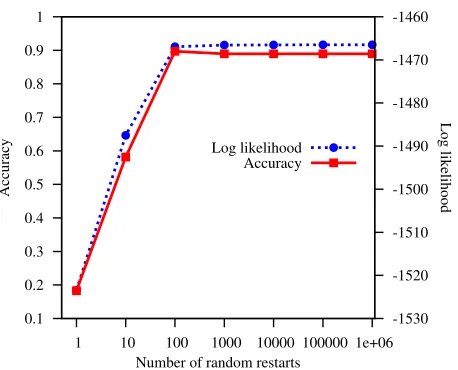
Figure 1: Zodiac 408 cipher. Accuracy by best model score and best model score vs. number of random restarts. Bootstrapped from 1M random restarts.
tions.3 We found that smoothing EM was important for good performance. We added a smoothing con-stant of0.1to the expected emission counts before each M-step. We tuned this value on a small held out set of automatically generated ciphers.
In all experiments we used a trigram character language model that was linearly interpolated from character unigram, bigram, and trigram counts ex-tracted from both the Google N-gram dataset (Brants and Franz, 2006) and a small corpus (about 2K words) of plaintext messages authored by the Zodiac killer.4
3.2 An Easy Cipher: Zodiac 408
Zodiac 408 is a homophonic cipher that is 408 char-acters long and contains 54 different cipher sym-bols. Produced by the Zodiac killer, this cipher was solved, manually, by two amateur code-breakers a week after its release to the public in 1969. Ravi and Knight (2011) were the first to crack Zodiac 408 us-ing completely automatic methods.
In our first experiment, we compare a decode of Zodiac 408 using one random restart to a decode us-ing 100 random restarts. Random restarts have high
3While this does not guarantee convergence, in practice 200
iterations seems to be sufficient for the problems we looked at. 4
variance, so when we present the accuracy corre-sponding to a given number of restarts we present an average over many bootstrap samples, drawn from a set of one million random restarts. If we attack Zodiac 408 with a single random restart, on aver-age we achieve an accuracy of 18%. If we instead use 100 random restarts we achieve a much better average accuracy of 90%. The accuracies for vari-ous numbers of random restarts are plotted in Fig-ure 1. Based on these results, we expect accuracy to increase by about 72% when using 100 random restarts instead of a single random restart; however, using more than 100 random restarts for this partic-ular cipher does not appear to be useful.
Also in Figure 1, we plot a related graph, this time showing the effect that random restarts have on the achieved model score. By construction, the (maxi-mum) model score must increase as we increase the number of random restarts. We see that it quickly saturates in the same way that accuracy did.
This raises the question: have we actually achieved the globally optimal model score or have we only saturated the usefulness of random restarts? We can’t prove that we have achieved the global op-timum,5but we can at least check that we have
sur-passed the model score achieved by EM when it is initialized with the gold encryption key. On Zodiac 408, if we initialize with the gold key, EM finds a local optimum with a model score of −1467.4. The best model score over 1M random restarts is −1466.5, which means we have surpassed the gold initialization.
The accuracy after gold initialization was 92%, while the accuracy of the best local optimum was only 89%. This suggests that the global optimum may not be worth finding if we haven’t already found it. From Figure 1, it appears that large in-creases in likelihood are correlated with inin-creases in accuracy, but small improvements to high like-lihoods (e.g. the best local optimum versus the gold initialization) may not to be.
5ILP solvers can be used to globally optimize objectives
corresponding to short 1-to-1 substitution ciphers (Ravi and Knight, 2008) (though these objectives are slightly different from the likelihood objectives faced by EM), but we find that ILP encodings for even the shortest homophonic ciphers cannot be optimized in any reasonable amount of time.
0.3 0.35 0.4 0.45 0.5 0.55 0.6 0.65 0.7 0.75 0.8
1 10 100 1000 10000 100000 1e+06 -1310 -1305 -1300 -1295 -1290 -1285 -1280
Accuracy
Log likelihood
Number of random restarts Log likelihood
[image:3.612.312.542.60.244.2]Accuracy
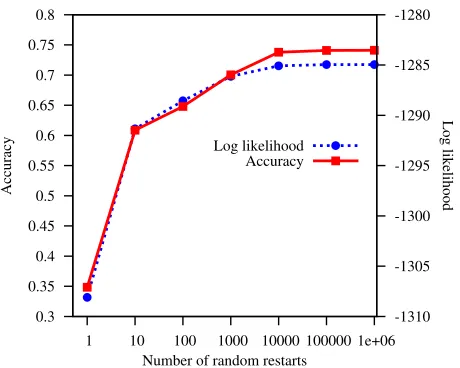
Figure 2: Synth 340 cipher. Accuracy by best model score and best model score vs. number of random restarts. Bootstrapped from 1M random restarts.
3.3 A Hard Cipher: Synth 340
What do these graphs look like for a harder cipher? Zodiac 340 is the second cipher released by the Zo-diac killer, and it remains unsolved to this day. How-ever, it is unknown whether Zodiac 340 is actually a homophonic cipher. If it were a homophonic cipher we would certainly expect it to be harder than Zo-diac 408 because ZoZo-diac 340 is shorter (only 340 characters long) and at the same time hasmore ci-pher symbols: 63. For our next experiment we gen-erate a cipher, which we call Synth 340, to match properties of Zodiac 340; later we will generate mul-tiple such ciphers.
We sample a random consecutive sequence of 340 characters from our small Zodiac corpus and use this as our message (and, of course, remove this se-quence from our language model training data). We then generate an encryption key by assigning each of 63 cipher symbols to a single plain text charac-ter so that the number of cipher symbols mapped to each plaintext character is proportional to the fre-quency of that character in the message (this bal-ancing makes the cipher more difficult). Finally, we generate the actual ciphertext by randomly sampling a cipher token for each plain text token uniformly at random from the cipher symbols allowed for that to-ken under our generated key.
0 10000 20000 30000 40000 50000 60000
-1340 -1330 -1320 -1310 -1300 -1290 -1280 -1270
Frequency
Log likelihood 42%
ntyouldli 59% veautital
[image:4.612.76.295.60.261.2]74% veautiful
Figure 3: Synth 340 cipher. Histogram of the likelihoods of the local optima encountered by EM across 1M random restarts. Several peaks are labeled with their average accuracy and a snippet of a decode. The gold snippet is “beautiful.”
lute gain in accuracy of about 9% between 100 ran-dom restarts and 100K ranran-dom restarts. A similarly large gain is seen for model score as we scale up the number of restarts. This means that, even after tens of thousands of random restarts, EM is still finding new local optima with better likelihoods. It also ap-pears that, even for a short cipher like Synth 340, likelihood and accuracy are reasonably coupled.
We can visualize the distribution of local optima encountered by EM across 1M random restarts by plotting a histogram. Figure 3 shows, for each range of likelihood, the number of random restarts that led to a local optimum with a model score in that range. It is quickly visible that a few model scores are substantially more likely than all the rest. This kind of sparsity might be expected if there were a small number of local optima that EM was ex-tremely likely to find. We can check whether the peaks of this histogram each correspond to a single local optimum or whether each is composed of mul-tiple local optima that happen to have the same like-lihood. For the histogram bucket corresponding to a particular peak, we compute the average relative dif-ference between each multinomial parameter and its mean. The average relative difference for the highest peak in Figure 3 is 0.8%, and for the second highest peak is 0.3%. These values are much smaller than
0 2000 4000 6000 8000 10000 12000 14000
-1330 -1320 -1310 -1300 -1290 -1280
Frequency
[image:4.612.316.534.62.260.2]Log likelihood
Figure 4: Zodiac 340 cipher. Histogram of the likelihoods of the local optima encountered by EM across 1M random restarts.
the average relative difference between the means of these two peaks, 40%, indicating that the peaks do correspond to single local optima or collections of extremely similar local optima.
There are several very small peaks that have the highest model scores (the peak with the highest model score has a frequency of 90 which is too small to be visible in Figure 3). The fact that these model scores are both high and rare is the reason we continue to see improvements to both accuracy and model score as we run numerous random restarts. The two tallest peaks and the peak with highest model score are labeled with their average accuracy and a small snippet of a decode in Figure 3. The gold snippet is the word “beautiful.”
3.4 An Unsolved Cipher: Zodiac 340
In a final experiment, we look at the Zodiac 340 cipher. As mentioned, this cipher has never been cracked and may not be a homphonic cipher or even a valid cipher of any kind. The reading order of the cipher, which consists of a grid of symbols, is unknown. We make two arguments supporting the claim that Zodiac 340 is not a homophonic cipher with row-major reading order: the first is statistical, based on the success rate of attempts to crack similar synthetic ciphers; the second is qualitative, compar-ing distributions of local optimum likelihoods.
expect to crack it? In order to answer this question we generate 100 more ciphers in the same way we generated Synth 340. We use 10K random restarts to attack each cipher, and compute accuracies by best model score. The average accuracy across these 100 ciphers was 75% and the minimum accuracy was 36%. All but two of the ciphers were deciphered with more than 51% accuracy, which is usually suf-ficient for a human to identify a decode as partially correct.
We attempted to crack Zodiac 340 using a row-major reading order and 1M random restarts, but the decode with best model score was nonsensical. This outcome would be unlikely if Zodiac 340 were like our synthetic ciphers, so Zodiac 340 is probably not a homophonic cipher with a row-major order. Of course, it could be a homophonic cipher with a dif-ferent reading order. It could also be the case that a large number of salt tokens were inserted, or that some other assumption is incorrect.
In Figure 4, we show the histogram of model scores for the attempt to crack Zodiac 340. We note that this histogram is strikingly different from the histogram for Synth 340. Zodiac 340’s histogram is not as sparse, and the range of model scores is much smaller. The sparsity of Synth 340’s histogram (but not Zodiac 340’s histogram) is typical of histograms corresponding to our set of 100 generated ciphers.
4 Conclusion
Random restarts, often considered a footnote of ex-perimental design, can indeed be useful on scales beyond that generally used in past work. In particu-lar, we found that the initializations that lead to the local optima with highest likelihoods are sometimes very rare, but finding them can be worthwhile; for the problems we looked at, local optima with high likelihoods also achieved high accuracies. While the present experiments are on a very specific unsuper-vised learning problem, it is certainly reasonable to think that large-scale random restarts have potential more broadly.
In addition to improving search, large-scale restarts can also provide a novel perspective when performing exploratory analysis, here letting us ar-gue in support for the hypothesis that Zodiac 340 is not a row-major homophonic cipher.
References
Taylor Berg-Kirkpatrick and Dan Klein. 2011. Sim-ple effective decipherment via combinatorial optimiza-tion. InProceedings of the 2011 Conference on Em-pirical Methods in Natural Language Processing. Thorsten Brants and Alex Franz. 2006. Web 1t 5-gram
version 1. Linguistic Data Consortium, Catalog Num-ber LDC2009T25.
Arthur Dempster, Nan Laird, and Donald Rubin. 1977. Maximum likelihood from incomplete data via the EM algorithm.Journal of the Royal Statistical Society. Kevin Knight, Anish Nair, Nishit Rathod, and Kenji
Ya-mada. 2006. Unsupervised analysis for decipherment problems. InProceedings of the 2006 Annual Meeting of the Association for Computational Linguistics. John Nickolls, Ian Buck, Michael Garland, and Kevin
Skadron. 2008. Scalable parallel programming with CUDA.Queue.
Sujith Ravi and Kevin Knight. 2008. Attacking deci-pherment problems optimally with low-order n-gram models. In Proceedings of the 2008 Conference on Empirical Methods in Natural Language Processing. Sujith Ravi and Kevin Knight. 2011. Bayesian inference
for Zodiac and other homophonic ciphers. In Proceed-ings of the 2011 Annual Meeting of the Association for Computational Linguistics: Human Language Tech-nologies.