Source-Side Classifier Preordering for Machine Translation
Uri Lerner
Google Inc.
Mountain View, CA, USA [email protected]
Slav Petrov
Google Inc. New York, NY, USA
Abstract
We present a simple and novel classifier-based preordering approach. Unlike existing pre-ordering models, we train feature-rich dis-criminative classifiers that directly predict the target-side word order. Our approach com-bines the strengths of lexical reordering and syntactic preordering models by performing long-distance reorderings using the structure of the parse tree, while utilizing a discrimina-tive model with a rich set of features, includ-ing lexical features. We present extensive ex-periments on 22 language pairs, including pre-ordering into English from 7 other languages. We obtain improvements of up to 1.4 BLEU on language pairs in the WMT 2010 shared task. For languages from different families the improvements often exceed 2 BLEU. Many of these gains are also significant in human eval-uations.
1 Introduction
Generating the appropriate word order for the tar-get language has been one of the fundamental prob-lems in machine translation since the ground setting work of Brown et al. (1990). Lexical reordering ap-proaches (Tillmann, 2004; Zens and Ney, 2006) add a reordering component to standard phrase-based translation systems (Och and Ney, 2004). Because the reordering model is trained discriminatively, it can use a rich set of lexical features. However, it only has access to the local context which often times is insufficient to make the long-distance re-ordering decisions that are necessary for language pairs with significantly different word order.
Preordering (sometimes called pre-reordering or simply reordering) approaches (Xia and McCord, 2004; Collins et al., 2005) preprocess the input in such a way that the words on the source side appear closer to their final positions on the target side. Be-cause preordering is performed prior to word align-ment, it can improve the alignment process and can then be combined with any subsequent translation model. Most preordering models use a source-side syntactic parser and perform a series of tree trans-formations. Approaches that do not use a parser ex-ist as well and typically induce a hierarchical rep-resentation that also allows them to perform long-distance changes (Tromble and Eisner, 2009; DeN-ero and Uszkoreit, 2011; Neubig et al., 2012).
Models that use a source-side parser differ on two main dimensions: the way tree transformations are expressed, and whether they are built manually or learned from data. One common type of tree trans-formation are rewrite rules. These typically involve some condition under which the transformation can be applied (e.g., a noun and an adjective found in the same clause) and the transformation itself (e.g., move the adjective after the noun). These rules can be designed manually (Collins et al., 2005; Wang et al., 2007) or learned from data (Xia and McCord, 2004; Habash, 2007; Genzel, 2010; Wu et al., 2011). Another type of tree transformations uses ranking functions to implement precedence-based reorder-ing. Here, a function assigns a numerical value to every word in a clause, intended to express the precedence of the word in the target language. The reordering operation is then to sort the words accord-ing to their assigned values. The rankaccord-ing function
can be designed manually (Xu et al., 2009) or trained from data (Yang et al., 2012). This approach is particularly effective for Subject-Object-Verb (SOV) languages.
In this work we present a simple classifier-based preordering model. Our model operates over de-pendency parse trees and is therefore able to per-form long-distance reordering decisions, as is typ-ical for preordering models. But instead of deter-ministic rules or ranking functions, we use discrim-inative classifiers to directly predict the final word order, using rich (bi-)lexical and syntactic features.
We present two models. The first model uses a classifier to directly predict the permutation order in which a family of words (a head word and all its children) will appear on the target side. This ap-proach is similar in spirit to the work of Li et al. (2007), except that they use constituency parse trees and consider only nodes with 2 or 3 children. We instead work with dependency trees and consider much larger head-children sets. Our second model is designed to decompose the exponential search space of all possible permutations. The prediction task is broken into two separate steps. In the first step, for each child word a binary classifier decides whether it appears before or after its parent in the target lan-guage. In the second step, we predict the best order of the words on each side of the parent. We show that the second approach is never worse than the first one and sometimes significantly better.
We present experiments on 22 language pairs from different language families using our preorder-ing approach in a phrase-based system (Och and Ney, 2004), as well as a forest-to-string system (Zhang et al., 2011). In a first set of experiments, we use the WMT 2010 shared task data (Callison-Burch et al., 2010) and show significant improve-ments of up to 1.4 BLEU (Papineni et al., 2002) on three out of eight language pairs. In a second set of experiments, we use automatically mined par-allel data from the web and build translation sys-tems for languages from various language families. We obtain especially big improvements in transla-tion quality (2-7 BLEU) when the language pairs have divergent word order (for example English to Indonesian, Japanese, Korean or Malay). In our ex-periments on English to and from Hungarian, Dutch, and Portuguese translation, we find that we can
ob-tain consistent improvements in both translation di-rections. To additionally verify our improvements we use human raters, who confirm the significance of the BLEU score improvements.
Finally, we compare training the preordering clas-sifiers on small amounts of manually aligned data to training on large quantities of automatically aligned data for English to Arabic, Hebrew, and Japanese. When evaluated on a pure reordering task, the mod-els trained on manually aligned data perform slightly better, but similar BLEU scores are obtained in both scenarios on an end-to-end translation task.
2 Classifier Reordering
Our goal is to learn a model that can transform the word order of an input sentence to an order that is natural in the target language. For example, when translating the English sentence:
The black cat climbed to the tree top.
to Spanish, we would like to reorder it as:
The cat black climbed to the top tree.
When translating to Japanese, we would like to get:
The black cat the tree top to climbed.
Such a model can then be used in combination with any translation model.
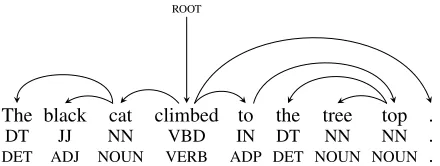
In our approach we first part-of-speech (POS) tag and parse the input sentence, producing the POS tags and head-modifier dependencies shown in Fig-ure 1. Reordering is then done by traversing the dependency tree starting at the root. For each head word we determine the order of the head and its chil-dren (independently of other decisions) and continue the traversal recursively in that order. In the exam-ple, we first need to decide on the order of the head
“climbed”and the children“cat”,“to”, and“.”.
2.1 Classification Model & Features
Obviously, it is possible to use any classification model and learning algorithm. We use maximum entropy classifiers withl1/l∞ regularization trained with the GradBoost algorithm (Duchi and Singer, 2009). We chose this setup since it naturally sup-ports multi-class prediction and can therefore be used to select one out of many possible permuta-tions. Additionally, the learning algorithm produces a sparse set of features. In our experiments the final models have typically only a few 100K non-zero fea-ture weights per language pair. Given this relatively small number of features, it is possible to manually inspect the feature weights and gain insights into the behavior of the model. We show an example analy-sis in Section 5.
Our features encode information about the context in which a word occurs in the sentence. We model context as “informative” words:
• The head itself.
• The children. We indicate whether each child is before, immediately before, immediately after, or after the head.
• For every child, if there is a gap between it and the head, then the first and last word of that gap.
• For every pair of consecutive children, if there is a gap between them, then the first and last word of that gap.
• The head’s immediate sibling to the left/right or an indication that none exists.
When extracting the features, every word can be rep-resented by its word identity, its fine-grained POS tag from the treebank, and a coarse-grained POS cat-egory, similar to the universal categories described in Petrov et al. (2012). We also include pairs of these features, resulting in potentially bilexical features.
2.2 Training Data
The training data for the classifiers is generated from the word aligned parallel text. Since parallel data is plentiful, we can afford to be selective. We first construct the intersection of high-confidence source-to-target and target-to-source alignments. For every family in the source dependency tree we generate a training instance if and only if the intersection de-fines a full order on the source words:
• Every source word must be aligned to at least one target word.
The black cat climbed to the tree top .
DT JJ NN VBD IN DT NN NN .
DET ADJ NOUN VERB ADP DET NOUN NOUN .
det
amod nsubj prep
det nc pobj p
[image:3.612.318.538.55.138.2]ROOT
Figure 1: A sentence, its dependency parse and its fine-grained and coarse-fine-grained POS tags.
• No two source words can be aligned to the same target word.
• If a source word is aligned to multiple target words, then no target word in this range can be aligned to a different source word.
While this might sound restrictive, we can usually generate at least some training instances from every sentence and discard the remaining families in the tree. In particular, we do not need to extract train-ing instances for all words in a given sentence since the reordering decisions are made independently for every head word.
A potential concern might be that our method for selecting training data can exclude all instances of certain words. Consider the English phrase “the boy”. For languages without articles (e.g. Russian or Japanese) the determiner“the”may either not be aligned to any word or get aligned to the foreign word for “boy”. In both cases the family will be discarded according to either the first or the second condition above. The concern is therefore that we would have no training data with the English word
“the”. In practice, however, this does not seem to be a problem. First, there are instances where the En-glish word“the”gets aligned to something (perhaps a preposition), and second, since the word“the”is omitted in the target language its location in the re-ordered sentence is not very important.
align-ment, train a preordering model, use the preordering model to learn a new alignment, and then train the final preordering model.
2.3 1-Step Classifier
As a first approach we use a single classifier to di-rectly predict the correct permutation of a given fam-ily. Consider the family headed by “climbed” in Figure 1. There are three children and the original order of the words is “cat”, “climbed”, “to”, and
“.”. A possible outcome of the classifier can be the permutation 0-2-1-3, representing the order “cat”,
“to”,“climbed”, and“.”.
The number of permutations for the head and n
children is of course (n+1)!, which becomes large very quickly and causes some problems. In practice we therefore limit ourselves to theK most common permutations. Unfortunately, this means that when-ever there are many children, the correct permuta-tion order might not be available as an oppermuta-tion. Even when the correct permutation is available, classifica-tion accuracy typically deteriorates as the number of possible classes increases.
An additional subtle issue is that the 1-step classi-fier cannot share useful information across different numbers of children. For example, in Spanish adjec-tives usually appear after the noun, but sometimes they appear before the noun. The decision depends on the adjective itself and sometimes the head noun, but does not depend on other children. Ideally, if for some adjective we have enough examples with 1 or 2 children we would like to make the same decision for a larger number of children, but these classifiers may not have enough relevant examples.
2.4 2-Step Classifier
Our 2-step approach addresses the exponential blowup of the number of children by decomposing the prediction into two steps:
1. For every child, decide whether it should ap-pear before or after the head.
2. Determine the order of the children that appear before the head and the order of the children after the head.
The two steps make the reordering of the modifiers before and after the head independent of each other, which is reminiscent of the lexicalized parse tree
generation approach of Collins (1997). In the run-ning example, for the head“climbed”we might first make the following three binary decisions: the word
“cat”should appear before the head and the words
“to”and “.” should appear after the head. In the second step there is only one word before the head so there is nothing to do. There are two words after the head, so we use another classifier to determine their order. The first step is implemented using a bi-nary classifier, called the pivotclassifier (since the head functions like the pivot in quicksort). The sec-ond step classifiers directly predict the correct per-mutation of the children before/after the head.
To illustrate the effectiveness of the 2-step ap-proach, consider a head word with 4 children. The 1-step approach must predict 1 of 5!=120 outcomes. In the 2-step approach, in the worst case the second step must predict 1 of 4! = 24 outcomes (if all the children are on one side of the head); if we are lucky and the children split evenly, then we only need two binary decisions in the second step (for the two pairs before and after the head). If we define hard cases as cases involving 5 or more words, 5.54% of the non-leaves are hard cases with the 1-step approach, but only 1.07% are hard cases with the 2-step approach.
3 Experimental Setup
To provide a through evaluation of our approach, we conduct experiments on two sets of data and with two translation systems. The first translation system is a phrase-based system (Och and Ney, 2004). In addition to the regular distance distortion model, we incorporate a maximum entropy based lexicalized phrase reordering model (Zens and Ney, 2006). Our second system is a forest-to-string system (Zhang et al., 2011). The forest-to-string system uses a one-best parse tree but factorizes it into a packed forest of binary elementary trees – hence the name forest-to-string rather than tree-forest-to-string.
In our implementation, in the 1-step approach we did not do any reordering for nodes with 7 or more children. In the 2-step approach we did not reorder the children on either side of the head if there were 7 or more of them. Even though there was no techni-cal reason that prevented us from raising the thresh-olds, there was no good reason to do so. There were very few cases where children were not reordered because of these thresholds, many of them corre-sponded to bad parses, and they had very little im-pact on the final scores. Thus, for the 1-step ap-proach we had 6 classifiers: 1 binary classifier for a head and a single child and 5 multi-class classifiers for 3–7 words. For the 2-step approach we had 11 classifiers: 1 pivot classifier, 5 classifiers for words before the head, and 5 for words after the head.
For a direct comparison to a strong preordering system, we compare to the system of Genzel (2010), which learns a set of unlexicalized reordering rules from automatically aligned data by minimizing the number of crossing alignments. We used a sliding window of size 3 and tried all three of their vari-ants. There were about 40-50 rules per language pair. While conceptually possible, it is not practi-cal to learn more rules (including lexipracti-calized rules) with this system, because of the computational com-plexity of the learning algorithm and the incremental nature in which the rules are learned and applied.
3.1 WMT Setup
In our first set of experiments, we use the data pro-vided for the WMT 2010 shared task (Callison-Burch et al., 2010). We build systems for all lan-guage pairs: English to and from Czech, French, German, and Spanish. Since this is a publicly avail-able dataset, it is easy to compare our results to other submissions to the shared task.
During word alignment, we filter out sentences exceeding 60 words in the parallel texts and per-form 6 iterations of IBM Model-1 training (Brown et al., 1993), followed by 6 iterations of HMM train-ing (Vogel et al., 1996). We do not use Model-4 because it is slow and did not add much value to our systems in a pilot study. Standard phrase extraction heuristics (Koehn et al., 2003) are applied to extract phrase pairs with a length limit of 6 from alignments symmetrized with the “union” heuristic. Maximum jump width is set to 8. Rule extraction for the
forest-to-string system is limited to 16 rules per tree node. There are no length-based reordering constraints in the forest-to-string system. We train two 5-gram lan-guage models with Kneser-Ney smoothing for each of the target languages. One is trained on the tar-get side of the parallel text, the other on a news cor-pus provided by the shared task. We tune the fea-ture weights for every configuration with 10 rounds of hypergraph-based Minimum Error Rate Training (MERT) (Kumar et al., 2009).
3.2 Additional Languages
In our second set of experiments, we explore the im-pact of classifier preordering for a number of lan-guages with different word orders. Some of the lan-guages included in our study are verb-subject-object (VSO) languages (Arabic, Irish, Welsh), subject-object-verb (SOV) languages (Japanese, Korean), and fairly free word order languages (Dutch, Hun-garian). Where a parser is available, we also conduct experiments on translating into English.
Since there are no standard training sets for many of these language pairs, we use parallel data auto-matically mined from the web. The amount of par-allel text for each language pair is between 120M and 160M words. For evaluation, we use a set of 9K English sentences collected from the web and trans-lated by humans into each of the target languages. Each sentence has one reference translation. We use 5K sentences for evaluation and the rest for tuning.
3.3 Evaluation
We use case-sensitive BLEU (Papineni et al., 2002) to assess translation quality. For Japanese and Ko-rean we use character-level BLEU. We use bootstrap resampling to compute confidence intervals.
Additionally, we also conduct a side-by-side hu-man evaluation on 750 sentences for each language pair (sampled from the same sentences used for computing BLEU). For each sentence, we ask bilin-gual annotators to compare the translations from two different systems and say whether one is better, lead-ing to three possible scores of -1, 0, and+1. We fo-cus on this relative comparison since absolute scores are difficult to calibrate across languages and raters.
3.4 Syntactic Parsers
Table 1 shows our treebank sources and parsing ac-curacies. For English, we use the updated WSJ with OntoNotes-style annotations converted to Stanford dependencies (de Marneffe et al., 2006). The re-maining treebanks are all available in dependency format. In all cases, we apply a set of heuristics to the treebank data to make the tokenization as simi-lar as possible to the one of the bitext. Our heuristics can split treebank tokens but do not merge treebank tokens. We found that adjusting the treebank tok-enization is crucial for obtaining good results. How-ever, this makes the reported parsing accuracies not comparable to other numbers in the literature. When necessary, we projectivize the treebanks by raising arcs until the tree becomes projective, as described in Nivre and Nilsson (2005); we do not reconstruct non-projective arcs at parsing time, since our subse-quent systems expect projective trees.
Our part-of-speech tagger is a conditional random field model (Lafferty et al., 2001) with simple word-identity and affix features. The parsing model is a shift-reduce dependency parser, using the higher-order features from Zhang and Nivre (2011). Addi-tionally, we include 256 word-cluster features (Koo et al., 2008) trained on a large amount of unlabeled monolingual text (Uszkoreit and Brants, 2008).
4 Experiments
Due to the large number of experiments and lan-guage pairs we divide the experiments into groups and discuss each in turn. We only include the results
UAS LAS POS
en: English1 92.28 90.28 97.05
cs: Czech2 84.66 72.01 98.97
de: German3 89.30 86.98 97.69
es: Spanish4 86.24 82.32 96.62
fr: French5 88.57 86.40 97.48
hu: Hungarian2 87.66 82.51 94.47
nl: Dutch3 86.09 82.31 97.38
[image:6.612.324.534.53.177.2]pt: Portuguese4 90.22 87.26 98.10
Table 1: Parsing accuracies on the retokenized treebanks. UAS is unlabeled attachment score, LAS is labeled at-tachment score, and POS is part-of-speech tagging accu-racy. The treebank sources are (1): Marcus et al. (1993)
+Judge et al. (2006)+Petrov and McDonald (2012), (2): Nivre et al. (2007), (3): Buchholz and Marsi (2006), (4): McDonald et al. (2013), (5): Abeill´e et al. (2003).
from the forest-to-string system when they are bet-ter than the phrase-based results. We use * to denote results from the forest-to-string system.
4.1 WMT Experiments
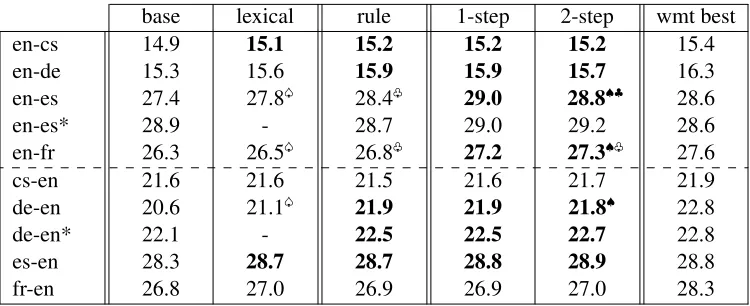
Table 2 presents detailed results on the WMT setup. Lexical reordering (Zens and Ney, 2006) never hurts and is thus included in all systems. Overall, our re-sults are a little better than the best rere-sults of the WMT 2010 shared task for two language pairs and within reach of the best results in most other cases.
base lexical rule 1-step 2-step wmt best
en-cs 14.9 15.1 15.2 15.2 15.2 15.4
en-de 15.3 15.6 15.9 15.9 15.7 16.3
en-es 27.4 27.8s 28.4p 29.0 28.8♠♣ 28.6
en-es* 28.9 - 28.7 29.0 29.2 28.6
en-fr 26.3 26.5s 26.8p 27.2 27.3♠p 27.6
cs-en 21.6 21.6 21.5 21.6 21.7 21.9
de-en 20.6 21.1s 21.9 21.9 21.8♠ 22.8
de-en* 22.1 - 22.5 22.5 22.7 22.8
es-en 28.3 28.7 28.7 28.8 28.9 28.8
[image:7.612.119.494.53.206.2]fr-en 26.8 27.0 26.9 26.9 27.0 28.3
Table 2: BLEU scores on the WMT 2010 setup. Results from the forest-to-string system are marked with * and are only included when better than the phrase-based results. Thebasesystem includes a distance distortion model; the
lexicalsystem adds lexical reordering;ruleis the rule preordering system of Genzel (2010) plus lexical reordering;
1-stepand2-stepare our classifier-based systems plus lexical reordering. Bolded results are statistically significantly better than non-bolded results as measured by a bootstrap sample test with a 99% confidence interval. Human evals are conducted only where indicated; we use♠and♣to indicate a significantly better result thansandpin the human eval at 95%. Also included are the best results from the WMT 2010 task.
Compared to a state-of-the-art preordering sys-tem, the automatic rule extraction system of Gen-zel (2010), we observe significant gains in several cases and no losses at all. The improvements on English-Spanish are significant also in the human evaluation, while the English-French improvements are positive, but not statistically significant.
Comparing the different languages, Czech (cs) ap-pears the most immune to improvements from pre-ordering (and lexical repre-ordering). One possible ex-planation is that Czech has a relatively free word order with a default SVO structure. It is therefore difficult to learn reordering changes from English to Czech. Additionally, the accuracy (LAS) of our Czech parser is by far the lowest of all parsers that we used, potentially limiting the benefits that can be obtained when translating from Czech into English. On this setup there is fairly little difference in per-formance between the 1-step and 2-step approaches. The main benefit of the 2-step approach is compact-ness: the set of 2-step classifiers has about half the number of non-zero features as the 1-step classifiers.
4.2 Additional Languages Experiments
Table 3 shows our first set of results on the additional languages, including some languages with a wide disparity in word order relative to English. The SOV languages Korean (ko) and Japanese (ja) benefit the
most from preordering and gain more than 7 BLEU relative to the phrase-based baseline and still more than 3 BLEU for the forest-to-string system. Simi-lar improvements were reported by Xu et al. (2009) with manual reordering rules. Indonesian (id) and Malay (ms) are next with gains of 2.5 BLEU. Malay does not have a grammatical subject in the sense that English does, but instead uses a concept of an agent and an object, whose order is determined by the voice of the verb. It appears that our classifiers have learned to model some of these highly lexical, but systematic ordering preferences. Welsh (cy) and Irish (ga) as VSO languages also exhibit large gains of 2.1 BLEU. For Arabic (ar) and Hebrew (iw), the gains are smaller, but still significant and exceed 1 BLEU relative to the baseline.
base rule 1-step 2-step
en-ar 11.4 12.3 12.5 12.6
en-cy 29.3 31.1 31.9p 32.4♣
en-ga 17.0 18.5 18.8p 19.1♣
en-iw 18.8 19.7 20.2 20.2
en-id 31.0 33.4 34.0p 34.3p
en-ja 10.4 16.4 17.5p 18.0♣
en-ja* 14.9 18.0 18.2p 18.6♣
en-ko 24.1 31.8 31.8p 32.7♣
[image:8.612.316.538.53.164.2]en-ms 20.4 22.5 22.9 22.9
Table 3: BLEU scores for language from various lan-guage families: Arabic (ar), Welsh (cy), Irish (ga), In-donesian (id), Hebrew (iw), Japanese (ja), Korean (ko), and Malay (ms). Lexical reordering is not included in any of the systems. Bolded results are significant at 99%.
♣is significantly better thanpin a human eval at 95%.
the 1-step system. The human judgments exactly agree with the results of the BLEU significance tests. The gains relative to the rule reordering system of Genzel (2010) and the no-preordering baseline are even larger and therefore clearly also significant.
In Table 4 we show results for Hungarian (hu), Dutch (nl), and Portuguese (pt). In all cases but English-Hungarian we observe significant improve-ments over the no preordering baseline. It should be noted that the gains are not symmetric – sometimes there are larger gains for translating out of English, while for Hungarian the gains are higher for trans-lating into English. Hungarian has a free word order which is difficult to predict which might partially ex-plain why there are no improvements for translating into Hungarian. For Dutch-English, the forest-to-string system yields the best results, which was also the case for German-English, further supporting the observation that combining different types of syn-tactic reordering approaches can be beneficial.
4.3 Manually Aligned Data
For Arabic (ar), Hebrew (iw), and Japanese (ja) we conducted some additional experiments with man-ually aligned data. We asked bilingual speakers to translate about 20K English sentences into the re-spective target language and to mark the alignment between the words. We reserved 20% of this data for evaluation and used the rest for training. For evalu-ation we used the fuzzy metric defined by Talbot et
base rule 1-step 2-step
en-hu 12.7 12.6 12.8 12.7
en-nl 25.3 26.1 26.4 26.4
en-pt 30.2 31.9 32.6 32.8
hu-en 22.0 22.2 22.7 22.7
nl-en 34.9 35.7 35.2 35.1
nl-en* 36.3 36.5 36.6 36.7
[image:8.612.79.296.53.191.2]pt-en 39.8 40.1 40.1 40.1
Table 4: BLEU scores for translating to and from En-glish for: Hungarian (hu), Dutch (nl), and Portuguese (pt). Lexical reordering is not used for any language pair. Bolded results are significant at 99%.
al. (2011), which counts the fraction of words that are reordered into the correct position.
The BLEU scores in Table 5 show that training from small amounts of manually aligned data or large amounts of automatically aligned data results in models of similar quality. In terms of the fuzzy metric, the models trained from manually aligned data were better. A possible explanation is that these models were trained on data which was much more similar to the evaluation data (both were subsets of the manually aligned data), biasing the metric in their favor. In absolute terms, the reordering ac-curacy is around 80% for Arabic and Japanese and close to 90% for Hebrew. Most impressively, more than 60% of the Hebrew sentences are exactly in the correct word order, implying that monotonic trans-lation may suffice.
We also examined the accuracy of the individual classifiers and found that the pivot classifier has an accuracy around 95%. It is therefore unlikely that a word is reordered to the wrong side of its head in the 2-step reordering approach. The classifiers that predict the final word order have an accuracy above 90% when there are only two words and drop to still respectable 70%-80% when there are 4 or more chil-dren or 20 possible options.
5 Analysis
In this section, we analyze an example whose trans-lation is significantly improved by our preordering approach, demonstrating the usefulness of our lexi-calized features. Consider the English sentence:
no reordering manual automatic
fuzzy exact BLEU fuzzy exact BLEU fuzzy exact BLEU
en-ar 63.2 19.8 11.4 83.5 47.6 12.4 79.0 38.9 12.6
en-iw 67.9 22.2 18.8 89.8 62.4 20.3 89.2 61.2 20.2
[image:9.612.115.500.53.124.2]en-ja* 44.1 0.0 14.9 80.9 41.5 18.4 78.5 36.8 18.6
Table 5: Preordering accuracy for the 2-step classifiers using manual alignments vs. automatic alignments. Fuzzy refers to the metric defined in Talbot et al. (2011) and exact is the percentage of sentences with a perfect preordering.
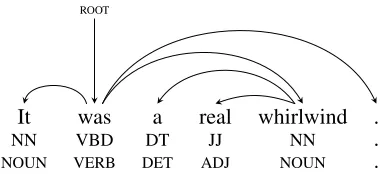
taken from the WMT test set. The dependency parse tree is shown in Figure 2. In our experiments the rule-based approach of (Genzel, 2010) reordered the source sentence into:
It was a whirlwind real.
and produced the translation:
Es un torbellino real.
In comparison, our 2-step system kept the English sentence unchanged and produced the translation:
Fue un aut´entico torbellino.
The second translation is better than the first because of the correct tense (which is not related directly to the preordering) and because the noun phrase“real whirlwind”is ordered correctly.
The main reason for the difference in the ordering is that the rule-based system can only use the unlex-icalized information from the parse tree. The head
“whirlwind”is a noun and the child“real”is an ad-jective; since adjectives typically appear after nouns in Spanish, their order is reversed.
To understand why the classifier-based system keeps “real” before “whirlwind”we can examine the features used by the classifier to make this deci-sion. In Table 6 we consider the 3 strongest features in favor of the child“real”appearing after the head
“whirlwind”and the three strongest features in favor of the child appearing before the head. Recall that the pivot is a binary classifier: positive features sup-port one decision (in our case: the child should be after the head) and the negative features support the other decision (the child should be before the head).
The three features that have the highest positive weight encode the fact that the child is an adjective, since in general, adjectives in Spanish appear after the noun. On the other hand, the three features with the most negative weights all encode the fact that the child is the word“real” which unlike most
adjec-tives tends to appear before the noun. It is interesting to note that for this particular ordering decision the child word is much more informative than the head word and indeed, all the important features contain information about the child and none of them con-tains any information about the head.
6 Conclusions & Future Work
We presented a simple and novel preordering ap-proach that produces substantial improvements in translation accuracy on a large number of languages. We use a source-side syntactic parser and train dis-criminative classifiers to predict the order of a parent and its children in the target language, using features from the dependency tree as well as (bi-)lexical fea-tures. To decompose the exponential space of all possible permutations, we introduce the 2-step ap-proach. We show empirically that this approach is significantly better than directly predicting the full permutation for some languages, and never signifi-cantly worse.
We obtain strong results on the WMT 2010 shared task data, observing gains of up to 1.4 BLEU over a state-of-the-art system. We also show gains of up to 0.5 BLEU over a strong directly comparable pre-ordering system that is based on learning unlexical-ized reordering rules. We obtain improvements of more than 2 BLEU in experiments on additional lan-guages. The gains are especially large for languages where the sentence structure is very different from English. These positive results are confirmed in hu-man side-by-side evaluations.
be-It was a real whirlwind .
NN VBD DT JJ NN .
NOUN VERB DET ADJ NOUN .
nsubj
det
amod attr
p
[image:10.612.336.518.54.151.2]ROOT
Figure 2: An example where lexical information is nec-essary for choosing the correct word order.
cause preordering is performed before learning word alignments, it has the potential to improve the word alignments. Second, by using discriminative clas-sifiers we can take advantage of lexical features. Finally, preordering can be combined with syntax-based translation models and our results confirm the complementary benefits that can be obtained.
Compared to other preordering models, our ap-proach has the obvious problem of having to make predictions over an exponential set of permutations. We show that this is not an insurmountable diffi -culty: our 2-step approach decomposes the exponen-tial space, often leading to much easier prediction tasks. Even when the number of possible permuta-tions is large we can limit ourselves to the K most popular permutations.
On the other hand, our approach provides im-portant advantages. Compared to systems that use rewrite rules, it is much easier to encode useful knowledge that by itself is not enough to determine a full rewrite rule, such as “a determiner is unlikely to be the last word in a clause.” Perhaps more im-portantly, our model provides an elegant answer to the question of what to do when multiple rewrite rules can be applied. Previous work has employed different heuristics: use the most specific rule (Xia and McCord, 2004), use all applicable rules (Gen-zel, 2010), or use the most frequent rule (Wu et al., 2011). In our model there is no need for such heuris-tics – all the “rules” are treated as features to a dis-criminative classifier, and the task of analyzing their interactions is handled by the learning algorithm.
Compared to preordering systems that use rank-ing functions, our model has the advantage that it can encode information about the complete permu-tation. For example, for three source words A, B, and C, we can naturally express the useful prior that
Feature Weight
PrevChild:tag=JJ,PrevSibling:a 0.448
PrevChild:cat=ADJ,PrevSibling:a 0.292
PrevChild:cat=ADJ,NoNextSibling 0.212
...
PrevChild:real,NoNextHeadSibling -0.310
PrevChild:real,PrevSibling:cat=DET -0.516
[image:10.612.89.281.55.142.2]PrevChild:real,PrevSibling:a -0.979
Table 6: The three features with the highest and low-est weights for choosing the position of“real” relative to“whirlwind.” PrevChild means that the child is the immediate word before the head. PrevSiblingrefers to the child’s sibling immediately to the left (the determiner
“a”). NoNextSiblingandNoNextHeadSiblingmean that the child and head do not have a sibling to the right.
A-B-C and C-B-A are likely orders but C-A-B is not. Promising directions for future work are joint parsing and reordering models, and measuring the influence of parsing accuracy on preordering and fi-nal translation quality.
References
A. Abeill´e, L. Cl´ement, and F. Toussenel. 2003. Build-ing a Treebank for French. In A. Abeill´e, editor, Tree-banks: Building and Using Parsed Corpora, chap-ter 10. Kluwer.
P. F. Brown, J. Cocke, S. A. Della Pietra, V. J. Della Pietra, F. Jelinek, J. D. Lafferty, R. L. Mercer, and P. S. Roossin. 1990. A statistical approach to machine translation.Computational Linguistics, 16(2). P. F. Brown, V. J. Della Pietra, S. A. Della Pietra, and
R. L. Mercer. 1993. The mathematics of statistical machine translation: Parameter estimation. Computa-tional Linguistics, 19.
S. Buchholz and E. Marsi. 2006. CoNLL-X shared task on multilingual dependency parsing. InProc. of CoNLL ’06.
C. Callison-Burch, P. Koehn, C. Monz, K. Peterson, M. Przybocki, and O. Zaidan. 2010. Findings of the 2010 joint workshop on statistical machine trans-lation and metrics for machine transtrans-lation. InProc. of ACL’05 WMT.
M. Collins, P. Koehn, and I. Kuˇcerov´a. 2005. Clause re-structuring for statistical machine translation. InProc. of ACL ’05.
M. Collins. 1997. Three generative, lexicalised models for statistical parsing. InACL ’97.
J. DeNero and J. Uszkoreit. 2011. Inducing sentence structure from parallel corpora for reordering. InProc. of EMNLP ’11.
J. Duchi and Y. Singer. 2009. Boosting with structural sparsity. InProc. of ICML ’09.
C. Dyer and P. Resnik. 2010. Context-free reordering, finite-state translation. InProc. of NAACL-HLT ’10. M. Galley, M. Hopkins, K. Knight, and D. Marcu. 2004.
What’s in a translation rule? InProc. of NAACL-HLT ’04.
D. Genzel. 2010. Automatically learning source-side re-ordering rules for large scale machine translation. In
Proc. of COLING ’10.
N. Habash. 2007. Syntactic preprocessing for statistical machine translation. InProc. of MTS ’07.
L. Huang, K. Knight, and A. Joshi. 2006. Statistical syntax-directed translation with extended domain of locality. InProc. of AMTA ’06.
J. Judge, A. Cahill, and J. v. Genabith. 2006. Question-Bank: creating a corpus of parse-annotated questions. InProc. of ACL ’06.
P. Koehn, F. J. Och, and D. Marcu. 2003. Statistical phrase based translation. InProc. of NAACL-HLT ’03. T. Koo, X. Carreras, and M. Collins. 2008. Simple semi-supervised dependency parsing. InProc. of ACL-HLT ’08.
S. Kumar, W. Macherey, C. Dyer, and F. Och. 2009. Effi -cient minimum error rate training and minimum bayes-risk decoding for translation hypergraphs and lattices. InProc. of ACL ’09.
J. Lafferty, A. McCallum, and F. Pereira. 2001. Con-ditional Random Fields: Probabilistic models for seg-menting and labeling sequence data. InProc. of ICML ’01.
C. H. Li, M. Li, D. Zhang, M. Li, M. Zhou, and Y. Guan. 2007. A Probabilistic Approach to Syntax-based Re-ordering for Statistical Machine Translation. InProc. of ACL ’07.
M. Marcus, B. Santorini, and M. Marcinkiewicz. 1993. Building a large annotated corpus of English: The Penn Treebank. InComputational Linguistics. R. McDonald, J. Nivre, Y. Quirmbach-Brundagez,
Y. Goldberg, D. Das, K. Ganchev, K. Hall, S. Petrov, H. Zhang, O. T¨ackstr¨om, C. Bedini, N. Bertomeu Castell´o, and J. Lee. 2013. Universal dependency an-notation for multilingual parsing. InProc. of ACL ’13. G. Neubig, T. Watanabe, and S. Mori. 2012. Inducing a discriminative parser to optimize machine translation reordering. InProc. of EMNLP-CoNLL ’12.
J. Nivre and J. Nilsson. 2005. Pseudo-projective depen-dency parsing. InProc. of ACL ’05.
J. Nivre, J. Hall, S. K¨ubler, R. McDonald, J. Nilsson, S. Riedel, and D. Yuret. 2007. The CoNLL 2007 shared task on dependency parsing. InProc. EMNLP-CoNLL ’07.
F. J. Och and H. Ney. 2004. The alignment template approach to statistical machine translation. Computa-tional Linguistics, 30(4).
K. Papineni, S. Roukos, T. Ward, and W. Zhu. 2002. BLEU: a method for automatic evaluation of machine translation. InProc. of ACL ’02.
S. Petrov and R. McDonald. 2012. Overview of the 2012 shared task on parsing the web. InProc. of NAACL ’12 SANCL.
S. Petrov, D. Das, and R. McDonald. 2012. A universal part-of-speech tagset. InProc. of LREC ’12.
D. Talbot, H. Kazawa, H. Ichikawa, J. Katz-Brown, M. Seno, and F. Och. 2011. A lightweight evalua-tion framework for machine translaevalua-tion reordering. In
Proc. of EMNLP ’11 WMT.
C. Tillmann. 2004. A unigram orientation model for sta-tistical machine translation. InProc. of NAACL-HLT ’04.
R. Tromble and J. Eisner. 2009. Learning linear ordering problems for better translation. In Proc. of EMNLP ’09.
J. Uszkoreit and T. Brants. 2008. Distributed word clus-tering for large scale class-based language modeling in machine translation. InProc. of ACL-HLT ’08. S. Vogel, H. Ney, and C. Tillmann. 1996. HMM-based
word alignment in statistical translation. InIn Proc. of COLING ’96.
C. Wang, M. Collins, and P. Koehn. 2007. Chinese syn-tactic reordering for statistical machine translation. In
Proc. of EMNLP-CoNLL ’07.
X. Wu, K. Sudoh, K. Duh, H. Tsukada, and M. Nagata. 2011. Extracting pre-ordering rules from predicate-argument structures. InProc. of IJCNLP ’11.
F. Xia and M. McCord. 2004. Improving a statistical MT system with automatically learned rewrite patterns. In
Proc. of COLING ’04.
P. Xu, J. Kang, M. Ringgaard, and F. Och. 2009. Using a dependency parser to improve SMT for subject-object-verb languages. InProc. of NAACL-HLT ’09.
K. Yamada and K. Knight. 2001. A syntax-based statis-tical translation model. InProc. of ACL ’01.
N. Yang, M. Li, D. Zhang, and N. Yu. 2012. A ranking-based approach to word reordering for statistical ma-chine translation. InProc. of ACL ’12.
R. Zens and H. Ney. 2006. Discriminative reordering models for statistical machine translation. InProc. of NAACL ’06 WMT.
Y. Zhang and J. Nivre. 2011. Transition-based depen-dency parsing with rich non-local features. InProc. of ACL-HLT ’11.