Exploring Demographic Language Variations to Improve Multilingual
Sentiment Analysis in Social Media
Svitlana Volkova Center for Language and
Speech Processing Johns Hopkins University
Baltimore, MD [email protected]
Theresa Wilson Human Language Technology
Center of Excellence Johns Hopkins University
Baltimore, MD [email protected]
David Yarowsky Center for Language and
Speech Processing Johns Hopkins University
Baltimore, MD [email protected]
Abstract
Different demographics, e.g., gender or age, can demonstrate substantial variation in their language use, particularly in informal contexts such as social media. In this paper we focus on learning gender differences in the use of sub-jective language in English, Spanish, and Rus-sian Twitter data, and explore cross-cultural differences in emoticon and hashtag use for male and female users. We show that gen-der differences in subjective language can ef-fectively be used to improve sentiment anal-ysis, and in particular, polarity classification for Spanish and Russian. Our results show statistically significant relative F-measure im-provement over the gender-independent base-line 1.5% and 1% for Russian, 2% and 0.5% for Spanish, and 2.5% and 5% for English for polarity and subjectivity classification.
1 Introduction
Sociolinguistics and dialectology have been study-ing the relationships between language and speech at the phonological, lexical and morphosyntactic lev-els and social identity for decades (Picard, 1997; Gefen and Ridings, 2005; Holmes and Meyerhoff, 2004; Macaulay, 2006; Tagliamonte, 2006). Re-cent studies have focused on exploring demographic language variations in personal email communica-tion, blog posts, and public discussions (Boneva et al., 2001; Mohammad and Yang, 2011; Eisenstein et al., 2010; O’Connor et al., 2010; Bamman et al., 2012). However, one area that remains largely unex-plored is the effect of demographic language varia-tion on subjective language use, and whether these
differences may be exploited for automatic senti-ment analysis. With the growing commercial im-portance of applications such as personalized rec-ommender systems and targeted advertising (Fan and Chang, 2009), detecting helpful product review (Ott et al., 2011), tracking sentiment in real time (Resnik, 2013), and large-scale, low-cost, passive polling (O’Connor et al., 2010), we believe that sen-timent analysis guided by user demographics is a very important direction for research.
In this paper, we focus on gender demographics and language in social media to investigate differ-ences in the language used to express opinions in Twitter for three languages: English, Spanish, and Russian. We focus on Twitter data because of its vol-ume, dynamic nature, and diverse population world-wide.1 We find that some words are more or less likely to be positive or negative in context depend-ing on the the gender of the author. For example, the word weaknessis more likely to be used in a pos-itive way by women (Chocolate is my weakness!) but in a negative way by men (Clearly they know our weakness. Argggg). The Russian wordдостичь (achieve) is used in a positive way by male users and in a negative way by female users.
Our goals of this work are to (1) explore the gen-der bias in the use of subjective language in so-cial media, and (2) incorporate this bias into models to improve sentiment analysis for English, Spanish, and Russian. Specifically, in this paper we:
• investigate multilingual lexical variations in the use of subjective language, and cross-cultural
1
As of May 2013, Twitter has 500m users (140m of them in the US) from more than 100 countries.
emoticon and hashtag usage on a large scale in Twitter data;2
• show that gender bias in the use of subjec-tive language can be used to improve sentiment analysis for multiple languages in Twitter. • demonstrate that simple, binary features
repre-senting author gender are insufficient; rather, it is the combination of lexical features, together with set-count features representing gender-dependent sentiment terms that is needed for statistically significant improvements.
To the best of our knowledge, this work is the first to show that incorporating gender leads to signifi-cant improvements for sentiment analysis, particu-larly subjectivity and polarity classification, for mul-tiple languages in social media.
2 Related Work
Numerous studies since the early 1970’s have inves-tigated gender-language differences in interaction, theme, and grammar among other topics (Schiffman, 2002; Sunderland et al., 2002). More recent research has studied gender differences in telephone speech (Cieri et al., 2004; Godfrey et al., 1992) and emails (Styler, 2011). Mohammad and Yang (2011) ana-lyzed gender differences in the expression of senti-ment in love letters, hate mail, and suicide notes, and emotional word usage across genders in email.
There has also been a considerable amount of work in subjectivity and sentiment analysis over the past decade, including, more recently, in mi-croblogs (Barbosa and Feng, 2010; Bermingham and Smeaton, 2010; Pak and Paroubek, 2010; Bifet and Frank, 2010; Davidov et al., 2010; Li et al., 2010; Kouloumpis et al., 2011; Jiang et al., 2011; Agarwal et al., 2011; Wang et al., 2011; Calais Guerra et al., 2011; Tan et al., 2011; Chen et al., 2012; Li et al., 2012). In spite of the surge of research in both sentiment and social media, only a limited amount of work focusing on gender identi-fication has looked at differences in subjective lan-guage across genders within social media. Thel-wall (2010) found that men and women use emoti-cons to differing degrees on MySpace, e.g., female
2Gender-dependent and independent lexical resources of subjective terms in Twitter for Russian, Spanish and English can be found here:http://www.cs.jhu.edu/~svitlana/
users express positive emoticons more than male users. Other researchers included subjective patterns as features for gender classification of Twitter users (Rao et al., 2010). They found that the majority of emotion-bearing features, e.g., emoticons, repeated letters, exasperation, are used more by female than male users, which is consistent with results reported in other recent work (Garera and Yarowsky, 2009; Burger et al., 2011; Goswami et al., 2009; Argamon et al., 2007). Other related work is that of Otter-bacher (2010), who studied stylistic differences be-tween male and female reviewers writing product reviews, and Mukherjee and Liu (2010), who ap-plied positive, negative and emotional connotation features for gender classification in microblogs.
Although previous work has investigated gen-der differences in the use of subjective language, and features of sentiment have been used in gender identification, to the best of our knowledge no one has yet investigated whether gender differences in the use of subjective language can be exploited to improve sentiment classification in English or any other language. In this paper we seek to answer this question for the domain of social media.
3 Data
For the experiments in this paper, we use three sets of data for each language: a large pool of data (800K tweets) labeled for gender but unlabeled for senti-ment, plus 2K development data and 2K test data labeled for both sentiment and gender. We use the unlabeled data to bootstrap Twitter-specific lexicons and investigate gender differences in the use of sub-jective language. We use the development data for parameter tuning while bootstrapping, and the test data for sentiment classification.
tool (Bergsma et al., 2012). According to LID, there are 1,881,620 (63.6%) English tweets from which we select a random, gender-balanced sample of 0.8M tweets. Burger’s corpus does not include Russian and Spanish data on the same scale as En-glish. Therefore, for Russian and Spanish we con-struct a new Twitter corpus by downloading tweets from followers of region-specific news and media Twitter feeds. We use LID to identify Russian and Spanish tweets, and remove retweets as before. In this data, gender is labeled automatically based on user first and last name morphology with a precision above 0.98 for all languages.
Sentiment labels for tweets in the development and test sets are obtained using Amazon Mechanical Turk. For each tweet we collect annotations from five workers and use majority vote to determine the final label for the tweet. Snow et al. (2008) show that for a similar task, labeling emotion and valence, on average four non-expert labelers are needed to achieve an expert level of annotation. Below are the example Russian tweets labeled for sentiment:
• Pos: Как же приятно просто лечь в по-стель после тяжелого дня... (It is a great pleasure to go to bed after a long day at work...) • Neg: Уважаемый господин Прохоров ку-пите эти выборы!(Dear Mr. Prokhorov just buy the elections!)
• Both:Затолкали меня на местном рынке! но зато закупилась подарками для всей семьи :)(It was crowded at the local market! But I got presents for my family:-))
• Neutral:Киев очень старый город(Kiev is a very old city).
Table 1 gives the distribution of tweets over senti-ment and gender labels for the developsenti-ment and test sets for English (EDEV, ETEST), Spanish (SDEV, STEST), and Russian (RDEV, RTEST).
Data Pos Neg Both Neut ♀ ♂
EDEV 617 357 202 824 1,176 824 ETEST 596 347 195 862 1,194 806 SDEV 358 354 86 1,202 768 1,232 STEST 317 387 93 1203 700 1,300 RDEV 452 463 156 929 1,016 984 RTEST 488 380 149 983 910 1,090
Table 1: Gender and sentiment label distribution in the development and test sets for all languages.
4 Subjective Language and Gender
To study the intersection of subjective language and gender in social media, ideally we would have a large corpus labeled for both. Although our large corpus is labeled for gender, it is not labeled for sen-timent. Only the 4K tweets for each language that compose the development and test sets are labeled for both gender and sentiment. Obtaining sentiment labels for all tweets would be both impractical and expensive. Instead we use large multilingual senti-ment lexicons developed specifically for Twitter as described below. Using these lexicons we can begin to explore the relationship between subjective lan-guage and gender in the large pool of data labeled for gender but unlabeled for sentiment. We also look at the relationship between gender and the use of different hashtags and emoticons. These can be strong indicators of sentiment in social media, and in fact are sometimes used to create noisy training data for sentiment analysis in Twitter (Pak and Paroubek, 2010; Kouloumpis et al., 2011).
4.1 Bootstrapping Subjectivity Lexicons
Recent work by Banea et.al (2012) classifies meth-ods for bootstrapping subjectivity lexicons into two types: corpus-based and dictionary-based. Corpus-based methods extract subjectivity lexicons from unlabeled data using different similarity metrics to measure the relatedness between words, e.g., Pointwise Mutual Information (PMI). Corpus-based methods have been used to bootstrap lexicons for ENGLISH (Turney, 2002) and other languages, including ROMANIAN (Banea et al., 2008) and JAPANESE(Kaji and Kitsuregawa, 2007).
Dictionary-based methods rely on relations be-tween words in existing lexical resources. For exam-ple, Rao and Ravichandran (2009) construct HINDI and FRENCH sentiment lexicons using relations in WordNet (Miller, 1995), Rosas et. al. (2012) boot-strap a SPANISHlexicon using SentiWordNet (Bac-cianella et al., 2010) and OpinionFinder,3Clematide and Klenner (2010), Chetviorkin et al. (2012) and Abdul-Mageed et. al. (2011) automatically expand and evaluate GERMAN, RUSSIANand ARABIC sub-jective lexicons.
3
We use the corpus-based, language-independent approach proposed by Volkova et al. (2013) to boot-strap Twitter-specific subjectivity lexicons. To start, the new lexicon is seeded with terms from the initial lexicon LI. On each iteration, tweets in the
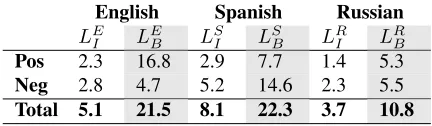
[image:4.612.321.528.330.466.2]unla-beled data are launla-beled using the current lexicon. If a tweet contains one or more terms from the lexicon it is marked subjective, otherwise neutral. Tweet po-larity is determined in a similar way, but takes into account negation. For every term not in the lexi-con with a frequency threshold, the probability of that word appearing in a subjective sentence is cal-culated. The topkterms with a subjective probabil-ity are then added to the lexicon. Bootstrapping con-tinues until there are no more new terms meeting the criteria to add to the lexicon. The parameters are op-timized using a grid search on the development data using F-measure for subjectivity classification. In Table 2 we report size and term polarity from the ini-tialLI and the bootstrappedLBlexicons. Although
more sophisticated bootstrapping methods exist, this approach has been shown to be effective for atomi-cally learning subjectivity lexicons in multiple lan-guages on a large scale without any external, rich, lexical resources, e.g., WordNet, or advanced NLP tools, e.g., syntactic parsers (Wiebe, 2000) or infor-mation extraction tools (Riloff and Wiebe, 2003).
For English, seed terms for bootstrapping are the strongly subjective terms in the MPQA lexicon (Wilson et al., 2005). For Spanish and Russian, the seed terms are obtained by translating the English seed terms using a bi-lingual dictionary, collecting subjectivity judgments from MTurk on the transla-tions, filtering out translations that are not strongly subjective, and expanding the resulting word lists with plurals and inflectional forms.
To verify that bootstrapping does provide a bet-ter resource than existing dictionary-expanded lexi-cons, we compare our Twitter-specific lexiconsLB
English Spanish Russian
LE
I LEB LSI LSB LRI LRB
Pos 2.3 16.8 2.9 7.7 1.4 5.3
Neg 2.8 4.7 5.2 14.6 2.3 5.5
[image:4.612.77.293.593.656.2]Total 5.1 21.5 8.1 22.3 3.7 10.8
Table 2: The initialLI and the bootstrappedLB
(high-lighted) lexicon term count (LI ⊂ LB) with polarity
across languages (thousands).
to the corresponding initial lexiconsLI and the
ex-isting state-of-the-art subjective lexicons including: • 8K strongly subjective English terms from
Sen-tiWordNetχE(Baccianella et al., 2010); • 1.5K full strength terms from the Spanish
sen-timent lexiconχS(Perez-Rosas et al., 2012); • 5K terms from the Russian sentiment lexicon
χR(Chetviorkin and Loukachevitch, 2012). For that we apply rule-based subjectivity classi-fication on the test data.4 This subjectivity classi-fier predicts that a tweet is subjective if it contains at least one, or at least two subjective terms from the lexicon. To make a fair comparison, we auto-matically expand χE with plurals and inflectional forms,χSwith the inflectional forms for verbs, and
χR with the inflectional forms for adverbs, adjec-tives and verbs. We report precision, recall and F-measure results in Table 3 and show that our boot-strapped lexicons outperform the corresponding ini-tial lexicons and the external resources.
Subj≥1 Subj≥2
P R F P R F
χE 0.67 0.49 0.57 0.76 0.16 0.27
LE
I 0.69 0.73 0.71 0.79 0.34 0.48
LEB 0.64 0.91 0.75 0.7 0.74 0.72
χS 0.52 0.39 0.45 0.62 0.07 0.13 LSI 0.50 0.73 0.59 0.59 0.36 0.45 LSB 0.44 0.91 0.59 0.51 0.71 0.59
χR 0.61 0.49 0.55 0.74 0.17 0.29 LRI 0.72 0.34 0.46 0.83 0.07 0.13 LR
B 0.64 0.58 0.61 0.74 0.23 0.35
Table 3: Precision, recall and F-measure results for sub-jectivity classification using the externalχ, initialLIand
bootstrappedLBlexicons for all languages.
4.2 Lexical Evaluation
With our Twitter-specific sentiment lexicons, we can now investigate how thesubjective useof these terms differs depending on gender for our three lan-guages. Figure 1 illustrates what we expect to find.
{F}and{M}are the sets of subjective terms used
by females and males, respectively. We expect that some terms will be used by males, but never by fe-males, and vice-versa. The vast majority, however, will be used by both genders. Within this set of shared terms, many words will show little difference
4
Figure 1: Gender-dependent vs. independent subjectivity terms (+ and - indicates term polarity).
Figure 2: The distribution of gender-dependent GDep and gender-independentGIndsentiment terms.
in their subjective use when considering gender, but there will be some words for which gender will have an influence. Of particular interest for our work are words in which the polarity of a term as it is used in context is gender-influenced, the extreme case being terms that flip their polarity depending on the gender of the user. Polarity may be different because the concept represented by the term tends to be viewed in a different light depending on gender. There are also words likeweaknessin which a more positive or more negative word sense tends to be used by men or women. In Figure 2 we show the distribution of gender-specific and gender-independent terms from theLBlexicons for all languages.
To identify gender-influenced terms in our lexi-cons, we start by randomly sampling 400K male and 400K female tweets for each language from the data. Next, for both genders we calculate the probability of termti appearing in a tweet with another
subjec-tive term (Eq.1), and the probability of it appearing with a positive or negative term (Eq.2-3) fromLB.
pti(subj∣g) =
c(ti, P, g) +c(ti, N, g)
c(ti, g)
, (1)
whereg∈F, M andPandN are positive and
nega-tive sets of terms from theinitiallexiconLI.
pti(+∣g) =
c(ti, P, g)
c(ti, P, g) +c(ti, N, g) (2)
pti(−∣g) =
c(ti, N, g)
c(ti, P, g) +c(ti, N, g) (3)
We introduce a novel metric∆p+
ti to measure po-larity change across genders. For every subjective termtiwe want to maximize the difference5:
∆p+
ti= ∣pti(+∣F) −pti(+∣M)∣ s.t.
R R R R R R R R R R R R
1−
tftsubj i (F) tftsubji (M) R R R R R R R R R R R R
≤λ, tftsubj
i (M) ≠0, (4)
where p(+∣F) and p(+∣M) are probabilities that
term ti is positive for females and males
respec-tively; tftsubj
i (F) and tf
subj
ti (M) are correspond-ing term frequencies (iftftsubji (F) >tftsubj
i (M)the fraction is flipped); λ is a threshold that controls the level of term frequency similarity6. The terms in which polarity is most strongly gender-influenced are those withλ→0and∆p+t
i →1.
Table 4 shows a sample of the most strongly gender-influenced terms from the initialLI and the
bootstrappedLB lexicons for all languages. A plus
(+) means that the term tends to be used positively
by women and minus (−) means that the term tends
to be used positively by men. For instance, in En-glish we found thatperfectingis used with negative polarity by male users but with positive polarity by female users; the termdogfightinghas negative po-larity for women but positive popo-larity for men.
4.3 Hashtags
People may also express positive or negative senti-ment in their tweets using hashtags. From our bal-anced samples of 800K tweets for each language, we extracted 611, 879, and 71 unique hashtags for English, Spanish, and Russian, respectively. As we did for terms in the previous section, we evaluated the subjective use of the hashtags. Some of these are clearly expressing sentiment (#horror), while others seem to be topics that people are frequently opinion-ated about (#baseball, #latingrammy, #spartak).
5
One can also maximize∆p−
ti= ∣pti(−∣F) −pti(−∣M)∣.
6
λ=0means term frequencies are identical for both
[image:5.612.79.293.170.289.2]English Initial TermsLE
I ∆p
+ λ English Bootstrapped TermsLE B ∆p
+ λ
perfecting + 0.7 0.2 pleaseeeeee + 0.7 0.0
weakened + 0.1 0.0 adorably + 0.6 0.4
saddened – 0.1 0.0 creatively – 0.6 0.5
misbehaving – 0.4 0.0 dogfighting – 0.7 0.5
glorifying – 0.7 0.5 overdressed – 1.0 0.3
Spanish Initial TermsLS
I Spanish Bootstrapped TermsL S B
fiasco (fiasco) + 0.7 0.3 cafeína (caffeine) + 0.7 0.5 triunfar (succeed) + 0.7 0.0 claro (clear) + 0.7 0.3 inconsciente (unconscious) – 0.6 0.2 cancio (dog) – 0.3 0.3 horroriza (horrifies) – 0.7 0.3 llevara (take) – 0.8 0.3 groseramente (rudely) – 0.7 0.3 recomendarlo (recommend) – 1.0 0.0
Russian Initial TermsLRI Russian Bootstrapped TermsLRB
магическая(magical) + 0.7 0.3 мечтайте(dream!) + 0.7 0.3
сенсационный(sensational) + 0.7 0.3 танцуете(dancing) + 0.7 0.3
обожаемый(adorable) – 0.7 0.0 сложны(complicated) – 1.0 0.0
искушение(temptation) – 0.7 0.3 молоденькие(young) – 1.0 0.0
[image:6.612.107.502.47.271.2]заслуживать(deserve) – 1.0 0.0 достичь(achieve) – 1.0 0.0
Table 4: Sample of subjective terms sorted by∆p+
to show lexical differences and polarity change across genders (module is not applied as defined in Eq.1 to demonstrate the polarity change direction).
English ∆p+ λ Spanish ∆p+ λ Russian ∆p+ λ #parenting + 0.7 0.0 #rafaelnarro (politician) + 1.0 0.0 #совет(advise) + 1.0 0.0 #vegas – 0.2 0.8 #amores (loves) + 0.2 1.0 #ukrlaw + 1.0 1.0 #horror – 0.6 0.7 #britneyspears + 0.1 0.3 #spartak (soccer team) – 0.7 0.9 #baseball – 0.6 0.9 #latingrammy – 0.5 0.1 #сны(dreams) – 1.0 0.0 #wolframalpha – 0.7 1.0 #metallica (music band) – 0.5 0.8 #iphones – 1.0 1.0
Table 5: Hashtag examples with opposite polarity across genders for English, Spanish, and Russian.
Table 5 gives the hashtags, correlated with sub-jective language, that are most strongly gender-influenced. Analogously to∆p+values in Table 4, a
plus (+) means the hashtag is more likely to be used
positively by women, and a minus (−) means the
hashtag is more likely to be used positively by men. For example, in English we found that male users tend to express positive sentiment in tweets men-tioning #baseball, while women tend to be nega-tive about this hashtag. The opposite is true for the hashtag#parenting.
4.4 Emoticons
We investigate how emoticons are used differently by men and women in social media following the work by (Bamman et al., 2012). For that we rely on the lists of emoticons from Wikipedia7 and present the cross-cultural and gender emoticon differences in Figure 3. The frequency of each emoticon is given
7
List of emoticons from Wikipedia http://en. wikipedia.org/wiki/List_of_emoticons
on the right of each language chart, with probability of use by a male user in that language given on the
x-axis. The top 8 emoticons are the same across lan-guages and sorted by English frequency.
We found that emoticons in English data are used more overall by female users, which is consistent with previous findings in Schnoebelen’s work.8 In addition, we found that some emoticons like :-)
(smile face)and:-o(surprised)are used equally by both genders, at least in Twitter. When comparing English emoticon usage to other languages, there are some similarities, but also some clear differences. In Spanish data, several emoticons are more likely to be used by male than by female users, e.g.,:-o (sur-prised)and:-&(tongue-tied), and the difference in probability of use by males and females is greater for the emoticons, as compared to the same emoti-cons for English. Interestingly, in Russian Twitter
8
[image:6.612.78.534.311.384.2]p(Male|Emoticon)
0.0 0.2 0.4 0.6 0.8 1.0 34.4K
8.7K
4.1K
2.7K
0.9K
0.7K
0.4K
0.1K
0.1K
0.1K :)
:(
:-)
:-&
:-(
:[
:-/
8)
()
:-o
p(Male|Emoticon)
0.0 0.2 0.4 0.6 0.8 1.0 19.1K
9.5K
1.5K
0.1K
0.3K
0.3K
0.1K
1.5K
0.1K
0.1K :)
:(
:-)
:-&
:-(
:[
:-/
8)
%)
:-o
p(Male|Emoticon)
0.0 0.2 0.4 0.6 0.8 1.0
41.5K
4.5K
4.6K
0.4K
0.4K
0.1K
0.1K
0.4K
0.4K
0.1K :)
:(
:-)
:-&
:-(
:[
:-/
8)
%)
[image:7.612.108.504.80.260.2]()
Figure 3: Probability of gender and emoticons for English, Spanish and Russian (from left to right).
data emoticons tend to be used more or equally by male users rather than female users.
5 Experiments
The previous section showed that there are gender differences in the use of subjective language, hash-tags, and emoticons in Twitter. We aim leverage these differences to improve subjectivity and po-larity classification for the informal, creative and dynamically changing multilingual Twitter data.9 For that we conduct experiments using gender-independent GInd and gender-dependent GDep
features and compare the results to evaluate the in-fluence of gender on sentiment classification.
We experiment with two classification ap-proaches: (I) rule-based classifier which uses only subjective terms from the lexicons designed to verify if the gender differences in subjective language cre-ate enough of a signal to influence sentiment classifi-cation; (II) state-of-the-art supervised models which rely on lexical features as well as lexicon set-count features.10,11 Moreover, to show that the
gender-9
For polarity classification we distinguish between positive and negative instances, which is the approach typically reported in the literature for recognizing polarity (Velikovich et al., 2010; Yessenalina and Cardie, 2011; Taboada et al., 2011)
10
A set-count feature is a count of the number of instances from a set of terms that appears in a tweet.
11We also experimented with repeated punctuation ( !!, ??) and letters (nooo, reealy), which are often used in sentiment classification in social media. However, we found these features
sentiment signal can be learned by more than one classifier we apply a variety of classifiers imple-mented in Weka (Hall et al., 2009). For that we do 10-fold cross validation over English, Spanish, and Russian test data (ETEST, STEST and RTEST) la-beled with subjectivity (pos, neg, both vs. neut) and polarity (pos vs. neg) as described in Section 3.
5.1 Models
For the rule-basedGIndRBsubjclassifier, tweets are la-beled as subjective or neutral as follows:
GIndRBsubj = { 1 if ⃗
w⋅ ⃗f≥0.5,
0 otherwise (5)
where w⃗ ⋅ ⃗f stands for weighted set features, e.g.,
terms fromLI only, emoticonsE, or different
part-of-speech tags (POS) fromLB weighted usingw=
p(subj) = p(subj∣M) + p(subj∣F) subjectivity
score as shown in Eq.1. We experiment with the POS tags to show the contribution of each POS to sentiment classification.
Similarly, for the rule-based GIndRBpol classifier, tweets are labeled as positive or negative:
GIndRBpol = { 1 if ⃗
w+⋅ ⃗f+≥w⃗−⋅ ⃗f−,
0 otherwise (6)
wheref⃗+,f⃗−are feature sets that include only
posi-tive and negaposi-tive features fromLIorLB;w+andw−
0.6 0.7 0.8 0.9 0.62 0.64 0.66 0.68 0.70 Recall Pre ci si on +E +A +R +V +N L_I +E +A +R +V +N L_I
(a) Rule-based subjectivity
0.65 0.70 0.75 0.80 0.85 0.90
0.65 0.70 0.75 0.80 0.85 Recall Pre ci si on L_I +E +A +R +V +N L_I +E +A +R +V +N
(b) Rule-based polarity
BLR NB AB RF J48 SVM
Classifiers F -me asu re 0.55 0.60 0.65 0.70 0.75 0.80
0.85 GIndSubjAND
GDepSubjAND
GIndPolAND
GDepPolAND
[image:8.612.77.539.67.219.2](c) SL subjectivity and polarity
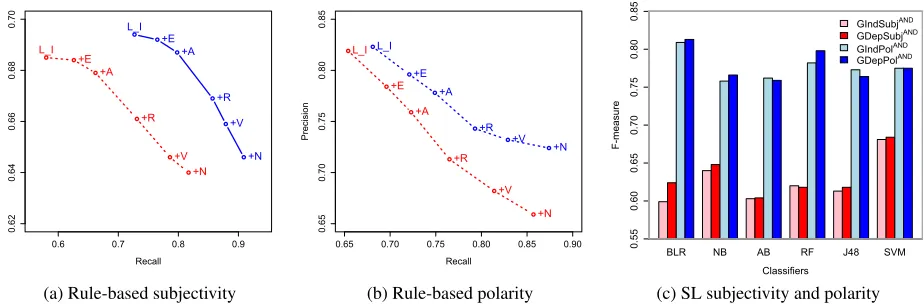
Figure 4: Rule-based (RB) and Supervised Learning (SL) sentiment classification results for English. LI - the initial
lexicon,E- emoticons,A, R, V, N are adjectives, adverbs, verbs, nouns fromLB.
are positive and negative polarity scores estimated using Eq.2 - 3 such as: w+
=p(+∣M) +p(+∣F)and
w−
=p(−∣M) +p(−∣F).
The gender-dependent rule-based classifiers are defined in a similar way. Specifically,f⃗is replaced
by f⃗M and f⃗F in Eq.5 and f⃗−,f⃗+ are replaced
by f⃗M− ,f⃗F−
and f⃗M+ ,f⃗F+
respectively in Eq.6. We learn subjectivitys⃗and polarityp⃗score vectors
using Eq.1-3. The difference between GInd and
GDep models is that GInd scoresw⃗, w⃗+ and w⃗−
are not conditioned on gender.
For gender-independent classification using su-pervised models, we build feature vectors using lex-ical featuresV represented as term frequencies, to-gether with set-count features from the lexicons:
⃗
fsubjGInd= [LI, LB, E, V];
⃗
fpolGInd= [L+I, L+B, E+, L−I, L−B, E−, V].
Finally, forgender-dependentsupervised models, we try different feature combinations. (A) We ex-tract set-count features for gender-dependent subjec-tive terms fromLI, LB,andEjointly:
⃗
fGDep−J
subj = [L M
I , LMB, EM, LIF, LFB, EF, V];
⃗
fDep−J
pol = [L M+
I , LM
+
B , EM
+ , LF+
I , LF
+
B , EF
+
LM−
I , LM
−
B , EM
− , LF−
I , LF
−
B , EF
− , V].
(B) We extract disjoint (prefixed) gender-specific features (in addition to lexical features V) by rely-ing only on female set-count features when classify-ing female tweets; and only male set-count features
for male tweets. We refer to the joint features as
GInd−JandGDep−J, and to the disjoint features
GInd−DandGDep−D.
5.2 Results
Figures 4a and 4b show performance improvements for subjectivity and polarity classification under the rule-based approach when taking into account gen-der. The left figure shows precision-recall curves for subjectivevs.neutral classification, and the mid-dle figure shows precision-recall curves for positive
vs.negative classification. We measure performance starting with features fromLI, and then
incremen-tally add emoticon featuresE and features fromLB
one part of speech at a time to show the contribution of each part of speech for sentiment classification.12 This experiment shows that there is a clear improve-ment for the models parameterized with gender, at least for the simple, rule-based model.
For the supervised models we experiment with a variety of learners for English to show that gen-der differences in subjective language improve sen-timent classification for many learning algorithms. We present the results in Figure 4c. For subjectiv-ity classification, Support Vector Machines (SVM), Naive Bayes (NB) and Bayesian Logistic Regres-sion (BLR) achieve the best results, with improve-ments in F-measure ranging from 0.5 - 5%. The po-larity classifiers overall achieve much higher scores, with improvements forGDepfeatures ranging from 1-2%. BLR with Gaussian prior is the top scorer
12
P R F A Arand P R F A Arand
English subj vs. neutral p(subj)=0.57 English pos vs. neg p(pos)=0.63
GIndLR 0.62 0.58 0.60 0.66 – 0.78 0.83 0.80 0.71 –
GDep−J 0.64 0.62 0.63 0.68 0.66 0.80 0.83 0.82 0.73 0.70
∆R,% +3.23 +6.90 +5.00 +3.03 3.03↓ +2.56 0.00 +2.50 +2.82 4.29↓
GIndSV M 0.66 0.70 0.68 0.72 – 0.79 0.86 0.82 0.77 –
GDep−D 0.66 0.71 0.68 0.72 0.70 0.80 0.87 0.83 0.78 0.76
∆R,% –0.45 +0.71 0.00 –0.14 2.85↓ +0.38 +0.23 +0.24 +0.41 2.63↓
Spanish subj vs. neutral p(subj)=0.40 Spanish pos vs. neg p(pos)=0.45
GIndLL 0.67 0.71 0.68 0.61 – 0.71 0.63 0.67 0.71 –
GDep−J 0.67 0.72 0.69 0.62 0.61 0.72 0.65 0.68 0.71 0.68
∆R,% 0.00 +1.40 +0.58 +0.73 1.64↓ +2.53 +3.17 +1.49 0.00 4.41↓
GIndSV M 0.68 0.79 0.73 0.65 – 0.66 0.65 0.65 0.69 –
GDep−D 0.68 0.79 0.73 0.66 0.65 0.68 0.67 0.67 0.71 0.68
∆R,% +0.35 +0.21 +0.26 +0.54 1.54↓ +2.43 +2.44 +2.51 +2.08 4.41↓
Russian subj vs. neutral p(subj)=0.51 Russian pos vs. neg p(pos)=0.58
GIndLR 0.66 0.68 0.67 0.67 – 0.66 0.72 0.69 0.62 –
GDep−J 0.66 0.69 0.68 0.67 0.66 0.68 0.73 0.70 0.64 0.63
∆R,% 0.00 +1.47 +0.75 0.00 1.51↓ +3.03 +1.39 +1.45 +3.23 1.58↓
GIndSV M 0.67 0.75 0.71 0.70 – 0.64 0.73 0.68 0.62 –
GDep−D 0.67 0.76 0.71 0.70 0.69 0.65 0.74 0.69 0.63 0.62
[image:9.612.93.523.47.325.2]∆R,% –0.30 +1.46 +0.56 +0.14 1.44↓ +0.93 +1.92 +1.46 +1.49 1.61↓
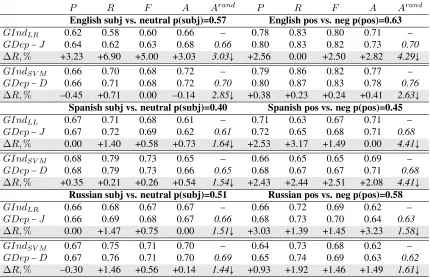
Table 6: Sentiment classification results obtained using gender-dependent and gender-independent joint and disjoint features for Logistic Regression (LR) and SVM models.
for polarity classification with an F-measure of 82%. We test our results for statistical significance us-ing McNemar’s Chi-squared test (p-value<0.01) as
suggested by Dietterich (1998). Only three classi-fiers, J48, AdaBoostM1 (AB) and Random Forest (RF) do not always show significant improvements for GDep features over GIndfeatures. However, for the majority of classifiers,GDepmodels outper-formGIndmodels for both tasks, demonstrating the robustness ofGDepfeatures for sentiment analysis.
In Table 6 we report results for subjectivity and polarity classification using the best performing classifiers (as shown in Figure 4c) :
- Logistic Regression (LR) (Genkin et al., 2007) forGInd−J andGDep−J models.
- SVM model with radial-based kernel for
GInd−D and GDep−D models. We use
LibSVM implementation (EL-Manzalawy and Honavar, 2005).
Each ∆R(%) row shows the relative percent
im-provements in terms of precision P, recall R, F-measureF and accuracyAforGDepcompared to
GIndmodels. Our results show that differences in subjective language across genders can be exploited
to improve sentiment analysis, not only for English but for multiple languages. For Spanish and Russian results are lower for subjectivity classification, we suspect, because lexical features V are already in-flected for gender and set-count features are down-weighted by the classifier. For polarity classifica-tion, on the other hand, gender-dependent features provide consistent, significant improvements (1.5-2.5%) across all languages.
As a reality check, Table 6 also reports accuracies (inArandcolumns) for experiments that use random permutations of male and female subjective terms, which are then encoded as gender-dependent set-count features as before. We found that all gender-dependent models,GDep−J andGDep−D,
out-performed their random equivalents for both subjec-tivity and polarity classification (as reflected by rel-ative accuracy decrease↓forArandcompared toA).
These results further confirm the existence of gen-der bias in subjective language for any of our three languages and its importance for sentiment analysis.
fea-English Spanish Russian
P R P R P R
[image:10.612.83.288.61.147.2](a) 0.73 0.93 0.68 0.63 0.66 0.74 (b) 0.72 0.94 0.69 0.64 0.66 0.74 (c) 0.78 0.83 0.71 0.63 0.66 0.72 (d) 0.69 0.93 0.71 0.62 0.65 0.76 (e) 0.80 0.83 0.72 0.65 0.68 0.73
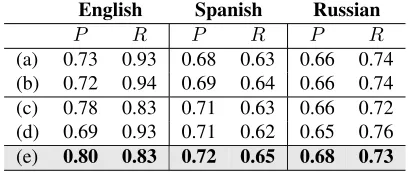
Table 7: Precision and recall results for polarity classifi-cation: encoding gender as a binary feature vs. gender-dependent featuresGDep−J.
tures such as: (a) unigram term frequenciesV, (b) term frequencies and gender binaryV +GBin, (c)
gender-independent GInd, (d) gender-independent and gender binary GBin+GInd, and (e)
gender-dependent GDep−J. We train logistic-regression
model for polarity classification and report precision and recall results in Table 7. We observe that includ-ing gender as a binary feature does not yield signif-icant improvements compared toGDep−J for all
three languages.
6 Conclusions
We presented a qualitative and empirical study that analyses substantial and interesting differences in subjective language between male and female users in Twitter, including hashtag and emoticon usage across cultures. We showed that incorporating au-thor gender as a model component can significantly improve subjectivity and polarity classification for English (2.5% and 5%), Spanish (1.5% and 1%) and Russian (1.5% and 1%). In future work we plan to develop new models for joint modeling of personal-ized sentiment, user demographics e.g., age and user preferences e.g., political favorites in social media.
Acknowledgments
The authors thank the anonymous reviewers for helpful comments and suggestions.
References
Muhammad Abdul-Mageed, Mona T. Diab, and Mo-hammed Korayem. 2011. Subjectivity and sentiment analysis of modern standard Arabic. InProceedings of the 49th Annual Meeting of the Association for Com-putational Linguistics: Human Language Technolo-gies: short papers - Volume 2, pages 587–591.
Apoorv Agarwal, Boyi Xie, Ilia Vovsha, Owen Rambow, and Rebecca Passonneau. 2011. Sentiment analysis of twitter data. In Proceedings of the Workshop on Languages in Social Media (LSM’11), pages 30–38. Shlomo Argamon, Moshe Koppel, James W.
Pen-nebaker, and Jonathan Schler. 2007. Min-ing the blogosphere: Age, gender and the va-rieties of self-expression. First Monday, 12(9). http://www.firstmonday.org/ojs/index.php/fm/article/ view/2003/1878.
Stefano Baccianella, Andrea Esuli, and Fabrizio Sebas-tiani. 2010. Sentiwordnet 3.0: An enhanced lexical resource for sentiment analysis and opinion mining. In
Proceedings of the Seventh International Conference on Language Resources and Evaluation (LREC’10), pages 2200–2204.
David Bamman, Jacob Eisenstein, and Tyler Schnoebe-len. 2012. Gender in Twitter: styles, stances, and so-cial networks.Computing Research Repository. Carmen Banea, Rada Mihalcea, and Janyce Wiebe. 2008.
A bootstrapping method for building subjectivity lex-icons for languages with scarce resources. In Pro-ceedings of the Sixth International Conference on Lan-guage Resources and Evaluation (LREC’08), pages 2764–2767.
Luciano Barbosa and Junlan Feng. 2010. Robust sen-timent detection on Twitter from biased and noisy data. InProceedings of the 23rd International Con-ference on Computational Linguistics (COLING’10), pages 36–44.
Shane Bergsma, Paul McNamee, Mossaab Bagdouri, Clayton Fink, and Theresa Wilson. 2012. Language identification for creating language-specific Twitter collections. In Proceedings of the Second Workshop on Language in Social Media (LSM’12), pages 65–74. Adam Bermingham and Alan F. Smeaton. 2010. Clas-sifying sentiment in microblogs: Is brevity an advan-tage? InProceedings of the 19th ACM International Conference on Information and Knowledge Manage-ment (CIKM’10), pages 1833–1836.
Albert Bifet and Eibe Frank. 2010. Sentiment knowl-edge discovery in Twitter streaming data. In Proceed-ings of the 13th International Conference on Discovery Science (DS’10), pages 1–15.
Bonka Boneva, Robert Kraut, and David Frohlich. 2001. Using email for personal relationships: The differ-ence gender makes. American Behavioral Scientist, 45(3):530–549.
Pedro Henrique Calais Guerra, Adriano Veloso, Wagner Meira Jr, and Virgílio Almeida. 2011. From bias to opinion: a transfer-learning approach to real-time sen-timent analysis. In Proceedings of the17th Interna-tional Conference on Knowledge Discovery and Data Mining (KDD’11), pages 150–158.
Lu Chen, Wenbo Wang, Meenakshi Nagarajan, Shaojun Wang, and Amit P. Sheth. 2012. Extracting diverse sentiment expressions with target-dependent polarity from Twitter. In Proceedings of the Sixth Interna-tional AAAI Conference on Weblogs and Social Media (ICWSM’12), pages 50–57.
Ilia Chetviorkin and Natalia V. Loukachevitch. 2012. Extraction of Russian sentiment lexicon for prod-uct meta-domain. In Proceedings of the 25rd In-ternational Conference on Computational Linguistics (COLING’12), pages 593–610.
Christopher Cieri, David Miller, and Kevin Walker. 2004. The Fisher corpus: a resource for the next gen-erations of speech-to-text. In Proceedings of the 4th International Conference on Language Resources and Evaluation (LREC’04), pages 69–71.
Simon Clematide and Manfred Klenner. 2010. Eval-uation and extension of a polarity lexicon for Ger-man. In Proceedings of the Workshop on Computa-tional Approaches to Subjectivity and Sentiment Anal-ysis (WASSA’10), pages 7–13.
Dmitry Davidov, Oren Tsur, and Ari Rappoport. 2010. Enhanced sentiment learning using Twitter hashtags and smileys. In Proceedings of the 23rd Inter-national Conference on Computational Linguistics (COLING’10), pages 241–249.
Thomas G. Dietterich. 1998. Approximate statistical tests for comparing supervised classification learning algorithms.Neural Computation, 10(7):1895–1923.
Jacob Eisenstein, Brendan O’Connor, Noah A. Smith, and Eric P. Xing. 2010. A latent variable model for ge-ographic lexical variation. InProceedings of the Con-ference on Empirical Methods in Natural Language Processing (EMNLP’10), pages 1277–1287.
Yasser EL-Manzalawy and Vasant Honavar, 2005.
WLSVM: Integrating LibSVM into Weka Environment. http://www.cs.iastate.edu/ yasser/wlsvm.
Teng-Kai Fan and Chia-Hui Chang. 2009. Sentiment-oriented contextual advertising. Advances in Informa-tion Retrieval, 5478:202–215.
Nikesh Garera and David Yarowsky. 2009. Modeling la-tent biographic attributes in conversational genres. In
Proceedings of the Joint Conference of the 47th An-nual Meeting of the ACL and the 4th International Joint Conference on Natural Language Processing of the AFNLP, pages 710–718.
David Gefen and Catherine M. Ridings. 2005. If you spoke as she does, sir, instead of the way you do: a so-ciolinguistics perspective of gender differences in vir-tual communities. SIGMIS Database, 36(2):78–92. Alexander Genkin, David D. Lewis, and David Madigan.
2007. Large-scale Bayesian logistic regression for text categorization. Technometrics, 49:291–304.
Kevin Gimpel, Nathan Schneider, Brendan O’Connor, Dipanjan Das, Daniel Mills, Jacob Eisenstein, Michael Heilman, Dani Yogatama, Jeffrey Flanigan, and Noah A. Smith. 2011. Part-of-speech tagging for Twitter: annotation, features, and experiments. In Pro-ceedings of the 49th Annual Meeting of the Associa-tion for ComputaAssocia-tional Linguistics: Human Language Technologies: short papers - Volume 2, pages 42–47. John J. Godfrey, Edward C. Holliman, and Jane
Mc-Daniel. 1992. Switchboard: telephone speech corpus for research and development. InProceedings of the IEEE International Conference on Acoustics, Speech, and Signal Processing (ICASSP’92), pages 517–520. Sumit Goswami, Sudeshna Sarkar, and Mayur Rustagi.
2009. Stylometric analysis of bloggers age and gen-der. InProceedings of AAAI Conference on Weblogs and Social Media, pages 214–217.
Mark Hall, Eibe Frank, Geoffrey Holmes, Bernhard Pfahringer, Peter Reutemann, and Ian H. Witten. 2009. The WEKA data mining software: an update.
SIGKDD Exploratory Newsletter, 11(1):10–18. Janet Holmes and Miriam Meyerhoff. 2004. The
Hand-book of Language and Gender. Blackwell Publishing. Long Jiang, Mo Yu, Ming Zhou, Xiaohua Liu, and Tiejun Zhao. 2011. Target-dependent Twitter sentiment clas-sification. InProceedings of the 49th Annual Meeting of the Association for Computational Linguistics: Hu-man Language Technologies, pages 151–160.
Nobuhiro Kaji and Masaru Kitsuregawa. 2007. Building lexicon for sentiment analysis from massive collection of HTML documents. InProceedings of the Confer-ence on Empirical Methods in Natural Language Pro-cessing (EMNLP’07), pages 1075–1083.
Efthymios Kouloumpis, Theresa Wilson, and Johanna Moore. 2011. Twitter sentiment analysis: The good the bad and the OMG! InProceedings of the Fifth In-ternational AAAI Conference on Weblogs and Social Media (ICWSM’11), pages 538–541.
Guangxia Li, Steven Hoi, Kuiyu Chang, and Ramesh Jain. 2010. Micro-blogging sentiment detection by collaborative online learning. In Proceedings of IEEE 10th International Conference on Data Mining (ICDM’10), pages 893–898.
Conference on Language,Information and Computa-tion (PACLIC’12), pages 27–136.
Ronald Macaulay. 2006. Pure grammaticalization: The development of a teenage intensifier. Language Varia-tion and Change, 18(03):267–283.
Rada Mihalcea, Carmen Banea, and Janyce Wiebe. 2012. Multilingual subjectivity and sentiment analysis. In
Proceedings of the Association for Computational Lin-guistics (ACL’12).
George A. Miller. 1995. Wordnet: a lexical database for english. Communications of the ACM, 38(11):39–41. Saif Mohammad and Tony Yang. 2011. Tracking
senti-ment in mail: How genders differ on emotional axes. In Proceedings of the 2nd Workshop on Computa-tional Approaches to Subjectivity and Sentiment Anal-ysis (WASSA’11), pages 70–79.
Arjun Mukherjee and Bing Liu. 2010. Improving gen-der classification of blog authors. InProceedings of the Conference on Empirical Methods in Natural Lan-guage Processing (EMNLP’10), pages 207–217. Brendan O’Connor, Jacob Eisenstein, Eric P. Xing, and
Noah A. Smith. 2010. A mixture model of de-mographic lexical variation. InProceedings of NIPS Workshop on Machine Learning in Computational So-cial Science, pages 1–7.
Myle Ott, Yejin Choi, Claire Cardie, and Jeffrey T. Han-cock. 2011. Finding deceptive opinion spam by any stretch of the imagination. InProceedings of the 49th Annual Meeting of the Association for Computational Linguistics: Human Language Technologies, pages 309–319.
Jahna Otterbacher. 2010. Inferring gender of movie re-viewers: exploiting writing style, content and meta-data. InProceedings of the 19th ACM International Conference on Information and Knowledge Manage-ment (CIKM’10), pages 369–378.
Alexander Pak and Patrick Paroubek. 2010. Twitter as a corpus for sentiment analysis and opinion mining. In
Proceedings of the Seventh International Conference on Language Resources and Evaluation (LREC’10), pages 1320–1326.
Veronica Perez-Rosas, Carmen Banea, and Rada Mihal-cea. 2012. Learning sentiment lexicons in Spanish. In Proceedings of the 8th International Conference on Language Resources and Evaluation (LREC’12), pages 3077–3081.
Rosalind W. Picard. 1997. Affective computing. MIT Press.
Delip Rao and Deepak Ravichandran. 2009. Semi-supervised polarity lexicon induction. InProceedings of the 12th Conference of the European Chapter of the Association for Computational Linguistics (EACL’09), pages 675–682.
Delip Rao, David Yarowsky, Abhishek Shreevats, and Manaswi Gupta. 2010. Classifying latent user at-tributes in Twitter. In Proceedings of the Work-shop on Search and Mining User-generated Contents (SMUC’10), pages 37–44.
Philip Resnik. 2013. Getting real(-time) with live polling. http://vimeo.com/68210812.
Ellen Riloff and Janyce Wiebe. 2003. Learning extrac-tion patterns for subjective expressions. In Proceed-ings of the Conference on Empirical Methods in Nat-ural Language Processing (EMNLP’03), pages 105– 112.
Harold Schiffman. 2002. Bibliography of gender and language. http://ccat.sas.upenn.edu/ haroldfs/popcult/ bibliogs/gender/genbib.htm.
Rion Snow, Brendan O’Connor, Daniel Jurafsky, and Andrew Y. Ng. 2008. Cheap and fast—but is it good?: evaluating non-expert annotations for natural language tasks. InProceedings of the Conference on Empirical Methods in Natural Language Processing (EMNLP’08), pages 254–263.
Will Styler. 2011. The EnronSent Corpus. Technical report, University of Colorado at Boulder Institute of Cognitive Science. http://verbs.colorado.edu/enronsent/.
Jane Sunderland, Ren-Feng Duann, and Paul Bake. 2002. Gender and genre bibliography. www.ling.lancs.ac.uk/pubs/clsl/clsl122.pdf.
Maite Taboada, Julian Brooke, Milan Tofiloski, Kimberly Voll, and Manfred Stede. 2011. Lexicon-based meth-ods for sentiment analysis. Computational Linguis-tics, 37(2):267–307.
Sali A. Tagliamonte. 2006. Analysing Sociolinguistic Variation. Cambridge University Press, 1st. Edition. Chenhao Tan, Lillian Lee, Jie Tang, Long Jiang, Ming
Zhou, and Ping Li. 2011. User-level sentiment anal-ysis incorporating social networks. InProceedings of the 17th International Conference on Knowledge Dis-covery and Data Mining (KDD’11), pages 1397–1405. Mike Thelwall, David Wilkinson, and Sukhvinder Uppal. 2010. Data mining emotion in social network com-munication: Gender differences in MySpace. Journal of the American Society for Information Science and Technology, 61(1):190–199.
Peter D. Turney. 2002. Thumbs up or thumbs down?: semantic orientation applied to unsupervised classifi-cation of reviews. InProceedings of the 40th Annual Meeting on Association for Computational Linguistics (ACL’02), pages 417–424.
the Annual Conference of the North American Chap-ter of the Association for Computational Linguistics (NAACL’10), pages 777–785.
Svitlana Volkova, Theresa Wilson, and David Yarowsky. 2013. Exploring sentiment in social media: Boot-strapping subjectivity clues from multilingual Twitter streams. In Proceedings of the 51st Annual Meet-ing of the Association for Computational LMeet-inguistics (ACL’13), pages 505–510.
Xiaolong Wang, Furu Wei, Xiaohua Liu, Ming Zhou, and Ming Zhang. 2011. Topic sentiment analysis in Twit-ter: A graph-based hashtag sentiment classification ap-proach. InProceedings of the 20th ACM International Conference on Information and Knowledge Manage-ment (CIKM’11), pages 1031–1040.
Janyce Wiebe. 2000. Learning subjective adjectives from corpora. In Proceedings of the Seventeenth National Conference on Artificial Intelligence and Twelfth Conference on Innovative Applications of Ar-tificial Intelligence (AAAI’00, pages 735–740. Theresa Wilson, Janyce Wiebe, and Paul Hoffmann.
2005. Recognizing contextual polarity in phrase-level sentiment analysis. InProceedings of the Conference on Empirical Methods in Natural Language Process-ing (EMNLP’05), pages 347–354.
Ainur Yessenalina and Claire Cardie. 2011. Composi-tional matrix-space models for sentiment analysis. In