22
Revisiting neural relation classification in clinical
notes with external information
Simon ˇSuster, Madhumita Sushil and Walter Daelemans
Computational Linguistics & Psycholinguistics Research Center, University of Antwerp, Belgium
Abstract
Recently, segment convolutional neural net-works have been proposed for end-to-end rela-tion extracrela-tion in the clinical domain, achiev-ing results comparable to or outperformachiev-ing the approaches with heavy manual feature engi-neering. In this paper, we analyze the errors made by the neural classifier based on confu-sion matrices, and then investigate three sim-ple extensions to overcome its limitations. We find that including ontological association be-tween drugs and problems, and data-induced association between medical concepts does not reliably improve the performance, but that large gains are obtained by the incorporation of semantic classes to capture relation triggers.
1 Introduction
The extraction of relations from clinical notes is a fundamental clinical NLP task, crucial to sup-port automated health care systems and to enable secondary use of clinical notes for research (Wang et al., 2017). In clinical relation extraction, the 2010 i2b2/VA challenge dataset has been by far the most widely used. Three categories of relations are annotated in discharge summaries: those between medical treatments and problems (TrP)1, between tests and problems (TeP)2 and between pairs of problems (PP)3(Uzuner et al.,2011). Many sys-tems participating in the shared task used carefully crafted syntactic and semantic features, sometimes in combination with rules (Grouin et al.,2010;Rink et al.,2011). Recently, neural network approaches have been applied to this task, where they serve as feature extractors, with a softmax layer for classifi-cation. In this case, human-engineered or external features are usually not included. Two examples
1
Tr[A|C|I|NA|W]P: treatment{administered for, causes, improves, not administered because of, worsens}a problem.
2
Te[C|R]P: test{conducted for, revealed}a problem.
3PIP: problem indicates a medical problem.
on which we base our work areSahu et al.(2016) and Luo et al. (2017), who achieve results sim-ilar to or better than the best-scoring approaches participating in the i2b2 challenge. They use convo-lutional neural networks, in which a convoconvo-lutional unit processes a piece of text segment (SegCNN) in a sliding window manner, and then applies a max-pooling operation to provide the hidden features. InSahu et al.(2016), the unit of text is simply a sentence, and the CNN constructs a global repre-sentation. On the other hand, Luo et al. (2017) argue that since multiple relations can occur in a single sentence, one representation is not sufficient. Therefore, they break the sentence into segments, so the encoding and the pooling operations apply to one segment at a time. Each sentence consists of five segments: tokens preceding the first concept
c1;c1itself; tokens betweenc1andc2; conceptc2;
and the tokens following it. This idea is related to
dynamic pooling, known from previous event
ex-traction work on the ACE 2005 dataset (Chen et al.,
2015). More generally, the extension of neural networks with background information have been studied, inter alia, for text categorization, natural language inference, and entity and event extraction (K. M. et al.,2018;Yang and Mitchell,2017).
In our work, we aim to boost the performance of a SegCNN classifier by first identifying its weak-est points in a confusion matrix analysis, and then addressing these with external linguistic and do-main features. We observe as much as a 6 point improvement in % F1 by a simple addition of se-mantic classes; a modest improvement with PMI features for PP relations; and no effect when adding association information between drugs and prob-lems. We make the code, which is a modification of
Luo et al.(2017)’s implementation of segment con-volutional neural networks, available athttps:
g\s None TrAP TrCP TrIP TrN AP
TrWP
None 980 86 15 3 7 0
TrAP 139 423 5 3 3 0
TrCP 48 27 69 0 0 0
TrIP 11 12 1 16 0 0
TrNAP 11 24 3 0 7 0
TrWP 11 16 5 4 1 4
(a) TrP relations.
g\s None TeCP TeRP None 575 17 294
TeCP 41 52 36
TeRP 89 9 612
(b) TeP relations.
g\s None PIP None 2544 135 PIP 122 343
[image:2.595.82.278.63.322.2](c) PP relations.
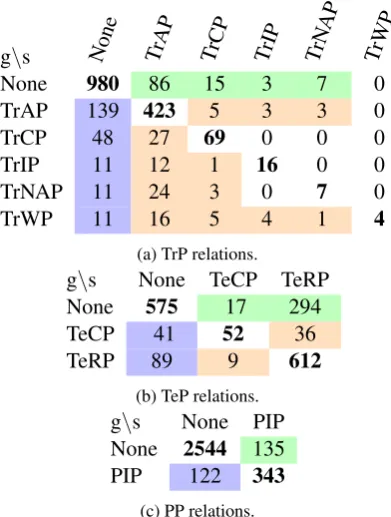
Table 1: Confusion matrices for different relation cat-egories of the base SegCNN. The first diagonal repre-sents the number of correctly classified relations, and is shown in bold. The colored cells highlight low sensi-tivity (blue), hallucinating relations (green) and confus-able relations (orange).
2 Analysis of limitations
To better understand the limitations of a SegCNN extractor, we analyze its results with confusion ma-trices. In Table 1, we use color coding to point to three types of challenges: a) poor sensitivity
(blue cells), which are errors due to the classifier’s conservativeness in proclaiming a relation; b) “hal-lucinating” relations(green), which are precision errors where relations should not be identified; and c) confusable relations (orange), where we see that the TrCP relation is often classified as TrAP (27/69 times), and similarly for the other treatment-problem relations. This is especially true for the less frequent relations TrNAP and TrWP, where the correct predictions are outnumbered by the cases wrongly predicted as TrAP. The TrAP predictions by the system account for the most mistakes. We can see from the number of a) and b) errors on the TrP relations—76% of all mistakes made by the model—that identifying the presence of a rela-tion is more challenging than type classificarela-tion of relations, cf.Rink et al.(2011). Similar observa-tions can be made about the test-problem relaobserva-tions. For example, TeCP is frequently confused with
TeRP (36), and the TeRP type is often hallucinated (294). Overall, determining the presence of a rela-tion is more difficult than discriminating between TeCP and TeRP as 91% of mistakes are only due to detection. This number is higher here than for TrP relations since we are dealing with a smaller number of relation types, which causes less con-fusion in class assignment. For problem-problem relations, the matrix shows the model is somewhat more likely to predict the relation spuriously than to miss the relation.
In a qualitative analysis, we find that relations are often unrecognized in sentences with several (coordinated) concepts:
(1) she also had climbing bilirubin [. . . ] and
was started on zosyntrfor suspected biliary
obstruction and ascending cholangitispr
coverage . (gold: TrAP)
Relations can be hallucinated especially when two concepts may seem to be associated, but the knowl-edge of syntax or the domain tells us they are not:
(2) the patient was treated with tylenol orallytr
as well as ativan for anxietyprthat she had
about going home(gold: none)
Here, medical knowledge of compatibility between drugs and problems could help, e.g. that tylenol is not indicated for anxiety, but ativan is. In the following example, the classifier wrongly predicts TeCP, although there is a clear cue for the correct relation TeRP in the predicate (“found”):
(3) during initial evaluationte for a coronary
artery bypass graft , 80% to 90% of the
right coronary artery stenosisprwas found
3 Addressing the limitations
● ●
●
● 65.58 65.8
72.4
65.87
60
70
80
90
SegCNN +PMI +Drugbank +SemClass
model
F1
(a) TrP
● ●
●
80.09 80
85.96
60
70
80
90
SegCNN +PMI +SemClass
model
F1
(b) TeP
● ●
72.67 73.3
60
70
80
90
SegCNN +PMI
model
F1
[image:3.595.81.523.61.185.2](c) PP
Figure 1: Results per relation category in percentage F1. The reported scores are averaged over 20 runs, and the 95% confidence intervals are shown.
3.1 Drug-problem association (Drugbank)
We use Drugbank (Wishart et al.,2017) to obtain a compatibility score between a drug treatment and a problem. We create a mapping from all drug names, synonyms and product names, to their indi-cations. We also extract a mapping between drugs and their adverse reactions. In this way, we obtain 71,683 drug names, 3108 indications and 1163 ad-verse reactions. If there is a match for an observed treatment-problem pair in the drug-indication map-ping, we simply assign a value of 1 (and scale it, as explained in Appendix) and -1 otherwise. Consider the example where we consider creating a relation betweenneurontintr andseizure historypr. In the indication for neurontin from Drugbank, seizures are mentioned as a possible medical problem, so this type of information could serve as background evidence for the classifier. The adverse drug ef-fects represent a separate feature and are included in the same way. Due to low coverage of the drug-problem features for the treatment-drug-problem concept pairs in the data (416 pairs are found, out of 7699), we also investigate a more general, data-induced approach, described next.
3.2 Concept-concept association (PMI)
We obtain association scores for concept pairs in all relation types by estimating a pointwise mutual information (PMI) model on a large corpus. We use the MIMIC-III corpus (Johnson et al.,2016) to compute the PMI for the co-occurring concepts. We first recognize clinical concepts in MIMIC-III using CLAMP (Soysal et al.,2017), and use Ucto (Van Gompel et al., 2012) for preprocess-ing. We then collect the counts, where two con-cepts are taken as co-occurring if they are men-tioned in the same sentence, irrespective of the ordering. If found, we remove any determiners
and pronouns. The concept type identified by CLAMP is appended to its mention. For a con-cept pair in our data, we perform a type-sensitive and order-insensitive lookup. In case of no match, we back-off by gradually removing up to two left-most tokens. We find that the coverage lies be-tween 68–82% depending on the relation category and the dataset split, and that the highest coverage applies for PP relations. The concept-concept as-sociation for relation extraction has been studied previously byDemner-Fushman et al.(2010) and
de Bruijn et al.(2011), who used MedlineR as the
resource, whereas we achieved better results and coverage on the development set with MIMIC-III than MedlineR.
3.3 Semantic classes
The semantic classes can provide cues about the relation types present in the sentence and facilitate distinguishing between different TrP and TeP rela-tions4. We obtain the classes with WordNet (Miller,
1995) and an online thesaurus5. This was a man-ual process, in which we looked up the synonyms for all relation type names. For the seven TrP and TeP relation types, a hundred lexical triggers were obtained in total. For example,{show,reveal, dis-play. . .}belong to the “revealing” class indicative of the TeRP relation. Lexical triggers are matched to their semantic classes if they occur in the non-concept sentence segments. We find that for TrP relations, matching only with the middle segment works best, but for TeP, the preceding, middle and succeeding segments work best.
4
We do not use semantic classes for PP since there is only one relation type, PIP.
58.4 −56.7 2.1 −2.4 −1.5 0.2
−7.7 5.3 −0.3 1.7 0 1
−2.8 2.8 1.3 −2.1 −0.7 1.5
−5.1 −0.5 5 0 0.6 0
−45.8 47.5 −2.2 −0.5 0.8 0.2
−3.2 1.6 1.2 0 0.4 0
None TrAP TrCP TrIP TrNAP TrWP
T
rWP
T
rNAP
T
rIP
T
rCP
T
rAP
None
System
Gold
−30 0 30 SemClass − SegCNN
(a) SemClass: TrP
73.6 −11.9 −61.7
−38 3.2 34.8 −7.1 1.7 5.4
None TeCP TeRP
T
eRP
T
eCP
None
System
Gold
−40 0 40 SemClass − SegCNN
(b) SemClass: TeP
14.9 −0.8 −14.1
10.7 −0.3 −10.4 2.8 −1.8 −0.9
None TeCP TeRP
T
eRP
T
eCP
None
System
Gold
−10 −5 0 5 10 PMI − SegCNN
(c) PMI: TeP
6.2 −6.2
−1.2 1.1
None PIP
PIP
None
System
Gold
−6 −3 0 3 6 PMI − SegCNN
[image:4.595.80.272.65.636.2](d) PMI: PP
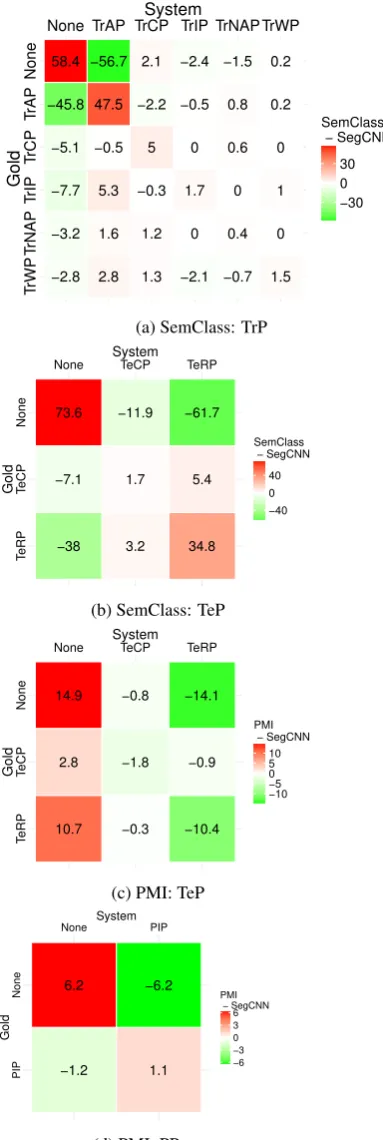
Figure 2: A comparison of counts between a SegCNN and a model using either semantic classes or PMI fea-tures, for different relation categories.
4 Results
In our experiments, we use different data splits from those used inLuo et al.(2017) to increase
the size of the training part and to also create a development set. The details, including the experi-mental setting, can be found in the Appendix. For the results using the vanilla SegCNN, we retrain the original models byLuo et al.(2017) and report their performance on our data splits. This gives us the results which are a few points lower on TrP and TeP relations, but also few points higher on PP relations, than the results reported in their paper.
We show the results in Figure 1, where % F1 is reported for different relation categories. Over-all, the highest scores are achieved on TeP rela-tions. The addition of semantic classes helps the most, with an improvement of almost 7 points over SegCNN for TrP, and 6 points for TeP relations. We think the advantage comes from the fact that the relation triggers are represented explicitly as the in-put to the classifier, whereas in the case of the base SegCNN, the classifier can only rely on a dense vectorial representation, which captures the trigger words more fuzzily. The contribution of the associa-tion features is less pronounced. The drug-problem (SemClass) and concept-concept (PMI) features have a small positive effect for TrP relations, with PMI working best (+0.5) for PP relations, where the coverage is the highest.
asso-ciation (PMI) feature is shown in Figures2cand
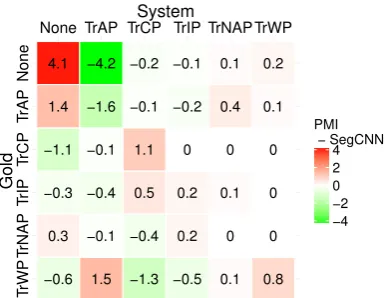
2d.6For TeP relations, we see that the addition of this feature type helps in reducing the number of hallucinated relations (first row), but at the expense of sensitivity—note that several relations are left unidentified (the counts in the TeCP and TeRP in the first column increased). A slight positive effect of PMI features can be seen for the PP relation, where the model becomes less prone to proclaim unrelated concepts as related (first row). Based on these figures, we can conclude that the PMI feature helps in deciding whether a pair of concepts should be linked with a relation or not, but does not have sufficient power to distinguish between different relations.
In conclusion, results show that the SegCNN model often misses, hallucinates or confuses tions, and that including semantic classes for rela-tion triggers helps for different relarela-tion types.
Acknowledgments
We would like to thank the anonymous review-ers for their useful comments. This research was carried out within the Accumulate strategic basic research project, funded by the government agency Flanders Innovation & Entrepreneurship (VLAIO) [grant number 150056].
References
Berry de Bruijn, Colin Cherry, Svetlana Kiritchenko, Joel Martin, and Xiaodan Zhu. 2011. Machine-learned solutions for three stages of clinical infor-mation extraction: the state of the art at i2b2 2010.
Journal of the American Medical Informatics Asso-ciation, 18(5):557–562.
Yubo Chen, Liheng Xu, Kang Liu, Daojian Zeng, and Jun Zhao. 2015. Event extraction via dynamic multi-pooling convolutional neural networks. In ACL-IJCNLP.
Dina Demner-Fushman, Emilia Apostolova, R Isla-maj Dogan, et al. 2010. NLM’s system description for the fourth i2b2/VA challenge. InProceedings of the 2010 i2b2/VA Workshop on Challenges in Natu-ral Language Processing for Clinical Data. Boston, MA, USA: i2b2.
Cyril Grouin, Asma Ben Abacha, Delphine Bernhard, Bruno Cartoni, Louise Deleger, Brigitte Grau, Anne-Laure Ligozat, Anne-Lyse Minard, Sophie Ros-set, and Pierre Zweigenbaum. 2010. CARAMBA: concept, assertion, and relation annotation using
6We include the remaining TrP matrix and the matrices for
the Drugbank model in Appendix.
machine-learning based approaches. In i2b2 Medi-cation Extraction Challenge Workshop.
Kai Hakala, Suwisa Kaewphan, Tapio Salakoski, and Filip Ginter. 2016. Syntactic analyses and named entity recognition for pubmed and pubmed central — up-to-the-minute. InProceedings of the 15th Work-shop on Biomedical Natural Language Processing, pages 102–107. Association for Computational Lin-guistics.
Alistair EW Johnson, Tom J Pollard, Lu Shen, Li-wei H Lehman, Mengling Feng, Mohammad Ghas-semi, Benjamin Moody, Peter Szolovits, Leo An-thony Celi, and Roger G Mark. 2016. MIMIC-III, a freely accessible critical care database. Scientific data, 3:.
Annervaz K. M., Somnath Basu Roy Chowdhury, and Ambedkar Dukkipati. 2018. Learning beyond datasets: Knowledge graph augmented neural net-works for natural language processing. In Proceed-ings of the 2018 Conference of the North American Chapter of the Association for Computational Lin-guistics: Human Language Technologies, Volume 1 (Long Papers), pages 313–322. Association for Computational Linguistics.
Yuan Luo, Yu Cheng, ¨Ozlem Uzuner, Peter Szolovits, and Justin Starren. 2017. Segment convolutional neural networks (Seg-CNNs) for classifying rela-tions in clinical notes.Journal of the American Med-ical Informatics Association, 25(1):93–98.
Tomas Mikolov, Kai Chen, Greg Corrado, and Jeffrey Dean. 2013. Efficient estimation of word represen-tations in vector space. InICLR Workshop Papers.
George A. Miller. 1995. WordNet: A Lexical Database for English.Communications of the ACM, 38(11).
Bryan Rink, Sanda Harabagiu, and Kirk Roberts. 2011. Automatic extraction of relations between medical concepts in clinical texts. Journal of the American Medical Informatics Association, 18(5):594–600.
Sunil Sahu, Ashish Anand, Krishnadev Oruganty, and Mahanandeeshwar Gattu. 2016. Relation extraction from clinical texts using domain invariant convolu-tional neural network. In Proceedings of the 15th Workshop on Biomedical Natural Language Process-ing, pages 206–215. Association for Computational Linguistics.
Ergin Soysal, Jingqi Wang, Min Jiang, Yonghui Wu, Serguei Pakhomov, Hongfang Liu, and Hua Xu. 2017. CLAMP — a toolkit for efficiently build-ing customized clinical natural language processbuild-ing pipelines. Journal of the American Medical Infor-matics Association.
¨
Ozlem Uzuner, Brett R South, Shuying Shen, and Scott L DuVall. 2011. 2010 i2b2/va challenge on concepts, assertions, and relations in clinical text.
# documents # TrP # TeP # PP
[image:6.595.85.280.63.123.2]train 272 (64%) 2220 2233 1413 dev. 68 (16%) 587 485 325 test 86 (20%) 846 839 465
Table 2: Data statistics.
Maarten Van Gompel, Ko van der Sloot, and Antal van den Bosch. 2012. Ucto: Unicode Tokeniser. Technical report, Tilburg Centre for Cognition and Communication, Tilburg University and Radboud Centre for Language Studies, Radboud University Nijmegen.
Yanshan Wang, Liwei Wang, Majid Rastegar-Mojarad, Sungrim Moon, Feichen Shen, Naveed Afzal, Sijia Liu, Yuqun Zeng, Saeed Mehrabi, Sunghwan Sohn, et al. 2017. Clinical information extraction appli-cations: A literature review. Journal of biomedical informatics.
David S Wishart, Yannick D Feunang, An C Guo, Elvis J Lo, Ana Marcu, Jason R Grant, Tanvir Sajed, Daniel Johnson, Carin Li, Zinat Sayeeda, et al. 2017. Drugbank 5.0: a major update to the drug-bank database for 2018. Nucleic acids research, 46(D1):D1074–D1082.
Bishan Yang and Tom Mitchell. 2017. Leveraging knowledge bases in LSTMs for improving machine reading. In Proceedings of the 55th Annual Meet-ing of the Association for Computational LMeet-inguistics (Volume 1: Long Papers), volume 1, pages 1436– 1446.
A Supplemental Material
A.1 Experimental setup
Luo et al.(2017) used a part of the i2b2/VA dataset that is no longer available to those requesting the dataset. We therefore only have 170 documents for training and 256 documents for testing. Since our goal is to build an accurate relation extractor, we re-balance the dataset by increasing the size of the training corpus, reducing the size of the test set and creating a small development set. The sizes of the final splits are shown in Table2. In all our exper-iments, we use the gold-standard concept annota-tions, and train one classifier per relation category.
Hyper-parameters We use the same set of hyper-parameters asLuo et al.(2017), except that we turn off the drop out on the final layer of the classifier network, which harmed the performance in our experiments on the development set. We also noticed that scaling of the added features positively affected the results, so we tuned the scaling factor as well.
4.1 −4.2 −0.2 −0.1 0.1 0.2
−0.3 −0.4 0.5 0.2 0.1 0
−0.6 1.5 −1.3 −0.5 0.1 0.8
−1.1 −0.1 1.1 0 0 0
1.4 −1.6 −0.1 −0.2 0.4 0.1
0.3 −0.1 −0.4 0.2 0 0 None TrAP TrCP TrIP TrNAP TrWP
T
rWP
T
rNAP
T
rIP
T
rCP
T
rAP
None
System
Gold
−4 −2 0 2 4 PMI − SegCNN
Figure 3: A comparison of counts between a base SegCNN and a model extended with PMI features, for different relation categories.
Embeddings We trained the word embeddings on a combination of PubMed abstracts, open-access PMC articles (Hakala et al., 2016) and MIMIC-III intensive care notes (Johnson et al.,
2016), all segmented and tokenized, totaling around 9 billion tokens. We induce the embed-dings using word2vec’s CBOW model (Mikolov et al.,2013) and the default parameters, except for dimensionality, which we set to 200 for TrP rela-tions, 500 for TeP and 400 for PP relarela-tions, as in
Luo et al.(2017).
A.2 Supplementary results
[image:6.595.319.514.64.213.2]−0.4 −3.3 2.7 0.8 −0.4 0.7
−0.2 −0.7 0.1 0.8 0 0
−2.7 2.1 1 −0.5 −0.5 0.7
−4.6 2.4 2 0.1 0.1 0
−4.4 4 0.2 −0.6 0.5 0.3
0.8 0.7 −0.1 0 −1.4 0 None TrAP TrCP TrIP TrNAP TrWP
T
rWP
T
rNAP
T
rIP
T
rCP
T
rAP
None
System
Gold
−4 −2 0 2 4 Comp − SegCNN
(a) Drugbank: TrP
1.3 −1.3 0
−2.8 0.9 1.9 0.8 0.8 −1.5
None TeCP TeRP
T
eRP
T
eCP
None
System
Gold
−2 −1 0 1 Comp − SegCNN
(b) Drugbank: TeP
5 −5
2.8 −2.8
None PIP
PIP
None
System
Gold
−5.0 −2.5 0.0 2.5 5.0 Comp − SegCNN
[image:7.595.81.279.173.598.2](c) Drugbank: PP