149
Syntax-based Transfer Learning for the Task
of Biomedical Relation Extraction
Jo¨el Legrand1, Yannick Toussaint1, Chedy Ra¨ıssi1and Adrien Coulet1,2 1Universit´e de Lorraine, CNRS, Inria, LORIA, 54000 Nancy, France
2 Stanford University, Stanford Center for Biomedical Informatics Research, California
Abstract
Transfer learning (TL) proposes to enhance machine learning performance on a problem, by reusing labeled data originally designed for a related problem. In particular, domain adap-tation consists, for a specific task, in reusing training data developed for the same task but a distinct domain. This is particularly relevant to the applications of deep learning in Natural Language Processing, because those usually require large annotated corpora that may not exist for the targeted domain, but exist for side domains. In this paper, we experiment with TL for the task of Relation Extraction (RE) from biomedical texts, using the TreeLSTM model. We empirically show the impact of TreeLSTM alone and with domain adaptation by obtain-ing better performances than the state of the art on two biomedical RE tasks and equal per-formances for two others, for which few an-notated data are available. Furthermore, we propose an analysis of the role that syntactic features may play in TL for RE.
1 Introduction
A bottleneck problem for training deep learning-based architecture on text is the availability of large enough annotated training corpora. This is especially an issue in highly specialized domains such as those of biomedicine. TL approaches ad-dress this problem by leveraging existing labeled data originally designed for related tasks or do-mains (Weiss et al., 2016). However, adaptation between dissimilar domains may lead to negative transfer, i.e. transfer that decreases the perfor-mance for the target domain. In this article, we ap-ply a TL strategy using the TreeLSTM model for the task of biomedical Relation Extraction (RE). We propose an analysis of the syntactic features of source and target domain corpora to provide ele-ments of interpretation for the improveele-ments we obtained.
Figure 1: Example of relationship typed as Weak Confidence Association between two named entities: aSNP (single nucleotide polymorphism)and a Pheno-type, from the SNPPhenA corpus.
Relation Extraction (RE) aims at identifying in raw and unstructured text all the instances of a pre-defined set of relations between identified entities. A relationship takes the form of an edge between two or more named entities as illustrated in Figure 1. We are considering here binary RE that can be seen as a classification task by computing a score for each possible relation type, given a sentence and two identified entities.
with-out considering more labeled corpora .
Domain adaptation is a type of TL that allows taking advantage of data annotated for a source
domain to improve the performances in a related
targetdomain (Weiss et al.,2016). However, even if the source and target domain share the same language (i.e., English), thus a common syntax, TL between domains may lead to negative transfer since specific source domains may use specific vo-cabularies as well as specific formulations that are inadequate to the target domain. Hence, we need to better understand and characterize what makes a source corpus potentially helpful, or harmful, with regard to a RE task.
The contribution of this paper is twofold. First, we show that, compared to a baseline Convo-lutional Neural Network (CNN)-based model, a syntax-based model (i.e., the TreeLSTM model) can better benefit from a TL strategy, even with very dissimilar additional source data. We conduct our experiments with two biomedical RE tasks and relatively small associated corpora, SNPPhenA (Bokharaeian et al.,2017) and EU-ADR (van Mul-ligen et al., 2012) as target corpora and three larger RE corpora, Semeval 2013 DDI ( Herrero-Zazo et al.,2013), ADE-EXT (Gurulingappa et al., 2012), reACE (Hachey et al.,2012) as source cor-pora. Second, we propose a syntax-based analy-sis, using both quantitative criteria and qualitative observations, to better understand the role of syn-tactic features in the TL behavior.
2 Related work
2.1 Deep Learning Models for Relation Extraction
Deep learning models, based on continuous word representations have been proposed to overcome the problem of sparsity inherent to NLP (Huang and Yates, 2009). In Collobert et al. (2011), the authors proposed a unified CNN architecture to tackle various NLP problems traditionally handled with statistical approaches. They obtained state-of-the-art performances for several tasks, while avoiding the hand design of task specific features. Zeng et al.(2014) showed that CNN models can also be applied to RE. In this study, they learn a vectorial sentence representation, by applying a CNN model over word and word position embed-dings, which is used to feed a softmax classifier (Bishop, 2007). To improve the performance of RE, authors, such as Xu et al. (2015) and Yang
et al. (2016), consider elements of syntax within the embedding provided to the model.
Beside CNN models that incorporate syntac-tic knowledge in their embeddings, other ap-proaches proposed neural networks (NN) in which the topology is adapted to the syntactic structure of the sentence. In particular, Recursive Neural Network (RNN) have been proposed to adapt to tree structures resulting from constituency pars-ing (Socher et al., 2013;Legrand and Collobert, 2014). In this vein, Tai et al. (2015) introduced a TreeLSTM, a generalization of LSTM for tree-structured network topologies, which allows pro-cessing trees with arbitrary branching factors.
The first model to use RNN for RE was pro-posed byLiu et al.(2015). The authors introduced a CNN-based model applied on the shortest depen-dency path between two entities, augmented with a RNN-based feature designed to model subtrees attached to the shortest path. Miwa and Bansal (2016) introduced a variant of the TreeLSTM that allows, like the model used in this paper, to take the whole dependency tree into account and not only the shortest path between two entities.
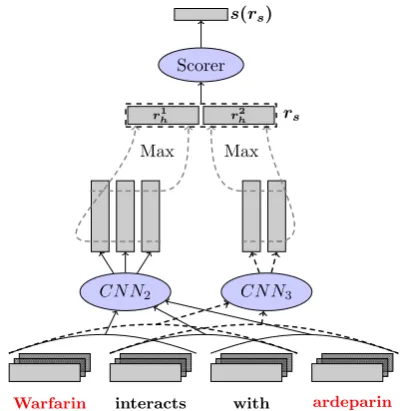
In this paper, we compare two deep learn-ing strategies for RE: (1) the MultiChannel CNN (MCCNN) model (Quan et al., 2016), which has been successfully applied to the task of protein-protein interaction extraction without using any syntactic feature as input and (2) the TreeLSTM model (Tai et al.,2015), which is designed for con-sidering dependency trees. These two models are detailed in section3.
2.2 Transfer learning
TL allows to overcome the lack of training data for a given targettask by transferring knowledge fromsource data not originally designed for that purpose (Weiss et al.,2016). One can distinguish
multitask learning in which performances on a given task are improved using information con-tained in the training signals of auxiliary related tasks (Caruana,1997) fromdomain adaptationin which only one task is considered but its appli-cation domains differ (Ben-David et al., 2010). While the former is a form of inductive transfer in which the auxiliary task introduces an inductive bias during training, the latter is a form of trans-ductive transfer.
Warfarin interacts with ardeparin
CN N2 CN N3
Scorer
Max Max s(rs)
rs r1
[image:3.595.78.281.63.269.2]h r2h
Figure 2: The MCCNN model with three channels, two CNN kernels of size 2 (CN N2) and 3 (CN N3).
Red words correspond to the entities.
such as Plank and Moschitti (2013) focusing on unsupervised domain adaptation (i.e., without any labeled target data) and deep learning based ones such as (Fu et al.,2017;Zhao et al.,2017) focus-ing on domain adversarial learnfocus-ing (an approach which ensures that the feature distributions over the source and target domains are made similar us-ing an extra domain classifier at train time). Dif-ferently, our approach is a case of multi-source domain adaptation (i.e., implying that we have la-beled data, both in target and source corpora) and does not involve adversarial training.
Negative transfer occurs when the information learned from a source domain and task has a nega-tive impact on the performances of the target task. Despite the fact that negative transfer is a major is-sue in TL, to our knowledge only few works have been conducted to overcome this problem (Weiss et al.,2016). Most of them use a relatedness met-rics to select the elements of the source that are the most related to the target. For instance,Seah et al. (2013) defined a positive transferability measure that allows removing irrelevant source data. Ge et al. (2014) also focused on domain adaptation from multiple sources. They proposed a method to avoid negative learning caused by unrelated or ir-relevant source domains, using a weighting mech-anism based on a relatedness metrics between the source and target data.
In this work, we experiment with a domain adaptation method on the RE task using the
TreeL-LSTM
Warfarin
LSTM
interacts rs
LSTM
with
LSTM
ardeparin
Scorer s(rs)
Figure 3: The TreeLSTM model. Each node takes as input the representation of its children. Red words correspond to the entities.
STM model, with relatively small biomedical cor-pora as target corcor-pora and, larger biomedical or general domain corpora as source corpora. We also provide elements of interpretation of the im-pact of syntactic dependency structures on TL. In this matter, and unlike Seah et al. (2013) or Ge et al.(2014), the relatedness measures used in this work emphasizes the key role of syntax in TL with TreeLSTM.
3 Models
We compare in this article the performances of the MCCNN and TreeLSTM models. Both models compute a fixed-size vector representation for a whole sentence by composing input embeddings. A score is computed for each possible type of re-lationship (e.g., negative, positive or speculative) between two identified entities.
In this section, we first introduce the embed-ding input layer, which is common to both ap-proaches (i.e., MCCNN and TreeLSTM); Then, we detail how each approach composes sequences of embedding in order to compute a unique vec-torial sentence representation; Finally, we present the scoring layer, which is common to both ap-proaches.
3.1 Input layer
Both models are fed withword embeddings(i.e., continuous vectors) of dimension dw, along with
extraentity embeddingsof sizede. These
embed-dings are concatenated to form the input of the model. Formally, given a sentence of N words,
w1, w2, . . . , wN, each wordwi ∈ W is first
[image:3.595.319.508.63.216.2]ap-Corpus Subcorpus Train Size Test Size #Entity #Relation
name sent. rel. sent. rel. Types Types
Target corpora
SNPPhenA – 362 935 121 365 2 3
drug-disease 244 176 4 3
EU-ADR drug-target 247 310 – – 4 3
target-disease 355 262 4 3
Source corpora
SemEval DrugBank 5,675 3,805 973 889 4 4
2013 DDI MEDLINE 1,301 232 326 95 4 4
ADE-EXT – 5,939 6,701 – – 2 1
[image:4.595.102.496.63.166.2]reACE – 5,984 2,486 – – 4 5
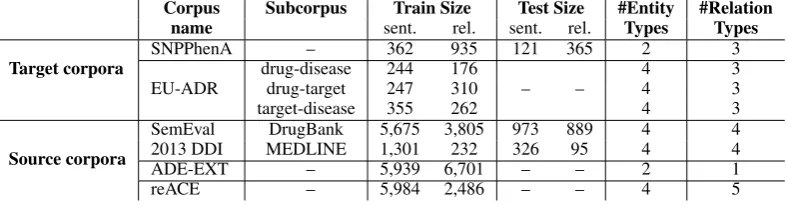
Table 1: Main characteristics of our target and source corpora. Two corpora are divided into subcorpora. The sizes of the training and test corpora are reported in term of number of sentences (sent.) and annotated relationships (rel.). EU-ADR, ADR-EXT and reACE have no proper test corpus.
plying a lookup-table operation: LTW(wi) =
Wwi , where the matrix W ∈ R
dw×|W|
repre-sents the parameters to be trained in this lookup-table layer. The dictionary W is composed of all the words of the given corpus. Each column
Wwi ∈R
dw corresponds to the vector embedding
of thewithword in our dictionaryW.
Besides, entity embeddings (coming from a simple 3-elements dictionary) enable to distin-guish between words which compose either the first entity, the second entity or are not part of any entity. They are respectively calledfirst entity, sec-ond entity and other embeddings. Finally, word and entity embeddings are concatenated to form the input corresponding to a given word. Let’s denotexithe concatenated input corresponding to
theithword.
3.2 Composition layers
Both models take the embeddings as input and output a fixed-size representation rs of size ds,
which corresponds to the whole sentence with two identified entities. Accordingly, one sentence with more than two entities will lead to one embedding for each pair of entities. This section details the two models used in this study.
3.2.1 MCCNN
The MCCNN models applies a variable kernel size CNN to multiple input channels of word embed-dings. Inspired by the three-channel RGB im-age processing models, it considers different em-bedding channels (i.e., different word emem-beddings versions for each word) allowing to capture differ-ent aspects of input words.
More formally, given an input sequence
x1, . . . , xN, applying a kernel to the ith window
of sizekis done using the following formula:
C =h( N−k+1
X
j=1
W[xi, . . . , xi+k−1]j+b)
where [ ]j denotes the concatenation of inputs
from channelj,W ∈ R(dw+de)×dh andb ∈ Rdh
are the parameters, dh is the size of the hidden
layer, h is a pointwise non-linear function such as the hyperbolic tangent andc is the number of input channels. For each kernel, a fixed size rep-resentationrh∈ Rdhis then obtained by applying
a max-pooling over time (here, the time means the position in the sentence).:rh= maxC
We denote K the number of kernels with dif-ferent sizes. A sentence representationrs ∈ Rds
(withds=K∗dh) is finally obtained by
concate-nating the output corresponding to theK kernels
rs = [r1h, . . . , rkh], where rhk corresponds to the
output of the kth kernel. Figure 2 illustrates the
structure of a two-channel CNN, with two kernels of size 2 and 3, on a four-words sentence.
3.2.2 TreeLSTM
The TreeLSTM model, and more specifically its
Child-Sumversion, (Tai et al.,2015) processes the dependency tree associated with an input sentence in a bottom-up manner. This model is suitable for processing dependency trees since it handles trees with arbitrary branching factors and no order be-tween children of a node. This is done by recur-sively processing the nodes of the tree, using at each iteration, the representations of the children of the current node as input. The transition func-tion for a nodejand a set of childrenC(j)can be found in the original paper (Tai et al.,2015) using
xj ∈ Rdw+de as input for node j. The
TreeL-STM outputs a sentence representationrs ∈ Rds
node (i.e., the root node of the dependency tree that spans all the others). Figure3illustrates the structure of the TreeLSTM computed for a four-words sentence.
3.3 Scoring layer
Both the MCCNN and TreeLSTM models output a unique vector representationrs∈ Rds that takes
the entire sentence into account, as well as two identified entities. This representation is used to feed a single layer NN classifier, which outputs a score vector with one score for each possible type of relationship. This vector is obtained us-ing the formula: s(rs) = W(s)rs+b(s), where
W(s) ∈ Rds×|S|and b(s) ∈ R|S| are the trained
parameters of the scorer,|S|is the number of pos-sible relation types. The scores are interpreted as probabilities using a softmax layer (Bishop,2007).
4 Datasets
We explore how RE tasks that focus on a type of relationship associated with scarce resources may take advantage from larger corpora developed for distinct domains. To this purpose, we selected(i)
two smalltargetbiomedical corpora and(ii)three larger source corpora. All are publicly available and detailed in the following section. Table3 sum-marizes their main characteristics.
4.1 Target corpora
SNPPhenA(Bokharaeian et al.,2017) is a corpus of abstracts of biomedical publications, obtained from PubMed (Fiorini et al.,2017), annotated with two types of entities: single nucleotide polymor-phisms(SNPs) andphenotypes. Relationships be-tween them are annotated and classified in 3 types:
positive,negativeandneutral.
EU-ADR(van Mulligen et al.,2012) is a corpus of PubMed abstracts annotated withdrugs, diseases
and drug targets (proteins/genesorgene variants) entities. It is composed of 3 subcorpora of 100 abstracts each, encompassing annotations of ei-ther target-disease, target-drug or drug-disease re-lationships. Annotated relationships are classified in 3 types:positive,speculativeandnegative asso-ciations(PA, SA and NA respectively). In (Bravo et al., 2015), performances are assessed over the
TRUEclass, which is composed of the PA, SA and NA types, in contrast with theFALSEclass.
4.2 Source corpora
SemEval 2013 DDI (Drug-Drug Interaction) (Herrero-Zazo et al.,2013) consists of texts from DrugBank and MEDLINE annotated with drugs. Drug are categorized in 4 categories:drug,brand,
group anddrug n (i.e., active substances not ap-proved for human use). Relationships are classi-fied in 4 types: mechanism,effect, adviceandint
(default category, when no detail is provided).
ADE-EXT (Adverse Drug Effect corpus, ex-tended) (Gurulingappa et al., 2012) consists of MEDLINE case reports, annotated withdrugsand
conditions (e.g., diseases, signs and symptoms), along with untyped relationships between them.
reACE (Edinburgh Regularized Automatic Con-tent Extraction) (Hachey et al., 2012) consists of English broadcast news and newswire annotated with organization, person, fvw (facility, vehicle or weapon) andgpl(geographical, political or lo-cation) entities along with relationships between them. Relationships are classified in five types:
general-affiliation, organisation-affiliation, part-whole,personal-socialandagent-artifact.
5 Experiments
5.1 Training and Experimental Settings
Our models were trained by minimizing the log-likelihood over the training data. All parame-ters (weights, biases and embeddings) were it-eratively updated via backpropagation for the MCCNN and backpropagation Through Struc-ture (Goller and Kuchler, 1996) for the TreeL-STM. Hyper-parameters were tuned using a 10-fold cross-validation by selecting the values lead-ing to the best averaged performance, and fixed for the remaining experiments. Word embed-dings were pre-trained on ˜3.4 million PubMed
abstracts (corresponding to all those published be-tween Jan. 1, 2014 and Dec. 31, 2016) using the method described inLebret and Collobert(2014).
MCCNN model. FollowingKim (2014) both channels were initialized with pre-trained word embeddings, but gradients were backpropagated only through one of the channels. Hyper-parameters were fixed to dw = 100, de = 10,
dh = 100 for each of the 2 channels, ds = 2×dh = 200. We used two kernels of size 3 and 5
Test Corpus Model Train corpus P R F σF
SNPPhenA alone 58.9 73.8 65.5 4.1
TreeLSTM + SemEval 2013 DDI 65.2 71.1 68.0 4.7
+ ADE-EXT 62.8 72.1 67.2 3.4
SNPPhenA + reACE 61.8 74.3 67.1 3.6
SNPPhenA alone 55.1 75.0 63.3 4.8
MCCNN + SemEval 2013 DDI 55.3 74.4 63.3 4.9
+ ADE-EXT 56.1 73.2 63.2 4.8
+ reACE 53.2 70.9 60.6 4.1
EU-ADR drug-disease alone 74.8 84.1 79.1 12.3 TreeLSTM + SemEval 2013 DDI 74.8 90.6 82.0 13.1
+ ADE-EXT 73.9 88.2 80.4 13.7
EU-ADR + reACE 74.3 91.1 79.3 14.3
drug-disease EU-ADR drug-disease alone 73.3 94.7 80.2 14.2
MCCNN + SemEval 2013 DDI 72.6 87.9 76.6 14.3
+ ADE-EXT 73.0 85.5 76.0 14.5
+ reACE 74.1 91.5 79.2 13.8
EU-ADR drug-target alone 72.4 90.6 80.2 10.9 TreeLSTM + SemEval 2013 DDI 71.9 95.5 82.5 8.5
+ ADE-EXT 70.2 96.7 80.9 9.2
EU-ADR + reACE 70.4 96.5 80.8 9.3
drug-target EU-ADR drug-target alone 74.5 92.3 81.0 9.3
MCCNN + SemEval 2013 DDI 74.9 88.8 80.0 10.6
+ ADE-EXT 76.3 87.4 80.3 10.1
+ reACE 73.4 92.1 80.5 7.8
EU-ADR target-disease alone 77.0 89.7 82.7 6.4 TreeLSTM + SemEval 2013 DDI 77.4 91.6 83.9 8.2
+ ADE-EXT 77.7 89.5 83.3 6.9
EU-ADR + reACE 75.9 91.7 83.0 7.7
target-disease EU-ADR target-disease alone 76.9 91.8 82.6 7.7
MCCNN + SemEval 2013 DDI 77.6 90.6 82.5 7.1
+ ADE-EXT 75.5 87.4 81.8 10.1
[image:6.595.115.481.60.404.2]+ reACE 77.1 91.2 82.0 6.8
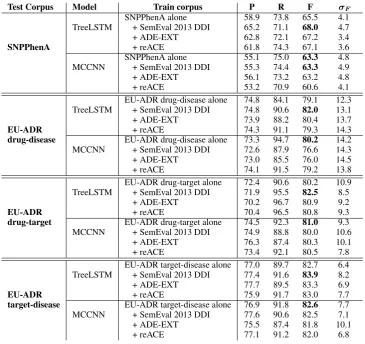
Table 2: Results of our TL strategy in terms of precision (P), recall (R) and f-measure (F).σF is the standard
deviation of the f-measure. The+in the columnTrain corpusindicates that we trained our model using the target corpus plus one additional source corpus.
TreeLSTM model. Dependency trees were derived from parsing trees obtained using the Charniak-Johnson parser trained on GENIA and PubMed data (McClosky and Charniak, 2008). Hyper-parameters were fixed todw = 100,de = 10,dh= 200andds= 200. We applied a dropout
regularization after every TreeLSTM unit and af-ter the embedding layers. The dropout probability was fixed to 0.25. All the parameters are initial-ized randomly except the word embeddings.
We evaluated performances in terms of preci-sion (P), recall (R) and f-measure (F). For multi-label classifications, we report the macro-average performance1. For SNPPhenA, we performed a cross-validation using 10% of the corpus for the validation and the provided test corpus for testing (which is about 30% the size of the training
cor-1The macro-average metric is less impacted by classes
with few test instances (and thus a high variance). For this reason, it is more representative of the performance of our model.
pus). Because no test corpus is provided with EU-ADR, we performed a 10-fold cross-validation us-ing 10% of the corpus for the validation and 10% for the test of our models.
5.2 Transfer learning experiment
Test corpus Work (train corpus) P R F SNPPhena Bokharaeian et al.(2017)(SNPPhenA) 56.6 59.8 58.2
[image:7.595.108.491.59.155.2]This work(SNPPhenA + SemEval 2013 DDI) 64.5 75.2 69.4 EU-ADR Bravo et al.(2015)(EU-ADR drug-disease) 70.2 93.2 79.3 drug-disease This work(EU-ADR drug-disease + SemEval 2013 DDI) 74.8 90.6 82.0 EU-ADR Bravo et al.(2015)(EU-ADR drug-target) 74.2 97.4 83.3 drug-target This work(EU-ADR drug-target + SemEval 2013 DDI) 73.5 95.6 83.1 EU-ADR Bravo et al.(2015)(EU-ADR target-disease) 75.1 97.7 84.6 target-disease This work(EU-ADR target-disease + SemEval 2013 DDI) 78.7 91.4 84.6
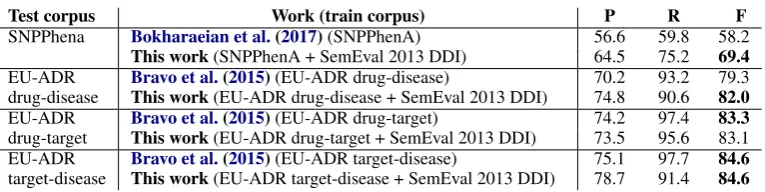
Table 3: Performance comparison between the state of the art (Bokharaeian et al.,2017;Bravo et al.,2015) and this work in terms of precision (P), recall (R) and F-measure (F). Results reported for this work are ensembles of the 5 best models obtained.
Figure 4: Dependency parse tree of a sentence from SNPPhena expressing a relation between the entitiesrs429358
anddementia. The shortest dependency path between the two entities is shown in bold.
This training procedure is done, starting from dif-ferent random initialization for each fold of our cross-validation. Table 2 presents the results of the TL study. Each results is an average of 100 experiment (10 experiments for each fold start-ing from different random initialization). We ob-served that for the TreeLSTM model, additional source corpora consistently improved the perfor-mances. More interestingly, this phenomenon oc-curs even for corpora of distinct types of entities such as the combination of SNPPhenA and Se-mEval 2013 DDI and, to a lesser extend, with the corpus that is outside of the biomedical do-main, reACE. We note that the pre-trained em-beddings were obtained using biomedical sources. This may affect the TL performance with reACE that is not of the biomedical domain. Also, we did not observed any benefit of the TL strategy for the MCCNN model, which performances decrease slightly in comparison with the baseline experi-ments.
5.3 Comparison with the state of the art
Table 3 presents a comparison of performances obtained with our approach versus two state-of-the-art systems applied to the RE tasks associ-ated respectively with SNPPhenA (Bokharaeian et al., 2017) and EU-ADR (Bravo et al., 2015). Our results are obtained using, for each fold, an ensemble of the 5 best models for this fold, ac-cording to the validation. The ensembling was done by averaging the scores s(rs) of each
in-dividual model, followingLegrand and Collobert
(2014). We report the 10-folds average perfor-mance. Both state-of-the-art systems use a com-bination of a shallow linguistic kernel with a ker-nel that exploits deep syntactic features. Our ap-proach outperforms the performances reported for SNPPhenA and one EU-ADR subtasks and lead to similar performances for the two remaining EU-ADR subtasks.
6 On the role of syntactic features in transfer learning
Empirical results suggest that the TreeLSTM model is more positively-influenced by syntac-tic similarity between source and target corpora than by domain closeness. Indeed, the TreeLSTM model explicitly includes the syntactic structure of the sentences in the network topology. Thus, a source corpus, such as reACE, that share nei-ther entity nor vocabulary with the target corpus proved to be helpful. We propose in the following an analysis of the role of the syntactic features. We also provide real examples illustrating similarities between corpora and comment them.
Syntactic features. We propose three com-parisons based on patterns extracted from short-est paths between two entities in dependency graphs. Shortest path proved to be effective for RE (Bunescu and Mooney, 2005; Cellier et al., 2010). From a shortest path (as betweenrs429358
[image:7.595.121.475.216.255.2]example, in Figure 4, ”NN nsubj *JJ* nmod NN nmod NN”2. The second and the third patterns are built by keeping only either the POS or the DT. The patterns associated with our running example are then:”NN *JJ* NN NN”and”nsubj ** nmod nmod”. For a given pattern, the syntactic simi-larityscore is obtained using the following proce-dure: Given 2 corpora, (1) we first extract all the shortest path pattern that appear between two re-lated entities. (2) For each corpus, we compute the pattern distribution (i.e., the list of patterns, along with their frequency) by normalizing over all the patterns in the corpus. (3) The score is then com-puted with the cosine similarity between the pat-tern distributions of two corpora. Table 4 shows the cosine similarity measures between target and source corpora for the three different pattern dis-tributions. We observe that, for the two target cor-pora, the performance gain obtained using the TL strategy using a given source corpus can be related to the cosine similarity with this corpus: the higher cosine similarity lead to the best transfer TL.
Source corpora
DDI ADE reACE
POS + DT
Sour
ce
cor
pora
SNPPhena 0.53 0.22 0.13
EU-ADR 0.24 0.20 0.09
POS only SNPPhena 0.80 0.70 0.35
EU-ADR 0.77 0.68 0.32
DT only SNPPhena 0.53 0.23 0.14
[image:8.595.345.490.87.117.2]EU-ADR 0.25 0.24 0.10
Table 4: Cosine similarity score between target and source corpora for the three different pattern distribu-tions. POS is part of speech pattern and DT is depen-dency type pattern.
Dictionary coverage. On the opposite, we ob-served that the efficiency of TL in our experiments can not be fully explained by the lexical similar-ity between source and target corpora. As shown in Table5, the vocabulary overlap with the target corpora is almost equivalent whether we are con-sidering DDI or ADE (53.4vs. 51.2 and 58.9vs.
60.5), whereas performances obtained with DDI were better than those obtained with ADE. Un-surprisingly, it is lower for reACE which is not a
2
The stars mark the lowest common ancestor of the two entities in the dependency tree and are used to prevent similar pattern with different common ancestors to be considered the same. Note that the patterns are not directed, thus the two patterns”NN nsubj *JJ* nmod NN nmod NN”and”NN nmod NN nmod *JJ* nsubj NN”are equivalent.
biomedical corpus.
[image:8.595.101.266.373.484.2]DDI ADE reACE SNPPhenA 53.4 51.2 39.8 EU-ADR 58.9 60.5 38.3
Table 5: Dictionary coverage. Percentage of words from the target copora present in the source corpora.
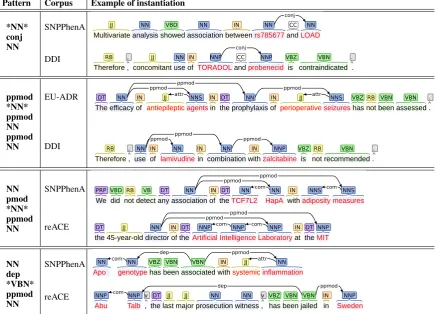
Lexical and semantic paradigms. We com-plete this analysis with few examples illustrat-ing the lexical and semantic heterogeneity of sen-tences that may instantiate a same pattern. Ta-ble 6 provides 4 patterns and their instantiations in source and target corpora. One can observe that sentences instantiating a same pattern seems to have no particular similarity when considering lexical and semantic paradigms. A similar hetero-geneity is observed when considering the lowest common ancestor term (or the head) of the pat-terns. Table7lists the most frequent lowest com-mon ancestor in each corpus. Again, we observe no direct link with learning improvement.
7 Conclusion
In this paper, we empirically showed that a TL strategy can benefit biomedical RE tasks when us-ing the TreeLSTM model, whereas it is mainly harmful with a model that does not consider syn-tax. This is of great interest for specific do-mains, such those of biomedicine, for which few annotated resources are available. Our TL ap-proach led(i)to better performances than the state of the art for two biomedical RE tasks: SNP-phenotype and drug-disease RE; and(ii)to state-of-the-art results for two others focusing on target-disease and target-drug relationships. Interest-ingly, we showed that even a general domain cor-pus (reACE) may carry useful information and lead to improved performances. We proposed an analysis with syntax-based metrics and examples to provide elements of interpretation of this behav-ior and emphasize the key role of syntax in TL for RE. An exciting direction would be to explore this transfer strategy with Electronic Health Records of various origin.
Aknowledgement
This work is funded by the French National Re-search Agency (ANR) under thePractiKPharma
Pattern Corpus Example of instantiation
*NN* conj NN
SNPPhenA
DDI
ppmod *NN* ppmod NN ppmod NN
EU-ADR
DDI
NN pmod *NN* ppmod NN
SNPPhenA
reACE
NN dep *VBN* ppmod NN
SNPPhenA
reACE
Table 6: Examples of patterns and of their instantiation in corpora. Red words correspond to entities.
SNPPhenA EU-ADR DDI ADE reACE
associated (25.2) analyzed (5.8) entity(17.8) entity(30.1) entity(60.6)
entity(12.2) associated (4.3) administered (4.1) developed (11.1) is (2.2) genotyped (5.4) entity(2.9) increase (3.0) associated (4.1) was (1.9) association (4.4) is (2.9) administration (2.7) is (2.7) said (1.4)
showed (3.8) polymorphisms (2.4) reported (2.6) induced (2.3) observed (3.3) over-represented (2.4) interact (2.6) case (1.6)
[image:9.595.82.519.64.378.2]genes (2.6) showed (2.4) reduce (2.5) following (1.4)
Table 7: Terms corresponding to the lowest common ancestor in the POS + DT patterns. Their relative frequency in each corpus is provided in parenthesis.Entitymeans that the term is one of the two entities.
References
Shai Ben-David, John Blitzer, Koby Crammer, Alex Kulesza, Fernando Pereira, and Jennifer Wortman Vaughan. 2010. A theory of learning from different domains. Machine Learning, 79(1-2):151–175.
Christopher M. Bishop. 2007. Pattern recognition and machine learning, 5th Edition. Information science and statistics. Springer.
Behrouz Bokharaeian, Alberto D´ıaz Esteban, Nas-rin Taghizadeh, Hamidreza Chitsaz, and Ramyar Chavoshinejad. 2017. SNPPhenA: a corpus for extracting ranked associations of single-nucleotide polymorphisms and phenotypes from literature. J. Biomedical Semantics, 8(1):14:1–14:13.
`
Alex Bravo, Janet Pi˜nero Gonz´alez, N´uria Queralt-Rosinach, Michael Rautschka, and Laura In´es Fur-long. 2015. Extraction of relations between genes and diseases from text and large-scale data analysis: implications for translational research. BMC Bioin-formatics, 16:55:1–55:17.
Razvan C. Bunescu and Raymond J. Mooney. 2005. A shortest path dependency kernel for relation ex-traction. In HLT/EMNLP 2005, Human Language Technology Conference and Conference on Empiri-cal Methods in Natural Language Processing, Pro-ceedings of the Conference, 6-8 October 2005, Van-couver, British Columbia, Canada, pages 724–731.
Peggy Cellier, Thierry Charnois, and Marc Plantevit. 2010. Sequential patterns to discover and charac-terise biological relations. In Computational Lin-guistics and Intelligent Text Processing, 11th Inter-national Conference, CICLing 2010, Iasi, Romania, March 21-27, 2010. Proceedings, pages 537–548.
Ronan Collobert, Jason Weston, L´eon Bottou, Michael Karlen, Koray Kavukcuoglu, and Pavel P. Kuksa. 2011. Natural language processing (almost) from scratch. Journal of Machine Learning Research, 12:2493–2537.
Nicolas Fiorini, David J. Lipman, and Zhiyong Lu. 2017. Towards PubMed 2.0. Elife, 6.
Lisheng Fu, Thien Huu Nguyen, Bonan Min, and Ralph Grishman. 2017. Domain adaptation for re-lation extraction with domain adversarial neural net-work. In Proceedings of the Eighth International Joint Conference on Natural Language Processing (Volume 2: Short Papers), volume 2, pages 425–429.
Liang Ge, Jing Gao, Hung Q. Ngo, Kang Li, and Aidong Zhang. 2014. On handling negative trans-fer and imbalanced distributions in multiple source transfer learning. Statistical Analysis and Data Min-ing, 7(4):254–271.
Christoph Goller and Andreas Kuchler. 1996. Learning task-dependent distributed representations by back-propagation through structure. InNeural Networks, 1996., IEEE International Conference on, volume 1, pages 347–352. IEEE.
Harsha Gurulingappa, Abdul Mateen-Rajpu, and Luca Toldo. 2012. Extraction of potential adverse drug events from medical case reports. Journal of biomedical semantics, 3(1):15.
Ben Hachey, Claire Grover, and Richard Tobin. 2012. Datasets for generic relation extraction. Natural Language Engineering, 18(1):21–59.
Mar´ıa Herrero-Zazo, Isabel Segura-Bedmar, Paloma Mart´ınez, and Thierry Declerck. 2013. The DDI corpus: An annotated corpus with pharmacological substances and drug-drug interactions. Journal of Biomedical Informatics, 46(5):914–920.
Fei Huang and Alexander Yates. 2009. Distributional representations for handling sparsity in supervised sequence-labeling. InACL 2009, Proceedings of the 47th Annual Meeting of the Association for Compu-tational Linguistics and the 4th International Joint Conference on Natural Language Processing of the AFNLP, 2-7 August 2009, Singapore, pages 495– 503.
Yoon Kim. 2014. Convolutional neural networks for sentence classification. InProceedings of the 2014 Conference on Empirical Methods in Natural Lan-guage Processing, EMNLP 2014, October 25-29, 2014, Doha, Qatar, A meeting of SIGDAT, a Special Interest Group of the ACL, pages 1746–1751.
R´emi Lebret and Ronan Collobert. 2014. Word em-beddings through hellinger PCA. In Proceedings of the 14th Conference of the European Chapter of the Association for Computational Linguistics, EACL 2014, April 26-30, 2014, Gothenburg, Swe-den, pages 482–490.
Jo¨el Legrand and Ronan Collobert. 2014. Joint RNN-based greedy parsing and word composition. CoRR, abs/1412.7028.
Yang Liu, Furu Wei, Sujian Li, Heng Ji, Ming Zhou, and WANG Houfeng. 2015. A dependency-based neural network for relation classification. In Pro-ceedings of the 53rd Annual Meeting of the Associ-ation for ComputAssoci-ational Linguistics and the 7th In-ternational Joint Conference on Natural Language Processing (Volume 2: Short Papers).
David McClosky and Eugene Charniak. 2008. Self-training for biomedical parsing. InACL 2008, Pro-ceedings of the 46th Annual Meeting of the Associa-tion for ComputaAssocia-tional Linguistics, pages 101–104.
Mike Mintz, Steven Bills, Rion Snow, and Dan Juraf-sky. 2009. Distant supervision for relation extrac-tion without labeled data. In Proceedings of the Joint Conference of the 47th Annual Meeting of the ACL and the 4th International Joint Conference on Natural Language Processing of the AFNLP: Vol-ume 2-VolVol-ume 2, pages 1003–1011. Association for Computational Linguistics.
Makoto Miwa and Mohit Bansal. 2016. End-to-end relation extraction using LSTMs on sequences and tree structures. InProceedings of the 54th Annual Meeting of the Association for Computational Lin-guistics, ACL 2016.
Erik M. van Mulligen, Annie Fourrier-R´eglat, David Gurwitz, Mariam Molokhia, Ainhoa Nieto, Gian-luca Trifir`o, Jan A. Kors, and Laura In´es Furlong. 2012. The EU-ADR corpus: Annotated drugs, dis-eases, targets, and their relationships. Journal of Biomedical Informatics, 45(5):879–884.
Barbara Plank and Alessandro Moschitti. 2013. Em-bedding semantic similarity in tree kernels for do-main adaptation of relation extraction. In Proceed-ings of the 51st Annual Meeting of the Association for Computational Linguistics (Volume 1: Long Pa-pers), volume 1, pages 1498–1507.
Chanqin Quan, Lei Hua, Xiao Sun, and Wenjun Bai. 2016. Multichannel Convolutional Neural Network for Biological Relation Extraction. BioMed re-search international, 2016:1850404.
Herbert Robbins and Sutton Monro. 1985. A stochas-tic approximation method. InHerbert Robbins Se-lected Papers, pages 102–109. Springer.
Richard Socher, John Bauer, Christopher D. Manning, and Andrew Y. Ng. 2013. Parsing with composi-tional vector grammars. InProceedings of the 51st Annual Meeting of the Association for Computa-tional Linguistics, ACL 2013, pages 455–465.
Nitish Srivastava, Geoffrey E. Hinton, Alex Krizhevsky, Ilya Sutskever, and Ruslan Salakhutdi-nov. 2014. Dropout: a simple way to prevent neural networks from overfitting. Journal of Machine Learning Research, 15(1):1929–1958.
Kai Sheng Tai, Richard Socher, and Christopher D. Manning. 2015. Improved semantic representations from tree-structured long short-term memory net-works. In Proceedings of the 53rd Annual Meet-ing of the Association for Computational LMeet-inguis- Linguis-tics, ACL 2015, pages 1556–1566.
Karl R. Weiss, Taghi M. Khoshgoftaar, and Dingding Wang. 2016. A survey of transfer learning. J. Big Data, 3:9.
Kun Xu, Yansong Feng, Songfang Huang, and Dongyan Zhao. 2015. Semantic relation classifica-tion via convoluclassifica-tional neural networks with simple negative sampling. InProceedings of the 2015 Con-ference on Empirical Methods in Natural Language Processing, EMNLP 2015, pages 536–540.
Yunlun Yang, Yunhai Tong, Shulei Ma, and Zhi-Hong Deng. 2016. A position encoding convolutional neural network based on dependency tree for rela-tion classificarela-tion. InProceedings of the 2016 Con-ference on Empirical Methods in Natural Language Processing, EMNLP 2016, pages 65–74.
Daojian Zeng, Kang Liu, Siwei Lai, Guangyou Zhou, and Jun Zhao. 2014. Relation classification via convolutional deep neural network. In COLING 2014, 25th International Conference on Computa-tional Linguistics, pages 2335–2344.