Proceedings of the 2018 Conference on Empirical Methods in Natural Language Processing (System Demonstrations), pages 96–101 96
Visualizing Group Dynamics based on Multiparty Meeting Understanding
Ni Zhang1, Tongtao Zhang1, Indrani Bhattacharya2, Heng Ji1 and Richard J. Radke2
1Department of Computer Science
2Department of Electrical, Computer, and Systems Engineering
Rensselaer Polytechnic Institute
{zhangn5, zhangt13, bhatti, jih}@rpi.edu [email protected]
Abstract
Group discussions are usually aimed at shar-ing opinions, reachshar-ing consensus and mak-ing good decisions based on group knowledge. During a discussion, participants might ad-just their own opinions as well as tune their attitudes towards others’ opinions, based on the unfolding interactions. In this paper, we demonstrate a framework to visualize such dy-namics; at each instant of a conversation, the participants’ opinions and potential influence on their counterparts is easily visualized. We use multi-party meeting opinion mining based on bipartite graphs to extract opinions and cal-culate mutual influential factors, using the Lu-nar Survival Task as a study case.
1 Introduction
Group meetings are pervasive in modern work-places, consuming workers’ time and energy. Reaching consensus and making decisions more efficiently are major challenges. For example, dur-ing a meetdur-ing, some of the participants might in-sist on their own opinions towards the discussed items or topics, while others might rapidly change opinions and attitudes. As a meeting unfolds, we can observe developing leadership characteristics among the participants; for example, some partic-ipants may speak more assertively to drive deci-sive conclusions and steer the meeting, while oth-ers may follow the crowd and merely deliver tiny ideas.
In order to track the dynamics that reflect the change of opinions and the procedure of decision making, we require a meeting assistant that works in real time. That is, the assistant should keep track of the agenda and discussion process as a minute or note-taker, as well as record and assess the influence and contribution of each participant. In this paper, using the NASA Lunar Survival
Task1 as a study case, we present an automatic meeting assistant with the following functionali-ties:
• The assistant detects and extracts participants’ opinions from their speech and visualizes the groups’ instantaneous state (ranking of items) based on current and previous utterances.
• The assistant visualizes an influence factor for each participant using current and previous ut-terances in real time. Using this information, emerging leadership in the group can be visual-ized.
The proposed assistant begins with speech recognition output, and detects the opinions from the speakers with Natural Language Processing (NLP) tools. We propose a bipartite graph formal-ism to assess participants’ influence.
2 System Overview
2.1 Study Case Introduction
The NASA Lunar Survival Task is a widely used group consensus exercise that helps encourage the development of communication, cooperation, and decision making skills (Hall and Watson, 1970). In small groups of 3–4, participants discuss a hy-pothetical survival scenario and rank the value of supplies that may aid in their survival and safe rendezvous with their mothership. Before the dis-cussion, each participant is asked to independently rank the items. Next, the participants are asked to reach consensus on the ranking with active verbal interaction. Each member of the group must agree upon the final ranking, which acts as the group de-cision.
Video
Participant Indicator & Aggregated
Influence
Current Speaker & Speech Proposed Ranking
Current Ranking of all Discussed Items
[image:2.595.89.480.72.367.2]Influence Curves over Time
Figure 1: Main interface of our proposed meeting assistant.
2.2 Interface Details
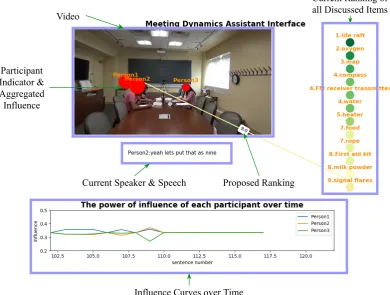
Figure1illustrates the interface of the meeting as-sistant2.
A video window shows the meeting scene. In this window, we use red circles to denote the par-ticipants. The sizes of the circles denote the aggre-gated influence factors of participants; the larger the circle is, the more influence (i.e., contribution to the conversation) the participant possesses.
Beneath the video window we provide the cur-rent speaker and speech. The raw speech is pro-cessed by IBM Watson’s Speech to Text System 3, and we use the text output to detect
discus-sion/focus items and extract speakers’ opinions as detailed further below.
On the right side, we place a real-time rank-ing list for items that have been discussed. As the discussion proceeds, the ranking list expands with newly involved items. We also illustrate the current focus item of each participant and her/his proposed rank of the focused item with a col-ored edge. The colors of item circles and
opin-2
A short video clip illustrating the meeting assistant can be viewed athttps://youtu.be/3_YS0ZGQNQo.
3https://www.ibm.com/watson/services/
speech-to-text/
ion edges denote different rankings; greener items have higher rankings and redder items have lower rankings.
At the bottom, we illustrate curves indicating instantaneous influence factors from each partic-ipant in real time based on the current speech.
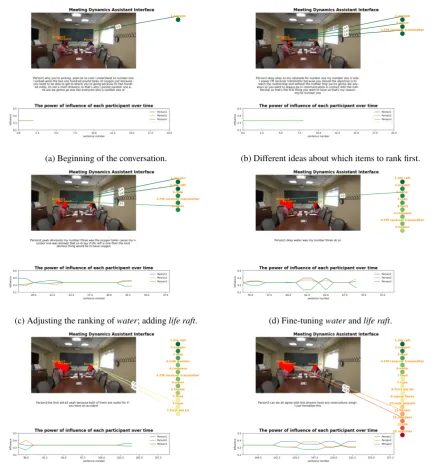
Figure2illustrates a series of screenshots from our proposed meeting assistant. Three participants attend the meeting and start the discussion about several items. In Figure 2a and 2b, the meet-ing was in an early stage, and there is no differ-ence among the participants in terms of infludiffer-ence. As the discussion continues in Figure2c and2d, where more items have been discussed, the curves of influence fluctuate and imply differences in ac-tivity among participants. Moreover, the rank-ings of discussed items are adjusted according to the speech and extracted opinions as mentioned above.
Finally, as shown in Figure 2f, from the size of the red circles representing aggregated influ-ences and the historical record of the curves, we can conclude that Person 1 and Person 2
are contributing more in the discussion, while
(a) Beginning of the conversation. (b) Different ideas about which items to rank first.
(c) Adjusting the ranking ofwater; addinglife raft. (d) Fine-tuningwaterandlife raft.
[image:3.595.80.517.60.530.2](e) Proceeding with other items. (f) A substantially complete list at the end of discussion.
Figure 2: Screenshots of the meeting assistant at different points in time.
3 Opinion Detection and Extraction
Our system takes as input transcribed meeting speech, sentence by sentence, and outputs real-time rankings (opinion words) of the items after each participant expresses her/his thoughts.
3.1 Opinion Word Identification
In the context of the Lunar Survival Task discus-sion, we observed that participants express their opinions of item rankings in multiple ways, in-cluding
1. Explicitly mentioning an item with its
rank-ing(e.g., “In my opinion, we should put water as the second most important.”)
2. Agreement or disagreement (e.g., “Yeah, I agree.”)
3. Comparison of the items by relative ranking (e.g., “Matches are less important than signal flares because they don’t work on the moon.”)
numbers beyond 15 and numbers that are parts of pronouns such “this one”. Additionally, in this specific discussion, people use “last” or “least” to imply they are ranking the item at 15 and we also implemented this rule.
As for the second scenario, people typically express agreement/disagreement with the person who talked immediately before them (Abu-Jbara et al.,2012). For agreement, we assume the cur-rent speaker accepts the previous speaker’s stated opinion, which means we pass the weights cap-tured for the previous person to the current speaker if we find the expression of agreement in the cur-rent sentence. We found that expressions of dis-agreement are not useful since people typically ex-press their own opinion following their disagree-ment.
We currently do not deal with the third scenario of relative rankings, because no definitive ranking can be extracted from such statements.
3.2 Target Identification and Ranking
In this step, we identify discussed items in the dis-cussion. As participants must have a very con-densed discussion of these 15 items in a relatively short time, they usually mention the items with the exact words from the list they are given. Thus, we take the nouns and noun phrases as chunks and if any word matches with the nouns in the given list, it is recognized as the item in the given list.
So far, we have the opinion words and potential targets annotated in the conversation, and we want to pair them up and find the target of the ranking. It has been shown in previous work on relation ex-traction that the shortest dependency path between any two entities captures the information required to assert a relationship between them (Bunescu and Mooney, 2005). Based on the observation that people tend to mention items and their related ranks close to each other, we pair the item with the rank found in its shortest dependency path.
4 Bipartite Graph Construction
We propose an assessment method of the influ-ence factors among participants based on bipartite graphs.
4.1 Dynamic Update of Weights and Vertices
We construct a directed bipartite graphG= (U∪
V, E), where the vertices U represent the partic-ipants in the discussion, the vertices V represent
the items, andEdenotes the edges between these vertices. uidenotes theith vertex or participants’ cumulative informative score in U. vj is thejth vertex or item ranking inV.
In the Lunar Survival scenario, we observed that the information given in the conversation is very helpful in getting the right result and reaching con-sensus. To reflect this observation, we have total number of sentences so far for each speaker in the conversation as an informativeness indicator. The edges of the bipartite graph carry weightswij, rep-resenting the relationship between verticesui and vj, i.e., ui’s current ranking ofvj. Thus, we can represent all the edge weights of the graph as a
|U| × |V|matrixW = [wij]. With the item-rank pair extracted, we dynamically updateW, and cal-culatevj as
P
iwij
i .
4.2 Influence Model
We implemented an influence model (IM) (Basu et al., 2001) to track and understand the pants’ opinion behaviors. We model the partici-pants’ opinion shifts as a Markov chain with each state representing a user’s opinion on the item. We use the coupled HMM to correlate the influence of the opinions among multiple participants. Each participantihas a chain of rankings on the items at timetdenotedSti. We assume that
P(Sti|St−1 1, ..., St−N1) = X
j
αijP(Sti|St−j 1), (1)
whereαij (calculated from the model) can tell us how much the state transition of personiis influ-enced by the given neighborj.
This observed IM is characterized by (Φ, A), whereΦis the state transition probability matrix, andAis the influence strength vector. At any time t, we calculate the pairwise transition probabil-ity matrixP(Sti|St−j 1)by counting, and determine αij using the constrained gradient ascent method to maximize per-chain likelihood.
5 Experiments
5.1 Dataset Construction
Team ID Precision Recall F1 score
Team 1 0.53 0.21 0.31
Team 2 0.65 0.55 0.6
Team 3 0.71 0.62 0.66
Team 4 0.65 0.33 0.44
[image:5.595.320.519.63.233.2]Team 5 0.59 0.70 0.64
Table 1: Information extraction measures
performed the opinion extraction and target pair-ing as described in Section 3 for the 5 meetpair-ings. The extraction precision and accuracy compared to human annotated ground truth is summarized in Table1. The precision is defined as the fraction of correct ranks among all ranks retrieved from the conversation, and recall is the fraction of correct ranks that have been retrieved over all the ranks supposed to be retrieved as in ground truth.
5.2 Meeting Dynamics Analysis
We see that groups have very distinct opinions on the 15 items before each meeting, and that they all achieved consensus at the final stage of the meet-ing. From the playback of the meeting assistant videos, we have a very clear view of the unfold-ing speech content that influences the participants’ state of mind.
We observed the following patterns that corre-late with a participant’s influence:
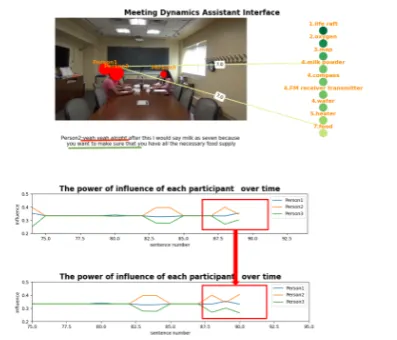
1. Approval of other people first, followed by stat-ing clearly the opinion on an item (e.g., Figure
3)
2. Detailed explanation of the reason to choose a specific rank (e.g., “It’s a two hundred mile trek so you need some sort of sustenance for the hu-man body.”)
3. Drawing attention before a statement (e.g., “OK so proposition hear me out. We’re at nine now right? If we’re going forward so what if we put milk powder as ten?”)
6 Related Work
Opinion target extraction and pairing: In our context, the targets are constrained to 15 items given beforehand, but they appear in different forms in the conversation. In the context of prod-uct review mining, (Hu and Liu, 2004) extracted frequent nouns and noun phrases as product fea-ture candidates. Following that method, ( Abu-Jbara et al.,2012) extracted frequent noun phrases
Figure 3: Example of arguments with stronger in-fluence.
and named entities mentioned by different discus-sants.
As for opinion extraction, various methods were used in different contexts. (Kim and Hovy,2006) collected opinion-bearing words and classified them into 3 classes. (Ortigosa et al., 2014) also studied opinion from 3 classes. Since in our case, the opinion on an item is restricted to a ranking of 1–15, we used name tagging results to identify the ordinals and numbers mentioned in the conversa-tion.
Group dynamics studies: Most group dynam-ics studies to date of role recognition or influ-ence studies are based on non-linguistic features. (Rienks and Heylen, 2005) used audio-only fea-tures including a collection of nonverbal and ver-bal cues to perform three-way classification of the participants dominance level. (Beyan et al.,2018) acquired audio and visual features and predicted emergent leadership with multiple kernel learn-ing. Our group has extended the system proposed here to include non-verbal and visual cues to ac-curately predict emergent leadership and contribu-tion (Bhattacharya et al.,2018).
[image:5.595.87.278.66.156.2]7 Conclusion and future work
In this paper we demonstrate a system for meeting assistance, visualizing real-time opinion extrac-tion and group dynamics. We use the Lunar Sur-vival Task to observe how people gradually change their opinions and make decisions. With the cur-rent meeting assistant tool, we have a closed set of 15 items given in advance and a fixed set of ranks. In future work, we plan to develop infor-mation extraction systems that handle open sets and detect multiple topics in a meeting. The opin-ions extracted could be used to study group dy-namics and recognize roles in meetings, extending the scope of the meeting assistant to more general scenarios.
8 Acknowledgements
Thanks to Mike Foley, Christoph Riedl and Brooke Foucault Welles at Northeastern Univer-sity for the experimental design. This work was supported by the U.S. National Science Founda-tion No. IIP-1631674. The views and conclusions contained in this document are those of the authors and should not be interpreted as representing the official policies, either expressed or implied, of the U.S. Government. The U.S. Government is autho-rized to reproduce and distribute reprints for Gov-ernment purposes notwithstanding any copyright notation here on.
References
Amjad Abu-Jbara, Mona Diab, Pradeep Dasigi, and Dragomir Radev. 2012. Subgroup detection in ide-ological discussions. In50th Annual Meeting of the Association for Computational Linguistics: Long Papers-Volume 1, pages 399–409.
Chalee Asavathiratham. 2001. The Influence Model: A Tractable Representation for the Dynamics of Networked Markov Chains. Ph.D. thesis, Mas-sachusetts Institute of Technology.
Sumit Basu, Tanzeem Choudhury, Brian Clarkson, Alex Pentland, et al. 2001. Learning human inter-actions with the influence model. NIPS.
Cigdem Beyan, Francesca Capozzi, Cristina Becchio, and Vittorio Murino. 2018. Prediction of the leader-ship style of an emergent leader using audio and vi-sual nonverbal features. IEEE Transactions on Mul-timedia, 20(2):441–456.
Indrani Bhattacharya, Michael Foley, Ni Zhang, Tong-tao Zhang, Christine Ku, Cameron Mine, Heng Ji, Christoph Riedl, Brooke Foucault Welles, and
Richard J. Radke. 2018. A multimodal-sensor-enabled room for unobtrusive group meeting anal-ysis. In ACM International Conference on Multi-modal Interaction.
Razvan C Bunescu and Raymond J Mooney. 2005. A shortest path dependency kernel for relation extrac-tion. In Conference on Human Language Technol-ogy and Empirical Methods in Natural Language Processing, pages 724–731. Association for Com-putational Linguistics.
Chengyao Chen, Wenjie Li, Dehong Gao, and Yuex-ian Hou. 2017. Exploring interpersonal influence by tracking user dynamic interactions.IEEE Intelligent Systems, 32(3):28–35.
Jenny Rose Finkel, Trond Grenager, and Christopher Manning. 2005. Incorporating non-local informa-tion into informainforma-tion extracinforma-tion systems by Gibbs sampling. In43rd Annual Meeting on Association for Computational Linguistics, pages 363–370. As-sociation for Computational Linguistics.
Jay Hall and Wilfred Harvey Watson. 1970. The ef-fects of a normative intervention on group decision-making performance.Human Relations, 23(4):299– 317.
Minqing Hu and Bing Liu. 2004. Mining and summa-rizing customer reviews. In ACM SIGKDD Inter-national Conference on Knowledge Discovery and Data Mining, pages 168–177. ACM.
Soo-Min Kim and Eduard Hovy. 2006. Extracting opinions, opinion holders, and topics expressed in online news media text. InProceedings of the Work-shop on Sentiment and Subjectivity in Text.
Christopher Manning, Mihai Surdeanu, John Bauer, Jenny Finkel, Steven Bethard, and David McClosky. 2014. The Stanford CoreNLP natural language pro-cessing toolkit. In 52nd Annual Meeting of the Association for Computational Linguistics: System Demonstrations, pages 55–60.
Alvaro Ortigosa, Jos´e M Mart´ın, and Rosa M Carro. 2014. Sentiment analysis in Facebook and its appli-cation to e-learning. Computers in Human Behav-ior, 31:527–541.
Rutger Rienks and Dirk Heylen. 2005. Dominance de-tection in meetings using easily obtainable features. InInternational Workshop on Machine Learning for Multimodal Interaction, pages 76–86. Springer.