Proceedings of the 5th Workshop on Argument Mining, pages 90–96 90
Frame- and Entity-Based Knowledge for
Common-Sense Argumentative Reasoning
Teresa Botschen∗ Daniil Sorokin∗ Iryna Gurevych
Ubiquitous Knowledge Processing Lab (UKP) and Research Training Group AIPHES Department of Computer Science, Technische Universit¨at Darmstadt
www.ukp.tu-darmstadt.de
Abstract
Common-sense argumentative reasoning is a challenging task that requires holistic under-standing of the argumentation where external knowledge about the world is hypothesized to play a key role. We explore the idea of using event knowledge about prototypical situations from FrameNet and fact knowledge about con-crete entities from Wikidata to solve the task. We find that both resources can contribute to an improvement over the non-enriched ap-proach and point out two persisting challenges: first, integration of many annotations of the same type, and second, fusion of complemen-tary annotations. After our explorations, we question the key role of external world knowl-edge with respect to the argumentative reason-ing task and rather point towards a logic-based analysis of the chain of reasoning.
1 Introduction
Recently,Habernal et al.(2018) introduced a chal-lenging dataset for Argument Reasoning Compre-hension (ARC) used in the SemEval-2018 shared task. After reviewing the participating systems, they hypothesize that external world knowledge may be essential for ARC.1We explore enriching models with event and fact knowledge on ARC to investigate into this hypothesis.
Semantic tasks profit from external knowledge: language understanding requires more complex knowledge than that contained in current systems and word embeddings. For the task of semantic plausibility,Wang et al.(2018) reveal the failure of models only relying on distributional data, whilst the injection of world knowledge helps.Glockner et al.(2018) point out the deficiency of state-of-the-art approaches for understanding entailment on
∗
First and second authors contributed equally to this work. 1SemEval-2018 Task 12: https://competitions.
codalab.org/competitions/17327
the large-scale SNLI corpus (Stanford Natural Lan-guage Inference) (Bowman et al.,2015). In their study, the model incorporating external lexical in-formation from WordNet, KIM (Knowledge-based Inference Model) (Chen et al.,2018), does not yield the awaited improvements — where the crucial point might be WordNet (Miller,1995) which does not contain explicit world knowledge in the form of event- and fact-based knowledge. Previous work argues that information in WordNet overlaps with word embeddings (Zhai et al.,2016), therefore we focus on other types of knowledge in our work.
Complementary sources of external knowledge: we experiment using the lexical-semantic resource FrameNet (FN) and the knowledge base Wikidata (WD). These resources provide information be-yond the lexical relations encoded in WordNet and thus have a potential to enhance the underlying model with other kind of external world knowledge. On the one hand, FN provides qualitative event-knowledge about prototypical situations. Thus, identifying frames (FrameId) unveils the situation or action that is happening. On the other hand, WD provides fact-knowledge about the concrete entities. So, linking entities to a knowledge base (EntLink) disambiguates the participants. Furthermore, both resources provide meta-knowledge about how their frames or entries relate to each other.
OutlineIn this paper, we investigate whether ex-ternal information in terms of event-based frames (FN) and fact-based entities (WD) can contribute to holistic understanding of the argumentation in the ARC task. First, we examine the effect of both annotations separately and second, we explore whether a joint annotation benefits from the inher-ent compleminher-entarity of the schemata in FN and WD and eventually leads to a better annotation cov-erage. We enhance the baseline model provided with the ARC task in order to contrast three system configurations: ‘+FN’, ‘+WD’ and ‘+FN/WD’.
Contributions We(1) present a proof of con-cept for semantic enrichment for the ARC task,(2) identify the importance of advanced combinations of complementary semantic annotations and (3) question the key role of external world knowledge with respect to ARC.
Code The code for the experiments with the enriched model is available online: https: //github.com/UKPLab/emnlp2018-argmin-commonsense-knowledge
2 Our Approach: Semantic Enrichment for Argument Reasoning
Comprehension (ARC)
First, we explain the ARC task together with the baseline that we will build upon (cf. Sec. 2.1). Second, we review our two external knowledge sources, FN and WD, and comment on their com-plementarity (cf. Sec.2.2, 2.3, 2.4). Finally, we present our approach with preprocessing and the actual model enrichment (cf. Sec.2.5,2.6).
2.1 ARC Task
The ARC task (Habernal et al.,2018) is formulated as follows: given a debate title (a), claim (b) and reason (c), a system chooses the correct warrant (i) over the other (ii), see Figure1. The warrants vary only slightly, e.g., by a single negation. The argu-mentation chain is sophisticated and uses logical reasoning and language understanding. In order to automatically draw the correct decision, a holistic
Figure 1: An instance of the ARC corpus, illustrating ti-tle (a), claim (b), reason (c) and the warrants (i) and (ii).
understanding of the context of both, claim and reason, is crucial – for whichHabernal et al.(2018) recommend the inclusion of external knowledge.
Baseline The baseline provided byHabernal et al.
(2018) is an intra-warrant attention model that reads inWord2Vecvectors (Mikolov et al.,2013) of all words in (a-c) and adapts attention weights for the decision between (i) and (ii).
Shared task winner The shared task winner, GIST (Choi and Lee, 2018), transfers inference knowledge (SNLI,Bowman et al.,2015) to the task of ARC and benefits from similar information in both datasets.
Our approach in contrast to GIST Our ap-proach extends the baseline model with two exter-nal knowledge schemata, FN and WD, to explore their effects. The intuition can be explained with the instance in Figure1: FN could be helpful by disambiguating ‘companies’ and ‘corporations’ to the same frame with meta-knowledge how it relates to other frames and WD could be of additional help by mapping them to entities with detailed informa-tion and examples for such instituinforma-tions. We focus on utilizing the two knowledge schemata of FN and WD and thus, our interest is orthogonal to GIST. The advantage of our approach is independence of domain and task, which becomes especially rele-vant in scenarios lacking large-scale support data.
2.2 FrameNet’s Event Knowledge
The Berkeley FrameNet (Baker et al.,1998; Rup-penhofer et al., 2016) is an ongoing project for manually building a large lexical-semantic resource with expert annotations. It embodies the theory of frame semantics (Fillmore,1976): frames cap-ture units of meaning corresponding to prototypical situations. It consists of two parts, a lexicon that maps predicates to frames they can evoke, and fully annotated texts. For example, the verbbuy can evoke either the frameCommerce buyorFall for, depending on the context (buying goods versus buy-ing a lie). Furthermore, the lexicon gives access to frame-specific role-labels (e.g.,Buyer, Goodsor Deception, Victim) as applied in semantic role label-ing. Finally, FN specifies high-level relations (e.g., inherit, precede) between frames, forming a hier-archy with a collection of (frame,relation,frame)-triples. We use FN 1.5 which contains∼1K frames and∼12K distinct predicate-frame combinations.2
2.3 Wikidata’s Fact Knowledge
Wikidata is a collaboratively constructed knowl-edge base that encodes world knowlknowl-edge in the form of binary relations. It contains more than 40 million entities and 350 million relation instances.3 The binary relations express both semantic and ontological connections between the entities (e. g.
CAPITAL(Hawaii,Honolulu);INSTANCE OF(Hawaii, location)). Wikidata includes an ontology of fine-grained classes and is interlinked with other seman-tic web resources. A broad community curation, similar to Wikipedia, ensures a higher data qual-ity compared to other knowledge bases (F¨arber et al.,2015). Formally, Wikidata can be described as a graph W = (E, R, I), whereE is a set of entities, R is a set of binary relation types and I is a collection of relation instances encoded as r(e1, e2), r∈R, e1, e2 ∈E.
2.4 Complementarity of Annotations
Work on event semantics hints at two annotation types complementing each other: additional in-formation about participants benefits event predic-tion (Ahrendt and Demberg,2016;Botschen et al.,
2018) and context information about events bene-fits the prediction of implicit arguments and entities (Cheng and Erk,2018). The complementarity is further affirmed by efforts on aligning WD and the FN lexicon: the best alignment approach only maps 37% of the total WD properties to frames (Mousselly-Sergieh and Gurevych, 2016). The complementarity of FN an WD annotations is the reason for also testing a model with the joint anno-tation ‘+FN/WD’.
2.5 Preprocessing - Obtaining Annotations
We use two freely available systems to obtain se-mantic annotations for the claim (b), the reason (c) and the alternative warrants (i, ii): the frame iden-tifier byBotschen et al.(2018) for frame annota-tions and the entity linker bySorokin and Gurevych
(2018). We employ pre-trained vector representa-tions to encode information from FN and WD. We use the pre-trained frame embeddings (50-dim.) that are learned withTransE(Bordes et al.,2013) on the structure of the FN hierarchy with the collec-tion of(frame, relation, frame)-triples (Botschen et al.,2017). We also useTransEto pre-train entity embeddings (100-dim.) on the WD graph. The
an-3www.wikidata.org/wiki/Special:
[image:3.595.321.513.61.122.2]Statistics
Figure 2: Different embeddings from layers of annota-tions for a sentence: words, frames, entities.
notation of the ARC data leads to more frames per sentence (6.6on avg.) than entities per sentence (0.7on avg.).
2.6 Model - Enriching with Semantics
We extend the baseline model byHabernal et al.
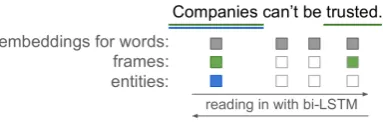
(2018) with embeddings for frames and entities (cf. Sec.2.5for frame embeddings and entity em-beddings). The baseline model is an intra-warrant attention model that only uses conventional pre-trained word embeddings as an input. We apply a late fusionstrategy: obtain the annotations sepa-rately and combine them afterwards by appending the frame and entity embeddings to the word vec-tors on the token level. Each input sentence is processed by a bi-directional long short-term mory (LSTM) network that reads not only word em-beddings, but also frame embeddings for all event mentions and entity embeddings for all entity men-tions (Figure 2). Now, the attention weights for the decision between the two warrants are adapted based on the semantically enriched representation of claim (b) and reason (c).4
We optimize hyperparameters on the develop-ment set with random search. All models are trained using the Adam optimizer (Kingma and Ba,2014) with a batch size of16. For our evalua-tion, we perform ten runs and report the mean and max accuracy together with the standard deviation.
3 Results
In Table1we report our results on the ARC task. Our extended approaches ‘+FN’ and ‘+WD’ for se-mantic enrichment with information about frames and entities increase the averaged performance by more than one percentage point against the baseline. For the best run, the advantage of ‘+FN’ and ‘+WD’ becomes even clearer (+2.2 pp.). On the other hand, the straightforward combination of the two external knowledge source, ‘+FN/WD’, does not lead to further improvements. This points out the
mean max
Approach Dev. (±) Test (±) Test
Habernal et al.(2018) (reimpl.) 0.6712 0.0155 0.5570 0.0184 0.5878
+WD 0.6623 0.0071 0.5680 0.0235 0.6036
+FN 0.6741 0.0119 0.5676 0.0257 0.6104
[image:4.595.92.507.67.156.2]+FN/WD 0.6630 0.0088 0.5592 0.0164 0.5946
Table 1: Mean and max accuracy over ten runs on the ARC dev. and test sets (best results highlighted in bold).
need for advanced models that are able to fuse anno-tations of different types. Albeit positive the results do not seem be a strong support for the hypothesis of (Habernal et al., 2018) about external knowl-edge being beneficial for the defined task, as we observe only moderate improvements. Overall, the enriched models (‘+WD’, ‘+FN’ and ‘+FN/WD’) make mostly the same predictions as the baseline system. For instance, for ‘+WD’ there is79,5%
overlap of the predictions with the baseline, and for ‘+FN’, it is76.6%. In the following section, we try to identify the reasons why the structured knowledge in the form of FN and WD does not further improve the results.
3.1 Error analysis
The amount of semantic information that the model can utilize is dependent on the number of annota-tions for a test instance5. We analyze the perfor-mance of the enriched models by the number of annotations for ‘+WD’ and for ‘+FN’.
Figure3 shows the performance of ‘+WD’ in comparison to the baseline against the number of WD entities per test instance. As expected, there is no difference in performance for the instances
5
Each instance is four sentences: a claim, a reason, a debate title and a candidate warrant.
0 50 100
orange:
#
instances
0 1 2 3 ≥4
0.45 0.5 0.55 0.6
Accurac
y
[image:4.595.312.523.594.712.2]WD Habernal et al.(2018) (reimpl.)
Figure 3: Performance for the ‘+WD’ approach by the number of WD entities in a test set instance.
without WD annotations. We can see a clear im-provement for the instances with one or two en-tities, which indicates that some semantic knowl-edge is helping to draw the decision between the two warrants. Contrary, ‘+WD’ performs equal to the baseline for three or more annotations.
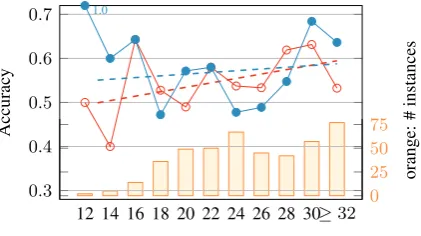
The performance of the ‘+FN’ model against the number of the frame annotations is plotted in Figure 4. Whilst the difference between ‘+FN’ and baseline varies more, we can observe a simi-lar tendency: once some semantic annotations are available the enriched model outperforms the base-line, whereas with the growing number of frames the difference in performance decreases.
Both annotation tools, the WD entity linker as well as the FN frame identifier, introduce some noise: for the entity linker,Sorokin and Gurevych
(2018) report0.73F-score and the frame identifier has an accuracy of0.89(Botschen et al.,2018). We perform a manual error analysis on 50 instances of the test set to understand the effect of the noisy WD annotation.6 In44%of errors, no WD anno-tation was available and in52%, the annotations were (partially) incorrect. Only 4%of errors
oc-6Judging if a predicted frame is correct requires deep lin-guistic expertise and special training on the FrameNet guide-lines. Therefore, we excluded FN from this first study.
0 25 50 75
orange:
#
instances
12 14 16 18 20 22 24 26 28 30≥32 0.3
0.4 0.5 0.6 0.7 1.0
Accurac
y
FN Habernal et al.(2018) (reimpl.)
[image:4.595.76.290.595.721.2]cur despite correct entities being available to the model. Notably, in65%of the cases a correct entity annotation leads to a correct prediction.
Taken together, for instances with little context and therefore only some annotations with frames or entities, the semantic enrichment helps to cap-ture a broader context of the argumentation chain which in turn benefits the classification. However, for instances with more context and therefore more annotations with frames or entities, the benefit is turned down by a worse precision of the annota-tion tools. Interestingly, the effect of improved performance only for shorter sequences with less annotations is in line with findings of research on in-formation retrieval (M¨uller et al.,2008), where the trade-off between some annotations that increase the accuracy and more annotations that can hurt the performance is known as precision-recall balance (Riedel et al.,2010;Manning et al.,2008).
3.2 Qualitative analysis
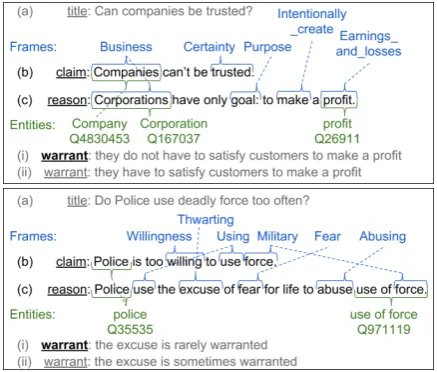
When manually inspecting the annotations of frames and entities, it becomes questionable whether these actually have the potential of con-tributing to a clear distinction between the two war-rants. Figure5shows two instances of the ARC corpus with FN and WD annotations. Both anno-tation layers contribute useful information about the world, which is not contained in the textual input. For instance, ‘companies’ and ‘corporations’ are correctly disambiguated and linked to the same frame and the phrase ‘use of force’ is mapped to the entity Q971119 for a legal concept. Neverthe-less, when manually inspecting the annotations of frames and entities it becomes apparent that the provided background knowledge is not sufficient to draw the distinction between the two warrants. In the first example in Figure5, the key difference between the two warrants is the negation (and simi-lar in the second example). Even if our approach performs a semantic enrichment of the context, the crucial capability of performing reasoning is still missing. This means, our input representation is semantically enriched, but is not parsed into a logic-based representation.
[image:5.595.307.526.62.248.2]To sum up, in the previous Section3.1, we show that our approach is of help by successfully en-riching the context with semantics for shorter in-stances; and in this Section3.2, we analyze why our approach is too limited to solve some key chal-lenges of the ARC task. We conclude with the
Figure 5: Instances of ARC corpus, with claim (b) and reason (c) annotated with frames and entities.
key challenge of ARC not being lexical-semantic gaps between warrants but rather different phenom-ena such as negation and that this challenge is to be resolved with logical analysis rather than with integrating world knowledge.
4 Conclusion
We integrate world knowledge from FrameNet and Wikidata into the task of common-sense argumen-tative reasoning and achieve an improvement in performance compared to the baseline approach. Based on the experiments and the manual analysis, we conclude that external world knowledge might not be enough to gain significant improvements in argumentative reasoning, and we rather point towards logical analysis.
Starting from the hypothesis of the evaluators of the shared task about world knowledge being essen-tial for the Argument Reasoning Comprehension task, we show the potential of semantic enrichment of the context for shorter instances. Our results offer a first perspective on using external resources for the Argument Reasoning Comprehension task. More broadly, our approaches ‘+FN’ (events) and ‘+WD’ (facts) showcase the contribution of
seman-tic enrichment to high-level tasks requiring com-mon sense knowledge.
Acknowledgments
This work has been supported by the DFG-funded research training group “Adaptive Preparation of In-formation form Heterogeneous Sources” (AIPHES, GRK 1994/1).
References
Eneko Agirre, Mona Diab, Daniel Cer, and Aitor Gonzalez-Agirre. 2012. Semeval-2012 task 6: A pi-lot on semantic textual similarity. InProceedings of the First Joint Conference on Lexical and Computa-tional Semantics-Volume 1: Proceedings of the main conference and the shared task, and Volume 2: Pro-ceedings of the Sixth International Workshop on Se-mantic Evaluation, pages 385–393. Association for Computational Linguistics.
Simon Ahrendt and Vera Demberg. 2016. Improving event prediction by representing script participants. InProceedings of the 16th Annual Conference of the North American Chapter of the Association for Com-putational Linguistics: Human Language Technolo-gies (NAACL), pages 546–551, San Diego, USA. As-sociation for Computational Linguistics.
Collin F. Baker, Charles J. Fillmore, and John B. Lowe. 1998. The Berkeley FrameNet project. In Pro-ceedings of the 36th Annual Meeting of the Associ-ation for ComputAssoci-ational Linguistics and 17th International Conference on Computational Linguistics -Volume 1, pages 86–90, Stroudsburg, PA, USA.
Antoine Bordes, Nicolas Usunier, Alberto Garcia-Dur´an, Jason Weston, and Oksana Yakhnenko. 2013. Translating embeddings for modeling multi-relational data. InProceedings of the 26th Interna-tional Conference on Advances in Neural Informa-tion Processing Systems (NIPS), pages 2787–2795.
Teresa Botschen, Iryna Gurevych, Jan-Christoph Klie, Hatem Mousselly Sergieh, and Stefan Roth. 2018. Multimodal Frame Identification with Multilingual Evaluation. InProceedings of the 16th Annual Con-ference of the North American Chapter of the As-sociation for Computational Linguistics: Human Language Technologies (NAACL), pages 1481–1491. Association for Computational Linguistics.
Teresa Botschen, Hatem Mousselly-Sergieh, and Iryna Gurevych. 2017. Prediction of Frame-to-Frame Re-lations in the FrameNet Hierarchy with Frame Em-beddings. In Proceedings of th 2nd Workshop on Representation Learning for NLP (RepL4NLP, held in conjunction with ACL), pages 146–156.
Samuel R. Bowman, Gabor Angeli, Christopher Potts, and Christopher D. Manning. 2015. A large anno-tated corpus for learning natural language inference. InProceedings of the 2015 Conference on Empirical Methods in Natural Language Processing (EMNLP), pages 632–642. Association for Computational Lin-guistics.
Qian Chen, Xiaodan Zhu, Zhen-Hua Ling, Diana Inkpen, and Si Wei. 2018. Neural Natural Language Inference Models Enhanced with External Knowl-edge. In Proceedings of the 56th Annual Meet-ing of the Association for Computational LMeet-inguistics (ACL), pages 2406–2417, Melbourne, Australia. As-sociation for Computational Linguistics.
Pengxiang Cheng and Katrin Erk. 2018. Implicit ar-gument prediction with event knowledge. In Pro-ceedings of the 16th Annual Conference of the North American Chapter of the Association for Computa-tional Linguistics: Human Language Technologies (NAACL), pages 831–840. Association for Computa-tional Linguistics.
HongSeok Choi and HyunJu Lee. 2018. Gist at semeval-2018 task 12: A network transferring in-ference knowledge to argument reasoning compre-hension task. In Proceedings of the 16th Annual Conference of the North American Chapter of the Association for Computational Linguistics: Human Language Technologies (SemEval-Workshop), page (to appear), New Orleans, LA, USA. Association for Computational Linguistics.
Michael F¨arber, Basil Ell, Carsten Menne, and Achim Rettinger. 2015. A Comparative Survey of DBpedia, Freebase, OpenCyc, Wikidata, and YAGO. Seman-tic Web Journal, 1:1–5.
Charles J. Fillmore. 1976. Frame semantics and the na-ture of language. Annals of the New York Academy of Sciences, 280:20–32.
Max Glockner, Vered Shwartz, and Yoav Goldberg. 2018. Breaking NLI Systems with Sentences that Require Simple Lexical Inferences. InThe 56th An-nual Meeting of the Association for Computational Linguistics (ACL), Melbourne, Australia.
Jiang Guo, Wanxiang Che, Haifeng Wang, Ting Liu, and Jun Xu. 2016. A unified architecture for se-mantic role labeling and relation classification. In Proceedings of the 26th International Conference on Computational Linguistics: Technical Papers (COL-ING), pages 1264–1274.
Ivan Habernal, Henning Wachsmuth, Iryna Gurevych, and Benno Stein. 2018. The Argument Reason-ing Comprehension Task: Identification and Recon-struction of Implicit Warrants. In Proceedings of the 16th Annual Conference of the North American Chapter of the Association for Computational Lin-guistics: Human Language Technologies (NAACL), pages 1930–1940, New Orleans, LA, USA. Associa-tion for ComputaAssocia-tional Linguistics.
Diederik Kingma and Jimmy Ba. 2014. Adam: A Method for Stochastic Optimization. arXiv preprint arXiv:1412.6980.
Christopher D. Manning, Prabhakar Raghavan, and Hinrich Sch¨utze. 2008. Introduction to Information Retrieval. Cambridge University Press, New York, NY, USA.
Tomas Mikolov, Kai Chen, Greg Corrado, and Jef-frey Dean. 2013. Efficient Estimation of Word Representations in Vector Space. arXiv preprint arXiv:1301.3781.
George A Miller. 1995. WordNet: a lexical database for English. Communications of the ACM, 38(11):39–41.
Nasrin Mostafazadeh, Nathanael Chambers, Xiaodong He, Devi Parikh, Dhruv Batra, Lucy Vanderwende, Pushmeet Kohli, and James Allen. 2016. A Cor-pus and Cloze Evaluation for Deeper Understand-ing of Commonsense Stories. InProceedings of the 2016 Conference of the North American Chapter of the Association for Computational Linguistics: Hu-man Language Technologies (NAACL), pages 839– 849, San Diego, California. Association for Compu-tational Linguistics.
Hatem Mousselly-Sergieh and Iryna Gurevych. 2016. Enriching Wikidata with Frame Semantics. In Pro-ceedings of the 5th Workshop on Automated Knowl-edge Base Construction (AKBC, held in conjunction with NAACL), pages 29–34.
Christof M¨uller, Iryna Gurevych, and Max M¨uhlh¨auser. 2008. Closing the Vocabulary Gap for Computing Text Similarity and Information Retrieval. Interna-tional Journal of Semantic Computing, 2(02):253– 272.
Hao Peng, Sam Thomson, Swabha Swayamdipta, and Noah A Smith. 2018. Learning joint se-mantic parsers from disjoint data. arXiv preprint arXiv:1804.05990.
Sebastian Riedel, Limin Yao, and Andrew McCallum. 2010. Modeling Relations and Their Mentions with-out Labeled Text. InProceedings of the European Conference on Machine Learning and Knowledge Discovery in Databases, pages 148–163, Barcelona, Spain.
Josef Ruppenhofer, Michael Ellsworth, Miriam R.L. Petruck, Christopher R. Johnson, and Jan Schef-fczyk. 2016. FrameNet II: Extended Theory and Practice, revised november 1, 2016 edition. Interna-tional Computer Science Institute, Berkeley, USA.
Daniil Sorokin and Iryna Gurevych. 2018. Mixing Context Granularities for Improved Entity Linking on Question Answering Data across Entity Cate-gories. In Proceedings of the 7th Joint Conference on Lexical and Computational Semantics (*SEM, held in conjunction with NAACL), pages 65–75. As-sociation for Computational Linguistics.
Su Wang, Greg Durrett, and Katrin Erk. 2018. Model-ing Semantic Plausibility by InjectModel-ing World Knowl-edge. InProceedings of the 16th Annual Conference of the North American Chapter of the Association for Computational Linguistics: Human Language Technologies (NAACL), pages 303–308. Association for Computational Linguistics.