Incremental Integer Linear Programming for Non-projective Dependency
Parsing
Sebastian Riedel and James Clarke School of Informatics, University of Edinburgh
2 Bucclecuch Place, Edinburgh EH8 9LW, UK
[email protected],[email protected]
Abstract
Integer Linear Programming has recently been used for decoding in a number of probabilistic models in order to enforce global constraints. However, in certain ap-plications, such as non-projective depen-dency parsing and machine translation, the complete formulation of the decod-ing problem as an integer linear program renders solving intractable. We present an approach which solves the problem crementally, thus we avoid creating in-tractable integer linear programs. This ap-proach is applied to Dutch dependency parsing and we show how the addition of linguistically motivated constraints can yield a significant improvement over state-of-the-art.
1 Introduction
Many inference algorithms require models to make strong assumptions of conditional indepen-dence between variables. For example, the Viterbi algorithm used for decoding in conditional ran-dom fields requires the model to be Markovian. Strong assumptions are also made in the case of McDonald et al.’s (2005b) non-projective depen-dency parsing model. Here attachment decisions are made independently of one another1. However, often such assumptions can not be justified. For example in dependency parsing, if a subject has already been identified for a given verb, then the probability of attaching a second subject to the verb is zero. Similarly, if we find that one coor-dination argument is a noun, then the other argu-1If we ignore the constraint that dependency trees must be
cycle-free (see sections 2 and 3 for details).
ment cannot be a verb. Thus decisions are often co-dependent.
Integer Linear Programming (ILP) has recently been applied to inference in sequential condi-tional random fields (Roth and Yih, 2004), this has allowed the use of truly global constraints during inference. However, it is not possible to use this approach directly for a complex task like non-projective dependency parsing due to the ex-ponential number of constraints required to pre-vent cycles occurring in the dependency graph. To model all these constraints explicitly would re-sult in an ILP formulation too large to solve effi-ciently (Williams, 2002). A similar problem also occurs in an ILP formulation for machine transla-tion which treats decoding as the Travelling Sales-man Problem (GerSales-mann et al., 2001).
In this paper we present a method which extends the applicability of ILP to a more complex set of problems. Instead of adding all the constraints we wish to capture to the formulation, we first solve the program with a fraction of the constraints. The solution is then examined and, if required, addi-tional constraints are added. This procedure is re-peated until all constraints are satisfied. We apply this dependency parsing approach to Dutch due to the language’s non-projective nature, and take the parser of McDonald et al. (2005b) as a starting point for our model.
In the following section we introduce depen-dency parsing and review previous work. In Sec-tion 3 we present our model and formulate it as an ILP problem with a set of linguistically mo-tivated constraints. We include details of an in-cremental algorithm used to solve this formula-tion. Our experimental set-up is provided in Sec-tion 4 and is followed by results in SecSec-tion 5 along with runtime experiments. We finally discuss
Figure 1: A Dutch dependency tree for “I’ll come at twelve and then you’ll get what you deserve”
ture research and potential improvements to our approach.
2 Dependency Parsing
Dependency parsing is the task of attaching words to their arguments. Figure 1 shows a dependency graph for the Dutch sentence “I’ll come at twelve and then you’ll get what you deserve” (taken from the Alpino Corpus (van der Beek et al., 2002)). In this dependency graph the verb “kom” is attached to its subject “ik”. “kom” is referred to as the head of the dependency and “ik” as its child. In labelled dependency parsing edges between words are la-belled with the relation captured. In the case of the dependency between “kom” and “ik” the label would be “subject”.
In a dependency tree every token must be the child of exactly one other node, either another to-ken or the dummy root node. By definition, a de-pendency tree is free of cycles. For example, it must not contain dependency chains such as “en”
→“kom”→“ik”→“en”. For a more formal
def-inition see previous work (Nivre et al., 2004). An important distinction between dependency trees is whether they are projective or non-projective. Figure 1 is an example of a projec-tive dependency tree, in such trees dependencies do not cross. In Dutch and other flexible word or-der languages such as German and Czech we also encounter non-projective trees, in these cases the trees contain crossing dependencies.
Dependency parsing is useful for applications such as relation extraction (Culotta and Sorensen, 2004) and machine translation (Ding and Palmer, 2005). Although less informative than lexicalised phrase structures, dependency structures still cap-ture most of the predicate-argument information needed for applications. It has the advantage of be-ing more efficient to learn and parse.
McDonald et al. (2005a) introduce a depen-dency parsing framework which treats the task as searching for the projective tree that maximises the sum of local dependency scores. This
frame-Figure 2: An incorrect partial dependency tree. The verb “krijg” is incorrectly coordinated with the preposition “om”.
work is efficient and has also been extended to non-projective trees (McDonald et al., 2005b). It provides a discriminative online learning algo-rithm which when combined with a rich feature set reaches state-of-the-art performance across multi-ple languages.
However, within this framework one can only define features over single attachment decisions. This leads to cases where basic linguistic con-straints are not satisfied (e.g. verbs with two sub-jects or incompatible coordination arguments). An example of this for Dutch is illustrated in Figure 2 which was produced by the parser of McDonald et al. (2005b). Here the parse contains a coordi-nation of incompatible word classes (a preposition and a verb).
Our approach is able to include additional con-straints which forbid configurations such as those in Figure 2. While McDonald and Pereira (2006) address the issue of local attachment decisions by defining scores over attachment pairs, our solution is more general. Furthermore, it is complementary in the sense that we could formulate their model using ILP and then add constraints.
The method we present is not the only one that can take global constraints into account. Deter-ministic dependency parsing (Nivre et al., 2004; Yamada and Matsumoto, 2003) can apply global constraints by conditioning attachment decisions on the intermediate parse built. However, for effi-ciency a greedy search is used which may produce sub-optimal solutions. This is not the case when using ILP.
3 Model
Our underlying model is a modified labelled ver-sion2of McDonald et al. (2005b):
s(x,y) = X
(i,j,l)∈y
s(i, j, l)
= X
(i,j,l)∈y
w·f(i, j, l)
2Note that this is not described in the McDonald papers
[image:2.595.327.489.679.739.2]where x is a sentence, y is a set of labelled de-pendencies, f(i, j, l) is a multidimensional
fea-ture vector representation of the edge from token i to token j with label l and w the correspond-ing weight vector. For example, a featuref101inf could be:
f101(i, j, l) =
1 ift(i) =“en”∧p(j) =V ∧l=“coordination” 0 otherwise
wheret(i)is the word at tokeniandp(j)the
part-of-speech tag at tokenj.
Decoding in this model amounts to finding the yfor a givenxthat maximisess(x,y):
y0
= arg max
y s(x,y)
while fulfilling the following constraints:
T1 For every non-root token inxthere exists ex-actly one head; the root token has no head.
T2 There are no cycles.
Thus far, the formulation follows McDonald et al. (2005b) and corresponds to the Maximum Spanning Tree (MST) problem. In addition toT1
and T2, we include a set of linguistically
moti-vated constraints:
A1 Heads are not allowed to have more than one
outgoing edge labelledl for all l in a set of labelsU.
C1 In a symmetric coordination there is exactly
one argument to the right of the conjunction and at least one argument to the left.
C2 In an asymmetric coordination there are no
ar-guments to the left of the conjunction and at least two arguments to the right.
C3 There must be at least one comma between
subsequent arguments to the left of a sym-metric coordination.
C4 Arguments of a coordination must have
com-patible word classes.
P1 Two dependencies must not cross if one of
their labels is in a set of labelsP.
A1 covers constraints such as “there can only
be one subject” ifU contains “subject” (see Sec-tion 4.4 for more details of U). C1 applies to
configurations which contain conjunctions such as “en”,“of” or “maar” (“and”, “or” and “but”). C2
will rule-out settings where a conjunction such as “zowel” (translates as “both”) having arguments to its left. C3 forces coordination arguments to
the left of a conjunction to have commas in be-tween. C4 avoids parses in which incompatible
word classes are coordinated, such as nouns and verbs. Finally,P1allowsselective projective
pars-ing: we can, for instance, forbid the crossing of “Noun-Determiner” dependencies if we add the corresponding label type toP(see Section 4.4 for more details ofP) . If we extendP to contain all labels we forbid any type of crossing dependen-cies. This corresponds to projective parsing.
3.1 Decoding
McDonald et al. (2005b) use the Chu-Liu-Edmonds (CLE) algorithm to solve the maxi-mum spanning tree problem. However, global con-straints cannot be incorporated into the CLE algo-rithm (McDonald et al., 2005b). We alleviate this problem by presenting an equivalent Integer Lin-ear Programming formulation which allows us to incorporate global constraints naturally.
Before giving full details of our formulation we first introduce some of the concepts of lin-ear and integer linlin-ear programming (for a more thorough introduction see Winston and Venkatara-manan (2003)).
Linear Programming (LP) is a tool for solving optimisation problems in which the aim is to max-imise (or minmax-imise) a given linear function with respect to a set of linear constraints. The
func-tion to be maximised (or minimised) is referred to as theobjective function. A number ofdecision variablesare under our control which exert
influ-ence on the objective function. Specifically, they have to be optimised in order to maximise (or min-imise) the objective function. Finally, a set of con-straints restrict the values that the decision vari-ables can take. Integer Linear Programming is an extension of linear programming where all deci-sion variables must take integer values.
meth-Algorithm 1Incremental Integer Linear
Program-ming C←Bx
repeat
y←solve(C, Ox, Vx)
W ←violated(y, Ix)
C←C∪W
untilV =∅ return y
ods yield an exponential number of constraints. Although the latter scales cubically, it produces non-fractional solutions in its relaxed version; this causes long runtimes for the branch and bound al-gorithm (Williams, 2002) commonly used in inte-ger linear programming. We found out experimen-tally that dependency parsing models of this form do not converge on a solution after multiple hours of solving, even for small sentences.
As a workaround for this problem we follow an incremental approach akin to the work of Warme (1998). Instead of adding constraints which forbid all possible cycles in advance (this would result in an exponential number of constraints) we first solve the problem without any cycle constraints. The solution is then examined for cycles, and if cycles are found we add constraints to forbid these cycles; the solver is then run again. This process is repeated until no more violated constraints are found. The same procedure is used for other types of constraints which are too expensive to add in advance (e.g. the constraints ofP1).
Algorithm 1 outlines our approach. For a sen-tence x, Bx is the set of constraints that we add in advance andIx are the constraints we add in-crementally. Ox is the objective function andVx is a set of variables including integer declarations.
solve(C, O, V) maximises the objective function
Owith respect to the set of constraintsCand vari-ablesV.violated(y, I)inspects the proposed
so-lution (y) and returns all constraints inIwhich are violated.
The number of iterations required in this ap-proach is at most polynomial with respect to the number of variables (Gr¨otschel et al., 1981). In practice, this technique converges quickly (less than 20 iterations in 99% of approximately 12,000 sentences), yielding average solve times of less than 0.5 seconds.
Our approach converges quickly due to the quality of the scoring function. Its weights have
been trained on cycle free data, thus it is more likely to guide the search to a cycle free solution.
In the following section we present the objec-tive function Ox, variables Vx and linear con-straintsBxandIxneeded for parsingxusing Al-gorithm 1.
3.1.1 Variables
Vxcontains a set of binary variables to represent labelled edges:
ei,j,l ∀i∈0..n, j∈1..n,
l∈bestk(i, j)
wherenis the number of tokens and the index 0 represents the root token.bestk(i, j)is the set ofk
labels with highests(i, j, l).ei,j,l equals 1 if there is a edge (i.e., a dependency) with the labell be-tween tokeni(head) andj(child), 0 otherwise.k depends on the type of constraints we want to add. For the plain MST problem it is sufficient to set k= 1and only take the best scoring label for each
token pair. However, if we want a constraint which forbids duplicate subjects we need to provide ad-ditional labels to fall back on.
Vx also contains a set of binary auxiliary vari-ables:
di,j ∀i∈0..n, j ∈1..n
which represent the existence of a dependency be-tween tokensiandj. We connect these to theei,j,l variables by the constraint:
di,j = X
l∈bestk(i,j)
ei,j,l
3.1.2 Objective Function
Given the above variables our objective function Oxcan be represented as (using a suitablek):
X
i,j
X
l∈bestk(i,j)
s(i, j, l)·ei,j,l
3.1.3 Base Constraints
We first introduce a set of base constraintsBx which we add in advance.
Only One Head (T1) Every token has exactly
one head:
X
i
di,j = 1
for non-root tokens j > 0 inx. An exception is
made for the artificial root node: X
i
Label Uniqueness (A1) To enforce uniqueness
of children with labels inU we augment our model with the constraint:
X
j
ei,j,l ≤1
for every tokeniinxand labellinU.
Symmetric Coordination (C1) For each
con-junction token i which forms a symmetric coor-dination we add:
X
j<i
di,j ≥1
and
X
j>i
di,j = 1
Asymmetric Coordination (C2) For each
con-junction tokeniwhich forms an asymmetric coor-dination we add:
X
j<i
di,j = 0
and
X
j>i
di,j ≥2
3.1.4 Incremental Constraints
Now we present the set of constraintsIxwe add incrementally. The constraints are chosen based on the two criteria: (1) adding them to the base con-straints (those added in advance) would result in an extremely large program, and (2) it must be ef-ficient to detect whether the constraint is violated iny.
No Cycles (T2) For every possible cycle c for the sentencexwe have a constraint which forbids the case where all edges incare active simultane-ously:
X
(i,j)∈c
di,j ≤ |c| −1
Comma Coordination (C3) For each
symmet-ric conjunction tokeniwhich forms a symmetric coordination and each set of tokensAinxto the left ofiwith no comma between each pair of suc-cessive tokens we add:
X
a∈A
di,a≤ |A| −1
which forbids configurations whereihas the argu-ment tokensA.
Compatible Coordination Arguments (C4)
For each conjunction token iand each set of to-kensAinxwith incompatible POS tags, we add a constraint to forbid configurations whereihas the argument tokensA.
X
a∈A
di,a≤ |A| −1
Selective Projective Parsing (P1) For each pair
of triplets(i, j, l1)and(m, n, l2) we add the con-straint:
ei,j,l1 +em,n,l2 ≤1
ifl1orl2is inP.
3.2 Training
For training we use single-best MIRA (McDon-ald et al., 2005a). This is an online algorithm that learns by parsing each sentence and comparing the result with a gold standard. Training is com-plete after multiple passes through the whole cor-pus. Thus we decode using the Chu-Liu-Edmonds (CLE) algorithm due to its speed advantage over ILP (see Section 5.2 for a detailed comparison of runtimes).
The fact that we decode differently during train-ing (ustrain-ing CLE) and testtrain-ing (ustrain-ing ILP) may de-grade performance. In the presence of additional constraints weights may be able to capture other aspects of the data.
4 Experimental Set-up
Our experiments were designed to answer the fol-lowing questions:
1. How much do our additional constraints help improve accuracy?
2. How fast is our generic inference method in comparison with the Chu-Liu-Edmonds algo-rithm?
3. Can approximations be used to increase the speed of our method while remaining accu-rate?
4.1 Data
We use the Alpino treebank (van der Beek et al., 2002), taken from the CoNLL shared task of mul-tilingual dependency parsing3. The CoNLL data differs slightly from the original Alpino treebank as the corpus has been part-of-speech tagged using a Memory-Based-Tagger (Daelemans et al., 1996). It consists of 13,300 sentences with an average length of 14.6 tokens. The data is non-projective, more specifically 5.4% of all dependencies are crossed by at least one other dependency. It con-tains approximately 6000 sentences more than the Alpino corpus used by Malouf and van Noord (2004).
The training set was divided into a 10% devel-opment set (dev) while the remaining 90% is used
as a training and cross-validation set (cross).
Fea-ture sets, constraints and training parameters were selected through training oncrossand optimising
againstdev.
Our final accuracy scores and runtime eval-uations were acquired using a nine-fold cross-validation oncross
4.2 Environment and Implementation
All our experiments were conducted on a Intel Xeon with 3.8 Ghz and 4Gb of RAM. We used the open source Mixed Integer Programming li-brary lp solve4 to solve the Integer Linear
Pro-grams. Our code ran in Java and called the JNI-wrapper around thelp solvelibrary.
4.3 Feature Sets
Our feature set was determined through experi-mentation with the development set. The features are based upon the data provided within the Alpino treebank. Along with POS tags the corpus contains several additional attributes such as gender, num-ber and case.
Our best results on the development set were achieved using the feature set of McDonald et al. (2005a) and a set of features based on the addi-tional attributes. These features combine the at-tributes of the head with those of the child. For example, if token ihas the attributes a1 and a2, and token j has the attribute a3 then we created the features(a1∧a3)and(a2∧a3).
3For details see http://nextens.uvt.nl/
˜conll.
4The software is available from http://www.
geocities.com/lpsolve.
4.4 Constraints
All the constraints presented in Section 3 were used in our model. The set U of unique labels constraints contained su, obj1, obj2, sup, ld, vc, predc, predm, pc, pobj1, obcompandbody. Here sustands for subject andobj1for direct object (for
full details see Moortgat et al. (2000)).
The set of projective labels P contained cnj,
for coordination dependencies; and det, for
de-terminer dependencies. One exception was added for the coordination constraint: dependencies can cross when coordinated arguments are verbs.
One drawback of hard deterministic constraints is the undesirable effect noisy data can cause. We see this most prominently with coordination argu-ment compatibility. Words ending in “en” are typ-ically wrongly tagged and cause our coordination argument constraint to discard correct coordina-tions. As a workaround we assigned words ending in “en” a wildcard POS tag which is compatible with all POS tags.
5 Results
In this section we report our results. We not only present our accuracy but also provide an empiri-cal evaluation of the runtime behaviour of this ap-proach and show how parsing can be accelerated using a simple approximation.
5.1 Accuracy
An important question to answer when using global constraints is: How much of a performance boost is gained when using global constraints?
We ran the system without any linguistic con-straints as a baseline (bl) and compared it to a
system with the additional constraints (cnstr). To
evaluate our systems we use the accuracy over la-belled attachment decisions:
LAC = Nl
Nt
where Nl is the number of tokens with correct head and label and Nt is the total number of to-kens. For completeness we also report the unla-belled accuracy:
U AC = Nu
Nt
LAC UAC LC UC bl 84.6% 88.9% 27.7% 42.2% cnstr 85.1% 89.4% 29.7% 43.8%
Table 1: Labelled (LAC) and unlabelled (UAC)
ac-curacy using nine-fold cross-validation on cross for baseline (bl) and constraint-based (constr)
sys-tem.LCandUCare the percentages of sentences
with 100% labelled and unlabelled accuracy, re-spectively.
Table 1 shows our results using nine-fold cross-validation on the cross set. The baseline system
(no additional constraints) gives an unlabelled ac-curacy of 84.6% and labelled acac-curacy of 88.9%. When we add our linguistic constraints the per-formance increases by 0.5% for both labelled and unlabelled accuracy. This increase is significant (p <0.001) according to Dan Bikel’s parse
com-parison script and using the Sign test (p <0.001).
Now we give a little insight into how our results compare with the rest of the community. The re-ported state-of-the-art parser of Malouf and van Noord (2004) achieves 84.4% labelled accuracy which is very close numerically to our baseline. However, they use a subset of the CoNLL Alpino treebank with a higher average number of tokens per sentences and also evaluate control relations, thus results are not directly comparable. We have also run our parser on the relatively small (approx-imately 400 sentences) CoNNL test data. The best performing system (McDonald et al. 2006; note: this system is different to our baseline) achieves 79.2% labelled accuracy while our baseline sys-tem achieves 78.6% and our constrained version 79.8%. However, a significant difference is only observed between our baseline and our constraint-based system.
Examining the errors produced using the dev
set highlight two key reasons why we do not see a greater improvement using our constraint-based system. Firstly, we cannot improve on coordina-tions that include words ending with “en” based on the workaround present in Section 4.4. This prob-lem can only be solved by improving POS taggers for Dutch or by performing POS tagging within the dependency parsing framework.
Secondly, our system suffers from poor next best solutions. That is, if the best solution violates some constraints, then we find the next best solu-tion is typically worse than the best solusolu-tion with
violated constraints. This appears to be a conse-quence of inaccurate local score distributions (as opposed to inaccurate best local scores). For ex-ample, suppose we attach two subjects,t1 andt2, to a verb, where t1 is the actual subject whilet2 is meant to be labelled as object. If we forbid this configuration (two subjects) and if the score of la-belling t1 object is higher than that for t2 being labelled subject, then the next best solution will labelt1 incorrectly as object andt2incorrectly as subject. This is often the case, and thus results in a drop of accuracy.
5.2 Runtime Evaluation
We now concentrate on the runtime of our method. While we expect a longer runtime than using the Chu-Liu-Edmonds as in previous work (McDon-ald et al., 2005b), we are interested in how large the increase is.
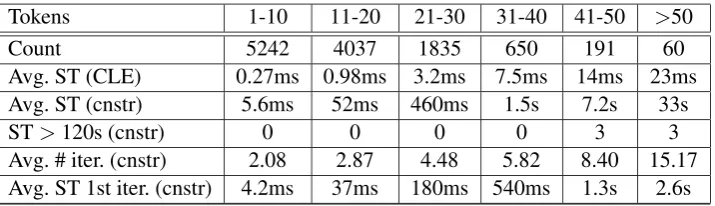
Table 2 shows the average solve time (ST) for
sentences with respect to the number of tokens in each sentence for our system with constraints ( cn-str) and the Chu-Liu-Edmonds (CLE) algorithm.
All solve times do not include feature extraction as this is identical for all systems. For cnstr we
also show the number of sentences that could not be parsed after two minutes, the average number of iterations and the average duration of the first iteration.
The results show that parsing using our generic approach is still reasonably fast although signifi-cantly slower than using the Chu-Liu-Edmonds al-gorithm. Also, only a small number of sentences take longer than two minutes to parse. Thus, in practice we would not see a significant degrada-tion in performance if we were to fall back on the CLE algorithm after two minutes of solving.
When we examine the average duration of the first iteration it appears that the majority of the solve time is spent within this iteration. This could be used to justify using the CLE algorithm to find a initial solution as starting point for the ILP solver (see Section 6).
5.3 Approximation
Tokens 1-10 11-20 21-30 31-40 41-50 >50
Count 5242 4037 1835 650 191 60
Avg. ST (CLE) 0.27ms 0.98ms 3.2ms 7.5ms 14ms 23ms Avg. ST (cnstr) 5.6ms 52ms 460ms 1.5s 7.2s 33s
ST>120s (cnstr) 0 0 0 0 3 3
[image:8.595.122.480.61.164.2]Avg. # iter. (cnstr) 2.08 2.87 4.48 5.82 8.40 15.17 Avg. ST 1st iter. (cnstr) 4.2ms 37ms 180ms 540ms 1.3s 2.6s
Table 2: Runtime evaluation for different sentence lengths. Average solve time (ST) for our system
with constraints (constr), the Chu-Liu-Edmonds algorithm (CLE), number of sentences with solve times
greater than 120 seconds, average number of iterations and first iteration solve time.
q=5 q=10 all CLE
LAC 84.90% 85.11% 85.14% 85.14%
[image:8.595.72.291.237.282.2]ST 351s 760s 3640s 20s
Table 3: Labelled accuracy (LAC) and total solve
time (ST) for thecrossdataset using varyingq val-ues and the Chu-Liu-Edmonds algorithm (CLE)
Thus we investigate if it is possible to speed up our inference using a simple approximation. For each token we now only consider theq variables in Vx with the highest scoring edges. For exam-ple, if we set q = 2 the set of variables for a
to-ken j will contain two variables, either both for the same headibut with different labels (variables ei,j,l1 and ei,j,l2) or two distinct heads i1 and i2
(variables ei1,j,l1 andei2,j,l2) where labelsl1 and
l2may be identical.
Table 3 shows the effect of different q values on solve time for the full corpus cross (roughly
12,000 sentences) and overall accuracy. We see that solve time can be reduced by 80% while only losing a marginal amount of accuracy when we set q to 10. However, we are unable to reach the 20 seconds solve time of the CLE algorithm. Despite this, when we add the time for preprocessing and feature extraction, the CLE system parses a cor-pus in around 15 minutes whereas our system with q = 10takes approximately 25 minutes5. When
we view the total runtime of each system we see our system is more competitive.
6 Discussion
While we have presented significant improve-ments using additional constraints, one may won-5Even when caching feature extraction during training
McDonald et al. (2005a) still takes approximately 10 minutes to train.
der whether the improvements are large enough to justify further research in this direction; espe-cially since McDonald and Pereira (2006) present an approximate algorithm which also makes more global decisions. However, we believe that our ap-proach is complementary to their model. We can model higher order features by using an extended set of variables and a modified objective function. Although this is likely to increase runtime, it may still be fast enough for real world applications. In addition, it will allow exact inference, even in the case of non-projective parsing. Also, we argue that this approach has potential for interesting exten-sions and applications.
For example, during our runtime evaluations we find that a large fraction of solve time is spent in the first iteration of our incremental algorithm. Af-ter the first iAf-teration the solver uses its last state to efficiently search for solutions in the presence of new constraints. Some solvers allow the specifica-tion of an initial soluspecifica-tion as a starting point, thus it is expected that significant improvements in terms of speed can be made by using the CLE algorithm to provide an initial solution.
7 Conclusion
In this paper we have presented a novel proach for inference using ILP. While previous ap-proaches which use ILP for decoding have solved each integer linear program in one run, we incre-mentally add constraints and solve the resulting program until no more constraints are violated. This allows us to efficiently use ILP for depen-dency parsing and add constraints which provide a significant improvement over the current state-of-the-art parser (McDonald et al., 2005b) on the Dutch Alpino corpus (seeblrow in Table 1).
Although slower than the baseline approach, our method can still parse large sentences (more than 50 tokens) in a reasonable amount of time (less than a minute). We have shown that pars-ing time can be significantly reduced uspars-ing a simple approximation which only marginally de-grades performance. Furthermore, we believe that the method has potential for further extensions and applications.
Acknowledgements
Thanks to Ivan Meza-Ruiz, Ruken C¸akıcı, Beata Kouchnir and Abhishek Arun for their contribu-tion during the CoNLL shared task and to Mirella Lapata for helpful comments and suggestions.
References
Culotta, Aron and Jeffery Sorensen. 2004. Dependency tree kernels for relation extraction. In42nd Annual Meeting of the Association for Computational Linguistics. Barcelona,
Spain, pages 423–429.
Daelemans, W., J. Zavrel, and S. Berck. 1996. MBT: A memory-based part of speech tagger-generator. In Pro-ceedings of the Fourth Workshop on Very Large Corpora.
pages 14–27.
Ding, Yuan and Martha Palmer. 2005. Machine transla-tion using probabilistic synchronous dependency insertransla-tion grammars. InThe 43rd Annual Meeting of the Association of Computational Linguistics. Ann Arbor, MI, USA, pages
541–548.
Germann, Ulrich, Michael Jahr, Kevin Knight, Daniel Marcu, and Kenji Yamada. 2001. Fast decoding and optimal de-coding for machine translation. InMeeting of the Asso-ciation for Computational Linguistics. Toulouse, France,
pages 228–235.
Gr¨otschel, M., L. Lov´asz, and A. Schrijver. 1981. The ellip-soid method and its consequences in combina- torial opti-mization.CombinatoricaI:169– 197.
Malouf, Robert and Gertjan van Noord. 2004. Wide cover-age parsing with stochastic attribute value grammars. In
Proc. of IJCNLP-04 Workshop ”Beyond Shallow Analy-ses”. Sanya City, Hainan Island, China.
McDonald, R., K. Crammer, and F. Pereira. 2005a. Online large-margin training of dependency parsers. In43rd
An-nual Meeting of the Association for Computational Lin-guistics. Ann Arbor, MI, USA, pages 91–98.
McDonald, R. and F. Pereira. 2006. Online learning of ap-proximate dependency parsing algorithms. In11th Con-ference of the European Chapter of the Association for Computational Linguistics. Trento, Italy, pages 81–88.
McDonald, R., F. Pereira, K. Ribarov, and J. Hajic. 2005b. Non-projective dependency parsing using spanning tree algorithms. InProceedings of Human Language Technol-ogy Conference and Conference on Empirical Methods in Natural Language Processing. Association for
Computa-tional Linguistics, Vancouver, British Columbia, Canada, pages 523–530.
McDonald, Ryan, Kevin Lerman, and Fernando Pereira. 2006. Multilingual dependency analysis with a two-stage discriminative parser. In Proceedings of CoNLL-2006.
New York, USA.
Moortgat, M., I. Schuurman, and T. van der Wouden. 2000. Cgn syntactische annotatie. Internal report Corpus Gesproken Nederlands.
Nivre, J., J. Hall, and J. Nilsson. 2004. Memory-based depen-dency parsing. In Proceedings of CoNLL-2004. Boston,
MA, USA, pages 49–56.
Roth, D. and W. Yih. 2004. A linear programming formu-lation for global inference in natural language tasks. In
Proceedings of CoNLL-2004,. Boston, MA, USA, pages
1–8.
van der Beek, L., G. Bouma, R. Malouf, G. van Noord, Leonoor van der Beek, Gosse Bouma, Robert Malouf, and Gertjan van Noord. 2002. The Alpino dependency tree-bank. In Computational Linguistics in the Netherlands (CLIN). Rodopi.
Warme, David Michael. 1998. Spanning Trees in Hyper-graphs with Application to Steiner Trees. Ph.D. thesis,
University of Virginia.
Williams, Justin C. 2002. A linear-size zero - one program-ming model for the minimum spanning tree problem in planar graphs.Networks39:53–60.
Winston, Wayne L. and Munirpallam Venkataramanan. 2003. Introduction to Mathematical Programming.
Brooks/Cole.