Partially Supervised Sense Disambiguation by Learning Sense Number
from Tagged and Untagged Corpora
Zheng-Yu Niu, Dong-Hong Ji
Institute for Infocomm Research 21 Heng Mui Keng Terrace
119613 Singapore
{zniu, dhji}@i2r.a-star.edu.sg
Chew Lim Tan
Department of Computer Science National University of Singapore
3 Science Drive 2 117543 Singapore
Abstract
Supervised and semi-supervised sense dis-ambiguation methods will mis-tag the in-stances of a target word if the senses of these instances are not defined in sense in-ventories or there are no tagged instances for these senses in training data. Here we used a model order identification method to avoid the misclassification of the in-stances with undefined senses by discov-ering new senses from mixed data (tagged and untagged corpora). This algorithm tries to obtain a natural partition of the mixed data by maximizing a stability cri-terion defined on the classification result from an extended label propagation al-gorithm over all the possible values of the number of senses (or sense number, model order). Experimental results on SENSEVAL-3 data indicate that it outper-forms SVM, a one-class partially super-vised classification algorithm, and a clus-tering based model order identification al-gorithm when the tagged data is incom-plete.
1 Introduction
In this paper, we address the problem of partially supervised word sense disambiguation, which is to disambiguate the senses of occurrences of a tar-get word in untagged texts when given incomplete tagged corpus1.
Word sense disambiguation can be defined as associating a target word in a text or discourse 1“incomplete tagged corpus” means that tagged corpus
does not include the instances of some senses for the target word, while these senses may occur in untagged texts.
with a definition or meaning. Many corpus based methods have been proposed to deal with the sense disambiguation problem when given definition for each possible sense of a target word or a tagged corpus with the instances of each possible sense, e.g., supervised sense disambiguation (Leacock et al., 1998), and semi-supervised sense disambigua-tion (Yarowsky, 1995).
Supervised methods usually rely on the infor-mation from previously sense tagged corpora to determine the senses of words in unseen texts. Semi-supervised methods for WSD are charac-terized in terms of exploiting unlabeled data in the learning procedure with the need of prede-fined sense inventories for target words. The in-formation for semi-supervised sense disambigua-tion is usually obtained from bilingual corpora (e.g. parallel corpora or untagged monolingual corpora in two languages) (Brown et al., 1991; Da-gan and Itai, 1994), or sense-tagged seed examples (Yarowsky, 1995).
Some observations can be made on the previous supervised and semi-supervised methods. They always rely on hand-crafted lexicons (e.g., Word-Net) as sense inventories. But these resources may miss domaspecific senses, which leads to in-complete sense tagged corpus. Therefore, sense taggers trained on the incomplete tagged corpus will misclassify some instances if the senses of these instances are not defined in sense invento-ries. For example, one performs WSD in informa-tion technology related texts using WordNet 2 as sense inventory. When disambiguating the word “boot” in the phrase “boot sector”, the sense tag-ger will assign this instance with one of the senses of “boot” listed in WordNet. But the correct sense 2Online version of WordNet is available at
http://wordnet.princeton.edu/cgi-bin/webwn2.0
“loading operating system into memory” is not in-cluded in WordNet. Therefore, this instance will be associated with an incorrect sense.
So, in this work, we would like to study the problem of partially supervised sense disambigua-tion with an incomplete sense tagged corpus. Specifically, given an incomplete sense-tagged corpus and a large amount of untagged examples for a target word3, we are interested in (1) label-ing the instances in the untagged corpus with sense tags occurring in the tagged corpus; (2) trying to find undefined senses (or new senses) of the target word 4 from the untagged corpus, which will be represented by instances from the untagged cor-pus.
We propose an automatic method to estimate the number of senses (or sense number, model or-der) of a target word in mixed data (tagged cor-pus+untagged corpus) by maximizing a stability criterion defined on classification result over all the possible values of sense number. At the same time, we can obtain a classification of the mixed data with the optimal number of groups. If the es-timated sense number in the mixed data is equal to the sense number of the target word in tagged corpus, then there is no new sense in untagged corpus. Otherwise new senses will be represented by groups in which there is no instance from the tagged corpus.
This partially supervised sense disambiguation algorithm may help enriching manually compiled lexicons by inducing new senses from untagged corpora.
This paper is organized as follows. First, a model order identification algorithm will be pre-sented for partially supervised sense disambigua-tion in secdisambigua-tion 2. Secdisambigua-tion 3 will provide experi-mental results of this algorithm for sense disam-biguation on SENSEVAL-3 data. Then related work on partially supervised classification will be summarized in section 4. Finally we will conclude our work and suggest possible improvements in section 5.
2 Partially Supervised Word Sense Disambiguation
The partially supervised sense disambiguation problem can be generalized as a model order iden-3Untagged data usually includes the occurrences of all the
possible senses of the target word
4“undefined senses” are the senses that do not appear in
tagged corpus.
tification problem. We try to estimate the sense number of a target word in mixed data (tagged cor-pus+untagged corpus) by maximizing a stability criterion defined on classification results over all the possible values of sense number. If the esti-mated sense number in the mixed data is equal to the sense number in the tagged corpus, then there is no new sense in the untagged corpus. Other-wise new senses will be represented by clusters in which there is no instance from the tagged corpus. The stability criterion assesses the agreement be-tween classification results on full mixed data and sampled mixed data. A partially supervised clas-sification algorithm is used to classify the full or sampled mixed data into a given number of classes before the stability assessment, which will be pre-sented in section 2.1. Then we will provide the details of the model order identification procedure in section 2.2.
2.1 An Extended Label Propagation Algorithm
Table 1: Extended label propagation algorithm. Function: ELP(DL,DU,k,YD0L+DU)
Input: labeled examplesDL, unlabeled
examplesDU, model orderk, initial
labeling matrixY0 DL+DU;
Output: the labeling matrixYDU onDU;
1 Ifk < kXLthen
YDU=NULL;
2 Else ifk=kXLthen
Run plain label propagation algorithm onDU withYDU as output;
3 Else then
3.1 Estimate the size of tagged data set of new classes;
3.2 Generate tagged examples fromDU
for(kXL+ 1)-th tok-th new classes;
3.3 Run plain label propagation algorithm onDU with augmented tagged dataset
as labeled data;
3.4 YDU is the output from plain label
propagation algorithm; End if
4 ReturnYDU;
Let XL+U = {xi}ni=1 be a set of contexts of
occurrences of an ambiguous word w, where xi
represents the context of thei-th occurrence, andn
SL={sj}cj=1denote the sense tag set ofwinXL,
whereXLdenotes the firstlexamplesxg(1≤g≤
l)that are labeled asyg(yg ∈SL). LetXUdenote
otheru(l+u=n) examplesxh(l+ 1≤h≤n)
that are unlabeled. Let Y0
XL+U ∈ N
|XL+U|×|SL| represent initial
soft labels attached to tagged instances, where
Y0
XL+U,ij = 1ifyiissjand0otherwise. LetY 0 XL
be the toplrows ofY0
XL+UandY 0
XUbe the
remain-ingurows. Y0
XLis consistent with the labeling in
labeled data, and the initialization ofY0
XU can be
arbitrary.
Letkdenote the possible value of the number
of senses in mixed data XL+U, andkXL be the
number of senses in initial tagged dataXL. Note
thatkXL=|SL|, andk≥kXL.
The classification algorithm in the order identi-fication process should be able to accept labeled dataDL5, unlabeled dataDU6and model orderk
as input, and assign a class label or a cluster index to each instance inDU as output. Previous
super-vised or semi-supersuper-vised algorithms (e.g. SVM, label propagation algorithm (Zhu and Ghahra-mani, 2002)) cannot classify the examples inDU
intokgroups ifk > kXL. The semi-supervised
k-means clustering algorithm (Wagstaff et al., 2001) may be used to perform clustering analysis on mixed data, but its efficiency is a problem for clus-tering analysis on a very large dataset since multi-ple restarts are usually required to avoid local op-tima and multiple iterations will be run in each clustering process for optimizing a clustering so-lution.
In this work, we propose an alternative method, an extended label propagation algorithm (ELP), which can classify the examples in DU into k
groups. If the value of k is equal to kXL, then
ELP is identical with the plain label propagation algorithm (LP) (Zhu and Ghahramani, 2002). Oth-erwise, if the value of k is greater thankXL, we
perform classification by the following steps: (1) estimate the dataset size of each new class as
sizenew class by identifying the examples of new
classes using the “Spy” technique7and assuming 5D
Lmay be the datasetXLor a subset sampled fromXL.
6D
U may be the datasetXU or a subset sampled from
XU.
7The “Spy” technique was proposed in (Liu et al., 2003).
Our re-implementation of this technique consists of three steps: (1) sample a small subsetDs
Lwith the size15%×|DL| fromDL; (2) train a classifier with tagged dataDL−DsL; (3) classifyDUandDsL, and then select some examples from
DUas the dataset of new classes, which have the
classifica-that new classes are equally distributed; (2)DL0 =DL,D
0
U =DU;
(3) remove tagged examples of the m-th new
class (kXL+ 1 ≤ m ≤k) fromD
0
L8and train a
classifier on this labeled dataset without them-th
class;
(4) the classifier is then used to classify the ex-amples inD0U;
(5) the least confidently unlabeled point
xclass m ∈D
0
U, together with its labelm, is added
to the labeled data DL0 = D0L +xclass m, and
D0U =D0U−xclass m;
(6) steps (3) to (5) are repeated for each new class till the augmented tagged data set is large enough (here we try to selectsizenew class/4
ex-amples with their sense tags as tagged data for each new class);
(7) use plain LP algorithm to classify remaining unlabeled dataD0UwithDL0 as labeled data.
Table 1 shows this extended label propagation algorithm.
Next we will provide the details of the plain la-bel propagation algorithm.
DefineWij =exp(− d2
ij
σ2)ifi6=jandWii = 0
(1≤i, j≤ |DL+DU|), wheredij is the distance
(e.g., Euclidean distance) between the examplexi
andxj, andσis used to control the weightWij.
Define |DL+DU| × |DL+ DU| probability
transition matrixTij = P(j → i) = PnWij k=1Wkj
, whereTijis the probability to jump from example
xj to examplexi.
Compute the row-normalized matrix T by Tij =Tij/Pnk=1Tik.
The classification solution is obtained by
YDU = (I −Tuu)
−1
TulYD0L. I is|DU| × |DU|
identity matrix.TuuandTulare acquired by
split-ting matrixTafter the|DL|-th row and the|DL|-th
column into 4 sub-matrices.
2.2 Model Order Identification Procedure For achieving the model order identification (or sense number estimation) ability, we use a clus-ter validation based criclus-terion (Levine and Domany, 2001) to infer the optimal number of senses ofw
inXL+U.
tion confidence less than the average of that inDsL. Classifi-cation confidence of the examplexiis defined as the absolute value of the difference between two maximum values from thei-th row in labeling matrix.
8Initially there are no tagged examples for them-th class
Table 2: Model order evaluation algorithm. Function: CV(XL+U,k,q,YX0L+U)
Input: data setXL+U, model orderk,
and sampling frequencyq;
Output: the score of the merit ofk;
1 Run the extended label propagation algorithm withXL,XU,kandYX0L+U;
2 Construct connectivity matrixCkbased
on above classification solution onXU;
3 Use a random predictorρkto assign
uniformly drawn labels to each vector inXU;
4 Construct connectivity matrixCρk using
above classification solution onXU;
5 Forµ= 1toqdo
5.1 Randomly sample a subsetXLµ+U with
the sizeα|XL+U|fromXL+U,0< α <1;
5.2 Run the extended label propagation algorithm withXLµ,XUµ,kandY0µ;
5.3 Construct connectivity matrixCkµusing
above classification solution onXUµ; 5.4 Useρkto assign uniformly drawn labels
to each vector inXUµ;
5.5 Construct connectivity matrixCµ ρkusing
above classification solution onXUµ;
Endfor
6 Evaluate the merit ofkusing following
formula:
Mk= 1qPµ(M(C µ
k, Ck)−M(Cρµk, Cρk)),
whereM(Cµ, C)is given by equation (2);
7 ReturnMk;
Then this model order identification procedure can be formulated as:
ˆ
kXL+U =argmaxKmin≤k≤Kmax{CV(XL+U, k, q, Y 0 XL+U)}.
(1)
ˆ
kXL+U is the estimated sense number inXL+U,
Kmin (or Kmax) is the minimum (or maximum)
value of sense number, andkis the possible value of sense number inXL+U. Note that k ≥ kXL.
Then we setKmin =kXL. Kmaxmay be set as a
value greater than the possible ground-truth value.
CV is a cluster validation based evaluation
func-tion. Table 2 shows the details of this funcfunc-tion. We setq, the resampling frequency for estimation of stability score, as20. αis set as0.90. The
ran-dom predictor assigns uniformly distributed class labels to each instance in a given dataset. We run this CV procedure for each value of k. The
value ofkthat maximizes this function will be
se-lected as the estimation of sense number. At the same time, we can obtain a partition ofXL+Uwith
ˆ
kXL+U groups.
The functionM(Cµ, C)in Table 2 is given by
(Levine and Domany, 2001):
M(Cµ, C) =
P
i,j1{C µ
i,j =Ci,j= 1, xi, xj∈X µ U}
P
i,j1{Ci,j= 1, xi, xj∈X µ U}
,
(2)
whereXUµ is the untagged data inXLµ+U, X µ L+U
is a subset with the size α|XL+U|(0 < α < 1)
sampled fromXL+U,C orCµis|XU| × |XU|or
|XUµ| × |XUµ|connectivity matrix based on
classi-fication solutions computed onXU orXUµ
respec-tively. The connectivity matrix C is defined as: Ci,j = 1ifxi andxj belong to the same cluster,
otherwiseCi,j = 0. Cµ is calculated in the same
way.
M(Cµ, C)measures the proportion of example
pairs in each group computed onXU that are also
assigned into the same group by the classification solution on XUµ. Clearly, 0 ≤ M ≤ 1.
Intu-itively, if the value of kis identical with the true
value of sense number, then classification results on the different subsets generated by sampling should be similar with that on the full dataset. In the other words, the classification solution with the true model order as parameter is robust against re-sampling, which gives rise to a local optimum of
M(Cµ, C).
In this algorithm, we normalizeM(Ckµ, Ck)by
the equation in step 6 of Table 2, which makes our objective function different from the figure of merit (equation ( 2)) proposed in (Levine and Do-many, 2001). The reason to normalizeM(Ckµ, Ck)
is thatM(Ckµ, Ck)tends to decrease when
increas-ing the value ofk(Lange et al., 2002). Therefore
for avoiding the bias that the smaller value of k
is to be selected as the model order, we use the cluster validity of a random predictor to normalize
M(Ckµ, Ck).
IfkˆX
L+U is equal tokXL, then there is no new
sense in XU. Otherwise (kˆXL+U > kXL) new
senses ofwmay be represented by the groups in
which there is no instance fromXL.
3 Experiments and Results 3.1 Experiment Design
Table 3: Description of The percentage of official training data used as tagged data when instances with different sense sets are removed from official training data.
The percentage of official training data used as tagged data
Ssubset={s1} 42.8%
Ssubset={s2} 76.7%
Ssubset={s3} 89.1%
Ssubset={s1, s2} 19.6%
Ssubset={s1, s3} 32.0%
Ssubset={s2, s3} 65.9%
the 57 English words ) 9, and further empirically compared it with other state of the art classifi-cation methods, including SVM 10 (the state of the art method for supervised word sense disam-biguation (Mihalcea et al., 2004)), a one-class par-tially supervised classification algorithm (Liu et al., 2003)11, and a semi-supervised k-means clus-tering based model order identification algorithm. The data for English lexical samples task in SENSEVAL-3 consists of 7860 examples as offi-cial training data, and 3944 examples as offioffi-cial test data for 57 English words. The number of senses of each English word varies from 3 to 11.
We evaluated these four algorithms with differ-ent sizes of incomplete tagged data. Given offi-cial training data of the word w, we constructed
incomplete tagged data XL by removing the all
the tagged instances from official training data that have sense tags from Ssubset, whereSsubset is a
subset of the ground-truth sense setSforw, andS
consists of the sense tags in official training set for
w. The removed training data and official test data
ofwwere used asXU. Note thatSL=S−Ssubset.
Then we ran these four algorithm for each target word w with XL as tagged data andXU as
un-tagged data, and evaluated their performance us-ing the accuracy on official test data of all the 57 words. We conducted six experiments for each tar-get wordwby settingSsubsetas{s1},{s2},{s3},
{s1, s2},{s1, s3}, or{s2, s3}, wheresiis the i-th
most frequent sense ofw. Ssubsetcannot be set as
{s4}since some words have only three senses.
Ta-ble 3 lists the percentage of official training data used as tagged data (the number of examples in
in-9Available at http://www.senseval.org/senseval3
10we used a linear SV Mlight, available at http://svmlight.joachims.org/.
11Available at http://www.cs.uic.edu/∼
liub/LPU/LPU-download.html
complete tagged data divided by the number of ex-amples in official training data) when we removed the instances with sense tags fromSsubset for all
the 57 words. If Ssubset = {s3}, then most of
sense tagged examples are still included in tagged data. IfSsubset={s1, s2}, then there are very few
tagged examples in tagged data. If no instances are removed from official training data, then the value of percentage is100%.
Given an incomplete tagged corpus for a target word, SVM does not have the ability to find the new senses from untagged corpus. Therefore it la-bels all the instances in the untagged corpus with sense tags fromSL.
Given a set of positive examples for a class and a set of unlabeled examples, the one-class partially supervised classification algorithm, LPU (Learn-ing from Positive and Unlabeled examples) (Liu et al., 2003), learns a classifier in four steps:
Step 1: Identify a small set of reliable negative examples from unlabeled examples by the use of a classifier.
Step 2: Build a classifier using positive ex-amples and automatically selected negative exam-ples.
Step 3: Iteratively run previous two steps until no unlabeled examples are classified as negative ones or the unlabeled set is null.
Step 4: Select a good classifier from the set of classifiers constructed above.
For comparison, LPU 12 was run to perform classification on XU for each class in XL. The
label of each instance in XU was determined by
maximizing the classification score from LPU out-put for each class. If the maximum score of an instance is negative, then this instance will be la-beled as a new class. Note that LPU classifies
XL+U intokXL+ 1groups in most of cases.
The clustering based partially supervised sense disambiguation algorithm was implemented by re-placing ELP with a semi-supervised k-means clus-tering algorithm (Wagstaff et al., 2001) in the model order identification procedure. The label information in labeled data was used to guide the semi-supervised clustering onXL+U. Firstly, the
labeled data may be used to determine initial clus-ter centroids. If the clusclus-ter number is greaclus-ter
12The three parameters in LPU were set as follows: “-s1
thankXL, the initial centroids of clusters for new
classes will be assigned as randomly selected in-stances. Secondly, in the clustering process, the instances with the same class label will stay in the same cluster, while the instances with different class labels will belong to different clusters. For better clustering solution, this clustering process will be restarted three times. Clustering process will be terminated when clustering solution con-verges or the number of iteration steps is more than 30. Kmin=kXL =|SL|,Kmax=Kmin+m.m
is set as 4.
We used Jensen-Shannon (JS) divergence (Lin, 1991) as distance measure for semi-supervised clustering and ELP, since plain LP with JS diver-gence achieves better performance than that with cosine similarity on SENSEVAL-3 data (Niu et al., 2005).
For the LP process in ELP algorithm, we con-structed connected graphs as follows: two in-stances u, vwill be connected by an edge ifu is
among v’s10nearest neighbors, or ifv is among u’s10nearest neighbors as measured by cosine or JS distance measure (following (Zhu and Ghahra-mani, 2002)).
We used three types of features to capture the information in all the contextual sentences of tar-get words in SENSEVAL-3 data for all the four algorithms: part-of-speech of neighboring words with position information, words in topical con-text without position information (after removing stop words), and local collocations (as same as the feature set used in (Lee and Ng, 2002) except that we did not use syntactic relations). We removed the features with occurrence frequency (counted in both training set and test set) less than 3 times.
If the estimated sense number is more than the sense number in the initial tagged corpusXL, then
the results from order identification based meth-ods will consist of the instances from clusters of unknown classes. When assessing the agreement between these classification results and the known results on official test set, we will encounter the problem that there is no sense tag for each instance in unknown classes. Slonim and Tishby (2000) proposed to assign documents in each cluster with the most dominant class label in that cluster, and then conducted evaluation on these labeled docu-ments. Here we will follow their method for as-signing sense tags to unknown classes from LPU, clustering based order identification process, and
ELP based order identification process. We as-signed the instances from unknown classes with the dominant sense tag in that cluster. The result from LPU always includes only one cluster of the unknown class. We also assigned the instances from the unknown class with the dominant sense tag in that cluster. When all instances have their sense tags, we evaluated the their results using the accuracy on official test set.
3.2 Results on Sense Disambiguation
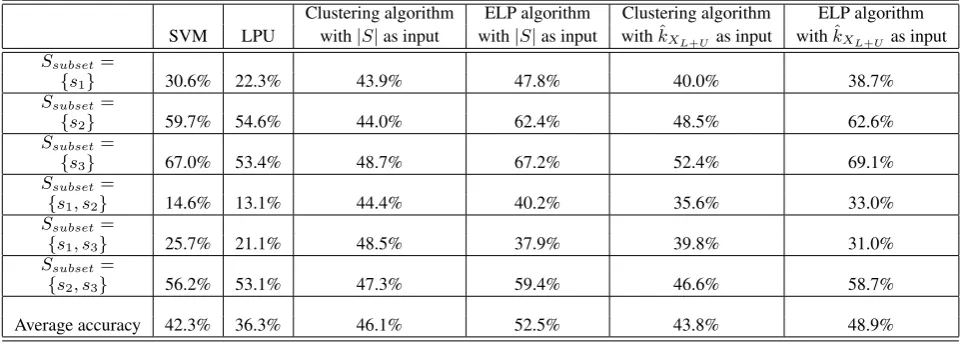
Table 4 summarizes the accuracy of SVM, LPU, the semi-supervised k-means clustering algorithm with correct sense number|S|or estimated sense number kˆX
L+U as input, and the ELP algorithm
with correct sense number|S|or estimated sense
numberˆkX
L+U as input using various incomplete
tagged data. The last row in Table 4 lists the av-erage accuracy of each algorithm over the six ex-perimental settings. Using|S|as input means that
we do not perform order identification procedure, while using ˆkX
L+U as input is to perform order
identification and obtain the classification results onXU at the same time.
We can see that ELP based method outperforms clustering based method in terms of average accu-racy under the same experiment setting, and these two methods outperforms SVM and LPU. More-over, using the correct sense number as input helps to improve the overall performance of both clus-tering based method and ELP based method.
Comparing the performance of the same sys-tem with different sizes of tagged data (from the first experiment to the third experiment, and from the fourth experiment to the sixth experiment), we can see that the performance was improved when given more labeled data. Furthermore, ELP based method outperforms other methods in terms of ac-curacy when rare senses (e.g. s3) are missing in
the tagged data. It seems that ELP based method has the ability to find rare senses with the use of tagged and untagged corpora.
Table 4: This table summarizes the accuracy of SVM, LPU, the semi-supervised k-means clustering al-gorithm with correct sense number|S|or estimated sense numberˆkXL+U as input, and the ELP algorithm
with correct sense number|S|or estimated sense numberˆkXL+U as input on the official test data of ELS
task in SENSEVAL-3 when given various incomplete tagged corpora.
Clustering algorithm ELP algorithm Clustering algorithm ELP algorithm SVM LPU with|S|as input with|S|as input withkˆX
L+U as input withˆkXL+U as input
Ssubset=
{s1} 30.6% 22.3% 43.9% 47.8% 40.0% 38.7%
Ssubset=
{s2} 59.7% 54.6% 44.0% 62.4% 48.5% 62.6%
Ssubset=
{s3} 67.0% 53.4% 48.7% 67.2% 52.4% 69.1%
Ssubset=
{s1, s2} 14.6% 13.1% 44.4% 40.2% 35.6% 33.0%
Ssubset=
{s1, s3} 25.7% 21.1% 48.5% 37.9% 39.8% 31.0%
Ssubset=
{s2, s3} 56.2% 53.1% 47.3% 59.4% 46.6% 58.7%
[image:7.595.71.555.126.298.2]Average accuracy 42.3% 36.3% 46.1% 52.5% 43.8% 48.9%
Table 5: These two tables provide the mean and standard deviation of absolute values of the differ-ence between ground-truth results |S| and sense
numbers estimated by clustering or ELP based or-der identification procedure respectively.
Clustering based method ELP based method
Ssubset=
{s1} 1.3±1.1 2.2±1.1
Ssubset=
{s2} 2.4±0.9 2.4±0.9
Ssubset=
{s3} 2.6±0.7 2.6±0.7
Ssubset=
{s1, s2} 1.2±0.6 1.6±0.5
Ssubset=
{s1, s3} 1.4±0.6 1.8±0.4
Ssubset=
{s2, s3} 1.8±0.5 1.8±0.5
when only one sense is missing inXL.
When very few labeled examples are avail-able, the noise in labeled data makes it difficult to learn the classification score (each entry in
YDU). Therefore using the classification
confi-dence criterion may lead to poor performance of seed selection for unknown classes if the classifi-cation score is not accurate. It may explain why ELP based method does not outperform cluster-ing based method with small labeled data (e.g.,
Ssubset ={s1}).
3.3 Results on Sense Number Estimation Table 5 provides the mean and standard devia-tion of absolute difference values between
ground-truth results |S| and sense numbers estimated by
clustering or ELP based order identification pro-cedures respectively. For example, if the ground truth sense number of the wordwiskw, and the
es-timated value isˆkw, then the absolute value of the difference between these two values is|kw−kˆw|.
Therefore we can have this value for each word. Then we calculated the mean and deviation on this array of absolute values. LPU does not have the order identification capability since it always as-sumes that there is at least one new class in un-labeled data, and does not further differentiate the instances from these new classes. Therefore we do not provide the order identification results of LPU. From the results in Table 5, we can see that esti-mated sense numbers are closer to ground truth re-sults when given less labeled data for clustering or ELP based methods. Moreover, clustering based method performs better than ELP based method in terms of order identification when given less la-beled data (e.g., Ssubset = {s1}). It seems that
ELP is not robust to the noise in small labeled data, compared with the semi-supervised k-means clus-tering algorithm.
4 Related Work
group negative examples into meaningful clusters. In contrast, our algorithm can find the occurrence of negative examples and further group these neg-ative examples into a “natural” number of clusters. Semi-supervised clustering (Wagstaff et al., 2001) may be used to perform classification by the use of labeled and unlabeled examples, but it encoun-ters the same problem of partially supervised clas-sification that model order cannot be automatically estimated.
Levine and Domany (2001) and Lange et al. (2002) proposed cluster validation based criteria for cluster number estimation. However, they showed the application of the cluster validation method only for unsupervised learning. Our work can be considered as an extension of their methods in the setting of partially supervised learning.
In natural language processing community, the work that is closely related to ours is word sense discrimination which can induce senses by group-ing occurrences of a word into clusters (Schu¨tze, 1998). If it is considered as unsupervised meth-ods to solve sense disambiguation problem, then our method employs partially supervised learning technique to deal with sense disambiguation prob-lem by use of tagged and untagged texts.
5 Conclusions
In this paper, we present an order identification based partially supervised classification algorithm and investigate its application to partially super-vised word sense disambiguation problem. Exper-imental results on SENSEVAL-3 data indicate that our ELP based model order identification algo-rithm achieves better performance than other state of the art classification algorithms, e.g., SVM, a one-class partially supervised algorithm (LPU), and a semi-supervised k-means clustering based model order identification algorithm.
References
Brown P., Stephen, D.P., Vincent, D.P., & Robert, Mer-cer.. 1991. Word Sense Disambiguation Using
Sta-tistical Methods.Proceedings of ACL.
Dagan, I. & Itai A.. 1994. Word Sense Disambigua-tion Using A Second Language Monolingual Cor-pus. Computational Linguistics, Vol. 20(4), pp. 563-596.
Denis, F., Gilleron, R., & Tommasi, M.. 2002. Text Classification from Positive and Unlabeled
Exam-ples. Proceedings of the 9th International
Confer-ence on Information Processing and Management of Uncertainty in Knowledge-Based Systems.
Lange, T., Braun, M., Roth, V., & Buhmann, J. M.
2002. Stability-Based Model Selection. NIPS 15.
Leacock, C., Miller, G.A. & Chodorow, M.. 1998. Using Corpus Statistics and WordNet Relations for
Sense Identification. Computational Linguistics,
24:1, 147–165.
Lee, Y.K. & Ng, H.T.. 2002. An Empirical Eval-uation of Knowledge Sources and Learning
Algo-rithms for Word Sense Disambiguation.
Proceed-ings of EMNLP, (pp. 41-48).
Levine, E., & Domany, E. 2001. Resampling Method for Unsupervised Estimation of Cluster Validity.
Neural Computation, Vol. 13, 2573–2593.
Lin, J. 1991. Divergence Measures Based on the
Shannon Entropy. IEEE Transactions on
Informa-tion Theory, 37:1, 145–150.
Liu, B., Dai, Y., Li, X., Lee, W.S., & Yu, P.. 2003. Building Text Classifiers Using Positive and
Unla-beled Examples. Proceedings of IEEE ICDM.
Manevitz, L.M., & Yousef, M.. 2001. One Class
SVMs for Document Classification. Journal of
Ma-chine Learning, 2, 139-154.
Mihalcea R., Chklovski, T., & Kilgariff, A.. 2004. The SENSEVAL-3 English Lexical Sample Task.
SENSEVAL-2004.
Niu, Z.Y., Ji, D.H., & Tan, C.L.. 2005. Word Sense Disambiguation Using Label Propagation Based
Semi-Supervised Learning. Proceedings of ACL.
Schu¨tze, H.. 1998. Automatic Word Sense
Discrimi-nation. Computational Linguistics, 24:1, 97–123.
Wagstaff, K., Cardie, C., Rogers, S., & Schroedl, S.. 2001. Constrained K-Means Clustering with
Back-ground Knowledge. Proceedings of ICML.
Yarowsky, D.. 1995. Unsupervised Word Sense
Dis-ambiguation Rivaling Supervised Methods.
Pro-ceedings of ACL.
Yu, H., Han, J., & Chang, K. C.-C.. 2002. PEBL: Pos-itive example based learning for web page
classifi-cation using SVM. Proceedings of ACM SIGKDD.
Zhu, X. & Ghahramani, Z.. 2002. Learning from La-beled and UnlaLa-beled Data with Label Propagation.