Hedge Detection Using the
RelHunter
Approach
∗Eraldo R. Fernandes†and Carlos E. M. Crestana‡and Ruy L. Milidi´u§
Departamento de Inform´atica, PUC-Rio Rio de Janeiro, Brazil
{efernandes, ccrestana, milidiu}@inf.puc-rio.br
Abstract
RelHunter is a Machine Learning based method for the extraction of structured in-formation from text. Here, we apply Rel-Hunter to the Hedge Detection task, pro-posed as the CoNLL-2010 Shared Task1. RelHunter’s key design idea is to model the target structures as a relation over enti-ties. The method decomposes the original task into three subtasks: (i) Entity Iden-tification; (ii) Candidate Relation Gener-ation; and (iii) Relation Recognition. In the Hedge Detection task, we define three types of entities: cue chunk, start scope token and end scope token. Hence, the Entity Identification subtask is further de-composed into three token classification subtasks, one for each entity type. In the Candidate Relation Generation sub-task, we apply a simple procedure to gen-erate aternarycandidate relation. Each in-stance in this relation represents a hedge candidate composed by a cue chunk, a start scope token and an end scope to-ken. For the Relation Recognition sub-task, we use a binary classifier to discrim-inate between true and false candidates. The four classifiers are trained with the Entropy Guided Transformation Learning algorithm. When compared to the other hedge detection systems of the CoNLL shared task, our scheme shows a competi-tive performance. TheF-score of our
sys-tem is54.05on the evaluation corpus.
∗This work is partially funded by CNPq and FAPERJ
grants 557.128/2009-9 and E-26/170028/2008.
† Holds a CNPq doctoral fellowship and has financial
support from IFG, Brazil.
‡Holds a CAPES doctoral fellowship. §Holds a CNPq research fellowship.
1Closed Task 2: detection of hedge cues and their scopes.
1 Introduction
Hedges are linguistic devices that indicate un-certain or unreliable information within a text. The detection of hedge structures is important for many applications that extract facts from textual data. The CoNLL-2010 Shared Task (Farkas et al., 2010) is dedicated to hedge detection.
A hedge structure consists of acueand ascope. In Figure 1, we present a sentence with two hedge instances. The hedge cues are highlighted and their scopes are delimited by brackets. The hedge cue comprises one or more keywords that indi-cate uncertainty. The hedge scope is the uncertain statement which is hedged by the cue. The scope always includes the corresponding cue.
[ Theyindicate that[ the demonstration ispossiblein this context ] and there is a correlation ]
Figure 1: Sentence with two hedge instances.
Over the last two decades, several Computa-tional Linguistic problems have been successfully modeled as local token classification tasks (Brill, 1995; Milidi´u et al., 2009). Nevertheless, the harder problems consist in identifying complex structures within a text. These structures comprise many tokens and show non local token dependen-cies.
Phrase chunking (Sang and Buchholz, 2000) is a task that involves structure recognition. Pun-yakanok and Roth decompose this task into four subtasks, that are sequentially solved (Pun-yakanok and Roth, 2001). They use Hidden Markov Models for the first three subtasks. They find out that task decomposition improves the overall token classification modeling.
Clause identification (Sang and D´ejean, 2001) is another task that requires structure recognition. As clauses may embed other clauses, these
tures involve stronger dependencies than phrase chunks. Carreras et al. propose an approach that extends Punyakanok and Roth’s previous work (Carreras et al., 2002). Their system comprises complex methods for training and extraction, in order to exploit the specific dependency aspects of clause structures.
Phrase Recognition is a general type of task that includes both phrase chunking and clause iden-tification. Carreras et al. propose the Filtering-Ranking Perceptron (FRP) system for this general task (Carreras et al., 2005). The FRP task model-ing is strongly related to previous proposals (Pun-yakanok and Roth, 2001; Carreras et al., 2002). However, it simultaneously learns to solve three subtasks. FRP is very effective, although compu-tationally expensive at both training and prediction time. Currently, FRP provides the best performing clause identification system.
In Morante and Daelemans (2009), the hedge detection task is solved as two consecutive classi-fication tasks. The first one consists of classify-ing the tokens of a sentence as hedge cues usclassify-ing the IOB tagging style. The second task consists of classifying tokens of a sentence as being the start of a hedge scope, the end of one, or neither. The result of those two tasks is combined using a set of six rules to solve the hedge detection task.
Here, we describe RelHunter, a new method for the extraction of structured information from text. Additionally, we apply it to the Hedge Detec-tion task. RelHunter extends the modeling strat-egy used both in Carreras et al. (2005) and Pun-yakanok et al. (2001). Other applications of this method are presented in Fernandes at al. (2009b; 2010).
The remainder of this text is organized as fol-lows. In Section 2, we present an overview of the RelHunter method. The modeling approach for the Hedge Detection task is presented in Sections 3 and 4. The experimental findings are depicted and discussed in Section 5. Finally, in Section 6, we present our final remarks.
2 RelHunter Overview
The central idea ofRelHunteris to model the tar-get structures as a relation over entities. To learn how to extract this relation from text, RelHunter uses two additional schemes: task decomposition and interdependent classification.
We decompose the original task into three
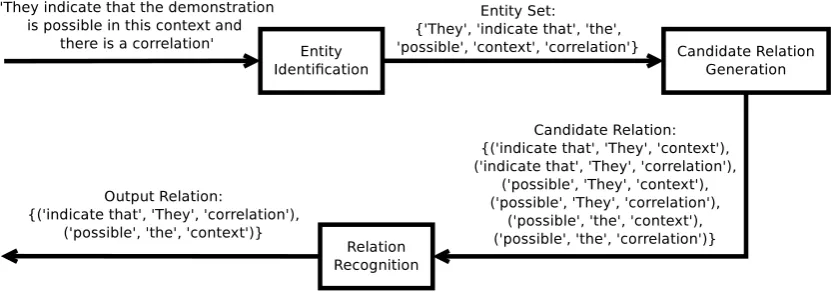
sub-tasks: (i)Entity Identification; (ii)Candidate Re-lation Generation; and (iii)Relation Recognition. In Figure 2, we illustrate the application of Rel-Hunter to hedge detection. We use the sentence introduced by Figure 1.
Entity Identification is a local subtask, in which simple entities are detected without any concern about the structures they belong to. The outcome of this subtask is theentity set. For instance, for hedge detection, we identify three types of enti-ties: hedge cues, tokens that start a scope and to-kens that end a scope.
The second subtask is performed by a simple procedure that generates the candidate relation over the entity set. This relation includes true and false candidates. This procedure considers do-main specific knowledge to avoid the generation of all possible candidates. In the hedge detection task, we define the candidate relation as the set of entity triples that comprise a hedge cue, a start scope token and an end scope token, such that the start token does not occur after the end token and the hedge cue occurs between the start and the end tokens.
The Relation Recognition subtask is a binary classification problem. In this subtask, we dis-criminate between true and false candidates. The output relationproduced in this subtask contains the identified hedge instances.
3 Hedge Detection using RelHunter In this section, we detail the RelHunter method and describe its application to hedge detection.
3.1 Entity Identification
We consider three specific entity types: cue chunk, start scope token, and end scope token. We divide entity identification into three token classification tasks, one for each entity type. Thus, we use the original corpus to train three classifiers.
The cue chunk subtask is approached as a to-ken classification problem by using the IOB tag-ging style. The token tag is defined as follows: I, when it is inside a hedge cue; O, when it is outside a hedge cue; and B, when it begins a hedge cue immediately after a distinct cue. As the baseline classifier, we use the Cue Dictionary proposed in Morante and Daelemans (2009), classifying each occurrence of those words as a cue.
Figure 2: Diagram of theRelHuntermethod.
As the baseline classifier for the start scope sub-task, we assign the first token of each hedge cue as the start of a scope.
We have two baseline classifiers for the end scope subtask: END andEND-X. The END sys-tem classifies as an end token the second to the last token of each sentence that contains a cue. Due to the frequent occurrence of parenthesized clauses at the end of sentences in full articles, the END-X system extends the END system with an additional operation. It reassigns an end scope tag, from a close parentheses token, to the token before its corresponding open parentheses.
3.2 Candidate Relation Generation
We define as the candidate hedge relation the set of entity triples that comprise a hedge cue, a start scope token and an end scope token, such that the start token does not occur after the end token and the hedge cue occurs between the start and the end tokens.
3.3 Relation Recognition
We train a binary classifier to discriminate be-tween positive and negative candidates within the candidate relation. This classifier is trained on the relation dataset, which is built by a general pro-cedure. This dataset contains an entry for each candidate. For each candidate, we generate two feature sets:local featuresandglobal features.
The local features include local information about each candidate entity, namely: cue chunk, start scope token and end scope token. These fea-tures are retrieved from the original corpus. For the start and end tokens, we use all their features in the original corpus. For the cue chunk, we use the features of the rightmost token within the chunk.
The global features follow Carreras et al. (2002). These features are generated by consid-ering the whole sentence where the candidate lies in. They inform about the occurrence ofrelevant elementswithin sentencefragments. We consider as relevant elements the three entity types and ver-bal chunks.
For each candidate entity, we consider three fragments. The first one contains all the tokens be-fore the entity. The second, all the entity tokens, and the third all the tokens after the entity. Simi-larly, for the whole candidate, we have three more fragments: one containing all the tokens before the candidate, another containing all the candidate to-kens, and the third one containing all the tokens after the candidate. Thus, there are 12 fragments for each candidate, three for each entity plus three for the whole candidate.
For each relevant element and fragment, we generate two global features in the relation dataset: a flag indicating the occurrence of the element within the fragment and a counter showing its fre-quency.
The relation dataset has kmlocal features and
6r(k+ 1) global features, wherekis the relation
cardinality (number of entities), mis the number of features in the original corpus, andris the
num-ber of relevant elements.
4 Interdependent Classification
The input to the Relation Recognition subtask is the candidate relation, i.e., a set of hedge candi-dates. The corresponding classifier must discrim-inate positive from negative candidates. However, identifying one candidate as positive implies that some other candidates must be negatives. This in-volves a special modeling issue: interdependent classification. The learning engine may explore these dependencies, when building the classifier for this subtask.
Interdependent classification is usually assumed for neighboring examples. When the learning model adopts a Markovian Property, then the neighborhood is given by a context window. This is the case for Markovian Fields such as Hidden Markov Models. Another model that also explores interdependent examples is ETL.
ETL is a very attractive modeling tool and has been applied to several classification tasks (Mi-lidi´u et al., 2008; dos Santos and Mi(Mi-lidi´u, 2009; Fernandes et al., 2009a; Fernandes et al., 2010). ETL uses an annotated corpus, where the corre-sponding class is attached to each example. The corpus is partitioned into segments. Each segment is a sequence of examples. Examples within the same segment are considered dependent. Con-versely, examples within different segments are considered independent. Moreover, an example classification depends only on the features of the examples from its correspondingcontext window. Hence, to apply ETL we need to provide three modeling ingredients: segment definition, exam-ple ordering within a segment and the context win-dow size. Given that, classification dependencies are explored by the ETL classifier. Hence, Rel-Hunteruses ETL as its learning engine.
We include in the same segment the hedge can-didates that have the same cue and start scope to-kens. Within a segment, we order the candidates by the order of the end token in the original cor-pus. We use a context window of 7 candidates, i.e., three candidates before the current, the current candidate and three candidates after the current.
5 Experimental Results
We use the corpus provided in the CoNLL-2010 Shared Task to train and evaluate our hedge de-tection system. We add the following annota-tion to the corpus: word stems, part-of-speech tags, phrase chunks, and clause annotations. Word
stems have been generated by the Porter stemmer (Porter, 1980). The additional annotation has been generated by ETL based systems (dos Santos and Milidi´u, 2009; Fernandes et al., 2009b; Milidi´u et al., 2008).
The CoNLL corpus is based on the BioScope corpus (Vincze et al., 2008). Since it contains doc-uments of two different kinds – paper abstracts and full papers – we split it into two subcorpora. The first subcorpus is calledABSTand contains all the paper abstracts. The second is called FULL and contains all the full papers.
We have two experimental setups:Development andEvaluation. In the Development Setup, we use ABSTas the training corpus andFULLas the de-velopment corpus. This is a conservative decision since the CoNLL Evaluation Corpus is comprised only of full articles. In the Evaluation Setup, we use the union of ABST and FULL as the train-ing corpus and report the performance over the CoNLL Evaluation Corpus.
5.1 Development
Here, we report the development setup experimen-tal findings. In Table 1, we show the performance of the three baseline classifiers. The start and end classifiers are evaluated with golden standard cue chunks. All results are obtained with theEND-X baseline system, except when explicitly stated.
Task Precision Recall F-score
Cue 51.96 51.65 51.80 Start scope 72.01 72.22 72.11 End scope 65.90 58.97 62.24
Table 1: Development performance of the three Baseline Classifiers.
In Table 2, we report the performance of the three entity identification ETL classifiers. Again, the start and end classifiers are evaluated with golden standard cue chunks. These results indi-cate that the end scope subtask is the hardest one. Indeed, our ETL classifier is not able to improve the baseline classifier performance. The last ta-ble line shows the performance of theRelHunter method on the target task – hedge detection.
5.2 Evaluation
Task Precision Recall F-score
[image:5.595.322.508.68.119.2]Cue 81.23 73.20 77.01 Start scope 91.81 72.37 80.94 End scope 65.90 58.97 62.24 Hedge 53.49 34.43 41.89
Table 2: Development performance of the three entity identification ETL classifiers and the Rel-Huntermethod to hedge detection.
baseline classifiers. The start and end classifiers are evaluated with golden standard cue chunks.
Task Precision Recall F-score
Cue 45.12 60.02 51.52 Start scope 75.51 75.73 75.62 End scope 81.01 72.56 76.55
Table 3: Evaluation performance of the three Baseline Classifiers.
In Table 4, we report the performance of the three entity identification ETL classifiers. Again, the start and end classifiers are evaluated with golden standard cue chunks. The last table line shows the performance of the RelHuntermethod on the target task – hedge detection.
Task Precision Recall F-score
Cue 78.73 77.05 77.88 Start scope 89.21 77.86 83.15 End scope 81.01 72.56 76.55 Hedge 57.84 50.73 54.05
Table 4: Evaluation performance of the three entity identification ETL classifiers and the Rel-Huntermethod to hedge detection.
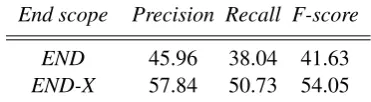
In Table 5, we report the Hedge Detection per-formances when using END and END-X, as the baseline classifier for the end scope subtask. The use of END-X improves the overall system F -score by more than ten twelve.
In Table 6, we report the Final Results of the CoNLL-2010 Shared Task – Closed Task 2. For the sake of comparison, we also include the per-formance of the RelHunter system with END-X, that has been developed and tested after the
com-End scope Precision Recall F-score
END 45.96 38.04 41.63 END-X 57.84 50.73 54.05
Table 5: Evaluation performance of theRelHunter system when usingENDandEND-X.
petition end. The version with the END baseline holds rank 7 at the competition.
Official
System P R F
Rank
1 Morante 59.62 55.18 57.32 2 Rei 56.74 54.60 55.65 3 Velldal 56.71 54.02 55.33
- RelHunter 57.84 50.73 54.05
4 Li 57.42 47.92 52.24
5 Zhou 45.32 43.56 44.42 6 Zhang 45.94 42.69 44.25 7 Fernandes 45.96 38.04 41.63 8 Vlachos 41.18 35.91 38.37 9 Zhao 34.78 41.05 37.66 10 Tang 34.49 31.85 33.12 11 Ji 21.87 17.23 19.27 12 T¨ackstr¨om 02.27 02.03 02.15
Table 6: Evaluation performance of the CoNLL-2010 systems and theRelHuntermethod with the END-Xend scope classifier.
6 Conclusion
We propose RelHunter, a new machine learning based method for the extraction of structured in-formation from text.RelHunterconsists in model-ing the target structures as a relation over entities. To learn how to extract this relation from text, Rel-Hunteruses two main schemes: task decomposi-tion and interdependent classificadecomposi-tion.
RelHunterdecomposes the identification of en-tities into several but simple token classification subtasks. Additionally, the method generates a candidate relation over the identified entities and discriminates between true and false candidates within this relation.
[image:5.595.312.520.220.437.2]ex-ploits this powerful feature in order to tackle de-pendencies among the hedge candidates.
RelHunter is easily applied to many complex Computational Linguistic problems. We show its effectiveness by applying it to hedge detection. Other successful applications of this method are presented in Fernandes et al. (2009b; 2010).
RelHunterexplores the dependency among lin-guistic structures by using a powerful feature of the ETL algorithm. Nevertheless, this feature is restricted to sequentially organized examples, since ETL has been initially proposed for token classification problems. Linguistic structures in-volve topologies that are frequently more complex than that. The ETL algorithm may be extended to consider more complex topologies. We conjecture that it is possible to consider quite general topolo-gies. This would contribute to the construction of better solutions to many Computational Linguistic tasks.
Acknowledgments
The authors thank Evelin Amorim and Eduardo Motta for coding dataset normalization procedures that are very handy for Hedge Detection.
References
Eric Brill. 1995. Transformation-based error-driven learning and natural language processing: a case study in part-of-speech tagging. Computational Lin-guistics, 21(4):543–565.
Xavier Carreras, Llu´ıs M`arquez, Vasin Punyakanok, and Dan Roth. 2002. Learning and inference for clause identification. In Proceedings of the Thir-teenth European Conference on Machine Learning, pages 35–47.
Xavier Carreras, Llu´ıs M`arquez, and Jorge Castro. 2005. Filtering-ranking perceptron learning for par-tial parsing.Machine Learning, 60(1–3):41–71. C´ıcero N. dos Santos and Ruy L. Milidi´u, 2009.
Foun-dations of Computational Intelligence, Volume 1: Learning and Approximation, volume 201 of Stud-ies in Computational Intelligence, chapter Entropy Guided Transformation Learning, pages 159–184. Springer.
Rich´ard Farkas, Veronika Vincze, Gy¨orgy M´ora, J´anos Csirik, and Gy¨orgy Szarvas. 2010. The CoNLL-2010 Shared Task: Learning to Detect Hedges and their Scope in Natural Language Text. In Proceed-ings of the Fourteenth Conference on Computational Natural Language Learning (CoNLL-2010): Shared Task, pages 1–12, Uppsala, Sweden, July. Associa-tion for ComputaAssocia-tional Linguistics.
Eraldo R. Fernandes, C´ıcero N. dos Santos, and Ruy L. Milidi´u. 2009a. Portuguese language processing service. InProceedings of the Web in Ibero-America Alternate Track of the 18th World Wide Web Confer-ence (WWW’2009), Madrid.
Eraldo R. Fernandes, Bernardo A. Pires, C´ıcero N. dos Santos, and Ruy L. Milidi´u. 2009b. Clause identifi-cation using entropy guided transformation learning. InProceedings of the 7th Brazilian Symposium in In-formation and Human Language Technology (STIL), S˜ao Carlos, Brazil.
Eraldo R. Fernandes, Bernardo A. Pires, C´ıcero N. dos Santos, and Ruy L. Milidi´u. 2010. A ma-chine learning approach to Portuguese clause iden-tification. In Proceedings of the Nineth Interna-tional Conference on ComputaInterna-tional Processing of the Portuguese Language (PROPOR), volume 6001 ofLecture Notes in Artificial Intelligence, pages 55– 64, Porto Alegre, Brazil. Springer.
Ruy L. Milidi´u, C´ıcero N. dos Santos, and Julio C. Duarte. 2008. Phrase chunking using entropy guided transformation learning. InProceedings of ACL-08: HLT, pages 647–655, Columbus, USA. Association for Computational Linguistics.
Ruy L. Milidi´u, C´ıcero N. dos Santos, and Carlos E. M. Crestana. 2009. A token classification ap-proach to dependency parsing. In Proceedings of the 7th Brazilian Symposium in Information and Hu-man Language Technology (STIL’2009), S˜ao Carlos, Brazil.
Roser Morante and Walter Daelemans. 2009. Learn-ing the scope of hedge cues in biomedical texts. In Proceedings of the BioNLP 2009 Workshop, pages 28–36, Boulder, USA, June. Association for Com-putational Linguistics.
Martin F. Porter. 1980. An algorithm for suffix strip-ping. Program, 14(3):130–137.
Vasin Punyakanok and Dan Roth. 2001. The use of classifiers in sequential inference. InProceedings of the Conference on Advances in Neural Information Processing Systems (NIPS), pages 995–1001. MIT Press.
Erik F. Tjong Kim Sang and Sabine Buchholz. 2000. Introduction to the CoNLL-2000 shared task: Chunking. In Proceedings of CoNLL-2000 and LLL-2000, Lisbon, Portugal.
Erik F. T. K. Sang and Herv´e D´ejean. 2001. Introduc-tion to the CoNLL-2001 shared task: Clause identifi-cation. InProceedings of Fifth Conference on Com-putational Natural Language Learning, Toulouse, France.