Multilingual Dependency-based Syntactic and Semantic Parsing
Wanxiang Che, Zhenghua Li, Yongqiang Li, Yuhang Guo, Bing Qin, Ting LiuInformation Retrieval Lab
School of Computer Science and Technology Harbin Institute of Technology, China, 150001
{car, lzh, yqli, yhguo, qinb, tliu}@ir.hit.edu.cn
Abstract
Our CoNLL 2009 Shared Task system in-cludes three cascaded components: syntactic parsing, predicate classification, and semantic role labeling. A pseudo-projective high-order graph-based model is used in our syntactic de-pendency parser. A support vector machine (SVM) model is used to classify predicate senses. Semantic role labeling is achieved us-ing maximum entropy (MaxEnt) model based semantic role classification and integer linear programming (ILP) based post inference. Fi-nally, we win the first place in the joint task, including both the closed and open challenges.
1 System Architecture
Our CoNLL 2009 Shared Task (Hajiˇc et al., 2009): multilingual syntactic and semantic dependencies system includes three cascaded components: syn-tactic parsing, predicate classification, and semantic role labeling.
2 Syntactic Dependency Parsing
We extend our CoNLL 2008 graph-based model (Che et al., 2008) in four ways:
1. We use bigram features to choose multiple pos-sible syntactic labels for one arc, and decide the op-timal label during decoding.
2. We extend the model with sibling features (Mc-Donald, 2006).
3. We extend the model with grandchildren fea-tures. Rather than only using the left-most and right-most grandchildren as Carreras (2007) and Johans-son and Nugues (2008) did, we use all left and right grandchildren in our model.
4. We adopt the pseudo-projective approach in-troduced in (Nivre and Nilsson, 2005) to handle the non-projective languages including Czech, German and English.
2.1 Syntactic Label Determining
The model of (Che et al., 2008) decided one la-bel for each arc before decoding according to uni-gram features, which caused lower labeled attach-ment score (LAS). On the other hand, keeping all possible labels for each arc made the decoding in-efficient. Therefore, in the system of this year, we adopt approximate techniques to compromise, as shown in the following formulas.
flbl
uni(h, c, l) =f1lbl(h,1, d, l)∪f1lbl(c,0, d, l)
L1(h, c) = arg maxK1l∈L(w·funilbl (h, c, l))
flbl
bi (h, c, l) =f2lbl(h, c, l)
L2(h, c) = arg maxK2l∈L1(h,c)(w· {funilbl ∪fbilbl})
For each arc, we firstly use unigram features to choose theK1-best labels. The second parameter of
flbl
1 (·)indicates whether the node is the head of the
arc, and the third parameter indicates the direction.
Ldenotes the whole label set. Then we re-rank the
labels by combining the bigram features, and choose
K2-best labels. During decoding, we only use the
K2labels chosen for each arc (K2 ¿K1 <|L|).
2.2 High-order Model and Algorithm
Following the Eisner (2000) algorithm, we use spans as the basic unit. A span is defined as a substring of the input sentence whose sub-tree is already pro-duced. Only the start or end words of a span can link with other spans. In this way, the algorithm parses the left and the right dependence of a word indepen-dently, and combines them in the later stage.
We follow McDonald (2006)’s implementation of first-order Eisner parsing algorithm by modifying its scoring method to incorporate high-order features. Our extended algorithm is shown in Algorithm 1.
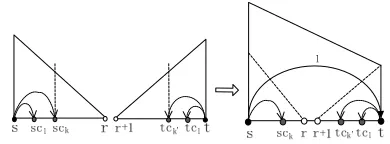
There are four different span-combining opera-tions. Here we explain two of them that correspond to right-arc (s < t), as shown in Figure 1 and 2. We
Algorithm 1High-order Eisner Parsing Algorithm
1: C[s][s][c] = 0,0≤s≤N,c∈cp, icp#cp: complete;icp: incomplete 2: forj= 1toNdo
3: fors= 0toNdo
4: t=s+jL
5: ift > Nthen
6: break
7: end if
# Create incomplete spans
8: C[s][t][icp] = maxs≤r<t;l∈L2(s,t)(C[s][r][cp] +C[t][r+ 1][cp] +Sicp(s, r, t, l)) 9: C[t][s][icp] = maxs≤r<t;l∈L2(t,s)(C[s][r][cp] +C[t][r+ 1][cp] +Sicp(t, r, s, l))
# Create complete spans
10: C[s][t][cp] = maxs<r≤t;l=C[s][r][icp].label(C[s][r][icp] +C[r][t][cp] +Scp(s, r, t, l)) 11: C[t][s][cp] = maxs≤r<t;l=C[t][r][icp].label(C[r][s][cp] +C[t][r][icp] +Scp(t, r, s, l)) 12: end for
13: end for
[image:2.612.83.278.314.386.2]follow the way of (McDonald, 2006) and (Carreras, 2007) to represent spans. The other two operations corresponding to left-arc are similar.
Figure 1: Combining two spans into an incomplete span
Figure 1 illustrates line 8 of the algorithm in Al-gorithm 1, which combines two complete spans into an incomplete span. A complete span means that only the head word can link with other words fur-ther, noted as “→” or “←”. An incomplete span
indicates that both the start and end words of the span will link with other spans in the future, noted as “99K” or “L99”. In this operation, we combine two smaller spans,sps→randspr+1←t, intosps99Ktwith
addingarcs→t. As shown in the following
formu-las, the score ofsps99Ktis composed of three parts:
the score of sps→r, the score ofspr+1←t, and the
score of adding arcs→t. The score of arcs→t is
determined by four different feature sets: unigram features, bigram features, sibling features and left grandchildren features (or inside grandchildren fea-tures, meaning that the grandchildren lie betweens
andt). Note that the sibling features are only related to the nearest sibling node oft, which is denoted as sck here. And the inside grandchildren features are
related to all the children oft. This is different from
the models used by Carreras (2007) and Johansson and Nugues (2008). They only used the left-most child of t, which istck0here.
ficp(s, r, t, l) =funi(s, t, l)∪fbi(s, t, l)
∪fsib(s, sck, t)∪ {Sk
0
i=1fgrand(s, t, tci, l)}
Sicp(s, r, t, l) =w·ficp(s, r, t, l)
S(sps99Kt) =S(sps→r) +S(spr+1←t)
+Sicp(s, r, t, l)
In Figure 2 we combinesps99Kr andspr→t into sps→t, which explains line 10 in Algorithm 1. The
score of sps→t also includes three parts, as shown
in the following formulas. Although there is no new arc added in this operation, the third part is neces-sary because it reflects the right (or called outside) grandchildren information ofarcs→r.
rrc1 rck t
s r s r rc1rck t
l
[image:2.612.328.520.528.590.2]l
Figure 2: Combining two spans into a complete span
fcp(s, r, t, l) =Ski=1fgrand(s, r, rci, l)
Scp(s, r, t, l) =w·fcp(s, r, t, l)
S(sps→t) =S(sps99Kr)
2.3 Features
As shown above, features used in our model can be decomposed into four parts: unigram features, bi-gram features, sibling features, and grandchildren features. Each part can be seen as two different sets: arc-related and label-related features, except sibling features, because we do not consider labels when us-ing siblus-ing features. Arc-related features can be un-derstood as back-off of label-related features. Actu-ally, label-related features are gained by simply at-taching the label to the arc-features.
The unigram and bigram features used in our model are similar to those of (Che et al., 2008), ex-cept that we use bigram label-related features. The sibling features we use are similar to those of (Mc-Donald, 2006), and the grandchildren features are similar to those of (Carreras, 2007).
3 Predicate Classification
The predicate classification is regarded as a super-vised word sense disambiguation (WSD) task here. The task is divided into four steps:
1. Target words selection: predicates with multi-ple senses appearing in the training data are selected as target words.
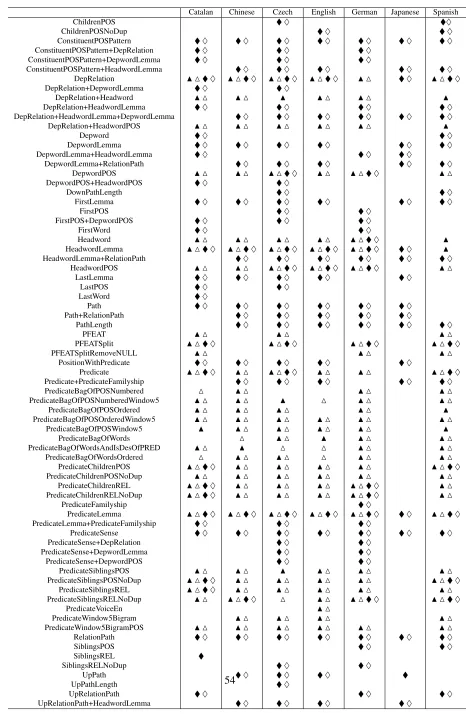
2. Feature extraction: features in the context around these target words are extracted as shown in Table 4. The detailed explanation about these fea-tures can be found from (Che et al., 2008).
3. Classification: for each target word, a Support Vector Machine (SVM) classifier is used to classify its sense. As reported by Lee and Ng (2002) and Guo et al. (2007), SVM shows good performance on the WSD task. Here libsvm (Chang and Lin, 2001) is used. The linear kernel function is used and the trade off parameterCis 1.
4. Post processing: for each predicate in the test data which does not appear in the training data, its first sense in the frame files is used.
4 Semantic Role Labeling
The semantic role labeling (SRL) can be divided into two separate stages: semantic role classification (SRC) and post inference (PI).
During the SRC stage, a Maximum en-tropy (Berger et al., 1996) classifier is used to predict the probabilities of a word in the sentence
Language No-duplicated-roles
Catalan arg0-agt, arg0-cau, arg1-pat, arg2-atr, arg2-loc Chinese A0, A1, A2, A3, A4, A5,
Czech ACT, ADDR, CRIT, LOC, PAT, DIR3, COND English A0, A1, A2, A3, A4, A5,
German A0, A1, A2, A3, A4, A5, Japanese DE, GA, TMP, WO
[image:3.612.310.542.57.171.2]Spanish arg0-agt, arg0-cau, arg1-pat, arg1-tem, arg2-atr, arg2-loc, arg2-null, arg4-des, argL-null, argM-cau, argM-ext, argM-fin
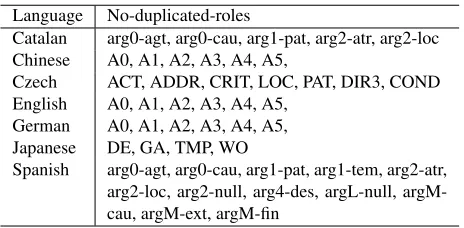
Table 1: No-duplicated-roles for different languages
to be each semantic role. We add a virtual role “NULL” (presenting none of roles is assigned) to the roles set, so we do not need semantic role identification stage anymore. For a predicate of each language, two classifiers (one for noun predicates, and the other for verb predicates) predict probabilities of each word in a sentence to be each semantic role (including virtual role “NULL”). The features used in this stage are listed in Table 4.
The probability of each word to be a semantic role for a predicate is given by the SRC stage. The re-sults generated by selecting the roles with the largest probabilities, however, do not satisfy some con-strains. As we did in the last year’s system (Che et al., 2008), we use the ILP (Integer Linear Program-ming) (Punyakanok et al., 2004) to get the global op-timization, which is satisfied with three constrains:
C1: Each word should be labeled with one and only one label (including the virtual label “NULL”). C2: Roles with a small probability should never be labeled (except for the virtual role “NULL”). The threshold we use in our system is 0.3.
C3: Statistics show that some roles (except for the virtual role “NULL”) usually appear once for a predicate. We impose a no-duplicate-roles straint with a no-duplicate-roles list, which is con-structed according to the times of semantic roles’ duplication for each single predicate. Table 1 shows the no-duplicate-roles for different languages.
Our maximum entropy classifier is implemented with Maximum Entropy Modeling Toolkit1. The
classifier parameters are tuned with the development data for different languages respectively. lp solve 5.52is chosen as our ILP problem solver.
5 Experiments
5.1 Experimental Setup
We participate in the CoNLL 2009 shared task with all 7 languages: Catalan (Taul´e et al., 2008), Chinese (Palmer and Xue, 2009), Czech (Hajiˇc et al., 2006), English (Surdeanu et al., 2008), Ger-man (Burchardt et al., 2006), Japanese (Kawahara et al., 2002), and Spanish (Taul´e et al., 2008). Be-sides the closed challenge, we also submitted the open challenge results. Our open challenge strategy is very simple. We add the SRL development data of each language into their training data. The pur-pose is to examine the effect of the additional data, especially for out-of-domain (ood) data.
Three machines (with 2.5GHz Xeon CPU and 16G memory) were used to train our models. Dur-ing the peak time, Amazon’s EC2 (Elastic Com-pute Cloud)3 was used, too. Our system requires
15G memory at most and the longest training time is about 36 hours.
During training the predicate classification (PC) and the semantic role labeling (SRL) models, golden syntactic dependency parsing results are used. Pvious experiments show that the PC and SRL test re-sults based on golden parse trees are slightly worse than that based on cross trained parse trees. It is, however, a pity that we have no enough time and ma-chines to do cross training for so many languages.
5.2 Results and Discussion
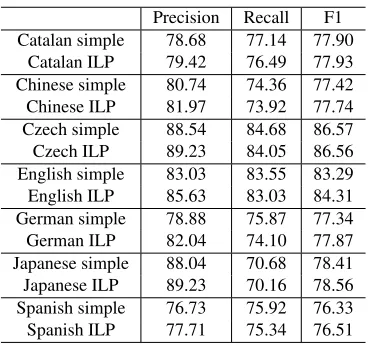
In order to examine the performance of the ILP based post inference (PI) for different languages, we adopt a simple PI strategy as baseline, which se-lects the most likely label (including the virtual la-bel “NULL”) except for those duplicate non-virtual labels with lower probabilities (lower than 0.5). Ta-ble 2 shows their performance on development data. We can see that the ILP based post inference can improve the precision but decrease the recall. Ex-cept for Czech, almost all languages are improved. Among them, English benefits most.
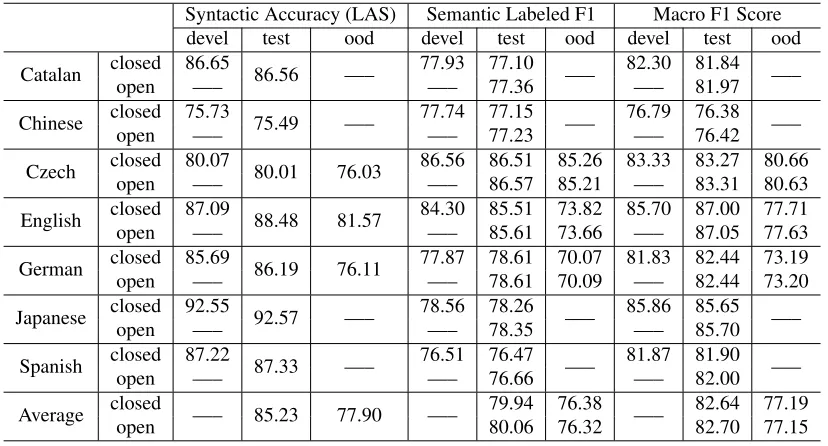
The final system results are shown in Table 3. Comparing with our CoNLL 2008 (Che et al., 2008) syntactic parsing results on English4, we can see that
our new high-order model improves about 1%.
3http://aws.amazon.com/ec2/
4devel: 85.94%, test: 87.51% and ood: 80.73%
Precision Recall F1 Catalan simple 78.68 77.14 77.90
[image:4.612.332.518.55.228.2]Catalan ILP 79.42 76.49 77.93 Chinese simple 80.74 74.36 77.42 Chinese ILP 81.97 73.92 77.74 Czech simple 88.54 84.68 86.57 Czech ILP 89.23 84.05 86.56 English simple 83.03 83.55 83.29 English ILP 85.63 83.03 84.31 German simple 78.88 75.87 77.34 German ILP 82.04 74.10 77.87 Japanese simple 88.04 70.68 78.41 Japanese ILP 89.23 70.16 78.56 Spanish simple 76.73 75.92 76.33 Spanish ILP 77.71 75.34 76.51 Table 2: Comparison between different PI strategies
For the open challenge, because we did not mod-ify the syntactic training data, its results are the same as the closed ones. We can, therefore, examine the effect of the additional training data on SRL. We can see that along with the development data are added into the training data, the performance on the in-domain test data is increased. However, it is inter-esting that the additional data is harmful to the ood test.
6 Conclusion and Future Work
Our CoNLL 2009 Shared Task system is com-posed of three cascaded components. The pseudo-projective high-order syntactic dependency model outperforms our CoNLL 2008 model (in English). The additional in-domain (devel) SRL data can help the in-domain test. However, it is harmful to the ood test. Our final system achieves promising results. In the future, we will study how to solve the domain adaptive problem and how to do joint learning be-tween syntactic and semantic parsing.
Acknowledgments
Syntactic Accuracy (LAS) Semantic Labeled F1 Macro F1 Score
devel test ood devel test ood devel test ood
Catalan closed 86.65 86.56open —– —– 77.93 77.10—– 77.36 —– 82.30 81.84—– 81.97 —–
Chinese closed 75.73 75.49open —– —– 77.74 77.15—– 77.23 —– 76.79 76.38—– 76.42 —–
Czech closed 80.07 80.01open —– 76.03 86.56 86.51 85.26 83.33 83.27 80.66—– 86.57 85.21 —– 83.31 80.63
English closed 87.09 88.48open —– 81.57 84.30 85.51 73.82 85.70 87.00 77.71—– 85.61 73.66 —– 87.05 77.63
German closed 85.69 86.19open —– 76.11 77.87 78.61 70.07 81.83 82.44 73.19—– 78.61 70.09 —– 82.44 73.20
Japanese closed 92.55 92.57open —– —– 78.56 78.26—– 78.35 —– 85.86 85.65—– 85.70 —–
Spanish closed 87.22 87.33open —– —– 76.51 76.47—– 76.66 —– 81.87 81.90—– 82.00 —–
[image:5.612.97.511.57.280.2]Average closedopen —– 85.23 77.90 —– 79.94 76.3880.06 76.32 —– 82.64 77.1982.70 77.15
Table 3: Final system results
References
Adam L. Berger, Stephen A. Della Pietra, and Vincent J. Della Pietra. 1996. A maximum entropy approach to natural language processing. Computational
Lin-guistics, 22.
Aljoscha Burchardt, Katrin Erk, Anette Frank, Andrea Kowalski, Sebastian Pad´o, and Manfred Pinkal. 2006. The SALSA corpus: a German corpus resource for lexical semantics. InLREC-2006.
Xavier Carreras. 2007. Experiments with a higher-order projective dependency parser. In
EMNLP/CoNLL-2007.
Chih-Chung Chang and Chih-Jen Lin, 2001. LIBSVM: a
library for support vector machines.
Wanxiang Che, Zhenghua Li, Yuxuan Hu, Yongqiang Li, Bing Qin, Ting Liu, and Sheng Li. 2008. A cascaded syntactic and semantic dependency parsing system. In
CoNLL-2008.
Jason Eisner. 2000. Bilexical grammars and their cubic-time parsing algorithms. InAdvances in Probabilistic
and Other Parsing Technologies.
Yuhang Guo, Wanxiang Che, Yuxuan Hu, Wei Zhang, and Ting Liu. 2007. HIT-IR-WSD: A wsd system for english lexical sample task. InSemEval-2007. Jan Hajiˇc, Jarmila Panevov´a, Eva Hajiˇcov´a, Petr
Sgall, Petr Pajas, Jan ˇStˇep´anek, Jiˇr´ı Havelka, Marie Mikulov´a, and Zdenˇek ˇZabokrtsk´y. 2006. Prague De-pendency Treebank 2.0.
Jan Hajiˇc, Massimiliano Ciaramita, Richard Johans-son, Daisuke Kawahara, Maria Ant`onia Mart´ı, Llu´ıs M`arquez, Adam Meyers, Joakim Nivre, Sebastian
Pad´o, Jan ˇStˇep´anek, Pavel Straˇn´ak, Mihai Surdeanu, Nianwen Xue, and Yi Zhang. 2009. The CoNLL-2009 shared task: Syntactic and semantic dependen-cies in multiple languages. InCoNLL-2009.
Richard Johansson and Pierre Nugues. 2008. Dependency-based semantic role labeling of Prop-Bank. InEMNLP-2008.
Daisuke Kawahara, Sadao Kurohashi, and Kˆoiti Hasida. 2002. Construction of a Japanese relevance-tagged corpus. InLREC-2002.
Yoong Keok Lee and Hwee Tou Ng. 2002. An empir-ical evaluation of knowledge sources and learning al-gorithms for word sense disambiguation. In
EMNLP-2002.
Ryan McDonald. 2006. Discriminative Learning and
Spanning Tree Algorithms for Dependency Parsing.
Ph.D. thesis, University of Pennsylvania.
Joakim Nivre and Jens Nilsson. 2005. Pseudo-projective dependency parsing. InACL-2005.
Martha Palmer and Nianwen Xue. 2009. Adding seman-tic roles to the Chinese Treebank. Natural Language
Engineering, 15(1).
Vasin Punyakanok, Dan Roth, Wen-tau Yih, and Dav Zi-mak. 2004. Semantic role labeling via integer linear programming inference. InColing-2004.
Mihai Surdeanu, Richard Johansson, Adam Meyers, Llu´ıs M`arquez, and Joakim Nivre. 2008. The CoNLL-2008 shared task on joint parsing of syntactic and se-mantic dependencies. InCoNLL-2008.
Catalan Chinese Czech English German Japanese Spanish
ChildrenPOS ¨ ♦ ¨♦
ChildrenPOSNoDup ¨ ♦ ¨ ♦
ConstituentPOSPattern ¨ ♦ ¨ ♦ ¨ ♦ ¨ ♦ ¨ ♦ ¨ ♦ ¨ ♦
ConstituentPOSPattern+DepRelation ¨ ♦ ¨ ♦ ¨ ♦
ConstituentPOSPattern+DepwordLemma ¨ ♦ ¨ ♦ ¨ ♦
ConstituentPOSPattern+HeadwordLemma ¨ ♦ ¨ ♦ ¨ ♦ ¨ ♦ ¨ ♦
DepRelation N M ¨ ♦ N M ¨ ♦ N M ¨ ♦ N M ¨ ♦ N M ¨ ♦ N M ¨ ♦
DepRelation+DepwordLemma ¨ ♦ ¨ ♦
DepRelation+Headword N M N M N N M N M N
DepRelation+HeadwordLemma ¨ ♦ ¨ ♦ ¨ ♦ ¨ ♦
DepRelation+HeadwordLemma+DepwordLemma ¨ ♦ ¨ ♦ ¨ ♦ ¨ ♦ ¨ ♦ ¨ ♦
DepRelation+HeadwordPOS N M N M N M N M N M N
Depword ¨ ♦ ¨ ♦
DepwordLemma ¨ ♦ ¨ ♦ ¨ ♦ ¨ ♦ ¨ ♦ ¨ ♦
DepwordLemma+HeadwordLemma ¨ ♦ ¨ ♦ ¨ ♦
DepwordLemma+RelationPath ¨ ♦ ¨ ♦ ¨ ♦ ¨ ♦ ¨ ♦
DepwordPOS N M N M N M ¨ ♦ N M N M ¨ ♦ N M
DepwordPOS+HeadwordPOS ¨ ♦ ¨ ♦
DownPathLength ¨ ♦ ¨ ♦
FirstLemma ¨ ♦ ¨ ♦ ¨ ♦ ¨ ♦ ¨ ♦ ¨ ♦
FirstPOS ¨ ♦ ¨ ♦
FirstPOS+DepwordPOS ¨ ♦ ¨ ♦ ¨ ♦
FirstWord ¨ ♦ ¨ ♦
Headword N M N M N M N M N M ¨ ♦ N
HeadwordLemma N M ¨ ♦ N M ¨ ♦ N M ¨ ♦ N M ¨ ♦ N M ¨ ♦ ¨ ♦ N
HeadwordLemma+RelationPath ¨ ♦ ¨ ♦ ¨ ♦ ¨ ♦ ¨ ♦ ¨ ♦
HeadwordPOS N M N M N M ¨ ♦ N M ¨ ♦ N M ¨ ♦ N M
LastLemma ¨ ♦ ¨ ♦ ¨ ♦ ¨ ♦ ¨ ♦
LastPOS ¨ ♦ ¨ ♦
LastWord ¨ ♦
Path ¨ ♦ ¨ ♦ ¨ ♦ ¨ ♦ ¨ ♦ ¨ ♦
Path+RelationPath ¨ ♦ ¨ ♦ ¨ ♦ ¨ ♦ ¨ ♦
PathLength ¨ ♦ ¨ ♦ ¨ ♦ ¨ ♦ ¨ ♦ ¨ ♦
PFEAT N M N M N M
PFEATSplit N M ¨ ♦ N M ¨ ♦ N M ¨ ♦ N M ¨ ♦
PFEATSplitRemoveNULL N M N M N M
PositionWithPredicate ¨ ♦ ¨ ♦ ¨ ♦ ¨ ♦ ¨ ♦
Predicate N M ¨ ♦ N M N M ¨ ♦ N M N M N M ¨ ♦
Predicate+PredicateFamilyship ¨ ♦ ¨ ♦ ¨ ♦ ¨ ♦ ¨ ♦
PredicateBagOfPOSNumbered M N M N M N M
PredicateBagOfPOSNumberedWindow5 N M N M N M N M N M
PredicateBagOfPOSOrdered N M N M N M N M N
PredicateBagOfPOSOrderedWindow5 N M N M N M N M N M N M
PredicateBagOfPOSWindow5 N N M N M N M N M N
PredicateBagOfWords M N M N N M N M
PredicateBagOfWordsAndIsDesOfPRED N M N M M N M N M
PredicateBagOfWordsOrdered M N M N M M N M N M
PredicateChildrenPOS N M ¨ ♦ N M N M N M N M N M ¨ ♦
PredicateChildrenPOSNoDup N M N M N M N M N M N M
PredicateChildrenREL N M ¨ ♦ N M N M N M N M ¨ ♦ N M
PredicateChildrenRELNoDup N M ¨ ♦ N M N M N M N M ¨ ♦ N M
PredicateFamilyship ¨ ♦
PredicateLemma N M ¨ ♦ N M ¨ ♦ N M ¨ ♦ N M ¨ ♦ N M ¨ ♦ ¨ ♦ N M ¨ ♦
PredicateLemma+PredicateFamilyship ¨ ♦ ¨ ♦ ¨ ♦
PredicateSense ¨ ♦ ¨ ♦ ¨ ♦ ¨ ♦ ¨ ♦ ¨ ♦ ¨ ♦
PredicateSense+DepRelation ¨ ♦ ¨ ♦
PredicateSense+DepwordLemma ¨ ♦ ¨ ♦
PredicateSense+DepwordPOS ¨ ♦ ¨ ♦
PredicateSiblingsPOS N M N M N N M N M N M
PredicateSiblingsPOSNoDup N M ¨ ♦ N M N M N M N M N M ¨ ♦
PredicateSiblingsREL N M ¨ ♦ N M N M N M N M N M
PredicateSiblingsRELNoDup N M N M ¨ ♦ M N M N M ¨ ♦ N M ¨ ♦
PredicateVoiceEn N M
PredicateWindow5Bigram N M N M N M N M
PredicateWindow5BigramPOS N M N M N M N M N M N M
RelationPath ¨ ♦ ¨ ♦ ¨ ♦ ¨ ♦ ¨ ♦ ¨ ♦ ¨ ♦
SiblingsPOS ¨ ♦ ¨ ♦
SiblingsREL ¨
SiblingsRELNoDup ¨ ♦ ¨ ♦
UpPath ¨ ♦ ¨ ♦ ¨ ♦ ¨
UpPathLength ¨ ♦
UpRelationPath ¨ ♦ ¨ ♦ ¨ ♦
UpRelationPath+HeadwordLemma ¨ ♦ ¨ ♦ ¨ ♦ ¨ ♦
[image:6.612.66.532.51.765.2]