172
Node Embeddings for Graph Merging: Case of Knowledge Graph
Construction
Ida Szubert Mark Steedman School of Informatics University of Edinburgh Edinburgh, Scotland, UK
[email protected], [email protected]
Abstract
Combining two graphs requires merging the nodes which are counterparts of each other. In this process errors occur, resulting in incor-rect merging or incorincor-rect failure to merge. We find a high prevalence of such errors when us-ing AskNET, an algorithm for buildus-ing Knowl-edge Graphs from text corpora. AskNET node matching method uses string similarity, which we propose to replace with vector embedding similarity. We explore graph-based and word-based embedding models and show an overall error reduction of from 56% to 23.6%, with a reduction of over a half in both types of incor-rect node matching.
1 Introduction
The work we present here is an extension of the graph building algorithm of AskNET (Harrington and Clark, 2008). The overall task we consider is to automatically extract information from text and integrate it into one resource, a knowledge graph. In this paper we focus on one aspect of the AskNET graph building algorithm – the process of merging document-level graphs into a corpus level one. We propose improvements which reduce the rates of two common and non-trivial errors which arise when matching nodes between two graphs.
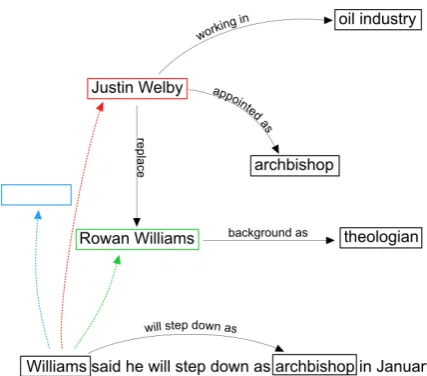
Merging two graphs, with an assumption that they potentially represent overlapping informa-tion, requires node matching. We need to decide which nodes should be merged, and this can re-sult in two types of errors: merging two nodes even if they do not represent the same thing, or not merging nodes which do. As an example, Figure
[image:1.595.307.521.218.406.2]1shows a sample graph representing information from a news article and a new sentence together with its own graph. In merging the two graphs we could correctly decide to match and merge theWilliams node to theRowan Williamsone. If we matched toJustin Welbywe would merge the
Figure 1: A graph representing a news article about Arch-bishop appointment and a sentence to be integrated into the graph. Green dotted arrow shows correct node matching, the red match leads to spurious merging, and the blue arrow and node represent no match found and a spurious addition.
nodes incorrectly, resulting in conflation of infor-mation about two different people. If we did not find a match at all the result would be the pres-ence of two nodes representing the same person. We call the first error spurious merging, and the second spurious addition.
Both of those problems occur in graphs built with the AskNET algorithm, which uses string similarity as a tool for node matching. We propose to modify the algorithm with using vector embed-dings instead. We explore word-based and graph-based ways of obtaining graph node embeddings and show that both lead to reduction in merging and addition errors.
2 Methods
In this paper we explore a modification of the
AskNET algorithm. We provide an overview
2.1 AskNET
The AskNET system uses a semantic parser (Boxer (Bos,2005)) to obtain graph representation of sentential content in a large corpus and incre-mentally combines them, first into document level graphs (DG), and then into one semantic network, which we are calling a knowledge graph (KG)1. The central challenge in the process of graph merging is, as described before, node matching. In AskNET the matching problem is approached with an iterative message passing (aka activation spreading) procedure, the intuition behind which is to find, for a nodenDGfrom DG, a nodenKG
in the KG such that the neighbourhoods of nDG
andnKGin their respective graphs are similar.
Given a nodenDG, the algorithm selects a
can-didate set CKG of KG nodes such that it likely
contains the correct matching nKG. Afterwards
in an iterative procedure for each of the DG nodes the scores of each element of CKG are updated
until convergence. The pre-selection step is cru-cial for ensuring time and space efficiency of the algorithm.However it also means that if the qual-ity ofCKG is a limiting factor for the correctness
of the output. If the correct match is not present inCKG, either spurious merging or addition will
result. Moreover, errors will also arise whenCKG
does contain the correct match, but it is easily con-fused with the rest of the set members.
As Harrington(2009) recognizes, spurious ad-dition and merging are challenging errors to fix, and the AskNET algorithm does not attempt it. In our implementation of AskNET, only about 44% of nodes are correctly matched, with the rest di-vided between spurious addition (24%) and merg-ing(32%). We approach this issue by improving the candidate node sets with the aim of minimiz-ing the problems. The task we consider is thus: given a KG, a DG, and nodenDG, produce a set
CKG such that it (1) contains the true match and
(2) minimizes merging and addition errors. In the approach of (Harrington and Clark,2008) the se-lection is based on approximate string matching between the name associated with nDG and the
names associated with the KG nodes. This sim-ilarity measure is not reliable in contexts where
1
Semantic parses used in AskNET follow a version of Discourse Representation Theory as implemented by the Boxer parser; in our replication we represent the information contained by a sentence with a set of entity-relation triples, which express all the binary relations involving at least one named entity
one entity can be called by various names and ti-tles, as is especially common in news text in which repetitions are avoided. In our evaluation, only about 55% of candidate sets generated with string similarity actually contain a correct match. Our contribution is investigating the use of vector em-beddings for candidate node selection. We show that both word-based and graph-based embedding models provide a better notion of similarity, and that combining them brings optimal benefits.
2.2 Dataset
For our experiments we use a subsection of the NewsSpike corpus (Zhang and Weld, 2013). For purposes of efficiency and ease of evaluation we decided to build a KG of around 15k nodes (size in line with the FB15k dataset (Bordes et al.,2013) popular in graph embedding literature), which we achieved by selecting 127,221 documents from the NewsSpike corpus. We preprocessed the NewsSpike corpus using the DBPedia entity linker (Nguyen et al.,2014) which enabled us to identify the most frequently occurring named entities. We chose top nnamed entities such that when a KG is created of all the documents mentioning thosen entities, the graph has approximately 15k nodes.2 Documents in our dataset are relatively short, av-eraging 338 words. The average number of named entities per document is 10.3. We held out 10 ran-domly selected documents each for development and test sets, and the rest forms the training set.
2.3 Base KG
The KG used in our experiments is built out of the training set documents using the original AskNET algorithm. To obtain graphs representing indi-vidual sentences we use the semantic parser of (Reddy et al., 2014) and extract binary relations from its output. We only use relations which in-volve at least one named entity. The nodes in the graph are labeled with a set containing all strings from the original documents which have been linked to that node (e.g. a set containing
Rowan Williams, Williams, Rev. Williams, Arch-bishop of Canterbury). The edges are labeled with relation names, where the relation set is open and can include any two place predicate used in the source documents.
2.4 Graph-based embeddings
The first way of generating DG and KG node em-beddings is using a graph embedding method. We decided to use theGraphSAGE model of ( Hamil-ton et al.,2017) which generates node representa-tions by taking into account the features of each node and the structure of it’s neighborhood. This model, as compared to numerous recent graph em-bedding models, is particularly well suited to our use case. It can be trained with an unsupervised objective, once trained can produce embeddings for unseen nodes and even nodes in unseen graphs, and leverages node features, e.g. text attributes. We train GraphSAGE, in an unsupervised setting3 and mean aggregators, on the base KG. The initial node features are node degree and mean of one-hot encoding of the node labels. The model learns a set of aggregator functions, which not only gen-erate final embeddings for the KG nodes, but also for DG nodes in the development and test sets.
2.5 Word-based embeddings
Another approach to obtaining node embeddings is through word embeddings. We make use of of the ELMo model for deep contextualized word representation (Peters et al.,2018). We represent a node in a KG as an average of the word em-beddings of every entity that has been resolved to that node during graph building. In other words, given a document we generate ELMo embeddings for every mention of every entity4, and in the DG a node representing an entity is assigned an em-bedding which is an average of all the mentions of that entity. When nodes are merged during in-tegration of the DG into the KG, the embedding of the KG node is updated so that it is always an average of the embeddings of all document-level nodes resolved to that KG node. For the purposes of our experiments we perform this embedding ag-gregation when building the base KG so that em-beddings for all of its nodes are available. How-ever, we do not use those embeddings to aid in the building process.
We use the original large pre-trained ELMo model (ELMo large), which has been trained on
3with the objective of maximizing the similarity of close by nodes and minimizing that of distant nodes, where the closeness is determined by co-occurrence on fixed-length random walks
4Because of pre-processing the documents in our corpus with an entity linker we know which word sequences consti-tute entity names and we treat them as single lexical item.
the same genre as our corpus. For the purposes of meaningful comparison with the graph-based embeddings, which cannot be pre-trained, we also train an ELMo model on our corpus only (ELMo small and exeriment with the resulting embed-dings.
2.6 Hybrid embeddings
We expect that the two methods might provide complementary benefits: GraphSAGE make use of the structure of the KG, and ELMo accumulate information from the original texts, including in-formation which is not present in the KG. We pro-pose to combine them by using theGraphSAGE
model with initial node features being node degree and theELMo largeembedding of the node.
3 Experiments
We propose to find the set CKG by evaluating
embedding similarity, rather than string similar-ity, between embeddings of the nDG and all KG
nodes. We treat the string-similarity method as a baseline. We expect relying on embedding simi-larity to result in better candidate sets and in re-duced number of merging and addition errors.
Regardless of the embedding method, candidate selection requires us to pickkclosest neighbours for a given node from all of the nodes of the KG. To do that we use random projection-based ap-proximate nearest neighbour search algorithm im-plemented in the Annoy library5. For candidate se-lection in the original string-based method we use the SimString library which performs approximate string matching according to the method proposed in (Okazaki and Tsujii,2010), and we define the similarity betweenndandnKGas the edit distance
divided by the length of the shorter of the names. We use the development set to setkto 7 and string similarity threshold to 0.36.
For each test document, we build a DG using the original AskNET method. Each node in that graph is associated with a set of names and ELMo large and ELMo small embeddings. Using the Graph-SAGE and hybrid models trained on the base KG we assign each node in DG a GraphSAGE and hybrid embeddings. Then, for each DG node we find fiveCKG sets, one for each method, and run
the rest of the AskNEt algorithm for each set to
5
https://github.com/spotify/annoy
errors goodCKG correct merging addition
baseline 54.5 44.2 24.2 31.6
GraphSAGE 67.3 61.8 18.2 20.0
ELMo small 63.6 55.1 19.4 25.5
ELMo large 71.5 64.2 13.9 21.9
[image:4.595.73.295.71.134.2]hybrid 82.4 76.4 10.9 12.7
Table 1: Node matching results: percentage ofCKG
con-taining a correct match (higher is better); percentage of test nodes correctly resolved (higher is better), spuriously merged with some KG node and spuriously added to KG as a new node (lower is better)
recover the one (or none) final match for each method.
3.1 Evaluation
Evaluation of information graph building methods is inherently challenging in the absence of gold-standard KGs. In our experimental setting the base KG is automatically constructed and as such is noisy. We then ask how well are different meth-ods capable of matching DG nodes to the nodes in the noisy KG. There is no ground truth, and so our evaluation relies on a human annotator in-specting the neighbourhoods of the candidate KG nodes and making a judgment about how likely is it that they are a match to the DG node. When the annotator finds no likely matches in the set, they search the KG (by keywords, names, etc.) to ascer-tain whether likely matches are present in the KG at all. The annotator has access to the test set docu-ments, document-level graphs, and can inspect the KG.
For each node in a DG in the test set, we man-ually evaluate the candidate sets produced by the five methods (baseline, GraphSAGE, ELMo large, ELMo small, hybrid) and the one (or none) node returned by the AskNET algorithm as the final match. There are 165 nodes in the 10 test set doc-uments.
We evaluate the candidate sets by manually as-sessing whether any of the candidates can be rea-sonably considered to be a match, and if so the set is deemed to be correct. For the final match de-cision we perform a 3-way classification: correct KG node selected or correct in choosing no KG node; incorrect KG node selected and leading to spurious merging; or incorrectly selecting no KG node and leading to spurious addition.
4 Results
Overall, both graph- and word-based embedding similarity outperform string similarity as a
candi-date node selection tool, and the most benefit is to be had by using a hybrid model. Both the percent-age of good candidate sets and the percentpercent-age of correct matches are significantly increased. More-over, the difference between the two measures is smaller for our proposed methods than for base-line, indicating that our candidate sets are less con-founding for the AskNET algorithm.
As can be seen in table 1 word- and graph-based embedding differ in what kind of confound-ing candidates they introduce to the sets alongside the correct match. This is reflected in the different rates of spurious merging and addition they result in. GraphSAGE reduces addition more then merg-ing. Given a node nDG, using GraphSAGE we
select KG nodes whose neighbourhood is similar, in terms of features and structure, to that ofnDG.
This makes it more likely that the correct match is inCKG, thus reducing spurious addition.
How-ever, the subsequent steps of the AskNET algo-rithm also rely on estimating the similarity of the neighborhoods which means that the candidates selected using this method are easy to confuse.
An opposite tendency can be observed for ELMo embeddings, whereCKG includes entities
mentioned in similar textual context as nDG. If
the correct match is present in the set, it is eas-ier for the AskNET algorithm to identify it using the neighbourhood information, because the can-didates are likely to have diverse neighbourhoods. Therefore merging mistakes are significantly re-duced.
5 Conclusions
References
Antoine Bordes, Nicolas Usunier, Alberto Garcia-Duran, Jason Weston, and Oksana Yakhnenko. 2013. Translating embeddings for modeling multi-relational data. In Advances in neural information processing systems, pages 2787–2795.
Johan Bos. 2005. Towards wide-coverage semantic in-terpretation. In Proceedings of Sixth International Workshop on Computational Semantics IWCS, vol-ume 6, pages 42–53.
Will Hamilton, Zhitao Ying, and Jure Leskovec. 2017. Inductive representation learning on large graphs. InAdvances in Neural Information Processing Sys-tems, pages 1024–1034.
Brian Harrington. 2009.ASKNet: automatically creat-ing semantic knowledge networks from natural lan-guage Text. Ph.D. thesis, Oxford University.
Brian Harrington and Stephen Clark. 2008. Asknet: Creating and evaluating large scale integrated se-mantic networks. International Journal of Semantic Computing, 2(03):343–364.
Dat Ba Nguyen, Johannes Hoffart, Martin Theobald, and Gerhard Weikum. 2014. AIDA-light: High-Throughput Named-Entity Disambiguation. In
Workshop on Linked Data on the Web, pages 1–10, Seoul, Korea.
Naoaki Okazaki and Jun’ichi Tsujii. 2010. Sim-ple and efficient algorithm for approximate dictio-nary matching. In Proceedings of the 23rd Inter-national Conference on Computational Linguistics, pages 851–859. Association for Computational Lin-guistics.
Matthew E Peters, Mark Neumann, Mohit Iyyer, Matt Gardner, Christopher Clark, Kenton Lee, and Luke Zettlemoyer. 2018. Deep contextualized word rep-resentations. arXiv preprint arXiv:1802.05365.
Siva Reddy, Mirella Lapata, and Mark Steedman. 2014.
Large-scale semantic parsing without question-answer pairs. Transactions of the Association for Computational Linguistics, 2:377–392.